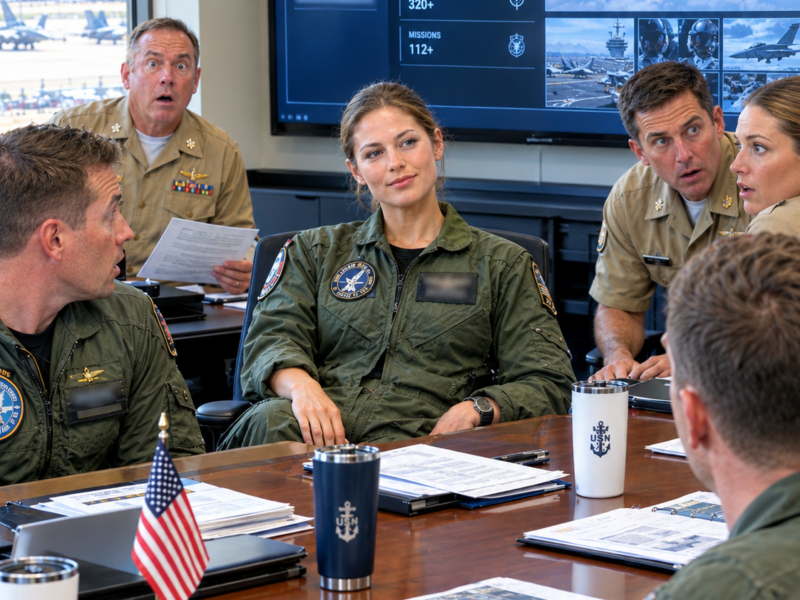
“The squadron commander glanced at my plain name tag, smirked, and told me to take notes while the real pilots discussed the mission
The captain’s words hung over the briefing room.
“Commander, there’s one thing in that report you haven’t been told.”
Commander Hayes turned toward him. “Then tell us, Captain.”
Captain Robert Ellis looked at me first, as if asking permission to open a door I’d spent six years trying to keep shut.
I gave him a small nod.
He turned to the squadron.
“Before you judge Lieutenant Commander Bennett by a call sign on a page, you need to understand what happened during Operation Black Harbor—and why that call sign was retired.”
Jake Morrison shifted in his chair. The easy grin I’d seen on his face since arriving at Oceana was gone.
Captain Ellis pointed at the photograph on the screen.
“That aircraft belonged to a four-pilot detachment operating from a carrier group in the North Atlantic. Their mission was classified, and most of the details remain restricted. But the incident itself became known to the people who needed to know about it.”
He paused.
“Lieutenant Commander Bennett was the lead tactical pilot that night. Her call sign was Ghost.”
The name landed harder than I expected.
Someone at the back of the room whispered it again.
Ghost.
For six years, I’d heard that name in debriefs, secure communications, and the occasional conversation between people who had been there. I had never expected to hear it spoken in a room full of strangers.
Captain Ellis continued.
“That call sign wasn’t given to her because she was the loudest pilot or the most aggressive. It was earned because she could remain composed when communications broke down, maintain situational awareness when other crews lost the picture, and make decisions without waiting for someone else to tell her what the situation already demanded.”
He looked at Hayes.
“And during Black Harbor, those qualities mattered.”
I stared at the photograph instead of the faces around me.
There I was, younger by six years, standing beside an F/A-18 with my flight helmet tucked beneath one arm. Lieutenant Daniel Price stood on my right, smiling as if the world had never surprised him. Lieutenant Commander Marcus Reed stood on my left, his arm around our squadron’s weapons systems officer, Lieutenant Peter Walsh.
We looked tired, sunburned, and certain we had plenty of time left.
I could still remember the smell of hot metal on the flight line and the way Price used to tap the side of his helmet before every launch.
“Keep your head, Bennett,” he’d tell me. “The sky doesn’t care how confident you feel.”
I had laughed at him then.
I didn’t laugh anymore when I remembered the last time I heard his voice.
“Captain,” Hayes said, “the written summary says the detachment encountered an unexpected threat during a routine repositioning exercise. It doesn’t explain why the mission ended the way it did.”
“Because the written summary was never intended to tell the whole story,” Ellis replied.
He opened a second folder.
“Six years ago, the detachment was conducting a complex training operation that included a simulated intercept and coordination with other aircraft in the area. Weather conditions deteriorated faster than forecast, and a communications failure complicated the situation.”
“Was it an equipment failure?” someone asked.
“That was the initial assessment.”
“Initial?” Jake repeated.
Ellis gave him a level look.
“Yes, Lieutenant. Initial.”
He returned his attention to the photograph.
“During the operation, one aircraft reported a serious systems problem. Another crew lost reliable communications. The flight lead had to choose between maintaining the planned formation and diverting to protect an aircraft that was no longer responding normally.”
I knew every word that was coming.
I’d replayed that night so many times that I could have recited the radio exchanges in my sleep.
Ellis continued.
“Ghost recommended a change in the plan. That decision prevented the remaining aircraft from entering an unsafe portion of the training area while the emergency was being assessed.”
He stopped there.
It sounded impressive when he said it like that.
It didn’t mention the empty seat in the ready room the following morning.
It didn’t mention the way I had stood outside the medical bay, still wearing my flight suit, waiting for someone to tell me that Price was going to be all right.
And it didn’t mention the last thing I’d said to him over the radio.
“You’re leaving out the part about the command decision,” a voice said from the far side of the table.
Everyone turned.
Commander Hayes had been quiet, but his expression had grown more troubled with every sentence.
“What command decision?” he asked.
Ellis looked at me again.
I could have answered for him.
Instead, I let him speak.
“Ghost was not the senior officer in the formation. She had to decide whether to follow the existing instruction or act on information that suggested the instruction no longer matched the situation.”
“And she acted?” Hayes asked.
“She made a recommendation. The flight lead initially rejected it.”
The room became still.
I could feel Jake watching me.
Ellis continued.
“Seconds later, the flight lead reconsidered. The formation changed course. That change prevented the emergency from becoming a larger accident.”
“Then why was her call sign retired?” Jake asked.
It was the first useful question he’d asked since I’d arrived.
Ellis closed the folder.
“Because the operation ended with the loss of an aircraft and the death of one of the pilots.”
No one moved.
I looked down at my hands.
I had known Price for four years before Black Harbor. He was the kind of man who remembered birthdays, even for people who insisted they didn’t care about birthdays. He once drove three hours to bring me a replacement flight bag after mine split open during a deployment.
He had also been the flight lead that night.
And he had been the man who didn’t come home.
“Was Bennett responsible?” someone asked.
The question came from a junior pilot near the windows. His face had gone pale as soon as the words left his mouth, but he didn’t take them back.
Hayes’s gaze sharpened.
“That’s not an appropriate question.”
“It’s all right,” I said.
My voice sounded calmer than I felt.
I looked at the young pilot.
“No. I wasn’t responsible for the equipment failure, and I didn’t make the decision that caused the aircraft to be lost.”
I paused.
“But I was the last person who spoke to Daniel Price before he disappeared from our radar picture.”
The young pilot lowered his eyes.
I couldn’t blame him for asking. I’d wondered the same thing about myself for years.
Ellis stepped away from the screen.
“Lieutenant Commander Bennett was cleared of wrongdoing after the investigation. Her actions were reviewed by the appropriate authorities, and her recommendations were found to be consistent with the information available to her at the time.”
“Then why does the report sound so vague?” Hayes asked.
“Because some of the details were classified, some involved equipment failures that were still under investigation, and some involved decisions made by people who were not present in this room.”
His eyes moved briefly toward the door.
That was the first moment I wondered whether Captain Ellis had come to Oceana merely to observe an evaluation.
He had arrived carrying a folder that had already been on Hayes’s desk before I walked in. He knew which photograph to display. He knew which parts of the story were missing from the report.
And he seemed to be waiting for someone else to react.
“Captain,” I said, “why are we discussing Black Harbor at a readiness briefing?”
Ellis met my eyes.
“Because the readiness evaluation isn’t the only reason I’m here.”
A low murmur passed around the table.
He placed another document beside the photograph.
“Three weeks ago, a technical review reopened questions about the communications failure that occurred during the operation. A component recovered from the aircraft was examined using newer diagnostic methods. The findings raised concerns that the original explanation may not have been complete.”
My fingers tightened around the edge of the table.
“Are you saying the equipment didn’t fail on its own?”
“I’m saying the technical review identified evidence that requires further examination. I won’t speculate beyond that.”
“Does this have anything to do with the call sign?” Hayes asked.
“Not directly.”
Ellis hesitated.
“But it may have something to do with why the original report never fully explained the sequence of events.”
For the first time since I entered the room, I forgot about being the new pilot.
All I could see was Price’s face in that old photograph.
“Captain,” I said, “I want to read the technical review.”
“I expected you would.”
He slid a sealed envelope across the table.
“Your access has been authorized for the material relevant to your role. You’ll receive instructions through the proper channels.”
I didn’t touch it immediately.
Six years ago, I’d asked for the same information. I had submitted written requests, sat through interviews, and reviewed every document I was permitted to see. Each time, I had been told the investigation was complete and the available evidence supported the findings.
I’d eventually stopped asking.
Not because I was satisfied, but because the answers weren’t coming.
Now the past had found me in a room full of people who barely knew me.
Hayes looked around the table.
“This meeting is concluded. Anyone not specifically assigned to the review will keep the discussion confidential.”
Chairs scraped against the floor.
The pilots filed out more quietly than they had entered.
Jake lingered by the door, holding his flight helmet against his side.
“Lieutenant Commander Bennett?”
I turned.
He looked uncomfortable, as though he’d rehearsed several versions of what he wanted to say and rejected all of them.
“I shouldn’t have made the paperwork joke yesterday.”
“No,” I said. “You shouldn’t have.”
He nodded.
“I didn’t know.”
“You didn’t ask.”
The words were sharper than I’d intended, but I didn’t soften them.
He accepted the answer and left.
When the room had emptied, Hayes came around the table.
“I owe you an apology.”
I put the envelope into my flight bag.
“For what, Commander?”
“For assuming that your record was incomplete because you lacked experience. And for treating you as though you needed to prove you belonged here before I’d even read it.”
I studied him.
He looked genuinely uncomfortable, which made the apology easier to believe than a polished speech would have.
“Thank you,” I said.
He nodded toward the sealed envelope.
“Do you want to talk about the operation?”
“Not until I know what’s in that review.”
“Fair enough.”
I started toward the door.
“Bennett?”
I looked back.
“If something from that night affects today’s exercise, I want you to tell me. Whatever happened six years ago, I won’t let this squadron turn a technical review into a guessing game.”
For the first time, I felt a measure of respect for him.
“That’s all I’m asking for, sir.”
I spent the next two hours in a secure office reading the authorized material.
The report was dense, filled with technical language and references to maintenance logs, recorded communications, and data recovered from the aircraft. Most of it confirmed what I already knew. The weather had deteriorated quickly. The formation had been forced to adapt. Price’s aircraft had experienced a systems malfunction during the maneuver.
But one section stood out.
A diagnostic comparison suggested that a component in the communications system may have behaved inconsistently before the flight. The original maintenance record showed that the issue had been examined and marked resolved. The newer review questioned whether the tests performed at the time had been sufficient to rule out an intermittent fault.
It wasn’t proof of sabotage.
It wasn’t proof of negligence.
But it meant that the explanation I’d lived with for six years might have rested on an assumption.
I read the section again.
Then I looked at the attached timeline.
The timestamps were familiar, but a note in the margin referenced a recording that had not been included in the original package I reviewed.
A recording from a ground station.
I wrote down the reference number and called the review office.
The officer who answered confirmed that the recording existed but explained that I needed separate authorization to access it.
“Is there a reason it wasn’t included in the earlier report?” I asked.
“I can’t speak to the original distribution decisions, ma’am.”
“Who can?”
“I’ll provide the contact information for the review officer.”
I thanked him and ended the call.
Outside the office, the base was moving through its ordinary morning rhythm. Aircraft engines rose and faded beyond the hangars. Sailors crossed the walkway carrying clipboards. Somewhere, a maintenance crew laughed at something I couldn’t hear.
The world had not changed because I had found a new question.
I had.
That afternoon, I met Hayes in the simulator building to discuss the readiness evaluation.
He had rearranged the exercise so that I would lead the opposing-force element while Jake’s team handled the intercept. It was a sensible assignment. I knew the scenario well enough to recognize where a formation could become trapped by its own assumptions.
“You’ve reviewed the materials?” he asked.
“Yes, sir.”
“Anything that changes how you want to run the exercise?”
“Only that I’d like the crews to be evaluated on how they respond to uncertainty, not just whether they execute the original plan.”
Hayes considered that.
“Explain.”
“Give them incomplete information. Let the weather change. Introduce a communications problem and see whether they confirm what they think they’re hearing before committing the formation.”
He looked at the scenario outline.
“That will make the exercise harder.”
“It should.”
A brief smile crossed his face.
“All right. Build it.”
The following morning, the squadron assembled in the simulator control room.
Jake stood with his team beside the consoles. He met my eyes and gave a short nod. The teasing was gone, replaced by a cautious professionalism.
I returned the nod and put on my headset.
The scenario began with a routine patrol and a changing weather picture. Two aircraft were assigned to track a simulated contact while the remaining flight maintained separation and monitored the training area.
For the first few minutes, everything went according to plan.
Then I introduced the communications fault.
A transmission arrived with a missing segment. The message was plausible enough that a hurried crew could interpret it in more than one way.
Jake’s team moved to adjust its route.
“Confirm the last transmission,” I said over the control channel.
“We have the instruction,” Jake replied.
“That’s not what I asked.”
There was a pause.
His pilot checked the available information, then requested clarification through the simulated control station.
Good.
I changed the weather conditions and introduced a second complication. The planned route was no longer the safest option, and the team had to decide whether to continue the mission or break formation and reassess.
Jake hesitated.
I could almost see the argument happening behind his visor: follow the plan, preserve the schedule, don’t be the one who overreacts.
Then he spoke.
“Control, we have conflicting information. We’re holding our current position while we verify the route.”
I allowed myself a small breath.
“Copy. Continue.”
They completed the exercise with a minor delay and no simulated safety violations.
When the simulator shut down, Jake removed his headset and looked at me.
“You built that scenario around Black Harbor, didn’t you?”
“I built it around a problem every pilot needs to know how to handle.”
“That’s not an answer.”
“It’s the one I can give you.”
He looked away, then nodded.
“Fair enough.”
Hayes joined us, carrying the evaluation sheets.
“Your team performed well,” he told Jake. “You lost time, but you recognized the uncertainty before it became a safety issue.”
Jake accepted the feedback.
Then Hayes turned to me.
“And your scenario exposed a weakness in how we evaluate communication failures. We’ll be changing the training plan.”
It was a quiet acknowledgment, but I understood its value. He wasn’t praising me because of a call sign. He was responding to work he could see and measure.
For the first time since arriving at Oceana, I felt that I might be able to build a life there without constantly explaining the one I’d left behind.
That evening, I called the review officer listed in the technical report.
His name was Commander Alan Brooks. He spoke carefully and made it clear that he could not discuss classified material over an unsecured line. He confirmed that my request for the ground-station recording had been received and that the review team would contact me once the authorization process was complete.
I thanked him and ended the call.
Then I sat at my kitchen table and opened the old metal case again.
The photograph lay where I’d left it.
I traced the edge of Price’s shoulder with my thumb.
“You told me to keep my head,” I whispered. “I’m trying.”
I didn’t know whether I was looking for an answer or simply giving myself permission to keep searching.
The next three days passed without news.
I flew scheduled training sorties, completed administrative work, and answered questions from people who had suddenly discovered an interest in my background. Some were sincere. Others seemed to want a dramatic story they could repeat in the ready room.
I gave them neither.
When someone asked whether being called Ghost had made me famous, I told him it had made my radio calls shorter.
When another pilot asked whether I had ever been afraid, I said, “Every pilot who tells you otherwise is either lying or hasn’t understood the job yet.”
That answer earned a laugh, but it also ended the conversation.
On Friday afternoon, a message arrived through the authorized system.
My access request had been approved.
I was to report to a secure review room at 0800 on Monday.
I read the message twice, then forwarded the notification to Hayes as required.
His reply came a few minutes later.
I’ll accompany you if the review officer permits it.
I appreciated the offer, though I wasn’t sure I wanted anyone beside me when I heard that recording.
Monday morning arrived under a low gray sky.
I reached the review building early and waited outside the access-controlled entrance. Commander Brooks met me at the appointed time, checked my identification, and escorted me inside.
The room contained a computer terminal, a secure audio system, and several folders arranged in a precise stack.
Brooks sat across from me.
“Before we begin, I want to be clear about what this recording can and cannot establish,” he said. “It captures communications routed through a ground station during the operation. It may help us understand the sequence of messages, but it doesn’t independently prove why an aircraft lost communications.”
“Understood.”
“The review team is examining a discrepancy between the timing in the original report and the timing recorded by the ground station.”
He turned the monitor toward me.
A timeline appeared, with three entries highlighted.
The first was a routine transmission.
The second was a message from Price’s aircraft.
The third was a ground-station acknowledgment recorded several seconds later than the original report indicated.
I leaned forward.
“That timestamp is different.”
“Yes.”
“How different?”
“Enough to warrant further review, not enough to support a conclusion by itself.”
He activated the recording.
Static filled the room, followed by the clipped voices of pilots and controllers working through the deteriorating conditions.
I heard my own voice, younger and sharper, calling for confirmation.
I heard Price respond.
His tone was calm, almost amused.
“Copy, Ghost. I see it.”
My throat tightened.
The recording continued.
A controller issued an instruction. Another transmission overlapped it. The audio broke into fragments, then returned.
I heard Price ask for clarification.
Then came a burst of static.
After that, a voice transmitted an instruction that sounded like the one we’d been told Price had received before his aircraft disappeared from the radar picture.
I looked at Brooks.
“Play that again.”
He did.
I listened carefully.
The voice was familiar, but the recording was too distorted to identify it with confidence. More importantly, the instruction seemed to contradict the sequence described in the original summary.
“Who issued that transmission?” I asked.
“The source is still being verified.”
“Was it recorded on the flight channel?”
“That’s part of the discrepancy. The ground station captured the transmission, but the original report categorized it differently.”
I sat back.
For six years, I’d believed that the decisive moment had been the moment Price’s aircraft failed to respond. I’d believed that the emergency unfolded too quickly for anyone to reconstruct the sequence with certainty.
Now I was hearing evidence that someone might have spoken at a point the original report had not accurately represented.
It didn’t tell me who had transmitted the instruction.
It didn’t tell me whether the message had been misunderstood, routed incorrectly, or recorded with a timing error.
But it changed the questions that needed to be asked.
Brooks paused the recording.
“Lieutenant Commander, I need you to tell me whether you recognize the voice.”
I closed my eyes and listened to the last fragment in my memory.
I recognized the cadence.
I recognized the clipped way the speaker ended the sentence.
But recognition was not identification, and I had learned long ago that confusing the two could damage more than a career.
“I can’t identify the speaker from this recording alone,” I said. “I can tell you the voice sounds familiar, but I’d need a verified comparison before I could say more.”
Brooks nodded, apparently satisfied that I understood the distinction.
“That’s the correct answer.”
He opened another folder.
“There is one more item you should review.”
He showed me a transcript from the original investigation. One line had been marked for reconsideration because its timing did not match the ground-station record.
It was a brief exchange between Price and the controller.
In the original transcript, Price appeared to acknowledge a route change before the disputed instruction was transmitted.
In the newer timeline, that acknowledgment occurred afterward.
The difference was only seconds.
In an operation where aircraft were moving fast and the available information was incomplete, seconds mattered.
“Could this have been a transcription error?” I asked.
“Yes.”
“Could it have been a clock synchronization problem?”
“Also possible.”
“Could the instruction have come from the wrong source?”
Brooks folded his hands.
“That is one of the possibilities under examination.”
I stared at the transcript.
The report had always seemed to place the final decision on Price’s shoulders. He was the flight lead. He had made the call. I had recommended a change, he had initially rejected it, and then the formation had altered course.
That was the version I had carried with me.
But if the timing was wrong, then we might not have understood the decision in the correct order.
And if the instruction had come from an unexpected source, the investigation needed to determine how it had entered the communications chain.
I looked at Brooks.
“What happens now?”
“The review team will compare the recording with other available data, including maintenance records and verified communications logs. We’ll also interview the personnel who were involved in preparing the original report, where they’re available.”
“And me?”
“You may be asked to provide a formal statement about what you remember. We’ll separate your recollection from what the recording establishes.”
I nodded.
That was how it should be done.
As Brooks escorted me out, I felt no sudden relief. I had no proof that anyone had done anything wrong, and I wasn’t willing to accuse a fellow officer based on a distorted voice and a few seconds of conflicting timestamps.
But I no longer had to pretend that every question had already been answered.
Outside, Hayes was waiting in the corridor.
“How did it go?” he asked.
“They found a discrepancy in the timing of a transmission.”
His expression sharpened.
“Does it change the original findings?”
“Not yet. It means the review needs to continue.”
He studied my face.
“Are you all right?”
I considered giving him the usual answer.
Instead, I said, “I don’t know. But I’m glad someone is finally checking.”
He nodded.
“Then we’ll let them do their job.”
For the next two weeks, the review proceeded quietly.
I gave a formal statement, reviewed my recollections with the investigators, and answered questions about the formation’s decisions. I was careful not to fill gaps with assumptions, even when the silence made me uncomfortable.
The review team confirmed that the timing discrepancy was real. They also found that a maintenance entry relating to the communications system had been summarized too broadly in the original report. Neither finding, by itself, established misconduct.
The aircraft’s loss remained a tragedy with technical and operational factors still being assessed.
But the old certainty had disappeared.
During that period, Jake changed in small ways.
He stopped treating questions as challenges and began asking them because he wanted to understand the answer. When a briefing included an ambiguous instruction, he requested clarification rather than pretending he’d understood it.
One afternoon, he found me reviewing a flight plan.
“Can I ask you something?”
“Go ahead.”
“When you were leading that formation, how did you know when to challenge the flight lead?”
I set down my pen.
“I didn’t always know. Sometimes I was wrong. Sometimes I had to ask twice. But if I saw a risk I couldn’t reconcile, I had a responsibility to say so.”
“Even if the person in charge didn’t want to hear it?”
“Especially then, if the risk was real.”
He looked at the flight plan.
“I thought confidence meant making a decision and sticking to it.”
“Confidence helps. So does knowing when the information has changed.”
He gave a small nod.
“I owe you another apology.”
“For what?”
“For assuming that being quiet meant you didn’t have much to contribute.”
I watched him for a moment.
“Don’t apologize for what you thought yesterday if you behave differently tomorrow.”
He smiled faintly.
“That’s fair.”
Then he returned to his team.
The review’s preliminary findings arrived at the end of the month.
Commander Brooks called me into his office and explained that the investigators had confirmed errors in the original timeline and weaknesses in the documentation of the communications-system inspection. They had not found sufficient evidence to conclude that the disputed instruction was deliberately falsified or that any individual had intentionally caused the loss.
The source of the transmission remained under examination, and the final report would distinguish confirmed facts from unresolved possibilities.
It wasn’t the dramatic answer I might once have wanted.
There would be no single villain to blame, no hidden confession that could turn six years of grief into something simple.
There were mistakes in the record, questions that should have been pursued sooner, and a system that had treated an uncertain sequence as more settled than it was.
That mattered.
So did the fact that Price’s final decisions could not be reconstructed with complete certainty.
I left the office carrying a copy of the findings I was authorized to retain.
For the first time, I could acknowledge that my memory of Black Harbor had been shaped not only by what happened, but by the story I had been given afterward.
I had blamed myself for years because I could not change the ending.
I had also blamed Price in the quietest corners of my mind because he had been the flight lead, and because it was easier to be angry at a dead man than to live with unanswered questions.
Neither response had brought him back.
The report couldn’t do that, either.
But it gave me permission to stop treating uncertainty as proof that I had failed him.
That evening, I went to the small memorial garden near the base chapel.
The wind moved through the trees, carrying the distant sound of aircraft from the flight line. I sat on a bench and took the old photograph from my pocket.
Price was smiling in it, his arm resting across my shoulders.
I turned it over.
“Keep your head, Bennett.”
His handwriting was faded, but the words were still legible.
I laughed once, quietly, and wiped my eyes with the heel of my hand.
“I am trying, Daniel.”
I stayed there until the light began to fade.
The next morning, Hayes called a squadron meeting.
He didn’t display my photograph or mention Black Harbor. He spoke about training standards, communication discipline, and the obligation to challenge an instruction when credible information suggested it might be unsafe.
He also announced a revision to the squadron’s evaluation process so that pilots would be assessed on how they handled conflicting information, not merely on how quickly they followed a plan.
Then he turned to me.
“Lieutenant Commander Bennett will help lead the updated training program. Her experience and performance during the readiness evaluation make her well suited to the role.”
No one applauded.
I was glad they didn’t.
This wasn’t a ceremony, and I hadn’t come to Oceana to become a legend.
Hayes continued with the day’s assignments.
When the meeting ended, the pilots gathered their folders and moved toward the door. Jake waited until the room had mostly emptied.
“Ghost,” he said.
I looked at him.
He seemed unsure whether the name was an insult, a compliment, or something he had no right to use.
“You don’t have to call me that,” I said.
“I know. I just wanted to say I understand a little better now.”
I closed my notebook.
“Understanding isn’t the same as knowing what happened.”
“No,” he said. “But it’s a start.”
He left before I could answer.
I stayed behind for a moment, looking at the empty chairs and the screen where my old photograph had appeared.
When I’d first walked into that room, I’d wanted only to be treated like another pilot. I hadn’t wanted anyone to know the call sign, the operation, or the grief that had followed me from one assignment to the next.
I still didn’t need their admiration.
What I needed was the chance to do my job without being reduced to the worst night of my life.
And that was finally beginning to happen.
The final review would take more time. Some questions might never be answered, and I had learned not to confuse the need for certainty with the pursuit of truth.
Daniel Price deserved an accurate account of what happened, not a convenient story built around incomplete records.
So did the people who had served beside him.
I would keep cooperating with the investigators, keep asking the questions the evidence justified, and keep flying.
That afternoon, I walked out toward the hangar as the sun broke through the clouds.
An F/A-18 sat beyond the open doors, its gray wings catching the light. A maintenance crew worked beneath its fuselage, checking the aircraft with the patient attention that safe flight demanded.
I stopped beside the hangar entrance and watched them for a moment.
For years, I’d thought of Ghost as the person who had survived Black Harbor when Daniel hadn’t.
Now I understood that a call sign could carry a memory without having to become a sentence.
I could honor the people I’d lost without spending the rest of my life standing in the same moment.
The next time I climbed into a cockpit, I would still listen carefully, still question what didn’t make sense, and still remember the voice that had once told me to keep my head.
But I would no longer mistake carrying the past for owing it every future I had left.
I adjusted the strap of my flight bag and walked toward the aircraft, ready to fly under my own name again.
THE END.









