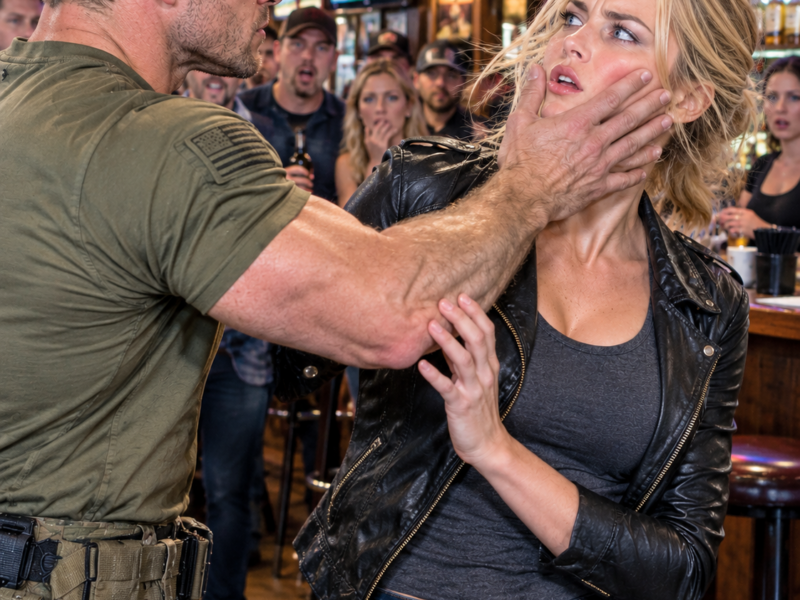
“The slap echoed across the crowded Nashville bar, sending my drink crashing to the floor as a six-foot-tall man leaned down
“That depends,” I said. “Who wants to know?”
The older man stared at me for another second before slowly lifting his right hand in a salute.
Not the casual gesture some veterans used when they recognized one another in public.
It was precise, deliberate, and accompanied by a look of disbelief that made the people standing nearest us stop pretending they weren’t watching.
“Chief Petty Officer Daniel Mercer,” he said. “Former Naval Special Warfare.”
I studied his face.
The scar near his jaw was new, but the eyes were familiar. I’d seen them through the red glow of night-vision equipment, across the back of a helicopter, and once through the dust of a collapsed building half a world away.
“Mercer,” I repeated.
His shoulders eased slightly.
“You remember.”
“I remember a lot of people.”
A faint, humorless smile crossed his face.
“Yeah. I imagine you do.”
Brad looked between us, his expression shifting from irritation to confusion.
“All right, what’s going on here? You two friends or something?”
Mercer turned toward him.
For the first time, I saw anger in the older man’s face.
“Do you have any idea who you just put your hands on?”
Brad scoffed.
“She mouthed off. I corrected her.”
Mercer’s jaw tightened.
“You struck a woman in a public bar because she wouldn’t give you attention.”
“She disrespected me.”
“No,” Mercer said. “She ignored you. You couldn’t stand the difference.”
A few people murmured.
Brad’s face reddened.
“Look, man, I don’t know what kind of game you’re playing, but—”
“Then stop talking.”
The words came out quietly, but Brad actually stopped.
I picked up my jacket and slipped one arm into it.
“Mercer, don’t.”
He looked at me.
“Don’t what?”
“Turn this into a ceremony.”
For a moment, he seemed ready to argue. Then he remembered the kind of person I was and let out a slow breath.
“Still hate attention, huh?”
“Attention usually means somebody wants something.”
That earned a brief smile.
It disappeared when he glanced at my cheek.
“You’re bleeding.”
“It’s a small cut.”
“That’s not the point.”
“It is to me.”
I reached for my purse.
Brad stepped sideways, blocking the narrow path to the door.
“Nobody’s going anywhere until somebody explains what’s happening.”
I looked down at his shoes, then back at him.
“Move.”
He laughed, but the sound lacked the confidence he’d had moments earlier.
“Or what?”
I didn’t answer.
I simply held his gaze.
Something in my stillness made him reconsider. He moved aside, muttering under his breath.
Mercer followed me toward the entrance.
Outside, Nashville’s evening air was cool, and the neon signs along the street reflected across the damp pavement. I stopped beneath the awning and pressed a clean napkin against my cheek.
Mercer stood a few feet away, giving me room.
For several seconds, neither of us spoke.
Then he said, “I thought you were dead.”
I lowered the napkin.
“That’s a strange thing to say to someone you just found drinking bourbon.”
“I heard the extraction went bad.”
“It did.”
“They told us there were no survivors.”
“Then somebody gave you bad information.”
He looked toward the bar’s windows.
“I saw the casualty report.”
I folded the napkin between my fingers.
“Reports aren’t the same as people.”
His expression tightened.
“I should have known better.”
I didn’t answer because I knew exactly what he meant.
Three years earlier, I’d walked away from a mission that had left people injured, a teammate missing, and a classified investigation that nobody involved wanted discussed in public.
Afterward, I had spent months answering questions in rooms without windows.
When the investigation ended, I was offered the choice of returning to operational duty or accepting an honorable separation.
I chose to leave.
I didn’t explain the decision to reporters, friends, or the few people who still had permission to contact me.
I certainly didn’t explain it to strangers in bars.
Mercer rubbed a hand across his face.
“You look different.”
“I cut my hair.”
“That’s not what I mean.”
“I know.”
His eyes returned to my wrist.
“Ghost Team was deactivated after the operation.”
“Teams change.”
“That’s one way to describe it.”
I put the napkin in my pocket.
“Mercer, if you’ve come over here to talk about old missions, pick another night.”
“I’m not.”
He hesitated.
Then he glanced back through the glass.
“That man inside served with my reserve unit for a while. Brad Kessler. He talks a lot about his military connections.”
“That sounds exhausting.”
“He claims he spent time working alongside special operations units.”
“Did he?”
“Not the way he says.”
I shrugged.
“Then correct him.”
“I tried. He doesn’t listen.”
“Most people don’t.”
Mercer studied me for a moment.
“You’re really going to let him walk away after what he did?”
I looked at him.
“What would you have me do?”
“At least report the assault.”
“That isn’t your decision.”
“No,” he said. “It isn’t.”
His answer surprised me.
He’d always been the kind of man who wanted a plan, a backup plan, and a third plan in case the first two failed.
Now he looked tired.
“There’s a police officer inside,” he said. “He saw what happened. The bartender did, too. You don’t have to do anything alone.”
I looked through the window at the bar.
Brad was talking loudly to two men near the pool table, his arms moving as he told his version of the story.
He glanced toward the door and caught sight of me.
Even from outside, I could see the contempt on his face.
I had spent years learning when to act and when to let a situation resolve itself.
But walking away had a cost, too.
“Fine,” I said. “I’ll give a statement.”
Mercer nodded.
“I’ll stay if you want.”
“I didn’t say you could.”
He almost smiled.
“Still giving orders.”
“Still ignoring them?”
“Only the ones I deserve.”
We went back inside.
The bartender had already called the police, and an officer was speaking with a woman who had recorded the incident on her phone.
Brad saw us and straightened.
“Are you kidding me?”
The officer turned toward him.
“Sir, I need you to remain where you are.”
Brad’s expression changed.
“She hit me first.”
The woman with the phone shook her head.
“I recorded the whole thing. She never touched you.”
Brad looked at her.
“You weren’t even watching.”
“I was recording my friends. You walked right into the frame.”
The officer took the phone and watched the video.
Then he looked at Brad.
“Step over here, please.”
Brad’s confidence began to unravel.
“This is ridiculous. I’m a veteran.”
“That doesn’t change what happened.”
He glanced at Mercer, looking for support.
“Tell them who she is.”
Mercer folded his arms.
“She’s the woman you assaulted.”
A few people laughed under their breath.
Brad’s face went dark.
“You know what? Fine. Arrest me for slapping somebody. But don’t stand there pretending she’s some kind of hero.”
I was tired enough to let that pass.
Then he added, “Whatever she did overseas, I doubt it was anything special.”
I stopped walking.
The officer looked at me, waiting to see whether I wanted to respond.
I turned toward Brad.
“You don’t have to believe anything about me.”
For the first time that night, my voice carried clearly across the room.
“But you don’t get to rewrite what happened just because you embarrassed yourself.”
Brad opened his mouth.
I continued before he could speak.
“I came here for a drink. You decided that my size meant you could control me. When I refused, you hit me. That’s the whole story.”
Nobody laughed now.
The officer escorted Brad toward the entrance to take his statement separately. The video was clear, and the witnesses agreed on what they had seen.
Mercer waited until the officer had finished speaking with me.
Then he asked, “Can I buy you another drink?”
I touched my cheek.
“Not tonight.”
“Coffee, then?”
“Maybe.”
He nodded as though that were a reasonable compromise.
We exchanged numbers, and I left.
I thought that would be the end of it.
I was wrong.
By Saturday morning, a clip from the bar had appeared on social media.
The video showed Brad striking me, Mercer recognizing me, and the crowd falling silent when he said my call sign.
Someone had added a caption claiming that a Navy SEAL legend had been attacked by a drunken bully.
By noon, the clip had been shared thousands of times.
By three, strangers were sending me messages.
Some praised me. Others wanted details about my service. A few accused me of inventing my military history because I was a woman who happened to know a retired chief.
I ignored them all.
I’d spent too much of my life protecting information to start discussing it with strangers because a video had gone viral.
At four thirty, my phone rang.
The caller ID displayed an unfamiliar Washington, D.C., number.
I nearly let it go to voicemail.
Something made me answer.
“Mara Ellis?”
The voice belonged to a woman.
“Yes.”
“This is Commander Rebecca Shaw, Naval Special Warfare Command. I need to speak with you about the video from Nashville.”
I sat down on the edge of my couch.
“If this is about my service record, I haven’t disclosed anything.”
“It’s not.”
There was a pause.
“Someone contacted our office after seeing the clip. They believe they recognized another person in the background.”
“Who?”
“We can’t confirm that over the phone.”
I glanced toward the window.
The street outside was quiet, a delivery truck rumbling past the row of parked cars.
“Then why are you calling me?”
“Because that person was officially reported missing during the operation you were involved in three years ago.”
My fingers tightened around the phone.
For a moment, I couldn’t hear anything except the low hum of my refrigerator.
“Who was it?”
Commander Shaw took a breath.
“Petty Officer First Class Evan Cole.”
I closed my eyes.
Evan had been my closest friend on the team.
He’d taught me to shoot left-handed after an injury temporarily weakened my right arm. He’d smuggled terrible coffee into the operations room and pretended not to notice when I fell asleep over mission reports.
He was the person who had once told me that the hardest part of our job wasn’t surviving the mission.
It was learning how to live afterward.
Three years earlier, I’d watched him disappear behind a wall of dust and gunfire.
I’d searched until the team leader ordered me to withdraw.
I had refused.
Evan had dragged me toward the extraction point himself, shouting that he wasn’t going to let me die trying to rescue him.
The last thing I’d seen was his hand disappearing beneath a collapsed concrete beam.
We never recovered his body.
I had attended a memorial service with an empty coffin.
“That’s impossible,” I whispered.
“I understand why you would say that.”
“Did you see the video?”
“Yes.”
“Then you know it proves nothing.”
“You’re right. But the individual who contacted us identified a distinctive scar and a tattoo visible on the man’s forearm.”
I stood and began pacing.
“Evan had a tattoo on his left forearm.”
“What kind?”
“A compass rose, with a small break in the northern point.”
The commander was silent for several seconds.
“That matches the description we received.”
I pressed my free hand against the kitchen counter.
“Where was the person standing?”
“Near the rear entrance of the bar.”
“Did anyone get his name?”
“No.”
“Then you don’t know it’s Evan.”
“Not yet.”
I stared at the floor.
“Why tell me?”
“Because your name appears in the original incident report, and because I think you deserve to know that the matter is being reviewed.”
I almost laughed.
Three years earlier, I’d begged people to review that report.
I’d asked for another search, another interview, another look at the intelligence that had sent us into the operation.
Instead, I’d been told that the mission had failed, that Evan was presumed dead, and that continuing to question the official account would only cause more pain.
I had left the Navy believing that some truths were beyond my reach.
Now one of them might be standing in a Nashville bar.
“Commander,” I said, “I need to see that video.”
“We can arrange a meeting.”
“No. I need to know what the witness saw.”
“We’ll contact you tomorrow.”
The call ended.
I remained beside the counter, staring at my phone.
Then another message appeared.
It was from Mercer.
You need to see something. Can you meet me tonight?
I called him immediately.
“What did you find?”
“I didn’t find anything,” he said. “Someone sent me a message.”
“Who?”
“I don’t know. No name, no profile picture. Just a photograph.”
“Of what?”
He hesitated.
“Of you and Evan.”
My mouth went dry.
“Send it to me.”
“I don’t think you should look at it alone.”
“Mercer.”
“All right. I’m sending it now.”
The image arrived seconds later.
It showed two people standing outside a concrete building at night.
One was unmistakably me, younger, my hair tucked beneath a helmet.
The other was Evan.
He was alive, standing beside me with one hand resting on my shoulder.
On the back of the photograph, someone had written a date.
It was three days after the operation in which Evan had supposedly died.
Beneath the date were six words.
You were never supposed to find him.
I stared at the image until my eyes burned.
Then I called Mercer again.
“Where did this come from?”
“I told you. An anonymous message.”
“Did you recognize the building?”
“No.”
I zoomed in on the photograph.
Behind Evan’s shoulder, a small sign hung above a doorway.
The lettering was blurred, but I could make out a partial word.
…RIDGE.
My hands began to tremble.
I knew that word.
Not from the mission.
From the classified investigation that had followed it.
A private security contractor called Ridgeway Strategic had supplied intelligence for the operation.
Their report had identified the location where Evan was last seen.
Their report had also claimed that no one could have survived the collapse.
Three months later, Ridgeway’s contract with the Navy had been renewed.
I had questioned the timing.
I had questioned the coordinates.
I’d even questioned why the team had received a map that differed from the one used by the local intelligence liaison.
Every question had led to another closed door.
Now someone had sent me a photograph that appeared to place Evan alive after the official report said he was gone.
“Mercer,” I said, “I need you to do something for me.”
“Name it.”
“Don’t contact anyone else about this photograph.”
“Why?”
“Because whoever sent it knows I exist, knows you know me, and knows enough about our past to use it against us.”
He went quiet.
Then he said, “You think this is connected to the operation.”
“I think it’s connected to something we were never allowed to understand.”
I looked again at the words on the photograph.
You were never supposed to find him.
For three years, I’d believed the hardest part of losing Evan was accepting that I couldn’t save him.
Now I wondered whether someone had made sure I never had the chance.
That night, I barely slept.
At six the following morning, a knock sounded at my door.
I looked through the peephole.
Mercer stood in the hallway, holding two coffees and wearing the same exhausted expression he’d worn outside the bar.
I opened the door.
“You look terrible,” he said.
“I’ve had a busy night.”
He handed me a coffee.
“Then you’ll appreciate this.”
He pulled out his phone and showed me a message from an unknown number.
It contained an address outside Nashville and a time: 10:00 a.m.
Below it was a single sentence.
If Mara wants to know what happened to Evan, she needs to come alone.
I read it twice.
“No.”
Mercer frowned.
“No?”
“I’m not going anywhere because an anonymous stranger tells me to.”
“Good. I was hoping you’d say that.”
I looked up.
He tapped his phone.
“I sent it to Commander Shaw. She has people checking the address.”
“Without telling them why?”
“I told them enough to make them take it seriously.”
For the first time since the call the previous afternoon, I felt something other than dread.
It wasn’t relief.
It was the faint, unfamiliar comfort of knowing I didn’t have to carry every question by myself.
We waited for Shaw’s response.
At nine fifteen, she called.
The address belonged to a closed vehicle repair shop twenty miles outside the city.
The property had changed hands twice in the last year, most recently through a company connected to Ridgeway Strategic.
Commander Shaw told us not to go there.
She also told us that investigators had located the person who had contacted the Navy.
He was a former employee of the contractor.
His name was Paul Hensley.
And he had disappeared the previous evening.
“Do you have any idea where he might have gone?” I asked.
“We’re checking his known contacts.”
“Does he know Evan?”
“We don’t know yet.”
I stared at Mercer.
The photograph, the message, the property, the missing witness.
Each piece pointed toward the same place, but none told us what we would find if we followed it.
I had spent three years living with the certainty that Evan was dead.
Now I had to confront a different possibility: that someone had deliberately made me believe it.
“I want to see the original mission files,” I said.
Commander Shaw hesitated.
“Those files are still classified.”
“I know.”
“You no longer have access.”
“I know that, too.”
“Then what are you asking me?”
I looked at the photograph on my table.
“I’m asking you to stop treating this as a question about a missing sailor and start treating it as a question about a mission that may have been compromised.”
There was a long silence.
Finally, she said, “Come to Washington tomorrow morning.”
The meeting took place in a secure conference room with no windows.
Commander Shaw sat across from me, accompanied by a legal officer and a senior intelligence analyst.
They had printed the photograph, enlarged the image, and compared it with the original mission records.
The date was consistent with the time Evan was believed to have been held at the site.
The building’s partial sign matched a facility Ridgeway had operated overseas.
And the tattoo was visible enough to warrant further examination.
But the most important discovery wasn’t in the photograph.
It was in the mission timeline.
The official report stated that our team had received an emergency extraction order at 0217.
I remembered that order.
I remembered the voice over the radio telling us the perimeter had been breached.
I remembered dragging Evan away from the collapsing wall while the others covered our retreat.
But the archived communications log showed that the extraction order had been entered into the system at 0254.
Thirty-seven minutes later.
Someone had altered the timeline.
The legal officer folded his hands.
“That discrepancy doesn’t prove intentional misconduct.”
“No,” I said. “But it proves the report is wrong.”
The intelligence analyst leaned forward.
“There’s another issue. The location coordinates in the initial briefing were different from the coordinates transmitted to the team.”
I stared at him.
“How different?”
“Enough to put your team inside the secondary facility rather than the primary target.”
My mouth went dry.
We hadn’t simply walked into a dangerous location.
We might have been sent to the wrong one.
“Who authorized the change?”
“We’re tracing the communications chain.”
“Do you have a name?”
“Not yet.”
I sat back.
For three years, I’d blamed myself for the moment I stopped searching for Evan.
I’d replayed every decision, every radio call, every second between the collapse and extraction.
I’d wondered whether I could have done something differently.
Now the timeline suggested that someone had manipulated the information we received.
It didn’t erase my choices.
It changed what those choices meant.
Commander Shaw slid a document across the table.
“There’s one more thing.”
The page contained a list of payments made by Ridgeway Strategic to a consulting company shortly after the operation.
The consulting company had no public office, no employees listed, and no visible business activity.
Its registered agent was a retired Navy officer who had served on the staff responsible for reviewing the mission.
I recognized the name.
Captain Richard Vale.
He had been the senior officer who questioned me after the operation.
He’d looked me in the eye and told me that Evan was gone, that the team had done everything possible, and that I needed to accept the findings.
I had believed him.
Or perhaps I had needed to.
“Has anyone spoken to Vale?” I asked.
“We have not approached him,” Shaw said. “At this stage, we don’t know whether the payments were improper.”
“Then find out.”
She studied me.
“You understand this could take months.”
“I spent three years waiting for an answer I was told would never come.”
I stood.
“I’m not asking you to make an accusation. I’m asking you to follow the evidence.”
The meeting ended without a promise.
But as I left the building, Commander Shaw caught up with me in the corridor.
“We’re opening a formal review,” she said. “And I want you to understand something. If Evan is alive, finding him will be dangerous.”
I looked at the photograph in my hand.
“I understand.”
“Do you?”
I thought about the collapsed building, the radio going silent, and the empty coffin at Evan’s memorial.
Then I looked at her.
“I don’t need to know whether it’s safe. I need to know whether it’s true.”
The review moved faster than anyone expected.
Within forty-eight hours, investigators found evidence that Ridgeway had maintained an unreported detention facility at the site.
Financial records showed payments to shell companies linked to two former intelligence officials.
A former contractor agreed to cooperate after learning that Hensley had vanished.
His statement revealed that several detainees had been moved from the facility shortly after the operation.
One of the names on the transfer list was Evan Cole.
The record was incomplete, but it included a destination.
A private medical center in Virginia.
The facility had closed the previous year, and its records had supposedly been destroyed.
Supposedly.
A court order allowed investigators to recover archived billing records from the company that had managed its accounts.
Among the files was a payment for emergency treatment made under an alias.
The date was four days after Evan disappeared.
The patient description included a healed fracture in the left forearm, a surgical scar beneath the ribs, and a compass rose tattoo with a broken northern point.
I sat in the conference room reading the report.
For the first time in three years, there was evidence that Evan had survived the operation.
I wanted to celebrate.
Instead, I felt sick.
If he had survived, why hadn’t he contacted us?
Why had nobody told his family?
Why had a private contractor been paying for his medical care under a false name?
Commander Shaw sat beside me.
“We have a probable location for the individual who used the alias.”
“Where?”
“A rehabilitation facility in western Virginia.”
I stared at the map.
It was less than an hour from the cabin where I’d lived since leaving the Navy.
I had spent three years trying to build a life in the same state where my best friend might have been held without my knowledge.
“I want to go,” I said.
Shaw nodded.
“We’ll arrange it.”
The facility stood at the end of a narrow road lined with bare trees.
It was a small private center that treated patients recovering from severe injuries. Investigators had confirmed that a man using Evan’s alias had been transferred there several months earlier.
The staff had no idea who he really was.
They knew only that his treatment was paid for by a trust and that he rarely received visitors.
I stood outside the building with Mercer beside me.
For the first time since we’d met in Nashville, he had nothing to say.
A nurse led us down a quiet corridor.
At the end was a small room with a window overlooking a courtyard.
A man sat beside the window, reading a paperback.
His hair was shorter than I remembered, and his shoulders were narrower. A pale scar ran along his neck.
But when he turned his head, I recognized his eyes.
“Evan,” I whispered.
The book slipped from his hands.
He stared at me as if he were seeing something he had spent years trying to forget.
Then he stood, slowly and painfully, gripping the edge of the table.
“Mara?”
I took one step forward.
He shook his head.
“No.”
His voice cracked.
“No, you can’t be here.”
I stopped.
“Why?”
He looked toward the nurse, who quietly left the room and closed the door.
Then he turned back to me.
“Because they told me you were dead.”
The words landed harder than any accusation in the bar.
I stared at him.
“Who told you that?”
Evan sank into the chair.
“Ridgeway. They said the extraction team never made it out. They said you were killed in the collapse.”
I couldn’t speak for a moment.
“That’s not true.”
“I know that now.”
He rubbed his face with both hands.
“Not at first. At first, I believed them. I was injured, sedated, and moved between facilities. They kept telling me the operation had been compromised and that anyone who knew the details was a target.”
“Why didn’t you contact the Navy?”
“I tried.”
He looked up at me.
“Twice. The first time, the message never reached anyone. The second time, someone came to my room and told me that if I tried again, my family would pay for it.”
My anger gave way to something heavier.
“They threatened your family?”
“They showed me photographs of my sister’s house. Her car. Her kids.”
He swallowed.
“I believed them because they knew things nobody outside the operation should have known.”
Mercer turned toward the window, jaw clenched.
I pulled a chair closer to Evan.
“Tell me what happened that night.”
He looked at me for a long time.
Then he began.
After the collapse, Ridgeway personnel had recovered him from the wreckage. They told him the team had abandoned him, then transferred him to a private facility under an alias.
He was kept under guard while he recovered from his injuries.
When he demanded to contact his family, they told him the operation was under investigation and that his communication would compromise national security.
He didn’t believe them.
Then they showed him altered reports bearing his own name and signatures, documents suggesting he’d participated in an unauthorized transfer of intelligence.
They threatened to charge him with treason if he went public.
“They needed someone to take responsibility for what happened at the facility,” he said. “Someone whose disappearance could be explained by the chaos of the operation.”
“And you were convenient.”
He nodded.
“I was injured, isolated, and officially presumed dead. They could keep me hidden while they moved the people and records they didn’t want found.”
“Who was running it?”
Evan looked at Mercer, then back at me.
“Captain Vale.”
The name confirmed what the financial records had suggested.
Evan continued.
Vale had authorized the altered coordinates and approved the false extraction timeline. Ridgeway had used the confusion to remove sensitive records from the site.
The records concerned an unauthorized detention program and payments made to people who had arranged the transfers.
Evan had seen part of the paperwork before the collapse.
He’d also photographed a page on his personal device, a page that documented the transfer of detainees and the names of officials who had approved it.
“Do you still have the photograph?” I asked.
“No. They took my phone.”
“Did you memorize anything?”
He looked down.
“One account number. And a date.”
It was enough to give investigators another lead.
But Evan wasn’t finished.
“There was another reason they kept me alive,” he said.
I waited.
“They thought I knew where the original records were.”
“Did you?”
He nodded.
“Before the operation, I made a copy of the file and sent it to someone I trusted. I didn’t tell them what was in it. I only told them to keep it somewhere safe until I could retrieve it.”
“Who?”
He hesitated.
Then he gave me the name of a former teammate who had left the Navy before the mission.
The man was alive, living in Colorado, and had no idea why investigators might be looking for him.
For the first time, the path ahead seemed clear.
We had the altered reports, the financial records, Evan’s testimony, and the possibility of an original file that could connect the people involved.
But the case was not over.
Captain Vale had spent years building a reputation as a respected veteran. Ridgeway had powerful clients, experienced lawyers, and enough money to bury an investigation in paperwork.
And Evan’s account, however compelling, was only the beginning.
Before we left the facility, he caught my hand.
“Mara.”
I turned back.
“Why did you keep looking?”
I looked at the scar beneath his collar and the gray beginning to show at his temples.
“I stopped looking,” I admitted. “They convinced me there was nothing left to find.”
He lowered his eyes.
“I would have done the same.”
“No,” I said quietly. “You would have found another way.”
He smiled faintly.
“You always did think I was better than I was.”
“Maybe.”
I squeezed his hand.
“But I never thought you were disposable.”
His face crumpled for an instant before he looked away.
We didn’t hug.
Not then.
There were too many years between us, too many unanswered questions, and too much pain that neither of us knew how to name.
Instead, I sat beside him until the afternoon light faded across the courtyard.
It was enough to be in the same room.
The evidence gathered over the next several weeks changed everything.
The original file was recovered from the former teammate’s storage unit in Colorado. It matched Evan’s account and contained records linking Vale to the unauthorized transfers.
Investigators also found evidence that Ridgeway had falsified invoices, concealed detainee movements, and used shell companies to pay intermediaries.
Vale was placed under investigation.
Several former Ridgeway executives were charged with offenses related to fraud, unlawful detention, and obstruction.
The case took months to build, and the legal process was slow.
There were sealed hearings, contested records, and days when it seemed that the truth would disappear beneath procedural arguments.
But Evan’s testimony held.
So did the documents.
And the altered mission timeline became one of the central pieces of evidence showing that the original investigation had been built on a false account.
No single discovery explained everything.
Together, they made the official story impossible to defend.
When the Navy formally corrected the mission record, I received a letter acknowledging that my actions during the operation had been consistent with my orders and that the original findings had relied on inaccurate information.
I read it at my kitchen table, then placed it in a drawer.
It mattered.
But it couldn’t return the years we’d lost.
Evan moved into a rehabilitation apartment near his sister, where he began the slow work of rebuilding his life.
He had trouble sleeping, struggled with crowded rooms, and sometimes went silent when a car backfired outside.
I learned not to fill every silence.
We met for coffee every Wednesday.
Some weeks, we talked about the case.
Other weeks, we argued about baseball or complained about the price of groceries.
One afternoon, he asked whether I’d ever regretted leaving the Navy.
I watched a man at the next table try to convince his toddler to eat a piece of toast.
“Sometimes,” I said. “Mostly when I think about the people I left behind.”
Evan stirred his coffee.
“You didn’t leave me behind.”
“I thought I did.”
“You came looking when you had a reason to believe I might be alive.”
He looked up.
“That’s more than most people would have done.”
I wanted to tell him that he was wrong, that I should have questioned the report harder, that I should have refused to accept the official conclusion.
Instead, I let the words settle between us.
I couldn’t change what I’d believed three years earlier.
I could only decide what to do with the truth now.
Several months after the Nashville incident, Mercer invited me to a veterans’ fundraiser.
I almost declined.
Then he reminded me that the event supported a program helping former service members find housing and mental health care.
I agreed to attend.
The ballroom was crowded, the music too loud, and the speeches too long.
I wore a simple dark dress and kept my hair tied back.
No uniform.
No medals.
No visible reminder of the life I’d left.
Halfway through the evening, I noticed Brad Kessler standing near the bar.
He looked different without the crowd around him. Smaller, somehow, though he was still broad-shouldered and still carried himself like a man accustomed to taking up space.
When he saw me, he hesitated.
For a moment, I thought he would turn away.
Instead, he approached.
“Mara.”
I looked at him without smiling.
“Brad.”
He rubbed the back of his neck.
“I owe you an apology.”
I waited.
He glanced toward Mercer, who stood several feet away, then back at me.
“What I did in that bar was wrong. There’s no excuse for it.”
“No,” I said. “There isn’t.”
He swallowed.
“I’ve been thinking about that night. About why I did it.”
I didn’t help him.
“I wanted everyone to think I was the toughest guy in the room. And when you wouldn’t pay attention to me, I felt stupid.”
“So you hit me.”
“Yes.”
He looked down.
“I was wrong.”
I studied him for a moment.
I could see that the apology cost him something. I could also see that he wanted it to be enough.
“I’m glad you understand what you did,” I said. “But understanding it doesn’t mean I owe you forgiveness.”
He nodded slowly.
“I know.”
“Good.”
I turned toward the room.
He didn’t follow me.
I never learned whether Brad became a different man after that night.
Maybe he did.
Maybe he didn’t.
It wasn’t my responsibility to find out.
Later, Mercer found me near the exit.
“You handled that well,” he said.
“I told him the truth.”
“Same thing, sometimes.”
We stepped outside into the cool evening air.
Across the street, traffic moved through the city in long ribbons of white and red light.
Mercer leaned against the railing.
“You know, when I first saw that tattoo, I thought I was looking at someone who’d come back from the dead.”
I glanced at him.
“That’s dramatic.”
“Occupational hazard.”
He smiled, then grew serious.
“I also thought you might be the same person you were three years ago.”
“And?”
“I was wrong.”
I waited.
He shrugged.
“You’ve got less patience.”
“I had less patience before.”
“Fair enough.”
We stood quietly for a moment.
Then he said, “You know what I think people got wrong about you?”
I raised an eyebrow.
“Only one thing?”
He laughed.
“They thought the legend was the important part.”
I looked back through the ballroom windows at the people moving between tables.
The word legend had followed me for years, usually spoken by people who knew very little about what the job actually required.
It had always made me uncomfortable.
A legend was something distant, a story polished until the difficult parts disappeared.
I wasn’t interested in being a story.
I was interested in being a person who could live with the choices she’d made.
“People like legends,” I said. “They’re easier to understand than real people.”
Mercer nodded.
“And real people make mistakes.”
“Especially when they’re tired.”
“Or scared.”
“Or convinced they’re right.”
He held out his hand.
I shook it.
For the first time in years, the past didn’t feel like a locked room I had to keep trying to enter.
It felt like a place I’d finally been able to leave.
A week later, Evan called me from his apartment.
He’d found an old photograph while sorting through the few belongings that had survived his years in captivity.
It showed our team standing beside a helicopter before the operation.
We were younger, sunburned, and exhausted. Someone had drawn a crooked smiley face on the corner of the picture.
I could barely remember who’d done it.
Evan laughed when I told him that.
“That was you.”
“I would never.”
“You absolutely would.”
We argued about it for five minutes, then agreed to disagree.
Before hanging up, he asked whether I wanted a copy.
“Of course,” I said.
A few days later, the photograph arrived in the mail.
I placed it on the shelf above my desk, beside the letter correcting the mission record.
The photograph reminded me of who we had been.
The letter reminded me that the truth could survive even when people worked hard to bury it.
Neither could give us back the years we’d lost.
But both belonged in the same room.
I still live in Virginia.
I still drink bourbon when I feel like it, though I usually choose a quiet place where the bartender knows my name.
And every now and then, someone recognizes me from the video that made its way around the internet.
They ask whether it’s true that I was a Navy SEAL.
They ask whether I really earned the call sign Ghost.
Sometimes they ask how a woman my size managed to survive a world built around people who assumed she couldn’t.
I usually tell them the truth.
I trained hard.
I made mistakes.
I had people who trusted me, and I trusted them.
I survived because of skill, luck, preparation, and the people who refused to leave me behind.
Then I change the subject.
Because the most important moment of that night in Nashville wasn’t when Brad slapped me, or when Mercer recognized the tattoo on my wrist, or even when a photograph brought Evan back into my life.
It was the moment I realized that I no longer needed strangers to believe I was dangerous, brave, or extraordinary.
I only needed the truth to be heard.
And sometimes, the strongest person in the room is the one who no longer feels the need to prove it.
THE END









