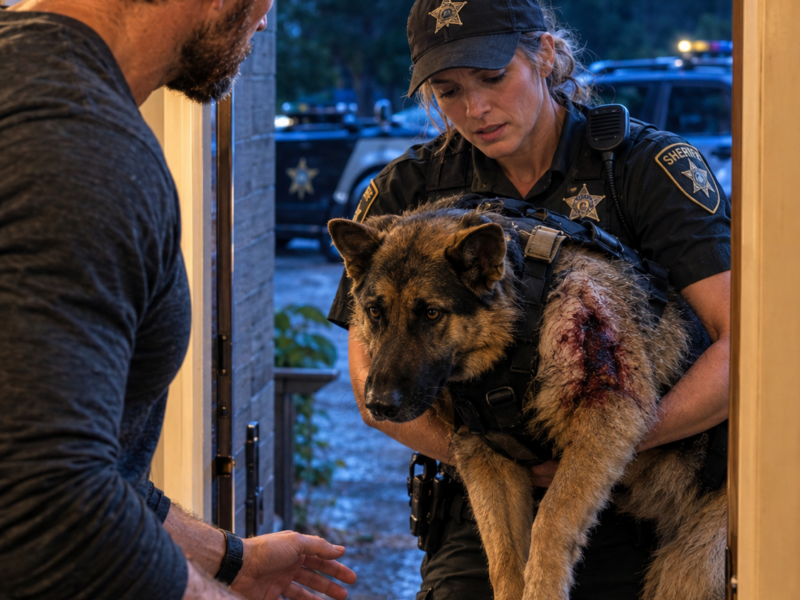
“The sheriff’s deputy laid a blood-soaked German Shepherd on my porch in rural Montana and told me
I reached for the flashlight, but Cole caught my wrist before I could move toward the door.
“Don’t go out there alone,” he said.
His grip was firm, though his eyes kept drifting toward the dark window above the sink.
I looked down at his hand until he let go.
“You’re a sheriff’s deputy, Cole. If someone’s on my property, shouldn’t you be the one going after him?”
“Normally, yes.”
“Normally?”
He glanced at Duke, who lay on the kitchen table beneath Dr. Harris’s careful supervision. The dog had stopped growling, but his ears remained pointed toward the service road.
“There’s something I haven’t told you,” Cole said. “Thomas Walker called the sheriff’s office three days ago. He said someone was following him, and he specifically asked for a deputy who hadn’t worked with federal agencies.”
“Why?”
“He wouldn’t say. He only gave us your name and told us that if anything happened to him, we should bring Duke to you.”
I studied him.
“And your department agreed to deliver a wounded military dog to a private citizen in the middle of the night?”
“No. My department told me to wait until morning.”
He looked toward the window again.
“I didn’t.”
That answer told me more about Cole than his badge ever could.
He was either a man who took reckless chances or a man who had seen enough to know when official procedures were being used to buy someone time.
I couldn’t yet tell which.
A second metallic clatter came from outside.
This time, it was followed by the crunch of gravel.
Someone was walking away from the service road.
I killed the kitchen light.
Cole drew his flashlight but kept it pointed at the floor. I moved to the side window, careful to stay out of the line of sight, and looked through a narrow gap in the curtains.
A dark SUV stood beyond the trees.
Its engine was running.
I couldn’t make out the license plate, but I could see a pale shape behind the windshield.
A face, perhaps.
Then the SUV rolled backward, turned on the gravel, and disappeared down the road.
“Did you get the plate?” Cole whispered.
“No.”
He swore under his breath.
Dr. Harris straightened from Duke’s side.
“He needs the clinic,” she said. “I can stabilize him here for a little while, but I can’t keep him on this table all night.”
Duke lifted his head when I approached.
“Hey, buddy.”
I rubbed the fur between his ears.
His eyes followed my hand, and I noticed a small scar cutting through the hair above his left eye.
It was shaped like a crescent.
My stomach tightened.
I had seen that scar before.
Not on Duke.
On Ranger, six years earlier, after a piece of metal had torn through his fur during a training accident.
It was an ordinary injury, the kind a working dog could acquire a dozen different ways.
But Duke’s scar sat in precisely the same place.
I leaned closer.
“Where did you come from, boy?”
Duke pressed his nose into my palm.
For a moment, I thought I could smell the desert again—hot dust, engine oil, and the bitter smoke that had clung to our uniforms after the mission that killed Daniel.
I pulled my hand away.
No.
I had seen enough injured dogs to know that scars could resemble one another.
Grief was good at turning coincidences into evidence.
Still, I couldn’t stop looking at him.
Dr. Harris finished securing the temporary dressing around Duke’s side and prepared him for transport.
“I’ll take him to my clinic,” she said. “He’ll be safer there than in a house where someone may be watching.”
“I’ll follow you,” I said.
Cole shook his head.
“You should stay here. If that person comes back, I need to know.”
“Then stay with the house.”
He looked as though he wanted to argue.
Instead, he handed me a small card with his personal number written on the back.
“If you find anything in that shed, don’t touch it until I get there.”
I pocketed the card.
“You’re assuming I’m going to the shed.”
“No,” he said. “I’m assuming you already decided to go there the second you read that note.”
He wasn’t wrong.
Twenty minutes later, after Dr. Harris’s truck disappeared down the road with Duke secured in the back, I stood alone in my kitchen.
The memory card sat inside its evidence bag beside the photograph of Daniel.
Tomorrow’s date was written on the note.
The north gate was supposed to open tomorrow.
And someone had just tried to open it tonight.
I pulled on my boots, grabbed my flashlight, and went outside.
The air smelled of wet pine and cold earth. Water dripped from the branches overhead, pattering against my jacket as I crossed the yard.
My father’s storage shed stood behind a line of fir trees, nearly hidden by blackberry vines and years of neglect.
He had built it when I was twelve.
After he died, I had used it to store tools, old camping equipment, and boxes I couldn’t bring myself to sort through.
I’d locked it before leaving for my last deployment.
When I came home, I had never opened it again.
I told myself I didn’t need anything inside.
The truth was that the last time I had seen my father, we’d argued about my decision to enlist.
He’d spent twenty years as a mechanic for a defense contractor before retiring to Montana. He understood military life better than most civilians, but he had never wanted it for me.
“You don’t owe anybody your life, Mason,” he’d told me.
I’d answered that he didn’t understand.
I hadn’t called him again before deploying.
Three weeks later, I received word that he’d died in his sleep.
For years, I had carried that unfinished conversation like another wound.
Now his shed waited beneath the trees, and I could see fresh mud beside the door.
Someone had been there recently.
I tested the handle.
Locked.
I went around the side, pushed aside a curtain of wet branches, and found a narrow metal box bolted beneath the eaves.
The key was taped to its underside.
My father had hidden spare keys in strange places, but this one was different.
A strip of masking tape covered the top of the box.
On it, in his unmistakable block handwriting, were the words:
FOR MASON. ONLY IF THEY COME BACK.
I stared at the message until the flashlight trembled in my hand.
My father had written those words before his death.
The date on the tape was six years old.
I opened the box.
Inside lay a brass key, a folded map, and a small envelope bearing my name.
I recognized the handwriting immediately.
I hadn’t seen it in years, but I would have known it anywhere.
My father’s.
The envelope was sealed.
I slipped it into my jacket and unfolded the map.
It showed our property, the service road, and a narrow strip of land extending beyond the eastern boundary. A red line marked a path through the trees to an old stone culvert.
At the edge of the map, my father had written two words.
NORTH GATE.
I had never known there was a gate.
I knew the property boundaries well enough. The land beyond the eastern fence had once belonged to a timber company, and a decommissioned access road ran through it before disappearing into state forest.
But the map showed something else.
A small rectangular building stood beyond the culvert, marked with a symbol I recognized from my military years.
A storage designation used for controlled equipment.
I folded the map and walked toward the culvert.
The chain across the old service road had been cut.
Fresh tire tracks ran through the mud beyond it.
I followed them until my flashlight caught the outline of a steel gate between two stone pillars.
It was almost invisible beneath the overgrowth.
A keypad had been installed on one pillar, its metal face scratched and weathered. Beside it sat a small panel with a mechanical lock.
The brass key fit.
I turned it.
A heavy bolt withdrew with a dull click.
The gate opened just far enough for me to squeeze through.
Beyond it, the road descended toward a low concrete building half-hidden beneath the trees.
There were no windows.
A ventilation pipe protruded from the roof, and a faded government warning sign hung beside the door.
My father had never mentioned this place.
I approached slowly, watching the ground for fresh tracks.
The door wasn’t locked.
Inside, the air smelled of dust, cold metal, and something faintly chemical. My flashlight swept over empty shelving, a workbench, and a wall covered in old electrical diagrams.
At the far end of the room stood a steel cabinet.
A small label had been riveted to its front.
PROJECT NORTHSTAR.
Below it was a serial number.
I knew the designation.
I’d seen it once in a classified briefing six years ago, before Daniel’s final mission.
Northstar had been described as an intelligence program designed to test new tracking technology for military working dogs. The briefing had been short, and our team had been told the program was unrelated to our assignment.
Daniel hadn’t believed that.
He’d questioned why our mission coordinates had been changed at the last minute and why a private contractor had been allowed access to the operational plan.
I’d told him to trust the chain of command.
He’d looked at me for a long moment.
Then he’d said, “Sometimes the chain is exactly where the problem starts.”
I had never forgotten those words.
I stepped closer to the cabinet.
The brass key opened its lock.
Inside were several binders, a portable computer, and a sealed envelope marked with a date from six years earlier.
I opened the nearest binder.
The first page listed equipment transfers, veterinary records, and personnel assignments. Most of the names meant nothing to me.
Then I found Daniel’s.
His name appeared beside a series of entries documenting a field trial conducted three days before his death.
The next page contained a photograph of a German Shepherd wearing a tactical harness.
Underneath it was a name.
RANGER.
I gripped the edge of the binder.
Ranger had been officially recorded as killed during the mission that took Daniel’s life.
I had watched the recovery team carry what they said was his body away from the scene.
I’d never been permitted to see the veterinary report.
The file in my hand showed that Ranger had been transferred to a Northstar facility two days before the mission.
The transfer had been authorized by a man whose signature I recognized.
Thomas Walker.
I turned another page.
A handwritten note had been tucked into the binder.
The ink had faded, but the words were clear.
THE DOG IS NOT THE OBJECTIVE. THE DOG IS THE WITNESS.
My flashlight flickered.
Somewhere behind me, a floorboard creaked.
I turned sharply.
A man stood in the doorway.
He was in his late fifties, with silver hair, a weathered face, and a dark jacket beaded with rain.
His hands were empty.
But I noticed the scar running along his jaw.
I had seen that scar in the photograph.
“Put the binder down, Mason,” he said.
I didn’t move.
“Who are you?”
He looked at the papers in my hand.
“My name is Peter Harlan. I worked with your father.”
“On what?”
“Northstar.”
I raised the flashlight so it illuminated his face.
“Did you kill Thomas Walker?”
“No.”
“Did you kill Daniel Brooks?”
His expression changed.
Not anger.
Something closer to grief.
“No,” he said quietly. “But I helped create the conditions that got him killed.”
The words landed harder than a denial would have.
I kept my distance.
“Start talking.”
Peter glanced toward the open cabinet.
“Your father built the tracking system used in the original trials. He believed it would help search-and-rescue teams locate people in remote terrain. The government wanted something else. They wanted a way to follow people without their knowledge, using equipment hidden in a working dog’s harness.”
“And Daniel found out.”
“Daniel found evidence that the system was being used outside authorized operations. He believed a private contractor was selling location data to people who had no right to it.”
“Thomas Walker.”
Peter nodded.
“Walker helped run the program. At first, he believed he was working under legitimate intelligence authority. When he realized what was happening, he tried to preserve the records.”
“Why didn’t he go to the authorities?”
“He did. The complaint disappeared. The people he reported were the same people who controlled the investigation.”
I thought of the photograph, the official report, and the six years I’d spent accepting the explanation I’d been given.
“Why my father?”
“Because he discovered that the tracking system had been modified to retain data even after a device was supposedly deactivated. He found records connecting the program to Daniel’s mission.”
“You’re telling me my father knew Daniel was going to die?”
“No.” Peter’s voice hardened. “I’m telling you your father tried to stop it.”
He reached slowly into his jacket and removed a small notebook.
I shifted my weight, ready to move if he reached for anything else.
Peter noticed.
“I’m not armed,” he said. “And I’m not here to hurt you.”
“Then why are you here?”
“Because someone found out Thomas had recovered the last copy of the original Northstar logs. He hid them with Duke, then sent the dog to you.”
“Why me?”
“Because you were the last person Daniel trusted, even after you refused to believe him.”
I looked down at the binder.
“That’s not an answer.”
“No,” Peter said. “It’s the reason Daniel chose you.”
He opened the notebook and placed it on the workbench.
Inside were dates, coordinates, and a series of handwritten observations. One entry was underlined twice.
D-17 / RANGER / HANDLER RESPONSE CONFIRMED.
Beside it was a date three days before the mission.
My name appeared in the margin.
I felt the room tilt around me.
“What does that mean?”
Peter looked at me carefully.
“Northstar wasn’t only testing tracking equipment. They were recording how handlers responded to specific cues, including false alerts and manipulated location reports. The goal was to see whether a handler could be induced to follow a target into a controlled environment without realizing the information had been altered.”
I remembered the coordinates changing.
The message telling us a civilian informant had been located.
Daniel asking why the route had been redirected.
And me insisting that we had to move before the window closed.
“You’re saying they used us as part of the trial.”
“Yes.”
I closed the notebook.
“Then why did Daniel die?”
Peter took a breath.
“Because he discovered the deception before the operation was complete. He tried to abort the mission and get Ranger out. The people overseeing the trial couldn’t allow him to leave with the evidence.”
I stared at him.
“Who gave the order?”
Peter hesitated.
That hesitation was answer enough to make my hands curl into fists.
“Say the name.”
“Adrian Vale.”
I knew it.
Commander Adrian Vale had been the senior intelligence officer overseeing our deployment. He’d briefed us personally, spoken about duty and trust, and stood beside Daniel’s parents at the memorial.
After my injury, he’d sent me a letter praising my service.
I’d kept it in a drawer for years.
“Vale told us the mission had been compromised by enemy forces.”
“That was the official story.”
“And Daniel?”
Peter lowered his eyes.
“Daniel was shot while trying to get Ranger and the data out. Walker was ordered to destroy the remaining records. Instead, he took them and disappeared.”
“Why wait six years?”
“Because the records weren’t enough. Walker needed proof that connected the altered mission orders to Vale. Your father found it, but he couldn’t get it out safely. He hid the original logs here.”
Peter tapped the steel cabinet.
“Thomas came back for them two nights ago. Someone followed him.”
I looked at the map.
“Then why leave the note about the gate opening tomorrow?”
“Because the gate isn’t just a gate. Your father installed a timed access system that records every entry. He expected someone to come looking for the files eventually. Tomorrow is the anniversary of the original field trial.”
I thought of the date on the note.
“Someone wants me to open it.”
“Someone wants to know whether you found what your father left behind.”
I took a step toward Peter.
“Who is watching my house?”
“I don’t know.”
“Who was in the SUV?”
“I don’t know that either.”
I wanted to hit him for every answer he couldn’t give me.
Instead, I forced myself to look at the evidence.
A binder, a notebook, a map, and a man who admitted he’d helped build the system that had destroyed my life.
“Why should I believe you?”
“You shouldn’t,” Peter said. “Not yet.”
He reached into his pocket and took out a small photograph.
This one showed my father standing beside a younger Peter in front of the same concrete building. Between them stood a German Shepherd with a dark harness.
On the back, my father had written a date and a sentence.
IF MASON EVER COMES HERE, TELL HIM I WAS WRONG TO KEEP HIM OUT OF IT.
I read it twice.
My father had known I might one day find the shed.
He’d known the past might come looking for me.
And he’d left me a way to discover the truth without asking anyone to trust a word they said.
“Where are the original logs?” I asked.
Peter pointed toward the portable computer.
“Encrypted. Thomas gave me the key before he died, but I haven’t opened the files.”
“Why not?”
“Because the key is tied to a second verification. Your father designed it that way.”
I studied the computer.
A small prompt glowed on the screen.
ENTER HANDLER IDENTIFICATION.
Below it were three fields.
OPERATOR.
CANINE.
MISSION DATE.
I entered my name.
The screen accepted it.
I typed RANGER.
A red warning appeared.
IDENTIFICATION MISMATCH.
Peter leaned closer.
“Try the dog’s current name.”
I typed DUKE.
The screen went black for two seconds, then displayed a new field.
ORIGINAL HANDLER ID.
I entered the identification number I’d carried during my deployment.
The system paused.
Then a list of dates appeared.
The final field asked for the mission date.
I typed the date Daniel had died.
A progress bar appeared.
For a moment, nothing happened.
Then the computer unlocked.
Folders filled the screen.
Mission logs, audio files, equipment records, and personnel communications.
At the top of the directory was a file labeled D.B. — FINAL TRANSMISSION.
I couldn’t move.
Peter stepped back, giving me space.
I clicked the file.
Static filled the room.
Then Daniel’s voice came through the small computer speaker.
“Mason, if you’re hearing this, it means I didn’t make it out.”
I sat down hard on the edge of the workbench.
Daniel sounded tired, but unmistakably himself.
“I need you to listen carefully. The coordinates are false. The intelligence is false. Vale knows the location was changed, and he’s using Ranger’s tracking system to make it look like the enemy moved us.”
There was a burst of static.
Then Daniel continued.
“I know you trust him. I did too. But I found the transfer records. Ranger wasn’t supposed to be on that mission. They wanted the system tested under live conditions, and we were the control group.”
I pressed my fingers against my mouth.
“If you made it home, don’t blame yourself for following the order. You were given bad information by someone who knew exactly how you’d respond. That’s what they were testing.”
My eyes burned.
Daniel paused, and I heard him take a breath.
“Get the records to someone outside the command structure. Don’t go through Vale. Don’t trust anyone who tells you this can be handled quietly.”
The recording crackled.
Then came his final words.
“And Mason? If Ranger made it out, take care of him. He’ll remember you even if you don’t remember him.”
The file ended.
I stared at the screen.
For six years, I had replayed the final moments of that mission in my mind, changing my decisions, imagining different routes, different words, different choices.
Daniel had known I would blame myself.
He’d tried to stop me from doing it before he died.
But the recording left another question.
Ranger had supposedly died during the mission.
Duke had a scar in the same place.
And the system had accepted Duke’s name.
I turned to Peter.
“Is Duke Ranger?”
Peter didn’t answer immediately.
“I can’t prove it from the files alone. The original veterinary records were altered. Thomas believed Ranger survived, but the dog was transferred through a private facility and given a new identification.”
“Why would they change his name?”
“To erase the connection to the trial.”
I looked toward the door.
“If Duke is Ranger, he recognized me.”
“Possibly.”
“Then I need to see him.”
Peter nodded.
“Before you do, there’s something else.”
He opened another folder on the computer.
Inside was a series of financial transfers, signed authorization forms, and a document bearing Vale’s electronic signature.
The last page contained a list of names.
Some belonged to contractors.
Others belonged to officers who had served on our deployment.
At the bottom was a name I recognized from the local sheriff’s office.
Sheriff Alan Mercer.
I read it again.
“Why is the sheriff’s name here?”
Peter looked grim.
“Because someone has been using the old Northstar network to monitor the property. Your father never completely disconnected the system. The gate’s access logs show that someone entered this building three nights ago.”
“Who?”
“The credentials belong to Sheriff Mercer.”
I reached for my phone.
Cole had been the one who brought Duke to me. He had gone against his department’s instructions, delivered the evidence, and warned me about the person watching my house.
If Mercer was involved, Cole might be the only person in the sheriff’s office I could trust.
Or he might have brought the dog to my door because he knew exactly where the evidence would lead.
I called him.
He answered on the second ring.
“Mason?”
“I found the facility.”
A pause.
“Are you alone?”
“No.”
“Who else is there?”
“Peter Harlan.”
The silence on the line lasted long enough to become an answer of its own.
“Listen to me,” Cole said. “You need to leave that building. Right now.”
“Why?”
“Because Mercer just issued an order for me to bring you in for questioning, and he sent two deputies to your house.”
I looked at Peter.
He was already moving toward the cabinet, gathering the notebooks and binders.
“Did he say why?”
“He claims you stole evidence from a homicide scene.”
“That’s convenient.”
“Mason, I’m not joking. One of the deputies told me Mercer has a warrant. I haven’t seen it, and I don’t know if it’s legitimate.”
I heard a door slam on Cole’s end.
Then another voice, muffled but close.
“Deputy Bennett, put the phone down.”
Cole whispered, “I have to go.”
The call ended.
I looked at Peter.
“How many exits?”
“Two. The front door and a service hatch behind the storage shelves.”
We moved quickly.
I copied the files onto an encrypted drive, took photographs of the documents, and slipped the original map into my jacket. Peter carried the binders.
Before we reached the service hatch, headlights swept across the narrow windows.
A vehicle stopped outside.
Then another.
Voices carried through the walls.
“Search the building.”
Peter closed his eyes for a second.
“Vale’s people.”
“How do you know?”
“Because Mercer doesn’t have that many men he can trust.”
I pulled open the service hatch.
A narrow passage led into a drainage channel beneath the building. The concrete floor was slick with moisture, and the air smelled of earth.
We crawled through the opening and emerged among the trees behind the old culvert.
I could hear boots moving across the road.
We stayed low until the voices faded.
Then I ran.
Peter followed me to the truck, and we drove toward Dr. Harris’s clinic without turning on the headlights until we reached the county road.
I called Cole three times.
He didn’t answer.
At the clinic, Dr. Harris met us at the back entrance.
Duke lay in a recovery kennel, connected to monitoring equipment. His breathing was steadier, and a fresh bandage covered his side.
When I stepped into the room, he raised his head.
I approached slowly and knelt beside him.
“Hey, buddy.”
His tail moved once.
Then he pushed his muzzle against my hand.
The scar above his left eye caught the overhead light.
I ran my thumb gently along its edge.
“Ranger?”
The dog let out a soft sound and pressed closer.
I couldn’t prove it was him.
I couldn’t explain how a retired military dog had ended up carrying my name, or why a six-year-old mission recording had identified him as the witness.
But when I whispered the command Daniel and I had used during training, Duke’s ears lifted.
“Find your man.”
He rose unsteadily, took two steps, and pressed his nose against my chest.
Dr. Harris covered her mouth.
Peter turned away.
I buried my face in the dog’s neck, careful not to disturb his bandages.
For six years, I’d believed Ranger had died beside Daniel.
Now the dog was alive, and I had no idea what the truth would cost us.
My phone vibrated.
A message from an unknown number appeared on the screen.
WE HAVE DEPUTY BENNETT. BRING THE ORIGINAL LOGS TO THE OLD RAIL YARD BY MIDNIGHT. COME ALONE.
A second message followed.
OR WE TELL THE WORLD YOU KILLED DANIEL BROOKS.
I read the words twice.
Dr. Harris stood beside me.
“Don’t go,” she said.
Peter shook his head.
“They want the files. If you show up with them, they’ll destroy the evidence and make sure you never leave.”
“Then we don’t bring the files.”
I looked at the encrypted drive in my hand.
“We bring a copy. The originals go somewhere they can’t reach.”
Peter studied me.
“Where?”
I thought of Daniel’s final transmission.
Get the records to someone outside the command structure.
Not the sheriff.
Not the Navy officer who had controlled our mission.
Someone independent.
I knew a former military investigator who had left federal service after exposing corruption in a procurement program. She’d once told me that if I ever found evidence of a cover-up, I should call her before I called anyone wearing a badge.
Her name was Rachel Collins.
I hadn’t spoken to her in four years.
I called her.
She answered after six rings.
“This had better be important, Mason.”
“It is. I have evidence connecting a former commander to an illegal intelligence program and a military operation that ended with my teammate dead.”
Her voice sharpened.
“Do you have the original records?”
“Yes.”
“Are they in your possession?”
“For now.”
“Then listen carefully. Make two copies. Send one to me through the secure channel I’m about to text you. Keep the original somewhere separate. Do not go to the rail yard alone, and do not hand anything over until I confirm that the evidence is preserved.”
“Someone has Deputy Bennett.”
“I’ll contact a trusted field office and get people moving. But I need time.”
“How much?”
“At least an hour.”
I looked at the clock.
We had less than two.
“Rachel, the man behind this is Adrian Vale.”
She went quiet.
When she spoke again, her voice had changed.
“I know.”
Those two words chilled me more than anything else that night.
“You know?”
“I’ve been investigating Vale’s contractors for eighteen months. I never had the evidence tying him to the Northstar trials. If you have what I think you have, don’t let him get it back.”
She sent the secure transfer instructions.
I made two copies of the files, photographed the physical records, and transmitted one encrypted archive. Rachel confirmed receipt and told me she was contacting an independent federal prosecutor.
For the first time since the deputy arrived at my door, I felt we had a chance.
Not a guarantee.
A chance.
Then Dr. Harris came into the room holding a small object she’d found beneath Duke’s harness.
It was a folded piece of paper sealed inside a plastic sleeve.
“Mason,” she said, “I think this belongs to you.”
I opened it carefully.
The paper contained a short message written in Daniel’s handwriting.
If you ever find Ranger, don’t let them separate you again.
Beneath it was a string of numbers.
I recognized them as coordinates.
Not the mission coordinates.
The coordinates of the old rail yard.
Daniel had left a trail that ended at the same place where someone now wanted to meet me.
I showed Peter.
His face went pale.
“That’s not a coincidence,” he said.
“What is it?”
“The original Northstar field station. The rail yard was where they tested the tracking equipment before deployment. If Daniel hid something there, it could be the missing piece.”
I looked at Ranger.
He had settled back onto his blanket, but his eyes remained fixed on me.
I checked the time.
Twenty minutes until midnight.
I wasn’t going to hand over the evidence.
But I was going to the rail yard.
Not alone, and not unprepared.
Rachel confirmed that her team was moving toward the area, though she warned me they might not arrive before the deadline. Cole still hadn’t answered his phone.
Before leaving, I knelt beside Ranger.
“I’m coming back,” I told him.
He placed his paw against my wrist.
It was a small gesture, but I understood it.
I had spent six years believing that survival was something I owed Daniel.
For the first time, I wondered whether living meant something else entirely.
It meant choosing what happened next.
The old rail yard lay beyond the industrial edge of town, where rusted tracks disappeared beneath weeds and abandoned freight cars stood like dark buildings against the night.
Peter and I approached from the service road.
I carried a decoy drive containing harmless files. The real evidence was already secured with Rachel.
A single work light burned inside the largest warehouse.
Someone had left the side door open.
We entered cautiously.
Cole sat tied to a metal chair in the center of the room, his face bruised, one sleeve torn. Two men stood behind him.
Near the far wall, wearing a dark overcoat and polished shoes, stood Commander Adrian Vale.
He looked older than I remembered, but not much had changed. His hair was silver at the temples, and his expression carried the same calm authority that had once made me trust him without question.
“Mason,” he said. “You’ve made this much more difficult than it needed to be.”
I stopped several yards away.
“You killed Daniel.”
Vale sighed, as though I had disappointed him.
“Daniel made a series of reckless decisions during a classified operation.”
“He discovered what you were doing.”
“He misunderstood a complicated program.”
“Then why change the mission coordinates?”
Vale’s gaze moved to Peter.
“Because people like Mr. Harlan don’t understand the consequences of unauthorized disclosures.”
Peter stepped forward.
“People like me watched you turn a search-and-rescue system into a tool for covert surveillance.”
Vale ignored him.
“Give me the drive, Mason.”
I held it up.
“First, tell me what happened to Ranger.”
For the first time, Vale’s composure faltered.
Only slightly.
Enough.
“The dog was transferred for medical evaluation after the operation.”
“You reported him dead.”
“The records were incomplete.”
“You falsified them.”
Vale’s jaw tightened.
“That dog was part of a classified program. His identity was changed to protect the project.”
“And Daniel?”
“Daniel threatened to expose the program before we could secure the data. He made his choice.”
“No,” I said. “You made it for him.”
Vale took a step closer.
“You think the world is better because you know what happened? You think releasing these files will bring your friend back? It will compromise intelligence sources, destroy careers, and expose operations that kept Americans alive.”
“Then why are you here for one drive?”
His eyes hardened.
“Because you don’t understand what you’re holding.”
“I understand enough.”
I glanced at Cole.
He had stopped struggling. His eyes were fixed on Vale, and I saw something in his expression that hadn’t been there when he brought Ranger to my door.
Recognition.
“Deputy,” I said, “did you get the warrant?”
Cole gave a small nod.
“Before they took me.”
Vale turned sharply.
“What?”
Cole shifted his shoulders against the restraints.
“I sent the photographs of Thomas Walker’s evidence bag and the note to the state investigator before I left your office. I also sent the message you ordered me to deliver.”
Vale stared at him.
For the first time that night, he looked uncertain.
Cole continued.
“I didn’t know what Northstar was. But I knew Thomas Walker was dead, and I knew you were trying to keep the investigation away from the sheriff’s department. That was enough.”
Vale’s hand moved inside his coat.
One of the men behind Cole stepped forward.
I didn’t wait for them to decide what came next.
I threw the decoy drive across the warehouse.
It skidded beneath a workbench.
Vale’s attention followed it.
Peter moved toward Cole, and I crossed the distance between us, knocking the nearest guard off balance. The second man lunged, but Cole drove his chair sideways into the man’s legs.
The room erupted into shouts and scraping metal.
Vale ran toward the side door.
He made it three steps before the warehouse lights snapped on.
“Federal investigators! Nobody move!”
Armed officers entered from both sides.
Vale stopped.
For a moment, he looked like the commander I remembered, waiting for someone to acknowledge his authority.
No one did.
An investigator approached him and ordered him to place his hands where they could be seen.
Vale complied slowly.
As they led him away, he turned toward me.
“You think this is over?”
I looked at the man who had shaped six years of my life with a lie.
“No,” I said. “I think it’s finally being investigated.”
His face tightened.
Then the officers took him outside.
Cole’s restraints were cut, and a paramedic checked his injuries. Peter gave his statement to the investigators. Rachel arrived shortly afterward, carrying confirmation that the encrypted files had been received and copied.
The evidence would not disappear this time.
The following weeks were harder than I expected.
The investigation expanded beyond Northstar, uncovering unauthorized surveillance contracts, falsified reports, and a network of officials who had concealed the program’s real purpose.
Adrian Vale was charged with conspiracy, obstruction, and crimes connected to the illegal operation. Several other people were suspended pending investigation.
Peter agreed to testify.
Cole returned to duty after recovering from his injuries, though he never again pretended that following orders was the same thing as doing the right thing.
And I spent a long time learning how to live with the truth.
Daniel hadn’t died because I failed to trust him.
He had died because someone had deliberately manipulated the information we relied on, knowing that good soldiers would follow what they believed were legitimate orders.
That truth didn’t erase my guilt.
It gave it somewhere honest to go.
Three months later, Rachel sent me a copy of the final veterinary records.
The original identification number matched Ranger’s.
So did the surgical history, the old scar above his eye, and a series of distinctive markings documented before the mission.
Duke was Ranger.
The name change had been part of the cover-up, but the dog had survived.
He was older now, with a damaged side and a slight limp that worsened in cold weather. Dr. Harris warned me that he might never return to full working condition.
I told her I didn’t need him to.
I brought him home on a clear afternoon in early spring.
He walked slowly through the kitchen, sniffed the corners, and stopped beside the old wooden table where I’d first seen him bleeding beneath the deputy’s arms.
Then he looked at me.
“You’re home now,” I said.
His tail swept once across the floor.
I had made a bed for him near the fireplace, with a thick blanket and a water bowl beside it. He settled there that evening while I opened the envelope my father had left in the metal box.
I’d carried it for months without reading it, waiting until I could face whatever else it contained.
The letter was short.
Mason,
If you’ve found this, then the people I feared have come looking for what I kept.
I should have told you about Northstar before you left. I thought I was protecting you by keeping you outside it. I was wrong.
Your friend Daniel came to me because he believed the truth mattered, even when the people in charge wanted him to stop asking questions. He reminded me of you when you were young—stubborn, certain that doing the right thing would always be obvious.
It isn’t.
I can’t tell you what choices you’ll face, and I can’t make the past easier for you. I can only tell you that you were never responsible for knowing what someone deliberately hid from you.
If you find the truth, don’t let it take the rest of your life from you.
Love,
Dad.
I folded the letter carefully.
For years, I’d imagined what I would say if I could speak to my father again. I had rehearsed apologies, explanations, and questions that no answer could fully settle.
His letter didn’t give me another conversation.
It gave me permission to stop trying to win an argument that had ended before I understood what it meant.
That evening, I took Ranger outside.
The mountains were turning gold in the setting sun. Wind moved through the fir trees, carrying the smell of pine and damp earth.
I walked with him to the old service road.
The gate stood open now, its lock removed by investigators. Beyond it, the path disappeared into the trees.
Ranger stopped beside me.
For a moment, I thought about Daniel, about the last recording, and about the years I’d spent believing the worst part of that mission was that I’d survived.
I reached down and rested my hand against Ranger’s neck.
“We’re not going back there,” I told him.
He leaned into my leg.
We turned toward the house.
The past was still there, waiting in the files, the memories, and the places where I had once been afraid to look. It would always be part of my life.
But it no longer got to decide what my life would become.
That night, Ranger slept beside the fireplace while rain tapped softly against the windows.
I sat in my father’s old chair, listening to the steady rhythm of the dog’s breathing.
For the first time in six years, when I closed my eyes, I didn’t see the road where Daniel had died.
I saw the kitchen door opening, a deputy standing in the rain, and a wounded dog who had somehow found his way home.
THE END.









