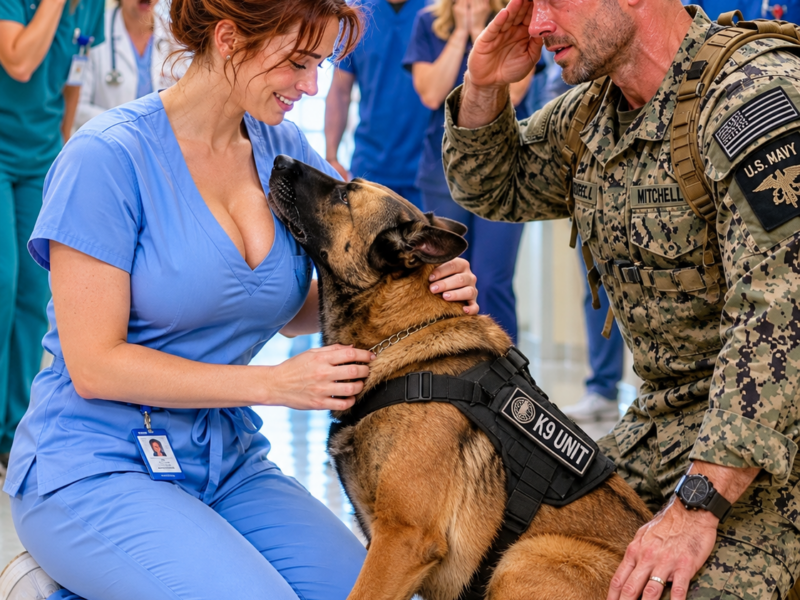
The SEAL Wanted to Hide in the Corner But His Fallen Friend’s K9 Dragged Him to One Nurse
I stared at the corpsman.
“What do you mean, Sergeant Mason’s death wasn’t an accident?”
He glanced toward the hallway.
“Not here.”
Jack stepped between him and the door.
“You’re going to explain that.”
“Staff Sergeant, I don’t have the authority to discuss—”
“Then find someone who does.”
Ranger stood beside Jack, his ears raised and his eyes fixed on the corpsman. The dog seemed to sense the tension before any of us spoke.
I held the envelope carefully.
“I’m not opening this until I know why my name is on it.”
The corpsman rubbed his forehead.
“I’m Lieutenant David Cole. I was assigned to Mason’s recovery team.”
“Then you knew him?”
“I served with him.”
Jack’s jaw tightened.
“Six months ago, you told me Mason died when his vehicle was hit by an explosive device. You told me there was nothing anyone could have done.”
Cole looked down.
“That was the official report.”
“And what was the unofficial report?”
He didn’t answer.
Jack grabbed the back of a chair.
“Tell me.”
Cole finally looked at him.
“Mason survived the explosion.”
The words seemed to drain the air from the room.
Jack stared at him.
“No.”
“He was alive when the recovery team reached him.”
“You told me he died at the scene.”
“I know.”
“You stood in front of me and told me that.”
Cole’s voice broke.
“I was ordered to.”
Jack moved toward him, but I stepped between them.
“Jack. Give him a moment.”
He stopped, breathing hard.
Ranger pressed his body against Jack’s leg.
I turned to Cole.
“Who gave that order?”
“Colonel Robert Harlan.”
The name meant nothing to me.
But Jack reacted immediately.
“Harlan was the mission commander.”
Cole nodded.
“He was responsible for the operation.”
“Why would he hide that Mason survived?”
Cole looked at the envelope in my hand.
“Because Mason saw something during that mission. Something he wasn’t supposed to see.”
I looked down at the letter.
“Then I think we should read this.”
Jack nodded.
I carefully opened the envelope.
Inside was a folded sheet of paper and a small photograph.
The photograph showed Mason sitting on a hospital bed. His face was bruised, his left arm wrapped in bandages, but he was alive.
On the back, he had written a date.
Six months ago.
Three days after the explosion.
I unfolded the letter.
Sarah,
If Ranger brought Jack to you, it means he has finally reached the point where he can no longer carry what happened alone.
I don’t know if you remember me. You treated our team after the training accident at Fort Bragg, two years ago. I was the one who kept making jokes while you stitched my shoulder. You told me that soldiers weren’t required to pretend they were made of steel.
I stopped reading.
A memory surfaced.
A young SEAL with a split eyebrow and a deep cut across his shoulder.
He had joked that the stitches would make him look more intimidating.
I remembered him now.
Mason.
I continued.
You also told me something I never forgot. You said that if a patient couldn’t tell the truth out loud, sometimes they needed someone who would simply sit beside them until they could.
That’s why I’m asking you to help Jack.
He believes my death was his fault. It wasn’t.
Our mission was compromised before we arrived. Someone changed the intelligence coordinates and sent us into a location that was supposed to be clear.
We discovered a shipment of stolen military equipment and records connecting several officers to an illegal weapons network.
Our team was attacked before we could transmit the evidence.
Jack got me out. He carried me through the smoke while Ranger covered our position.
I was alive when they took me away. I remember asking for Jack. I remember asking them to tell him I was safe.
They never did.
I lowered the letter.
Jack was staring at the photograph.
His lips moved, but no words came out.
I continued reading.
I don’t know where they took me. I don’t know how long I have. But I know they are watching the people who survived that mission.
Jack has the original mission coordinates. He doesn’t know it yet. I hid the memory card inside Ranger’s old training collar before they transferred him.
If anyone tells Jack I blamed him, they’re lying.
Tell him I was proud to serve beside him.
And Sarah, please tell him he is allowed to live.
— Mason
For several seconds, the only sound was the monitor in the hallway.
Jack slowly lowered himself into the chair.
“He was alive.”
I nodded.
“He was alive three days after the explosion.”
Jack covered his face.
“I heard him calling for me.”
His voice was barely audible.
“I heard him, Sarah.”
I sat down beside him.
“What do you remember?”
He stared at the floor.
“The vehicle exploded. Mason was thrown against the side. I got to him. He was breathing, but there was blood everywhere.”
He paused.
“I kept telling him we were getting out. He kept telling me to leave him.”
Ranger placed his head on Jack’s knee.
“I refused. I dragged him behind a concrete barrier. Then the second explosion hit.”
Jack’s hands began to shake.
“I woke up in a medical transport. They told me Mason hadn’t made it.”
He swallowed.
“I asked about him every day. They said his body had been recovered. They gave me his personal effects.”
He looked at the photograph.
“But he was alive.”
I didn’t try to stop his tears.
Sometimes the most important thing a nurse can do is allow a patient to grieve without rushing him toward feeling better.
Jack leaned forward and began crying.
Not quietly.
Not carefully.
He cried like a man who had spent six months holding his breath.
Ranger stood on his hind legs and rested his front paws against Jack’s chest.
Jack wrapped both arms around the dog.
“I’m sorry, buddy.”
Ranger licked his cheek.
“I should’ve found him.”
I placed a hand on Jack’s shoulder.
“You didn’t abandon him. You tried to save him.”
“But I heard him.”
“And you carried him out.”
Jack shook his head.
“I should have gone back.”
“You were injured. You were following the only information you had. You didn’t know he was alive.”
He looked at me.
“How can you be so sure?”
“Because I read the letter.”
I pointed to the final sentence.
“Mason wanted you to live.”
Jack closed his eyes.
For the first time since entering the hospital, he stopped fighting the tears.
Then Cole cleared his throat.
“There’s something else.”
Jack looked up.
“What?”
“The memory card.”
I held the letter.
“You know about it?”
Cole nodded.
“Mason mentioned a recording before he was transferred. I thought he was confused. I didn’t know where he had hidden it.”
Jack turned toward Ranger.
“The collar.”
The dog lifted his head.
Jack gently touched the worn harness.
“Ranger’s old training collar was returned with his equipment.”
Cole nodded.
“It was listed among Mason’s personal effects.”
“Where is it?”
“I don’t know. The storage facility might.”
Jack stood.
“We’re going there.”
I shook my head.
“Not yet.”
He looked at me.
“Sarah, I can’t sit here.”
“You don’t have to. But you also can’t walk into a situation without knowing who’s involved.”
Cole agreed.
“She is right. If the letter is genuine, someone may be monitoring the investigation.”
Jack’s expression hardened.
“Then we go through official channels.”
Cole looked uncomfortable.
“Colonel Harlan still has access to the command records.”
That was enough to make Jack stop.
“Then we don’t tell Harlan.”
Before anyone could respond, a security officer appeared at the doorway.
“Lieutenant Cole, there’s a call for you.”
Cole stepped into the hall.
I watched him leave.
Jack remained beside Ranger, one hand resting on the dog’s neck.
“Do you believe him?” he asked.
“I believe Mason’s letter.”
“That’s not what I asked.”
I looked toward the hallway.
“I don’t know Cole well enough to trust him. But I know what it looks like when someone is carrying a secret that’s eating them alive.”
Jack gave a tired nod.
The security officer returned.
“Lieutenant Cole has been asked to report to command immediately.”
Jack frowned.
“By whom?”
“Colonel Harlan.”
We looked at each other.
Cole returned a moment later, his face pale.
“He knows I’m here.”
Jack stepped toward him.
“Did you tell him?”
“No.”
“Then how?”
Cole glanced at the photograph.
“Someone accessed the hospital visitor log. They know you came here.”
I looked at the envelope.
“Then we need to protect the evidence.”
Cole nodded.
“I can contact an investigator outside the unit. Someone who isn’t connected to Harlan.”
Jack hesitated.
“Who?”
“Special Agent Rebecca Shaw. Military criminal investigative division. She worked a previous case involving procurement fraud.”
“Can she be trusted?”
“I believe so.”
Jack looked at me.
I nodded.
“Call her.”
Cole made the call from the hallway.
Less than twenty minutes later, Agent Shaw arrived in plain clothes.
She was in her early forties, with a serious expression and a small notebook in her hand.
She listened without interrupting while I explained the letter.
Then she examined the photograph.
“Do you have the original envelope?”
I handed it over.
She studied the handwriting and the seal.
“This looks authentic. But I need to verify the date and the chain of custody.”
Jack leaned forward.
“Can you find Mason?”
Shaw looked at him carefully.
“I can investigate. I won’t promise something I can’t guarantee.”
“He was alive.”
“I understand.”
“No. You don’t.”
Jack’s voice sharpened.
“You don’t understand what it’s like to bury someone who might still be breathing.”
Shaw didn’t argue.
She simply closed her notebook.
“Then let’s find out where he was taken.”
She asked Cole for the recovery records.
He gave her the unit reference number.
She typed it into a secure device and waited.
A few minutes later, her expression changed.
“What?”
Jack stood.
Shaw turned the screen toward him.
“The transfer record lists a private rehabilitation facility in Virginia.”
“Which one?”
“North Ridge Recovery Center.”
Cole frowned.
“That facility closed two months ago.”
Shaw nodded.
“Officially, yes.”
Jack stared at the screen.
“Where is it now?”
“That’s what I’m going to find out.”
Ranger suddenly stood and began sniffing the envelope.
Then he walked toward the door.
He looked back at Jack.
“Ranger?”
The dog gave a low whine.
I noticed something beneath the harness.
A small section of stitching looked newer than the rest.
“Jack, wait.”
He knelt beside the dog.
I carefully examined the harness.
“There’s something inside here.”
Jack’s hands moved gently along the seam.
He found a tiny pocket hidden beneath the identification patch.
Inside was a small metal key.
Agent Shaw took a photograph of it.
“Don’t touch anything else.”
She placed the key in an evidence bag.
“Do you recognize it?”
Jack shook his head.
“No.”
Cole looked at the key.
“I do.”
Everyone turned toward him.
“It’s a storage locker key. Mason had one like it before the mission.”
“Where?” Shaw asked.
Cole hesitated.
“An equipment depot outside Quantico.”
Jack’s eyes narrowed.
“Why didn’t you tell us?”
“Because I didn’t know he had hidden anything there.”
Shaw studied him.
“Then we’ll go there with a warrant.”
Jack looked down at Ranger.
The dog sat calmly beside him.
For the first time that night, Jack seemed to understand that Mason had left a trail.
Not a promise.
Not a miracle.
A trail.
And Ranger had led him to the first person who could help follow it.
The following afternoon, Agent Shaw returned with a search authorization.
Jack had been cleared for limited movement, but I wasn’t convinced he was ready to leave the hospital.
He insisted.
“I need to see this through.”
I looked at him.
“You need to keep taking care of yourself, too.”
He glanced at Ranger.
“I’m trying.”
It was the first time he had said those words without sounding ashamed.
We drove to the equipment depot in two vehicles.
The facility was a plain concrete building surrounded by fencing and security cameras.
Shaw presented the warrant.
A storage manager led us down a narrow corridor.
The locker was near the end.
Number 214.
The key turned smoothly.
Inside was a black equipment case, a folded map, and a small digital recorder.
Jack recognized the case immediately.
“Mason’s.”
He opened it.
Inside were photographs, mission notes, and several printed pages.
Shaw began photographing everything.
The map showed the coordinates of the mission site.
Several locations were marked in red.
One was labeled TRANSFER POINT.
Another was labeled SECOND EXTRACTION.
Jack leaned over it.
“That isn’t on our original mission map.”
Cole studied the markings.
“No. It wasn’t.”
Shaw opened the digital recorder.
A voice came through the speaker.
Mason’s.
“Jack, if you’re hearing this, then something happened to me. I’m sorry I couldn’t tell you everything before we went in.”
Jack closed his eyes.
Mason continued.
“The mission was changed two hours before deployment. The new coordinates came through command. I questioned them, but Harlan said the intelligence had been verified.”
A pause.
“There’s a weapons shipment at the site. The records show it was being moved through a private contractor. Someone inside our command structure approved the transfer.”
Shaw looked at the printed pages.
The contractor’s name appeared repeatedly.
A company called Sentinel Tactical Logistics.
Mason’s recording continued.
“I found the names of three officers who authorized the shipments. One of them is Harlan. The others are listed in the attached file.”
Jack’s face tightened.
“Keep playing it.”
Mason’s voice became quieter.
“If I don’t make it out, don’t let them tell you the mission failed because of us. We did what we were sent to do. Someone else made sure we never had a chance.”
The recording ended.
For a moment, nobody moved.
Then Shaw looked at Cole.
“Did you know about this?”
“No.”
“Were you aware that the mission coordinates had been changed?”
Cole looked down.
“I saw the update. I thought it came from intelligence.”
Jack turned toward him.
“You were our operations liaison.”
“I know.”
“You were supposed to verify it.”
Cole’s face tightened.
“I should have.”
Jack stared at him for a long moment.
Then he looked away.
Shaw placed the recorder in an evidence case.
“This is enough to open a formal investigation, but we need to find Mason and establish what happened after his transfer.”
I pointed to the map.
“What is this second extraction point?”
Cole leaned closer.
“An old medical staging facility. It was used during emergency evacuations.”
Shaw checked her device.
“It’s no longer active.”
“Could someone still be there?” Jack asked.
“Possibly. But we won’t go in without a proper team.”
Jack nodded.
For once, he didn’t argue.
We returned to the hospital that evening.
I thought the hardest part was behind us.
I was wrong.
At 2:15 in the morning, a nurse called me to the observation room.
Jack was sitting on the edge of the bed.
His breathing was fast, and his hands were shaking.
Ranger stood in front of him, whining.
I pulled a chair close.
“Jack, look at me.”
He didn’t.
“Jack.”
His eyes finally met mine.
“I can hear the explosion.”
I spoke softly.
“You’re here. You’re in the hospital.”
“I can hear Mason.”
“What do you hear?”
“He keeps telling me to leave him.”
I nodded.
“That memory is coming back.”
Jack pressed his palms against his eyes.
“I can’t shut it off.”
“You don’t have to fight it alone.”
“I should’ve gone back.”
I shook my head.
“You’ve said that before. But you don’t have to keep punishing yourself for something you couldn’t control.”
He stared at the floor.
“I was supposed to bring everyone home.”
I waited.
After a moment, he continued.
“I was the team leader. They trusted me.”
“Being responsible for your team doesn’t mean you control everything that happens to them.”
He looked at Ranger.
“Mason trusted me with him.”
“And Ranger is still here.”
Jack rubbed the dog’s ears.
“He’s been sleeping beside my bed every night.”
“Then perhaps he’s been looking after you, too.”
Jack gave a faint smile.
It was the first one I’d seen.
I arranged for the hospital’s behavioral health specialist to meet with him the following morning.
Jack agreed.
That mattered more than any speech I could have given him.
Two days later, Agent Shaw called.
They had located the old medical staging facility.
A security team had entered under a search authorization.
They found evidence of recent medical activity.
And they found a patient.
A man with a healing shoulder injury and a medical bracelet carrying a false name.
The photograph Shaw sent me showed a familiar face.
Mason.
He was thinner.
His hair was longer.
But he was alive.
Jack stared at the image.
For a few seconds, he didn’t move.
Then he whispered:
“That’s him.”
Shaw called again.
“He’s conscious. He’s being transferred to a secure medical facility now.”
Jack gripped the edge of the table.
“Can I see him?”
“Once the doctors clear him.”
He looked at me.
“Sarah?”
I smiled.
“We’ll go together.”
The reunion took place three days later.
Mason was lying in a private hospital room.
His left shoulder was supported by a brace, and there were scars along his neck and jaw.
But his eyes were bright.
Ranger entered first.
The dog stopped at the foot of the bed.
Mason looked up.
“Hey, buddy.”
Ranger let out a sound somewhere between a bark and a cry.
He rushed forward and rested his head against Mason’s chest.
Mason wrapped one arm around him.
“Good boy. You found him.”
Jack stood in the doorway.
He looked as though he had forgotten how to breathe.
Mason lifted his eyes.
“Hey, brother.”
Jack took one step.
Then another.
He reached the bedside and stopped.
“I thought you were dead.”
Mason nodded.
“I know.”
“They told me you didn’t make it.”
“I know.”
Jack shook his head.
“I heard you calling me. I thought I left you there.”
Mason’s eyes filled.
“You got me out of that vehicle, Jack. You didn’t leave me.”
Jack covered his mouth.
“I should have found you.”
“You were injured. They took me away before you woke up.”
“I looked for you.”
“I know.”
Mason reached out his good hand.
Jack took it.
For a long moment, they simply held on.
Then Jack leaned forward and pressed his forehead against Mason’s hand.
“I missed you.”
Mason smiled through his tears.
“Missed you too.”
Ranger whined and squeezed his head between them.
Mason laughed.
“Looks like he brought the whole family back.”
I stood near the doorway, trying not to cry.
Jack turned toward me.
“Sarah.”
I stepped closer.
Mason looked at me carefully.
“You came.”
I smiled.
“You left me a pretty unusual invitation.”
He laughed softly.
“I knew you’d understand.”
“Why did you write my name?”
Mason’s expression became serious.
“Because I remembered what you told me at Fort Bragg. You didn’t treat us like uniforms or missions. You treated us like people.”
I looked at Jack.
“He needed someone to listen.”
Mason nodded.
“He needed someone who wouldn’t let him disappear.”
Jack lowered his head.
“I wasn’t trying to disappear.”
Mason gave him a gentle look.
“Maybe not. But you were hiding.”
Jack didn’t deny it.
“I didn’t know how to live without you.”
Mason squeezed his hand.
“You don’t have to forget me to keep living.”
The words settled into the room.
For the first time, Jack seemed able to hear them.
The investigation continued over the following months.
Agent Shaw’s team traced Sentinel Tactical Logistics to a network of fraudulent military contracts. The evidence from Mason’s storage locker, combined with the recovered mission records, exposed the altered coordinates and unauthorized weapons transfers.
Colonel Harlan was removed from command and later charged alongside two associates.
Lieutenant Cole cooperated with the investigation. He admitted that he had followed orders to report Mason’s death without verifying the medical transfer.
He also admitted that he had spent six months regretting it.
Jack listened to his statement without interrupting.
When Cole finished, Jack said only:
“You should have told me.”
Cole nodded.
“I know.”
It wasn’t forgiveness.
But it was the beginning of an honest conversation.
Mason’s medical recovery took time.
He needed surgery, physical therapy, and months of rehabilitation. Jack attended nearly every appointment.
He also continued his own treatment.
There were difficult nights.
Some mornings, he couldn’t bear the sound of helicopters outside the hospital.
Other days, he found himself smiling at something Ranger did and then feeling guilty for being happy.
His therapist helped him understand that grief and recovery could exist together.
I watched him slowly return to himself.
Not the exact man he had been before the mission.
Someone different.
Someone who had finally stopped believing that being strong meant never breaking.
One afternoon, I found Jack sitting outside the rehabilitation center.
Ranger lay beside him, his head resting on Jack’s boot.
Mason was inside, working through another physical therapy session.
Jack looked up when I approached.
“Sarah.”
“How’s he doing?”
“Complaining about the exercises.”
I smiled.
“That’s a good sign.”
Jack looked down at Ranger.
“He’s been sleeping better.”
“And you?”
He thought for a moment.
“Some nights.”
“That counts.”
He nodded.
Then he reached into his pocket and handed me a small photograph.
It showed Mason, Jack, and Ranger standing together outside the rehabilitation center.
All three were smiling.
On the back, Mason had written:
The best missions are the ones where everyone comes home.
I looked at the photograph.
“That’s a good picture.”
Jack nodded.
“Ranger insisted.”
I laughed.
The dog lifted his head at the sound of his name.
Jack rubbed behind his ears.
“You know, I used to think Mason left him with me because he needed someone to protect him.”
“And now?”
Jack looked toward the window where Mason was visible through the glass.
“Maybe Mason knew I would need someone, too.”
I felt my eyes sting.
The first night Jack arrived, he had tried to disappear into the corner of a hospital room.
He believed he had failed his friend.
He believed he had abandoned a soldier who trusted him.
And he believed he no longer deserved to live a normal life.
But Ranger had remembered something Jack had forgotten.
Mason had trusted him.
Mason had loved him.
And Mason had never blamed him.
Sometimes healing didn’t begin with medicine or a perfect answer.
Sometimes it began with a loyal dog refusing to let someone stay alone in the darkest corner.
I returned to the nurses’ station that evening.
On my desk sat a new photograph.
It was the three of them again, this time with me standing beside them.
Jack had left it there with a short note.
Thank you for sitting with me when I couldn’t find my way out.
I placed the photograph beside my nameplate.
Then I went back to work.
Because somewhere in the hospital, another patient was waiting for someone to sit beside them.
And I knew, more than ever, that sometimes the smallest act of kindness could lead someone all the way home.
The end.









