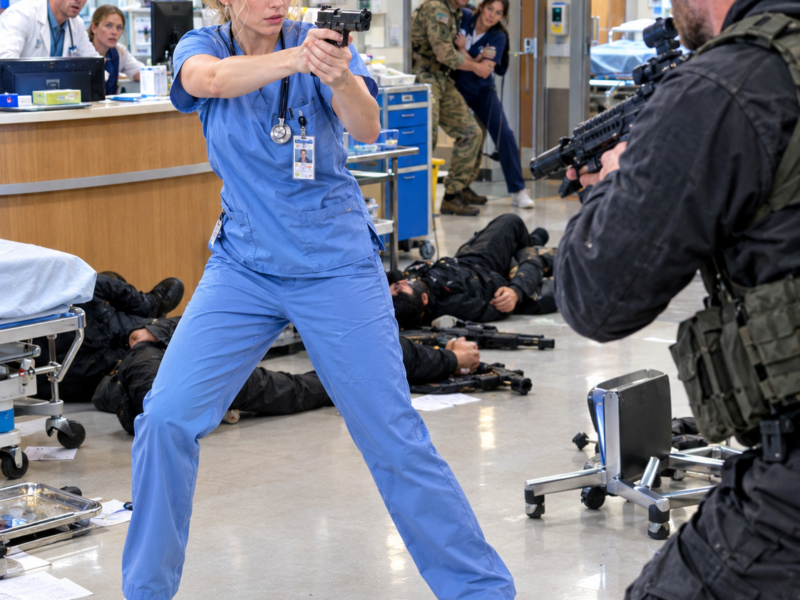
“The rookie nurse was supposed to be the least dangerous person in the military hospital, but when ten armed gunmen stormed the emergency ward
The pounding behind the reinforced door grew louder.
“Open this door!” Commander Vale shouted. “They’re not here for me. They’re here for the drive!”
The gunman nearest the access panel turned sharply.
“What drive?”
A second voice came from the other side of the door.
“Emily? Is that you?”
My blood ran cold.
I had never met Commander Michael Vale, but he knew my name.
And judging by the sudden silence in the corridor, the armed men knew it, too.
The leader stepped toward me, his rifle angled across his chest.
“You’re going to tell me what he means.”
I kept my hands visible.
“I’ve never spoken to him before today.”
“Then why does he know your name?”
“I don’t know.”
It was the truth, but the man didn’t believe me.
He grabbed the front of my scrubs and shoved me against the wall. My medical kit fell to the floor, scattering gauze, syringes, and sealed dressings across the tiles.
“Listen carefully, nurse. You are going to open that door, and you’re going to do exactly what I say.”
I looked at his hand gripping my uniform.
Then I looked at the corridor behind him.
Three staff members were crouched near the supply alcove. A wounded security officer lay beyond the corner. Somewhere in the emergency department, a little girl was still hiding with her mother.
Ten armed men had entered a hospital expecting frightened people who would obey.
They hadn’t expected anyone to stand in their way.
“I need you to release me,” I said.
He leaned closer.
“Or what?”
I didn’t answer.
I simply stopped pulling against his grip.
His expression shifted. He had expected me to struggle, to panic, or to beg.
Instead, I watched his shoulders, his balance, and the position of his weapon.
Old training took over.
When he shifted his weight forward, I turned with the movement, broke his grip, and pushed away from the wall.
His hand closed on empty fabric.
Before he could recover, I stepped out of reach.
The rifle never left his hands, and I made no attempt to seize it. My goal wasn’t to win a fight in a hospital corridor.
It was to create enough distance to keep him from using me as leverage against the other staff.
He stared at me.
The other gunmen turned.
“You said you were a nurse,” he muttered.
“I am.”
“Who taught you to move like that?”
I bent to retrieve my medical kit.
“Someone who taught me not to waste time answering questions during an emergency.”
His face darkened.
Then the reinforced door shook again.
“Emily!” Vale shouted. “Don’t let them take the drive!”
The leader raised his weapon toward the door.
“Open it!”
I stepped between him and the access panel.
“No.”
The word came out quieter than I expected.
But it stopped him for half a second.
That was enough for me to hear the next sound.
A series of heavy impacts echoed from the far end of the corridor.
Not gunfire.
Boots.
A lot of them.
Then a voice boomed over the hospital’s emergency speaker system.
“This is military security. All personnel remain behind cover. Armed response teams are entering the facility.”
The leader’s confidence cracked.
He glanced toward the main lobby, then at his men.
One of them swore.
Another began backing toward the stairwell.
Their plan was coming apart, but desperate men could be more dangerous than confident ones.
I had seen it happen before.
“Hold your positions!” the leader barked.
He grabbed a nurse by the shoulder and pulled her in front of him.
“Anyone comes through that corridor, she dies!”
The nurse screamed.
I felt the world narrow to a single point.
I knew that fear.
I knew the terrible helplessness of watching someone else become a shield because an armed man wanted control.
And I knew that if the response team rushed the corridor without understanding what was happening, innocent people could be caught between them.
I raised my hands.
“Let her go.”
The leader laughed.
“You don’t give orders here.”
“No,” I said. “But you don’t have control of this situation anymore.”
He pressed the weapon closer to the nurse.
I took one slow step sideways, keeping his attention on me.
“Look at me.”
He did.
“I’m the one who challenged you. I’m the one you want answers from. She has nothing to do with this.”
For a moment, his eyes flickered toward the nurse.
I saw the calculation.
He wanted an advantage.
He wanted a bargaining chip.
And he wanted the people approaching from the other corridor to believe he was still in charge.
I kept talking.
“You said you came for Commander Vale. He’s behind the door. I’m the only person here who has spoken to him through it. If you hurt her, you lose the one person who can help you understand what he knows.”
The leader’s jaw tightened.
“You’re lying.”
“Then ask him.”
I looked toward the door.
“Commander Vale! Tell him why he came here!”
Silence.
Then Vale answered.
“Because I have evidence that people inside this command have been selling operational information. The drive contains the records.”
The leader’s face went blank.
For the first time, he looked less like a man executing a plan and more like a man who had discovered that someone else had changed the rules.
“You were supposed to have destroyed it,” he snapped toward the door.
Vale answered immediately.
“I sent a copy before I was brought here.”
The leader swore under his breath.
There it was.
The reason for the attack.
Not a random act of violence.
Not a robbery.
They had come to erase evidence before it reached investigators.
And they had expected a hospital full of unarmed medical staff to be an easy place to do it.
I watched the leader’s hands.
He was angry now, but beneath the anger was fear.
Fear made people unpredictable.
I needed to keep him talking until the security team could establish a safe approach.
“You still have a choice,” I said.
He looked at me as if I’d insulted him.
“What choice?”
“You can stop making this worse.”
He gave a bitter smile.
“You think you can talk your way out of this?”
“No. I think you can decide what happens next.”
For one brief second, his grip on the nurse loosened.
She twisted away.
I caught her arm and pulled her toward the nearest alcove.
The leader lunged after us.
I moved to intercept him, keeping my hands clear of his weapon. We collided against the wall, and the impact sent pain shooting through my shoulder.
He was bigger than I was.
Stronger, too.
But he was rushing, and he wasn’t thinking beyond the next second.
I used the wall to regain my footing and shoved away, creating distance rather than trying to overpower him.
He stumbled.
A security officer appeared at the far end of the corridor, weapon raised but held steady.
“Drop it!”
The leader turned toward the voice.
Everything happened at once.
Two of his men ran toward the stairwell. One dropped to his knees and raised his hands. Another dragged a metal cart across the corridor to obstruct the approaching team.
The leader grabbed at my sleeve again.
I pulled free.
Then the first security officer shouted a second command, and the response team advanced behind protective cover.
I dropped to the floor and covered my head.
A burst of shouting filled the corridor.
Someone yelled for medical support.
A door slammed.
Then came a voice I recognized from my years in the Navy.
“Clear the left side! Watch the treatment rooms!”
The security team moved with discipline, securing the corridor and separating the gunmen from the staff. I stayed down until an officer ordered everyone to remain in place while the area was checked.
Within minutes, the immediate threat was contained.
The leader and several of his men were taken into custody. The others surrendered after being cut off near the stairwell.
No one in the corridor cheered.
Nobody celebrated.
People were crying, shaking, or sitting against the walls with their hands over their faces.
The hospital was still a hospital.
There were injuries to treat.
There were frightened patients to comfort.
There were people who had just discovered how quickly an ordinary morning could become the worst day of their lives.
I crawled to the nurse who had been held as a shield.
“Can you hear me?”
She nodded, trembling.
“Are you hurt?”
“No.”
“Look at me. Take a slow breath.”
She tried.
I stayed beside her until her breathing steadied, then helped her move to a safer room.
Only after I had checked the security officer’s dressing and confirmed that another medic had taken over did I allow myself to feel the pain in my shoulder.
It was throbbing badly.
I flexed my fingers.
Nothing seemed broken.
That would have to be enough for the moment.
A security officer approached me.
“Ma’am, we need you to come with us.”
I looked at him.
“Am I being detained?”
“No, ma’am. The commander overseeing the response wants to speak with you.”
“Which commander?”
“Commander James Mercer, Navy special operations liaison.”
I nearly laughed at the absurdity of the name.
Of course it would be another commander.
I followed him toward the hospital’s secure operations room.
The corridors were filled with security personnel, medical staff, and officers coordinating the response. Several patients were being moved away from the affected area. The emergency department had been divided into controlled sections while the security team confirmed that no additional attackers remained inside.
At the operations room door, the officer stopped.
“Before you go in, ma’am, I should warn you that Commander Mercer has already reviewed the security footage.”
“Then he knows what happened.”
“Yes, ma’am.”
He opened the door.
A broad-shouldered Navy commander stood beside a wall of monitors. His uniform was immaculate, but his expression was anything but relaxed.
He turned when I entered.
For several seconds, he simply stared at me.
Then he said, “Emily Carter.”
“Commander.”
“You were told to remain in the treatment area.”
“I was treating patients.”
“You confronted an armed man.”
“He was threatening a nurse.”
“You disarmed nobody, you had no weapon, and you had no authority to intervene in a hostage situation.”
“I didn’t need authority to keep him from hurting her.”
Mercer looked at the monitor behind him.
The footage showed me stepping away from the treatment bay, speaking to the gunman, and moving the nurse out of his grip.
It also showed the moment the leader realized I wasn’t reacting like the frightened civilian he had expected.
Mercer folded his arms.
“How long have you been a nurse?”
“Six months in civilian clinical practice. Three weeks at this facility.”
“That’s not what I asked.”
I said nothing.
He looked at the security officer.
“Give us a minute.”
The officer left and closed the door.
Mercer lowered his voice.
“Your personnel file is restricted. Your prior service history is incomplete in the hospital system. But the footage shows training that is not part of a standard nursing curriculum.”
I kept my face neutral.
“People learn different things in different jobs.”
“Don’t insult my intelligence.”
“I’m not.”
He stepped closer.
“Were you a member of a special operations unit?”
The room became very quiet.
I had spent years avoiding this conversation.
I had learned to answer questions about my past with careful half-truths. I had told myself that leaving the service meant I could finally be defined by what I did now rather than what I had done before.
But the footage had made that impossible.
“Yes,” I said.
“What unit?”
“Naval Special Warfare.”
His eyes narrowed.
“Were you a SEAL?”
“Yes.”
He exhaled slowly and looked back at the monitor.
“Your file says you left operational duty after an overseas deployment.”
“That’s correct.”
“Your file also says you requested a transfer into medical service.”
“That’s correct.”
“Why?”
I looked at the image frozen on the screen.
It showed me standing between the gunman and the nurse, my hands raised, my face calm.
It didn’t show the teammate I had lost overseas.
It didn’t show the weeks I had spent wondering whether one different decision could have changed the outcome.
It didn’t show the nights when sleep came only after I had checked the exits in every room.
“I wanted to save people in a different way,” I said.
Mercer studied me.
“And today?”
“Today I was a nurse in a hospital where armed men were threatening patients.”
He was quiet for a long moment.
Then he nodded toward the chair.
“Sit down, Commander.”
I didn’t move.
“I’m not currently serving in an operational command.”
“Your former rank remains relevant to this incident.”
“Then call me Emily.”
He considered that.
“Very well. Emily. I need you to tell me exactly what happened from the moment the alarms sounded.”
So I did.
I told him about the gunmen entering the lobby, the wounded security officer, the little girl in the yellow sweater, and the leader’s demand for Commander Vale. I explained how I had tried to keep the situation from escalating until security could reach us.
I did not exaggerate.
I did not claim I had controlled the outcome.
I told him what I had seen and what I could not know.
When I finished, Mercer asked one question.
“Why did Vale know your name?”
I stared at him.
“That is what I want to know.”
Mercer opened a folder.
Inside was a photograph of Commander Michael Vale, the patient behind the reinforced door. He looked older than the man I remembered from the deployment roster, with a scar running from his left temple toward his hairline.
I recognized him.
Not from the hospital.
From overseas.
Six years earlier, Vale had been attached to a joint intelligence team supporting our unit. He had been responsible for coordinating movement between several field locations. After our mission ended in disaster, his name appeared in a sealed report I was never permitted to read.
I had believed he had been reassigned.
I had never expected to see him again.
“Why is Vale here?” I asked.
Mercer watched me carefully.
“He was transported to this facility under protective medical custody after surviving an attack during a classified operation. His condition is stable, but he requested a specific medical team and insisted that the room remain secured.”
“Why?”
“Because he believes someone is trying to kill him.”
I looked down at the photograph.
“Apparently, he was right.”
Mercer nodded.
“The men who entered the hospital were not acting independently. We have reason to believe they were attempting to retrieve an encrypted drive and prevent Vale from giving a statement.”
“What’s on it?”
“Evidence related to unauthorized disclosure of operational information.”
I remembered the paper from six years earlier.
The mission coordinates.
The altered evacuation route.
The official report that had never made sense.
“Does it involve the mission in Afghanistan?”
Mercer’s expression changed.
“You know about that?”
“I was there.”
He closed the folder.
“Then this is bigger than today’s attack.”
He explained that Vale had been collecting evidence that sensitive mission details were being passed to people outside authorized channels. Several operations had been compromised, and investigators were examining whether the leaks had contributed to casualties.
Vale believed the information had come from someone with access to restricted planning documents.
He had preserved a copy of the transmission records and arranged to provide them to an independent investigative team.
Before he could do so, he was attacked.
The hospital had been chosen because it was a controlled medical environment where Vale could receive treatment while remaining under military protection.
The gunmen had found him anyway.
I listened, feeling the old weight return to my chest.
“Does the evidence identify the person responsible?”
“Some of it does. Some of it is circumstantial. We need to verify the records before drawing conclusions.”
“Good.”
Mercer raised an eyebrow.
“You approve?”
“I’ve seen what happens when people decide the answer before examining the evidence.”
He nodded slowly.
“Then you understand why I need your statement.”
I gave it.
An hour later, Agent Rebecca Sloan from the military criminal investigation team arrived to interview me. She asked detailed questions about the attack, the leader’s statements, and my interaction with the other gunmen.
She also asked about my former service.
I told her what I could without disclosing information unrelated to the investigation.
When she asked whether I had known Vale before that morning, I told her the truth.
“I recognized him from a deployment six years ago.”
“Did you have direct contact with him?”
“Briefly. He was part of the coordination team.”
“Did you know he was investigating operational leaks?”
“No.”
“Did you have any reason to believe your former unit was connected to the current incident?”
I hesitated.
“I have reason to believe the records from that deployment were incomplete. I don’t know whether the problems are connected.”
Sloan wrote something down.
“That distinction matters. We will investigate the connection rather than assume one exists.”
It was the first thing anyone had said that day that made me feel the investigation might be conducted properly.
After the interview, I returned to the emergency department.
The hospital was slowly regaining its rhythm, although the fear had not disappeared. Staff members checked on one another between patients. Security officers stood at every entrance. The little girl in the yellow sweater was asleep beside her mother in a quiet room.
I checked the wounded security officer.
His bleeding was controlled, and the medical team had determined that he would recover.
“You saved my life,” he told me weakly.
“No,” I said, adjusting his blanket. “The team treating you saved your life. I helped for a few minutes.”
He smiled.
“You always talk like that?”
“Like what?”
“Like you’re trying to make sure nobody gives you credit.”
I looked at him.
“Credit doesn’t help anyone heal.”
He chuckled, then winced.
“Fair enough.”
I finished checking his vital signs and stepped into the corridor.
Chief Nurse Mitchell was waiting outside the supply room.
Her eyes moved to the dressing on my shoulder.
“Sit down.”
“I’m fine.”
“That wasn’t a question.”
I obeyed.
She examined the bruising and arranged for a proper assessment. Nothing appeared fractured, but I was instructed to rest and return for a follow-up examination.
Then she sat opposite me.
“Emily, I have worked in military hospitals for twenty-two years. I’ve seen people freeze, panic, and make terrible decisions under pressure.”
I waited.
“You didn’t.”
“I was scared.”
“I know.”
She leaned forward.
“Being brave doesn’t mean you’re not frightened. It means you don’t let your fear make every decision for you.”
I looked toward the treatment bay where the little girl had been hiding.
“I didn’t want her to remember today as the day nobody helped.”
Mitchell’s expression softened.
“Then remember that. Not the guns. Not the shouting. Remember that you helped.”
For the first time since the attack began, I let myself breathe without counting the seconds.
But the day was not finished with me.
Near sunset, Agent Sloan returned with an update.
The ten gunmen had been identified as a coordinated group using false employment credentials and stolen access information. Investigators were still determining who had supplied the hospital’s internal security details.
The leader had refused to provide a complete statement.
However, one of the men had agreed to cooperate.
He claimed their instructions had come from someone who knew Vale would be transferred to the hospital that morning.
That person had also known the location of the secured treatment room.
“Do you have a name?” I asked.
“Not one we can verify yet,” Sloan said. “The suspect described an intermediary who used a military title and provided a schedule of Vale’s movements.”
I thought about the locked door.
The restricted patient board.
The altered access records.
Someone had known exactly where Vale would be.
Someone had also known that I would be working in the emergency department.
I asked Sloan whether my assignment had been specifically requested.
She looked at her notes.
“Your placement was approved through the normal medical staffing process. We haven’t found evidence that it was connected to the attack.”
“Could someone have known I would be here?”
“Possibly. But possibility isn’t proof.”
I nodded.
“Then check the access logs.”
“We are.”
She left me with no certainty, only the promise of an investigation.
That night, I remained at the hospital until the last of the displaced patients had been moved back into their rooms. I checked on the staff, helped document damaged equipment, and made sure the little girl’s mother had the information she needed before they were discharged.
When I finally stepped outside, the rain had stopped.
The parking lot lights reflected across the wet pavement.
I stood beside my car for a long time, listening to the distant hum of traffic.
I had spent years believing that leaving operational service would mean leaving the past behind.
But the past had followed me into the hospital.
It had arrived with ten armed men and a patient who knew my name.
And now I had to decide whether I would keep pretending those things were unrelated.
The next morning, I returned to work.
My shoulder hurt, and I had slept poorly, but I was determined not to let the attack become the only thing anyone remembered about the emergency department.
The staff greeted me with quiet nods and a few awkward smiles. Nobody asked me to demonstrate the movement I’d used against the gunman. Nobody called me a hero.
I was grateful.
I wanted to be a nurse again.
At nine o’clock, Commander Mercer asked me to meet him in a secure conference room. Agent Sloan was there, along with a civilian forensic analyst and a senior medical officer.
On the table lay a printed access log.
The analyst explained that the hospital’s internal system had recorded several attempts to access Vale’s restricted patient file in the hours before the attack. Most had been blocked. One had succeeded using a credential assigned to an administrative officer who had been away from the installation that day.
The credential had been copied.
The access occurred from a terminal in the hospital’s administrative wing.
“Can you identify who used it?” I asked.
“Not conclusively yet,” the analyst replied. “The terminal was accessed through a valid account, but the session was routed through a secondary device. We are examining the hardware and network logs.”
Mercer pointed to the timestamp.
“The successful access happened eleven minutes before the first alarm.”
I studied the record.
Someone had checked Vale’s location just before the gunmen entered.
“Did the access include my personnel file?”
The analyst paused.
“Yes.”
I felt my stomach tighten.
“Why?”
“We don’t know.”
Mercer folded his hands.
“Emily, I need to ask you about your final deployment.”
I stared at him.
“I’ve already given Agent Sloan my account.”
“This concerns a separate record. A mission summary that was amended after your unit returned.”
The room seemed to grow smaller.
I had never seen the complete summary.
I had only been told that the operation had been reviewed and closed.
Mercer slid a document across the table.
The page contained a list of personnel assigned to the mission, along with the approved extraction route. A handwritten amendment changed the route’s destination after the original plan had been signed.
At the bottom was a note indicating that the amended route had been authorized by a senior coordinator.
The name had been redacted in the copy I was shown.
But the initials remained.
M. V.
I looked at Mercer.
“Vale?”
“That’s what we’re investigating.”
“Why would he authorize a route that put the team at risk?”
“We don’t know whether the amendment reflects his decision or whether his authorization was added later.”
I thought of the mission again.
The communications failure.
The confusion during extraction.
The teammate we had lost.
The report that had never matched what I remembered.
“Was Vale involved in the original investigation?”
“Yes,” Mercer said. “He provided a statement. Several portions of that statement were later classified.”
“Did he ever see the final report?”
“According to the record, yes.”
“Then why is he trying to release the evidence now?”
Agent Sloan answered.
“Because he believes the final report concealed information that should have been disclosed to investigators. He says the original route approval and the subsequent amendment do not match the records he retained.”
I leaned back.
The facts were beginning to align, but they did not yet form a complete picture.
“Has anyone asked him directly?”
“He’s medically stable enough for a formal interview today,” Sloan said. “We were planning to conduct it this afternoon.”
“I want to be present.”
Mercer shook his head.
“You are a witness in the hospital attack. Your presence could complicate the interview.”
“I’m also a person who served on the mission.”
“Which is precisely why the investigators need to keep the accounts independent.”
I hated that he was right.
So I agreed to wait.
At two o’clock, Sloan conducted the interview with Vale while I remained in a nearby consultation room. I wasn’t permitted to hear the entire conversation, but I was asked to provide additional clarification about the medical timeline after the interview ended.
When Sloan returned, her expression was serious.
“Vale confirms that he did not authorize the route amendment as it appears in the file.”
“Can he prove it?”
“He has a copy of the original transmission chain. The forensic team is comparing it with the recovered records.”
“And the attack?”
“He believes the men were sent to retrieve his drive before he could submit the evidence.”
“Does he know who sent them?”
“He provided a name. We’re verifying it independently before taking further action.”
I didn’t ask her to tell me the name.
If the investigation had taught me anything, it was that suspicion could feel like certainty long before it became evidence.
Instead, I asked the question that had haunted me since the attack.
“Did he know I was assigned to the hospital?”
Sloan glanced down at her notes.
“Vale says he didn’t request you personally. He recognized your name when he heard your voice outside the door. He remembers you from the deployment and believes you may have noticed the same discrepancies he did.”
I closed my eyes.
At least that part made sense.
He had recognized me because we had shared a dangerous piece of history, not because someone had arranged for us to meet.
But it also meant the past was not finished with either of us.
Over the following days, the investigation expanded. Forensic analysts recovered additional communications from the drive, including messages showing that restricted operational details had been accessed without proper authorization. Several messages referenced the original mission, but investigators were careful not to interpret them beyond what the records supported.
The person suspected of coordinating the hospital attack was placed under investigation. The evidence included access logs, communications, and statements from the arrested gunmen. Authorities did not announce a final conclusion until the records had been independently verified.
Meanwhile, the hospital returned to its routines.
Patients needed medication.
Surgeries continued.
Families waited in corridors.
The work did not pause simply because the world had briefly become frightening.
I found comfort in that.
Every morning, I checked the charts, reviewed medication orders, and asked patients how they were feeling. I learned which elderly veteran wanted his coffee before breakfast and which young Marine pretended not to be afraid of his first surgery.
I was still the nurse who double-checked labels.
I was still the woman who apologized when she moved too slowly.
But I no longer mistook quietness for invisibility.
One afternoon, I visited Commander Vale in his recovery room.
His security detail remained outside. He was sitting upright in bed, reviewing a document with his left hand.
When I entered, he looked up.
“Captain Carter.”
“Commander.”
He gestured toward the chair.
“Please. Sit.”
I sat beside the window.
For a moment, we discussed his recovery. His injuries were serious but improving, and his doctors expected him to continue rehabilitation outside the hospital once his condition allowed.
Then he set the document aside.
“I owe you an apology.”
I looked at him.
“For what?”
“For what happened to your team. I knew the route amendment was wrong before the mission began. I raised concerns, but I didn’t push hard enough when the objections were dismissed.”
“That wasn’t your decision alone.”
“No. But I was part of the chain, and I had a responsibility to keep asking questions.”
He looked down at his hands.
“After the mission, I believed the investigation would correct the record. Instead, the evidence was classified, the report was amended, and everyone was told the matter had been resolved.”
“Why didn’t you speak up earlier?”
“I did, through the channels I was told to use. When those efforts failed, I preserved the records. But I underestimated how far someone would go to keep them from being reviewed.”
I watched him carefully.
“Do you believe the route change caused the casualties?”
“I believe it increased the risk. The investigators will have to determine exactly how the decisions affected the outcome. I won’t claim more than the evidence can prove.”
His answer mattered to me.
For six years, I had wanted someone to tell me that the loss had been preventable.
But I didn’t want another convenient story.
I wanted the truth, even if it was complicated.
“I’m glad you kept the records,” I said.
“So am I.”
He paused.
“And I’m sorry the men came into this hospital. The people here had nothing to do with what happened overseas.”
I thought of the nurse who had been held as a shield and the little girl hiding behind the chair.
“They were afraid,” I said. “But they’re recovering.”
Vale nodded.
“Then perhaps something good can still come from this.”
I wasn’t ready to call it good.
Not yet.
But I understood what he meant.
The hospital attack had forced open a door that had been kept closed for years. It had also reminded everyone involved that the consequences of secrecy did not remain safely contained in classified files.
They spread.
They reached nurses, patients, families, and people who had never heard the name of the original mission.
And once those consequences became visible, they could no longer be dismissed as someone else’s problem.
Several weeks later, the military released an official statement confirming that the hospital attack had been stopped and that the suspected organizers were facing formal proceedings. The investigation into the operational records remained ongoing, with independent reviewers examining the original mission and the handling of the evidence.
The statement did not reveal every detail, and it did not declare every allegation proven.
It didn’t need to.
The most important change had already occurred.
The records were being reviewed outside the chain that had originally approved them.
Vale’s testimony was on record.
The communications evidence had been preserved.
And the people who had tried to silence him could no longer assume that a closed file meant a closed case.
My own role was reviewed as well.
The hospital confirmed that I had acted to protect patients and staff during the attack. My previous service was acknowledged in a restricted personnel review, but no one asked me to return to operational duty.
I was relieved.
I had made my choice.
I wanted to keep working in medicine.
When Chief Nurse Mitchell heard the final decision, she found me restocking a treatment cart.
“So,” she said, “are you going to tell me what you actually did before you became a nurse?”
I looked up.
“Apparently, the whole building already knows.”
“Not the whole building. Just the people who watched the footage.”
I gave her a tired smile.
“I served in Naval Special Warfare.”
She leaned against the counter.
“I suspected you had some kind of military background.”
“You suspected I had an unusual way of standing.”
“That, too.”
She studied me.
“Do you regret not telling us?”
I thought about the question.
“I regret making people guess. But I don’t regret wanting a fresh start.”
Mitchell nodded.
“Then keep the fresh start. Just don’t confuse it with pretending the past never happened.”
I remembered those words long after she left.
The past had shaped me.
It had taught me to observe, to prepare, and to remain steady when other people were afraid. It had also taught me to hide the parts of myself that felt too difficult to explain.
For a long time, I had believed that if I became quiet enough, the memories would eventually grow quiet with me.
They hadn’t.
But I was beginning to understand that I didn’t have to fight them alone, either.
A month after the attack, the little girl in the yellow sweater returned to the hospital with her mother for a follow-up appointment. Her name was Sophie. She had been treated for a minor injury sustained while they were being moved to safety.
When she saw me in the corridor, she ran toward her mother and pointed.
“That’s the nurse who helped us.”
Her mother thanked me again.
I told her I was glad they were safe.
Sophie looked up at me.
“Were you scared?”
I crouched to meet her eyes.
“Yes,” I said. “Very scared.”
She frowned.
“But you helped us anyway.”
I smiled.
“That’s what people are supposed to do when someone needs help.”
She seemed to consider that seriously.
Then she nodded and went back to her mother.
I watched them walk toward the examination room.
For once, I didn’t think about how the security cameras had recorded my movements or what the commanders had concluded about my past. I didn’t think about whether someone might recognize the way I stood or the way I watched a doorway.
I thought about a frightened child who had survived a terrible day and would remember that someone had stepped between her and danger.
That was enough.
On my next shift, I arrived early and stood outside the emergency department for a moment before entering.
The lobby had been repaired. The damaged reception desk had been replaced, and the hospital had revised its security procedures. Additional safeguards were in place for restricted patients, and staff members had received updated emergency training.
The place looked almost ordinary again.
I could hear a monitor beeping inside.
A nurse laughing softly.
A patient asking for water.
Life continuing.
I adjusted my badge and walked through the doors.
My name was printed clearly beneath the word NURSE.
There was no mention of my former unit.
No special designation.
No explanation of the years I had spent learning to survive under fire.
I didn’t need those things on my badge.
I knew who I was.
I was a nurse who had once been a SEAL.
I was someone who had lost people, made mistakes, and spent years trying to find a way forward.
I was someone who could be frightened and still act.
And I was someone who had finally stopped believing that the only way to honor the people I had lost was to carry every memory in silence.
The hospital had never needed me to become a weapon again.
It had needed me to be present.
To see the frightened child.
To notice the wounded security officer.
To recognize that ten armed men were not the only danger in the room; panic, confusion, and the belief that nobody could help were dangers, too.
I had done what I could with the skills I had.
Others had done their part as well.
The security team had contained the threat.
The medical staff had cared for the injured.
The investigators had begun examining the evidence without promising conclusions before the facts were established.
And Commander Vale had finally been given the chance to tell his story.
The central questions about the original mission would take time to resolve. Formal proceedings would determine responsibility, and the evidence would have to withstand scrutiny.
I could not bring back the teammates we had lost.
I could not recover the years spent believing the official report.
But I could help make sure the next person who raised a concern was heard before a tragedy forced everyone to listen.
That morning, I entered the first treatment room and found an elderly veteran waiting beside his bed.
“Are you my nurse?” he asked.
“Yes, sir.”
He held out his arm for the blood pressure cuff.
I wrapped it carefully around his sleeve and checked the reading.
“Everything looks good,” I told him.
He smiled.
“Good. I was hoping you’d say that.”
I wrote the result on his chart.
Then I asked whether he needed anything else.
He shook his head.
“No, ma’am. I think I’m all right.”
I nodded and stepped toward the door.
Behind me, the monitor continued its steady rhythm.
For the first time in years, that simple sound did not remind me of a field hospital or a radio signal fading into static.
It sounded like what it was.
A life continuing.
And I was exactly where I wanted to be.
THE END.









