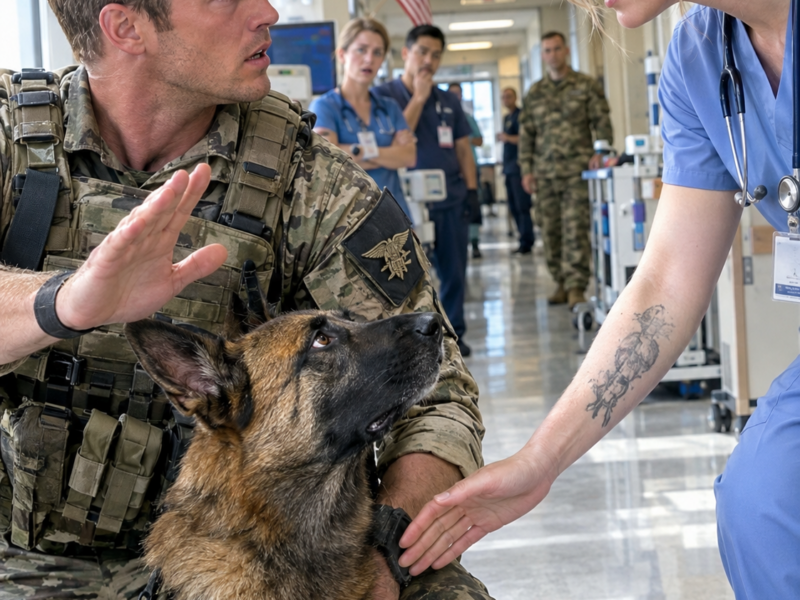
“The Navy SEAL nearly threatened to have the entire emergency room shut down when a nurse reached for his wounded K9
Mason held the photograph between two fingers as though the paper itself might burn him.
I couldn’t take my eyes off the handwriting.
Daniel’s handwriting.
The long, slanted letters. The way he crossed his sevens. The tiny mark he always made beneath his signature, a habit he’d picked up in high school and never explained.
I’d watched him write those same words on a birthday card, a grocery list, and a note he left on my windshield the morning he drove away for his final deployment.
If I don’t come home.
I’d thought those words were a promise to me.
Now they were in the hands of a stranger who knew my name.
“Where did you get that?” I asked.
Mason glanced at Duke. “It belonged to my first handler. Daniel was the man who trained me before I became a SEAL.”
He stopped, correcting himself with a faint shake of his head.
“Before I became a SEAL operator, he was the one who taught me how to trust a dog that could smell danger before I could.”
“Daniel wasn’t a dog handler,” I said. “He was an Army medic.”
Mason’s eyes narrowed, not with anger, but with the effort of fitting two pieces together that refused to connect.
“He was assigned to a joint operation in Afghanistan. He saved my life. He saved Duke’s life, too.”
He looked down at the photograph.
“I was told Daniel died during an extraction. His remains were never recovered, but the report said there was no chance he’d survived.”
I gripped the edge of the treatment cart.
“That was what they told me.”
For a moment, the emergency room seemed to recede around us. Monitors beeped, shoes squeaked across the polished floor, and someone called for a trauma team down the hall, but all I could hear was the name I’d spent eleven years learning not to say aloud.
Daniel.
Duke pushed his nose against my wrist again.
His ears were flattened, and his breathing came in shallow bursts.
Mason saw it.
“He hasn’t done that with anyone since the blast,” he said.
“What blast?”
“The one that killed Daniel.”
I looked at the scar beneath Duke’s harness. Then I looked at the compass on my arm.
“I need to know exactly what happened.”
Mason opened his mouth, but a sharp pain crossed his face. He caught the stretcher rail as his knees weakened.
I called for a nurse.
This time, when the team wheeled him toward imaging, he didn’t argue. He only kept his eyes on Duke until the doors swung shut between them.
“Take care of him,” he said.
I nodded.
“I will.”
Duke followed the stretcher as far as his leash allowed, then sank to the floor.
I knelt beside him.
“It’s all right,” I whispered, although I had no idea whether it was.
His nose rested against my tattoo.
For eleven years, I’d believed that symbol was all I had left of Daniel.
Now I wondered whether I’d been carrying a message I never understood.
By the time Mason returned from imaging, the sun had begun to lighten the windows overlooking the parking lot. His shoulder had been stitched, his head scanned, and his blood pressure had improved, but he looked more exhausted than before.
Duke had been sedated enough for the veterinary team to clean and close the wound along his flank. He lay on a padded mat beside Mason’s bed, breathing steadily beneath a blanket.
Mason watched him sleep.
“Can we talk somewhere private?” he asked.
I checked the chart. “You should be resting.”
“I’ve spent eleven years resting badly. A few more minutes won’t hurt.”
There was no humor in his voice.
I asked another nurse to keep an eye on him and followed him to a small consultation room at the end of the corridor.
He placed the photograph on the table.
“Daniel gave this to me three days before the operation,” he said. “He told me that if anything happened, I should find the woman with the compass.”
My fingers curled against my palm.
“What else did he say?”
Mason looked at me for a long moment.
“He said you were the only person who knew why the line pointed east instead of north.”
I sat down.
Daniel had drawn that compass on a napkin the night we met. We were nineteen, sharing a booth at a diner outside Fort Campbell, and I’d teased him about the crooked needle.
He’d told me a compass wasn’t useful if you already knew where you were going.
“Then why make one?” I’d asked.
“So you remember that getting lost isn’t the same as being gone.”
The line on my arm had never pointed north. It pointed toward the place where we’d planned to build a house, a little patch of land near the Chesapeake Bay where Daniel wanted a workshop and I wanted a garden.
It was an ordinary dream, which was why I’d believed it.
After he deployed, I kept the tattoo.
After he was declared dead, I couldn’t bear to remove it.
“How did Daniel know you would survive?” I asked.
“He didn’t.”
Mason rubbed his face with his uninjured hand.
“He told me to find you if I came home. He said you would know what to do with something he couldn’t carry.”
“What something?”
Mason looked toward the closed door.
“I don’t have it. Not anymore.”
I felt the first flicker of frustration.
“You came into my hospital with a photograph, a wounded dog, and a story about a man who died eleven years ago. You can’t tell me he left you a message without telling me what it was.”
“I know how it sounds.”
“Do you?”
His jaw tightened, but he didn’t turn away.
“I was twenty-four when I met Daniel. I thought being brave meant never admitting I was afraid. He was the first person who told me that fear wasn’t the opposite of courage. It was the part that made the choice matter.”
He looked down at his hands.
“During that operation, we were ambushed. Communications went down. Our vehicle was hit, and I was trapped beneath the wreckage. Daniel got me out. He was injured himself, but he went back for Duke when the dog refused to leave me.”
Mason paused.
“I remember Daniel shouting at me to keep moving. Then there was an explosion, and everything went white.”
“And you never saw him again?”
“No.”
“Then how can you be certain he died?”
“Because the people who brought me out said they watched him go down. Because the report said he couldn’t have survived. Because I spent months trying to find a reason to believe otherwise, and every door closed.”
He met my eyes.
“I’m not asking you to believe he lived. I’m asking you to help me understand why he gave me your name.”
I stared at the photograph.
The question I had avoided for eleven years finally formed in my mind.
What if the report had been wrong?
I didn’t want hope. Hope had been cruel enough the first time.
After Daniel was declared dead, an Army officer had visited my apartment with a folded flag and a brief explanation. They had recovered personal effects, he told me, but the identification had been complicated by the explosion. There would be no body to bury.
I’d signed papers with a shaking hand.
I’d attended a memorial service.
I’d learned to say “my late fiancé” without crying in front of people.
And I’d never been shown a single photograph from the scene.
I had accepted the official explanation because I didn’t know what else a grieving person was supposed to do.
“Who gave you the report?” I asked.
“An officer named Colonel Whitmore. He was the liaison overseeing the operation.”
The name struck a chord, though I couldn’t place it.
Mason continued.
“He told us the mission records were classified. He said there had been an equipment failure and that the blast destroyed most of the evidence.”
“Did Daniel have any family?”
“A sister in Ohio. He spoke about her sometimes. But he spoke about you more.”
My throat tightened.
“He told me he wanted to come home and marry you.”
“He was supposed to.”
I hated how small my voice sounded.
Mason didn’t rush to comfort me. For that, I was grateful.
Instead, he turned the photograph over.
On the back, in faded ink, was a string of numbers followed by two letters: E.B.
“Does this mean anything to you?” he asked.
I studied the numbers.
They looked like a date, perhaps, but the format was unfamiliar.
Then I noticed the two letters.
“East Bay,” I whispered.
Daniel and I had called our planned house East Bay, even though we’d never found a property.
I took out my phone and photographed the back of the picture.
“I’m going to need time to think.”
Mason nodded.
“Of course.”
When I returned to the treatment area, Duke was awake. He lifted his head as I approached, then rested it against my knee.
I scratched behind his ear.
“Did he tell you to find me, too?” I murmured.
Duke’s tail moved once across the blanket.
It was a small response, but I felt the pressure behind my eyes rise anyway.
I spent the next two days trying to put my life back into its usual shape.
I worked my shifts. I took calls from my mother. I bought groceries I barely touched and stood at my kitchen window watching cars pass in the rain.
Mason stayed at the hospital for observation, then transferred to temporary quarters nearby while Duke recovered.
We spoke each evening.
At first, we talked about practical things: the dog’s medication, the stitches in Mason’s shoulder, the paperwork needed to release them.
Then, slowly, we began talking about Daniel.
Mason told me how Daniel could repair almost anything with wire and patience, how he sang old country songs off-key when he was nervous, and how he’d once spent an entire night teaching a frightened young soldier to breathe through a panic attack.
I told Mason about the man who brought me coffee during my nursing exams, who memorized the names of every stray cat near our apartment, and who always left the last piece of pie for me even when he wanted it more.
We had known different versions of the same man.
Each version made the loss more complicated.
On the third evening, Mason arrived carrying a small cardboard box.
“I found this in my gear,” he said.
Inside lay a cracked plastic compass, a folded note, and a memory card sealed in a tiny waterproof case.
The compass was cheap, scratched, and missing part of its glass.
I recognized it immediately.
Daniel had carried it on every deployment.
My hands shook as I lifted the note.
The writing was faint, but the words were clear.
“Emily—if Mason finds you, it means the story they told us has outlived the truth. Don’t trust the first report. Find the original mission log. Look for the second extraction point.”
I read it twice.
Then a third time.
“Where did you get this?” I asked.
Mason shook his head.
“I didn’t know it was there until the hospital staff cut open the damaged lining of my pack. The seam had been repaired recently. I thought it was a field repair.”
I looked at the memory card.
“What’s on this?”
“I don’t know. I haven’t had a chance to open it.”
We took it to the hospital’s secure administrative office, where a colleague with the proper authorization helped us copy the files without altering the original.
The card contained several damaged images, a short audio recording, and a scan of a handwritten page.
Most of the images were nearly black.
One, however, showed a military vehicle beside a narrow dirt road. Two figures stood in the distance, one wearing a medical vest.
The other was partially obscured by smoke.
I zoomed in until the pixels blurred.
“Could that be Daniel?” I asked.
Mason leaned closer.
“I don’t know.”
The audio file crackled when we played it.
At first there was only wind and distant gunfire. Then a voice broke through the static.
“Second point compromised. Repeat, second point compromised.”
A pause.
Another voice, strained but unmistakable, answered.
“I’m moving the package. Keep Reed alive. That’s the priority.”
Mason gripped the edge of the desk.
“That was Daniel.”
I listened again.
There was something else in the background: a sharp metallic sound, followed by a voice calling a name that the recording swallowed.
Then the file ended.
The scanned page contained a grid of coordinates and a list of equipment numbers. Several lines had been crossed out.
At the bottom was a name.
Whitmore.
Mason looked at me.
“The man who signed the report.”
The next morning, Mason contacted his military legal officer and requested a formal review of the mission records. The request was denied within hours on the grounds that the material remained classified and the submitted evidence could not be authenticated.
He called me from outside the administrative building.
“They’re not even going to look at it.”
“Can they refuse?”
“They can refuse this request. That doesn’t mean it’s over.”
I heard the controlled anger in his voice.
“There’s something else,” he said. “Whitmore retired two years ago. But his name appears on a consulting company that handles security contracts overseas.”
“Does that mean he did something?”
“No. It means we need evidence before we accuse him of anything.”
For once, I was grateful someone was thinking clearly.
We had a photograph, a damaged recording, and a note from a man whose official death had never been independently explained to me.
We didn’t have proof of a cover-up.
We didn’t even know whether Daniel had survived the explosion.
But I could no longer pretend the questions were unreasonable.
I contacted Daniel’s sister, Rachel.
She answered on the fourth ring.
When I told her about Mason and the photograph, she was silent for so long I thought the call had dropped.
Then she whispered, “I knew there was something wrong.”
“What do you mean?”
“After Daniel was declared dead, a man came to my house. He said he was from the Army and wanted to collect Daniel’s personal correspondence. He told me it was standard procedure.”
“Did you give him anything?”
“I gave him the box of letters Daniel had sent from overseas. I thought it was what I was supposed to do.”
Her voice broke.
“Two weeks later, I found an envelope hidden inside an old toolbox. It had my name on it, but I couldn’t open it. I was afraid of what it might say.”
“Do you still have it?”
“Yes.”
Rachel agreed to meet us in Ohio.
Mason and I drove there with Duke resting in the back seat, his injured leg supported by a padded sling. The dog had grown calmer around me, though he still checked Mason’s position whenever the car slowed.
Rachel lived in a modest house with a white porch and wind chimes that clicked softly in the breeze.
She was older than Daniel by six years and had the same steady eyes.
When she saw the photograph in my hand, she covered her mouth.
“Oh, Danny.”
She brought us into the kitchen and placed a yellowed envelope on the table.
The seal had never been broken.
My name was written across the front.
Emily.
I couldn’t touch it.
For eleven years, I’d imagined receiving one last letter from Daniel. I’d imagined apologies, explanations, declarations of love. I’d imagined so many words that the real ones, if they existed, felt almost unbearable.
Rachel sat beside me.
“You don’t have to open it alone.”
I looked at Mason.
He nodded but said nothing.
I broke the seal.
Inside was a single sheet of paper.
“Emily, if you are reading this, something has happened that I couldn’t explain in time. I need you to know that I never chose to leave you. If the Army tells you I died, ask for the second extraction log. If they tell you it doesn’t exist, ask who signed the first one.”
The letter continued with a brief description of a planned evacuation and a warning that Daniel had discovered irregularities in the equipment manifest for their operation.
He wrote that some of the equipment listed as destroyed had been moved before the mission.
He suspected that someone was using the operation to conceal the diversion of supplies, but he had not yet found enough evidence to prove it.
The final lines were written more hurriedly.
“I love you. I wanted the ordinary life we planned. If I don’t make it back, don’t spend your life waiting at a door that may never open. Live, Emily. Not because I stopped loving you, but because I never wanted my absence to become the only thing you could remember about me.”
I pressed the paper against the table.
Mason looked away, giving me a moment I didn’t know how to use.
“He knew,” I whispered. “He knew something was wrong.”
Rachel wiped her eyes.
“He also knew you would need permission to keep living.”
I had no answer.
For years, I’d treated moving on as a betrayal. I’d kept Daniel’s old shirts in a drawer, refused to sell the little car we’d planned to replace, and avoided the road that led to the empty property near the bay.
I had convinced myself that loyalty meant preserving the life we’d imagined.
But Daniel’s letter wasn’t asking me to wait.
It was asking me to live.
The next step was the second extraction log.
Mason filed another request, this time through the inspector general’s office, with Rachel’s letter, the photograph, the audio file, and the equipment manifest attached.
The process moved slowly.
Weeks passed.
Duke’s wounds healed. Mason’s shoulder regained enough strength for physical therapy, though he still favored it when the weather changed.
I returned to my shifts and began sleeping through the night again, sometimes.
We didn’t become a couple in the middle of the investigation. Neither of us was ready to mistake shared grief for a future.
Instead, we became two people who could sit quietly in the same room without needing to fill every silence.
Mason brought coffee when my shifts ran long.
I checked his shoulder dressing when it needed attention.
Duke learned to rest his head on my shoes whenever I sat down.
Then, six weeks after our first meeting, the inspector general’s office called.
The second extraction log existed.
It had been filed under a different operation number and omitted from the original casualty review.
The log showed that a medical evacuation team had reached the second extraction point after the explosion. One injured service member had been transferred to a field hospital under a temporary identity because his identification records were missing.
The name was listed as unknown.
The date was correct.
The location matched Daniel’s mission.
Mason and I sat in a conference room while an investigator explained that the record alone did not establish what had happened afterward.
“We have evidence that someone survived the initial incident,” she said. “We don’t yet have evidence that the person was Daniel Carter.”
“Can you identify the evacuation team?” Mason asked.
“We’re working on it.”
“What about Whitmore?”
“He is being interviewed. At this stage, we are not making allegations against him.”
I understood the caution.
A missing log could indicate misconduct, confusion during combat, or an administrative failure. The truth had to be established, not guessed.
But the investigator had one more document.
A transfer record dated eleven days after the operation.
It showed that an unidentified patient had been moved from the field hospital to a rehabilitation facility in Germany.
The destination field had been blacked out in the original file, but a handwritten routing code remained visible.
The investigator slid a copy across the table.
“We’re trying to locate the receiving facility.”
I stared at the code.
It looked familiar.
Not because I’d seen it in a military document, but because Daniel had written the same combination of letters on the back of a postcard years earlier when he’d been trying to explain how military mail was routed.
I turned the page toward Mason.
“Could this be the place?”
He studied it carefully.
“It’s possible.”
The investigation expanded.
Records showed that the patient had remained in Germany for several months before being transferred to a domestic rehabilitation center under a different administrative category.
After that, the trail went cold.
The name on the transfer record was not Daniel Carter.
It was David Cole.
The investigator warned us that aliases were sometimes used when records were incomplete or when a patient’s identity could not be confirmed. The name alone proved nothing.
Still, I couldn’t stop thinking about it.
Daniel had once joked that if he ever needed to disappear, he’d choose the dullest name in America.
David Cole had made him laugh for an entire evening.
The coincidence was too precise to ignore, but I forced myself not to call it proof.
We waited another month.
Then the investigator called Mason and asked us to come in.
A former military nurse had contacted the review team after seeing a public notice requesting information about the evacuation. She remembered an injured patient brought to a rehabilitation center in Germany in the days after the operation.
The man had extensive facial injuries, a head injury, and no reliable identification. He had struggled with memory loss and was transferred under a temporary name.
The nurse remembered one detail.
He had a compass tattoo on his forearm.
My hand flew to my own tattoo.
“Did she say what happened to him?” I asked.
“She said he was discharged to a long-term rehabilitation program after his physical condition stabilized,” the investigator replied. “She doesn’t know where he went afterward.”
Mason sat very still.
“Can we speak to her?”
The investigator arranged a secure video call.
The nurse, now retired, appeared on the screen with a folder of old notes beside her.
She remembered the patient because he had repeatedly asked about a woman named Emily and a dog he called Duke.
She remembered that he could not recall his full name at first.
When he finally did, he was unsure whether it was real.
The nurse paused.
“I can’t promise the man was Daniel Carter. But I remember the tattoo, and I remember him saying, ‘If I ever get home, I have to tell her I tried.’”
I pressed both hands over my mouth.
Mason reached across the table but stopped short of touching me, allowing me to decide whether I wanted the comfort.
I took his hand.
For the first time in eleven years, I allowed myself to believe Daniel might still be alive.
The investigator traced the rehabilitation program to a small facility in western Pennsylvania. It had closed several years earlier, and its records had been transferred to a state archive.
A patient named David Cole had left the program after completing treatment.
His destination was listed as a residential address in a rural county.
We drove there on a cool October morning.
The address led to a narrow road lined with bare trees and fields of late-season corn. At the end stood a small house with a sagging porch, a woodpile beside the door, and a blue pickup truck parked beneath an oak tree.
There was no sign of a military life.
No flag.
No uniform.
No obvious evidence that anyone had ever lived through a war.
Mason turned off the engine.
Duke sat up in the back seat, ears forward.
I couldn’t move.
“What if it’s not him?” I whispered.
“Then we’ll know one more thing,” Mason said.
“And if it is?”
He took a slow breath.
“Then he gets to decide what happens next.”
We walked to the porch.
I knocked.
Footsteps sounded inside.
The door opened a few inches.
A man stood in the dim hallway, his hair gray at the temples, a scar running from his jaw toward his ear. His face was older than the one I remembered, and his shoulders were narrower.
But his eyes were the same.
He looked at Mason first, then at Duke.
The dog made a sound I had never heard from him before.
Not a bark.
Not a growl.
A trembling whine that seemed to rise from somewhere deep in his chest.
The man gripped the doorframe.
“Duke?”
The dog pushed past Mason before anyone could stop him.
He pressed his head against the man’s leg, wagging his tail so hard his injured paw slipped on the porch boards.
The man dropped to his knees and buried his face in the dog’s fur.
I stood frozen in the doorway, unable to breathe.
Then he looked up.
His gaze moved to my arm.
To the compass.
His mouth opened, but no words came.
“Emily,” he whispered.
I had rehearsed this moment in my mind for eleven years. In some versions, I slapped him. In others, I fell into his arms. Sometimes I demanded to know why he hadn’t come home; sometimes I simply asked him to say my name again.
But when I finally stood in front of him, I couldn’t make any of those words come out.
He rose slowly, keeping one hand on Duke’s back.
“I thought you were dead,” I said.
His eyes filled.
“I know.”
“You let me bury you.”
“I didn’t know what they’d told you.”
“You didn’t know?” My voice broke. “You were alive. Somewhere. For eleven years.”
He lowered his head.
“I woke up in Germany with no memory of the operation. I didn’t remember my name for months. When I did, I tried to find you.”
“Then why didn’t you?”
“Because I was told you had been notified. They said the Army had handled everything. When I finally got access to a telephone, I called the number I remembered for your apartment. It had been disconnected.”
I stared at him.
“I moved three months after you died.”
“I know that now.”
He explained that his injuries had left him with memory problems, chronic pain, and a long rehabilitation. He’d been transferred under a temporary identity because his records were incomplete. When he regained enough of his memory to ask questions, the people handling his case told him his identity was still under review.
He had written letters.
Some had been returned.
Others, he later learned, had never been delivered.
He’d eventually found evidence that the mission report had been altered, but by then he was struggling to keep a roof over his head and afraid that any attempt to expose what had happened would send him back into a system he no longer trusted.
“I should have kept trying,” he said. “I know that. There were years when I could have done more.”
I searched his face for the man I’d loved, the one who had promised to come home.
He was there, but he wasn’t untouched by what had happened.
Neither was I.
“Why didn’t you tell anyone where you were?”
“I did. More than once. But I had no proof of who I was, and I didn’t know who had changed the records. Every time I got close to an answer, I lost another piece of the trail.”
He looked toward Mason.
“Did you find the log?”
Mason nodded.
“The second extraction point. The transfer records. The photograph.”
Daniel shut his eyes.
“Then it wasn’t all lost.”
“No,” Mason said. “But we still don’t know who changed the report.”
Daniel invited us inside.
The house smelled of coffee, woodsmoke, and the faint medicinal scent of pain cream. On a shelf sat a stack of library books, a chipped mug, and a framed photograph of a woman I didn’t recognize.
Daniel saw me looking.
“She was a neighbor,” he said. “She helped me when I first moved here. She died last winter.”
He spoke gently, as though he expected me to ask whether they’d been together.
I didn’t.
Eleven years had passed. I had no right to demand that he had lived them as if they didn’t count.
Instead, I asked the question that mattered most.
“Did you know I believed you were dead?”
He nodded.
“Not until recently. A former medic found me through the review notice. She told me the original casualty report had been accepted as final.”
“Why didn’t you contact me then?”
His hands tightened around his mug.
“Because I didn’t know if you’d want me to. I saw an article about the hospital where you worked. I found your name. I sat with the phone in my hand for three days.”
“And?”
“I was afraid you had built a life that didn’t have room for a ghost.”
The words hurt because I understood them.
I had built a life. I had become a nurse, learned how to live alone, made friends, and stopped checking every unfamiliar face in a crowd.
But there had always been a room in my heart I kept closed.
Not because I wanted to wait forever.
Because I hadn’t known how to leave it without feeling that I was abandoning him.
“I needed to know you were alive,” I said. “That was all I needed eleven years ago.”
“I know.”
“No, Daniel. You know now.”
He accepted the correction without defending himself.
For a while, we sat in silence.
Duke lay between us, his head resting on Daniel’s boot, his tail touching my shoe. Mason watched the dog with a softness I hadn’t seen in him before.
Finally, Daniel asked about the tattoo.
I told him I’d kept it because I couldn’t bear to erase the last thing we’d chosen together.
“I thought it meant I was still waiting,” I said. “But I think I was just afraid that if I stopped waiting, what we had would disappear.”
Daniel’s eyes shone.
“It didn’t disappear.”
“No. But it changed.”
He nodded.
“I don’t expect you to pick up where we left off.”
“Good.”
A faint, sad smile crossed his face.
“I wouldn’t know how.”
For the first time since arriving, I laughed. It was brief and shaky, but it belonged to me.
We spent the afternoon talking about the years we had lost, though neither of us tried to account for every day. Some things were too small to explain. Others were too painful to fit into a single conversation.
Before we left, Daniel gave Mason the original compass he’d kept in a drawer beside his bed.
“Keep it,” he said. “You did what I asked.”
Mason shook his head.
“I only followed a trail.”
“That’s what people do when they refuse to let someone disappear.”
The investigation continued for several months.
The second extraction log, the altered equipment manifest, and the transfer records led investigators to a broader review of the operation. They found evidence that equipment had been diverted before the mission and that the casualty reporting process had been manipulated to conceal the discrepancies.
Colonel Whitmore denied ordering any falsification. Investigators could not establish every decision he had made, but the records showed that he had signed a report that omitted the second extraction and failed to account for the unidentified patient transferred to Germany.
The findings were referred for further administrative and legal review.
Daniel’s military record was corrected to reflect that his death had never been confirmed and that he had survived the operation. He received medical care for his lasting injuries and assistance restoring his identity.
No investigation could return the eleven years we had lost.
No official document could explain why the truth had been allowed to remain buried for so long.
But Daniel was no longer a name on a memorial.
He was a living man who had to learn how to live again.
So did I.
We didn’t move in together. We didn’t pretend the years apart had been a misunderstanding that could be repaired with a single embrace.
We met for coffee. We took slow walks when his pain allowed. Sometimes we talked about the future; sometimes we talked about nothing important at all.
There were days when anger returned without warning.
There were nights when Daniel woke from a dream and couldn’t remember which year he was in.
There were moments when I wanted to ask him why he hadn’t fought harder to find me, and moments when he wanted to ask why I hadn’t searched beyond the records I’d been given.
We learned to ask those questions without turning them into weapons.
Mason visited often, bringing Duke along once the dog was cleared for travel.
Duke grew steadily stronger. His limp remained, but he no longer flinched when someone approached his injured side.
He seemed to understand that the people around him were no longer trying to pull him away from the ones he loved.
On a cool spring morning, Daniel asked me to meet him near the Chesapeake Bay.
The property we’d once dreamed of buying had changed hands years earlier. The old diner was still there, though the sign had been repainted and the booths replaced.
Daniel had found a small public overlook nearby.
When I arrived, he was standing by the railing with his hands in his coat pockets.
“I used to imagine this place differently,” he said.
“So did I.”
“I thought we’d have a house by now. A garden. A workshop.”
“I wanted a dog that wouldn’t dig up the garden.”
He smiled.
“You always wanted impossible things.”
“Only the garden.”
Duke lay in the grass beside Mason, watching a gull circle over the water.
The wind carried the smell of salt and wet earth.
Daniel looked at my forearm.
“Do you still want to keep it?”
I turned my wrist, studying the faded compass.
For years, I’d thought the line pointed toward a destination I had failed to reach. Now it looked more like what it had always been: a reminder that a life could change direction without becoming meaningless.
“Yes,” I said. “But not because I’m waiting anymore.”
Daniel nodded.
“I’d like to know you again, Emily. If you’ll let me.”
I looked at the man I had loved, the stranger he had become, and the person I might still learn to trust.
“I can’t promise we’ll find our way back to what we were.”
“I wouldn’t ask you to.”
“But we can start with coffee.”
His smile was small and real.
“I’d like that.”
Mason called Duke away from the water, and the dog trotted toward him before turning back to check that Daniel and I were still standing together.
I watched him go.
For the first time in eleven years, the compass on my arm didn’t feel like a memorial.
It felt like a choice.
And when Daniel offered me his hand, I took it—not because the past had been restored, but because, at last, the future belonged to us again.
THE END.









