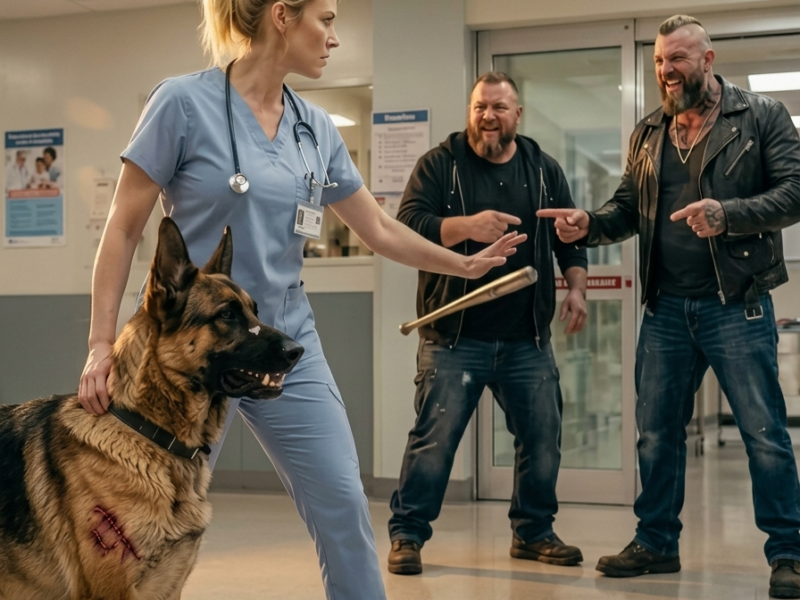
The moment the hospital security chief grabbed my K9 by the collar and shoved him against the ICU doors, I shouted, “Touch my dog again, and you’ll regret it,”
The fluorescent lights of Sacred Heart Hospital in Chicago hummed with a harsh, flickering tone that set my teeth on edge. It was 03:00, the graveyard hour where the line between life and death in the Emergency Room thinned to paper. I stood in my faded blue scrubs, my hand resting gently on the harness of Titan, my three-year-old German Shepherd. His thick fur was warm beneath my palm, his chest expanding in slow, measured breaths.
Titan was a certified medical support animal, but to me, he was much more. He was my anchor. When the phantom smells of burnt jet fuel and desert sand invaded my nostrils in the middle of the night, Titan was the only thing that brought me back to the present.
“Get this animal out of my hospital!” Richard Collins barked, his voice echoing loudly against the tiled walls of the waiting area.
Collins, the Chief of Hospital Security, stepped into the hallway, impeccably groomed in an expensive charcoal suit that looked completely out of place in an ER slick with rain, mud, and spilled antiseptics. He straightened his silk tie with two fingers, casting a disgusted look at Titan. Nearby, exhausted nurses and trembling patients watched in tense silence.
Titan stood perfectly still beside my left hip, his dark eyes locked on Collins. He didn’t bark. He didn’t bare his teeth. He had been trained by elite military handlers to protect, to observe, and to execute commands with absolute discipline.
“Sir, he’s a certified medical support dog,” I said, my voice low, clear, and unhurried. “He’s here because one of your critical ICU patients requested animal-assisted therapy as part of his post-trauma recovery plan. The paperwork was cleared by Chief of Surgery Vance.”
Collins sneered, taking a menacing step closer. “I don’t care if the President of the United States requested him. Animals are dirty, dangerous vectors of infection. Dogs don’t belong in my ICU.”
He snapped his fingers. Two burly security guards in dark tactical uniforms flanked him, their hands hovering near their heavy leather utility belts.
Behind Collins, Titan lowered his head by half an inch, his shoulders tightening into steel springs. A low, subterranean growl, felt more than heard, vibrated through his harness.
I placed two fingers on the leather collar behind his ears. “Easy, boy. Stand down.”
The growl cut off instantly. Titan relaxed his stance, though his golden eyes remained fixed on Collins’s throat.
Collins noticed the instant obedience and smirked, folding his arms arrogance personified. “Look at that. Even your mongrel knows who runs this facility.”
I said nothing. My silence was not submission; it was evaluation. In my previous life, during four combat deployments across the Middle East and Eastern Europe, I had learned a fundamental truth: the loudest person in a room is almost never the most dangerous. The truly lethal ones are the ones watching the doors, counting the exits, and calculating the angle of attack.
“Remove the dog,” Collins ordered, gesturing to the guard on his left—a heavy-set man named Miller whose tactical vest was stretched tight over his stomach.
Miller stepped forward, reaching out with a heavy hand, and yanked Titan’s leash with enough force to pull a lesser dog off balance. Titan’s paws skidded an inch on the slick linoleum floor.
Something inside my chest, dormant for four years, clicked shut like the bolt of a sniper rifle. The temperature in my blood plummeted to zero.
“Let go of him,” I said. My voice was no longer that of Sarah Hayes, the quiet 32-year-old night-shift nurse who always volunteered to take the double shifts nobody wanted. It was the voice that had commanded elite operators under mortar fire in Helmand Province.
Miller laughed, a wet, ugly sound. “Or what, sweetheart?”
I stepped directly between Miller and Titan, breaking their line of sight. “That’s your last warning.”
Collins chuckled. “Remove her, too. Escort Nurse Hayes off hospital grounds and log her for insubordination.”
Miller reached out with his right hand, intending to grab my left shoulder and spin me around.
To a civilian, what happened next was a blur. To me, it was simple mechanics.
As Miller’s hand reached within four inches of my scrub top, my left forearm rose in an open-palm parry, deflecting his wrist outward. Before his brain could register the redirection, my right hand struck the inside of his elbow joint, collapsing his frame. I stepped inside his guard, swept his front foot with the heel of my clog, and drove my hip into his center of gravity.
Miller flew sideways, his heavy frame crashing through a row of plastic waiting-room chairs before hitting the floor with a deafening groan. His flashlight rattled across the tiles.
The entire emergency room went dead silent. A nurse holding a tray of IV bags froze near the triage desk, her mouth slightly open.
I stood over Miller, my hands hanging loosely at my sides, my posture completely relaxed. I hadn’t used a close-quarters combat deflection in four years—not since my final deployment with Naval Special Warfare Development Group, where an ambushed extraction in the mountains of Syria had left two of my team members dead and my left shoulder torn to shredded cartilage.
I had left the Navy as a Lieutenant Commander, decorated with the Navy Cross and two Silver Stars, bearing the classified operational call sign Combat Master. I had chosen nursing because sewing up flesh and administering antibiotics felt like the only way to wash the blood of the men I couldn’t save off my hands. None of my coworkers knew my real background. To them, I was just Sarah—polite, fast with a tourniquet, and intensely private.
Collins stared at Miller, who was struggling to sit up while gasping for air. The security chief’s face turned a mottled, furious red. “What… what the hell are you?”
Before I could answer, a high-priority telemetry alarm erupted from the ICU hallway behind the double doors. The electronic siren chimed three times in rapid succession—Code Blue, Bed 4.
A voice blared over the hospital intercom: “Trauma team to ICU Room Four. Medical emergency. Staff Sergeant Daniel Brooks, cardiac arrest.”
My stomach dropped into a bottomless pit. Daniel Brooks.
Ten minutes earlier, an ambulance had brought in a young man found unconscious near the naval training center outside the city. I hadn’t seen his face, but I knew that name. Seven years ago, Staff Sergeant Daniel Brooks had been the youngest tactical communications specialist assigned to my SEAL support element—a nineteen-year-old kid who collected comic books and wrote postcards to his mother in Ohio after every firefight.
During a dark mission in Northern Iraq six years ago, Daniel’s unit had been cut off behind enemy lines. The official Pentagon report handed down to me stated that his team had been caught in a catastrophic mortar strike. He had been officially listed as Killed in Action, his body unrecoverable.
Now, his name was screaming through the intercom of a civilian hospital in Chicago.
Titan suddenly surged forward against his leash, whining with a sharp, desperate frequency I had never heard from him before. He pressed his snout against the reinforced glass of the ICU doors.
I stepped up to the glass and looked through.
Inside Room Four, three doctors and two nurses were frantic, surrounding a gurney. Through a gap in their white coats, I saw a pale, scarred arm hanging limply over the metal bed rail. The fingers on that hand were tapping weakly against the stainless steel frame.
Tap-tap-tap. Pause. Tap-tap.
My breath caught in my throat. My vision narrowed.
It wasn’t a muscle spasm. It was Navy Special Warfare tap-code—an emergency signal used when radio communications were compromised. Alpha-Three. It meant: Compromised from within.
I turned around to face Collins, my eyes burning with a cold, terrifying fire. “Open that door. Now.”
Collins shook his head, though he stepped back slightly, unnerved by the shift in my demeanor. “You’re… you’re suspended! You don’t have security access to the ICU!”
“Open the damn door, Collins,” I growled, stepping into his personal space until he could see his own terrified reflection in my pupils, “or I will use you to break it down.”
Before Collins could respond, the heavy double glass doors of the main hospital entrance were violently shoved open.
Six uniformed Navy Shore Patrol officers marched into the lobby in tight formation, their polished black boots clicking in unison on the tile. Behind them walked a silver-haired officer wearing the shoulder boards of a Navy Captain, holding a thick, red-stamped classified leather binder under his arm.
The Captain scanned the chaotic lobby, passed over Collins, passed over the fallen guard, and his eyes locked onto me.
He stopped ten feet away, snapped his heels together, and brought his hand up to his cover in a crisp, formal salute.
“Commander Hayes,” the officer said, his voice echoing in the silent ER. “We’ve been tracking your medical credentials across three states for four years.”
Collins’s face drained of every drop of color. “C-Commander?”
The Captain dropped his salute and stepped closer, his face grim. “Ma’am, I am Captain Thomas from Naval Intelligence. There is something you need to know about the ambush in Syria that destroyed your team.”
He unclasped the red binder and opened it. Sitting on top of a stack of redacted documents was a glossy satellite photograph. It showed Daniel Brooks standing beside a tall, muscular man wearing an unmarked tactical uniform—a man whose face was etched into my nightmares.
It was Vice Admiral Edward Vance—my former Commanding Officer, the man who had personally signed the casualty reports declaring Daniel Brooks dead, and the man who had ordered my team into the mountain pass where we were slaughtered.
Across the bottom of the photograph, written in dark red marker, was a single sentence:
SHE WAS NEVER SUPPOSED TO FIND OUT WHO GAVE THE ORDER.
Captain Thomas leaned in close to my ear, his voice dropping to a whisper that sent a wave of ice through my spine. “Commander, before you step into that ICU, you need to know… the person who authorized the hit on your team six years ago isn’t in Washington. He is inside this building right now.”
Suddenly, from behind the glass doors of the ICU, a sound tore through the air—Daniel’s voice, raw and screaming through an oxygen mask, calling out my old operational call sign:
“COMBAT MASTER! THEY’RE IN THE SYSTEM!”
CRACK-SPARK!
Every overhead light fixture in the Emergency Room exploded in a shower of white sparks. The main monitors flickered, screamed with static, and went completely black. Every security camera in the hospital went dead simultaneously.
And in the pitch darkness, the heavy, mechanical lock on the ICU doors clicked unlocked.
The darkness that enveloped the Emergency Room was absolute, save for the sickly green glow of emergency exit signs thirty feet above us. The hum of the air handlers died, replaced by the rising, chaotic screams of panicked patients and staff in the waiting area.
“Nobody move!” Captain Thomas shouted, his hand dropping to the sidearm at his hip. The six Shore Patrol officers pulled their weapons in unison, the metallic clack-clack of slides racking back sounding sharply in the dark.
I didn’t wait for orders. My eyes adapted to the dark in seconds—a trained response from hundreds of hours of night-combat operations.
“Titan, heel!” I commanded.
Titan pressed his shoulder against my leg. I reached into my scrub pocket, pulled out my small tactical penlight, and clicked it on. A narrow beam of intense white light sliced through the pitch-black hallway.
Collins was on his knees near the triage desk, whimpering like a child, covering his head with his hands. I stepped over him without a second glance, pushing through the heavy ICU doors.
The ICU was a nightmare zone. The backup generators should have kicked in within three seconds, but the silence remained unbroken. Whoever had taken down the power grid had manually bypassed the emergency transfer switches in the basement—an insider job executed with military precision.
Inside Room Four, the heart rate monitor had flatlined, emitting a continuous, high-pitched mechanical tone that cut through the dark like a knife.
“Daniel!” I called out, shining my flashlight onto the gurney.
The two civilian ER nurses who had been attending him were backed into the corner, paralyzed with fear. Daniel was sitting upright on the bed, his hospital gown soaked in sweat, his chest heaving violently. Blood trickled from an IV line that had been ripped from his arm.
“Sarah…” he gasped, his voice raspy and destroyed by years of trauma. “It’s… it’s a setup. The whole hospital… it’s a kill box.”
I rushed to the side of his bed, placing one hand on his chest while Titan took up a defensive post at the doorway, his body angled toward the main corridor.
“Take it easy, Daniel,” I said, checking his carotid pulse. It was rapid, thready, but present. “You’re safe. I’m here. Captain Thomas and a squad of Shore Patrol are right outside.”
Daniel grabbed my scrub top with a desperate, iron grip. His knuckles were white. “You don’t understand, Commander! Thomas isn’t here to save you! He’s Vance’s man! The binder… the file… it was designed to force you to reveal your identity!”
My blood ran cold.
Before I could digest his words, the heavy glass doors at the end of the ICU hallway groaned as they were manually sealed from the outside. A thick, metallic shutter rolled down over the central observation windows with a deafening CLANG.
“Commander Hayes,” a calm, synthesized voice echoed through the ceiling-mounted emergency speakers—a voice being run through a voice-changer, but carrying a familiar cadence. “You always were the most difficult piece to clear off the board.”
I stood up, pulling my penlight close to my body to minimize my profile. “Vance.”
“Vice Admiral Vance to you, Sarah,” the voice answered over the intercom. “Four years ago, you survived an ambush that should have buried you in the Syrian desert. You walked away, took a civilian job, and thought you could play guardian angel in a hospital. But Daniel here… Daniel survived as well. And when he tried to contact the Inspector General three days ago, he forced my hand.”
“You sold out your own team,” I said, my voice cutting through the speaker static like a blade. “Six years ago in Iraq. Four years ago in Syria. You leaked our extraction vectors to private military contractors for defense contract shares.”
A cold chuckle vibrated through the speakers. “War is a business, Sarah. Tactical teams are assets. Sometimes, assets need to be liquidated to protect the bottom line. I couldn’t let you or Daniel stay alive once he made it to Chicago.”
“Where are you, Vance?”
“I’m in the one place you can’t reach me,” the voice replied. “And in ninety seconds, a high-density thermal charge installed in the main oxygen manifold beneath your feet will detonate. The entire ICU block will burn at three thousand degrees. The official story tomorrow will be a tragic electrical fire caused by aging hospital infrastructure.”
The intercom clicked off with a sharp pop.
“Sarah…” Daniel coughed, struggling to swing his legs over the side of the bed. “The basement… the main oxygen lines run directly beneath Room Four. He’s going to melt this entire wing.”
I looked at the closed steel shutters blocking the main exit. The Shore Patrol officers outside were banging heavily on the metal, their voices muffled and useless.
“Captain Thomas set you up,” I muttered, connecting the dots. “He brought the file to trigger my reaction, ensuring I was trapped in this wing when the blackout hit.”
I turned to Titan. “Titan, find the hatch!”
Titan didn’t hesitate. He put his nose to the floor, weaving past the overturned IV poles and medical carts. Within three seconds, he stopped near the back corner of Room Four, scratching furiously at a rubber floor mat.
I rushed over, kicked the heavy mat aside, and revealed a square steel access hatch—a utility crawlspace used by hospital maintenance engineers to access the high-pressure oxygen and steam pipes running beneath the building.
“Good boy,” I whispered.
I grabbed the recessed handle of the steel hatch and pulled. The heavy door groaned, resisting for a second before flying open, revealing a dark, claustrophobic shaft dropping ten feet into the sub-basement. The air rising from the hole was hot, thick, and smelled faintly of copper and heating oil.
“Daniel, can you move?” I asked, rushing back to his bed.
“I can fight,” Daniel growled, ripping the remaining telemetry leads off his chest. He slid off the gurney, his legs wobbling, but his eyes burning with the unyielding spirit of a Navy SEAL. “Give me a direction, Commander.”
“Down,” I said.
I helped Daniel to the lip of the hatch and guided his feet down the steel ladder rungs inside the wall. “Titan, down!” I commanded.
Titan leaped into the dark shaft without a moment’s hesitation, landing silently on the concrete floor ten feet below. I followed immediately, pulling the heavy steel hatch shut above my head just as a muffled, heavy explosion detonated somewhere in the hallway above us, sending a wave of heat vibrating through the metal frame.
We were in the belly of the beast—the dark, humid labyrinth of the hospital’s mechanical foundation.
And somewhere in the dark ahead of us, Vice Admiral Vance’s mercenaries were waiting to finish the job.
The sub-basement smelled of rust, stagnant water, and ozone. Heavy steam pipes ran along the ceiling like exposed veins, leaking small plumes of white vapor that hissed loudly in the dark.
I clicked my tactical penlight to its lowest setting, casting a faint red beam onto the concrete path ahead. Daniel leaned against the damp concrete wall, holding his side, his breathing ragged but controlled. Titan walked three paces ahead, his nose high, sampling the heavy air currents.
“How many mercenaries does Vance have on the ground?” I whispered to Daniel, my eyes scanning the shadow-draped junction points ahead.
“At least four,” Daniel replied, his voice a low rasp. “Professional contractors from Black Briar Security—ex-Spetsnaz and retired tier-one guys. They brought tactical night-vision, silenced carbines, and thermite charges. They compromised the hospital’s central security hub twenty minutes before I was brought into the ER.”
I reached down to my boot and pulled out a four-inch medical scalpel I had grabbed from the ER tray—a tiny, razor-sharp steel tool, completely inadequate against armed mercenaries, but better than bare hands.
“We need a weapon,” I murmured.
Titan suddenly froze. His ears flattened against his skull, and his body lowered into an aggressive crouch near a massive electrical junction box thirty feet ahead.
I held up one hand, signaling Daniel to freeze against the wall.
Through the darkness, the faint, rhythmic sound of heavy rubber-soled boots stepping through shallow water drifted toward us.
Splash… splash… splash.
A green infrared beam swept across the ceiling thirty feet ahead—a mercenary equipped with Night Vision Goggles (NVGs) moving through the utility corridor.
“One target,” I whispered to Daniel. “Stay here.”
I melted into the shadows behind a cluster of thick PVC water pipes. I held the scalpel in a reverse grip in my right hand, controlling my breathing, lowering my heart rate to forty beats per minute—a trick mastered through years of sniper-suppression training.
The mercenary rounded the corner. He was dressed in a black tactical jumpsuit, holding an MP5 submachine gun fitted with a suppressor. The green glow from his helmet-mounted NVGs illuminated his lower face—cold, stubbled, and focused.
He stepped past my hiding spot, his weapon raised, scanning the main pipe line.
He didn’t see me. In the dark, without thermal imaging, a static human form merged into the background walls.
As his heels cleared my position, I struck.
I stepped out from behind the pipes with zero sound. My left hand shot out, grabbing his helmet-mounted NVG array and yanking it violently backward and down, snapping his head back and crushing his airway against his neck collar.
Before he could pull his trigger, I drove the butt of the scalpel handle into the side of his neck, striking the vagus nerve. His eyes rolled back, his body going completely limp.
I caught his falling weapon before it hit the wet floor, muffling his collapse with my leg.
In four seconds, the target was neutralized.
I stripped the mercenary’s gear with practiced efficiency:
MP5 submachine gun with three full magazines.
P226 suppressed sidearm.
Integrated tactical headset.
Night-vision helmet array.
I slipped the NVG helmet onto my head and flipped down the dual optics. The dark sub-basement instantly transformed into a crisp, green-hued high-definition field of view.
I walked back to Daniel, handing him the P226 sidearm and two magazines. “Can you shoot?”
Daniel took the pistol, pulled the slide back half an inch to verify a round was chambered, and offered a grim, lethal smile. “Commander, I can shoot in my sleep.”
I slipped the headset over my ear and adjusted the frequency dial. The channel clicked, and the voices of Vance’s mercenaries filled my ear:
“…Alpha Two, report in. Did you clear Sector Three?”
I held my breath, listening to the tactical network.
“Alpha Two is unresponsive,” a second voice replied—a deep, thick Eastern European accent. “Commander Vance, target may have breached the sub-basement hatch before the thermal charge detonated.”
Vance’s voice cut across the radio network, clear and cold: “Find them. Sarah Hayes is an elite close-quarters specialist. Do not engage her individually. If you spot her, collapse the tunnel section with secondary charges. I want her buried.”
“He’s in the main boiler room,” Daniel whispered, pointing down a long corridor lined with heavy steel doors marked HIGH VOLTAGE. “That’s where the hospital’s primary communication server trunk line enters from the street. He’s using it to override the city’s emergency dispatch system so no police respond to the hospital’s distress calls.”
“Then we end this in the boiler room,” I said.
I looked down at Titan. “Titan, point element. Lead the way.”
Titan took the lead, his muscular frame moving with silent, predatory grace through the green-tinted darkness. We moved deeper into the subterranean maze, passing gigantic water heaters, backup diesel fuel tanks, and maze-like clusters of high-voltage conduits.
As we neared the steel double doors of the main boiler room, a sudden, high-pitched electronic chime sounded inside my headset.
“Warning: Remote signal breach,” an automated computer voice chimed over Vance’s network. “Unidentified mobile node connected to Master Command Server.”
Vance’s voice exploded over the radio: “She’s on the network! Block the bridge! Block it now!”
I looked down at my wrist. The medical telemetry transponder I was wearing—a high-end wireless tablet used by ICU nurses to monitor patient vitals remotely—had automatically paired with the hospital’s internal Wi-Fi network the moment we entered the range of the boiler room’s master router.
The raw, unencrypted data files from Vance’s private server were flooding onto my seven-inch tablet screen.
I tapped the screen with my thumb.
A series of bank accounts, shell company registration files, and offshore transfers illuminated the display. And at the bottom of the master folder was a live video stream from a hidden camera inside the building’s executive conference room.
Sitting at a long mahogany table, surrounded by three armed mercenaries, was Vice Admiral Edward Vance.
And standing beside him, holding an open briefcase filled with stacks of hundred-dollar bills, was Richard Collins—the Hospital Security Chief.
Collins wasn’t just an arrogant administrator. He was Vance’s paid facilitator inside the building.
“Daniel,” I whispered, holding up the tablet screen so he could see the live video feed. “Collins was the inside man who gave them the security codes.”
Daniel’s eyes narrowed into slits of ice. “Then let’s go give the Chief of Security his final performance review.”
The doors to the main boiler room were three inches of solid, fire-rated steel, fitted with a heavy mechanical latch. Through the tiny reinforced glass window in the center of the door, I could see the massive, industrial scale of the facility: two three-story steam boilers hissed softly, surrounded by catwalks, iron staircases, and rows of glowing server racks mounted against the far brick wall.
Vice Admiral Vance stood near the central server array, dressed in a tailored navy trench coat over his uniform. His silver hair caught the dim light from the server LEDs. Collins stood three feet away, his hands shaking as he counted a stack of cash from the open briefcase.
Two mercenaries armed with short-barrel rifles were stationed on the upper catwalk, scanning the access ladders below.
“Two targets on the high ground,” I whispered to Daniel, pointing to the upper catwalk. “Vance and Collins on the floor level. Distance seventy feet.”
“I’ll take the catwalk left,” Daniel whispered back, raising his suppressed P226. “You take catwalk right. We drop them simultaneously, then squeeze Vance.”
“No,” I said, eyeing the steam valve directly above the upper catwalk. “If we open fire, Collins might be collateral, but I want Vance alive to face a general court-martial. We take away their visibility first.”
I pointed to a massive red wheel valve mounted on the main steam manifold ten feet to our left. It was marked: DANGER: HIGH PRESSURE STEAM – DO NOT OPERATE WITHOUT VENTING.
“When I turn that valve,” I instructed Daniel, “superheated steam will flood the upper catwalks within two seconds. Their night-vision goggles will bloom into pure blinding white from the thermal surge. That’s when we breach.”
Daniel nodded, taking up a crouched position beside the steel door. “On your mark, Commander.”
I stepped over to the red wheel valve, planted my feet, and gripped the iron rim with both hands. I pulled with everything I had.
The rusted iron wheel groaned, resisted, and then spun three full turns to the left.
SCREECH-ROAR!
A violent, deafening blast of superheated white steam erupted from the safety relief valves on the ceiling, filling the high rafters of the boiler room with an impenetrable cloud of thick, roaring vapor.
The temperatures on the upper catwalk spiked by eighty degrees in a second.
“MY EYES! MY GOGGLES!” a mercenary screamed over the tactical network as the thermal intensity of the steam completely fried the image intensifier tubes in his NVGs, blinding him with an overwhelming flash of green light.
“BREACH!” I yelled.
Daniel kicked the heavy mechanical latch of the steel door, slamming it open.
I surged through the doorway, Titan at my side, my MP5 raised to my shoulder.
TAP-TAP!
I fired a two-round burst at the right-hand catwalk mercenary who was tearing his burning NVG goggles off his helmet. The rounds struck his tactical vest, throwing him backward against the iron railing before he collapsed onto the metal grating.
To my left, Daniel’s P226 cracked twice in rapid succession. THWIP-THWIP. The second mercenary on the catwalk dropped his rifle and tumbled over the railing, crashing onto a pile of wooden pallets twenty feet below.
“Vance!” I roared, my voice carrying over the deafening hiss of the steam pipes. “Drop your weapon!”
The thick cloud of steam was rolling down toward the floor level. Collins let out a horrified shriek, dropping his briefcase, sending thousands of hundred-dollar bills scattering across the wet concrete floor like useless leaves.
“Don’t shoot! Don’t shoot!” Collins whimpered, diving behind a metal tool cabinet, covering his head with his hands. “I was forced! He threatened my family!”
Vice Admiral Vance didn’t scream, and he didn’t run. He slowly pulled a custom, chrome-plated M1911 pistol from his trench coat holster, keeping the barrel pointed at the concrete floor.
He turned to face me, his face calm, arrogant, and entirely devoid of remorse.
“Sarah,” Vance said, his voice loud enough to be heard over the steam. “You always were an overachiever. I gave you a clean exit four years ago. You could have lived a quiet, comfortable life as a civilian. Why did you have to dig up the past?”
“You murdered four men on my team in Iraq, Vance,” I said, stepping forward, my MP5 locked on his chest, Titan trotting beside me, his fur standing on end. “You left Daniel to rot in a foreign prison. And you tried to burn down an ICU full of innocent civilians tonight.”
Vance smiled—a cold, hollow expression. “Innocent civilians? Sarah, this country runs on shadow operations. The funds I generated from selling those outdated operational files built the satellite defense grid that protects millions of people today. Your four operators were an acceptable trade-off for strategic superiority.”
“They weren’t trade-offs,” Daniel growled, stepping out from behind a concrete pillar, his pistol trained directly on Vance’s head. “They were human beings with families. They were your soldiers.”
Vance glanced at Daniel, his eyes narrowing slightly. “Sergeant Brooks. You should have died in that cell.”
“I survived to make sure you paid for what you did,” Daniel answered, his hand rock-steady on the trigger.
Vance slowly raised his chrome pistol, aiming it toward Daniel’s chest. “Then let’s finish it.”
“VANCE, NO!” I yelled.
BANG!
The sharp, unsuppressed roar of Vance’s .45 caliber pistol echoed through the concrete chamber.
Before the bullet could hit Daniel, Titan executed what he had been trained to do since he was a six-month-old pup.
He launched his eighty-pound muscular body into the air, intercepting Vance’s line of fire.
The bullet grazed Titan’s shoulder, tearing through his leather harness, but the momentum of his body slammed directly into Vance’s chest like a fur-covered sledgehammer.
CRASH!
Vance was hurled backward, his pistol flying out of his hand, clattering across the floor. He hit the concrete hard, Titan pinning his arms to the ground, his teeth inches from Vance’s throat, releasing a ferocious, earth-shaking growl that echoed through the entire boiler room.
“Titan, HOLD!” I commanded, rushing forward.
Titan froze, his jaws hovering half an inch from Vance’s neck, his hot breath washing over the Vice Admiral’s terrified face.
Vance stared up at the dog, his composure finally shattered, his eyes wide with pure, unadulterated terror. “Get… get this beast off me!”
I stepped over him, kicked his chrome pistol away, and pulled out a set of heavy steel zip-ties from my pocket. I yanked Vance’s hands behind his back and bound his wrists until the plastic bit deep into his skin.
“Richard Collins,” I called out, turning my gaze to the metal tool cabinet.
Collins poked his pale, sweat-drenched face out from behind the steel frame, shivering uncontrollably.
“Get over here,” I ordered. “And start praying that my dog’s shoulder is just a scratch.”
The dawn light was just beginning to streak the Chicago sky in shades of deep orange and grey when the heavy metal double doors of the hospital lobby were reopened.
Outside, the street was a sea of blue and red flashing lights. Forty Chicago Police Department cruisers, six ambulances, and three massive black SWAT vans blocked the entire boulevard. Above us, two Navy MH-60 Black Hawk helicopters hovered low, their searchlights illuminating the hospital’s entrance.
A team of federal agents, accompanied by the true Naval Criminal Investigative Service (NCIS) elite units, swept into the building, taking custody of the scene.
I stood on the concrete steps outside the ER entrance, wearing a clean blanket over my blood-stained scrubs. Beside me sat Titan. A Navy veterinary corps officer had just finished dressing his shoulder—it was a shallow flesh wound, requiring only four stitches. Titan was sitting proudly, chewing happily on a large rubber ball the SWAT team leader had given him as a reward.
Daniel stood next to me, an IV bag hooked to a portable pole, sipping hot coffee from a paper cup. His face was pale, but his posture was upright, his eyes no longer filled with the haunting shadows of a trapped man.
Down the steps, two federal marshals led Vice Admiral Edward Vance in heavy wrist and leg irons. His uniform jacket was gone, his hair disheveled, and his face grim as he was loaded into the back of an armored transport vehicle. He would face charges of high treason, murder, and terrorism—charges that carried a permanent sentence in a maximum-security military prison.
Behind him, Richard Collins was being pushed into a police cruiser by two Chicago officers. His expensive suit was ruined, covered in boiler room rust and grease, his hands cuffed tightly behind his back.
As Collins passed me, he paused, looking at me with a mixture of awe, horror, and profound embarrassment.
“Nurse Hayes…” Collins stammered, his voice trembling. “I… I didn’t know…”
I looked at him—not with anger, but with the cold, quiet indifference he deserved.
“That’s your problem, Collins,” I said softly. “You judge people by the uniform they wear today, instead of the battles that shaped them yesterday.”
Collins dropped his head in shame as the officer shoved him into the back seat and slammed the door shut.
A tall officer in a service dress uniform walked up the steps toward us. It was Rear Admiral Miller, the head of Naval Special Warfare Command, who had flown in directly from Washington two hours earlier.
He stopped in front of me, looked at my faded blue scrubs, then at Titan, and brought his hand up to his cover in a deep, formal salute.
“Commander Hayes,” Admiral Miller said, his voice filled with genuine respect. “On behalf of the United States Navy and the Department of Defense, I apologize for the catastrophic breach of integrity that targeted you and your team. The nation owes you a debt that can never be fully repaid.”
I returned the salute, my form crisp and effortless. “The debt isn’t owed to me, Admiral. It’s owed to the families of the four men we lost six years ago. Their names need to be restored to the official records with full military honors.”
“It’s already being processed,” Miller assured me. “Their families have been notified. They will receive the honors their sons earned.”
Miller stepped closer, offering a slim black leather folder. “This is your official reinstatement paperwork, Commander. Your rank, your security clearances, and your command authority have been fully restored by executive order. We need operators like you back at DEVGRU.”
I looked at the leather folder for a long moment. I thought about the dark, high-pressure world of special operations—the endless flights, the cold briefing rooms, the heavy burden of command.
Then I looked down at Titan, who nudged my hand with his cold nose, asking for a scratch behind his ears. I looked at the hospital behind me, where dozens of civilian nurses, doctors, and patients were slowly returning to the building as the lights came back on.
I closed the folder and handed it back to Admiral Miller.
“Thank you, Admiral,” I said with a gentle smile. “But my war is over. I spent ten years learning how to break things. I think I’d rather spend the rest of my life helping fix them.”
Admiral Miller looked surprised for a second, then smiled warmly, nodding his head in complete understanding. “Understood, Commander. Or should I say… Nurse Hayes.”
“Nurse Hayes works just fine,” I said.
Miller saluted one last time, turned, and walked down the steps toward his command vehicle.
I took a deep breath of the cool morning air. The sun was breaking over the horizon, casting a warm, golden light across the city. The shadows that had haunted my mind for four long years—the ghosts of Syria, the guilt of survival, and the cold weight of betrayal—had finally dissolved into the light.
Daniel placed a hand on my shoulder. “What are you going to do now, Sarah?”
I looked at Titan, who wagged his tail, his golden eyes bright and full of life.
“Well,” I said, sliding my hand through Titan’s harness, “I think Titan and I have a shift to finish in the ICU.”
I turned around, walking back through the double glass doors of the hospital—not as a ghost, not as a weapon, but as a protector. And as Titan trotted proudly by my side, I knew that no matter what shadows lay ahead, the sky belonged to us.
THE END.









