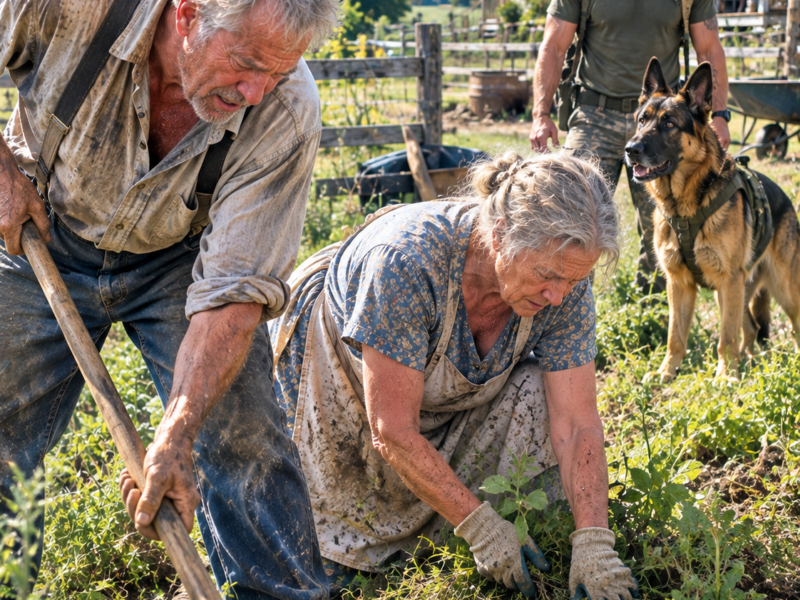
The moment I saw my father kneeling in the mud outside our family home, trying to repair a broken wheelchair with trembling hands
The front door slammed against the wall.
“Sheriff’s department! Nobody move!”
Rex launched himself into the hallway, barking so fiercely that the pictures on the walls trembled. I grabbed the metal box from the cabinet, shoved the folder beneath my jacket, and stepped between my parents and the men entering our home.
Sheriff Richard Mallory came through the doorway first.
Behind him stood Warren Cole, wearing the same expensive dark coat I had seen in the photograph. His expression was calm, almost amused, as if he had arrived to settle a disagreement over a property line rather than break into an elderly couple’s house.
“Daniel Hayes,” Mallory said. “Step away from the cabinet.”
I looked at the sheriff’s uniform, then at the hand resting near his belt.
“You have a warrant?”
“We have a report of stolen government property.”
“From my parents’ house?”
“Evidence suggests this residence contains documents belonging to a federal investigation.”
“Then bring the federal investigators.”
Mallory’s expression hardened.
“Don’t make this difficult.”
Behind me, my father struggled to stand straight. My mother had one hand on his shoulder, her face drained of color.
I knew what the sheriff wanted. He wanted the box.
He wanted the photographs, the recordings, the documents connecting Warren Cole to the theft of elderly residents’ homes. Most importantly, he wanted the file that linked my military service to a federal operation I had never known existed.
And he wanted it before I understood what it meant.
I slipped the brass key into my pocket.
“Dad,” I said without turning around, “take Mom to the kitchen.”
My father didn’t move.
“Daniel, don’t.”
“Please.”
Something in my voice finally reached him. He helped my mother toward the kitchen, but she kept looking back at me.
Warren Cole smiled.
“Your father always was stubborn. I warned him this would happen.”
I turned toward him.
“You warned him about what?”
“That old people make mistakes when they believe they understand things they don’t.”
“You mean when they discover someone is stealing their property?”
His smile faded.
Mallory stepped forward.
“Enough. Hand over the box.”
“No.”
The sheriff’s hand moved toward his belt.
Rex barked again, positioning himself between Mallory and me. His ears were forward, his body rigid, but he waited for my command.
I placed a hand on his harness.
“Easy, boy.”
Mallory glanced at the dog.
“Control that animal.”
“He’s under control.”
“Then make him stand down.”
“Give me a lawful reason to hand over my property, and we can talk.”
For a moment, the only sound in the room was Rex’s low growl.
Then Cole reached inside his coat and produced a folded document.
“Your parents signed away their rights to this property. The house belongs to Blue Ridge Asset Management. Your father has been occupying it unlawfully.”
My father appeared in the kitchen doorway.
“That’s a lie!”
Cole didn’t even look at him.
“The documents are filed with the county.”
“They’re forged,” I said.
“That’s a serious accusation.”
“So is fraud.”
Mallory held out his hand.
“The box. Now.”
I looked at the sheriff.
“You closed every complaint against Blue Ridge. Sixteen properties transferred to the same holding company. Elderly owners suddenly buried in debts they never owed. Your office called every case a civil dispute.”
His expression changed.
Only slightly, but I saw it.
“You’ve been doing your homework,” he said.
“Someone had to.”
“You don’t understand how these things work.”
“I understand enough to know you shouldn’t be here without a warrant.”
Cole leaned closer.
“Daniel, you’re a former Marine. You know what happens when a man decides he’s above the law.”
I met his eyes.
“I also know what happens when a man hides behind it.”
His smile disappeared completely.
Mallory stepped toward me.
“Last chance.”
Before he could reach the box, Rex suddenly turned toward the front window and barked.
A vehicle had pulled into the driveway.
Its headlights swept across the living room, illuminating the sheriff’s face.
A woman climbed out and approached the porch with a leather briefcase in one hand.
She wore a dark suit and a small identification badge clipped to her jacket.
“Sheriff Mallory,” she called through the open doorway. “Step away from the evidence.”
Mallory went pale.
Cole took one step backward.
The woman entered the house.
“My name is Special Agent Laura Bennett. Federal Bureau of Investigation.”
She held up her credentials.
“And if either of you touches another document in this room, I’ll have you both detained for obstruction of a federal investigation.”
For the first time since I had returned home, Warren Cole looked afraid.
And that was when I realized he had never expected anyone to arrive who could actually stop him.
Agent Bennett asked everyone to remain in the living room while she examined the documents.
Mallory protested immediately.
“This is a local property dispute. You have no reason to interfere.”
Bennett didn’t look up from her identification.
“Then you won’t mind explaining why your office repeatedly closed complaints involving the same registered agent, the same holding companies, and the same alleged victims.”
Mallory’s jaw tightened.
“I’d like to speak with my attorney.”
“That’s a good idea.”
Cole attempted to leave.
Two additional agents entered from outside and stopped him near the door.
“Mr. Cole,” Bennett said, “please remain where you are.”
“This is harassment.”
“Then I’m sure you’ll be happy to explain everything during your interview.”
I stood beside the cabinet, still holding the metal box.
Bennett turned to me.
“Sergeant Hayes?”
“Former Marine.”
“I know who you are.”
That answer made me uneasy.
She noticed.
“Your parents contacted our office eleven months ago,” she explained. “Their complaint was referred to a local agency for preliminary review. It never reached our investigative team.”
“Why not?”
“Because the referral was marked as a property dispute with insufficient evidence.”
“Who marked it that way?”
She glanced at Mallory.
“We’re still determining that.”
I opened the metal box and set it on the table.
“Then you should start here.”
Bennett examined the contents without touching them.
Photographs. Property records. Copies of bank statements. A sealed envelope containing an old audio cassette and a small digital storage device.
Then she saw the military personnel file.
Her expression changed.
“Where did you find this?”
“In the cabinet.”
“Has anyone else handled it?”
“My father, my mother, and me. The sheriff and Cole came in after I opened it.”
She nodded to another agent, who began photographing the room.
“Mr. Hayes, I need to ask you something. Have you ever participated in a classified investigation involving military procurement fraud?”
“No.”
“Have you ever been interviewed by a federal investigator about Sergeant Michael Turner?”
The name struck me like a physical blow.
“No.”
Bennett looked at the file again.
“Then someone has withheld important information from you.”
I glanced toward the kitchen.
My father stood in the doorway, his face gray.
“Dad,” I said quietly. “Who was Michael Turner?”
He lowered his head.
“I was hoping you’d never have to ask that question.”
“Who was he?”
My father looked at the agent, then at my mother.
For years, he had been the strongest man I knew. He had carried injured neighbors out of burning houses, worked through broken ribs, and refused to let a winter storm keep him from repairing the roofs of elderly people who couldn’t afford help.
Now he looked as though he might collapse under the weight of a single name.
“He was the son we lost before we lost you,” he whispered.
I couldn’t understand the words.
“What?”
My mother came forward and took my hand.
“Daniel, there’s something we should have told you a long time ago.”
Agent Bennett quietly closed the file.
“Mr. and Mrs. Hayes, I think we should continue this conversation somewhere secure.”
My father shook his head.
“No. He’s waited long enough.”
He looked directly at me.
“Michael Turner was your older brother.”
For several seconds, I heard nothing.
Not the agents moving around the room. Not Rex’s breathing. Not the rain tapping against the windows.
I stared at my father.
“I don’t have a brother.”
“You did.”
“No. You told me I was an only child.”
My mother began to cry.
“We thought we were protecting you.”
“From what?”
My father sank into a chair.
“From the truth.”
And then, in the living room where I had spent my childhood believing I knew my family, my father began to tell me the story of the brother I had never known.
Michael had been born six years before me.
My parents had raised him in the same house where I had grown up, teaching him to ride a bicycle on the gravel driveway and taking him fishing at the lake beyond the hills.
According to my father, Michael had been brilliant, stubborn, and determined to make a difference.
He studied criminal justice at a state university and later joined a federal investigative unit that worked on public corruption and financial crimes.
His work focused on government contractors, procurement fraud, and the misuse of public funds.
At first, my parents were proud.
Michael was doing exactly what they had taught him to do: standing up for people who couldn’t defend themselves.
Then, about fifteen years ago, he began investigating a network of contractors who were buying distressed properties through fraudulent liens and transferring the deeds into shell companies.
The operation seemed small at first.
An elderly homeowner would receive a notice claiming unpaid taxes. A legal representative would offer to help. A few weeks later, the homeowner would discover that the property had been transferred or encumbered by a debt they had never agreed to.
The victims often lacked the money to fight the case.
Some were too ill to understand what had happened.
Others were intimidated into leaving their homes.
Michael followed the money.
The trail led to Blue Ridge Asset Management, then to a network of related businesses, and eventually to a private defense contractor called Meridian Tactical Solutions.
The company handled logistics and property management for government facilities. It also maintained warehouses, training sites, and transport contracts for several federal agencies.
That connection transformed a property fraud investigation into something far more dangerous.
Michael discovered that some of the stolen properties had been used to conceal assets connected to illegal government contracts.
Buildings were transferred to shell companies, renovated with public money, and then used as temporary storage sites. Financial records were moved between businesses to disguise payments. Property owners who asked questions were pressured into signing agreements they didn’t understand.
Some of the money had come from military procurement accounts.
Some of it had disappeared into private companies.
And some had funded operations that were never properly recorded.
Michael began collecting evidence.
He made copies of financial statements, recorded conversations, and kept a ledger linking the shell companies to their true owners.
One of those owners was Warren Cole.
Another was a senior official responsible for approving certain defense contracts.
My father couldn’t remember every detail, but he remembered the night Michael came home for the last time.
It was raining.
Michael arrived after midnight, carrying a battered briefcase. He looked exhausted and kept checking the windows.
He told my parents that he had found evidence of a criminal network operating inside several public agencies.
He said the evidence was enough to bring down the people involved.
But before he could submit it, his supervisor warned him that the investigation had been compromised.
Someone inside the system was leaking information.
Michael didn’t know whom to trust.
He gave my parents copies of several documents and instructed them to hide them.
Then he left.
Two days later, my parents received a phone call.
The caller claimed to be a federal officer.
He told them Michael had died in an accident while traveling to meet a witness.
No body was shown to the family.
No official report was provided.
When my father demanded answers, he was told the investigation was classified.
For years, my parents believed their eldest son was dead.
Then, eleven years ago, shortly before my first overseas deployment, an unknown person sent them a photograph.
It showed Michael standing outside a warehouse.
He was alive.
On the back of the photograph were six words.
THEY KNOW WHERE YOUR YOUNGEST SON SERVES.
My father stared at the message for hours.
He had already watched one son disappear.
He couldn’t bear the possibility of losing another.
So he and my mother made a decision that would shape the rest of their lives.
They told no one.
They hid the evidence.
They allowed people to believe Michael was dead.
And when I joined the Marines, they said nothing about my brother.
Not because they didn’t love me.
Because they were terrified that knowing the truth would make me a target.
I stood beside the table, struggling to process what I had heard.
“You let me believe I was an only child.”
My mother reached for me.
“We thought we were saving your life.”
“You let me attend funerals for men I served with. You let me spend years believing people were dead while you were hiding the fact that my own brother might be alive.”
“Daniel—”
“You should have told me.”
My voice was louder than I intended.
Rex moved closer, pressing his head against my thigh.
My father flinched.
I hated that he did.
I had spent years training to stay calm under pressure. I had learned to control anger, fear, and grief because losing control could get people killed.
But there was no training for discovering that the foundation of your entire life had been built on a lie.
Agent Bennett gave us a few minutes.
Then she asked my parents to accompany her to a secure location while the agents processed the evidence.
My father agreed.
My mother took my hand before leaving.
“Your brother loved you,” she said. “He asked us to keep you safe.”
I looked away.
“Then why does everyone in this family think lying is the same thing as protecting someone?”
She had no answer.
When the agents finally left with the evidence, I remained in the living room with Rex.
The house was quiet.
For the first time since arriving, I was alone with the truth.
My brother was alive.
Or at least, someone had believed he was alive eleven years ago.
And if he had survived, he might still be out there somewhere, waiting for someone to finish the investigation he had started.
I took out my phone and searched for his name.
Nothing useful appeared.
No recent photographs. No public records. No obituary beyond a brief notice that had been withdrawn years earlier.
Then my phone vibrated.
An unknown number.
A message contained a photograph of a man standing outside a train station.
His hair was gray at the temples. His face was thinner than the one in the old family photographs.
But I recognized the eyes.
Below the picture was a single sentence.
YOUR PARENTS DIDN’T TELL YOU EVERYTHING. ASK THEM WHAT HAPPENED AT BLACK RIDGE.
I stared at the screen.
Then a second message arrived.
AND DON’T TRUST THE FBI AGENT WHO TOOK THE BOX.
I didn’t sleep that night.
Agent Bennett had arranged for my parents to stay at a secure hotel while investigators examined the house. She told me she would contact me in the morning with an update.
But the message on my phone changed everything.
I didn’t know who had sent it. I didn’t know whether it was a warning or a trap.
What I knew was that someone had access to information about my brother, my parents, and a classified military file.
Someone knew I had discovered the truth.
And someone wanted me to believe the FBI agent might be part of the conspiracy.
I looked at Rex.
He sat beside the bed, watching me.
“You think we should trust her?”
His ears moved.
That wasn’t an answer.
I had learned long ago that a working dog could detect a person’s stress, fear, and unusual behavior. But Rex wasn’t a magical lie detector. He couldn’t tell me whether Agent Bennett was corrupt.
He could, however, help me notice things I might otherwise miss.
I opened the photo again and studied the background.
The man was standing outside a train station, but the sign above the entrance was partly obscured. Behind him, a digital display showed a departure time.
I zoomed in.
The station wasn’t in Kentucky.
It was in West Virginia.
More specifically, it appeared to be the old station in Ashford, a town about three hours east of my parents’ home.
I searched my brother’s name alongside the town.
One result appeared in an archived local newspaper.
A report from eleven years earlier described a fire at an abandoned industrial facility near Black Ridge. Authorities had identified one body but had been unable to confirm the identity of a second person believed to have been inside the building.
The article had been updated several days later.
The second person was listed as unknown.
I checked the date.
The fire had occurred six weeks after my final deployment.
I opened the photograph again.
Black Ridge.
The message had told me to ask my parents what happened there.
I called my father.
He answered immediately.
“Daniel?”
“Dad, what happened at Black Ridge?”
Silence.
“Where did you hear that name?”
“Someone sent me a message.”
“Who?”
“I don’t know.”
My father breathed heavily into the phone.
“Listen to me. You need to stay away from that place.”
“Why?”
“Because your brother went there before he disappeared.”
I closed my eyes.
“Did he die there?”
“I don’t know.”
“Dad, I need the truth.”
“I told you everything I know.”
“No, you told me the story you thought I could handle.”
He didn’t respond.
I heard my mother speaking faintly in the background.
Then my father said, “Your brother believed the evidence was hidden at Black Ridge. He thought the original ledger was stored in a building connected to Meridian Tactical Solutions.”
“Did he find it?”
“He never told us.”
“Why didn’t you tell the FBI?”
“Because the agent who handled our original complaint told us the investigation was closed. She said Michael had died and that any further contact could put you in danger.”
“Who was the agent?”
My father hesitated.
“Laura Bennett.”
The room seemed to tilt.
The message had warned me not to trust the woman who had taken the box.
Now my father was telling me she had been involved in the case years earlier.
“Dad, did she know Michael was alive?”
“I don’t know.”
“Did she take the evidence from you?”
“No. We never met her in person. We spoke to her supervisor.”
I thought about the documents in the metal box.
The personnel file had been hidden in my parents’ cabinet for years. Agent Bennett had seemed genuinely surprised to see it.
Maybe she had been.
Or maybe she had known exactly what she was looking for.
“I’m going to Black Ridge,” I said.
“No!”
My father’s voice cracked.
“Daniel, please. Your brother went there, and we never saw him again. I cannot lose you too.”
I looked at Rex.
“I’ll be careful.”
“That’s what Michael said.”
The words struck harder than I expected.
I ended the call and sat quietly for a moment.
Then I opened the photograph one more time.
My brother was alive in the image.
He was looking directly into the camera.
And I couldn’t shake the feeling that he had known I would eventually see it.
Black Ridge was an abandoned industrial site surrounded by wooded hills and an old chain-link fence.
The facility had once processed materials for a defense contractor. After the company went bankrupt, the buildings were left empty, and the access road gradually disappeared beneath weeds and fallen branches.
I arrived shortly after dawn.
Rex and I approached on foot.
The dog moved ahead of me, sniffing the ground and checking the edges of the road. I kept my pace slow, looking for signs of recent activity.
There were tire tracks in the mud.
Fresh ones.
Someone had been here recently.
The main building stood behind a row of rusted storage tanks. Several windows were broken, and the roof had partially collapsed. A faded sign beside the entrance still carried the name Meridian Tactical Solutions.
I checked the door.
Unlocked.
Inside, the air smelled of dust and damp concrete.
I moved through the main hall, examining the rooms. Most were empty, but a few contained broken desks, filing cabinets, and old electrical equipment.
At the far end of the building, Rex stopped.
His ears lifted.
He sniffed the lower edge of a metal door and gave a short bark.
I knelt beside him.
The door had a new lock.
I checked the surrounding frame and noticed a narrow gap beneath it. There were scratches on the floor, as if someone had dragged a heavy object through the doorway.
I tried the handle.
Locked.
I stepped back and studied the frame.
The door had been installed recently, but the wall around it was old. A section of plaster near the hinge had been disturbed.
Someone was hiding something.
I used a tool from my kit to loosen the damaged panel.
Behind it was a narrow opening containing a small key taped to the inner wall.
I removed it and unlocked the door.
The room beyond was colder than the corridor.
Inside stood a desk, a filing cabinet, and a chair facing a wall-mounted monitor.
A paper cup sat beside the keyboard.
Still clean.
Someone had been here very recently.
On the desk lay a photograph.
I picked it up.
It showed my brother standing beside a younger version of Warren Cole. They were outside a building marked with a federal seal.
On the back, someone had written:
MICHAEL TURNER — CONFIDENTIAL SOURCE.
My hands tightened around the photograph.
My brother hadn’t merely investigated the network.
He had been working with federal authorities.
He had been a confidential source.
And someone inside the system had exposed him.
I opened the filing cabinet.
The first drawer contained copies of property deeds. The second held payment records and internal correspondence. The third was locked.
I found a small key taped beneath the desk.
Inside the drawer was a folder marked with a date from eleven years earlier.
The date of my deployment.
I opened it.
The first document was a list of military personnel assigned to a classified operation.
My name was there.
So were the names of the men who had served beside me.
The next page contained a series of notes about our movements, our assignments, and our expected return date.
At the bottom was a handwritten line.
OPERATION BLACK RIDGE: SECONDARY OBJECTIVE — IDENTIFY AND SECURE TURNER EVIDENCE.
I read it again.
My deployment hadn’t been a separate event.
It had been connected to my brother’s investigation.
I had been sent overseas while people were searching for the evidence he had collected.
And someone had used my unit’s mission as cover.
A faint sound came from the corridor.
Footsteps.
I closed the folder and moved behind the filing cabinet.
Two men entered the room.
One wore a dark jacket. The other carried a small case.
“Did you find the drive?” the first man asked.
“No,” the second replied. “The room was cleared before we arrived.”
“Then someone has it.”
“Cole said the Marine was back in town.”
The first man cursed.
“Find him. If Turner made contact, Hayes will follow the trail.”
My heart hammered.
They knew I was here.
The second man walked toward the desk.
“There’s something else. Bennett called.”
I froze.
“What did she say?”
“She wants the file delivered to her office before noon.”
“And Cole?”
“She says Cole is no longer a priority.”
The first man laughed bitterly.
“That’s what she said about the last three witnesses.”
The words settled over me like ice.
The message had been right.
Agent Bennett was connected to the operation.
I waited until the men moved into the adjoining room, then slipped out through the corridor and made my way toward the rear exit.
Rex stayed close, moving silently beside me.
We reached the woods before I heard the first shout.
“Hey! Stop!”
I ran.
Branches struck my face. Wet leaves slid beneath my boots. I heard footsteps behind us, followed by a gunshot that echoed through the trees.
Rex barked once, then continued forward.
We reached the service road and crossed it into a dense patch of woodland.
I didn’t stop until we were several hundred yards from the building.
Then I crouched behind a fallen tree and checked the folder.
It was still there.
The evidence had confirmed my worst suspicion.
My military deployment had been connected to my brother’s investigation.
And the federal agent assigned to protect the case might have been helping the people who wanted it buried.
But there was one detail I couldn’t explain.
The men had said Cole was no longer a priority.
Why?
What had changed?
I pulled out my phone.
An unknown number had sent another message.
YOU’RE CLOSE. GO TO THE OLD CHURCH ON MILLER ROAD. COME ALONE.
A second message followed.
I’M YOUR BROTHER.
I didn’t believe the message.
Not immediately.
It could have been a trap designed to lure me away from Rex and the evidence. Anyone who had access to the documents could have copied my brother’s name and used it to manipulate me.
But the message contained a detail no stranger should have known.
You still owe me ten dollars for the fishing boat.
I stared at the screen.
I had never owned a fishing boat.
But when I was eight, my father had built one from scrap wood for Michael. My brother had promised to let me use it if I helped him paint it.
I had accidentally knocked over the paint can, ruining the floor of the garage.
Michael had laughed and told me I owed him ten dollars.
For years, I had believed the memory was nothing more than a childhood joke.
Now it was the first proof I had that my brother might truly be alive.
I looked at Rex.
“We’re going to a church.”
The old church on Miller Road had been closed for nearly a decade. Its steeple leaned to one side, and weeds covered the steps.
I parked behind a stand of trees and approached on foot.
The front door was open.
Inside, dust floated through the pale morning light. Wooden pews lined the sanctuary, and a faded cross hung above the altar.
A man stood near the back.
His hair was gray. His face was thinner than the photograph. A scar crossed his left cheek, and he leaned slightly to one side as though one leg had never healed properly.
But his eyes were the same.
“Daniel,” he said.
I couldn’t move.
He took one step forward.
“You got tall.”
I laughed once, a short, broken sound.
“You’re supposed to be dead.”
“So I’ve heard.”
I stared at him.
“Are you really Michael?”
He reached into his coat slowly and pulled out an old photograph.
It showed two boys standing beside a half-painted wooden boat.
I recognized myself immediately.
I was missing one front tooth, and my shirt was covered in blue paint.
Michael stood beside me, grinning, with one arm around my shoulders.
On the back, in my mother’s handwriting, were the words:
MY BOYS — SUMMER OF 1998.
My knees nearly gave way.
“Why?” I whispered.
Michael’s expression softened.
“Because I found evidence that people inside the investigation were working with the criminals I was trying to expose. When I tried to report it, they turned the investigation against me.”
“You let Mom and Dad believe you were dead.”
“I thought it was the only way to keep them safe.”
“You let me believe I was an only child.”
“I know.”
“You watched me go to war without telling me what was happening.”
Michael lowered his head.
“I know.”
Anger rose inside me, but beneath it was something worse.
Grief.
I had spent years imagining the brother I might have had. I had wondered what it would have been like to have someone older to call when I was struggling, someone who understood our parents, someone who remembered the same childhood.
And he had been alive.
Somewhere in the world, he had been alive while I buried friends and learned to live with the things I had seen.
“You should have trusted me,” I said.
Michael nodded.
“I should have.”
“Why didn’t you?”
“Because the first time I tried to bring the evidence to federal investigators, someone gave them my location. Two days later, the warehouse where I was staying burned down. I barely escaped.”
He looked at Rex.
“Nice dog.”
“He’s better company than most people.”
Michael almost smiled.
Then his face became serious.
“Daniel, your deployment wasn’t an accident. The operation you were assigned to was designed to recover evidence connected to my investigation.”
I already knew the file had linked them.
Hearing him say it made the truth undeniable.
“You were the secondary objective,” he continued. “The people behind the operation wanted to locate the original ledger. They believed I had hidden it at Black Ridge.”
“Did I know any of this?”
“No. You were given a legitimate mission briefing, but the intelligence had been manipulated. Your team was being used as cover while a separate group searched for the archive.”
“What happened to my team?”
Michael closed his eyes briefly.
“The operation was compromised. I don’t know who gave the final order to attack your unit, but I know the attack was used to cover the theft of the evidence.”
I felt sick.
“My friends died because of a property fraud investigation?”
“No. They died because powerful people believed the evidence threatened their entire operation. The property fraud was one part of it. The military contracts were another.”
“Who ordered it?”
Michael looked toward the stained-glass windows.
“I have a name. But I need proof.”
“Vance?”
He nodded.
“Deputy Secretary Malcolm Vance authorized the operation that brought your unit into the area. But the final orders came through a chain of intermediaries. If we accuse him without the original records, he’ll say he never knew what was happening.”
I thought of the file in my jacket.
“I found the authorization.”
Michael’s eyes widened.
“You found it?”
“Not the original ledger. But I found a folder showing that my mission was linked to Black Ridge.”
He stepped closer.
“Where is it?”
“Safe.”
He studied me, then nodded.
“Good. Because the original ledger isn’t at Black Ridge anymore.”
“Where is it?”
Michael looked at me for a long moment.
“Your parents have it.”
I stared at him.
“What?”
“Not the whole ledger. The key to it. The original records were divided into three parts. I hid the first at Black Ridge. The second was sent to your parents. The third was kept by a federal investigator I believed I could trust.”
“Agent Bennett.”
Michael’s expression darkened.
“Yes.”
“She’s working with Cole.”
“She was supposed to protect the evidence. Instead, she gave Cole access to the investigation.”
I thought of the agents removing the box from my parents’ house.
“Then we need to get it back.”
Michael nodded.
“There’s one more thing.”
He reached into his coat and handed me a small envelope.
Inside was a photograph of a man standing beside a military vehicle.
I recognized him.
Not because I had seen him in the news.
Because I had served under him.
Colonel James Whitaker.
My former commanding officer.
The man who had recommended me for a medal after our deployment.
The man who had stood beside me at the memorial service for my fallen teammates.
The man who had told me that our mission had been a tragedy, but not a betrayal.
On the back of the photograph was a handwritten note.
WHITAKER SIGNED THE FINAL OPERATIONAL AUTHORIZATION.
I looked up.
“My commander?”
Michael nodded.
“He wasn’t supposed to know about the property investigation. But his signature appears on the final orders. I believe he was told the operation involved a legitimate security threat. I don’t know whether he understood the real objective.”
“Why didn’t you tell the investigators?”
“Because the first investigator I told was the one who exposed my location.”
I thought of the unknown message warning me not to trust Bennett.
The conspiracy had been built around a simple strategy.
Find the person who knew too much.
Make them look unreliable.
Then bury the evidence.
I folded the photograph and put it away.
“We need to get to Mom and Dad.”
Michael nodded.
“I’ve been trying to reach them for months. But every time I got close, Cole’s people appeared.”
“Then we stop running.”
He looked at me.
“That’s what I was hoping you’d say.”
For the first time since I had learned he existed, I felt something other than anger.
I felt relief.
My brother was alive.
And this time, I wasn’t going to let him disappear.
We returned to Kentucky under cover of darkness.
Michael rode in the back seat with Rex, who watched him closely for the first twenty miles before finally resting his head against his leg.
“You’ve got a good dog,” Michael said.
“He doesn’t trust people easily.”
“Smart animal.”
I glanced at him in the mirror.
“Where have you been all these years?”
“Everywhere.”
“That isn’t an answer.”
He looked out the window.
“I spent time in Canada. Then I moved between safe houses in several states. I worked with private investigators who helped me trace the companies connected to Cole. I sent information to journalists, but the evidence was always incomplete.”
“Why didn’t you go public?”
“Because every time I tried, someone leaked my location. I couldn’t prove who was responsible, and I couldn’t risk leading them to our parents.”
I tightened my hands on the steering wheel.
“You were trying to protect us.”
“Yes.”
“And you thought letting us believe you were dead was the best way?”
“No,” he admitted. “I thought it was the only way.”
The distinction mattered to him.
It didn’t yet matter to me.
We reached the hotel where my parents were staying shortly after midnight. Agent Bennett had left two agents outside the entrance, but neither was visible when we arrived.
Michael noticed immediately.
“Something’s wrong.”
I parked around the corner.
We approached the building on foot, keeping to the side entrance.
The lobby was empty.
A security guard sat behind the desk, staring at his phone. He looked up when we entered.
“Can I help you?”
“I’m looking for Daniel Hayes’s parents.”
“Room 214.”
“Are they still there?”
He hesitated.
“They left about an hour ago.”
“Who took them?”
“A woman from the federal team. She said they were being moved to another location.”
Michael and I exchanged a glance.
“Did she give you a name?” I asked.
The guard shook his head.
I pulled out my phone and called Agent Bennett.
She answered immediately.
“Daniel. I was about to contact you.”
“Where are my parents?”
“Safe.”
“Where?”
“I can’t disclose the location over an unsecured line.”
“Then meet me.”
A pause.
“There’s no need for that. We have the situation under control.”
“Your agents moved my parents without telling me.”
“It’s standard protective procedure.”
“Who authorized it?”
“I did.”
I looked at Michael.
He shook his head slightly.
I continued.
“Are they with you right now?”
“Yes.”
“Put my mother on the phone.”
“Daniel, that’s not appropriate.”
“Put her on the phone.”
Her voice hardened.
“You need to stop interfering with this investigation. You have evidence that belongs to the government, and you have repeatedly entered restricted locations without authorization. If you continue, you could jeopardize the entire case.”
“I’m trying to protect my family.”
“And I’m trying to protect witnesses.”
“Then prove it.”
Silence.
I heard a faint noise in the background.
A door closing.
Then Bennett spoke again.
“Go home, Daniel. I’ll call you tomorrow.”
She ended the call.
Michael took my phone and examined the screen.
“She isn’t protecting them.”
“How can you be sure?”
“Because she never asked whether they were safe. She only asked whether you had the evidence.”
I looked toward the lobby entrance.
A black sedan had pulled up outside.
The driver remained behind the wheel.
The rear window lowered slightly.
A face appeared in the darkness.
Warren Cole.
He looked directly at us.
Then the window rose, and the car drove away.
Michael swore under his breath.
“They’re moving faster than I expected.”
“Where would they take our parents?”
“Somewhere they can control access. Somewhere official enough that no one questions it.”
I thought of the property records.
The care company.
The fake legal documents.
The homes transferred to holding companies.
Then I remembered the wheelchair in my parents’ house.
Hollow Creek Care Services.
“They’ve been using the care company to move elderly people,” I said. “What if my parents aren’t in a hotel or a safe house? What if they’re in one of those facilities?”
Michael’s face changed.
“There’s a place near the county line. Hollow Creek’s main residential center. It’s listed as a rehabilitation facility, but I found records showing that several residents had been transferred there shortly before their properties changed ownership.”
“Then that’s where we go.”
He nodded.
“First, we call someone we can trust.”
“Who?”
“An attorney named Rachel Foster. She helped me document the original property fraud before the investigation was compromised. She’s been trying to find me for years.”
“Why should we trust her?”
“Because she’s the reason the original evidence still exists.”
He gave me a number.
I called.
A woman answered after two rings.
“Foster.”
“My name is Daniel Hayes. Michael Turner told me to call.”
Silence.
Then her voice changed.
“Is Michael with you?”
“Yes.”
“Are you both safe?”
“For now.”
“Listen carefully. Do not go to Hollow Creek without law enforcement. The facility is connected to a network of companies that have been under investigation for years. Several witnesses disappeared after being transferred there.”
“Are you saying the place is being used to hold people against their will?”
“I’m saying we have evidence of fraudulent admissions, unlawful financial control, and the deliberate isolation of vulnerable adults. We have not yet proved every allegation.”
“Can you help us get our parents out?”
“Yes. But we need to do this legally and quickly.”
I looked at Michael.
For the first time that night, he seemed relieved.
“Tell us what to do,” I said.
Rachel Foster met us at a small law office in the next town.
She was in her late fifties, with silver hair and a steady gaze. The office walls were lined with shelves of legal files, and a framed photograph of an elderly couple stood beside her desk.
She shook Michael’s hand first.
“You look terrible.”
“Good to see you too, Rachel.”
Then she turned to me.
“Daniel Hayes. I’ve heard a great deal about you.”
“None of it good, I assume.”
“Mostly that you were a brave young man who didn’t know he was being used.”
I didn’t like the sound of that.
She noticed.
“I’m not blaming you. I’m telling you what the evidence suggests.”
She opened a file.
“Your brother contacted me shortly after his investigation was compromised. He believed the property fraud and the military procurement scheme were linked. He was right.”
She placed three documents on the desk.
“The first is a list of properties transferred to Blue Ridge Asset Management. The second is a record of payments made through Meridian Tactical Solutions. The third is a chain of communications involving Warren Cole, Sheriff Mallory, and several officials connected to the county government.”
I studied the names.
There were more than I expected.
Judges. Lawyers. Financial officers. A former county commissioner.
And Colonel James Whitaker.
His name appeared beside a payment routed through a consulting firm.
I looked at Michael.
“You said you didn’t know whether he understood what he was signing.”
“I didn’t.”
Rachel tapped the page.
“This payment doesn’t prove he was part of the conspiracy. It does, however, establish a connection that needs to be investigated.”
I sat back.
For years, I had trusted Whitaker’s judgment without question. He had been the officer who taught me to remain calm under pressure, to protect my team, and to take responsibility for every decision I made.
If he had knowingly betrayed us, I didn’t know what that would mean.
Rachel continued.
“The most important evidence is still missing. We have copies of the financial records, but the original ledger contains the authentication data needed to prove who authorized the transfers.”
“Where is it?” I asked.
“Your parents may know.”
Michael leaned forward.
“They were given the second part of the ledger. I hid the first at Black Ridge. The third was held by the original federal investigator.”
Rachel nodded.
“And that investigator disappeared shortly after Michael’s location was compromised.”
“Who was it?”
“Agent Peter Lawson.”
The name meant nothing to me.
Rachel opened another file.
“Lawson was the agent who originally recruited Michael as a confidential source. He was also the person who warned him that the investigation had been compromised.”
“Was Lawson corrupt?”
“We don’t know. He may have been killed. He may have gone into hiding. Or he may have been part of the operation from the beginning.”
I rubbed my face.
“Everyone seems to be either missing, corrupt, or dead.”
“That’s because the people behind this spent years making sure no one could build a complete picture.”
Rachel looked at me directly.
“But we have something they didn’t expect.”
“What?”
“Two witnesses who can connect the property fraud to the military operation. One of them is alive when the criminals believed he was dead. The other is a decorated Marine who was deliberately kept in the dark.”
I didn’t like being described as a witness.
I liked even less the thought that my ignorance had been part of the plan.
Rachel closed the file.
“We’re going to contact the U.S. Attorney’s Office and request an emergency protective order for your parents. We can also seek a court order preventing any further transfer of their property.”
“How long will that take?”
“If the judge understands the urgency, we may have temporary relief by morning.”
“And if Bennett interferes?”
Rachel looked at Michael.
“Then we’ll make sure the request goes directly to the prosecutor supervising the case.”
She reached for her phone.
Before she could dial, it rang.
She answered.
Her face changed as she listened.
“What do you mean, the building is empty?”
She stood.
“Are you certain?”
A pause.
“Send me the records. Now.”
She ended the call.
“Hollow Creek’s residential center was evacuated an hour ago. Every resident has been transferred to another location.”
“Where?”
“We don’t know.”
Michael swore.
Rachel looked at me.
“But we have one lead. A former employee reported that the transfers were being arranged through a private transport company. The company uses a warehouse near Black Ridge.”
The same place where we had found the file.
The same place where the men had searched for the drive.
The same place that connected my brother’s disappearance to my deployment.
I stood.
“Then we go back.”
Rachel shook her head.
“Not without the authorities.”
“We’ve already lost hours.”
“And if you rush in without a plan, you’ll lose your parents.”
She was right.
I hated that she was right.
So we did something I had never imagined doing when I left the Marines.
We asked for help.
Rachel contacted the U.S. Attorney’s Office directly, bypassing the local chain of command. She submitted the documents we had found and requested an emergency search warrant for the warehouse and the Hollow Creek facilities.
Michael provided a sworn statement describing the original investigation.
I gave a detailed account of the military file, the suspicious operation, and the men we had encountered at Black Ridge.
The prosecutor listened without interrupting.
Then she asked one question.
“Do you have proof that your parents are being held against their will?”
“No,” I said. “Not yet.”
“Then we need to move carefully.”
I leaned forward.
“My parents are elderly. Their property was stolen. Their savings were drained. Someone has threatened them, and now they’ve been moved without my knowledge. If they’re being held somewhere, every minute matters.”
The prosecutor studied me.
Then she nodded.
“I’ll request the warrant.”
For the first time in years, the investigation was moving in the right direction.
But the people behind the conspiracy weren’t finished.
At 4:17 a.m., my phone rang.
It was my mother.
“Daniel?”
Her voice was barely audible.
“Mom? Where are you?”
“I don’t know. They took our phones, but I found one in an office.”
“Are you hurt?”
“No. Your father is with me.”
“Can you tell me what you see?”
She took a shaky breath.
“There’s a sign outside the window. It says Hollow Creek.”
My heart began pounding.
“Stay where you are. We’re coming.”
“Daniel, listen to me. The man who brought us here isn’t Warren Cole.”
“Who is it?”
My mother paused.
Then she whispered a name I had spent eleven years trying to forget.
“Colonel Whitaker.”
The phone went dead.
For several seconds, I sat motionless.
Colonel James Whitaker.
My former commanding officer.
The man who had signed the final authorization for my deployment.
The man whose name appeared in the property records.
The man who had stood beside me at the memorial service for my team and told me their deaths had not been in vain.
Now he was holding my parents at a care facility linked to a criminal network.
I felt the old anger rising, sharp and immediate.
Michael placed a hand on my shoulder.
“Don’t let him control your decisions.”
I looked at him.
“He used my team.”
“We don’t know everything yet.”
“We know enough.”
“No,” Michael said quietly. “We know enough to be angry. We don’t yet know enough to win.”
I hated hearing it.
But he was right.
We had spent years reacting to the moves of people who always seemed to know more than we did. If we rushed into the facility, we could give them another chance to destroy the evidence and disappear.
Rachel called the prosecutor and reported the new information.
Within an hour, a federal judge signed an emergency warrant authorizing a search of the Hollow Creek property and the seizure of records related to the alleged fraudulent transfers.
A team of federal agents was assembled.
Agent Bennett was not included.
When the lead investigator explained that Bennett had been removed from operational control pending an internal review, I felt a grim sense of confirmation.
She had not been cleared.
She had not been convicted either.
For now, she was simply another person whose role needed to be examined.
We reached Hollow Creek shortly after sunrise.
The facility stood behind a high fence, surrounded by neatly trimmed lawns and decorative trees. A sign near the entrance advertised assisted living, physical rehabilitation, and home-care services.
From the road, it looked respectable.
That was the most disturbing part.
The building didn’t look like a place where people were being isolated from their families. It looked like the kind of place a son might choose for his aging parents because he wanted them to receive good care.
A federal agent approached the front entrance with the warrant.
The doors remained locked.
A security guard appeared behind the glass.
He read the document, then disappeared.
Seconds later, the building’s lights went out.
The lead agent swore.
“Move!”
Agents spread around the facility as a vehicle engine roared from the rear parking lot.
A black van burst through a service gate and sped toward the road.
Two agents ran after it.
I spotted a second vehicle moving toward the rear exit.
“That’s them!”
I ran toward the side of the building.
Rex followed.
We reached a service door just as an employee tried to lock it from the inside. I pushed it open and entered a narrow corridor lined with supply closets.
“Federal agents!” someone shouted behind me.
I didn’t stop.
At the end of the hall, a stairwell led to the lower level.
I heard voices below.
One belonged to my father.
“Get your hands off me!”
I ran down the stairs.
Two men stood outside a storage room. One held my father by the arm. The other was trying to force my mother into the room.
I shouted.
“Let them go!”
Both men turned.
The first reached for his waistband.
Rex lunged forward, barking, forcing the man to stumble backward. I closed the distance and drove him against the wall, knocking the weapon from his hand.
The second man released my mother and ran.
I started after him, but my father grabbed my sleeve.
“Daniel! Your mother!”
I turned.
Mom was on the floor, breathing hard, one hand pressed against her chest.
I dropped beside her.
“Mom?”
She opened her eyes.
“I’m all right.”
I checked her pulse, helped her sit up, and called for medical assistance.
My father knelt beside her, his face twisted with fear.
Then he looked at me.
“Whitaker took the documents.”
“What documents?”
“The original ledger. He knew we had it.”
I felt the world narrow.
“Where is he?”
My father pointed toward the loading bay.
“He left in the van.”
I stood.
Outside, sirens filled the air.
Federal agents had blocked the main road, but the black van had already reached the service gate.
A helicopter circled overhead.
The lead agent spoke into his radio.
“Vehicle heading east. Suspect may be armed. Do not engage unless necessary.”
I looked toward the road.
Whitaker was escaping with the evidence.
And this time, I knew exactly why.
The ledger could prove that the operation that killed my teammates had been part of the same network that stole my parents’ home.
It could prove who signed the orders.
It could prove that my brother had been telling the truth all along.
I turned to my father.
“Where did you hide the original?”
He shook his head.
“Whitaker has it.”
“No. You said he took the documents. Which documents?”
My father hesitated.
Then he looked at my mother.
She reached into her cardigan and pulled out a small, folded piece of paper.
“He took the ledger,” she whispered. “But not the key.”
She handed it to me.
It was a thin sheet of paper with a sequence of numbers written in my father’s handwriting.
At the bottom was a short note.
THE ORIGINAL IS NOT A BOOK. IT IS A RECORDING.
I looked at Michael, who had arrived behind me.
His expression changed.
“The third part,” he said. “The original recording.”
“What does it contain?”
Michael stared toward the road where Whitaker had disappeared.
“The voice of the man who ordered the operation.”
The chase lasted less than twenty minutes.
Federal agents tracked Whitaker’s van to an abandoned warehouse outside town. When they arrived, the vehicle was empty.
Whitaker had escaped on foot.
The warehouse contained several boxes of files, a set of forged property documents, and equipment used to copy government records. There was no sign of the original ledger or the recording.
But one thing had been left behind.
A photograph.
It showed Whitaker standing beside Warren Cole outside a military facility. Behind them stood Deputy Secretary Malcolm Vance.
On the back, someone had written:
THE THREE WHO SIGNED THE ORDER.
Whitaker was not simply a former commander who had made a questionable decision.
He had been part of the conspiracy.
He had helped authorize the operation that had compromised my unit. He had protected the people who stole the evidence. And he had helped conceal the truth by allowing me to believe my brother was dead.
The evidence was finally beginning to fit together.
But we still didn’t know where Whitaker had gone.
Or whether he had the recording.
Agent Bennett was detained for questioning that afternoon.
She initially denied any involvement in the conspiracy. Then investigators showed her the financial records, the messages from Black Ridge, and the evidence connecting her to the unauthorized transfer of my parents.
She asked for a lawyer.
Later, she admitted that she had received payments through a consulting company controlled by Warren Cole. She claimed the payments were for information about the investigation, not for helping the conspiracy.
The prosecutors didn’t believe her explanation.
Neither did I.
But her testimony gave us something valuable.
She revealed that Whitaker had been using an old military communications site in the mountains as a temporary base.
The site had been decommissioned years earlier.
It was called Station Twelve.
Michael knew it.
He had visited the location during his original investigation because one of the shell companies had paid for maintenance work there.
“If Whitaker has the recording,” Michael said, “he’ll take it somewhere he can destroy it without being interrupted.”
“Station Twelve,” I replied.
He nodded.
Rachel looked between us.
“Then we’re not going alone.”
This time, I didn’t argue.
The federal team prepared to move before dawn.
My parents were taken to a hospital for evaluation and then placed under protective supervision. My mother had bruising on her wrist, but no serious injuries. My father was exhausted and dehydrated.
Before I left, I sat beside his hospital bed.
“I need you to tell me something.”
He looked at me.
“What?”
“Why didn’t you tell me about Michael when I came home from the military?”
He closed his eyes.
“Because I was afraid you would go looking for him.”
“I did anyway.”
“I know.”
“Did you think I was too weak to handle the truth?”
“No,” he said. “I thought you were too brave to leave it alone.”
I didn’t know what to say.
He took my hand.
“When Michael disappeared, I spent years blaming myself. I believed that if I had handled things differently, he might have come home. Then you joined the Marines, and I realized I could lose you the same way.”
He swallowed.
“I made a terrible choice. I thought silence would protect you. Instead, it left you to discover everything at once.”
I looked at him.
“You should have trusted me.”
“Yes.”
His voice broke.
“I should have.”
For the first time, I saw my father not as the man who had always been strong, but as someone who had been frightened and had made a mistake.
I squeezed his hand.
“We’ll talk about it when I get back.”
He nodded.
“Come back.”
“I will.”
My mother, lying in the adjoining bed, reached toward me.
I kissed her forehead.
Then I stood.
Rex was waiting by the door, his harness fitted and his eyes alert.
I checked the equipment bag, took one last look at my parents, and left the room.
This time, I wasn’t going to fight for a document.
I was going to make sure the people who had hurt my family could never use fear to control them again.
Station Twelve stood at the end of a winding mountain road, surrounded by thick forest and abandoned communication towers.
The building was low and windowless, with a concrete exterior designed to withstand severe weather. A rusted antenna rose above the roof.
We arrived shortly before sunrise.
The federal team established a perimeter while I studied the building from behind a stand of trees.
A single vehicle sat near the entrance.
Whitaker’s.
Michael crouched beside me.
“He knows we’re coming.”
“Probably.”
“Then why stay?”
“Because he has the recording.”
Michael nodded.
“And because he believes he can still bargain.”
The lead agent signaled that the team was ready.
A loudspeaker crackled.
“Colonel Whitaker, this is the FBI. Exit the building with your hands visible.”
Silence.
Then Whitaker’s voice came through the speaker.
“I was wondering when you’d catch up.”
“Come out now.”
“I have evidence of a conspiracy involving senior officials. I will not surrender it until I receive guarantees of protection.”
The agent looked at me.
Whitaker was trying to negotiate.
I stepped toward the building, keeping my hands visible.
“Colonel.”
There was a pause.
“Hayes?”
“It’s Daniel.”
“I know who you are.”
“Then you know why I’m here.”
Whitaker’s voice grew colder.
“You have no idea what you are asking for.”
“I want the truth about my team.”
“The truth will not bring them back.”
“No. But it might stop you from lying about them.”
Silence.
Then the door opened.
Whitaker stepped into the entrance, holding a small black device in one hand.
He looked older than I remembered. His hair had thinned, and deep lines crossed his forehead. But his posture was still straight, his expression still controlled.
He had taught me how to stand like that.
He had taught me how to keep my voice steady when everything around me was falling apart.
Now I was standing in front of him as the man who had helped destroy my life.
“Daniel,” he said. “You were a good Marine.”
“I was one of the men you sent into that operation.”
“You were following orders.”
“So were the men who died.”
His jaw tightened.
“I did what I believed was necessary.”
“Necessary for whom?”
He looked toward the agents.
“You don’t understand the consequences of what you’re doing. The recording contains information that could destabilize several agencies and expose operations that are still protecting American personnel overseas.”
“Then why did you use it to cover up a property scam?”
“That is not what happened.”
“Why did you sign the authorization linking my unit to Black Ridge?”
“I was told the operation involved a security threat.”
“Did you know Michael was the target?”
Whitaker’s eyes moved to my brother.
For the first time, he looked genuinely surprised.
“You found him.”
Michael stepped forward.
“You knew I was alive.”
Whitaker said nothing.
Michael’s voice sharpened.
“You signed the order that sent Daniel’s unit into the area where I had hidden the evidence. You knew the intelligence was false. You knew the mission was compromised.”
“I was given incomplete information.”
“You were given a chance to stop it.”
Whitaker looked at me.
“Your brother doesn’t understand the full picture.”
“Then explain it.”
He stared at the black device in his hand.
“Vance told me the evidence would expose a network of corrupt contractors. He said the operation would secure the records and prevent the information from reaching hostile governments. I believed the threat was real.”
“And the team?”
“I was told the objective was to recover the archive. I wasn’t told anyone would be killed.”
“Then why did you sign the final order?”
“Because the authorization came through official channels.”
I felt the old anger rising again.
“You taught me that a signature means responsibility.”
Whitaker’s face tightened.
“I made a mistake.”
“No. You made a choice.”
For a long moment, we stood facing each other.
Then Whitaker looked down at the device.
“The recording proves Vance gave the order. It also proves that I questioned it.”
“Did you stop it?”
“No.”
“Then your questions don’t absolve you.”
He flinched.
It was the first time I had ever seen him look ashamed.
“I know.”
He held out the device.
“Take it.”
The lead agent approached cautiously and accepted it.
Whitaker stepped away from the door.
“I’ll cooperate.”
The agents moved in and secured him.
I should have felt victorious.
Instead, I felt empty.
The man who had once been my commander had just admitted that he helped send my team into a compromised operation. He had spent eleven years allowing families to believe their loved ones had died in an unavoidable tragedy.
He had also helped hide the truth from my parents.
And for what?
Money. Influence. The promise that someone else would handle the consequences.
As the agents escorted him away, Whitaker turned toward me.
“Hayes.”
I stopped.
“I am sorry.”
I looked at him for a long moment.
“I believe you regret what happened.”
He nodded.
“But regret isn’t the same thing as accountability.”
Then I walked away.
The recording changed everything.
It was not merely a statement from Vance.
It was a conversation recorded during a private meeting between Vance, Whitaker, and Warren Cole. The audio contained explicit discussion of the property transfers, the military operation, and the plan to retrieve the evidence before an internal audit could expose the scheme.
Vance could no longer claim he had been unaware of the operation.
Cole could no longer claim his companies were legitimate property managers.
Whitaker could no longer claim he had simply followed routine orders.
The recording also identified the original federal investigator, Peter Lawson, as the person who had first discovered the connection between the property fraud and the defense contracts.
Lawson had not been a corrupt investigator.
He had been trying to expose the network.
After his superiors refused to act, he had copied the evidence and hidden it in separate locations. He had then disappeared after learning that someone inside the agency had leaked his identity.
The final section of the recording contained Lawson’s voice.
“If anything happens to me, the ledger must be divided. No single person can be trusted with the entire archive. The property records prove the financial fraud. The procurement documents prove the illegal transfers. The recording proves who authorized the operation.”
He paused.
“Michael Turner is the only source who can authenticate the original records. Daniel Hayes was never meant to know his brother was alive. If the two of them reunite, they may be able to reconstruct the entire chain of evidence.”
I listened to the recording twice.
The conspiracy had been designed to keep the evidence divided and the witnesses isolated.
My parents had hidden one piece.
Michael had protected another.
Lawson had preserved the final recording.
And I had unknowingly carried the consequences of the operation for eleven years.
The investigation expanded rapidly.
Federal agents searched Blue Ridge Asset Management’s offices, seized financial records, and froze accounts connected to the property transfers. The county sheriff was suspended pending prosecution. Several employees of Hollow Creek Care Services were charged with fraud and unlawful restraint.
The sixteen property cases were reopened.
For some families, the recovery process was straightforward. For others, the deeds had been transferred multiple times, and the legal fight would take months or years.
But the homes were no longer being quietly stolen.
The victims finally had people willing to listen.
My parents’ property transfer was invalidated after forensic examination proved the signature on the deed had been copied. Their savings could not all be recovered, but the court ordered the holding company to return the house and froze several accounts linked to the fraud.
The house belonged to them again.
It was not the same as getting back the years they had lost, but it was a beginning.
Warren Cole pleaded guilty to multiple fraud charges after investigators presented the recording and the financial evidence. He agreed to cooperate in identifying other properties and companies involved in the network.
Agent Bennett was charged with obstruction and accepting illegal payments. She claimed she had been pressured into cooperating with Cole, but the evidence showed she had received money before the alleged threats began.
Deputy Secretary Vance was arrested and charged with conspiracy, bribery, and obstruction of justice.
Colonel Whitaker cooperated with prosecutors and admitted that he had approved an operation based on intelligence he knew was incomplete. His testimony helped establish the chain of command, but it did not erase his responsibility for the consequences.
The military opened a formal review of my team’s mission.
The final report concluded that the operation had been compromised by officials working with private contractors. The original explanation—that our losses had resulted solely from an unexpected enemy attack—was withdrawn.
The families of the fallen Marines were informed.
Some were angry.
Some were relieved.
Many felt both.
There was no perfect way to tell a parent that the official story about their child’s death had been incomplete for eleven years.
But the truth belonged to them.
It should have belonged to them from the beginning.
The most difficult meeting came three months later.
I sat in a small conference room at a federal building with Michael, Rachel, and two investigators. On the table lay a copy of the final report.
The lead investigator closed the folder.
“There’s one remaining question we need to resolve.”
Michael leaned back.
“What is it?”
“Why was Daniel’s unit selected specifically?”
I looked at the report.
The documents showed that our team had been chosen because we were experienced, reliable, and likely to follow the mission orders without questioning the intelligence. But there was another factor.
The operation’s planners had known that Michael was my brother.
They had known our family connection.
And they had believed I could be used to draw him out.
I stared at the investigator.
“You knew about Michael before the deployment?”
“Someone in the intelligence chain had access to his personnel file. Your relationship was recorded in a confidential source database.”
“Then my assignment wasn’t random.”
“No.”
Michael’s face darkened.
“They used Daniel as leverage.”
The investigator nodded.
“The plan appears to have been to secure the evidence, then use Daniel’s deployment as a means of locating Michael. The operation was supposed to bring both the archive and the witness into custody.”
“And when it went wrong?” I asked.
“The evidence was lost, your team suffered casualties, and the people responsible focused on containing the damage.”
I felt the old wound open again.
My friends had been placed in danger not because of a legitimate military objective, but because someone wanted to recover a ledger.
I had carried guilt for years, wondering whether I could have made a different decision, whether I could have recognized the danger sooner, whether I could have saved the men who died.
Now I knew that the operation itself had been manipulated.
I could not change what happened.
But I could stop blaming myself for the choices of people who had deliberately concealed the truth.
Michael placed a hand on my shoulder.
“You did what you were trained to do.”
I looked at him.
“So did you.”
He nodded.
“And look where it got us.”
We both laughed quietly.
It wasn’t because the situation was funny.
It was because, after so many years, we could finally speak to each other without hiding anything.
My parents moved back into their house in the spring.
The repairs took months. The roof was replaced, the porch reinforced, and the wheelchair returned to the company that had supplied it. The refrigerator was full again. The garden had been replanted, and my mother spent every sunny afternoon tending the flowers she had once been too frightened to touch.
My father still struggled with his back, but he had started attending a local support group for elderly residents who had been targeted by financial scams.
He told me he wanted to make sure no one else had to endure what he and Mom had experienced.
One afternoon, I found him sitting on the porch with Michael.
They were arguing about a fishing boat.
“You ruined the paint job,” Michael told me when I stepped outside.
“I was eight.”
“You were old enough to know not to knock over the can.”
“I’m pretty sure you put it where I would trip over it.”
My father laughed so hard he had to wipe his eyes.
For a moment, I watched them without speaking.
The two men who had shaped my life were sitting together beneath the same roof, arguing about a childhood memory I had never known belonged to my brother.
I had spent years thinking I was the only child in our family.
Now I was learning how much of my life had existed just beyond the edge of what I had been told.
My mother came outside carrying a tray of lemonade.
She set it on the table and kissed Michael on the forehead.
“It’s good to have both my boys home.”
Michael lowered his head.
“I should have come back sooner.”
She sat beside him.
“You should have.”
He looked at her, surprised by the directness of her answer.
Then she took his hand.
“But you’re here now.”
That was the first time I saw my brother cry.
Not when he learned that our parents had been threatened.
Not when the investigation confirmed what had happened to my team.
Not even when the court released the final report.
He cried when our mother told him he was home.
I turned away and pretended to examine the garden.
Rex lay in the shade beside the porch, watching the family gather around the table. His tail thumped against the wooden boards whenever someone spoke to him.
For the first time in years, the house sounded like a home.
Six months later, I returned to the cemetery where the Marines from my unit were buried.
I went alone, with Rex beside me.
The morning was cold, and a thin mist hung above the grass. I carried a small bundle of flowers and a folded copy of the final investigative report.
I stopped at each headstone.
I remembered the jokes, the arguments, the long nights, and the way my teammates had looked at one another before we left for the mission.
I remembered the man who had trusted me to watch his back.
The man who had lent me his last clean shirt before a briefing.
The man who had promised he would visit my parents when we returned.
He never got the chance.
For eleven years, I had believed our deaths were the result of a mission that had gone wrong.
Now I knew the truth.
We had been placed in danger by people who believed our lives were less valuable than the secrets they were trying to protect.
I laid the flowers at the foot of the memorial.
“I can’t give you back the years,” I said quietly. “But I can tell your families what happened. I can make sure your names aren’t used to cover up someone else’s crimes.”
Rex sat beside me.
I rested a hand on his head.
“You did your job, boy.”
He looked up at me.
“And so did they.”
I stayed until the mist lifted.
Then I folded the report and placed it inside my jacket.
I had learned something that day, something I wished I had understood years earlier.
Honor is not the same as obedience.
Loyalty is not the same as silence.
And protecting someone does not always mean keeping them away from the truth.
Sometimes it means trusting them enough to face it together.
The final surprise came nearly a year after the investigation began.
I was at my parents’ house when Rachel Foster called.
She sounded excited but cautious.
“Daniel, we found something in Lawson’s files.”
“What?”
“A sealed letter. It was written shortly before he disappeared. He addressed it to your brother, but he also mentioned you.”
I looked toward the living room, where Michael was helping our father repair an old radio.
“What did it say?”
Rachel paused.
“Lawson believed the conspiracy extended beyond the property fraud and the military contracts. He thought someone had been using the stolen identities of elderly residents to create shell companies, obtain government contracts, and conceal payments.”
“Was Vance involved?”
“Yes. But Lawson believed Vance was taking orders from someone else.”
I felt a chill move through me.
“Who?”
“We don’t know yet. The letter contains a name, but it’s partially damaged. We’re having the document examined.”
“Can you send me a copy?”
“I can send it to your attorney. I don’t want you circulating it until the investigators confirm its authenticity.”
“Understood.”
I ended the call and sat quietly.
For months, I had believed the investigation was finally over.
The people responsible had been exposed. My parents had their home back. Michael was no longer living under a false identity. The families of my fallen teammates had received the truth.
But if Lawson had been right, the conspiracy might have been part of something larger.
I looked toward Michael.
He noticed my expression.
“What happened?”
I told him about the letter.
He listened without interrupting.
When I finished, he leaned back in his chair.
“I was afraid of that.”
“You knew?”
“Not for certain. But there were payments we couldn’t trace. Companies that disappeared before we could identify their owners. People who seemed to know about the investigation before we did.”
“Why didn’t you tell me?”
“Because I didn’t have proof.”
I looked at him.
“And now?”
“Now we wait for the evidence.”
I nodded.
I had spent enough years chasing answers to know that suspicion alone could lead a person down the wrong path.
This time, we would do it properly.
We would follow the documents, verify the facts, and make sure no one could dismiss the truth as the desperate accusations of a man who had lost his family.
A week later, Rachel called again.
The damaged name had been reconstructed.
It belonged to a former federal official who had retired more than a decade earlier.
The name was not one I recognized.
But the title beside it was enough to make me sit down.
Director, National Procurement Oversight Office.
The official had supervised the very department responsible for reviewing the defense contracts linked to Meridian Tactical Solutions.
He had also approved the original investigation into Michael’s disappearance.
And according to Lawson’s letter, he had been the one person who could authorize the transfer of the evidence between agencies without leaving a normal audit trail.
The investigation was not finished.
It had only reached another door.
I looked at Michael.
He read the expression on my face and nodded.
“We’ll find out who he was working for.”
I glanced toward the porch.
My parents were outside, sitting beneath the oak tree. My mother was reading, and my father was asleep in his chair. Rex lay at their feet, keeping watch.
For the first time in my life, I understood why my parents had been so desperate to protect the house.
It wasn’t only a building.
It was the last place where our family had been together before fear separated us.
They had hidden evidence there because they believed it was the only way to keep their children alive.
They had made mistakes. They had kept secrets. They had allowed the people responsible to control their lives.
But they had never stopped loving us.
And now, whatever came next, they would not have to face it alone.
On a quiet Saturday morning, I took my parents and Michael to the lake where our father had taught us to fish.
The old wooden boat was gone, but the water looked exactly as it had when I was a child. Sunlight moved across the surface, and the trees along the shore were beginning to turn gold.
My father sat in a folding chair, holding a fishing rod.
Michael stood beside him, arguing about the best place to cast.
My mother laughed at both of them.
Rex settled near my boots, his nose lifted toward the breeze.
I watched my family for a long moment.
A year earlier, I had returned home expecting to find two elderly parents who needed help repairing their house.
Instead, I had found a criminal network, a stolen identity, a brother I thought was dead, and evidence that my military service had been manipulated by people I had once trusted.
The truth had nearly destroyed the family I was trying to save.
But it had also brought us back together.
My father looked over his shoulder.
“Daniel! Are you fishing or just standing there?”
I smiled.
“I’m thinking.”
“That’s your problem,” Michael called. “You think too much.”
“You spent fifteen years hiding from everyone. I think you lost the right to give advice.”
He laughed.
“Fair enough.”
I picked up my rod and joined them.
For a while, we talked about ordinary things. The weather. The garden. The repairs to the house. Whether my father had ever actually caught a fish large enough to justify the stories he told about it.
It felt strange to have a normal morning after so many months of investigation, hearings, and difficult conversations.
But perhaps that was what we had been fighting for all along.
Not revenge.
Not headlines.
Not even the satisfaction of seeing powerful people punished.
We had been fighting for the chance to live without fear.
My mother called us over for lunch.
As we walked toward the picnic table, she slipped her hand into mine.
“I’m proud of you, sweetheart.”
I looked at her.
“You don’t have to say that.”
“I know.”
She squeezed my hand.
“That’s why I mean it.”
I kissed her cheek.
Then I looked at my father and brother, arguing over a fishing reel, and at Rex, who was already waiting beside the food.
I had come home believing I was returning to rescue my parents.
I left that first morning believing I had found them at their weakest.
I was wrong.
They had survived years of intimidation, financial abuse, and fear. They had protected evidence when the people responsible seemed untouchable. They had kept their family together in the only way they knew how, even when that meant making choices that hurt the people they loved.
They were not helpless.
They were survivors.
And I had been given the chance to stand beside them.
As the sun settled over the lake, I understood that the most important mission of my life had never been overseas.
It had been here, at home, among the people I loved.
The mission was to uncover the truth, protect the innocent, and make sure the people who had suffered in silence could finally speak.
And this time, I wasn’t going anywhere.
THE END









