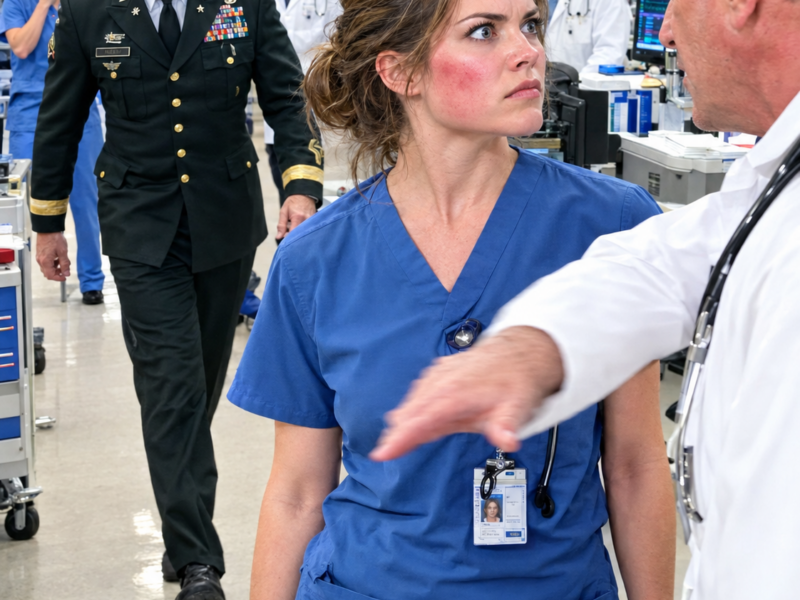
“The man in the $3,000 suit slapped me across the face in the middle of the ER at Mercy General Hospital
The photograph was only four inches wide, but it seemed to have pulled twelve years of my life into the space between General Whitaker and me.
I reached for it, then stopped before my fingers touched the paper.
“General,” I said quietly, “where did you get this?”
“From Daniel Caldwell.”
I looked toward the treatment room.
Richard’s father lay beneath a thin hospital blanket, an oxygen tube beneath his nose, his gray hair damp with sweat. His eyes were open now, fixed on the doorway.
Daniel Caldwell.
For twelve years, I had remembered him as a man who had vanished into smoke and gunfire on a dusty road in Afghanistan.
I had carried the memory of his last words through every birthday, every Christmas, and every sleepless night that followed.
Don’t come back for me, Carter. Get those men home.
I had obeyed him.
And now he was lying thirty feet away, alive.
“That’s impossible,” I whispered.
General Whitaker folded his hands behind his back. “I wish I could tell you it was.”
Richard gave a short, disbelieving laugh.
“Wait. You’re telling me my father knows this nurse from some military operation twelve years ago?”
Nobody answered him.
He looked at the photograph again, then at me, as though he were trying to fit my face into a story he had never heard.
“My father worked in defense contracting,” he said. “He wasn’t a soldier.”
“No,” I replied. “He wasn’t.”
I remembered Daniel Caldwell in a dusty shirt with rolled-up sleeves, kneeling beside a wounded soldier while bullets struck the concrete wall behind us. He had been a civilian logistics specialist attached to our unit, responsible for getting medical supplies and emergency equipment to places other people considered unreachable.
He had no obligation to run toward gunfire.
He had done it anyway.
And the last time I’d seen him, he had been bleeding from his shoulder while I tried to drag him behind the wreckage of an overturned transport truck.
General Whitaker watched me carefully.
“Emily, would you like to speak with him?”
I swallowed.
“I need to know why he never contacted me.”
The general’s expression softened, but he didn’t offer an answer.
“Then I think it’s time you heard it from him.”
I walked toward the treatment room on unsteady legs.
Behind me, Richard said, “This is ridiculous. My father is sick. He doesn’t need to be interrogated by hospital staff.”
I turned around.
“No one’s interrogating him. He’s my patient, and I intend to make sure he receives the care he needs.”
The words came out sharper than I expected.
For the first time since he had struck me, Richard had nothing to say.
Inside the room, the cardiac monitor displayed a steady rhythm. A nurse had adjusted Daniel’s oxygen and placed a glass of water on the bedside table.
He looked smaller than I remembered.
Twelve years had added lines around his eyes and silver to his hair, but the shape of his face was unmistakable.
I stepped beside his bed.
“Mr. Caldwell?”
His eyes moved to mine.
For a moment, he looked at me with the vague confusion of a patient waking from sedation.
Then his gaze settled on my identification badge.
“Emily.”
My knees nearly gave way.
“Do you remember me?”
He shut his eyes.
“Every day.”
I gripped the bed rail.
“Then why?”
It was the only question I could manage.
Why had he let me believe he was dead?
Why had I spent years wondering whether I could have saved him?
Why had I stood in a military hospital months later, listening to an officer tell me that no further recovery was possible, when the man himself was apparently alive?
Daniel opened his eyes again.
“Because I was a coward.”
The answer hurt more than an excuse would have.
I drew a slow breath.
“You let me go to your memorial.”
“I know.”
“You let me believe I left you behind.”
His mouth tightened.
“I know.”
I looked away, fighting the urge to leave the room before he could say anything else.
I had imagined finding him alive more times than I could count. In those imagined moments, he always had a reason that made the pain worthwhile.
He had been held captive.
He had lost his memory.
He had been unable to contact anyone.
Anything would have been easier than the quiet admission that he had chosen not to return.
“Your son hit me,” I said.
Daniel’s eyes widened.
“What?”
“In the emergency department. He was angry because I wouldn’t move you ahead of a child who was struggling to breathe.”
His face changed.
“Richard did that?”
I nodded.
He tried to sit up, then winced as the cardiac monitor began beeping faster.
“Please lie still,” I said, instinctively reaching to adjust his pillow.
He caught my wrist gently.
“Emily, I’m sorry.”
I eased my hand free.
“I’m not asking you to apologize for him. I’m asking why you disappeared.”
He stared at the ceiling.
Then, after a long silence, he said, “There was a mission report.”
The room seemed to narrow around those words.
“What kind of report?”
“The operation that went wrong. The one that left your team stranded outside the evacuation zone.”
I remembered the report. I had signed a statement confirming that Daniel had helped us reach an improvised field hospital before the final transport was destroyed.
Afterward, the official review concluded that the route had been compromised by faulty intelligence.
Several people were reprimanded.
One officer was quietly reassigned.
I had never questioned the findings because I had no reason to believe the investigation was incomplete.
Daniel turned his head toward me.
“The report was changed after we were evacuated.”
“Changed how?”
“Someone removed the communications logs. The original route authorization. A record of who approved the final transport.”
My fingers tightened around the bed rail.
“What does that have to do with you?”
“I found the discrepancy while recovering at a military facility. I was supposed to be transferred home. Instead, two men from the contracting company that supplied our equipment came to see me.”
He paused to catch his breath.
“They told me that if I spoke about the missing records, they’d make sure the people responsible were blamed on your team.”
I felt a cold pressure behind my ribs.
“My team?”
“You were the senior medical officer on the evacuation detail. Your signature was on the casualty paperwork. You were the easiest person to accuse of falsifying the timeline.”
I shook my head.
“I didn’t falsify anything.”
“I know that now.”
The words struck me with unexpected force.
“You didn’t know it then?”
Daniel looked ashamed.
“I knew you were honest. I didn’t know how far they were willing to go.”
Outside the room, footsteps passed in the hallway.
He lowered his voice.
“They told me that if I returned, I would be questioned. They said they’d release documents that would make it look like I had diverted supplies and abandoned the unit.”
“So you ran?”
“I thought I was protecting you.”
“By making me believe you were dead?”
He had no answer.
I stepped back from the bed.
For years, I had blamed myself for Daniel’s disappearance. I had replayed the moment I left him behind, searching for a different decision that might have saved him.
Now he was telling me that my suffering had been part of a decision he made without giving me a choice.
“You should have trusted me,” I said.
His eyes filled with tears.
“Yes.”
I wanted to forgive him. Part of me had wanted that from the moment I recognized his face.
But forgiveness was not a switch I could flip simply because the dead man in my memory had turned out to be alive.
“Who threatened you?” I asked.
Daniel glanced toward the doorway.
“My son knows nothing about the original operation.”
“That wasn’t my question.”
He swallowed.
“Richard’s company has contracts with the same defense supplier.”
I stared at him.
“Your son works for them?”
“He’s their regional director now.”
The pieces shifted in my mind, but they did not yet form a complete picture.
“Does Richard know about the altered report?”
“I don’t know.”
I remembered his expensive suit, the way he had spoken about influence, and his casual certainty that he could have me fired.
I did not want to believe those things meant anything.
Then Daniel reached beneath his blanket and touched the pocket of his hospital gown.
“There’s something I need to give you.”
He pulled out a small brass key attached to a frayed piece of blue string.
“It’s in my wallet,” he said. “The photograph wasn’t the only thing I kept.”
I glanced toward the door.
“Mr. Caldwell, you need to rest.”
“Please.”
His voice was suddenly urgent.
“I have carried this for twelve years. I thought I’d have more time to explain.”
I took the key.
“What does it open?”
“A storage box. At a bank in Virginia. The account is under my name, but the documents inside belong to the people who were with us that night.”
He looked directly into my eyes.
“If you find the original communication logs, you’ll understand why I couldn’t come home.”
I closed my fingers around the key.
Before I could ask another question, a sharp voice came from the doorway.
“What exactly are you giving her?”
Richard stood there, his face drained of color.
His eyes were fixed on the key in my hand.
And for the first time, I saw something in his expression that had nothing to do with arrogance.
Fear.
He stepped into the room.
“Dad, give me your wallet.”
Daniel shook his head.
“Richard, go outside.”
“I said give it to me.”
“Your father is recovering from a cardiac event,” I said. “You need to step back.”
Richard barely looked at me.
“That’s a family matter.”
“No,” Daniel said, his voice weak but clear. “It isn’t anymore.”
Richard’s jaw tightened.
He looked at the key again.
Then he did something I hadn’t expected.
He looked at the general standing behind him and said, “You don’t understand what you’re getting involved in.”
General Whitaker stepped into the room.
“Then perhaps you should explain it.”
Richard’s gaze darted toward the hallway, where the two military officers had remained.
“There’s nothing to explain.”
Daniel reached for my hand.
“Emily, don’t let him take that key.”Richard moved toward us.
The general stepped between him and the bed.
“Mr. Caldwell, you will remain where you are.”
For a moment, nobody moved.
Then Richard let out a short, bitter laugh.
“You think a uniform makes you untouchable? My company supplies half the equipment used on your bases. You have no idea how many people would prefer those old records stayed buried.”
The silence that followed was different from the silence after the slap.
This time, everyone had heard him.
General Whitaker turned toward one of the officers.
“Document that statement. And contact hospital security.”
Richard’s face hardened.
“You can’t do this to me.”
“I’m not doing anything to you,” the general replied. “I’m giving you an opportunity to stop making matters worse.”
Richard looked at his father.
“You told me you destroyed everything.”
Daniel went pale.
I felt the key dig into my palm.
There it was: the first admission that Richard knew something about the missing records.
But before I could ask what he meant, Daniel’s monitor began sounding an alarm.
His hand slipped from mine.
“Dad?” Richard shouted.
The room erupted into movement.
I was a nurse again before I had time to think about anything else.
I called for the attending physician, checked Daniel’s responsiveness, and moved aside as the emergency team entered. General Whitaker backed into the hallway, taking Richard with him.
For several minutes, all I could hear were medical instructions and the steady rhythm of practiced hands working to stabilize a man whose past had just caught up with him.
Daniel survived the episode, but the physician ordered him transferred to intensive care for close monitoring.
When I finally stepped out of the room, Richard was gone.
General Whitaker waited near the nurses’ station.
“You did the right thing,” he said.
“I was doing my job.”
“I know.”
He glanced at the key.
“Have you decided what you’ll do with that?”
I looked down at my hand.
Twelve years earlier, I had signed a statement, accepted the official findings, and tried to build a life that didn’t revolve around a battlefield.
I had thought the past was finished with me.
Now I had evidence that the story I’d been told was incomplete.
“I want to see those records,” I said.
The general nodded.
“Then we’ll make sure you don’t go alone.”
That evening, after my shift ended, I drove home through a cold October rain.
My cheek had begun to swell, and every time I passed a red light, I caught sight of the mark in the rearview mirror.
I thought about Richard’s expression when his father mentioned the records.
I thought about Daniel’s apology.
And I thought about the men in the photograph.
One of them was still alive.
Another had supposedly died.
The third was someone I had spent years trying not to remember.
I barely slept that night.
At seven the next morning, General Whitaker’s office arranged for a military liaison to accompany me to Virginia. The bank was an ordinary brick building on a quiet street, the kind of place people visited to refinance a mortgage or close an estate.
Nothing about it suggested that a dozen years of silence might be stored behind a locked door.
The manager examined Daniel’s authorization documents and the key.
After several calls and a long verification process, she led us into a private room and placed a metal box on the table.
I stared at it.
“Are you ready?” the liaison asked.
“No,” I admitted.
Then I opened it.
Inside were three folders, a sealed envelope, a small digital recorder, and a stack of printed communications held together with a rubber band.
The first folder contained copies of the official mission report.
The second contained the original route authorization, including a handwritten approval from a senior logistics officer.
The third contained records showing that a transport carrying medical supplies had been redirected away from our evacuation point shortly before the attack.
My hands went cold.
The route had not simply been compromised by faulty intelligence.
Someone had changed it.
The communications log included a message sent less than an hour before our team came under fire. The sender had instructed the transport coordinator to reroute the vehicle, despite an explicit warning that the alternative road was unsafe.
At the bottom was an approval code linked to a defense contractor.
The same contractor Richard Caldwell worked for.
I read the line twice.
Then I noticed the date on the final page.
The message had been sent after the intelligence warning was received.
Someone had known the route was dangerous.
Someone had sent us there anyway.
The liaison leaned closer.
“Do you recognize the approval code?”
I nodded slowly.
I’d seen it during the original investigation, buried in a document the review board had told me was unrelated to the incident.
At the time, I had accepted that explanation.
Now I understood why the document had been removed from the final report.
I opened the sealed envelope.
Inside was a handwritten letter from Daniel.
It began with my name.
Emily, if you’re reading this, then I failed to find a way to tell you the truth while I was still brave enough to face you.
I stopped reading.
I couldn’t continue with the liaison watching me, so I asked for a few minutes alone.
The letter described how Daniel had discovered evidence of deliberate interference with the transport schedule. He had confronted a company supervisor, who warned him that the contractor would deny everything and place the blame on the people whose signatures appeared on the casualty records.
Daniel had initially planned to report the matter through official channels.
Then he learned that the first investigator assigned to the case had received payments from a consulting firm connected to the contractor.
He had panicked.
Instead of trusting the system—or trusting me—he had disappeared with copies of the records.
He believed that staying away would prevent the company from using him to destroy my career.
The letter did not excuse his choice.
In fact, he wrote that he had spent years knowing he had traded my right to the truth for the comfort of avoiding his own fear.
I folded the letter carefully.
For the first time, I understood that Daniel’s silence had been born partly from fear and partly from shame.
That didn’t make it right.
But it made him human.
The last page contained a name I recognized.
Colonel Mark Ellison.
He had been the officer who led our original review.
He had retired shortly after the investigation closed.
And according to the financial records in the box, a consulting company associated with the defense contractor had paid him substantial sums in the months surrounding his retirement.
I sat back in the chair.
The original report had not been a mistake.
It had been a cover-up.
The next step was to establish whether the evidence could be authenticated and whether anyone involved could still be held accountable.
General Whitaker arranged for the records to be delivered to the appropriate military investigators and federal authorities. I gave a formal statement, provided the documents I had retained from my own service, and answered questions about the night the transport was rerouted.
The process was slow.
There were no dramatic arrests in the bank parking lot, no instant confession, no convenient announcement that twelve years of injustice had suddenly been repaired.
There were interviews, document examinations, and long stretches when nobody could tell me what would happen next.
During that time, Daniel remained in the hospital.
When I visited him three days later, he looked exhausted but alert.
“I read your letter,” I told him.
He nodded.
“I wondered if you would.”
“I don’t forgive you yet.”
“I wouldn’t ask you to.”
I sat beside his bed.
“But I believe you were afraid.”
He looked down at his hands.
“I was.”
“Next time, let me decide what risks I’m willing to take.”
A small, sad smile touched his face.
“There shouldn’t be a next time.”
“No,” I said. “There shouldn’t.”
For several minutes, we sat quietly.
Then he asked about the records.
“They’re with investigators. The original report is being reviewed, and they’ve confirmed that the communications logs are authentic.”
He shut his eyes.
“Thank God.”
“There’s something else,” I said. “Richard knew about the records.”
Daniel’s face tightened.
“I suspected he did.”
“Did he help hide them?”
“I don’t know.”
I believed him.
For all the pain he had caused me, I no longer thought he was trying to protect his son. He looked like a man who had finally realized that the secrets he had carried were no longer his to control.
“I want to talk to Richard,” he said.
“Why?”
“Because he’s my son.”
I understood that answer, even if I didn’t like it.
“Then you should talk to him when you’re well enough to make your own decisions.”
Daniel nodded.
A week later, Richard requested a meeting with the hospital’s patient advocate and a representative from the investigation team.
I was not required to attend.
I went anyway.
He arrived without the expensive suit, wearing a plain gray sweater and dark trousers. The confidence that had filled the emergency department seemed to have drained out of him.
He looked at my cheek.
“I owe you an apology,” he said.
I waited.
“What I did was unacceptable. There’s no excuse for it.”
“No,” I said. “There isn’t.”
He swallowed.
“I’ve spent my entire adult life believing my father was a weak man who ran away when things got difficult. He told me he had made a mistake years ago, but he never explained what happened.”
“So you decided I was the person to blame?”
“I decided you were someone I could intimidate.”
The admission was quiet, but it was the first honest thing I had heard him say.
“Why?”
He rubbed his hands together.
“Because that’s how I learned to deal with problems at work. If someone challenged me, I made sure they regretted it. I thought that was what being powerful meant.”
I studied him.
“And the company records?”
He stared at the floor.
“I knew my father had kept documents from the old investigation. I didn’t know exactly what was in them. When he mentioned a key last night, I realized he was planning to release whatever he had.”
“Why were you afraid of that?”
“Because my company had recently reopened an internal review of the old transport incident. A senior executive told me there were historical documents that could damage the business if they became public.”
He paused.
“I recognized the date. I asked questions, and I was told to leave it alone.”
“Did you know the transport had been deliberately rerouted?”
“No.”
“Did you suspect it?”
He took a long breath.
“By the time I understood what the investigation might uncover, I had already helped pressure two employees into signing confidentiality agreements. I told myself it was ordinary corporate risk management.”
“And now?”
“Now I think I was protecting people who knew more than I did.”
I didn’t tell him that his honesty erased what he had done to me.
It didn’t.
But I could hear the difference between an apology meant to escape consequences and one that began with the truth.
“The investigators will decide what happens with your involvement,” I said. “I won’t interfere with that process.”
He nodded.
“I understand.”
“Do you?”
He looked up.
“I think I’m starting to.”
He left without asking me to forgive him.
That mattered more than he probably knew.
Over the following months, the investigation uncovered evidence that the transport had been redirected to conceal the diversion of equipment and supplies through a separate contractor arrangement. The resulting attack had not been planned as an assault on our team, but the decision to ignore the warnings had exposed us to a danger that could have been prevented.
Several people had concealed the original communications.
Colonel Ellison was questioned about the payments connected to the consulting firm. The contractor faced civil claims and additional federal scrutiny. Richard’s employer placed him on leave while investigators examined whether his actions had obstructed the review.
The full legal consequences took time, and not every question was answered publicly.
But the official record was corrected.
The men and women on our team were no longer described as having made the decisions that caused the transport to be lost.
Their names were cleared of the accusations that had followed them.
For me, that mattered more than any headline.
I attended the formal review with General Whitaker beside me.
When the chairperson read the revised findings, I kept my hands folded in my lap. I had imagined feeling triumphant, but what came instead was a deep, tired sadness.
Twelve years could not be returned.
The birthdays I had spent wondering whether Daniel had died alone were still part of my life. So were the nights I had questioned my own judgment and the years I had avoided speaking about the mission.
The truth had corrected the record.
It could not rewrite my memories.
After the hearing, General Whitaker walked with me through the courthouse lobby.
“You carried more of this than you should have had to,” he said.
“I thought I was supposed to.”
“You were supposed to care for your people. You did that.”
He stopped near the exit.
“The rest was never yours to carry alone.”
I thought about those words for a long time.
A few months later, Daniel was discharged from the hospital.
He asked if I would meet him for coffee at a small diner near the river. I agreed, partly because I wanted to see what our relationship might become when it was no longer shaped by a hospital bed or a twelve-year-old lie.
He arrived early and stood when I walked in.
For a moment, we looked at each other without speaking.
Then he said, “Thank you for coming.”
I sat across from him.
“I haven’t decided what our relationship looks like now.”
“I know.”
“And I won’t pretend that what happened didn’t hurt me.”
“I don’t expect you to.”
He looked older than he had in the hospital, perhaps because he was no longer hiding behind the urgency of an emergency.
“I spent years telling myself I had made the only choice that could protect you,” he said. “It was easier than admitting I was frightened of what might happen if I came back.”
I stirred my coffee.
“Were you ever going to tell me?”
He looked at me for a long time.
“I don’t know. I kept waiting for a moment when the danger would be over and the truth would somehow hurt less.”
“And it never came.”
“No.”
I nodded slowly.
“That’s what secrets do. They make every day you wait feel like another reason to wait.”
He accepted that without arguing.
We talked for nearly an hour. Not about the mission, at least not all the time. He asked about my work, and I told him about a new nurse I was mentoring who could calm an angry patient with nothing more than a steady voice and a cup of water.
For the first time, Daniel laughed.
It was a small sound, rough around the edges, but it reminded me of the man I had known before the road, the smoke, and the years of silence.
When we left, I did not promise that everything would be all right.
I promised only that I would consider meeting him again.
It was enough for that day.
Richard later sent a written apology through the hospital. I kept it in a drawer for several weeks before deciding what to do with it.
Eventually, I wrote back.
I told him that I accepted the apology as an acknowledgment of what he had done, not as a declaration that the matter was forgotten. I told him that rebuilding trust would require more than regret and that I hoped he would learn to treat people with dignity even when he had no reason to fear them.
I never heard from him again.
Perhaps he was ashamed.
Perhaps he disagreed with my terms.
I learned to accept that I did not need to know.
I returned to work at Mercy General, where the emergency department remained exactly what it had always been: noisy, crowded, imperfect, and full of people who needed help at the worst moments of their lives.
The mark on my cheek faded within days.
The memory of the slap lasted longer, but it gradually lost its power to define that afternoon.
What I remembered most clearly was not Richard’s hand or the general’s salute.
It was the moment I realized that a person could be wronged without being powerless, and that dignity did not have to be defended through humiliation in return.
General Whitaker visited the hospital several months after the review. He stopped by the nurses’ station and asked whether I was still working too many shifts.
“Someone has to keep the place running,” I told him.
He smiled.
“That’s what you said overseas.”
I looked toward the treatment rooms, where Megan was helping an elderly patient settle into bed.
“I suppose some things don’t change.”
He glanced at my badge.
“I’m glad you kept your name.”
I touched the edge of it.
For years, I had thought my military service was something I needed to put behind me in order to become the nurse I wanted to be.
Now I understood that the two parts of my life had never been separate. The same instincts that had guided me through a field hospital guided me through the emergency department: pay attention, protect the vulnerable, and don’t mistake someone’s title for their character.
Daniel and I met for coffee again the following month.
We spoke about ordinary things and difficult ones. Sometimes the conversation was easy. Sometimes one of us said something that brought the old pain back into the room.
We learned not to force an answer simply because silence made us uncomfortable.
Forgiveness, I discovered, was not a single decision that erased the past.
It was a series of small choices about what I was willing to build next.
One evening, after a long shift, I stopped at my apartment door and noticed a letter tucked beneath the frame.
There was no return address.
Inside was a copy of the corrected mission report, along with a photograph of our old team.
On the back, Daniel had written a single sentence.
You brought them home, Emily. I should have trusted you enough to let you know that I came home, too.
I stood in the hallway for a long time, holding the photograph.
Then I placed it beside the small box where I kept the medals I had never worn to work.
Not because the past was finished.
Not because every wound had healed.
But because the truth no longer needed to remain hidden in order for me to move forward.
The next morning, I pinned on my identification badge, walked through the doors of Mercy General, and went to meet the next person who needed my help.
My name was Emily Carter.
I was a nurse.
And for the first time in twelve years, I no longer felt that I had to leave part of myself behind to be either one.
The end.









