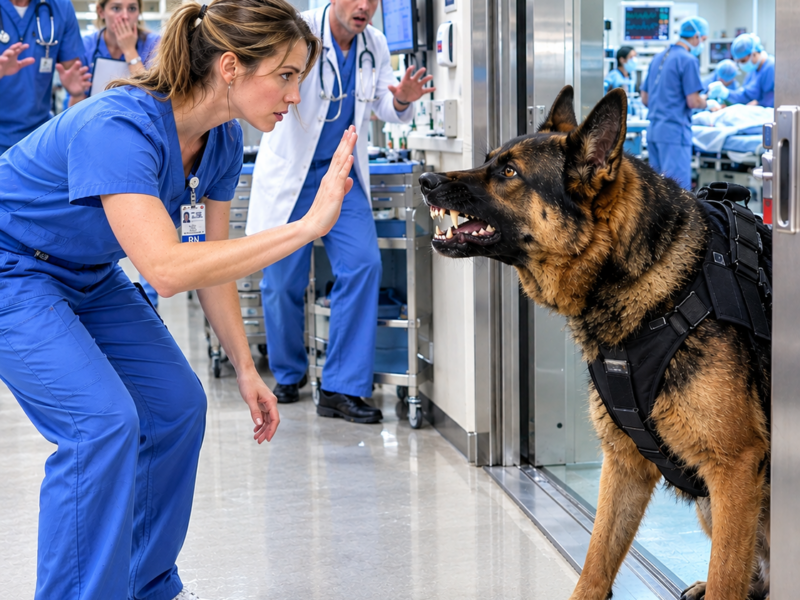
“The K9 guard dog blocked the operating room doors at St. Matthew’s Hospital, snarling at every surgeon who tried to enter
The operating room intercom crackled again.
“Sarah Mitchell, please report to Operating Room Three immediately.”
I stared at the speaker above the doors.
Nobody had called me by my full name over the hospital intercom in the four years I’d worked at St. Matthew’s. If a surgeon needed me, they called my extension or sent another nurse.
And whoever had just spoken had used a voice I recognized.
Not because I’d heard it recently, but because I’d spent seven years trying to forget it.
“Michael?” I whispered.
Rex pressed his head against my thigh.
Sergeant Daniel Brooks tightened his grip on the leash. “You heard that too, right?”
I nodded.
“Whoever’s inside knows your name,” he said. “And if that note is real, we need to find out why.”
Through the operating room window, I could see Dr. Andrew Collins standing beside the surgical table. Two other surgeons were preparing instruments while an anesthesiologist checked the patient’s monitors.
Everything appeared normal.
Except for the man lying beneath the surgical lights.
He was wearing a hospital gown, but his right wrist was cuffed to the bed rail.
I looked at Daniel.
“Why is a trauma patient handcuffed during emergency surgery?”
“I don’t know.”
Rex gave a low growl.
The patient’s head turned slightly toward the window.
For one brief moment, I saw his eyes.
He was awake.
And he was staring directly at me.
I grabbed the intercom receiver beside the doors.
“Dr. Collins, this is Sarah. Before you begin, I need to know why that patient is restrained.”
The reply came almost immediately.
“Sarah, step away from the doors. This is a controlled procedure.”
“Why is he handcuffed?”
“Security protocol.”
“Whose security protocol?”
There was a pause.
Then the same unfamiliar voice spoke over the intercom.
“Miss Mitchell, you are interfering with a medical procedure. Please return to your assigned department.”
I recognized the voice now.
It belonged to Colonel Nathaniel Shaw, a retired military intelligence officer who had been present during the investigation into Michael’s death.
Seven years ago, Shaw had sat across from me in a windowless office and told me that Michael had died instantly during the convoy attack.
He had looked me in the eye and said there was no reason to search for survivors.
Now he was inside my hospital.
And he was telling me to walk away.
I released the receiver.
Daniel stared at me.
“You know that man?”
“I know his voice.”
“Who is he?”
“Someone who told me my best friend was dead.”
Rex suddenly lunged toward the doors.
Daniel barely managed to hold him back.
The dog’s paws skidded across the polished floor, and his barking echoed through the corridor.
A security officer approached from the nurses’ station.
“What’s going on here?”
Before I could answer, the operating room doors opened.
Dr. Collins stepped into the hallway, removing his surgical mask.
His face was pale with anger.
“Sarah, I need you to stop this immediately. The patient has an abdominal injury, and every minute we delay increases the risk.”
I looked past him into the room.
The restrained man had turned his head toward the doorway.
His lips moved.
I couldn’t hear him, but I knew what he was saying.
My name.
“Dr. Collins,” I said, “did you personally examine this patient before deciding to operate?”
“Of course I did.”
“Did you review his identification?”
His expression changed.
“That’s not your concern.”
“It became my concern when I saw a patient handcuffed to a surgical bed and heard someone using a military command over a hospital intercom.”
Collins stepped closer.
“I’m the attending surgeon. You are a staff nurse. I will not have you questioning my judgment in front of the entire department.”
I felt the sting of his words, but I didn’t move.
“I am not questioning your ability to perform surgery. I’m asking whether you know who you’re operating on.”
For a second, something uncertain crossed his face.
Then he glanced toward the room.
“I was told he was a high-risk detainee being transported under federal authority.”
“By whom?”
“Colonel Shaw.”
The name landed between us.
I looked at Daniel.
He had heard it too.
“Does the patient have identification?” I asked.
Collins hesitated.
“There was a sealed envelope with his paperwork.”
“Where is it?”
“Security took it.”
I turned toward the officer in the hallway.
“Can you retrieve it?”
The officer looked uncomfortable.
“Ma’am, I’ve been instructed to keep this area clear.”
“By whom?”
He glanced toward the operating room.
“Colonel Shaw.”
I let out a slow breath.
Three different people had given me the same answer without providing a single verifiable fact.
Behind me, Rex began whining again.
I turned toward him.
The dog was no longer looking at the operating room doors.
He was staring at a supply cart parked against the wall.
His nose moved rapidly, taking in the air.
Then he approached the cart and began pawing at a folded blue surgical drape.
Daniel pulled him back.
“Rex, leave it.”
The dog refused.
He barked once, then nudged the drape aside with his nose.
Beneath it lay a small black pouch bearing the same military insignia as his harness.
My mouth went dry.
I recognized the pouch.
It was the kind our unit had used to carry emergency identification tags and encrypted memory cards.
Daniel crouched beside it without touching anything.
“Where did this come from?”
A hospital orderly appeared at the far end of the corridor.
When he saw the pouch, he stopped.
Then he turned and hurried toward the elevator.
“Security!” Daniel shouted.
The officer ran after him.
I looked down at the pouch.
There was a faded label on the front.
S. MITCHELL.
My name.
For several seconds, I couldn’t make sense of it.
I hadn’t seen that pouch since my last deployment. I’d left it in a locked storage locker before returning to civilian life.
Someone had taken it.
Someone had brought it here.
And Rex had found it.
I knelt and examined the outside without opening it.
A small metal tag was attached to the zipper.
Three words had been scratched into the surface.
Vesper. Hold. Three.
The old phrase.
The code I’d whispered to Rex.
Daniel stared at the tag.
“Sarah, what does that mean?”
I looked at the dog.
“It means Michael expected me to find this.”
“Then why not send it directly to you?”
“Because he couldn’t.”
The realization was beginning to take shape, but it was too large to trust yet.
I turned toward Dr. Collins.
“I need the hospital’s security director and the attending anesthesiologist. No one enters or leaves this room until we verify the patient’s identity.”
Collins looked furious.
“You cannot order a lockdown.”
“No,” I said. “But I can report a potential patient identification failure, a suspicious restraint, and an unauthorized individual interfering with surgery.”
I pulled my hospital phone from my pocket.
“And I’m doing that now.”
For the first time, Collins didn’t interrupt.
I called the hospital’s patient safety officer, explained what I had observed, and requested immediate verification of the patient’s identity and the authority for the restraints.
Then I contacted the hospital’s security director and asked him to preserve the hallway camera footage.
I didn’t accuse anyone of a crime.
I didn’t claim to know what was happening.
I simply refused to let the questions disappear.
Within minutes, the atmosphere changed.
A second surgeon arrived and reviewed the patient’s scans. The anesthesiologist confirmed that the patient’s condition was serious but that there was enough time for a brief identity and authorization check while the team continued monitoring him.
The patient safety officer arrived with a hospital administrator.
Colonel Shaw came out of the operating room moments later.
He was older than I remembered, with silver hair and the same rigid posture that had once made young soldiers straighten their backs when he entered a room.
His gaze settled on me.
“Miss Mitchell.”
“Colonel.”
“You need to leave.”
“I work here.”
“Not in this matter.”
“Then explain why my name is on a military pouch that appeared outside an operating room containing a restrained patient.”
For a moment, he said nothing.
Then he looked at Rex.
Something flickered in his eyes.
Recognition.
Fear.
It was gone almost immediately, but I had seen it.
“Sergeant Brooks,” Shaw said, “remove the animal.”
Daniel stood straight.
“Sir, the dog is under my control, and the hospital’s security team has asked us to remain until the identity issue is resolved.”
Shaw’s jaw tightened.
“That’s an order.”
“With respect, sir, you’re not in my chain of command.”
The general’s absence made the corridor feel suddenly smaller, but Daniel didn’t back down.
Shaw turned toward the hospital administrator.
“This patient is being transported under federal authority. Your staff have no legal basis to interfere.”
The administrator kept her voice calm.
“We are not refusing treatment. We are verifying identity and ensuring that the procedure is authorized.”
Shaw leaned closer.
“You may regret this.”
“Perhaps,” she replied. “But the verification will proceed.”
He stared at her, then walked back into the operating room.
Daniel let out a breath.
“That man has always had a talent for making people feel like they’ve done something wrong by asking a question.”
I almost smiled.
“He used to do it to entire rooms full of officers.”
Rex sat beside me, his gaze fixed on the doors.
I reached down and rested my hand on his head.
“Good boy.”
His tail moved once against the floor.
Then the hospital security director arrived with a sealed envelope recovered from the locked administrative office.
The envelope had been placed there shortly before the patient arrived.
It contained a transfer document, a temporary identification number, and an authorization signed by a federal contractor.
It did not contain a valid government identification record.
The patient safety officer asked for the original transport manifest.
Shaw said it was being held by the escort team.
The escort team said it had been sent electronically.
The electronic record showed an authorization code that had expired six months earlier.
The room went quiet.
Dr. Collins removed his gloves.
“I was told the paperwork had been verified.”
The administrator looked at him.
“By whom?”
He didn’t answer.
For the first time, I felt the situation move beyond my own history with Michael.
This was no longer just a question about a military dog or a mysterious note.
A patient was in an operating room under an identity that no one could verify, with a man claiming federal authority directing the procedure.
And somebody had gone to considerable trouble to make sure I was there.
The patient safety officer ordered the hospital to preserve all relevant records and requested independent verification of the transfer.
The surgeon returned to the patient.
His injuries still required treatment, regardless of who he was.
That was the part I kept reminding myself.
Whatever the mystery, the man on that bed was still a human being who might die without care.
As the medical team resumed its work under the hospital’s normal clinical oversight, Rex suddenly lifted his head.
A faint sound came from inside the operating room.
Three quick taps.
A pause.
Then two more.
I knew that rhythm.
It was an old field signal our team had used when radio communication was unavailable.
Three taps meant I’m here.
Two meant I’m listening.
I stepped toward the window.
The patient’s fingers moved against the bed rail.
Three taps.
A pause.
Two more.
My vision blurred.
“Michael,” I whispered.
Daniel looked at me.
“What?”
I couldn’t answer.
The patient turned his head toward the window.
Then, with an effort that seemed to cost him everything, he lifted his right hand.
Two fingers.
A slight bend of the thumb.
Our old recognition signal.
The one Michael had used to tease me whenever I was too tired to answer him properly.
I gripped the window ledge.
He was alive.
Or someone knew the signal well enough to make me believe he was.
I couldn’t afford to decide which without evidence.
I looked at the hospital administrator.
“I need to speak to the patient as soon as he’s stable enough.”
She nodded.
“We’ll arrange that through the medical team.”
Colonel Shaw reappeared in the doorway.
“You are making a serious mistake.”
I turned toward him.
“Then tell me what the mistake is.”
He looked at Rex, then at the pouch.
“You don’t understand what Michael was involved in.”
“Then explain it.”
“I can’t.”
“Won’t, or can’t?”
His expression hardened.
“You were a medic, Mitchell. You were never cleared to know the full scope of the operation.”
I felt an old anger rise in my chest.
“I was cleared to keep your people alive. I watched men bleed because someone sent us down a road that should never have been approved. I buried my best friend without a body. And now you’ve brought a restrained man into my hospital and told everyone to stop asking questions.”
My voice shook, but I kept going.
“You don’t get to use the word classified as an answer to everything.”
Shaw’s eyes narrowed.
For a moment, I thought he might order security to remove me.
Instead, he glanced at the administrator and walked away.
That was the first time I had ever seen him retreat from a question.
It was also the moment I realized he was afraid of the answer.
The operation took nearly three hours.
The patient survived.
The surgeons repaired the damage in his abdomen, controlled the bleeding, and transferred him to intensive care for close monitoring.
The hospital’s identity verification remained unresolved, and the security director preserved the records while the appropriate authorities were contacted.
I spent those three hours in a small consultation room with Daniel and Rex.
The black pouch sat inside a clear evidence bag on the table.
I hadn’t opened it.
The note was in my pocket, and I kept touching its folded edge as if the paper might change beneath my fingers.
Daniel sat across from me, studying the dog.
“Rex has never done anything like this,” he said.
“Has he ever reacted to someone from his old unit?”
“Not that I’ve seen. He recognizes certain commands, but his previous service records are incomplete.”
“Who trained him after Michael?”
“A military working dog program. Then he was transferred to our security detail.”
“Did anyone tell you why?”
Daniel shook his head.
“They said he was no longer suitable for field deployment. He had become distressed in certain medical environments.”
I looked at Rex.
“Because he was looking for Michael.”
“Maybe.”
The dog lifted his head at the name.
I crouched beside him.
“Rex, where is Michael?”
He pressed his nose against my palm.
Then he looked toward the door.
I followed his gaze.
A woman in a dark jacket stood in the hallway, speaking quietly to the security director. She held a slim folder against her chest and watched the consultation room through the glass.
When she noticed me looking, she turned away.
I recognized her from the operating room corridor.
She had been standing near the elevator when Rex first arrived.
“Who is that?” I asked.
Daniel looked through the glass.
“I don’t know.”
I opened the door.
“Excuse me.”
The woman stopped.
“Yes?”
“I’m Sarah Mitchell. You were here when the patient arrived, weren’t you?”
“I was.”
“Are you with the transport team?”
She glanced at the security director before answering.
“No.”
“Then why are you here?”
She held the folder tighter.
“I was asked to deliver something.”
“To whom?”
Her eyes moved toward Rex.
“To you.”
She handed me the folder.
Inside was a single photograph.
It showed Michael sitting in a chair in a plain room, thinner than I remembered, his hair cut short, a scar running from his temple toward his jaw.
He was holding a newspaper with that day’s date visible in the corner.
On the back, someone had written:
The man in the operating room is not the only one who needs your help.
I looked up.
The woman was already walking away.
“Wait!”
She stopped at the elevator but didn’t turn.
“Who sent you?”
She pressed the button.
“Someone who still owes Michael his life.”
The doors opened.
Before I could reach her, she stepped inside and disappeared.
I returned to the consultation room and showed Daniel the photograph.
He stared at it.
“That’s Michael.”
“Yes.”
“But if he’s the patient, who sent this?”
I looked at the note again.
If Rex finds you, trust no one.
Perhaps the warning had never been about the man in the operating room.
Perhaps it was about everyone surrounding him.
The next morning, I was allowed into the intensive care unit after the medical team confirmed that the patient was stable enough for a brief visit.
Rex could not accompany me into the unit, so Daniel remained outside with him.
I walked to the bedside alone.
The man beneath the blanket looked older, his face pale against the white pillow. A bandage covered part of his abdomen, and a monitor traced his heartbeat in green lines.
I stood beside him for a long time.
“Michael?”
His eyelids moved.
I leaned closer.
“It’s Sarah.”
His eyes opened slowly.
For a moment, there was nothing in them but exhaustion and confusion.
Then he focused on my face.
His lips parted.
“Sarah.”
The sound of my name broke something open inside me.
I took his hand carefully, avoiding the intravenous line.
“You’re alive.”
He tried to smile.
“Apparently.”
A laugh escaped me, followed by a sob I had been holding back for seven years.
I bent my head, pressing his hand against my forehead.
“You let me believe you were dead.”
His fingers tightened weakly around mine.
“I know.”
“Why?”
He closed his eyes.
“I wanted to come home.”
“Then why didn’t you?”
He was silent for so long that I thought the medication had pulled him back to sleep.
Finally, he whispered, “Because I found out what happened to our convoy.”
I lifted my head.
“What do you mean?”
“The attack wasn’t supposed to happen. The route was changed after the warning came in.”
I remembered the original report, the unexplained gaps in the communications logs, and the officer who had told us the route change was routine.
Michael swallowed.
“I found proof that someone had ordered the transport onto the road after the warning. I copied the records before they disappeared.”
“Who ordered it?”
He looked toward the closed door.
“Shaw knew the route had been compromised.”
I stared at him.
“Are you saying Shaw deliberately sent us into an ambush?”
“No. Not exactly.”
His answer unsettled me more than a simple accusation would have.
“He was told the route was safe. The contractor had supplied intelligence that made it look safe. When the first warning came through, Shaw received it—but he was also receiving orders from someone above him to keep the operation moving.”
“Who?”
Michael shook his head.
“I don’t know who issued the final instruction. But I know Shaw saw the warning. I know he delayed the evacuation. And I know the official report was changed afterward.”
“Why did he tell me you were dead?”
“Because I was reported missing, and then someone produced evidence that I had been killed in the convoy attack. Shaw believed it.”
“Believed it?”
Michael looked away.
“He didn’t know I had survived.”
I felt the anger in my chest shift into something more complicated.
“You were alive all this time.”
“Yes.”
“And you never contacted me.”
His eyes filled with tears.
“I tried once.”
“When?”
“About six months after the attack. I used a secure channel to send a message to the unit. It never reached you.”
“Why not?”
“I don’t know. Later, I learned that someone had accessed the account and erased the transmission record.”
I sat back.
“Who was keeping you hidden?”
Michael’s expression tightened.
“A man named Elias Ward. He was a civilian intelligence analyst attached to the operation. He helped me escape after I realized the investigation had been compromised.”
I remembered the woman with the folder.
“Is he still alive?”
“I think so.”
“Was he the one who sent the photograph?”
Michael nodded faintly.
“He promised he’d get word to you if I ever had a chance to come home.”
I looked at the bandage on his abdomen.
“Why did you come here under a false identity?”
“I didn’t choose the hospital. Ward arranged the transfer after I was injured. He believed Shaw’s people were watching the military medical facilities.”
“And the restraints?”
Michael’s mouth tightened.
“They weren’t there because I was dangerous. They were there because the people transporting me didn’t want me leaving before Shaw arrived.”
I felt sick.
“They used my hospital to hide you.”
“They used your hospital because Ward knew you worked here. He thought Rex would recognize you if he could get him close enough.”
I stared at him.
“You knew Rex would come?”
“I hoped he would.”
“Why not send me a message?”
“Every message I sent disappeared. Ward believed my communications were being monitored. The code was the only thing we thought might reach someone who knew me personally.”
I looked down at our joined hands.
“So you put the responsibility on a dog.”
Michael’s eyes filled with shame.
“Yes.”
For a while, neither of us spoke.
I was angry that he had used my grief as part of a plan. I was relieved he was alive. I was furious that he had spent years alone when he might have trusted someone to help him.
All those feelings existed at once, and none of them canceled the others.
“Did you ever think about what it did to me?” I asked.
He shut his eyes.
“Every day.”
“Then you know I can’t pretend this is all right just because you’re here.”
“I know.”
I squeezed his hand once.
“But I’m glad you’re alive.”
His face crumpled, and he began to cry silently.
I stayed beside him until the nurse came to check his monitors.
When I left the unit, Daniel was waiting outside with Rex.
The dog rose immediately.
I knelt and wrapped my arms around his neck.
“Good boy,” I whispered.
Rex pressed his face against my shoulder.
For the first time since the operating room doors had closed, I felt the smallest measure of peace.
But the investigation was only beginning.
Over the next several days, the hospital cooperated with federal investigators, who verified Michael’s identity and reviewed the circumstances surrounding his transfer.
The original communications logs from the convoy operation were located in an archived system that had not been included in the first review.
They confirmed that a warning about the road had been sent before the transport was redirected.
They also showed that Shaw had acknowledged receiving the warning.
That did not prove he had ordered an ambush, but it contradicted his earlier statement that he had never been informed of the danger.
When investigators confronted him with the record, Shaw changed his account.
He admitted that he had received the warning but claimed he had been ordered to proceed by a senior official whose identity he refused to disclose.
The inquiry expanded.
Elias Ward eventually came forward with additional records, including a copy of the original transport authorization and evidence that several communications had been removed from the official archive.
His testimony helped investigators establish how the report had been altered.
The case did not resolve overnight. People were interviewed, documents were authenticated, and legal questions were reviewed.
But the evidence was finally being examined by people who had not already decided what the truth was supposed to be.
Michael’s recovery was slow.
He had suffered internal injuries and spent weeks in rehabilitation before he could walk without assistance.
I visited him when my shifts allowed, although our conversations were often difficult.
Sometimes we talked about the old unit.
Sometimes we argued about his decision to disappear.
Once, he asked if I could ever forgive him.
I told him I didn’t know.
He nodded and didn’t ask again.
That was when I began to believe we might eventually find a way to be friends again.
Not the same friends we had been before the convoy attack.
We couldn’t return to that time.
But perhaps we could build something honest from what remained.
Three months after Rex blocked the operating room doors, the hospital held a small recognition ceremony for the staff who had helped protect the patient and preserve the evidence.
I almost declined the invitation.
I had never liked standing in front of a room while people applauded.
But Michael asked me to come.
He was still using a cane, and his face had grown fuller as he recovered. Rex sat beside Daniel in his working harness, watching the room with calm, alert eyes.
General officers, hospital staff, and several members of the investigative team filled the seats.
When the hospital administrator thanked the emergency department for following patient safety procedures despite intense pressure, I felt proud of my colleagues.
Not because we’d uncovered a military secret.
Because we’d refused to let uncertainty become an excuse to stop asking reasonable questions.
After the ceremony, Michael approached me.
“I owe you something,” he said.
I raised an eyebrow.
“If it’s another mysterious note, I’m leaving.”
He laughed softly.
“No notes.”
He handed me a small wooden box.
Inside lay my old military identification tag, the one I had lost during the convoy evacuation.
I turned it over in my palm.
“Where did you find this?”
“Ward recovered it from the equipment locker after the attack. He kept it because he thought it might help prove who I was if I ever got out.”
I ran my thumb over the worn metal.
“You could have returned it years ago.”
“I could have.”
He didn’t make an excuse.
That mattered.
“I don’t know if I can give you back the years you lost,” he said.
“You can’t.”
He nodded.
“But I can stop asking you to pretend they didn’t happen.”
I looked at him for a long moment.
Then I closed the box.
“That’s a start.”
Across the room, Rex stood and walked toward us.
He pressed his nose against Michael’s hand, then turned and nudged mine.
Michael crouched carefully and rubbed the dog’s ears.
“You did good, boy.”
Rex wagged his tail.
I watched them together, remembering the dog who had blocked an operating room entrance while everyone around him insisted he was the problem.
He had not understood the hospital’s procedures or the politics surrounding the patient.
He had understood a voice, a scent, a familiar signal, and the difference between a place where his handler belonged and a place where someone was trying to keep him out.
Sometimes, that was enough to make people stop and look again.
Michael stood slowly and faced me.
“I don’t expect you to trust me the way you used to.”
“Good.”
He gave a small, rueful smile.
“I was hoping you’d say that.”
I slipped the wooden box into my bag.
Trust would take time, and there were parts of the past that neither of us could repair. The investigation would continue, and those responsible would have to answer for what they had done.
But I no longer had to wonder whether Michael had died alone on a road in Afghanistan.
He was alive.
Rex was beside him.
And the truth, however painful, had finally found its way into the light.
The next morning, I returned to my shift at St. Matthew’s.
The emergency department was already crowded. A toddler was crying near the nurses’ station, a paramedic was giving a report, and Dr. Collins was asking where someone had left his coffee.
Everything was ordinary again.
At the entrance, I paused beside Rex, who was visiting with Daniel before returning to his duty assignment.
I crouched and touched the small metal tag on his harness.
“Vesper,” I whispered.
Rex looked at me.
“Hold the line.”
His tail brushed my leg.
Then I stood, pinned my identification badge straight, and walked back into the department.
I had spent seven years believing that the past was something I had to survive alone.
Now I understood that surviving it was only the beginning.
Sometimes the bravest thing you can do is keep asking the question everyone else wants you to stop asking.
And sometimes, when the answer finally comes, it arrives on four paws, carrying a memory no one else has been able to erase.
The end.









