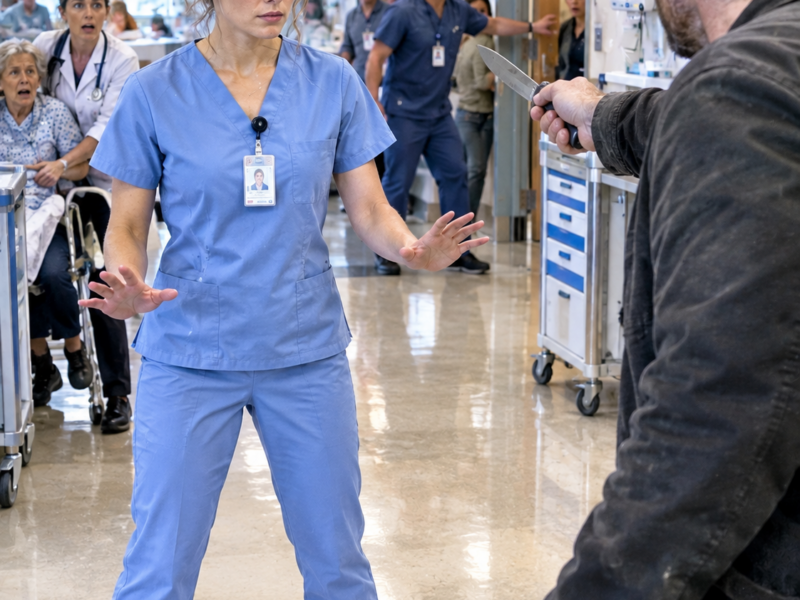
“The gunmen stormed the San Diego hospital expecting helpless doctors and frightened nurses, but when one of them pointed a rifle at the rookie nurse in Room 214
“Hello, Ghost.”
The name struck harder than the gunfire.
For six years, I’d trained myself not to react when I heard it in my nightmares. Now it came from the other side of a hospital door, spoken in the same calm voice that had once guided my team through darkness.
Captain Cole moved in front of me.
“Stay back,” he murmured.
I almost laughed.
He was injured, unarmed, and leaning heavily on a doorframe, yet he had positioned himself between me and the hallway as though that could change anything.
“Captain,” I whispered, “you need to get Mr. Brooks out of here.”
“Not without you.”
“You don’t understand.”
“Then explain it.”
The voice outside interrupted us.
“Emily, I know you’re in there. We can do this the easy way.”
I looked at Cole.
He recognized the voice, too.
“Commander Elias Voss,” he said quietly. “Retired special operations.”
“Not retired,” I replied.
Cole’s eyes narrowed.
Before he could ask what I meant, the door opened wider.
Voss stood in the corridor wearing a dark tactical jacket, no mask, and a silver raven patch on his shoulder.
He looked older than I remembered. His hair had gone almost completely gray, and a thin scar crossed his chin. But his eyes were unchanged: pale, steady, and always measuring the person in front of him.
Behind him stood two armed men.
Voss glanced at the unconscious gunman on the floor.
Then he looked at me.
“You’ve gotten rusty.”
I raised the IV pole.
“You’ve gotten careless.”
For the first time, his expression flickered.
It was gone almost immediately.
“Put that down, Emily.”
“No.”
“I’m not here to hurt you.”
“Then why did you send armed men into a hospital?”
His gaze shifted to Captain Cole.
“Because your friend has something that doesn’t belong to him.”
Cole tightened his grip on the doorframe.
“What are you talking about?”
Voss didn’t answer.
Instead, he looked at the unconscious man.
“Secure him. We don’t have time for this.”
One of the men moved forward.
I shifted my weight.
Voss lifted a hand.
“Don’t.”
The man stopped.
That small gesture told me more than his words had.
Voss was still in command. The others were following his orders, but I couldn’t tell whether they knew who he really was or why he’d brought them here.
I lowered the IV pole a fraction.
“What do you want?”
“The original archive.”
“I don’t have it.”
“You were the last person who saw it.”
“Six years ago.”
“Exactly.”
The word hung between us.
I felt the old mission return in fragments: rain against the windshield, a radio screaming with static, the smell of burned wiring, and my teammate Marcus shouting that the extraction route was compromised.
I remembered the explosion.
I remembered waking up in a field hospital three days later with a fractured wrist and a doctor telling me that the rest of my team had been killed.
I remembered Voss standing at the foot of my bed.
He had told me that the operation had failed, the intelligence had been compromised, and my identity was now a liability.
He had arranged my discharge, given me a new name, and told me to disappear until he contacted me.
He never did.
I had spent six years wondering whether he’d saved my life or simply made sure I couldn’t tell anyone what happened.
Now he was standing in front of me, asking for an archive I had never possessed.
“I don’t know what you’re talking about,” I said.
Voss sighed.
“You were always a terrible liar.”
“And you were always very good at making other people pay for your mistakes.”
His jaw tightened.
For one brief second, I saw the man who had buried three teammates and ordered me to walk away from their bodies.
Then he stepped aside.
“Take her.”
The man on his left raised his weapon.
Captain Cole moved before I could.
He shoved the door closed, sending the armed man stumbling backward. I grabbed Daniel Brooks’ bedside table and pushed it against the entrance.
“Get down!” I shouted.
Cole pulled me toward the adjoining bathroom as gunfire punched through the door.
We hit the floor behind the tiled wall.
A second burst tore through the room.
Glass shattered. A monitor fell. Daniel cried out from beneath the bed.
“Mr. Brooks, stay down!”
I crawled toward him while Cole pressed a hand against his wounded shoulder.
“Emily, no!”
“He’s an elderly patient!”
“So are you if you keep doing this!”
I ignored him.
Daniel was pale and shaking, but he was conscious.
“Can you move?” I asked.
He nodded.
“Then stay close to the wall. We’re leaving through the connecting room.”
I had noticed the shared doorway when I’d first checked the room. It led into a small supply area that connected to the west corridor.
I pulled Daniel upright and guided him toward it.
Cole followed, breathing hard.
Behind us, the gunmen forced the door open.
We reached the supply room just as Voss shouted, “Don’t shoot the nurse!”
The words confirmed what I had feared.
He wanted me alive.
The question was why.
We emerged into the west corridor, where staff were moving patients into locked treatment areas. A hospital security officer spotted us and ran over.
“Are you all right?”
“Not yet,” I said. “There are armed men on the east corridor. Lock the fire doors and get the patients away from the windows.”
The officer hesitated.
“Who are you?”
“Someone who needs you to listen.”
Something in my voice must have convinced him, because he immediately reached for his radio.
Cole leaned against the wall.
“You’ve done this before.”
“Yes.”
“How long?”
“Long enough.”
We reached the stairwell.
I helped Daniel onto a chair near the landing, then turned to Cole.
“You need medical attention.”
“So do you.”
“I’m not injured.”
“Your hands are shaking.”
I looked down.
He was right.
The adrenaline was fading, and my body had begun to remember what my mind was trying to suppress.
I pressed my palms against the cool concrete wall until the tremor eased.
Cole watched without speaking.
Finally, he said, “My brother died in a mission like the one you’re describing.”
I turned toward him.
“Was he special operations?”
“Military intelligence. He was investigating a classified equipment transfer when his convoy was attacked. The report said hostile fire. No suspects were identified.”
“Did he have evidence?”
Cole’s expression changed.
“He left a storage drive with me. I never knew what was on it.”
I stared at him.
“Where is it?”
“Locked in a safe at my house.”
“Does anyone know you have it?”
“No.”
The pieces began to align in a way I didn’t like.
Voss hadn’t come to the hospital because of Cole’s injury.
He had come because Cole possessed something connected to the operation that had destroyed my team.
“Your brother’s name?”
“Michael Cole.”
I closed my eyes for a moment.
I remembered the name from a briefing six years earlier. Michael had been an analyst assigned to the operation’s intelligence review.
He had been removed from the project shortly before the mission.
I had never been told why.
“Your brother was investigating the intelligence that sent us into the field,” I said.
Cole stared at me.
“Then the two incidents are connected.”
“Possibly. But we don’t know how.”
We heard footsteps above us.
I pulled Daniel behind the stairwell door and motioned for Cole to stay quiet.
A man appeared at the landing.
He wore hospital scrubs and carried a pistol low against his thigh.
He wasn’t hospital staff.
His eyes moved over the stairwell.
“Come out,” he said.
I waited until he stepped onto the landing.
Then I moved.
I caught his wrist, redirected the weapon toward the floor, and drove him against the wall. The pistol clattered down the stairs.
He tried to turn, but I used his momentum to bring him to his knees.
Cole stared at me.
“You’re definitely not a rookie nurse.”
“No,” I said, securing the man’s hands with a length of medical tubing. “I’m a very tired nurse.”
The man’s jacket shifted as he struggled.
A laminated card slipped from his pocket.
I picked it up.
It bore the name of a private security company I’d seen before.
Blackridge Solutions.
The company had provided logistics support during my final mission.
And its founder was a former officer who had been under investigation for missing military equipment.
I showed the card to Cole.
“Your brother’s storage drive may be the reason they’re here.”
“Then we need to get to it.”
“Not while the hospital is under attack.”
He looked toward Daniel.
“She’s right,” he said. “We need to get everyone out first.”
For the next twenty minutes, I did what I could.
I guided patients away from the exposed corridors, helped a nurse transfer an oxygen-dependent man into a protected treatment room, and directed security staff toward the west stairwell.
I didn’t carry a weapon.
I didn’t issue orders as though I were still in a military unit.
I simply paid attention to what was happening and used the skills I had spent six years trying to forget.
The hospital’s emergency team eventually secured the lower floor, and police arrived at the main entrance.
But Voss and his men had already moved deeper into the building.
They weren’t trying to escape.
They were looking for me.
I found him near the surgical wing, standing beside a locked records room.
His two remaining men were watching the corridor.
When he saw me, he dismissed them with a glance.
“Where’s the archive?”
“I don’t have it.”
“You expect me to believe that?”
“I expect you to stop pointing guns at hospital staff.”
He looked tired suddenly, older than I remembered.
“You don’t understand what you’re interfering with.”
“Then explain it.”
He glanced toward the records room.
“Your last mission wasn’t a standard extraction. We were sent to recover evidence that a contractor had been diverting restricted equipment. Your team was supposed to retrieve the original communications archive and return without engaging.”
“We never received that order.”
“Because the order was changed.”
“By whom?”
Voss looked away.
I felt my stomach tighten.
“You changed it.”
“I received new intelligence that indicated the archive was about to be moved. I believed the opportunity would be lost if we waited.”
“So you sent us into a compromised location.”
“I didn’t know it was compromised.”
“But someone did.”
He said nothing.
I stepped closer.
“Who?”
“Blackridge had access to the equipment manifests. Someone inside the operation gave them our route.”
“Who?”
Voss rubbed his face.
“I never proved it.”
“And you covered it up.”
“I tried to protect the surviving personnel.”
“You erased me.”
“I gave you a chance to live.”
“You gave me a new name and told me to disappear. You never told my family I was alive. You never told me what happened to Marcus, Lena, or James.”
His eyes closed briefly.
“I thought if you stayed dead on paper, they would leave you alone.”
“Who would?”
“Blackridge.”
The name sounded different coming from him.
Less like a company.
More like a threat he’d been carrying for years.
I thought of the hospital, the patients, and the men who had come through the doors with rifles.
“You could have gone to law enforcement.”
“I did. The investigation was compromised before it began. Documents disappeared. Witnesses changed their statements. I couldn’t prove who was responsible.”
“So you decided to handle it yourself?”
“I decided to find the archive.”
“And if you found it?”
He looked at me.
“Then I’d finally have proof.”
I studied his face.
He might have been telling the truth about the original mission. He might even have believed he was protecting me.
But he had brought armed men into a hospital and endangered innocent people to get what he wanted.
Whatever his intentions, I couldn’t let him continue.
“You’re going to surrender,” I said.
He gave a weary laugh.
“You think they’ll let me explain any of this?”
“I think the people you brought here are going to have a difficult time explaining their actions to the police.”
“And you think the police will believe you?”
“I don’t need them to believe everything today. I need them to stop you from hurting anyone else.”
For a moment, we stood in silence.
Then a voice came over the public-address system.
“Police are entering the east wing. All hospital personnel are instructed to remain in secure areas.”
Voss glanced toward the corridor.
I saw his hand move toward his jacket.
“Don’t,” I warned.
He stopped.
The movement had been small, but I had seen it.
“You’re not the only one who knows how to read a room, Commander.”
He slowly withdrew his hand.
“I never wanted this.”
“Neither did I.”
I stepped away from him and raised my voice toward the officers approaching the corridor.
“Police! He’s here. He’s unarmed, but he’s involved in the attack.”
Voss looked at me as if he couldn’t decide whether to be angry or relieved.
When the officers reached us, he did not resist.
They took him into custody along with the other men.
The hospital remained under lockdown for several hours. Two security officers were injured, several patients suffered minor injuries during the evacuation, and one of the gunmen was taken to surgery after being hurt in the struggle.
No patients died.
That was the only fact I allowed myself to think about until the last emergency team had cleared the building.
Then I sat alone in an empty examination room and began to shake.
I had spent six years convincing myself that the person I had been before the mission was gone.
But she hadn’t been gone.
She had been waiting.
Captain Cole found me there.
He had a fresh dressing on his shoulder and a blanket around his back.
“Are you all right?” he asked.
I looked at my hands.
“Not yet.”
He sat in the chair beside me.
For a while, neither of us spoke.
Then he said, “You saved a lot of people today.”
“I did my job.”
“Maybe. But I saw you go back for that elderly man when everyone else was running.”
I looked at him.
“His name is Daniel Brooks.”
Cole nodded.
“I’ll remember that.”
I almost smiled.
The police interview lasted until late that evening.
I gave a detailed account of the attack, the gunmen’s movements, and Voss’s statements. I made it clear which parts I had witnessed and which parts I suspected.
I did not tell them everything about my former unit. Some details were still classified, and I refused to guess about matters I couldn’t verify.
But I told them enough to establish that the attack had been planned and that the men had specifically sought me out.
Cole provided the name of his brother and the existence of the storage drive.
The police arranged for the drive to be retrieved under a documented process, with a digital forensics specialist present.
We waited two days before receiving the initial findings.
The drive contained archived emails, equipment manifests, and a series of financial records connecting Blackridge Solutions to unauthorized purchases and transfers of restricted equipment.
Several messages referred to the mission that had destroyed my team.
One included a revised extraction route sent to an address associated with Blackridge less than an hour before our deployment.
Another showed that a contractor had received payment after the mission for equipment listed as destroyed.
The evidence didn’t establish who had personally ordered the attack, but it supported the suspicion that someone had used the operation to conceal the diversion of equipment.
There was also a message from Voss.
It was brief.
The team was sent in on the revised route. We need the original archive before anyone else gets it.
I read the sentence three times.
“Does that mean he knew?” I asked the investigator.
“It means he knew the route had changed and believed the archive was important. It doesn’t prove he knew the team would be attacked.”
“Why didn’t he tell us?”
“That is one of the questions we are asking him.”
The drive also contained a reference to a second archive, stored separately from the original mission records.
It had never been recovered.
According to the messages, the second archive contained raw communications data that could identify the person who had leaked the route.
That was the evidence Voss had been searching for.
It was also the reason he had come to the hospital.
He believed Cole’s brother had copied the archive before his death and that Cole might possess the only remaining access key.
The police searched Voss’s belongings and recovered encrypted files, financial records, and communications with several Blackridge employees.
The investigation expanded beyond the hospital attack.
Within days, warrants were issued for the company’s offices and the homes of several executives. Some employees cooperated; others refused to speak without legal counsel.
The founder of Blackridge denied any involvement in the operation.
But the financial records and communications logs contradicted parts of his statement.
For the first time, the case had evidence that could be examined by people who had not been part of the original mission.
I was asked to identify the equipment manifest and explain how the route change had affected our team.
I did so carefully, with an attorney present.
I didn’t want revenge.
I wanted the truth to be established without turning suspicion into another false report.
Over the following weeks, the hospital repaired the damaged doors and replaced the shattered windows. Staff returned to their routines, though the sound of a dropped tray sometimes sent people glancing toward the exits.
I stayed.
I considered resigning more than once, but every time I looked at my patients, I remembered why I’d chosen nursing in the first place.
I wanted to do work that left people safer than I’d found them.
That didn’t mean I had to pretend the past hadn’t happened.
Captain Cole was discharged after his injuries stabilized. Before leaving, he stopped by the nurses’ station and handed me a small envelope.
Inside was a photograph of his brother, Michael, standing beside a younger Cole in front of a house with a crooked fence.
“He’d have liked you,” Cole said.
“Your brother?”
“He believed people should be judged by what they did when things went wrong, not by what they said when everything was easy.”
I studied the photograph.
“Sounds like he knew you well.”
“He did.”
Cole hesitated.
“I’m going to help the investigators however I can. I don’t know what they’ll find, but I want Michael’s death examined properly.”
“You should.”
He nodded, then looked at me with a question he seemed reluctant to ask.
“Do you think you’ll stay here?”
I glanced down the corridor toward Room 214.
“Yes.”
“Even after all this?”
“Especially after all this.”
He smiled faintly.
“Then I hope I never need your care again.”
“You and me both, Captain.”
He left the hospital that afternoon.
A month later, the investigation produced its first major breakthrough.
A former Blackridge technician agreed to testify that the company had obtained the revised route through an unauthorized source. Investigators recovered messages showing that senior executives had discussed the operation before it began.
The evidence did not answer every question, and the case remained ongoing.
Voss was charged in connection with the hospital attack and related offenses. He denied ordering anyone to harm me, but he admitted that he had organized the operation to retrieve the archive.
His claim that he had acted to protect the surviving team remained under investigation.
I visited him once before the case moved to trial.
He sat behind a glass partition in a secure interview room, wearing a plain gray shirt instead of his old tactical jacket.
“You came,” he said.
“I came to ask you something.”
He nodded.
“Ask.”
“Did you know our route had been compromised before we deployed?”
He looked down at his hands.
“I knew there was a risk. I believed the intelligence was reliable enough to proceed.”
“You didn’t tell us.”
“No.”
“Why?”
“Because I thought the target would be gone if we delayed. I thought I could control the risk.”
I waited.
He looked up.
“I was wrong.”
The admission didn’t undo anything.
It didn’t bring back Marcus, Lena, or James. It didn’t return six years of my life or erase the fear I’d carried into every unfamiliar room.
But it was the first time Voss had acknowledged his decision without hiding behind the mission.
“Why did you tell me to disappear?”
“Because I was afraid Blackridge would come after you. I thought if the official record showed you were dead, you’d be harder to find.”
“You made that decision for me.”
“Yes.”
“You should have given me the truth and let me decide what to do with it.”
He looked older than he had in the hospital.
“I know that now.”
I stood.
“I don’t know whether I’ll ever forgive you.”
“I wouldn’t ask you to.”
“Good.”
I left without shaking his hand.
Months later, the criminal investigation resulted in charges against several Blackridge executives and employees. The evidence established that restricted equipment had been diverted and that unauthorized access to operational information had contributed to the mission’s failure.
The courts would determine individual responsibility.
The official review of my team’s deaths was reopened, and the records were amended to reflect the unresolved circumstances surrounding the route change and communications breach.
The findings did not provide a neat answer for every loss.
They did something more important.
They stopped treating our deaths as a closed file.
I continued working as a nurse.
I learned to tell my colleagues a little more about my past without explaining every classified detail. I attended counseling, not because I was ashamed of what I’d done, but because I was tired of allowing old memories to decide how I lived.
Sometimes I still woke at night remembering the explosion.
Sometimes a loud noise made my muscles tighten before my mind could catch up.
But I no longer mistook those reactions for proof that I had failed to leave the past behind.
One afternoon, Daniel Brooks returned to the hospital for a follow-up appointment.
He brought a paper bag filled with homemade cookies and insisted that the nurses’ station had been keeping him alive on terrible coffee.
“You’re the one who told me to get under the bed,” he said when he saw me.
“I remember.”
“I never thanked you properly.”
“You don’t owe me anything, Mr. Brooks.”
He placed the bag on the counter.
“Then take the cookies as a complaint about the coffee.”
I laughed.
It was a small moment, ordinary enough that no one else in the corridor paid attention.
But I held on to it.
For six years, I’d believed the only way to survive was to become someone who never looked back.
The hospital attack had forced me to face the truth: I could not control what had happened to me, and I could not erase the choices other people had made.
I could only decide what I did next.
I still carried the old instincts. I still noticed exits, listened for changes in a person’s voice, and watched a room before sitting with my back to the door.
Those things were part of me.
But so was the nurse who stayed late with frightened patients, who remembered their families’ names, and who believed that a steady hand could sometimes save a life without ever raising a weapon.
I had spent years thinking I needed to choose between those two versions of myself.
I no longer did.
On the anniversary of the attack, I walked past the repaired entrance and paused beside the glass doors.
My reflection looked back at me in the morning light: hospital scrubs, tired eyes, an identification badge bearing the name Emily Carter.
Not Ghost.
Not a casualty on a classified report.
Not a weapon someone else could summon when they needed a problem solved.
Just Emily.
A nurse who had survived her past and chosen, every morning, to help someone else survive theirs.
THE END.









