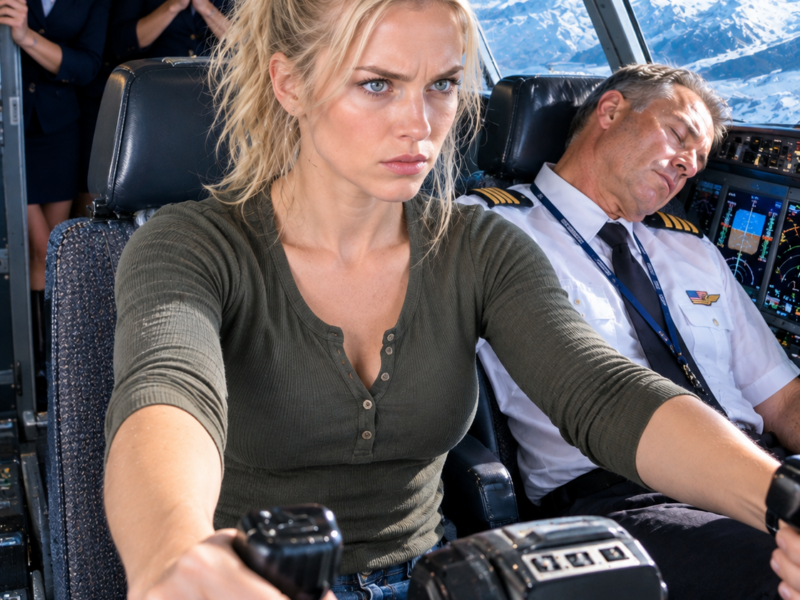
The first sign that something was wrong wasn’t the screaming, the oxygen masks dropping, or even the captain’s voice breaking over the intercom
The first officer was lying on the floor behind the cockpit door when I stepped inside.
His name tag read DANIEL PRICE. His eyes were half-open, and his breathing came in short, uneven gasps. A flight attendant was kneeling beside him, pressing an oxygen mask over his face while another tried to reach someone on the cabin interphone.
The captain was still in his seat.
He was conscious, but barely. His left hand gripped the armrest, and his right hovered over the controls as if he could no longer remember what each one did. His forehead glistened with sweat. Every few seconds, he closed his eyes and forced them open again.
“Who are you?” he whispered.
“Claire Morgan. I have flight experience.”
“What kind?”
“Military fixed-wing. I’m familiar with instrument flying and emergency procedures.”
His eyes sharpened just enough to understand the answer.
“Type?”
I gave him the aircraft family I had flown, then told him plainly that I was not qualified on this exact commercial model.
He swallowed hard.
“Autopilot’s engaged. We’re on a flight plan. But I’m getting dizzy. Can’t keep my eyes focused.”
I moved toward the empty right seat, careful not to touch anything.
“Captain, I need you to tell me what the aircraft is doing. I’m not going to assume I can operate your plane just because I’ve flown something else.”
He gave the smallest nod.
That was enough to begin.
The cockpit smelled of warm electronics, coffee, and the sharp tang of fear. Displays glowed across the instrument panel. Numbers and symbols moved in ways that looked familiar in principle but differed in details from the military aircraft I remembered. A warning tone sounded intermittently. The autopilot annunciation remained illuminated, but I knew that did not mean we were safe. Automation could keep an aircraft on a route; it could not replace a crew that understood what was happening.
“Tell me the symptoms,” I said.
“Chest pain. Shortness of breath. Started about ten minutes ago.” His words came slowly. “Daniel went down first. I thought it was turbulence. Then my hands started tingling.”
I looked toward the first officer.
“Did either of you eat the same food?”
The captain tried to answer, then stopped to breathe.
“I don’t know.”
I turned to the flight attendant. “Get the medical volunteer to the cockpit door, but don’t crowd the controls. Ask the cabin crew to identify anything unusual—smoke, fumes, strange smells. And tell them we may be diverting.”
She nodded and hurried out.
I sat in the right seat only after the captain gestured toward it. I kept my hands away from the controls while I took in the flight instruments and read the visible information aloud, asking the captain to confirm what I was seeing. The aircraft was cruising at high altitude, on a stable automated route. There was no immediate sign of a loss of control, but the captain’s condition was deteriorating, and the first officer was unable to assist.
“Can you talk to air traffic control?” the captain asked.
“Yes, if you can help me identify the correct radio controls and procedures.”
He pointed with a trembling finger. “That panel. Frequency is set. Push to talk there.”
I made the call using the aircraft’s existing radio setup, identifying the flight and declaring a medical emergency. I told air traffic control that both pilots were incapacitated or becoming incapacitated and that we needed immediate assistance and a diversion.
The controller answered in a calm, precise voice.
“Flight 482, roger. We have you. Maintain your current flight path and altitude if able. We’re coordinating with your company and emergency services. Can you confirm who is flying the aircraft?”
I glanced at the captain.
“I’m a passenger with prior military flight experience. I’m assisting under the captain’s direction. I am not type-rated on this aircraft.”
There was a brief pause.
“Understood, Flight 482. We’ll get you support. Do not make any changes you’re not certain about. We’ll coordinate with the aircraft operator and an instructor or qualified pilot as quickly as possible.”
That was exactly what I needed to hear.
I had spent enough years around aviation to know that confidence could become its own kind of danger. A person who was frightened but honest could still make sound decisions. A person who pretended to know everything could turn a manageable emergency into a catastrophe.
The cockpit door remained open a few inches. Beyond it, I could hear the cabin growing restless.
“Are we going to crash?” a passenger shouted.
“No,” the lead attendant replied, her voice strained. “Please remain seated and follow instructions.”
I looked at the captain.
“We need to get medical help to both of you. Can you tell me whether anything has changed in the cabin? Any reports of smoke or an unusual odor?”
“No.”
“Any warning that we’re losing pressurization?”
He shook his head faintly.
The medical volunteer arrived at the cockpit entrance. She was a woman in her fifties with silver hair and a small emergency kit. She introduced herself as Dr. Elaine Foster, an emergency physician traveling to Anchorage for a conference.
“I need to assess the pilots,” she said.
“Please do,” I replied. “The first officer is on the floor. The captain is conscious but deteriorating. We’ve declared an emergency.”
She moved to the first officer and began checking his pulse and breathing. Another crew member brought oxygen equipment and helped her position him safely. She asked for his medical history, allergies, and medications, but no one could give her a complete answer.
The captain tried to speak.
“Doctor… chest…”
“I’m going to assess you next,” she said. “Keep breathing slowly if you can. Don’t try to stand.”
She examined him as best she could in the cramped cockpit, then looked at me.
“Something is wrong with both of them. I can’t diagnose it here, but this could be a serious medical emergency. We need them on the ground.”
“We’re working on that,” I said.
The captain’s breathing became more labored.
“Claire,” he whispered, “I need you to take over.”
I felt the words land like a weight.
I had imagined many times what it would feel like to sit in a cockpit again. In some versions, I was calm and capable, soaring over familiar terrain. In others, I woke before the aircraft left the runway, my heart racing, my hands clenched in the sheets.
I had never imagined this.
I looked at the captain, then at the instrument panel. My past was no longer a memory I could keep at a distance. It was here, asking me to decide whether the skills I had spent nine years trying to bury were enough to help 187 people survive.
“I’ll assist,” I told him. “But I need you to remain with me as long as you can, and I need air traffic control and your airline to guide us through the aircraft-specific procedures.”
He gave a faint nod.
I repeated the situation to the controller, who confirmed that the airline was connecting a qualified pilot to the radio support channel. An aviation specialist would talk us through the aircraft systems, while controllers would provide navigation and coordinate the diversion. The destination was still being decided based on weather, runway conditions, and the aircraft’s state.
I did not ask for a dramatic landing in the middle of a storm. I asked for the safest available option.
The controller began relaying the initial plan, including the heading and altitude the aircraft should maintain while the diversion was coordinated. I read each instruction back and waited for confirmation. The captain verified what he could. I made no adjustment until the controller and captain agreed on it.
The next few minutes became a sequence of small, careful tasks.
Confirm the aircraft’s status.
Verify the radio.
Read back the clearance.
Keep the cockpit organized.
Make sure the flight attendants knew what to tell the passengers.
Ensure that someone was watching the captain and first officer.
No one cheered. No music swelled. I was too aware of how little margin for error we had.
A new voice joined the support channel: a training captain from the airline, speaking from a ground operations center.
“Flight 482, this is Captain Lewis. I understand you have prior flight experience but are unfamiliar with this exact aircraft. I’m here to assist alongside air traffic control. We’ll work through the procedures one step at a time. Tell me what you can see, and do not move any control unless you understand the instruction.”
“Understood,” I replied.
He asked me to identify the aircraft’s current automation status and confirm what information was available on the flight displays. I read it aloud. He cross-checked the details with the controller and the airline’s flight operations team.
We had a plan for the immediate future.
Then the aircraft jolted again.
The captain groaned and pressed a hand to his chest.
Dr. Foster looked up sharply.
“His condition is worsening.”
I watched the instruments while she checked him again. The aircraft remained stable, but the medical situation had become urgent enough that every minute mattered.
“Captain Lewis,” I said, “we need the nearest suitable airport. The captain may lose consciousness.”
“Understood. We’re coordinating that now.”
The controller returned with a diversion option and began providing the necessary information. The airline support pilot reviewed the proposed approach conditions and made clear that the airport choice was based on the weather and available emergency response, not simply on distance.
The destination was Anchorage.
We still had time to reach it if the aircraft remained stable, but no one could promise that the pilots would recover before we landed.
I heard a faint, high-pitched tone from the panel and felt my stomach tighten.
“What’s that alert?” I asked.
Captain Lewis requested a description of the indication. I gave it to him, and he checked it against the aircraft’s status information. It was not an immediate flight-control failure, but it required monitoring. He explained what it meant in general terms and told me which information to keep reporting.
I focused on the tasks he assigned.
At some point, I realized my hands were shaking.
I pressed them lightly against my thighs and breathed in through my nose, then out through my mouth. I had learned that trick during my first year of military flight training, when the instructors taught us that fear was not the enemy. Unchecked fear was.
A memory rose without warning: a runway at dusk, the smell of rain on hot tarmac, my instructor standing beside the aircraft with his arms folded.
“You don’t need to feel fearless, Morgan,” he had told me. “You need to be able to think while you’re afraid.”
I had hated him for saying it then.
Now I was grateful.
The lead flight attendant returned to the cockpit entrance.
“The passengers are asking what’s happening. Some have started praying. One man is demanding to speak to you.”
“Tell them we’ve declared a medical emergency and are diverting to Anchorage,” I said. “Tell them the aircraft is currently stable, the airline and air traffic control are assisting us, and they must remain seated with their seat belts fastened. No one should come forward unless the cabin crew directs them.”
She nodded, but she did not leave immediately.
“Can I tell them you’re a pilot?”
I thought about it.
“Tell them I have prior military flight experience and that I’m assisting the airline’s team. Don’t promise them anything we can’t guarantee.”
Her eyes softened.
“Thank you.”
She went back into the cabin.
For the first time since entering the cockpit, I allowed myself to look at the view through the windshield.
Alaska filled the horizon. Mountains rose through bands of cloud, dark rock and white snow meeting beneath a sky that seemed impossibly wide. The landscape was beautiful in the indifferent way of places that do not care whether you survive them.
I had once loved flying over places like this.
Then, nine years ago, a training flight had ended with a hard landing after a systems malfunction. My instructor had survived, but I had suffered injuries that kept me out of the cockpit for months. The physical recovery was long. The psychological recovery was worse.
I could still hear the metallic impact in my dreams.
I could still remember waking in a hospital bed and learning that my instructor would never fly again.
He had survived, but the injuries had ended his career. I had been cleared for duty eventually, yet I could not bring myself to return to operational flying. Every time I sat in a cockpit, I heard the sound of the aircraft striking the runway.
I left the service, took a job in aviation safety, then moved into a quieter civilian role. I told people I was ready for a new chapter.
The truth was that I was afraid of the old one.
Now the aircraft beneath my hands was carrying 187 people, and the only thing that mattered was what I could do next.
Captain Lewis brought me back to the present.
“Claire, we’re preparing for the approach. I need you to stay with the instructions, and we’ll confirm each step before it’s carried out. The cockpit crew is still unavailable, so we’ll proceed with the emergency plan.”
“Understood.”
The controller gave us updated weather and runway information. The airline support team reviewed the approach options and coordinated with emergency services on the ground. Fire crews and medical personnel would be standing by.
I repeated the key information back.
My mouth was dry. My shoulders ached from holding myself so still. Every sound seemed amplified: the hum of the aircraft, the voices on the radio, Dr. Foster’s quiet instructions as she monitored the captain.
The first officer stirred.
Dr. Foster leaned toward him.
“Daniel? Can you hear me?”
His eyes opened briefly.
“Captain?”
“You’re receiving medical care,” she said. “Stay still.”
He tried to sit up, but she gently stopped him.
“Don’t move. We need to keep you safe.”
He looked past her toward me.
“Who’s flying?”
“I’m assisting with the airline and air traffic control,” I said.
His eyes widened, then he tried to speak. Dr. Foster asked him to conserve his energy.
I wanted to ask what had happened, whether he had experienced chest pain before, whether the two pilots had shared anything unusual. But we had neither time nor the medical information needed to solve the mystery. The priority was getting the aircraft to the ground.
A few minutes later, the captain lost consciousness.
Dr. Foster immediately began treating him, calling for assistance from the cabin crew. I watched the flight instruments and kept the radio communication going, following the support pilot’s guidance. My stomach twisted, but I did not let myself stare.
The controller’s voice remained steady.
“Flight 482, you are not alone. We have you on radar. Emergency services are ready. Continue to follow the agreed plan.”
I held onto that sentence.
You are not alone.
I had spent nine years convincing myself that leaving the cockpit meant leaving behind everyone who had ever depended on me. I had treated my fear as a private failure, something I needed to hide until it disappeared.
But the voices on the radio were proof that aviation was never meant to be one person against the sky. It was a network of people sharing information, checking one another, and refusing to let pride replace procedure.
I did not have to be a miracle.
I had to be a reliable part of the team.
As we began the final stage of the diversion, the airline support pilot slowed his instructions and asked me to confirm each piece of information. He did not assume I knew the aircraft simply because I knew how to fly. I did not pretend I understood something I hadn’t been trained to operate.
The process was methodical and exacting.
The flight attendants prepared the cabin for landing. Passengers were told to remain seated, tighten their seat belts, and follow crew instructions. The crew secured loose items and checked the cabin. A mother held her toddler against her chest and whispered into his hair. The elderly man with the crossword had put the puzzle away and folded his hands together.
The businessman beside my original seat was no longer typing.
Through the cockpit doorway, I could see him watching me.
Our eyes met for a second.
He looked away first.
The runway was still ahead, hidden by the cloud layer. I could not see the ground clearly, and I would not pretend that my old training made the weather irrelevant. The approach was being coordinated with people who knew this aircraft and this airport far better than I did.
“Flight 482,” the controller said, “emergency vehicles are in position. Continue as cleared. We are monitoring your progress.”
I read back the instruction.
My heart was beating so hard I could feel it in my throat.
Then, through a break in the clouds, I saw the ground.
The world below was no longer an endless white wilderness. There were buildings, roads, and the unmistakable geometry of an airport. The runway lights formed a line across the gray winter landscape.
I felt a rush of relief so powerful that my eyes burned.
But I didn’t celebrate. We were not on the ground yet.
Captain Lewis continued to guide me through the aircraft-specific process, and the controller provided the necessary updates. I listened, confirmed, and followed only the instructions I understood. Every second required concentration.
The aircraft descended through the last layer of cloud.
For one brief moment, the runway seemed to slide away from the windshield. My body remembered the old accident before my mind could stop it. I heard the metallic impact from nine years earlier. My hands tightened.
“Claire,” Captain Lewis said calmly, “stay with me. Tell me what you see.”
I forced myself to describe the runway environment, the aircraft’s status, and the information he requested.
“Good,” he replied. “Keep going. One step at a time.”
One step at a time.
The words anchored me.
The runway grew larger. The ground rushed toward us. I could see emergency vehicles waiting near the side, their lights flashing against the gray afternoon.
I followed the final guidance from the airline support pilot and the controller.
Then the wheels met the runway.
There was a hard jolt, a long shudder, and a roar that seemed to rise through the entire aircraft. For a fraction of a second, I could not tell whether the sound was normal or something had gone wrong.
Then the aircraft continued along the runway, decelerating under the agreed emergency procedure.
We were down.
I did not cheer. I did not cry out. I stared ahead and listened as the controller confirmed our position and the ground crew prepared to assist.
Only when the aircraft had stopped and the emergency vehicles were alongside did I realize I had been holding my breath.
Dr. Foster looked up from the captain.
“We’re on the ground,” she said.
Her voice cracked on the last word.
I let my head fall back against the seat.
For several seconds, I couldn’t speak.
Then the cabin erupted.
People were crying, laughing, praying, embracing one another across the aisle. Someone clapped. Someone else shouted, “We’re alive!” A wave of applause rolled from the back of the plane toward the front.
I heard it through the cockpit door, but it felt as though it were happening to someone else.
The lead flight attendant appeared beside me, tears running down her face.
“Claire, you got us here.”
I shook my head.
“We got here. The controllers, the airline pilot, you, the doctor. Everyone did their part.”
She looked at me as if she wanted to argue, then simply took my hand.
Outside, emergency crews were already moving toward the aircraft. Medical personnel entered to help the captain and first officer. They were taken off the plane for urgent treatment, while cabin crew guided passengers through the disembarkation process according to the emergency plan.
I remained in the cockpit until an airline representative told me it was safe to leave.
When I finally stepped into the cabin, the passengers stood in the aisle. Some were crying openly. A little boy near the front stared at me with wide eyes.
“Are you the lady who landed the plane?”
I knelt slightly so I could speak to him without towering over him.
“I helped,” I said. “A lot of people helped.”
His mother wrapped an arm around his shoulders.
“Thank you,” she whispered.
I wanted to tell her not to thank me yet. I wanted to tell her how many people had been working behind the scenes, how many decisions had been checked and confirmed, how close we had come to losing our ability to respond.
Instead, I said, “I’m glad you’re safe.”
When I stepped onto the airport jet bridge, cold air moved through the open doorway. The smell of snow and jet fuel brought back memories so vivid that I had to stop walking.
A paramedic asked whether I needed medical attention.
“I’m all right,” I said automatically.
He gave me a look that suggested he had heard that answer too many times.
“Let’s check anyway.”
I let him.
My blood pressure was elevated, my hands were trembling, and I was exhausted in a way I had never experienced after an ordinary flight. But I was physically safe. The crew was receiving treatment, the passengers had been evacuated without serious injury, and the aircraft was secured.
The captain and first officer were transported to a hospital.
I learned later that both had suffered a serious medical event. Investigators would examine whether an environmental factor, a shared exposure, or another cause had contributed. The early reports did not establish a definitive explanation, and I refused to speculate when journalists began asking questions.
All I knew was that both men had been critically ill, and that they had needed immediate care.
That evening, an airline operations manager met me in a small room near the terminal. He asked for my contact information, my aviation history, and a detailed account of the events. I gave him the facts as accurately as I could remember them, distinguishing what I had seen from what I had been told.
He thanked me and said the airline would conduct a formal review.
I expected that to be the end of it.
Instead, by the next morning, my name was everywhere.
A passenger had recorded part of the cabin commotion. Another had captured the moment the flight attendant asked whether anyone knew how to fly. Someone else had posted a short clip of me leaving the cockpit after landing.
The headline on one news site read: MYSTERY PASSENGER HELPS LAND AIRLINER AFTER BOTH PILOTS FALL ILL.
By noon, a second headline had appeared: WHO IS CLAIRE MORGAN? THE WOMAN WHO BROUGHT 187 PEOPLE HOME.
I hated that one.
It made the story sound as though I had stepped out of a movie, performed a miracle, and returned to my seat.
It left out the people on the radio. It left out the crew who kept the cabin organized, the physician who treated the pilots, and the emergency personnel waiting on the ground. It left out the fact that I had openly acknowledged my limits and followed the guidance of qualified professionals.
Most of all, it left out the nine years in which I had believed my life was over because I could no longer fly.
I switched off my phone.
For the next two days, I stayed in Anchorage while the airline arranged travel for passengers. I walked along the edge of the waterfront, watched snow fall over the harbor, and tried to understand what had happened.
I had thought the hardest part would be getting the aircraft safely onto the runway.
It wasn’t.
The hardest part was facing the fact that I had been afraid of my own past for almost a decade, and that the moment I had spent years avoiding had arrived without asking permission.
I could not pretend that the fear had vanished. When I closed my eyes, I still heard the warning tones. I still saw the captain’s face as he struggled to breathe. I still remembered the instant the runway seemed to slip away from the windshield.
But beneath those memories was something new.
Not pride, exactly.
A sense that perhaps I had been wrong to believe that one terrible day had erased everything I had learned before it.
Three days after the flight, the airline contacted me again. They wanted me to participate in a formal debrief with their safety team and the relevant authorities. I agreed, with the understanding that I would describe what I had done and what I had not done.
At the debrief, an investigator asked me why I had volunteered to enter the cockpit.
“Because the pilots were incapacitated, and I had relevant experience,” I said.
“Were you confident you could land that aircraft?”
“No.”
The investigator looked up.
“I was confident I could help establish communication, assess what was happening, and assist under professional guidance. I was not confident that my experience alone qualified me to operate that specific aircraft. That’s why I asked for help.”
He wrote something down.
“Were you afraid?”
“Yes.”
“Why did you proceed?”
“Because fear didn’t change the situation. There were 187 people on board, and the people who could normally manage the emergency were unable to do so. I had to decide whether I could be useful.”
The investigator set his pen down.
“And were you?”
I thought of the controllers, the airline support pilot, the flight attendants, and Dr. Foster.
“I hope I was.”
The review continued for weeks. Investigators examined the aircraft systems, the pilots’ medical conditions, the radio recordings, and the decisions made during the diversion. The airline did not treat the event as a single heroic act. It treated it as an emergency that required careful reconstruction.
That mattered to me.
Aviation had taught me that surviving an emergency did not mean every decision had been perfect. It meant that the decisions had to be examined honestly so the next crew could learn from them.
Eventually, the captain and first officer began recovering. I received a short message from the airline saying that both men were stable and receiving further treatment. I did not contact them directly; their families deserved privacy, and I had no right to intrude on their recovery.
Several weeks later, a letter arrived from the captain.
It was handwritten on plain paper.
He said he remembered very little of the cockpit after his symptoms worsened. He had been told that a passenger with prior military flight experience had assisted the crew and followed the guidance of air traffic control and the airline’s support team.
He thanked me for being honest about what I could and could not do.
Then he wrote, “I have spent most of my career believing that preparation means knowing what to do. That day reminded me that preparation also means knowing when to ask for help.”
I read the sentence several times.
It was the kind of lesson I had once understood instinctively, then forgotten while trying to recover from the accident that ended my military flying career.
I wrote back, wishing him a full recovery and thanking him for the letter. I didn’t tell him that I had been afraid to sit in an aircraft cockpit for nine years. That story was mine to share only when I was ready.
Spring arrived slowly in Alaska and more quickly in Seattle.
I returned to my apartment, resumed my job, and tried to settle into ordinary life. For a while, every flight announcement made my stomach tighten. When a plane passed overhead, I found myself looking up before I could stop.
But I also began to notice something else.
I missed flying.
Not the danger, not the pressure, and not the feeling of being trapped inside a machine that could turn unforgiving in seconds. I missed the work itself: the discipline, the planning, the communication, the constant awareness that every decision had a purpose.
I missed being part of a team that took responsibility seriously.
For years, I had treated the cockpit as a place I could never return to because it was where my worst memory lived. Now I wondered whether it could become a place where I built a different memory.
I contacted an aviation medical specialist and a counselor experienced in trauma. I did not rush the process. I did not assume that surviving one emergency meant I was ready to fly professionally again. I wanted to understand my own reactions, complete the necessary assessments, and make decisions based on evidence rather than emotion.
Some days were difficult.
During one session, my counselor asked me what I thought would happen if I returned to a simulator.
“I might freeze.”
“What would freezing mean?”
“That I haven’t recovered.”
She tilted her head.
“Or that you’re having a human response to something that frightened you. What would you do if it happened?”
I considered the question.
“I would stop, assess what happened, and try again when I was ready.”
“Then perhaps that is what recovery looks like.”
The first time I entered a simulator again, my hands began shaking before I reached the seat.
I stood beside the cockpit mock-up, staring at the instruments.
For a moment, I was back on that runway nine years earlier.
Then I heard my instructor’s voice in my memory.
You don’t need to feel fearless. You need to be able to think while you’re afraid.
I sat down.
The session was supervised by an instructor who knew my history and understood that the goal was not to prove I was invulnerable. We began with routine procedures, paused when I needed to, and reviewed every step. When a simulated warning sounded, my pulse jumped, but I did not leave the seat.
I asked questions.
I made mistakes.
I corrected them.
And when the session ended, I was exhausted, but I was not broken.
Over the following months, I continued the process. I completed further assessments and received guidance on what kinds of aviation work were appropriate for me. I learned that returning to the cockpit did not have to mean returning to the exact career I had left.
Eventually, I accepted a position with a flight training organization, helping develop emergency communication and decision-making exercises for pilots and cabin crews. I was not handed a commercial flight deck because of what happened over Alaska. I earned the opportunity through training, evaluation, and the ordinary, unglamorous work of rebuilding trust in my own abilities.
I found that I loved teaching.
I could help crews practice the moments that never appeared in promotional videos: how to communicate when the captain was unwell, how to divide responsibilities under pressure, how to tell air traffic control exactly what was known and what remained uncertain, how to keep a cabin informed without making promises that could not be kept.
I never taught people to expect a stranger in Seat 3D to save them.
I taught them to build systems that made it less likely anyone would have to.
One year after the emergency, the airline invited me to a safety conference. The organizers wanted me to speak about the experience. I accepted on one condition: the presentation would acknowledge everyone who had contributed to the safe landing.
When I stood at the lectern, I looked out at a room filled with pilots, flight attendants, controllers, medical professionals, and safety investigators.
I had expected to feel like an impostor.
Instead, I felt at home.
I told them about the moment I heard the captain call for help. I described how I had entered the cockpit, acknowledged the limits of my experience, and asked for assistance. I spoke about the discipline of readbacks, the importance of clear communication, and the danger of allowing pride to make decisions.
Then I told them about the years I had spent avoiding the cockpit because I believed that fear meant I was no longer fit to fly.
“I used to think courage meant being the person who had the answer,” I said. “Now I think courage often means admitting what you don’t know, asking for the right help, and staying present long enough to do the next necessary thing.”
The room was silent.
I looked down at my notes, then back at the audience.
“The aircraft did not land because one passenger was extraordinary. It landed because a group of people communicated, followed a plan, and worked together under pressure. I was one part of that effort. I’m proud of the part I played, but I’m even more grateful that I didn’t try to do it alone.”
Afterward, a young pilot approached me.
“I’ve been afraid to tell my instructor that I struggle with anxiety before emergency simulations,” she said. “I thought it meant I shouldn’t be here.”
I recognized the look in her eyes.
“What do you do when you’re anxious?” I asked.
“I prepare more. I double-check everything.”
“That’s useful up to a point. But you also need to learn how to work with the anxiety, not just hide it. Talk to your instructor. Get support. Don’t make the decision about your future based on shame.”
She nodded, blinking quickly.
“Thank you.”
I watched her return to the group, and I thought about the woman I had been nine years earlier: injured, frightened, and convinced that leaving the cockpit meant she had failed.
I wished I could tell that woman what I knew now.
That a painful ending did not have to define every chapter that followed.
That asking for help was not weakness.
That a person could be afraid and still be useful, uncertain and still be capable, changed by an experience without being reduced to it.
And that sometimes the life you thought you had lost was not waiting for you to become the person you used to be. It was waiting for you to become someone who understood herself better.
I still think about Flight 482 when I look up at the sky.
I think about the 187 passengers who began that Thursday expecting an ordinary trip to Anchorage. I think about the crew who continued working while frightened, the doctor who treated two men in a cramped cockpit, the controllers who stayed on the radio, and the airline pilot who guided me through an aircraft I did not know well enough to operate alone.
I think about the captain and first officer, both recovering from a medical crisis they never expected.
And sometimes I think about the businessman beside my original seat, who had asked me where I was going when I stood up.
I never learned his name.
I hope he remembers that day not as a story about a woman who saved everyone, but as a reminder that people can surprise us when a crisis strips away our assumptions.
The quiet passenger may have skills no one can see.
The confident professional may need help.
The person who is frightened may still be the one willing to step forward.
And the person who steps forward does not have to pretend to be fearless.
I had boarded that aircraft hoping to reach Anchorage, finish my book, and return to a life that no longer asked me to remember what I had lost.
Instead, I found myself facing the part of me I had spent nine years avoiding.
I did not emerge from that flight magically healed. I still have difficult days. I still remember the accident. I still respect how quickly a routine flight can become an emergency.
But I no longer believe that fear has the final word.
Sometimes the moment that changes your life arrives as a sudden jolt above a frozen wilderness. Sometimes it comes through an open cockpit door and a voice asking whether anyone can help.
And sometimes the answer is not a declaration of certainty, not a promise that everything will be fine, but a simple commitment to do what you can, tell the truth about what you cannot, and trust the people willing to stand beside you.
That afternoon, Seat 3D was just a seat.
I was just a passenger with an old skill, a frightened heart, and a choice to make.
I didn’t save those people alone.
I simply stopped running from the part of myself that could help.
The End.









