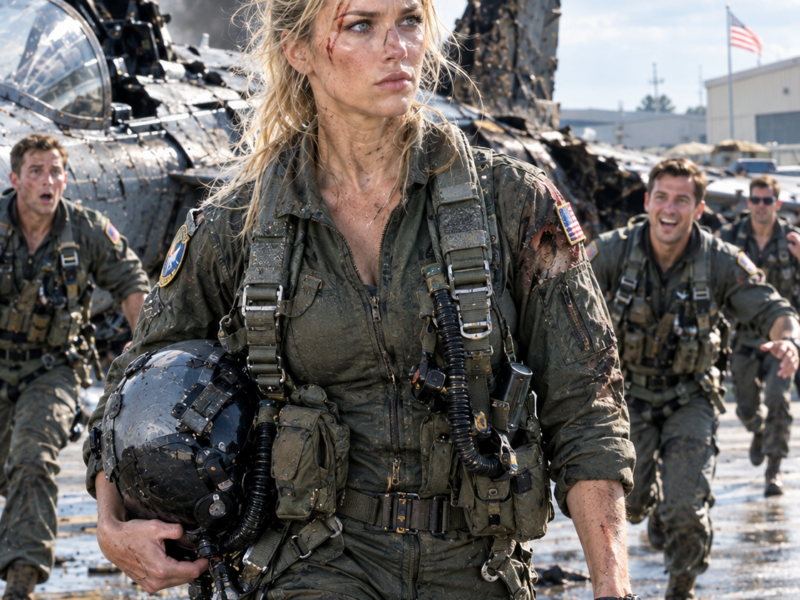
The control room went silent when the radar operator saw the call sign that had been missing for eleven years—RAVEN ONE
The radar track was coming straight toward our facility, and every instinct I had told me to call it a threat.
“Major Shaw,” I said, trying to keep my voice steady, “Raven One is closing at an estimated six hundred knots. No transponder. No authorized flight plan. If he maintains this heading, he’ll cross the outer perimeter in less than four minutes.”
Major Rebecca Shaw stood behind my console, staring at the glowing symbol as if it were a ghost that had learned to fly.
“Open a secure channel,” she ordered.
I switched to the old frequency, the one that had been dormant for eleven years. “Raven One, this is Nevada Control. Identify yourself and state your intentions.”
Static filled the room.
Then a voice answered.
“Control, I know you can hear me.”
It was the same voice from before—older, rougher, worn down by years of something none of us could imagine. But there was no confusion in it. No panic. Just an exhausted certainty.
“This is Captain Elias Vance. I’m requesting permission to land.”
The entire operations floor seemed to stop breathing.
Major Shaw leaned toward my headset. “Captain Vance, your aircraft is approaching restricted airspace. We need you to turn to heading zero-nine-zero and reduce speed immediately.”
“Negative.”
Two syllables. Calm. Absolute.
My stomach tightened.
“Captain,” Shaw said, “you are approaching a secured military installation. We need you to comply with instructions.”
“I know exactly what I’m approaching, Major.”
He paused. In the background, I heard a faint metallic rattle, followed by a warning tone.
“My left engine is unstable. Flight controls are degrading. I have fuel for approximately twelve minutes. I’m not going anywhere else.”
Shaw glanced at me.
“Ask him for his aircraft type,” she said.
I relayed the question.
“Experimental long-range reconnaissance platform,” Vance answered. “Designation was never entered into the public inventory. Tail number is seven-one-four.”
I typed the number into the system. Nothing appeared in the ordinary database.
Then Shaw entered a command using her own authorization.
A red banner flashed across my screen.
CLASSIFIED RECORD — ACCESS RESTRICTED.
She entered a second credential.
The record opened.
The aircraft was real. It had been part of a highly classified program eleven years earlier, a prototype designed to test endurance, high-altitude navigation, and electronic countermeasures. Its existence had been denied even inside the military units that supported the test program.
The last recorded flight had ended over a hostile region beyond the reach of friendly rescue teams.
The official report stated that the aircraft had suffered a catastrophic failure.
The pilot had been presumed killed.
But the line beneath his name made my skin crawl.
RECOVERY STATUS: SUSPENDED BY EXECUTIVE AUTHORITY.
“Major,” I whispered, “someone suspended the recovery.”
“I can read it, Cross.”
Her expression had changed. She was no longer looking at the screen like an officer confronted with an impossible return. She looked like someone who had finally reached the page in a book she had spent years trying not to open.
“Raven One,” she said into the channel, “we are preparing an emergency recovery corridor. Maintain your current altitude for as long as safely possible. Do not descend until instructed.”
“Understood.”
Then, quieter, he added, “Rebecca?”
Shaw went still.
Nobody on our floor called her by her first name over a secure military channel.
“Who gave you this frequency?” she asked.
“Your father.”
Her face lost its color.
I looked from her to the monitor. She didn’t move for several seconds.
“General Mercer is retired,” she said.
“I know.”
“He hasn’t had access to this facility in years.”
“I know that, too.”
“Then how did you—”
“He told me that if I ever made it home, I should ask for you.”
Shaw slowly removed her headset.
“My father died three years ago,” she whispered.
The radio remained open.
“I know,” Vance replied. “I’m sorry, Rebecca.”
For a moment, she looked less like a major responsible for hundreds of lives and more like a daughter who had just heard a voice from her childhood.
Then the warning tones from my console snapped her back to the present.
“Cross,” she said, “get me the base commander and the emergency landing team. Now.”
I moved.
Within ninety seconds, the facility transformed. Security personnel moved to the perimeter. Fire crews rolled toward the auxiliary runway. Medical teams received a preliminary briefing. Two armed interceptors launched from a nearby airfield, not to attack Raven One but to identify and escort him through the restricted corridor.
The order was explicit: do not engage unless the aircraft demonstrated hostile intent.
I returned to the radar.
The symbol was still there, cutting across the night sky with unnerving precision.
“Raven One, this is escort flight. We have you on radar. Turn left heading two-seven-zero.”
“Unable.”
“Raven One, confirm unable.”
“Confirmed. Flight controls are responding intermittently. I can hold the current course, but I can’t guarantee a turn.”
The escort controller relayed the information to Shaw.
She pressed her lips together. “Tell them to remain clear and continue visual identification. No aggressive maneuvering.”
I watched the aircraft approach the final restricted boundary.
It wasn’t behaving like a normal aircraft with a failing engine. Its speed fluctuated in small, controlled increments. Its altitude drifted, corrected, then drifted again. The radar return occasionally fragmented, as though the system couldn’t decide whether the aircraft was actually there.
“Captain Vance,” I said, “we’re seeing intermittent loss of your track. Can you confirm your navigation systems are operational?”
“Partially.”
“What about your onboard transmitter?”
“Barely.”
“Then how are you maintaining this heading?”
A long silence followed.
“Old-fashioned navigation.”
I almost laughed, though nothing about the situation was funny.
“Captain, with respect, that’s not enough information for me to keep you safe.”
“Fair point, son.”
The unexpected warmth in his voice caught me off guard.
“I’m using the terrain map I memorized before the flight. I’ve also got a backup magnetic compass and a pressure gauge that lies whenever it feels like it. The rest is guesswork.”
“That is not reassuring.”
“No,” he said. “It isn’t.”
For the first time, I heard something beneath his composure. Not fear exactly, but the fatigue of a man who had been forcing himself to remain calm for far too long.
“Daniel,” he added, reading the name displayed on the channel, “how old are you?”
“Twenty-nine.”
“Then you’re too young to remember what this place was like when Mercer ran it.”
“I know the stories.”
“Stories tend to leave out the expensive parts.”
Before I could ask what he meant, his aircraft dipped sharply on the radar.
The symbol fell nearly two thousand feet in seconds.
“Raven One, confirm altitude!”
“Control, I have a power fluctuation. I’m correcting.”
The return stabilized, but the drop had consumed precious altitude and time.
Shaw leaned over my station. “Can he reach the runway?”
I studied the predicted flight path. “If he can maintain altitude and the approach remains clear, yes. But with those control problems, I can’t promise a safe landing.”
“Don’t promise one,” she said. “Give him the best information we have.”
That was the kind of answer I needed.
I stopped trying to make the situation sound manageable and focused on the numbers. Wind direction. Runway availability. Approach angle. Distance. Estimated fuel. The emergency team confirmed that the auxiliary runway was clear, with crash crews positioned beyond the landing zone.
The lead escort pilot came over the channel.
“Raven One, we have visual contact.”
“Copy.”
“Aircraft appears to have severe exterior damage. No visible weapons deployment. We are maintaining distance.”
“Understood.”
“Captain,” I asked, “can you describe your landing gear status?”
A burst of static swallowed the first half of his reply.
“…not sure. Nose gear indicator is dead. Main gear pressure is inconsistent.”
Shaw looked toward the base commander, who had just entered the operations floor.
Colonel Harris was a broad-shouldered man with silver hair and the permanent expression of someone who had learned to distrust good news.
“Who authorized this aircraft to approach my base?” he demanded.
“Captain Elias Vance,” Shaw answered. “He is requesting an emergency landing.”
Harris looked at the classified record on the display.
Then he stared at her.
“That’s impossible.”
“Apparently not, sir.”
“His aircraft was destroyed.”
“The report says it was destroyed.”
“That is the same thing.”
“No,” Shaw said quietly. “It isn’t.”
Harris stepped closer to my console. “Open the original incident file.”
Shaw hesitated.
“Major.”
“Sir, this record is protected by executive restrictions.”
“I am the base commander. Open it.”
She entered her credentials and granted him access.
The file appeared, and Harris began reading.
I watched his expression shift as he reached the final pages.
“Who signed the recovery suspension?” he asked.
“General Mercer,” Shaw said.
“Your father?”
“Yes, sir.”
Harris looked at her with a mixture of anger and disbelief. “Do you understand what this means?”
“I have a few guesses.”
“It means somebody allowed a classified pilot to disappear and then buried the investigation.”
“Or somebody stopped the investigation from exposing something worse,” Shaw replied.
The colonel’s eyes narrowed.
Before he could answer, the radio crackled.
“Control, Raven One. I need a straight answer.”
I leaned toward the microphone. “Go ahead, Captain.”
“Is Mercer still alive?”
Shaw closed her eyes for a brief second.
“No, Captain,” she said. “He died three years ago.”
Silence.
Then Vance asked, “Did he leave anything for me?”
The question was so unexpected that nobody answered immediately.
“Captain,” Shaw finally said, “what do you mean?”
“A letter. He told me there would be a letter.”
Shaw looked at the classified note on my screen. The one dated eleven years earlier.
“If Raven One ever returns, do not treat him as an unidentified aircraft. Treat him as a survivor.”
“Is that all it says?” Vance asked.
“Yes.”
He released a slow breath.
“Then he kept the most important part to himself.”
A sharp alarm sounded across my console.
“Raven One is descending below assigned altitude,” I announced. “Rate of descent increasing.”
The aircraft had entered the final approach corridor.
The lead escort pilot reported that its exterior was worse than expected. One section of the fuselage was scorched black. A panel was missing near the left engine, and the right wing appeared to have sustained structural damage.
“Captain Vance,” I said, “you need to begin your final approach. Runway two-seven is available. Wind is from the west at eight knots. Visibility is good.”
“Copy.”
“Do you have visual contact with the runway?”
“Negative.”
“Can you see the escort aircraft?”
“Affirmative. Barely.”
The escort pilot began guiding him toward the approach.
For the next several minutes, the operations floor became a place of controlled urgency. Every person had a job. Every voice mattered. Nobody wasted a word.
Vance reported his altitude and speed. The escort pilot gave him visual references. I provided radar updates and corrected for the intermittent track loss. The tower confirmed the runway was clear.
Then Vance said something that made the room go silent.
“I need to tell you something before I land.”
“Go ahead, Captain,” Shaw replied.
“If I don’t make it, the flight data isn’t the only thing on board.”
“What else is on board?”
“Evidence.”
Harris turned sharply toward the radio.
“Evidence of what?”
“An operation that was never supposed to exist.”
“Captain, you need to concentrate on landing.”
“I’ve spent eleven years concentrating on surviving. I’m not going to die without telling somebody why.”
His voice grew quieter.
“The night I disappeared, I wasn’t flying a test route. I was ordered to verify a new navigation system over foreign territory. The system was supposed to be passive. No emissions, no interference, no exposure.”
He paused.
“It wasn’t passive.”
Shaw glanced at the incident report.
“What did you discover?”
“The system was being used to locate people. Not aircraft. People.”
The words landed like a physical blow.
“Who?” Harris demanded.
“Local sources. Informants. People who had helped our intelligence teams. Their identities were being fed into the system through a classified database. Once their locations were confirmed, other units were sent in.”
My throat tightened.
“Captain, are you saying the test system was used to target human sources?”
“Yes.”
“Who authorized it?”
“I don’t know who signed the original order. But I know who tried to stop it.”
“Who?”
“General Mercer.”
Shaw’s face changed.
Vance continued.
“He found out after my first evaluation flight. He ordered the program suspended. Then he learned somebody had already used the data. There were people dead because of information collected under the cover of a flight test.”
Harris shook his head. “That isn’t in the official record.”
“Of course it isn’t.”
“Why weren’t you recovered?”
“Because I found proof.”
A burst of static interrupted him.
When his voice returned, it sounded farther away.
“My aircraft was damaged during the return flight. I was forced down in hostile territory. I managed to transmit a short emergency signal, but before the rescue team could reach me, someone canceled the mission.”
Shaw stared at the suspended recovery authorization.
“Who canceled it?”
“I never saw the signature. I only heard the transmission.”
“What did it say?”
Vance was silent long enough that I thought we’d lost him.
Then he answered.
“Stand down. The pilot is expendable.”
Nobody moved.
The sentence seemed to drain the air from the room.
“Captain,” Shaw said, her voice tight, “how did you survive?”
“I was captured.”
The single word carried more weight than any detailed report could have.
“I was moved between facilities. They wanted the flight data and the names in my possession. I kept the information hidden. Eventually, I escaped with help from someone who had reasons of his own to see the operation exposed.”
“Who helped you?” Harris asked.
“A local engineer. His name was Samir Haddad. His brother had been killed after the system identified him as an informant. Samir had worked on the equipment and knew how to disable the tracking components. He got me out.”
“Where is he now?”
“I don’t know.”
The aircraft’s radar symbol flickered.
“Captain, your altitude is dropping,” I warned.
“I know, Daniel.”
“You need to focus on the approach.”
“I am.”
A pause.
“Tell Rebecca something for me.”
Shaw leaned closer to the speaker.
“I’m listening.”
“Your father tried to bring me home. He spent years looking for a way to do it without getting the people still alive on the ground killed. When he couldn’t, he gave me one last instruction.”
“What instruction?”
“To make sure you never had to carry his secret alone.”
Shaw’s eyes filled, but she didn’t look away from the console.
“My father never told me any of this.”
“He couldn’t. The people responsible were watching him. They were watching everyone.”
The base commander stepped away from the console and spoke to someone on his secure phone. I heard only fragments: “original authorization,” “outside review,” and “preserve every record.”
Then the tower came through.
“Raven One, you are cleared to land runway two-seven. Wind remains steady. Emergency crews standing by.”
Vance answered, “Copy. Beginning final approach.”
The radar return descended toward the runway.
“Altitude four thousand.”
“Copy.”
“Three thousand.”
“Copy.”
“Two thousand.”
The symbol shifted slightly left.
“Raven One, correct right two degrees.”
“Correcting.”
“Fifteen hundred.”
His voice came over the radio, calm but strained.
“Landing gear indication remains unreliable.”
The tower replied, “Understood. Emergency crews are ready.”
“One thousand.”
I could barely hear my own breathing.
“Five hundred.”
The track dipped.
“Raven One, your descent rate is increasing.”
“I’m correcting.”
The symbol steadied.
“Three hundred.”
The tower’s voice grew more urgent. “Raven One, runway is clear. Continue approach.”
“Two hundred.”
The aircraft vanished from radar.
“Track lost!” I shouted.
The operations floor erupted.
“Visual contact maintained!” the escort pilot called. “Aircraft is over the runway!”
I leaned toward the display, but the screen showed only an empty stretch of digital terrain.
“Raven One, do you copy?”
Nothing.
“Raven One, this is Nevada Control. Do you copy?”
Static.
Then the tower shouted, “Aircraft has touched down!”
I heard the words, but my mind refused to accept them.
“Confirm landing,” Shaw said.
“Confirmed. Aircraft is on the runway. Nose gear appears collapsed. It is sliding but maintaining alignment.”
A second later, the tower reported that the aircraft had come to a stop.
The room exploded into motion.
Fire crews raced toward the runway. Medical teams followed. Security personnel established a perimeter around the damaged prototype. The escort aircraft circled overhead until the tower confirmed that the immediate landing emergency had ended.
I watched the tracking screen as the symbol finally disappeared.
For eleven years, Raven One had been a dead man’s call sign.
Now it was an aircraft sitting on a runway, carrying a man who had survived what the world had been told was impossible.
“Cross,” Shaw said.
I turned.
“Stay on the channel. Keep every transmission recorded. Nobody deletes anything, nobody edits anything, and nobody transfers the files without a documented chain of custody.”
“Yes, ma’am.”
She started toward the exit, then stopped.
“Daniel?”
“Ma’am?”
“Thank you for treating him like a pilot instead of a target.”
I didn’t know what to say.
She left before I could answer.
I stayed at the console, listening to the radio as emergency crews reached the aircraft.
“Captain Vance, this is medical response. Can you hear me?”
A weak voice came through.
“Loud enough.”
“Can you open the cockpit?”
“Working on it.”
Metal groaned in the background. Somebody shouted for a cutting tool. A few moments later, the radio picked up the sound of a latch releasing.
Then a voice I had heard only through static said, “I’m out.”
The operations floor broke into applause.
I didn’t join in immediately. I was staring at the incident record, at the official declaration that Elias Vance had died eleven years earlier. The document looked so ordinary. A few typed paragraphs. A digital signature. A date.
A life erased by paperwork.
I wondered how many other people had been reduced to a line in a database because their survival was inconvenient.
At 03:06, the medical team confirmed that Vance was alive and conscious. He had a fractured left forearm, several deep cuts, signs of severe dehydration, and an old injury that appeared to have healed badly. He was taken to the base medical center under armed escort—not as a prisoner, but because his testimony and the evidence aboard his aircraft had become a national security matter.
At 03:21, Colonel Harris ordered a complete lockdown of the prototype hangar.
At 03:34, an independent military investigator arrived from another command, accompanied by two civilian attorneys and a forensic evidence team.
At 04:10, someone attempted to access the original flight incident file remotely.
The system rejected the request.
The attempted access came from an account belonging to a retired senior official who had once overseen the classified program.
That was when I understood that Vance’s return wasn’t the end of the story.
It was the beginning of the part somebody had spent eleven years trying to prevent.
By sunrise, the base was filled with people who had no idea why security had doubled or why an unmarked aircraft sat behind a guarded fence. Officially, it was an emergency landing involving a classified test platform. Unofficially, every person who had heard the transmission knew that history had just changed.
I was ordered to preserve the full recording and provide a written account of the radar sequence. I did it carefully, checking every timestamp against the system logs. I included the moments when the track disappeared, the calls from the escort aircraft, and every word spoken over the secure channel.
I did not embellish anything.
The truth had survived eleven years. It didn’t need my help becoming dramatic.
At 08:30, Major Shaw returned to the operations center. She looked exhausted, but her uniform was immaculate.
“Captain Vance is asking to speak with you,” she said.
“Me?”
“He says you’re the one who told him you couldn’t promise a safe landing.”
I felt my face warm. “I was just giving him accurate information.”
“Apparently, he appreciated that.”
She led me to a secure medical room on the other side of the facility.
Elias Vance sat propped against a raised hospital bed, his left forearm secured in a splint. His face was thinner than the photographs in the archived file, and gray had spread through his dark hair. There were scars along his jaw and neck. His eyes, however, were alert.
He looked like a man who had spent years learning to recognize danger before it announced itself.
“You’re Daniel,” he said.
“Yes, sir.”
“Don’t call me sir. Makes me feel older than I already am.”
I pulled a chair closer.
“I’m glad you made it down.”
“So am I.”
For a moment, neither of us spoke.
Then he nodded toward the recording device on the table.
“Did you save everything?”
“Yes. Every transmission from the first radar contact through the landing.”
“Good.”
“Can I ask you something?”
“That’s why I asked for you.”
“Why come back now?”
Vance looked toward the window. Beyond it, the desert stretched under a pale morning sky.
“Because the people who helped me escape are dying.”
I waited.
“Samir Haddad got me across the border. He hid me, found medicine, and helped me contact someone who could move us away from the people hunting us. He gave up everything to get me out. I promised him I would come back with proof.”
“Why didn’t you return earlier?”
“I tried.”
His answer came without hesitation.
“Every route I used was compromised. Every contact I trusted disappeared or stopped responding. I spent years moving between safe houses, trying to learn who had canceled the rescue and who still had the authority to keep the program buried.”
“And then?”
“Then I learned the system was being rebuilt.”
My stomach tightened.
“Under a new name?”
He nodded.
“The technology was more advanced, but the purpose was the same. It was being sold as a way to protect our forces by identifying threats before they reached them. But the same flaw remained. The system could locate people with extraordinary precision, and the people controlling it were deciding who counted as a threat.”
“Do you have proof?”
Vance looked directly at me.
“I brought it home.”
He explained that he had kept fragments of the original flight data on a removable storage module hidden inside a maintenance panel. During his captivity, he had memorized the names of people involved in the program and the dates of critical transmissions. Samir had helped him preserve copies of the records he could recover. Over the years, Vance had assembled a chain of evidence linking the original operation to the newer project.
The aircraft itself held additional data in a protected flight recorder. Some of it had survived the damage.
“Why tell us over the radio?” I asked.
“Because I didn’t know who I could trust when I got here.”
That answer stayed with me.
“Your father’s note,” I said. “The one about treating you as a survivor. Was that meant to protect you?”
Vance’s expression softened.
“Partly. Mercer knew that if I returned, somebody might try to classify me as a hostile actor or claim I was an impostor. The note was his way of forcing the first person who found me to pause long enough to ask questions.”
“He couldn’t tell his own daughter?”
“He wanted to. But he was being monitored. He was afraid that telling you would put you in danger.”
Shaw stood near the door. She had come in quietly and heard the last sentence.
“He should have trusted me,” she said.
Vance looked at her.
“He did trust you. That’s why he left the note where the right people could find it.”
“That isn’t the same thing.”
“No,” he agreed. “It isn’t.”
Her jaw tightened. For a moment, I thought she might argue. Instead, she pulled a chair to the other side of the bed.
“Tell me what happened to him,” she said. “Not the official version. The truth.”
Vance took a slow breath.
“After he tried to stop the program, Mercer was pushed out of the decision-making process. He spent years collecting documents and searching for the people who could testify. But he couldn’t expose the operation without revealing the identities of sources who were still alive.”
“Did he know you survived?”
“He knew there was a possibility. My emergency signal was never fully explained. He refused to accept the conclusion that I had died, but he couldn’t prove otherwise.”
“Why didn’t he tell me?”
“Because he didn’t want you to spend your life chasing a ghost.”
Shaw looked down at her hands.
“My father spent his final years believing he’d failed you,” Vance continued. “He said that was the one thing he couldn’t forgive himself for.”
Her eyes shone, but she blinked the tears away.
“He failed because he kept secrets.”
“He failed because powerful people made honesty dangerous,” Vance replied. “That doesn’t excuse the silence. But it matters.”
Nobody spoke for a while.
Then Shaw reached into her uniform pocket and removed a folded piece of paper.
“My father left this with his personal effects. I didn’t understand why he had kept it.”
She opened it and placed it on the table.
It was a photograph of a younger Elias Vance standing beside General Mercer outside a hangar. Both men were smiling. On the back, in Mercer’s unmistakable handwriting, were the words: Bring him home. Whatever it costs.
Vance stared at the photograph.
For the first time since I had met him, his composure broke.
He covered his eyes with his good hand and bent forward. His shoulders shook, but he made no sound.
Shaw reached across the bed and rested her hand on his arm.
I looked away, giving him the privacy that a man who had survived eleven years of captivity deserved.
When he finally lifted his head, he wiped his face with the back of his hand.
“I thought he forgot me,” he said.
Shaw shook her head.
“He never did.”
The investigation that followed lasted months.
The aircraft was dismantled under independent supervision. The flight recorder yielded fragments of encrypted data, including a transmission that matched Vance’s account of the canceled rescue. Investigators recovered enough metadata to establish that the order had originated from a command office outside Mercer’s authority.
The name attached to the authorization was retired Lieutenant General Warren Pike, who had directed the program before it was officially suspended. Pike denied ordering the rescue canceled. He claimed the transmission had been forged or taken out of context.
But the evidence did not depend on Vance’s memory alone.
Archived communications, financial records, and testimony from former contractors gradually established that the program had continued under alternate designations. Several officials had known about the targeting system and had used its capabilities beyond the approved scope. Others had signed documents without understanding what the system was being used to do.
The case became larger than anyone at our facility had anticipated.
There were congressional hearings. There were classified briefings. There were long legal battles over which records could be made public without exposing people who were still at risk.
Some officials retired before they could be formally charged. Others faced criminal investigations. Contracts were suspended, and the successor program was halted pending a full review.
The military did not announce every finding. Some details remained classified to protect surviving sources and ongoing operations.
But the central fact could no longer be buried: Captain Elias Vance had survived, his rescue had been deliberately canceled, and the official account of his death had concealed evidence of serious misconduct.
Vance testified before an independent panel under extraordinary security. He gave them the names he had memorized, the dates he had recorded, and the details of the people who had helped him stay alive. His testimony was direct and unsparing. He refused to describe himself as a hero.
“I survived,” he said during one session. “That does not make me the only victim. The people who died because of that system never got the chance to come home and explain what happened to them.”
Those words appeared in the public summary months later.
Samir Haddad’s name was among the first that Vance asked investigators to protect. A separate team began tracing the records of people who had helped him escape. Eventually, they confirmed that Samir had died several years earlier, but his actions had allowed investigators to recover evidence that otherwise would have vanished.
Vance attended a small memorial for him in a quiet room with no press, no cameras, and no speeches prepared for television. He placed a simple metal compass on the table beside Samir’s photograph.
“He showed me which way was home,” he said.
I was there because Shaw had asked me to preserve the record of the original transmission and because Vance had insisted that the person who answered his call should witness the memorial.
Afterward, we stood outside in the desert sunlight.
“Do you ever regret coming back?” I asked.
Vance considered the question.
“Every day I was away, I regretted not being home. Every day I was coming back, I regretted the people I might put in danger. Regret is easy. Choosing what to do with it is harder.”
“What happens now?”
“Now I learn how to live without watching every doorway.”
He said it with a small, weary smile.
“I suspect that will take longer than the flight.”
A year after the night Raven One appeared on our radar, I was still working at the operations center. The old secure channel had been preserved as part of the investigation archive, but it was no longer a mystery frequency. It was a piece of documented history.
Major Shaw was promoted to lieutenant colonel and assigned to an oversight office responsible for reviewing classified aviation programs. She accepted the role only after securing authority for independent audits and protected reporting channels. She told me once that she wanted to make it harder for the next officer who discovered wrongdoing to be silenced by the fear of what honesty might cost.
Captain Vance did not return to experimental flying.
His injuries and the years of captivity had taken too much from him, and he no longer wanted to spend his life proving that he could survive another impossible mission. Instead, he began working with investigators and aviation safety teams, helping them identify the warning signs that emerge when secrecy becomes more important than accountability.
He also visited military bases and spoke quietly with pilots who had survived crashes, captivity, or long periods away from their families. He never offered easy advice. He never told them that courage erased trauma.
One afternoon, he came back to our operations center.
The radar screens glowed blue and green across the room. The night shift had begun, and the air smelled faintly of burnt coffee. Vance stood behind my station, looking at the familiar display.
“Anything interesting tonight, Cross?”
“Nothing that should be coming back from the dead, sir.”
He laughed.
It was the first time I had heard him laugh without exhaustion hiding underneath it.
“Good. Let’s keep it that way.”
I showed him the preserved recording from the night he returned. He listened without speaking as his own voice came through the speakers.
“Control… this is Raven One.”
When the recording ended, he remained still.
“What do you hear?” he asked me.
I thought about it.
“At first, I heard an unidentified aircraft. Then I heard a man who needed help.”
“And now?”
I looked at the darkened display where his track had once appeared.
“Now I hear someone who refused to let the truth disappear with him.”
He nodded slowly.
“That’ll do.”
Before he left, he paused at the doorway.
“Daniel, you did something important that night.”
“I followed procedure.”
“You followed the right part of it. You asked for identification, gave me honest information, and didn’t pretend you could guarantee an outcome you couldn’t control.”
He rested a hand on the doorframe.
“People think saving a life means being certain. Most of the time, it means doing the next necessary thing while you’re still afraid.”
Then he walked down the corridor toward the sunlight.
I returned to my station and watched the radar continue its endless sweep across the desert. Aircraft entered and left our airspace every hour. Each track represented a person, a crew, a destination, and a set of lives waiting for someone to make the right decision at the right moment.
For eleven years, Elias Vance had existed in the records as a dead man. A missing aircraft. A closed case.
But a person was never just a line on a screen, and a life was never something a signature could erase.
At 02:17, the anniversary of his return, I opened the archived recording one last time.
The static crackled. The old channel came alive. Then the voice I would never forget reached me across eleven years of silence.
“Control… this is Raven One.”
I let the recording play to the end.
Outside, the Nevada sky was black and vast, scattered with stars. Somewhere beyond the base, a plane crossed the darkness, its lights moving steadily toward the horizon.
I watched it until it disappeared.
Then I turned back to my console, where the next aircraft was already appearing on radar.
This time, I knew better than to assume that a missing signal meant a lost life.
THE END.









