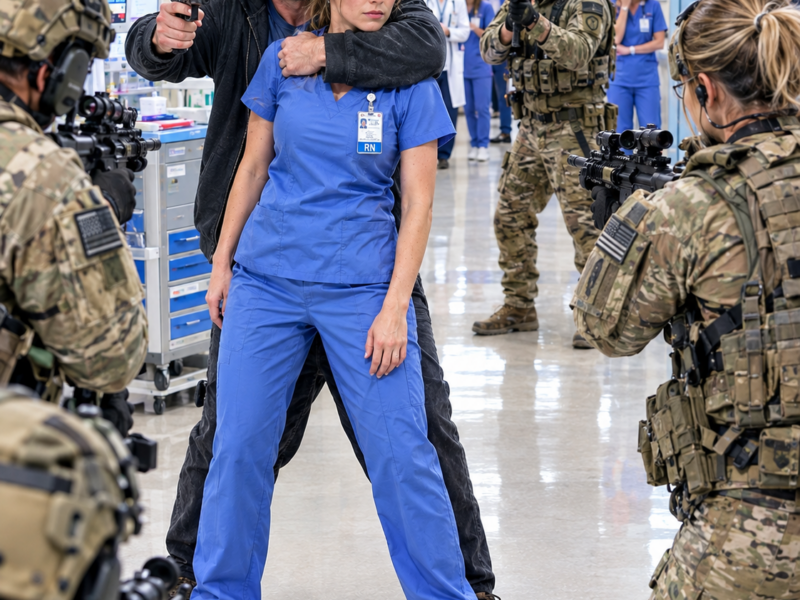
“The bully dragged a quiet nurse into an empty hospital room and held her hostage in front of terrified staff
The radio crackled again, and the man on the other end repeated the name that had haunted my dreams for seven years.
“Vesper.”
Marcus stared at me as if he expected me to transform into someone he no longer recognized.
I didn’t move.
I didn’t blink.
But inside, a door I had spent seven years trying to seal had just been kicked open.
Vesper was never my official military call sign.
It was the name used by a small special operations medical team that had been erased from several official records after a mission in Afghanistan went catastrophically wrong.
There were five of us.
Three never came home.
One disappeared.
And I was the only survivor who had been allowed to tell the story.
At least, that was what I had believed.
“Reed,” the radio voice said sharply. “Do you understand the instruction?”
Marcus swallowed.
“Yes.”
“Then secure the nurse and retrieve the package. You have six minutes.”
The radio fell silent.
I looked at Marcus’s trembling hand.
“What package?” I asked.
He pressed the scissors closer to my side.
“Stop asking questions.”
“You don’t look like someone who wants to hurt me.”
His jaw tightened.
“You don’t know anything about me.”
“Maybe not. But I know what it looks like when someone is terrified of the person giving the orders.”
For a moment, his expression changed.
Then he shoved me toward the bed.
“Sit down!”
I sat.
Not because he had defeated me.
Because the best way to control a dangerous situation was to understand it before making a move.
Outside the room, Detective Alvarez spoke again.
“Claire, can you hear me?”
“Yes.”
“Are you injured?”
“Not seriously.”
Marcus lifted the scissors.
“Tell him you’re fine. Tell him to leave.”
I looked toward the door.
“I need everyone to stay outside for now.”
There was a pause.
“Understood,” Alvarez replied. “We’re here when you’re ready.”
I heard his footsteps retreat.
Marcus exhaled as if he had been holding his breath for an hour.
“Why did you do that?” he whispered.
“Because I don’t want anyone getting hurt.”
“You could have told him to rush the door.”
“And what would that accomplish? You’d panic, someone would get injured, and the person controlling you would still be out there.”
He stared at me.
“You think you know everything.”
“No,” I said. “I think you’re carrying a radio you don’t trust, holding scissors you don’t want to use, and waiting for instructions from someone who doesn’t care whether you survive this.”
His eyes dropped.
That was when I noticed the blood on his jacket.
It wasn’t all from the cut above his eyebrow.
A dark stain spread beneath his left sleeve.
“You’re bleeding.”
“It’s nothing.”
“Let me see.”
“No!”
His reaction was immediate, almost desperate.
I stopped moving.
“Fine. But if you lose too much blood, you won’t be able to think clearly.”
He gave a bitter laugh.
“You sound just like her.”
The words struck harder than he could have known.
“Who?”
He looked away.
“Nobody.”
I studied his face.
“How did you get involved with these people, Marcus?”
He rubbed his forehead with the back of his hand.
“They told me they needed help getting something out of the hospital.”
“What something?”
“A drive.”
“What’s on it?”
“I don’t know.”
“Then why are you risking your life for it?”
His mouth tightened.
“Because they said they’d kill my sister if I didn’t.”
For the first time since he dragged me into the room, I saw the man beneath the threat.
Not an innocent man.
Not someone who hadn’t made choices.
But someone who had been frightened into making a terrible one.
“Where is your sister?” I asked.
“Home.”
“Is she safe?”
“I don’t know.”
He looked at the radio.
“They sent me a video this morning. My sister was sitting in her apartment. Someone was standing behind her with a gun.”
My stomach tightened.
“Did you see the person holding the gun?”
“No. Just a shadow.”
“And they told you to come here?”
“They gave me your name. They told me you were keeping something that belonged to them.”
I felt the room grow colder.
“What did they tell you would happen if you found it?”
“I’m supposed to take the drive and leave.”
“And if you don’t?”
He looked at me.
“They said I wouldn’t see my sister again.”
I took a slow breath.
“Marcus, listen carefully. You can help your sister without doing everything they tell you.”
He shook his head.
“You don’t understand how these people work.”
A small, humorless smile crossed my face.
“I’m afraid I understand better than you think.”
Seven years earlier, I had watched a man with that same confidence promise us that the people giving orders would never abandon their own.
He had been wrong.
The memory came in fragments.
A dusty road.
The metallic smell of blood.
A radio that had gone silent at the worst possible moment.
And a young Navy corpsman named Daniel Price, pressing a blood-soaked hand against my shoulder while the world shook around us.
“Claire,” he had whispered. “If you make it out, don’t let them bury what happened.”
I had promised him.
Then I had watched him die.
I pushed the memory away and focused on Marcus.
“Do you know where the drive is?”
He shook his head.
“They said it would be somewhere near the old records wing. They gave me a picture of a room number, but I couldn’t find it.”
The old records wing.
My fingers went cold.
St. Catherine’s had recently acquired the archived medical records of a small military treatment facility that had closed years earlier.
I had volunteered to help review some of the files because several former service members had been transferred there after deployment.
One file had stopped me cold.
Daniel Price.
The official record listed his death as occurring during evacuation.
But the medical notes had been altered.
The time of injury didn’t match the evacuation report.
The location was wrong.
And a page describing the injuries of the surviving team had been removed entirely.
I had reported the discrepancy to hospital administration.
Two days later, someone had accessed my office after hours.
Nothing was stolen.
But the file was gone.
I had told myself the incidents were unrelated.
Now I wasn’t so sure.
“Marcus,” I said, “did anyone tell you my military name?”
He hesitated.
“They called you Vesper.”
“Did they tell you why?”
“No.”
“Did they give you a photograph?”
He reached into his jacket with his free hand.
I tensed.
He pulled out a folded piece of paper.
“That’s all they gave me.”
He tossed it onto the bed.
I opened it.
It showed a grainy photograph of a woman standing beside a military vehicle.
She wore a helmet, body armor, and a medic’s patch.
Her face was younger, thinner, and harder than the face I saw in the mirror now.
But there was no mistaking her.
It was me.
On the back, someone had written a single sentence.
If Vesper has the drive, nobody leaves the hospital alive.
I read it twice.
Then I looked at Marcus.
“Who gave you this?”
“A man who called himself Grant.”
“Describe him.”
“Tall. Gray hair. Expensive suit. He had a scar near his chin.”
My pulse quickened.
I knew that description.
Not from the military.
From the hospital.
A man with gray hair and a scar near his chin had visited the records department three weeks earlier, claiming to represent a government contractor.
He had asked about archived files.
When I refused to give him access, he had smiled and told me I was making a mistake.
I had reported the encounter.
Nobody had followed up.
“Did he tell you his first name?” I asked.
“Only Grant.”
“Did you hear anyone call him anything else?”
Marcus thought for a moment.
“Someone on the phone called him Director.”
Director.
I folded the photograph and placed it on the bed.
My mind was moving through possibilities, but none of them made sense yet.
Why would someone send a frightened man to take a medical drive?
Why use the name Vesper?
And why had they waited seven years?
A sharp knock sounded against the door.
“Claire,” Detective Alvarez called. “We have a problem.”
Marcus jerked backward.
“What did you tell him?”
“Nothing.”
“Tell him to go away!”
I raised my voice.
“Detective, what is it?”
“Hospital security just found an unauthorized person in the records wing.”
I glanced at Marcus.
“Who?”
“We don’t know. The individual escaped through a service corridor, but we recovered a badge.”
“What kind of badge?”
There was a pause.
“Military medical contractor.”
My mouth went dry.
“Detective, listen to me. Nobody should enter that records wing alone.”
“Why?”
“Because someone is looking for a drive.”
Silence.
Then Alvarez said, “What drive?”
Before I could answer, the radio in Marcus’s hand crackled again.
“Reed, report.”
Marcus looked at me.
I nodded once, silently urging him to listen.
“Reed, do you have the package?”
He lifted the radio.
“Not yet.”
“You’re running out of time.”
“They haven’t told me where it is.”
The voice changed.
It became colder.
“Then ask the nurse.”
Marcus swallowed.
“She doesn’t know anything.”
“Don’t lie to me.”
Marcus’s face went pale.
“I swear—”
“Listen carefully. We have your sister’s address. If you fail to deliver the drive, the consequences will be immediate.”
A faint sound came through the speaker.
A woman’s muffled voice.
Then the connection cut off.
Marcus stared at the radio as if it had become a weapon aimed directly at his heart.
“They have her,” he whispered.
I wanted to tell him that everything would be fine.
But I had spent too many years learning that empty reassurance could be crueler than silence.
“What’s your sister’s name?”
“Emily.”
“How old is she?”
“Twenty-three.”
“Does she live alone?”
“Yes.”
“Do you know anyone who could reach her?”
He shook his head.
“They told me not to contact the police.”
“That’s because the police might interfere with what they’re doing.”
He pressed both hands against his face.
“I’ve ruined everything.”
“No,” I said. “You’ve made a dangerous mistake. What matters now is what you do next.”
He looked at me, his eyes wet with fear.
“Why are you helping me?”
“Because your sister deserves a chance, and because I’m not going to let someone use you to hurt more people.”
A long silence followed.
Then Marcus slowly lowered the scissors.
He placed them on the floor and slid them away from us.
It wasn’t complete trust.
It wasn’t redemption.
But it was the first decision he had made that wasn’t dictated by the voice on the radio.
I moved carefully toward the door.
“Marcus, I’m going to ask Detective Alvarez to arrange medical help and contact your sister through the proper emergency channels. You need to tell him everything you know.”
“What if they hurt her?”
“Then we make sure the people threatening her have no reason to believe you can still deliver what they want.”
I knocked twice.
“Detective, he’s putting the scissors down. I need medical assistance, and I need you to contact your team about a possible hostage threat at a private residence.”
Alvarez responded immediately.
“Understood. Step away from the door.”
I did.
Security removed the chair from the handle, and the door opened only after the officers had positioned themselves safely outside.
Marcus raised his hands.
“I don’t want to hurt anyone,” he said.
The officers took control of the room.
A paramedic checked his bleeding arm while Detective Alvarez spoke to him in a calm, measured voice.
Before they escorted him out, Marcus turned toward me.
“Claire?”
“Yes?”
“If they ask you about the drive, don’t tell them where it is.”
I stared at him.
“Do you know where it is?”
He shook his head.
“No. But I think they believe you do.”
Then he was gone.
And I was left standing in a room that suddenly felt much smaller than before.
Detective Alvarez returned fifteen minutes later.
He was in his forties, with tired eyes and a habit of listening longer than most people expected.
He closed the door behind him.
“Marcus has agreed to cooperate,” he said. “We’re checking on his sister now.”
“Good.”
“He also told us about the radio contact and the threats.”
“Did he give you the device?”
Alvarez nodded.
“Our technical team is examining it. For now, I need you to tell me everything you know about the records wing.”
I explained the missing medical file, the contractor’s visit, and the discrepancies I had found in Daniel Price’s record.
Alvarez listened without interrupting.
When I finished, he asked, “Why didn’t you tell me about the contractor earlier?”
“I reported him to hospital administration.”
“That isn’t the same as reporting a potential criminal threat.”
“I didn’t know it was one.”
He considered that.
“Fair enough. But from this point forward, don’t investigate this on your own.”
“I wasn’t planning to.”
He looked at me as though he wasn’t entirely convinced.
“Claire, the people involved may have access to private security, hospital credentials, and information about your military service. We don’t yet know what they want or how far they’re willing to go.”
“I understand.”
“Do you?”
I met his gaze.
“Yes.”
He paused.
“Your military record is unusual.”
My stomach tightened.
“What do you mean?”
“Some of it is classified. Some of it appears incomplete. And there are references to an operation that doesn’t seem to exist in the public record.”
I said nothing.
“I’m not asking you to discuss classified information,” he continued. “But I need to know whether the name Vesper is connected to that operation.”
I looked toward the window.
Outside, an ambulance pulled up to the emergency entrance.
For a moment, I could see the reflection of my younger self in the glass.
A woman who had believed following orders was enough to keep people alive.
A woman who had learned too late that good people could be trapped inside bad decisions.
“Yes,” I said. “It is.”
Alvarez opened his notebook.
“Then tell me what you can.”
I took a breath.
“Seven years ago, I was assigned as a combat medic supporting a special operations team. Our mission was to escort an injured intelligence officer to a secure evacuation point.”
“What happened?”
“Our route was changed at the last minute. The new route was supposed to be safer.”
“But it wasn’t.”
“No.”
I remembered the sound of gunfire striking the side of the vehicle.
I remembered Daniel trying to pull a wounded teammate out of the rear compartment.
I remembered the radio operator repeating a request for extraction until his voice broke.
“Our convoy was attacked,” I continued. “Three people died. I survived because I was thrown clear when the second vehicle was hit.”
“Who ordered the route change?”
“I never found out.”
“Was there an investigation?”
“Yes. The official report said the attack was unexpected and that the convoy had followed approved procedures.”
“And you disagreed?”
“I knew we’d received a warning before the route was changed. I heard it myself.”
Alvarez looked up.
“Was that warning documented?”
“It should have been.”
“Was it included in the report?”
“No.”
The room went quiet.
“Why didn’t you challenge the report?” he asked.
“I did. I submitted a statement and requested a review.”
“What happened?”
“My statement disappeared from the final record. I was told the communications log had been corrupted. Later, I was advised to stop asking questions.”
“And you left the military.”
“Not immediately. But eventually, yes.”
“Did you keep any evidence?”
“No.”
It was the answer that had haunted me for seven years.
I had kept memories.
I had kept the sound of the radio.
I had kept the final words of a dying friend.
But I had no recording, no document, no proof that would survive a challenge from someone powerful enough to rewrite a report.
Alvarez closed his notebook.
“Then the drive may be the missing piece.”
“What do you think is on it?”
“I don’t know. But someone is willing to threaten a man’s family to get it.”
He stood.
“We’re securing the records wing. Nobody goes in without authorization.”
“Detective?”
He turned.
“If the drive contains evidence about that mission, I need to see it.”
“You will, if it’s recovered and legally available to the investigation.”
It wasn’t the promise I wanted.
But it was a promise he could responsibly make.
After he left, I stood alone for a moment.
Then I remembered something.
A week before the contractor’s visit, I had received a plain envelope at home.
There was no return address.
Inside was a photograph of Daniel Price and me standing beside a field hospital tent.
On the back, someone had written:
You were right to keep asking.
I had shown it to nobody.
At the time, I thought it was a cruel joke.
Now I understood that it might have been a warning.
I reached for my phone.
The envelope was at home, tucked inside the back of a drawer.
But the photograph had been taken somewhere specific.
I could see the corner of a vehicle in the background, and a faded marking on its side.
A number.
A unit designation.
And something else I hadn’t noticed before.
A small symbol painted near the rear wheel.
Three black lines beneath a white star.
I remembered that symbol.
It had appeared on the transport vehicle that carried us away from the convoy attack.
It was not part of our unit’s markings.
I had asked about it once.
The officer who answered told me it belonged to a logistics contractor.
A contractor whose name had never appeared in the final investigation.
My phone vibrated.
A message from an unknown number appeared on the screen.
You have one chance to walk away.
Another message followed.
Ask what happened to Daniel Price’s original medical record.
Then a third.
And ask why he was alive when the official report said he was dead.
I stopped breathing.
Daniel Price had been declared dead at the scene.
I had seen his body.
I had held his hand while a medic checked for a pulse.
I had watched a military chaplain place a tag beside him.
But the message claimed something impossible.
I read it again.
Then my phone rang.
Unknown number.
I answered without speaking.
A woman’s voice came through.
“Claire Bennett?”
“Yes.”
“My name is Dr. Maya Ellis. I used to work in military medical records.”
I stood very still.
“What do you want?”
“To give you something that should have reached you seven years ago.”
“Who gave you my number?”
“Someone who believes you’re finally ready to know what happened.”
My grip tightened around the phone.
“Who?”
“Daniel Price.”
The room seemed to tilt.
“That’s impossible.”
“I understand why you think that.”
“He died.”
“That is what the report says.”
“Are you telling me he survived?”
“I’m telling you I have a document bearing his signature, dated three days after the attack.”
I couldn’t speak.
Maya continued.
“The document was entered into a restricted medical system, then removed. I kept a copy because the circumstances didn’t make sense.”
“Why contact me now?”
“Because someone has been searching for that record. And because the man who ordered it removed has learned that you’re asking questions again.”
“Who is he?”
“I can’t tell you over the phone.”
“Then tell me where to meet you.”
“Not at the hospital. Not at your home. There’s a public library on East Colfax, near the old transit station. Tomorrow at ten in the morning.”
“Why should I trust you?”
“You shouldn’t trust me yet.”
Her answer caught me off guard.
“Bring Detective Alvarez if you want,” she said. “But come prepared to hear something you may not want to believe.”
The line went dead.
For several seconds, I remained motionless.
Then I called Alvarez.
He answered on the second ring.
“Claire?”
“I have new information.”
I told him about the messages and the phone call.
He listened carefully.
“Do not meet her alone,” he said.
“I wasn’t planning to.”
“And don’t respond to any more messages.”
“Understood.”
“I’m going to run the number and see whether we can identify the caller. We’ll arrange a controlled meeting tomorrow, assuming we can verify her identity.”
“There’s one more thing.”
“What?”
“The photograph I received last week. It may connect the convoy to a contractor.”
“I want to see it.”
“I’ll bring it in.”
“Good. And Claire?”
“Yes?”
“Whatever this is, you’re no longer dealing with a missing file. You’re dealing with a coordinated effort to recover or destroy evidence.”
“I know.”
“Then let us do our jobs.”
After we hung up, I went to the staff restroom and locked myself in a stall.
My hands were shaking.
I pressed them together until they steadied.
Seven years.
Seven years of telling myself that Daniel had died believing he had failed.
Seven years of remembering the last look on his face.
Seven years of wondering whether I could have saved him if I had reached him sooner.
And now someone was telling me that he might have survived.
I wanted to believe it so badly that I was afraid to.
Because hope, when it came too late, could be another kind of wound.
The following morning, Detective Alvarez arranged for two investigators to accompany me to the library.
We arrived early.
The building smelled of old paper and floor polish. A few people sat at computers, and sunlight fell through the tall windows onto the reading tables.
At ten minutes past ten, a woman in her late fifties approached us.
She wore a gray coat and carried a canvas bag.
“Claire?”
“Yes.”
She glanced at Alvarez.
“Detective.”
He showed his credentials.
“Dr. Ellis, we need to verify your identity and understand what information you’re bringing.”
She nodded.
“Of course.”
She took a seat at the table and removed a sealed document sleeve from her bag.
Inside was a printed medical record.
The patient name was partially redacted.
But the date was clear.
Three days after the convoy attack.
The signature at the bottom was not.
I leaned closer.
Daniel Price.
His signature had a distinctive slant. He used to joke that it looked as though he had signed it while falling down a hill.
I knew that signature.
I’d seen it on letters, medical forms, and the back of a photograph he’d once given me.
My throat tightened.
“This is real,” I whispered.
Dr. Ellis nodded.
“The system log shows the document was created at a military medical facility outside the main evacuation corridor. The patient’s identity was restricted, but the signature matched a record I had access to.”
“Was he injured?”
“Severely. The notes describe blast trauma and a prolonged period of unconsciousness.”
“Why was he listed as dead?”
“That’s what I tried to find out.”
Alvarez examined the document.
“Who removed the record?”
Dr. Ellis took another page from the sleeve.
“A senior administrator authorized its transfer to a restricted archive. The request came from a man named Adrian Voss.”
I recognized the name.
Not from the hospital.
From the final briefing after the convoy attack.
Adrian Voss had been the civilian liaison assigned to coordinate logistics and intelligence support.
He had delivered the statement confirming that the route change was necessary.
He had also been the man who told us there had been no warning.
“Where is he now?” Alvarez asked.
“Until last year, he was a director at a private defense contractor called Meridian Strategic Systems.”
Alvarez’s expression hardened.
“Meridian.”
I looked at him.
“You know them?”
“They’ve been linked to several procurement investigations. Nothing we’ve discussed here proves they’re responsible for this incident, but the name is relevant.”
Dr. Ellis folded her hands.
“There’s more.”
She removed a small storage device from a separate envelope.
“This contains a copy of the original communications log. I made it before the archive was sealed.”
Alvarez didn’t touch it.
“Why didn’t you report this earlier?”
“Because I was told the record had been classified for national security reasons. When I questioned the order, my access was revoked. A few months later, someone followed me home.”
Her voice remained steady, but her hands had begun to tremble.
“I convinced myself that staying quiet was the only way to protect my family.”
I understood that kind of silence.
It wasn’t cowardice.
It was fear stretched across years until it began to feel like common sense.
Alvarez arranged for the device to be secured and examined by the appropriate investigators.
Then he asked Dr. Ellis the question I had been afraid to ask.
“Do you know whether Daniel Price survived?”
She looked at me.
“I don’t know where he is now. But I saw a later record suggesting he regained consciousness.”
“When?”
“Approximately six weeks after the attack.”
I closed my eyes.
Six weeks.
Six weeks after I had buried him in my mind.
Six weeks after I had written a letter to his family apologizing for failing to bring him home.
Six weeks after I had promised myself I would never again let someone else’s life become a responsibility I couldn’t carry.
“Why didn’t he contact me?” I whispered.
Dr. Ellis didn’t pretend to know.
“I don’t have that answer.”
Alvarez thanked her and arranged for her to be taken somewhere safe while the investigation continued.
Before she left, she turned back toward me.
“Claire, there’s something I want you to understand.”
I looked up.
“The document I found wasn’t the only record that disappeared. Someone was building a new version of what happened that day. One that made the route change look justified, the warning nonexistent, and the deaths unavoidable.”
“Why?”
“I believe the convoy was carrying something its escorts were never told about.”
“What?”
“I don’t know. But whatever it was, people were willing to falsify medical records to keep the truth buried.”
She hesitated.
“And if Daniel survived, he may be the only person who knows what was really on that vehicle.”
The next two days were a blur of interviews, security reviews, and long hours waiting for investigators to confirm what they could.
The storage device contained fragments of radio traffic.
Some were corrupted.
Others were clear enough to make my stomach turn.
A warning had been transmitted before the convoy changed routes.
The message identified a possible threat along the planned road and recommended delaying movement until the area could be reassessed.
A second voice acknowledged the warning.
Then another transmission ordered the convoy onto the alternate route.
The order had come from a command channel associated with Adrian Voss’s office.
It didn’t prove that Voss had arranged the attack.
But it proved that the warning existed.
And it proved that the final report had omitted it.
The investigation expanded.
Meridian Strategic Systems declined to comment, and its lawyers disputed the authenticity of the recovered records.
Alvarez cautioned me not to confuse a promising lead with a completed case.
I tried to listen.
But every time I closed my eyes, I saw Daniel’s signature.
On the third afternoon, I returned to the hospital after a long interview.
A familiar figure stood near the staff entrance.
He was thinner than I remembered.
His hair had gone almost completely gray.
A faint scar ran from his left temple toward his cheek.
He wore a plain dark jacket and held a walking stick in one hand.
For several seconds, I couldn’t move.
Then he lifted his head.
“Hello, Claire.”
I knew his voice.
I knew the small hesitation before he said my name.
And I knew the eyes that had once looked at me across a field hospital while both of us pretended we weren’t afraid.
“Daniel?”
He nodded.
My first instinct was to run toward him.
My second was to hit him.
I did neither.
I stood perfectly still, feeling seven years of grief rise so quickly that it almost took my breath away.
“You’re alive,” I whispered.
“Yes.”
The word was so small.
So inadequate.
I laughed once, but there was no humor in it.
“You’re alive.”
“I am.”
“You let me believe you were dead.”
His face crumpled.
“I know.”
“I stood beside your empty grave.”
“I know.”
“I wrote to your mother.”
His eyes filled with tears.
“I know, Claire.”
“How?”
He looked down at the walking stick.
“Because I read the letter.”
Something inside me broke.
“You read it?”
“A doctor gave it to me when I was recovering. I didn’t know how to answer you.”
“So you did nothing?”
“I thought I was protecting you.”
“From what?”
He looked toward the street.
“From the people who had decided the truth was more dangerous than the lies.”
I wanted to believe him.
I wanted to understand.
But I was still standing in the place where my grief had lived for seven years, and he had just walked into it as if he had every right to be there.
“You should have trusted me,” I said.
“I should have.”
“That’s all you have to say?”
“No.” His voice broke. “But it’s the only thing I can say without making excuses.”
I looked at the scar on his face.
“What happened to you?”
“The convoy explosion left me badly injured. I was moved to a restricted medical facility because the intelligence officer we were transporting had been killed, and the people handling the evacuation were worried about what the survivors might know.”
“Who moved you?”
“Voss’s people. At first, I thought they were trying to protect us. Then I realized they were controlling the records.”
“Did you know they had declared you dead?”
“Not at first. When I finally learned what had been entered into the system, I tried to contact you.”
“What stopped you?”
He reached into his jacket and took out a folded sheet of paper.
It was a copy of a letter.
My letter.
The one I had written to his family.
The paper had been handled so many times that its creases were nearly white.
“I read this after I regained consciousness,” he said. “I wanted to come home. I wanted to tell you everything.”
“Then why didn’t you?”
“Because a week later, a man came to my room and told me you were dead.”
I stared at him.
“What?”
“He showed me a photograph of a woman who looked like you. He said you had been killed in an accident after leaving the service.”
“That never happened.”
“I know that now.”
“You could have checked.”
“I tried. Every record I requested came back restricted. My calls were monitored. I had no access to the people who could confirm what was true.”
“So you accepted it?”
“No.” He shook his head. “I hid. I changed my name. I spent years trying to find the original communications log. I thought if I could prove what Voss had done, I could come back with something that would protect everyone involved.”
“And you never considered that I might have been trying to find the same thing?”
He lowered his head.
“I was afraid, Claire.”
The honesty of the answer hurt more than any excuse could have.
He continued.
“I had survived when Daniel Price was supposed to be dead. I had seen what happened to the records. I knew the report had been altered. And I believed that anyone who helped me would become a target.”
“You don’t get to decide what risks I can take.”
“I know.”
“You don’t get to erase yourself from my life and call it protection.”
“I know.”
I turned away, pressing my fingertips against my eyes.
I had imagined this moment a thousand times.
In some versions, I screamed at him.
In others, I hugged him and never let go.
In none of them had I understood how much anger could exist alongside relief.
“I don’t know how to look at you,” I whispered.
“You don’t have to forgive me.”
“I don’t know if I can.”
“I understand.”
He didn’t reach for me.
He didn’t ask me to make the pain easier for him.
For the first time since I had known him, Daniel allowed silence to stand without trying to fill it.
After a long moment, I looked back at him.
“Did you know about the drive?”
He nodded.
“I helped create the original archive. The drive contains copies of the communications log and a list of cargo entries from the convoy.”
“What was the convoy carrying?”
“Equipment listed as medical supplies. But the quantities didn’t match the manifest.”
“What kind of equipment?”
“Communications hardware. Restricted surveillance systems. Components that weren’t supposed to be transported under a medical evacuation authorization.”
I stared at him.
“Were they being moved illegally?”
“I don’t know whether every item was illegal. I do know the paperwork was falsified, and the route change placed the convoy in danger after a warning had been received.”
“Who knew?”
“Voss. At least one senior officer. Possibly others.”
“Why was the warning ignored?”
Daniel’s expression darkened.
“Because the cargo had to arrive on schedule. Someone had made a promise to a buyer, and delays would have exposed the shipment.”
“And the people who died?”
He closed his eyes.
“They were treated as an acceptable loss.”
For a moment, the world around us seemed to disappear.
I heard Daniel Price’s final words again.
Don’t let them bury what happened.
I had kept that promise for seven years without knowing whether it could ever be fulfilled.
Now the truth was standing in front of me, alive and wounded, carrying the weight of every question I had never been able to answer.
“Will you testify?” I asked.
Daniel nodded.
“Yes.”
“Even if it means facing Voss?”
“Yes.”
“Even if they try to discredit you?”
His jaw tightened.
“Especially then.”
I studied him for a long moment.
I didn’t forgive him.
Not that day.
But I believed he was finally ready to stop running.
And that was a beginning.
The investigation took months.
There were no dramatic arrests in the hospital corridor, no sudden confession, and no single document that resolved every question.
Instead, there were interviews.
Audits.
Recovered emails.
Contradictory statements.
And the slow, exhausting work of proving that the truth had been deliberately obscured.
Daniel gave a formal statement about the convoy and the medical facility where he had recovered.
Dr. Ellis authenticated the records she had preserved.
Investigators traced the contractor badge recovered from the hospital to a subcontractor that had provided security services for Meridian.
Marcus Reed’s testimony helped establish how the group had attempted to recover the drive and silence anyone who might know about it.
His sister was found safe after investigators located the apartment where she had been held under surveillance.
Marcus still faced consequences for taking me hostage.
He never asked to be excused from them.
When I saw him again, he was being interviewed in a secure room at the police station.
“I thought I was protecting Emily,” he said. “But I used you as a shield. I can’t pretend that was anything else.”
“No,” I said. “You can’t.”
He looked down.
“I’m sorry.”
I believed he meant it.
But an apology was not the same as undoing what had happened.
“You’ll have to live with what you did,” I told him. “And you’ll have to prove that you can make different choices.”
He nodded.
“I will.”
I left without offering him forgiveness he hadn’t yet earned.
The inquiry eventually confirmed that the convoy’s warning had been received and that the final report had been altered.
The evidence did not establish that every person involved had intended the attack to happen. It did establish that crucial information had been withheld and that records had been manipulated to conceal decisions made before the convoy departed.
Adrian Voss denied wrongdoing.
His company challenged the investigation’s findings.
But the recovered documents were difficult to dismiss, and the case was referred to federal authorities for further action.
For the first time in seven years, the official account of the convoy attack was being questioned by people who had the authority to change it.
Daniel’s status was corrected in the military records.
The families of the dead were notified that the original investigation had been compromised.
I received a formal letter acknowledging that my statement had been excluded from the final report.
I read it once.
Then I put it in a drawer.
It couldn’t return the people we had lost.
It couldn’t give me back seven years of grief.
But it meant I no longer had to wonder whether I had imagined the warning.
I hadn’t.
And Daniel hadn’t been dead.
Both truths had been hidden from me.
Neither could be undone.
Six months after the hostage incident, Daniel came to the hospital with a small cardboard box.
I was finishing a shift when I saw him waiting near the staff entrance.
He looked healthier.
He no longer needed the walking stick every day, though he still moved carefully when the weather turned cold.
“Can we talk?” he asked.
I glanced at the box.
“What is that?”
“Something I should have given you a long time ago.”
He placed it on the table between us.
Inside was a folded Navy medical patch, a worn photograph of our old team, and a small silver identification tag.
Daniel Price’s tag.
I picked it up.
The metal was scratched, and the chain had been repaired with a thin loop of wire.
“I thought this was buried with him,” I whispered.
“It was supposed to be. I found it in my belongings after I recovered. Someone had removed it before the official inventory.”
I turned it over in my hand.
The familiar engraving caught the light.
For seven years, I had carried Daniel’s last words in my memory.
Now I had something physical to hold.
“Why bring it to me?”
“Because you were the one who stayed with him at the end. And because he trusted you to tell the truth.”
My eyes burned.
“You could have sent this years ago.”
“Yes.”
“You could have called.”
“Yes.”
“You could have trusted me.”
He swallowed.
“Yes.”
I set the tag back in the box.
“I still don’t know if I can forgive you for disappearing.”
“I don’t expect you to.”
“But I don’t want to spend the rest of my life hating you, either.”
His eyes lifted to mine.
“Neither do I.”
We stood in silence.
Then I closed the box and handed it back to him.
“Keep it safe for now.”
He accepted it carefully.
“Of course.”
It wasn’t forgiveness.
It was permission for another conversation.
For the first time, that felt like enough.
Before he left, Daniel paused at the doorway.
“Claire?”
I looked up.
“I’m sorry I made you carry the truth alone.”
I thought about the years I’d spent trying to forget.
The nights I’d awakened hearing the radio.
The patients I’d treated because I could not save the people I’d lost.
The quiet life I’d built because I had believed my past was something I needed to bury.
“You weren’t the only one who disappeared,” I told him. “I disappeared, too. I just did it where everyone could see me.”
He nodded slowly.
“Maybe we can stop doing that.”
“Maybe.”
He left without asking for anything more.
I returned to the nurses’ station.
A new patient had arrived, frightened and in pain, with a family waiting anxiously beyond the curtain.
I washed my hands, checked the chart, and walked in.
For years, I had thought survival meant learning how to live without the people who didn’t come home.
Now I understood something harder.
Survival also meant allowing yourself to live after the truth arrived.
It meant accepting that some wounds would never disappear completely.
It meant holding people accountable without letting anger become the only thing left inside you.
And it meant remembering the dead without surrendering the rest of your life to the moment you lost them.
I was still Claire Bennett.
I was still a nurse.
I was still the woman who spoke softly and preferred not to be noticed.
But I was no longer pretending that the quiet parts of my life were the only parts that mattered.
Somewhere inside me, Lieutenant Claire Bennett had finally stopped waiting for permission to tell the truth.
And when the next frightened patient arrived, I would meet them the same way I always had.
With steady hands.
An open heart.
And the knowledge that courage did not always look like charging into danger.
Sometimes, courage was simply refusing to let the truth die quietly.
THE END.









