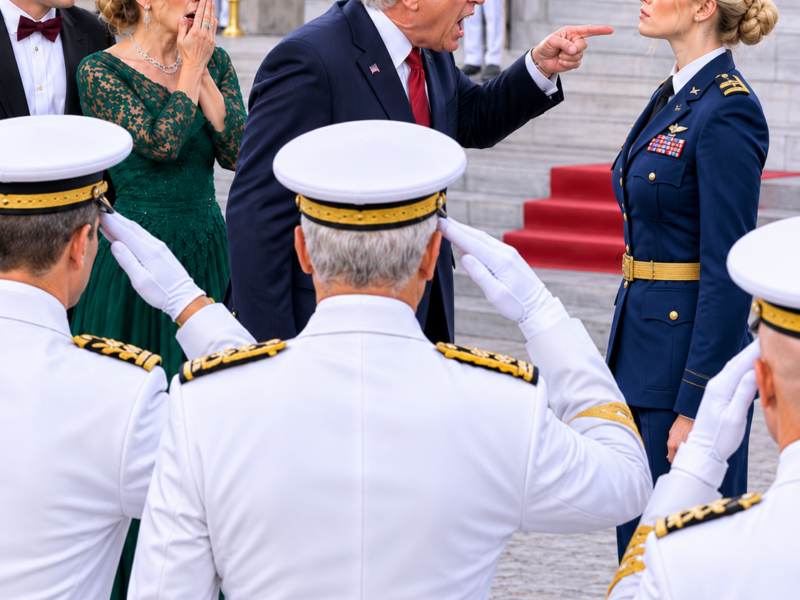
“My billionaire father grabbed my arm outside the White House and ordered me to pretend I didn’t know him, calling me a low-ranking security guard in front of his wealthy guests
General Vance turned toward the senior officers gathered behind him.
“Ladies and gentlemen, I’d like you to meet the officer whose leadership has helped shape the future of this institution. The woman who spent twenty-six years serving this country without ever asking her family name to open a single door.”
He paused.
“Four-star General Katherine Mercer.”
For a moment, nobody moved.
Then the courtyard erupted in applause.
Not the polite applause reserved for a scheduled introduction.
This was different.
It was the sound of people recognizing someone they respected.
I stood still, my hands resting at my sides, trying to keep my expression composed.
My father looked as though the ground had shifted beneath him.
Trevor’s mouth hung open.
Evelyn stared at the stars on my shoulders as if she expected them to disappear if she blinked hard enough.
“General Mercer,” General Vance said again, extending his hand. “It’s an honor to have you here.”
I shook it.
“Thank you, General.”
He leaned slightly closer.
“The Secretary is waiting inside. The briefing has been moved forward.”
“I understand.”
Then he stepped aside, allowing me to face the people who had spent the last several minutes pretending I was nobody.
My father finally found his voice.
“Kate?”
I turned toward him.
He took one step forward, his expression caught somewhere between disbelief and anger.
“What is going on?”
I looked at him calmly.
“You were told who I was.”
“No, I mean…” He glanced at the officers surrounding us. “Why are they calling you General?”
“Because that is my rank.”
Trevor let out a short, nervous laugh.
“Come on. This has to be some kind of misunderstanding.”
General Vance turned his head.
“Is there a reason you believe General Mercer is misrepresenting her rank?”
Trevor immediately stopped smiling.
My father recovered enough to straighten his jacket.
“This is a family matter.”
“No, sir,” I said quietly. “It stopped being a family matter when you decided to make my presence here a public embarrassment.”
His face tightened.
Evelyn moved closer to him, her voice low but sharp.
“Arthur, we should go.”
But my father didn’t move.
He was looking at my uniform again.
At the four stars.
At the ribbons earned over twenty-six years of deployments, command decisions, funerals, sleepless nights, and names I still remembered.
Then he looked at my face.
“You never told me.”
I almost laughed.
“You made it very clear you didn’t want to hear from me.”
“That was twenty-six years ago.”
“Yes.”
“I was trying to protect this family.”
I held his gaze.
“You were trying to protect your plans for me.”
His jaw flexed.
“That is not what happened.”
I could have argued.
I could have reminded him of the night he stood in his study and told me that choosing the Army meant choosing to become a stranger to him.
I could have repeated the words he used when I refused Wharton and accepted my commission.
You are throwing away everything I built.
I could have reminded him that he had watched me pack my bags and never once asked when I would be coming home.
But there were senior officers waiting.
A briefing inside the White House.
And a country that needed my attention more than an old argument did.
“General Vance,” I said, turning away from my father, “I’m ready.”
“Of course.”
He motioned toward the entrance.
As we started walking, I heard Trevor whisper behind me.
“Dad, what the hell?”
Then my father called after me.
“Kate, wait.”
I stopped.
Not because he had ordered me to.
Because I wanted to hear what he would say when he no longer had the power to make me stay.
He approached carefully, lowering his voice.
“We need to talk.”
I looked at him.
“About what?”
“About all of this.”
He gestured toward my uniform, the officers, the cameras, the White House.
“You understand what this means for the family.”
There it was.
Even now, after twenty-six years, he couldn’t look at me without calculating what I represented.
“I don’t know what you think it means,” I said, “but it doesn’t change anything about my responsibilities.”
His eyes narrowed.
“Your responsibilities?”
“Yes. I serve the United States. Not the Mercer family.”
He glanced around, suddenly aware of the people listening.
“Don’t be dramatic.”
I turned fully toward him.
“You told me to pretend I didn’t know you. I was prepared to respect that request.”
His face flushed.
“I didn’t mean it like that.”
“You said it clearly enough.”
“Kate—”
“Mr. Mercer.”
The correction landed harder than I expected.
He stared at me.
I continued, keeping my voice even.
“I have a briefing to attend. If you want to speak with me privately, you can request a meeting through the appropriate channels. But I will not discuss military business, government matters, or anything connected to my position with you here.”
He looked almost offended.
“I am your father.”
I held his eyes.
“You were.”
Then I turned and walked inside.
The doors closed behind me.
For the first time in twenty-six years, I didn’t look back.
The briefing room was already crowded.
Senior military officials, national security advisers, and members of the administration sat around a long table covered with folders and briefing materials.
A staff officer approached me.
“General Mercer, your seat is at the head of the table.”
I nodded and took my place.
General Vance sat to my right.
The Secretary entered moments later, greeted the room, and began the briefing.
The subject was a major defense modernization initiative.
It involved communication infrastructure, logistics systems, and a proposed network of private contractors that would support several military installations.
The project was important.
It was also complicated.
One of the companies under consideration was Mercer Strategic Technologies.
My father’s company.
I recognized the name before the slide finished appearing.
I didn’t move.
I didn’t ask a question.
I simply looked at the ethics counsel seated near the end of the table.
He noticed my expression.
“General Mercer,” he said, “we have a disclosure matter to address before we proceed.”
The Secretary paused.
I folded my hands.
“Please continue.”
The counsel opened a document.
“Your immediate family has a financial connection to one of the companies included in the preliminary vendor pool. We received the disclosure this morning.”
I looked at the screen.
“My father owns Mercer Strategic Technologies.”
“Yes, ma’am.”
“And I have no financial interest in that company.”
“That’s correct, according to the information provided.”
“Then I want the relationship formally recorded, and I want to be excluded from any evaluation, recommendation, or decision involving that company.”
The Secretary studied me.
“Are you certain?”
“Completely.”
General Vance nodded.
“That is the appropriate course.”
The counsel continued.
“We’ll document the recusal and ensure that the procurement team operates independently. Your family connection will not give the company any advantage.”
“Good.”
I looked toward the Secretary.
“My position should not be used to suggest that the company has access to me, influence over me, or any inside information.”
“Understood.”
The briefing continued.
For the next two hours, I did what I had come to do.
I asked questions.
I challenged assumptions.
I reviewed readiness concerns and logistical risks.
I made recommendations based on evidence, not relationships.
And when the discussion reached the portion involving my father’s company, I left the table and allowed the designated officials to handle it without me.
Nobody questioned the decision.
Nobody treated it as an inconvenience.
That was the difference between the life I had built and the world my father had tried to control.
When the meeting ended, General Vance walked with me into the corridor.
“You handled that well.”
“It was straightforward.”
“Not everyone would have found it straightforward.”
I glanced at him.
“My family name doesn’t change my oath.”
He gave a small nod.
“Your father is still outside.”
I stopped.
“Has he been waiting?”
“Since we came in.”
I exhaled slowly.
“I’ll speak with him. Briefly.”
General Vance looked at me with the kind of concern I had come to recognize in people who had served beside me for years.
“You don’t owe him an explanation for your career.”
“I know.”
“And you don’t owe him access to your work.”
“I know that, too.”
He stepped aside.
“I’ll be nearby.”
My father was standing near a row of windows overlooking the courtyard.
Evelyn sat on a bench.
Trevor was pacing, his phone pressed to his ear.
When he saw me, he ended the call.
“There she is.”
I stopped several feet away.
“Did you need something?”
My father looked at the people moving through the corridor.
“Can we find somewhere private?”
“There is a meeting room available. We can use it for ten minutes.”
He seemed surprised by the limit.
But he followed me.
Inside, he closed the door.
For a few seconds, nobody spoke.
Then he said, “You became a four-star general.”
“I did.”
“How?”
I studied him.
“By serving.”
“That isn’t an answer.”
“It is the answer.”
He shook his head.
“I don’t understand. You left with nothing. You had no money, no connections, no support.”
“I had a commission.”
“You were twenty-two years old.”
“And I learned.”
He stared at me.
“Why didn’t you tell me?”
I let the silence stretch.
Then I asked, “Would you have listened?”
His expression changed.
“You can’t know that.”
“I can remember it.”
He turned away and rubbed his forehead.
“I was angry.”
“You were disappointed.”
“I thought you were making a terrible mistake.”
“You told me I had destroyed my future.”
“I wanted you to have the best life possible.”
“You wanted me to have the life you designed.”
He looked back at me.
“You were going to inherit the company.”
“I never asked to.”
“You were my daughter.”
“I still was when you told me not to come home.”
He opened his mouth, but no words came.
I continued.
“I remember standing in the driveway with two bags. I remember asking if you would at least come to my commissioning ceremony.”
His eyes dropped.
“You said you had a board meeting.”
“I had responsibilities.”
“So did I.”
The room went quiet.
“I didn’t know what the Army would make of you,” he said finally.
“It made me responsible for people.”
“That isn’t what I meant.”
“It made me accountable for decisions that affect lives. It taught me that leadership isn’t about getting people to obey you. It’s about earning their trust.”
I looked directly at him.
“And it taught me that a title means nothing if you don’t have the character to carry it.”
He flinched.
“Is that what you think of me?”
“I think you made a choice twenty-six years ago. I’ve made mine.”
He sat down.
For the first time that day, he looked less like the powerful businessman whose name appeared on buildings and more like an older man who had run out of arguments.
“Your mother would have been proud,” he said.
I felt something tighten in my chest.
My mother had died when I was seventeen.
She had been the one person who never treated my ambition like a threat.
“She would have wanted you to come to my commissioning,” I said.
He closed his eyes.
“I know.”
It was the first honest thing he had said.
Then he looked up.
“I want to make this right.”
I didn’t answer immediately.
He leaned forward.
“We can have dinner. Just the two of us. We can start over.”
“Start over?”
“Yes.”
“You can’t start over by pretending nothing happened.”
“I know I hurt you.”
“You did.”
“I was wrong.”
I waited.
He swallowed.
“I am sorry.”
The apology was quiet.
It was also twenty-six years late.
I wanted it to change something.
I wanted the little girl who had once waited by the front door to hear those words.
But she was gone.
And I was no longer waiting.
“Thank you for saying that,” I replied.
His shoulders loosened slightly.
“So we’ll have dinner?”
“Not today.”
“Tomorrow?”
“I’m not promising anything.”
He nodded, but I could see the frustration returning.
Then he said, “There is something else.”
I almost expected it.
“What?”
“Mercer Strategic is bidding on the modernization project. I assume you saw that.”
“I did.”
“You could help us understand what the administration is looking for.”
I stared at him.
There it was.
The apology had barely left his mouth before the old calculation returned.
“I cannot help your company with that.”
“I’m not asking you to interfere.”
“You’re asking me to provide information about a government process involving your company.”
“Just general guidance.”
“I’ve already recused myself.”
“Kate, you know how these things work.”
“Yes. That’s why I’m not discussing them with you.”
He leaned back, irritated.
“I’m not asking for anything illegal.”
“Then you won’t have a problem going through the official process.”
His expression hardened.
“You’re going to let an opportunity like this pass because of an old family disagreement?”
“No. I’m going to let the process work without my involvement because that’s what integrity requires.”
He stared at me as if he couldn’t decide whether to be angry or impressed.
“You really are different.”
“I’ve always been this person.”
He looked away.
I opened the door.
“Our ten minutes are over.”
I expected the next few days to be filled with phone calls.
I was not disappointed.
My father called twice.
Trevor sent three messages.
Evelyn left a voicemail saying that everyone was emotional and that we should avoid making decisions we might regret.
I didn’t respond.
The first message from Trevor was almost polite.
Kate, I think there has been a misunderstanding. Dad is proud of you. We should talk.
The second was less restrained.
You embarrassed him in front of everyone. You could have handled this privately.
The third arrived after news coverage of the White House event appeared online.
I saw the photographs.
One showed General Vance shaking my hand.
Another showed me walking beside the Secretary.
A third captured my father standing near the entrance, his expression frozen.
The headline described the event as a national defense leadership gathering.
It did not mention my family.
That was intentional.
My career was not a family announcement.
A few days later, I received a message from a number I didn’t recognize.
It was my father’s assistant.
Mr. Mercer would appreciate a private conversation regarding the company’s bid.
I forwarded it to the ethics counsel.
He replied within minutes.
Thank you for flagging this. We will ensure all communications follow the established process.
I didn’t hear from the assistant again.
Then, two weeks after the event, my father called from his personal number.
I answered because I wanted to know whether he had finally learned how to speak to me without asking for something.
“Kate.”
“Hello, Dad.”
There was a pause.
“I heard you formally recused yourself.”
“I did.”
“I also heard the company was removed from the final vendor list.”
I sat down.
“I’m not involved in that decision.”
“I know.”
His voice sounded different.
Less angry.
More tired.
“Apparently, there were questions about the company’s financial disclosures.”
I said nothing.
“An independent review found inconsistencies in our cost projections. The board is investigating.”
“Then I hope they get clear answers.”
He sighed.
“I wanted you to know I wasn’t asking you to fix anything.”
“Okay.”
“I just thought you should hear it from me.”
“Thank you.”
Another pause.
Then he said, “I saw your picture.”
“Which one?”
“The one where you were standing with the Secretary.”
I waited.
“You looked confident.”
“I was doing my job.”
“I know.”
His voice broke slightly.
“I wish I’d seen that when you were twenty-two.”
I looked out the window.
For years, I had imagined a conversation in which he finally understood.
I had imagined him asking about my first command, my deployments, the people I had lost, and the moments that had nearly broken me.
I had imagined telling him everything.
But now, hearing him say those words, I realized that I didn’t need him to understand my life in order to know it had mattered.
“I’m glad you saw it now,” I said.
He was quiet for a long time.
“Could I come to your office sometime?”
I considered the question.
“My office isn’t a place for family visits.”
“I understand.”
“But we could meet somewhere neutral. If we agree on a time.”
“I’d like that.”
“I’ll think about it.”
“Thank you, Kate.”
When the call ended, I didn’t feel victorious.
I didn’t feel healed.
I felt something quieter.
A door that had been locked for years had finally been acknowledged.
Whether it would open was another question.
Three weeks later, I received a handwritten letter.
It arrived at my official residence in a plain envelope.
No company letterhead.
No assistant’s signature.
Just my name written in my father’s familiar handwriting.
I left it on the kitchen counter for several hours before opening it.
Inside were four pages.
He wrote about the night I left.
He admitted that he had believed success meant following the path he had chosen.
He admitted that he had confused obedience with love.
He wrote that he had spent years telling people I was pursuing a career in the military, but never explaining why he no longer saw me.
He also wrote about my mother.
He said she would have been proud.
I read that sentence three times.
At the end, he wrote:
I cannot ask you to give me back the years I wasted. I can only ask whether there is room for me in the years ahead.
I folded the letter and put it in my desk.
I didn’t answer that day.
Or the next.
I had work to do.
A deployment readiness review.
A meeting with the Secretary.
A call with a commander whose unit had suffered a tragic loss.
Those responsibilities did not pause because my father had finally discovered regret.
But I carried the letter with me.
Not because I needed it.
Because I was deciding what to do with it.
In the end, I agreed to meet him on a Saturday afternoon at a small restaurant outside the city.
No cameras.
No staff.
No security detail inside the dining room.
Just a table by the window and two cups of coffee.
He arrived early.
When I walked in, he stood.
For a moment, he seemed unsure whether to shake my hand or hug me.
I offered my hand.
He took it.
“Thank you for coming.”
“I said I would.”
We sat.
He didn’t mention the White House.
He didn’t mention the company.
He asked about my work.
Not the classified parts.
Not the decisions he could use to impress someone at a board dinner.
He asked whether I liked the people I served with.
I told him I did.
He asked whether I had ever regretted joining the Army.
I thought about it.
“I’ve regretted things that happened. I’ve regretted decisions I made. I’ve regretted not being able to save people.”
He listened.
“But I’ve never regretted serving.”
He nodded slowly.
“I think I understand that now.”
I looked at him.
“Do you?”
“I don’t know if I can understand it the way you do.”
“That would be impossible.”
He gave a small, sad smile.
“But I can respect it.”
For the first time, I believed him.
We talked for nearly two hours.
He told me about the company investigation.
He told me that the board had brought in an outside auditor.
He didn’t ask me to intervene.
He didn’t ask me to make a call.
He didn’t even ask whether I knew anyone who could help.
That mattered more than he probably realized.
Before we left, he reached into his coat and placed a small photograph on the table.
It was from my high school graduation.
I was standing between my parents, holding a diploma.
My mother had one hand on my shoulder.
My father stood beside us, smiling.
“I kept this,” he said.
I picked it up.
“I thought you’d thrown everything away.”
“I almost did.”
He looked at the photograph.
“But I couldn’t.”
I traced the edge of the frame.
“I miss her.”
“So do I.”
We sat quietly.
Then he asked, “Would you let me see you again?”
I slipped the photograph into my bag.
“Yes.”
His face changed.
Not into triumph.
Into relief.
“But slowly,” I added.
“Of course.”
“And no business conversations. No requests involving my position. No pretending the past didn’t happen.”
He nodded.
“I understand.”
“I mean it.”
“I know.”
I stood.
He stood too.
This time, when he opened his arms, I didn’t step forward.
Not yet.
He didn’t force it.
That, too, was new.
We said goodbye outside the restaurant.
I watched him walk toward his car.
He turned once and raised a hand.
I returned the gesture.
Then I walked in the opposite direction.
Months passed.
My father’s company completed its independent review.
The investigation found serious failures in its internal controls, but no evidence that I had been involved in the bidding process or that anyone had gained access through me.
The company was required to make substantial changes before it could be considered for future government work.
My father accepted the board’s decision.
He never asked me to help.
Our relationship remained careful.
We had dinner once a month.
Sometimes we spoke about the past.
Sometimes we didn’t.
He met a few of the people who had served with me, though he never tried to impress them with his business connections.
Once, he asked whether I would show him the medals I had received.
I brought out the case.
He looked at each one slowly.
He didn’t ask how much they were worth.
He asked what they meant.
I told him.
For the first time, he understood that none of them had been earned alone.
Behind every ribbon were people who had trusted me.
People who had challenged me.
People who had stood beside me when the decisions were hard.
Some of them were still alive.
Some were not.
My father listened without interrupting.
When I finished, he closed the case gently.
“I should have asked you about this years ago.”
“Yes,” I said.
He nodded.
He didn’t make an excuse.
That was progress.
Trevor took longer.
He eventually sent an apology, though it was mostly about the way he had spoken to me outside the White House.
I accepted it without pretending we were suddenly close.
Evelyn never apologized.
She sent a holiday card one year with a short note saying she hoped we could all move forward.
I wished her well.
That was enough.
I learned that forgiveness didn’t have to mean returning to the old arrangement.
It didn’t have to mean giving people the same access they once had.
And it certainly didn’t mean allowing someone to rewrite what happened simply because they were finally uncomfortable with the consequences.
My father and I were building something new.
It was fragile.
It was imperfect.
But it was honest.
A year after the White House event, I attended another ceremony in Washington.
This time, I was there to receive a national award for my service.
The room was full of officers, veterans, families, and government officials.
My father sat in the third row.
He had arrived early.
He wore a dark suit and held the program carefully in both hands.
When I stepped onto the stage, he stood with the rest of the audience.
I saw him.
For one brief moment, our eyes met.
He smiled.
Not the proud smile of a man who had discovered his daughter was important.
The quieter smile of a father who was finally learning to see her.
I accepted the award.
I thanked the soldiers, sailors, airmen, Marines, guardians, and civilians who had carried the work with me.
I thanked the mentors who had taught me that rank was a responsibility, not a reward.
And I thanked the families who had supported those who served.
I did not mention my father.
I did not need to.
After the ceremony, he waited near the reception hall.
“You were wonderful,” he said.
“Thank you.”
He looked at the medal in my hand.
“Your mother would have been proud.”
I smiled faintly.
“I think so.”
He hesitated.
“May I ask you something?”
“Go ahead.”
“Do you ever wonder what your life would have been like if you’d gone to Wharton?”
I considered it.
“Sometimes.”
“And?”
“I wonder what kind of person I would have become.”
He nodded.
“Do you think you would have been happy?”
I looked around the room.
At the officers greeting one another.
At the families waiting for photographs.
At the young lieutenant standing near the door, nervous about her first assignment.
At the people who had become my second family.
“No,” I said. “I don’t think I would have been.”
He followed my gaze.
“I used to think you chose against me.”
“I chose for myself.”
“I know that now.”
I turned back toward him.
“And I hope you understand something else.”
“What?”
“You didn’t lose me because I joined the Army. You lost me because you made love conditional on my obedience.”
He lowered his eyes.
“I understand.”
“I believe you are trying.”
“I am.”
“Then keep trying.”
He nodded.
We stood together for a moment.
Then he asked whether I wanted to get dinner.
I looked at my watch.
“I have a meeting early tomorrow.”
“Another time?”
“Next Sunday.”
His face brightened.
“Next Sunday.”
He reached out, and this time I let him hug me.
It was brief.
A little awkward.
Not a magical repair of everything that had happened.
But it was real.
When we separated, he stepped back.
“I’m proud of you, Kate.”
I looked at him.
For years, I had imagined those words as the finish line.
I had thought hearing them would make the past disappear.
It didn’t.
The hurt was still there.
The years were still gone.
But I no longer needed his approval to stand tall.
“Thank you, Dad,” I said.
Then I walked back into the reception.
My uniform caught the light.
Four stars rested on my shoulders.
I had not earned them to prove my father wrong.
I had not worn them to make him regret what he had done.
I had earned them one decision at a time, one difficult day at a time, alongside people who trusted me to lead.
And when I looked across that room, I understood something I wish I had known at twenty-two.
The greatest victory was never making the people who doubted me finally believe.
It was building a life so true to who I was that their doubt no longer had the power to define it.
The End.









