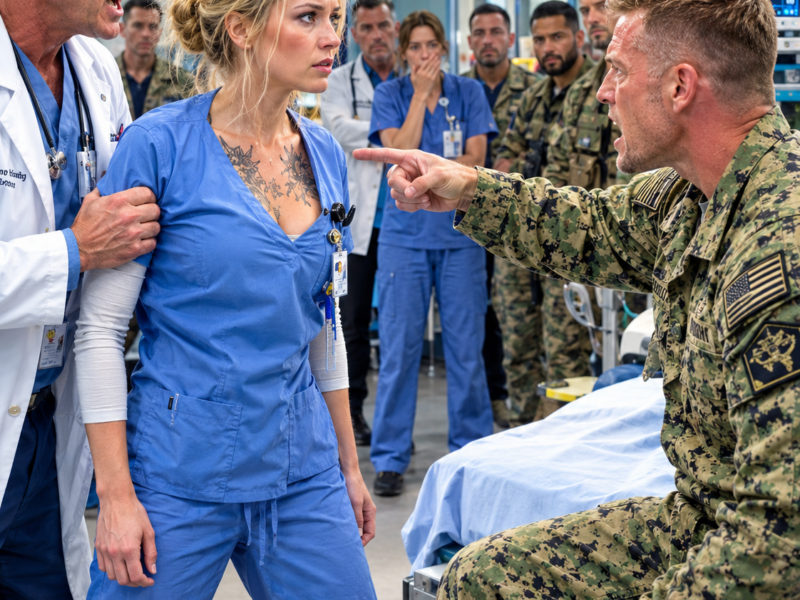
“‘MOVE, B*TCH!’ the doctor shouted, shoving me away from the trauma bay as if I were nothing but an obstacle
For several seconds, I couldn’t answer Dr. Keller.
My name was inside an evidence bag, sewn into a strip of fabric carried by a wounded man I had never met.
The location stitched beside it was worse.
It was the name of a remote medical station in Afghanistan that had supposedly been abandoned four years earlier—the place where my career had ended, my closest friend had disappeared, and the Navy had instructed me never to discuss what happened.
Chief Marcus Reed stepped closer.
“Rachel, look at me.”
I forced my eyes away from the evidence bag.
“Not here,” I whispered.
His expression hardened.
“Then where?”
“Somewhere nobody can hear us.”
Dr. Keller gave a sharp, incredulous laugh.
“Absolutely not. This is my emergency department. We have an unidentified critical patient, a security incident, and a civilian interfering with treatment. Nobody is leaving until I understand what’s going on.”
I turned toward him.
“Doctor, that man is dying. Whatever you think you know about me can wait.”
For the first time since he’d shoved me, Keller seemed to recognize that I wasn’t arguing with him.
I was asking him to make a decision.
He glanced at the monitor, then at the nurse working beside the patient’s bed.
“His pressure is responding,” she said. “But we need the vascular team in here.”
“Then get them,” I replied.
Keller’s jaw tightened.
But he turned back to the patient.
That was the first good decision he made that night.
I stepped away from the treatment area while Reed remained near the doorway. The hospital’s security supervisor arrived with two officers and asked everyone who had witnessed the confrontation to remain available for statements.
I gave my name, my identification, and a brief account of what had happened.
I did not explain the tattoo symbol on the patient’s wrist.
I did not explain how I had recognized his tapping pattern.
And I certainly didn’t explain why the sight of the black fabric had made my hands go cold.
Those details belonged to the investigation.
At least, that was what I told myself.
In reality, I was afraid that saying the story aloud would make the past real again.
Reed led me into a small consultation room near the emergency department’s staff corridor. He closed the door but left it unlocked.
For a moment, we simply looked at each other.
Four years earlier, Reed had been the man who told me our team had completed its final extraction. He had stood beside a transport vehicle with blood on his sleeve and promised me that everyone who could be saved had been brought home.
I had believed him.
Then I had discovered the missing name in the medical records.
Then the reports had changed.
Then my requests for clarification had stopped receiving answers.
Eventually, I had left active operational duty and built a life in which nobody knew what I had once done.
Now Reed stood in front of me with the same haunted look I’d seen on him the morning everything fell apart.
“Tell me what you recognized,” he said.
I folded my arms, partly to steady my hands.
“The tattoo is an identification mark from the Ash Lantern operation.”
Reed closed his eyes briefly.
“I was hoping you’d say something else.”
“You knew the symbol was still in circulation?”
“No.”
“Then why did you react when you saw me?”
“Because I know you. And because the last time I saw that look on your face, you were about to walk into a building everyone else had been ordered to abandon.”
“That building had civilians inside.”
“I remember.”
“Do you?”
The question came out sharper than I intended.
Reed didn’t defend himself.
That was unusual.
He had always been the kind of commander who could explain a bad decision in language that made it sound unavoidable. He could talk about constraints, operational priorities, conflicting intelligence, and decisions made under pressure.
Tonight, he seemed tired of explanations.
“I remember every minute of that mission,” he said.
“Then tell me why the medical station was erased from the official record.”
His gaze shifted toward the door.
“Because the operation was classified.”
“That’s not an answer.”
“No. It isn’t.”
He sat down.
“The mission was supposed to retrieve a wounded intelligence specialist and secure a storage device believed to contain information about compromised extraction routes. We were told the device had been recovered before our team arrived.”
“But it hadn’t.”
“No.”
“And when we reached the station, the route was already compromised.”
“Yes.”
I stared at him.
“Who changed the route?”
“We never established that.”
“Who ordered the station evacuated?”
“Central command.”
“Who decided the remaining patients weren’t worth the risk?”
Reed looked up.
“Rachel—”
“Don’t.”
My voice shook.
“Don’t tell me that wasn’t the question. I was there. I carried two people out through a corridor while the ceiling was coming down. I went back for a third, and you ordered me to stop because the extraction vehicle was leaving.”
“I ordered you to stop because the entire building was about to collapse.”
“There was someone still inside.”
“I know.”
“Did he survive?”
Reed said nothing.
That silence told me more than his official report ever had.
I stood up.
“You don’t know.”
“No,” he admitted. “I don’t.”
I turned toward the window, although all I could see was the reflection of my own face.
For four years, I had told myself that the people who made those decisions had at least been honest about what they knew.
Now I wasn’t sure they had ever intended to tell us the truth.
Reed opened his mouth to speak, but a knock interrupted him.
Agent Rebecca Sloan entered with a hospital security officer behind her. She introduced herself as the investigator assigned to the incident and asked Reed to step aside while she spoke with me.
I recognized the name from the hospital’s preliminary incident paperwork. She had already begun collecting statements about the unidentified patient and the disputed evidence.
“Ms. Hayes,” she said, “the hospital has confirmed that the patient was carrying a strip of fabric with your name and a location sewn into it. I’d like to understand your connection to that location.”
I looked at Reed.
He didn’t answer for me.
That mattered.
“I served in a military medical support unit attached to a special operations task group,” I said. “The location was a temporary medical station associated with a classified mission four years ago.”
“Were you assigned to that mission?”
“Yes.”
“Did you know the patient before tonight?”
“No.”
“Can you identify him?”
“Not yet.”
Sloan studied me.
“Can you explain why he might have been carrying your name?”
“No.”
It was the truth, but not the whole truth.
I knew what the symbol meant. I knew what the tapping pattern meant. And I knew that the patient’s attempt to communicate had been deliberate.
I did not yet know why he had chosen me.
Sloan seemed to understand that distinction.
“I’m going to ask the hospital to preserve the patient’s clothing and personal effects. We’ll also need to review the chain of custody for anything removed from the stretcher.”
“That’s reasonable.”
“I’m not asking you to disclose classified information outside the proper process. But if you believe the patient may be connected to a threat against you or anyone at this hospital, I need you to tell me now.”
I thought of the words he had mouthed.
*They found you.*
“I believe he was trying to warn me,” I said.
“About what?”
“I don’t know.”
Sloan made a note.
“Then we’ll establish what we can.”
She turned to Reed.
“Commander, I need your statement as well. And until we understand how this patient came to be carrying restricted material, I want everyone to avoid informal contact with him.”
Reed nodded.
“Agreed.”
Sloan looked back at me.
“One more question. Do you have any reason to believe someone knew you would be at this hospital tonight?”
I thought of the envelope in my pocket.
It had been addressed to Dr. Samuel Vance, a retired Navy medic who had disappeared from the public record two years earlier.
I had received it three days ago from an unmarked courier.
Inside was a single line written in Vance’s handwriting:
*If you want to know what happened at Ash Lantern, come to St. Matthew’s on Thursday. Bring nothing you cannot afford to lose.*
I had assumed the message was a trap.
I had come anyway.
“No,” I said.
The lie sat between us.
Sloan watched me for another moment, then closed her notebook.
“Please don’t leave the hospital without notifying security. If you remember anything else, contact me directly.”
When she left, Reed turned toward me.
“You’re holding something back.”
“Yes.”
“What?”
I took the envelope from my pocket and laid it on the table.
Reed read the line once.
Then again.
His face changed.
“Where did you get this?”
“Someone delivered it to my apartment.”
“Who?”
“I don’t know.”
He looked at the handwriting as if he recognized it.
“That’s Vance’s.”
“I know.”
“Rachel, Samuel Vance has been missing for two years.”
“Which is why I came.”
Reed folded the paper carefully.
“Why didn’t you tell Sloan?”
“Because I don’t know whether Vance is alive, whether this is genuine, or whether someone is trying to draw me into a second trap.”
He considered that.
“That’s fair.”
Then he looked at the door.
“But the man in the trauma bay changes everything.”
A nurse appeared in the doorway before I could answer.
“Chief Reed? Dr. Keller needs you in the trauma area. The patient is awake, and he’s asking for Rachel.”
I felt the room grow smaller.
Reed stood immediately.
“Did he say anything else?”
The nurse hesitated.
“He keeps saying the same thing. ‘Tell her the doctor was right.’”
My heart began to pound.
“What doctor?” I asked.
She shook her head.
“He won’t explain.”
I followed Reed back into the emergency department.
The atmosphere had changed. The initial rush had settled into controlled urgency. A vascular specialist was examining the patient’s arm while a nurse adjusted his medication. Dr. Keller stood at the foot of the bed, no longer shouting, his expression strained.
The wounded man turned his head when I entered.
His eyes found mine.
He was pale, exhausted, and fighting to remain conscious. A bandage covered the side of his neck, and a monitor tracked every shallow breath.
I moved closer but stopped outside the working area.
“I’m Rachel Hayes,” I said. “Can you tell me who you are?”
His lips parted.
No sound came out.
The nurse adjusted the oxygen tubing, and he tried again.
“Evan,” he whispered.
“Evan what?”
His eyes flickered toward Reed.
“Not… here.”
Dr. Keller stepped forward.
“His condition is unstable. He needs to conserve his energy.”
The patient grabbed my wrist.
His grip was weak, but the desperation in it was unmistakable.
“Vance,” he rasped. “Find Vance.”
Then his hand fell away.
The monitor alarm changed pitch.
The medical team moved in.
Keller ordered a medication adjustment and called for another set of blood results. I stepped back, forcing myself not to interfere.
Reed guided me away from the bedside.
“Evan could be a first name, a last name, or an operational identifier,” he said. “We shouldn’t assume anything yet.”
“He knows Vance.”
“Maybe.”
“He has my name sewn into his clothing.”
“I know.”
“And he came here with a warning.”
Reed looked at me.
“Then we’ll find out why. But we do it without turning this hospital into a battlefield.”
I nodded.
That was when Dr. Keller approached us.
He looked at me, then at the trauma bay.
“I owe you an apology,” he said.
I didn’t expect it.
He seemed uncomfortable, but he didn’t look away.
“I was under pressure. That doesn’t excuse what I said or how I treated you. You were trying to point out a possible medical concern, and I dismissed you because you weren’t wearing a badge that impressed me.”
I waited.
“I was wrong,” he continued. “I’ll provide a statement to hospital administration and cooperate with the review.”
“Thank you,” I said.
It wasn’t forgiveness.
Not yet.
But it was a start.
Keller glanced toward the patient.
“For what it’s worth, the swelling in his forearm was consistent with a vascular injury we might have missed if your warning hadn’t prompted the examination. The team addressed it before it progressed further.”
“I’m glad you caught it.”
He nodded, accepting the distinction.
Then he returned to his work.
For the first time that night, I saw him as something other than the man who had shoved me against a wall. He was a physician who had made a serious mistake, recognized it, and was now responsible for what happened next.
I hoped he would live up to that responsibility.
I had seen too many people mistake an apology for the end of accountability.
At 11:46 p.m., the hospital moved Evan to a monitored intensive care room.
He was stable enough for a brief interview, but Agent Sloan insisted that the first questions be limited to his identity and immediate safety. His clothing and the black fabric had been secured as evidence.
I was allowed to stand near the doorway while Sloan spoke to him.
“Can you tell me your full name?”
“Evan Cole.”
“Do you know why you were brought to this hospital?”
He closed his eyes.
“Because they found the envelope.”
“What envelope?”
“The one Vance gave me.”
Sloan leaned forward.
“Where is it?”
Evan’s eyes moved toward me.
“Gone.”
“Who took it?”
“I don’t know.”
“Did you bring it here?”
“No.”
His breathing quickened, and the nurse signaled that he needed a pause.
Sloan stopped questioning him.
I stood outside the room, staring at the floor.
The envelope I had received was not the only message in play. Someone had given Evan another one, and whatever it contained had disappeared before he reached the hospital.
Reed came to stand beside me.
“Vance may have known he was being watched.”
“Or someone wants us to believe that.”
“Exactly.”
I looked through the glass at Evan.
“Why would he sew my name into his clothing?”
“Because he needed you to recognize him,” Reed said. “Or because someone wanted you to think he did.”
I hated that both explanations made sense.
The next morning, Sloan obtained authorization to review the hospital’s exterior security footage and the ambulance dispatch record. The patient had been found near a closed industrial building several miles from the hospital. No identification had been recovered, and the emergency call had come from a prepaid phone that was no longer active.
The caller had given the dispatcher only one instruction.
“Tell Rachel Hayes the doctor was right.”
I read the transcript twice.
“What doctor?” I asked.
Sloan shook her head.
“We don’t know.”
“Could it mean Dr. Vance?”
“Possibly. It could also refer to someone else. We have no reason to settle on an interpretation yet.”
She showed me a still image from the ambulance bay camera.
A dark vehicle had followed the ambulance for two blocks before turning away. The license plate was obscured by rain and glare.
“Do you recognize it?”
“No.”
“Anyone who might have known you were coming here?”
I thought about the courier, the envelope, and Vance’s missing status.
“No one I can identify.”
Sloan closed the image.
“We’re checking the vehicle against available records. Meanwhile, I want you to understand something. We have evidence of a possible coordinated attempt to deliver this patient and a message. We do not yet have evidence that the hospital itself was targeted, or that anyone here is in immediate danger.”
I appreciated the careful wording.
The emergency department had been full of frightened patients and exhausted staff. I refused to let speculation turn them into pieces on a board.
“What about Evan?”
“He’s under protection while we establish his identity and determine who injured him.”
“Can I speak with him?”
“If his medical team approves it, and if he agrees.”
That afternoon, he did.
I entered his room with Reed and Sloan nearby. Evan looked more alert, though his face tightened with pain whenever he moved.
“Rachel Hayes,” he said.
“Yes.”
He studied me.
“You look different.”
“I’ve had four years to change.”
A faint smile crossed his face, then disappeared.
“You came.”
“You asked for me.”
“I didn’t know if you’d trust the message.”
“I didn’t. I came because I wanted to know who sent it.”
He glanced toward Sloan.
“Can we speak privately?”
“Not about the investigation,” Sloan replied. “We can give you a few minutes for personal conversation, but the room’s security procedures remain in place. If you need a break, say so.”
Evan nodded.
Reed moved back toward the door.
I remained beside the bed.
“Who are you?” I asked.
“Evan Cole. Former Navy corpsman. I worked under Dr. Samuel Vance at Ash Lantern.”
The room seemed to go quiet around me.
“You were at the station?”
“Yes.”
“I never saw you.”
“You weren’t supposed to. I was assigned to the recovery side. We were keeping the medical evacuation records separate from the operational logs.”
“Why?”
“Because somebody was changing the operational logs.”
My hands curled into fists.
“Who?”
“I don’t know the name. I know what I saw.”
He took a careful breath.
“Vance found that the approved extraction route had been replaced in the planning system before the team was sent out. The change redirected the transport away from the station. When the team requested the original route, the request was denied.”
I remembered the radio call.
I remembered the smoke.
I remembered the order to leave.
“Why didn’t he report it?”
“He did. Twice. The reports were closed without investigation. The third time, he made copies.”
“Copies of what?”
“Original route approvals. Medical transfer logs. Communications timestamps. He thought the records could prove that the route had been altered deliberately.”
“Where are they?”
Evan looked at me.
“That’s what Vance was trying to tell you.”
I stared at him.
“The envelope?”
He nodded.
“Not the one you received. The one he gave me.”
“Where did it go?”
“I don’t know. I was carrying it when they caught me.”
“Who caught you?”
His expression hardened.
“Two men. They knew my name, my former unit, and where I’d been staying. They told me the records were being recovered for an official review. Then they asked where Vance had hidden the original files.”
“Did you tell them?”
“No.”
He looked down at his bandaged arm.
“They wanted the location. When I refused, they hurt me. I escaped when their vehicle stopped at a service road. I made it to a phone and called for help.”
“Why did you give them my name?”
“Because Vance said you were the one person who would understand the warning.”
I felt anger rise again.
“Why didn’t he contact me directly?”
“I don’t know. He told me he’d tried. He said you were being watched, and he didn’t want to put you in danger.”
I looked toward the door, where Sloan was waiting.
“What exactly was in the envelope?”
Evan shook his head.
“I never opened it. Vance told me to deliver it only if the first plan failed.”
“What first plan?”
“To get the original records into a secure review.”
He closed his eyes for a moment, exhausted.
“I don’t know if he succeeded.”
I let the silence settle.
The story was beginning to take shape, but every new fact created another question.
A changed route.
A suppressed report.
Missing medical records.
A wounded corpsman.
And an envelope that had vanished before anyone could determine what it contained.
I stepped closer.
“Evan, do you know if anyone was left alive at the station when we evacuated?”
His eyes opened.
For a long moment, he didn’t answer.
Then he said, “Yes.”
My heart stopped.
“Who?”
He swallowed.
“I saw someone move in the lower corridor after the evacuation order. I couldn’t identify the person from where I was. Vance went back to check, but he never told me what he found.”
“Why didn’t anyone tell me?”
“Because the official report said the station had been cleared.”
I gripped the bed rail.
“I went back.”
“I know.”
“I searched the corridor.”
“I know.”
“I never found anyone.”
Evan’s voice softened.
“Rachel, I believe you.”
Those four words nearly broke me.
For years, I had carried the suspicion that I had failed someone because I hadn’t searched hard enough, hadn’t argued loudly enough, hadn’t refused the final order.
I had replayed that corridor in my mind until I could remember every broken light and every piece of fallen plaster.
I had never found proof that anyone remained inside.
Now there was a witness who said the official report had been wrong.
It wasn’t proof of who had been there, or whether the person had survived.
But it meant my memory wasn’t the only thing contradicting the record.
Sloan stepped into the room.
“Evan, I need to stop here for now. You need rest, and we need to verify the details you’ve provided.”
He nodded.
Before I left, he caught my hand.
“Don’t trust the copy.”
I leaned closer.
“What copy?”
“The route record. Vance said the version everyone had seen was altered. The original was never in the main archive.”
“Where is it?”
He looked toward the window.
“I don’t know.”
Then he released my hand.
That night, Reed and I met with Sloan in a secure conference room.
She had documented Evan’s account and was careful to separate his direct observations from what Vance had told him. The account was important, but she made it clear that it would need corroboration.
“His injuries are consistent with a violent assault,” she said. “That doesn’t establish who attacked him or whether the assault was related to the records.”
“What about the vehicle?” Reed asked.
“We’ve identified two possible matches, neither confirmed. The license plate is still unreadable. We’re working with local law enforcement to locate the vehicle through other evidence.”
“And Vance?”
“No confirmed location. His former residence has been searched under authorization. We found no original records, but there were signs that someone had accessed the property recently.”
I stared at the table.
“So whoever hurt Evan may still be looking for the envelope.”
“That’s one possibility,” Sloan said. “Another is that the envelope was taken before the assault. We cannot assume the same person was responsible for every event.”
Reed nodded.
“What do you need from us?”
“Anything that can establish the original route. Personal notes, retained communications, contemporaneous medical records. Anything created before the archive was altered.”
I thought of the old notebook in a storage box at my apartment.
I had kept it because I couldn’t bring myself to throw away the last pages I had written during the mission. It contained medication times, casualty estimates, and short notes about the evacuation.
I had never thought of it as evidence.
“I may have something,” I said.
Sloan looked up.
“What?”
“A notebook I kept during the operation. It wasn’t an official mission log, but I recorded the times of several medical transfers.”
“Have you altered it since?”
“No.”
“Have you shown it to anyone?”
“No.”
“Then don’t handle it until we arrange collection. If it is relevant, we need to preserve its condition and establish its history.”
I agreed.
The next morning, a forensic team collected the notebook under a documented chain of custody.
Two days later, Sloan called me back to the evidence office.
The notebook contained a time entry that matched a radio transmission preserved in a separate system. The transmission had been recorded nine minutes before the route approval appeared in the official archive.
The message clearly referred to a request to return to the original route.
The archive said no such request had been made.
Sloan placed the two records side by side.
“This establishes a conflict between the contemporaneous record and the later summary,” she said. “It doesn’t identify who altered the archive, but it gives us an independent basis to investigate the discrepancy.”
I read the message again.
The words were brief.
The timing was unmistakable.
For the first time, there was something beyond my memory and Evan’s account.
There was a record.
“Can this prove someone deliberately changed the route?”
“Not on its own,” Sloan said. “It proves the record is inconsistent. Intent and responsibility require more evidence.”
I nodded.
I was learning to live inside the space between suspicion and certainty.
It was uncomfortable.
It was also necessary.
Over the following weeks, investigators traced access to the archive and compared the altered records with independent backups. A former contractor had retained access to a planning account after his assignment ended. The account had been used to view the route file shortly before the later archive migration.
That discovery did not prove the contractor had changed the original route. It did establish a new lead.
The two men who had assaulted Evan were not immediately identified, and Vance remained missing.
The Navy reopened its review of the Ash Lantern operation. Several records were corrected to reflect that the evacuation and medical transfer timeline had not been fully verified. The official finding about the station’s final clearance was withdrawn pending further investigation.
No one announced a grand conspiracy.
No one stood in front of a camera and confessed.
The evidence was too incomplete for that.
But the official version was no longer treated as unquestionable.
And that mattered.
Dr. Keller’s part in the story ended more quietly.
Hospital administration reviewed the incident, interviewed staff, and examined the medical team’s response. Keller received formal corrective action for his conduct toward me and was required to complete additional training on workplace behavior and emergency communication.
He also continued treating patients.
A week after the incident, he asked to speak with me.
We met in the hospital cafeteria, where the fluorescent lights made everyone look more tired than they probably were.
“I wanted to thank you,” he said.
“For what?”
“For insisting that we examine the patient’s arm. The vascular team believes the injury could have become much more dangerous if it had gone unnoticed.”
“I was glad I could help.”
He nodded.
“I also wanted to apologize again. I treated you as if your appearance determined whether you deserved to be heard. That was unacceptable.”
I watched him for a moment.
“Why did you do it?”
He looked uncomfortable.
“Because I was overwhelmed, and I thought control meant making everyone obey me. I was wrong.”
“That isn’t an excuse.”
“No,” he said. “It isn’t.”
I appreciated that he didn’t try to turn the conversation into a request for forgiveness.
“I hope you do better next time,” I said.
“I intend to.”
We parted without a dramatic reconciliation.
That was fine.
Not every ending needed to be a friendship.
Some endings were simply a person accepting responsibility and choosing to act differently.
Evan’s recovery took longer.
His arm healed, but the injuries and the stress of the assault left him exhausted. He had nightmares and struggled to sleep. He sometimes remembered details about the men who had taken him, then questioned whether the memories were accurate.
Sloan arranged for him to speak with investigators only when his medical team agreed he was ready.
I visited when I could.
We talked about ordinary things. Food. Music. The terrible coffee in the hospital. The strange feeling of being alive after a period when he had believed he might not survive.
One afternoon, he told me he remembered another detail about the missing envelope.
“Vance said there was a second copy,” he explained. “Not a duplicate of the entire file. A set of records stored separately so that if the main archive changed, the original timing could still be checked.”
“Where?”
“He mentioned a medical supply ledger. Something that would look ordinary to anyone who didn’t know what to compare.”
I thought about my notebook.
“Could the ledger still exist?”
“Maybe. It would have been part of the station’s medical transfer records.”
Sloan was informed immediately. She arranged for investigators to search the archived logistics records, but the original ledger had not yet been located.
For a while, that was where the trail stopped.
I returned to my life in Norfolk. I continued working in medical support, now in a role that let me help patients without returning to operational deployments. I still woke sometimes with the sound of that evacuation order in my ears.
But the memory no longer had the same power to define every decision I made.
I had learned that I could acknowledge what happened without pretending I understood all of it.
I could keep looking for answers without treating every unanswered question as proof of betrayal.
And I could let other people carry their share of responsibility.
Three months after the night at St. Matthew’s, Sloan called me with an update.
The missing medical supply ledger had been found in an archive box that was scheduled for transfer to a different storage facility. Its inventory numbers matched the records from Ash Lantern.
The ledger did not contain a dramatic confession.
It contained something more useful.
A timestamped entry for a medical transfer that had been omitted from the official mission summary.
The entry showed that a patient had been moved from the station after the recorded evacuation time.
The patient’s name was missing.
But the receiving facility’s identifier matched the temporary identifier associated with Evan’s later medical records.
It did not establish who remained in the lower corridor.
It did not prove who had changed the route.
It did establish that the station’s medical activity had continued after the official record said the site had been cleared.
The review was expanded.
For the first time, investigators had a documented reason to examine the final hours at Ash Lantern as an unresolved event rather than a completed evacuation.
When I told Reed, he sat silently for a long time.
“It’s not everything,” he finally said.
“No.”
“But it’s something.”
“Yes.”
He looked at me.
“I should have pushed harder when the first report didn’t make sense.”
I considered that.
“Maybe. But I should have kept asking questions, too.”
“You did.”
“Not enough.”
“Rachel, you left the service because you couldn’t keep living inside a story nobody would explain. That doesn’t make the failure yours.”
I wanted to believe him.
I wasn’t sure I did.
But I no longer needed to settle that question in one conversation.
The investigation remained open. Vance had not been found, the men who assaulted Evan had not been conclusively identified, and the evidence did not yet establish who was responsible for the original route alteration.
Those facts were frustrating.
They were also the truth.
One rainy evening, several months after the incident, I returned to St. Matthew’s to deliver a training document to the medical support team. I passed the emergency department where Keller had once shouted at me.
A young nurse was standing beside a stretcher, trying to explain something to an impatient physician. He interrupted her twice.
I watched as she drew a breath and tried again.
The physician started to dismiss her.
Then another nurse stepped forward.
“Let her finish,” she said. “She noticed something important.”
The doctor paused.
The young nurse spoke.
The team listened.
I continued down the corridor before anyone noticed me watching.
It wasn’t a grand transformation. The world hadn’t become fair because one man had apologized. People would still make mistakes. Some would still use authority to silence others.
But someone had chosen to listen.
Sometimes that was where change began.
Before leaving the hospital, I stopped by Evan’s room. He was preparing for transfer to a rehabilitation facility closer to his family.
He looked at my wrist and smiled.
“Still wearing it?”
I glanced at the three lines and silver crescent.
“Yes.”
“Does it still mean the same thing?”
I thought about the operation, the missing records, the patient who had arrived carrying my name, and the months of careful work that had followed.
“No,” I said. “It means I don’t have to know everything to keep asking the right questions.”
Evan nodded.
“Vance would like that.”
“I hope we find him.”
“So do I.”
I shook his hand and wished him well.
Then I stepped out into the rain.
For years, I had believed that the worst part of Ash Lantern was the moment I left the station without knowing who remained behind.
I had believed that if I could uncover the truth, I would finally be able to forgive myself.
I understood now that the truth might arrive in fragments. It might never answer every question. It might reveal mistakes without revealing a villain, or expose wrongdoing without repairing everything that had been lost.
But uncertainty did not mean I had to stop looking.
And guilt did not mean I had to carry the whole mission alone.
The wounded man who arrived at St. Matthew’s had been trying to deliver a warning. The doctor who shoved me away had been forced to confront his own arrogance. The SEAL commander who recognized me had been forced to face the limits of his own certainty.
And I had been reminded that the past could return without owning the future.
I still didn’t know exactly what had happened in the lower corridor at Ash Lantern.
I still didn’t know who had altered the route.
I still didn’t know where Samuel Vance was.
But the records were being examined. Evan was alive. The official timeline had been challenged by evidence. And the people responsible for investigating the truth were no longer pretending the case was settled.
That was not the perfect ending I once imagined.
It was a beginning I could live with.
As I reached the parking lot, my phone vibrated with a message from Reed.
*Keep your phone on. Sloan has a new lead on Vance.*
I stopped beneath the awning and read it again.
Then I looked down at the tattoo on my wrist.
Three lines.
A silver crescent.
A reminder that even when every official route seemed closed, there could still be another way forward.
I put my phone away and stepped into the rain, ready to follow the next lead—not because I believed the truth would be easy, but because I finally understood that it was worth pursuing, one verified fact at a time.
THE END.









