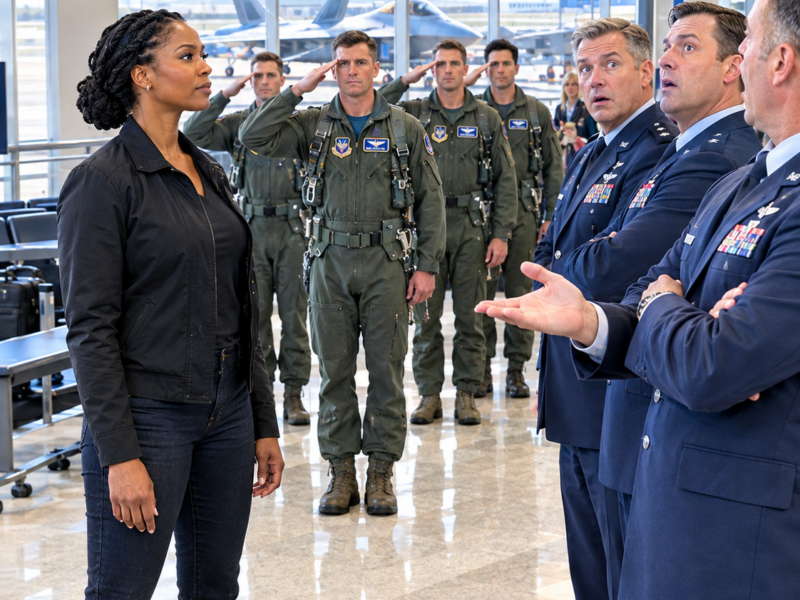
“Know your place, passenger!” the officer sneered as laughter spread across the military terminal
The commander opened the briefing-room door, turned toward the entire squadron, and said five words that made every smile disappear.
“She will be evaluating you.”
For several seconds, nobody spoke.
I stood beside General Marcus Hale, my worn flight bag hanging from one shoulder, while twenty-four F-22 pilots stared at me as if I had just walked out of a legend they had never believed was real.
Colonel Hayes stood near the front of the room. The same man who had ordered me to know my place was now struggling to decide whether to look at me, the general, or the floor.
General Hale gestured toward the empty chair at the head of the table.
“Captain, please.”
I set down my bag and took my seat.
“Thank you, General.”
He remained standing.
“For those who have not reviewed the classified briefing package, Captain Naomi Reed is assigned to conduct our tactical readiness evaluation. Her operational call sign is Nightglass. She has extensive experience in advanced air combat, electronic warfare environments, and mission recovery under degraded communications.”
He paused, allowing the words to settle.
“She is here because this squadron has been selected for an evaluation that will determine whether it is ready for a new joint-operation assignment. Her findings will go directly to my office.”
A pilot in the second row shifted in his chair.
Another glanced toward Colonel Hayes.
I opened the folder in front of me.
“Before we begin,” I said, “I want to make one thing clear. I’m not here to embarrass anyone. I’m here to determine whether you can trust your training, your equipment, and each other when the situation stops behaving the way you expected.”
I looked around the room.
“If you make a mistake during a simulation and admit it, we can learn from it. If you hide a mistake because you’re afraid of looking weak, we have a much bigger problem.”
My eyes stopped briefly on Hayes.
He looked away.
“Let’s begin.”
The first portion of the evaluation was supposed to be straightforward: a review of mission planning, communication discipline, and response procedures.
I asked the squadron to walk me through its standard response to conflicting tactical data.
Major Ethan Ward, the squadron’s lead tactics officer, stood beside the display.
“First, we compare the onboard picture against ground control. If the discrepancy persists, we cross-check the relevant data source and request clarification before changing the mission profile.”
“Good,” I said. “What happens if ground control confirms a vector that conflicts with the aircraft’s verified safety information?”
Ward hesitated.
“We request clarification.”
“And if the response is delayed?”
“We maintain the safest available profile while attempting to resolve the conflict.”
“Who has authority to reject an instruction that appears unsafe?”
“The pilot in command retains responsibility for the aircraft.”
“Even when the instruction comes from a senior officer?”
“Yes, ma’am.”
“Even when rejecting it delays the mission?”
“Yes.”
I nodded.
“That is the correct answer. Now let’s see whether your procedure survives contact with pressure.”
I instructed the technicians to begin the first simulation.
The large screen filled with a synthetic airspace map. Three friendly aircraft appeared as blue markers. Simulated weather cells stretched across the eastern sector, and a restricted training zone was marked in red.
The scenario involved a formation returning from a training mission when its primary communications channel became unreliable. A ground controller transmitted a route adjustment, but the digital display showed a conflicting boundary.
It was similar to the problem at the terminal that morning, though the simulation was more complicated.
I wanted to know whether the pilots would recognize the discrepancy before it became urgent.
For the first few minutes, everything proceeded normally.
Then the display changed.
A new route appeared, cutting directly across the restricted zone.
The radio operator announced that the ground controller had confirmed the adjustment.
Ward studied the map.
“Formation should maintain the existing route until the discrepancy is resolved,” he said.
“Why?” I asked.
“Because the new route conflicts with the validated boundary information.”
“Ground control says the route is approved.”
“That doesn’t resolve the contradiction.”
“Your commanding officer orders you to continue.”
Ward paused.
The room became quiet.
I watched his face as he weighed the simulated authority pressure against the information on the screen.
Then he said, “I would respectfully decline the route until the conflict was verified.”
“Why?”
“Because an instruction cannot make contradictory data consistent.”
I closed my folder.
“Excellent. Continue.”
The scenario escalated. One simulated aircraft reported a navigation disagreement. Another lost its primary data link. The formation’s assigned recovery route became unavailable, and the ground controller began issuing increasingly urgent instructions.
Two pilots started talking at once.
Ward raised his hand.
“One voice at a time. Confirm what we know, identify what we don’t know, and don’t invent certainty.”
The room settled.
Within minutes, the formation had established a safe contingency plan and reached the simulated recovery area.
When the exercise ended, I turned to the squadron.
“Your procedure is sound. Your initial execution was not.”
Several pilots frowned.
I replayed the recording.
The problem had not been their technical knowledge. It had been the delay between recognizing the contradiction and speaking clearly about it.
For twenty-three seconds, the simulated formation had continued toward a restricted boundary while three people waited for someone else to challenge the instruction.
“Twenty-three seconds,” I said. “That’s how long you knew something was wrong before the first clear objection.”
Ward crossed his arms.
“We corrected it before entering the boundary.”
“Yes. In a simulation, with no real consequences. But why did you wait?”
He considered the question.
“Because the controller confirmed the instruction.”
“That’s what the controller said. I’m asking why you trusted the confirmation more than the conflicting information in front of you.”
Nobody answered.
I walked to the display.
“Your training teaches you to trust the system. That’s necessary. But trusting a system does not mean pretending it cannot fail. A good pilot knows the difference between discipline and obedience without thought.”
I let the sentence settle.
“Again.”
This time, the squadron responded more quickly.
Not perfectly.
But better.
And that was the first sign that the morning might accomplish something useful.
During the break, I found Colonel Hayes standing alone near the coffee station.
He had removed his sunglasses and was staring into a paper cup.
“Captain Reed.”
“Colonel.”
He glanced toward the briefing room.
“I owe you an apology for my behavior earlier.”
I waited.
“I made assumptions based on your appearance. I dismissed your instructions and spoke to you disrespectfully. It was unprofessional.”
“Yes,” I said. “It was.”
His jaw tightened slightly, perhaps because he had expected me to make the apology easier for him.
“I’d like to put that behind us and focus on the evaluation.”
“We can focus on the evaluation,” I replied. “But putting something behind us doesn’t mean pretending it didn’t happen.”
He nodded once.
“Understood.”
I took a cup of water from the counter.
“Colonel, what would you have done if an unfamiliar pilot had challenged your instructions during a real operation?”
“I would have asked for their reasoning.”
“Would you have done that if you believed they didn’t belong in the room?”
He looked at me.
I held his gaze.
“That is the question you should be asking yourself.”
For a moment, he seemed ready to defend himself. Then the expression faded.
“I see your point.”
“I hope you do.”
I returned to the briefing room.
I wasn’t interested in revenge. I had no desire to watch Hayes squirm for the entertainment of his subordinates.
But I had seen what happened when people with authority treated their assumptions as facts. In aviation, the consequences could extend far beyond a wounded ego.
And the evaluation had only begun.
At 11:40 a.m., General Hale requested a private meeting.
His office overlooked the flight line. Beyond the windows, a pair of F-22s sat in the morning sunlight, their angular silhouettes sharp against the pale sky.
He motioned for me to sit.
“How serious is the squadron’s weakness?” he asked.
“It’s too early to make a final judgment.”
“Your preliminary assessment?”
“They know the procedures. Under pressure, some of them hesitate when the source of an instruction has more authority than the evidence supporting it.”
“Is that a leadership problem?”
“Partly. But it’s also a culture problem.”
He leaned back.
“Explain.”
“People don’t learn to challenge unsafe instructions merely because a manual tells them to. They learn it when leadership makes it safe to raise concerns. If a pilot is mocked, sidelined, or punished for asking a legitimate question, the entire squadron learns the wrong lesson.”
Hale nodded slowly.
“I suspected we had an issue with communication discipline. I didn’t realize it had reached that point.”
“You won’t see the full problem in a routine briefing. You have to observe what happens when people are tired, uncertain, and under pressure.”
He looked out at the flight line.
“That’s why I asked for you.”
I studied him.
“General, why me specifically?”
He turned back toward me.
“Because three years ago, during the joint exercise over the northern training range, you identified a data conflict that two separate control centers had missed. You prevented a formation from following an erroneous simulated intercept picture, then rebuilt the mission plan with your communications degraded.”
“That was a team effort.”
“I read the full report. You were the person who recognized the conflict, challenged the instruction, and kept the other pilots focused on verifiable information.”
He opened a drawer and removed a thin folder.
“There was another reason. Your final assessment recommended that the exercise be suspended until the data-integrity issue was investigated. The recommendation was unpopular. Several senior officers wanted the exercise declared successful.”
I remembered.
I remembered the long debrief, the tense conference calls, and the quiet suggestion that I should be more flexible in how I documented technical concerns.
“I wrote what the evidence supported,” I said.
“And you were right. The review later confirmed that the data feed had been compromised by a configuration error. No one was injured, but the findings led to changes across multiple units.”
He closed the folder.
“Your reputation isn’t based on a dramatic call sign, Captain. It’s based on the fact that when everyone else wanted to move on, you insisted on finding out what had actually happened.”
I thought of the pilots in the terminal, laughing while the radio crackled with uncertainty.
“Then I hope this squadron is ready to hear what I find.”
“So do I.”
At noon, the second evaluation began.
This exercise was designed to test the squadron’s ability to coordinate under degraded communications and an evolving threat picture. The details were classified, but the basic objective was simple: the pilots had to complete a simulated defensive mission while dealing with unreliable data, unexpected changes, and limited time.
I stood behind the observation console as the first formation entered the scenario.
For the first ten minutes, the squadron performed well.
Their coordination was smooth. Their radio calls were concise. Their formation discipline remained consistent as the simulated environment changed.
Then the system introduced an anomaly.
A friendly marker appeared where the validated picture showed no aircraft should be. At the same time, a ground controller issued an instruction based on the conflicting display.
The lead pilot, Captain Lucas Bennett, acknowledged the instruction.
“Formation, prepare to follow the revised vector.”
I leaned toward the console.
“Freeze the simulation at the next decision point.”
The screen paused.
Bennett’s voice remained suspended in the room.
I turned toward the observers.
“What information supports this instruction?”
Major Ward pointed at the ground-control display.
“The controller’s confirmation.”
“What independent information supports it?”
He examined the screen.
“None that we can verify yet.”
“Then why was the instruction acknowledged?”
Ward’s expression tightened.
“Because the lead pilot assumed the controller had access to better information.”
“An assumption,” I said, “is not a verification.”
I asked the technicians to resume the simulation.
Bennett followed the revised vector. Within seconds, the exercise’s safety monitor flagged a simulated loss of required separation.
The system stopped automatically.
Nobody spoke.
I asked Bennett to join us at the front.
“Captain, what did you believe when you acknowledged that instruction?”
“That the controller had a more complete picture than we did.”
“Did you have evidence that the controller’s picture was reliable?”
“Not at that point.”
“Did you have evidence that your own display was wrong?”
“No, ma’am.”
“Then what justified changing the plan?”
He stared at the floor.
“Nothing sufficient.”
“Thank you. That’s an honest answer.”
I turned to the squadron.
“Your mission failed because you treated authority as evidence. Those are not the same thing.”
Colonel Hayes shifted in his chair.
“Captain, with respect, in an actual operation, a pilot cannot stop every time two displays disagree.”
“Correct,” I replied. “And I am not asking anyone to stop for every minor discrepancy. I’m asking you to recognize the difference between an uncertainty that can be managed and a contradiction that changes the safety of the decision.”
I pointed to the frozen display.
“This was a safety-critical conflict. The controller’s instruction relied on information that had not been independently verified. The lead pilot had enough information to question it. Instead, he passed the uncertainty down the formation as if it were a confirmed fact.”
I looked at Bennett.
“What should you have said?”
He took a breath.
“Controller, we have conflicting data. We cannot verify the revised vector. Request confirmation through an independent source before proceeding.”
“Good. And if the controller insists?”
“We maintain the safest authorized profile and continue trying to resolve the discrepancy.”
“Exactly.”
I asked the technicians to reset the exercise.
This time, Bennett challenged the instruction. The formation held its safe profile, cross-checked the data, and identified the anomaly before proceeding.
The simulation ended successfully.
But the room had changed.
The pilots were no longer looking at me as an unexpected guest. They were looking at the evidence on the screen and recognizing that the problem had been present in their own behavior.
That was more important than any salute.
At 1:30 p.m., the evaluation took an unexpected turn.
A technician entered the briefing room and quietly spoke to General Hale. The general listened, asked two questions, and then turned toward me.
“We have a problem with the training system.”
“What kind?”
“The mission-data package loaded for this afternoon’s exercise does not match the package approved yesterday.”
I stood.
“Has the system been used?”
“Not yet. The technician caught the mismatch during the pre-run check.”
“Have they isolated the source?”
“They’re investigating.”
“Then no one runs the scenario until the discrepancy is explained.”
Colonel Hayes frowned.
“We have a schedule to keep. The system could have loaded an outdated file by mistake.”
“It could have,” I said. “Or something else could have happened. We don’t know yet.”
“We cannot suspend the entire evaluation because of a file mismatch.”
“I’m not asking you to suspend the evaluation. I’m asking you not to run an unverified mission-data package.”
Hale raised a hand before Hayes could respond.
“Captain Reed is correct. Freeze the package and preserve the logs. No one modifies the original files.”
The technician hurried away.
I asked to see the discrepancy report.
The two packages had similar names and almost identical timestamps. At first glance, the difference appeared minor. But one of the configuration fields referenced a different training boundary.
It was the same kind of issue we had seen in the morning’s radio scenario: a small inconsistency that could be dismissed if everyone assumed the underlying system was correct.
I compared the file identifiers.
“This is not simply an older copy,” I said. “The metadata indicates that one field was changed after the approval time.”
The technician looked concerned.
“Could that be a system-generated update?”
“Possibly. But we need to establish whether it was authorized.”
General Hale ordered the systems team to preserve the audit logs and investigate the source.
The afternoon exercise was delayed.
Within forty minutes, the technical team found that the package had been regenerated by an automated synchronization process after a configuration update. The change was not evidence of deliberate interference, but the resulting package had not passed the required approval step.
No one had tried to sabotage the evaluation.
That was a relief.
But the failure still mattered.
The system had produced a file that looked legitimate without completing the process required to make it legitimate.
I turned to the squadron.
“This is why verification matters. We don’t accuse people without evidence, and we don’t assume a system is safe just because it looks familiar. We preserve the records, establish what changed, and make a decision based on what we can confirm.”
Hayes nodded slowly.
For the first time that day, he spoke without defensiveness.
“Agreed.”
The word was small.
But it was different from the way he had spoken to me in the terminal.
By late afternoon, the final exercise was ready.
General Hale gave the squadron one instruction before the scenario began.
“Your objective is not to prove you can complete the mission at any cost. Your objective is to demonstrate that you can complete it safely, communicate honestly, and recognize when the information supporting a decision is no longer reliable.”
I watched the pilots settle into their stations.
The scenario began with a routine mission profile. A simulated weather change forced the formation to revise its plan. Then a communications failure disrupted the primary coordination channel.
The squadron adjusted.
A new instruction arrived from the simulated controller, but its coordinates conflicted with the validated data. This time, Bennett immediately raised the discrepancy.
“Control, we have a conflict between the transmitted vector and our verified boundary. We will maintain our current safe profile pending confirmation.”
The controller insisted that the new route had been approved.
Bennett did not argue.
“Understood. We still require independent verification before proceeding.”
Another pilot confirmed the conflict. A third identified an alternate route that avoided the disputed area. Ward coordinated the formation’s response while the simulated control center checked its data.
The situation grew more complicated. One aircraft reported a degraded sensor picture. Another lost its primary data link. The formation had to reorganize while maintaining separation and sharing only information that could be confirmed.
For several minutes, the room was filled with disciplined, precise radio calls.
No one pretended to know more than they did.
No one treated a question as an insult.
When the scenario introduced a final unexpected change, the squadron paused long enough to verify the new information, then adjusted its plan.
The formation reached the simulated recovery point.
The system marked the exercise successful.
I looked at the performance summary.
They had not been perfect. Their response time was slower than the best benchmark, and one communication handoff needed improvement. But the most important measure had changed: the pilots had challenged an unverified instruction before it became a safety failure.
I turned toward General Hale.
“That’s a pass for the final scenario.”
He nodded.
“And the squadron?”
I closed the folder.
“Conditionally ready. They have the technical skills, but they need continued work on decision-making under authority pressure and on independent verification. I recommend they proceed only after completing the corrective training and the required follow-up evaluation.”
Hayes looked as if he wanted to object to the word conditionally.
Then he glanced at the recorded failure from the morning.
He said nothing.
That silence, at least, was appropriate.
The formal debrief began at 5:15 p.m.
The pilots sat around the same table where they had first watched me walk into the room. This time, no one laughed at my clothes or questioned why I was there.
I stood beside the display.
“Today was not about my call sign,” I began. “It was not about who has the most flight hours, who wears the highest rank, or who can sound the most confident over the radio.”
I pointed to the first exercise.
“It was about a formation that nearly followed an unverified instruction because the source sounded authoritative.”
I pointed to the second.
“It was about a lead pilot who saw a contradiction but allowed the pressure of the situation to make the decision for him.”
Then I displayed the final scenario.
“And it was about what changed when the same pilot chose to speak clearly, preserve the safe profile, and ask for independent verification.”
I let the pilots study the three recordings.
“Confidence is useful. Discipline is essential. But neither one can replace judgment.”
I looked around the table.
“The strongest pilot in a formation is not necessarily the one who never hesitates. It’s the one who recognizes when hesitation is necessary—and when the team needs a clear decision.”
Bennett raised his hand.
“Captain, may I ask a question?”
“Of course.”
“When you challenged the corridor instruction this morning, you knew exactly what was wrong. How do you know when you’re justified in pushing back, rather than simply being difficult?”
It was a good question.
“You don’t begin by assuming you’re right,” I said. “You begin by identifying the specific conflict. What information do you have? What information is missing? What would make the instruction unsafe? Can the discrepancy be verified independently? And what is the safest action while you resolve it?”
I paused.
“You also have to be willing to discover that you’re wrong. Challenging an instruction isn’t a declaration that you know better than everyone else. It’s a request to establish what is true before committing people to a decision.”
Bennett nodded.
“And if the person giving the instruction takes it personally?”
“Then they have a leadership problem to solve. You still have a responsibility to raise a legitimate safety concern professionally.”
Across the room, Colonel Hayes lowered his eyes.
I wasn’t trying to make him an example.
He had already provided one.
General Hale stood.
“Captain Reed’s evaluation will be forwarded to command. The squadron will complete the required corrective training before receiving final readiness approval. We will also review how personnel are treated when they raise operational concerns.”
He looked directly at Hayes.
“Rank does not excuse disrespect. Expertise does not excuse arrogance. And no one should have to reveal a celebrated call sign before being treated like a professional.”
The room remained silent.
Then Hale turned to me.
“Captain, is there anything else?”
I thought about the terminal that morning. The laughter. The order to stay out of the way. The way the room had changed only after my call sign was authenticated.
“Yes, General.”
I stepped away from the display.
“I want the squadron to remember that the next person who raises a concern may not be famous. They may not have a call sign anyone recognizes. They may be the newest airman, the quietest technician, or the pilot whose uniform doesn’t match someone’s expectations.”
I looked from one face to another.
“If you only listen after you discover someone is important, you haven’t learned the lesson.”
No one moved.
“Listen because the information matters. Verify because the consequences matter. And treat people with respect before they have to prove they deserve it.”
General Hale nodded.
“Debrief concluded.”
Chairs shifted. Papers were gathered. The pilots began leaving in small groups, quieter than they had been when they entered.
Hayes remained at the table.
When the room was nearly empty, he approached me.
“Captain Reed, I understand that an apology doesn’t erase what happened this morning.”
“No,” I said. “It doesn’t.”
“I also understand that I was wrong to assume you didn’t belong here.”
“Yes.”
He took a breath.
“I will submit a written account of my conduct and accept the command’s decision.”
I studied him for a moment.
“That is your responsibility, Colonel. What you do differently afterward is what will matter.”
He nodded.
Then he extended his hand.
I shook it—not because everything was forgiven, and not because one conversation could repair the damage, but because accountability should leave room for someone to do better.
When he walked away, I picked up my flight bag.
The general was waiting near the door.
“You could have told him who you were,” he said.
“I could have.”
“Why didn’t you?”
“Because if I had shown him my credentials in the terminal, he might have treated me respectfully because of my reputation. I needed to see how he treated someone he believed had no status.”
Hale considered that.
“And what did you see?”
“A problem bigger than one man’s manners. A culture where people sometimes confuse authority with correctness and appearance with competence.”
He nodded.
“That will be addressed.”
“I hope so.”
He accompanied me down the corridor toward the flight line.
The evening light had turned the aircraft shelters gold. Ground crews moved between the hangars, and the distant sound of engines rolled across the base.
Near the terminal entrance, several of the F-22 pilots were waiting.
Captain Bennett stepped forward.
“Captain Reed, on behalf of the squadron, thank you for the evaluation.”
“You’re welcome.”
He hesitated.
“And for what you said about asking questions.”
“Remember it when someone asks you one.”
He smiled.
“We will.”
The pilots stood straighter as I passed. A few saluted. I returned each salute, then continued toward the waiting transport.
I had received salutes before. I had heard my call sign spoken with respect in places where mistakes could carry serious consequences.
But the moment I kept returning to was not the instant the radio authenticated Nightglass.
It was the moment the squadron challenged the conflicting vector in the final simulation—before they knew whether I would praise them, criticize them, or recommend that they be grounded.
They had finally begun to trust the process more than the pressure to appear infallible.
That was the real victory.
Three months later, Falcon Ridge completed its follow-up evaluation.
The squadron passed.
Its pilots demonstrated improved communication discipline, faster identification of conflicting data, and a stronger willingness to request independent verification. The command also introduced a formal review process for operational concerns, ensuring that personnel could report discrepancies without relying exclusively on the person whose decision they were questioning.
Colonel Hayes remained under command review for his conduct in the terminal. He was required to complete leadership remediation and was removed from his role as the squadron’s primary evaluation liaison. Whether he would eventually regain that responsibility depended on his performance and the findings of the review.
I did not follow his career closely.
My job was not to punish him personally. It was to ensure that the problem had been identified, documented, and addressed.
On my last visit to Falcon Ridge that year, I walked through the same terminal where he had called me a passenger.
The security airman at the desk recognized me.
“Good morning, Captain Reed. Welcome back.”
“Good morning.”
He directed me toward the operations lounge.
On the wall beside the entrance, the squadron had placed a simple framed statement from the final debrief:
VERIFY THE INFORMATION. RESPECT THE PERSON. NEVER CONFUSE AUTHORITY WITH THE TRUTH.
I stood in front of it for a moment.
Then I continued down the corridor.
A group of young pilots came toward me. One of them stepped aside to let me pass.
“Good morning, ma’am,” he said.
“Good morning.”
He didn’t ask for my call sign.
He didn’t need to.
And that was how I knew the lesson had begun to take hold.
I had entered Falcon Ridge as a woman they assumed was a passenger. I left as the evaluator who had shown them a weakness they could no longer afford to ignore.
But the story was never really about a Black woman proving that she belonged among elite fighter pilots. I had belonged there long before that morning.
It was about the danger of making respect conditional on reputation.
The radio had recognized Nightglass. The pilots had saluted. The general had backed my authority.
Those moments made a powerful story, but they were not the most important outcome.
The most important outcome was that the next time someone spoke up about a contradiction, the squadron would have a chance to hear the concern instead of dismissing the person.
Because the truth does not become more accurate when it comes from someone famous.
And a warning does not become less important because the person delivering it looks like someone you expected to see somewhere else.
I had spent years learning how to fly through uncertainty.
At Falcon Ridge, I had reminded a room full of elite pilots that the hardest skill was not always knowing exactly what to do.
Sometimes, it was having the discipline to question what everyone else had already decided.
And sometimes, the person who teaches you that lesson is the one you almost ordered out of the room.
THE END.









