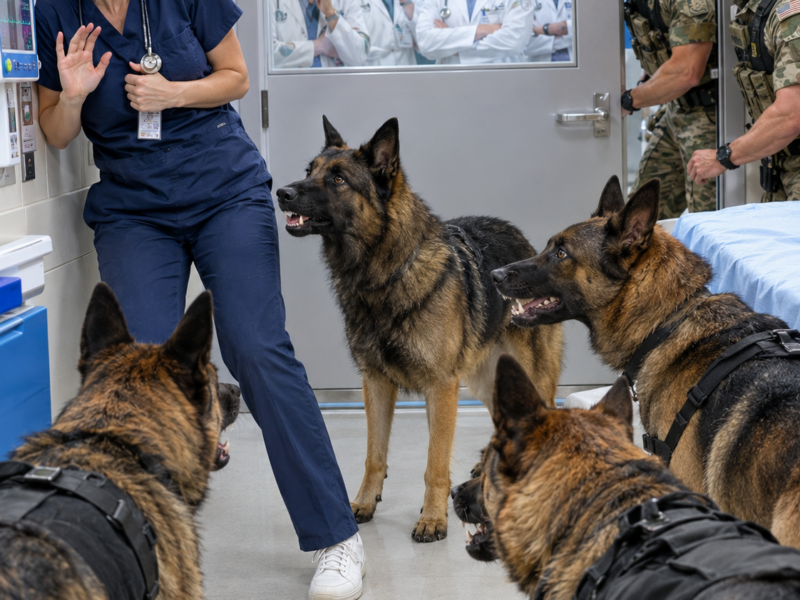
“I watched Dr. Nathan Cole lock the steel door behind me and leave me alone with four military attack dogs
The first thing I did was reach for the paper beneath the dog’s collar, but Dr. Nathan Cole stepped between us so quickly that all four German Shepherds lifted their heads at once.
“Don’t touch that,” he ordered.
His voice was sharp enough to make the room feel smaller.
I stood beside the largest dog, my fingers still resting against his thick neck. The animal had stopped growling. His amber eyes stayed fixed on me, and when Cole moved closer, the dog shifted his body between us.
Not attacking.
Protecting.
That frightened me more than his teeth ever could.
“Dr. Cole,” I said, keeping my voice level, “why is my name hidden under a military working dog’s collar?”
He glanced at the paper in my hand.
Then at the dog.
For one brief moment, the calm, controlled veterinarian disappeared. What remained was a man who looked as though a secret he’d buried years ago had just climbed out of the ground.
“Put it down, Captain Carter.”
I froze.
I had introduced myself as Dr. Emily Carter when I arrived at Fort Bragg that morning. My medical records listed me as a civilian veterinary specialist assigned to evaluate military working dogs with behavioral injuries.
I had never told him I once wore a uniform.
And I certainly hadn’t told him my former rank.
“Where did you hear that name?” I asked.
Cole didn’t answer.
Instead, he reached for the paper.
The black-and-tan Shepherd stepped forward, placing his broad chest against my hip. A low warning rolled through his throat.
Cole stopped.
The other three dogs watched him with an intensity that made the silence almost unbearable.
I unfolded the paper.
It was old, creased, and stained along one edge, as if someone had carried it through rain and then hidden it away for years. The handwriting was familiar enough to make my stomach tighten.
Six years earlier, I had served as a combat medic attached to a special operations unit overseas. During that deployment, a soldier named Daniel Hayes had disappeared after a mission went wrong.
The official report said he had died before the recovery team arrived.
There had been no body.
No final identification.
Only a closed investigation and a sealed envelope delivered to me weeks later.
Inside that envelope had been a single line from Hayes.
If anything happens, Emily, don’t believe the first report.
I had spent six years trying to understand what he meant.
Now his name was written on a scrap of paper beneath the collar of a military dog who looked at me as though he had been waiting for me to come home.
My hands began to shake.
“Where did you get this?”
Cole rubbed a palm across his mouth.
“You need to leave this room.”
“No.”
“Emily, listen to me.”
“You know my first name. You know my rank. You know something about Daniel Hayes. And you locked me in here with four dogs who are clearly responding to something you haven’t explained.”
I lifted the paper between us.
“Start talking.”
For a few seconds, Cole seemed to consider denying everything.
Then a sharp electronic beep sounded from the panel beside the door.
The lock clicked.
The door opened several inches.
A uniformed security officer appeared in the gap, his hand resting near his belt.
“Doctor, Colonel Whitaker wants the dogs moved to the assessment wing immediately. And he wants the new specialist escorted to administration.”
Cole’s face changed.
“Who authorized that?”
“Colonel Whitaker himself.”
The largest Shepherd pressed his muzzle against my hand.
I looked down at the faded medical tape still tucked beneath his collar. My name had been written there in block letters.
Not recently.
The ink had bled and faded with age.
Someone had put it there long before I arrived at Fort Bragg.
“What’s his name?” I asked.
Cole looked at the dog.
“Ranger.”
Ranger.
The name struck a memory I couldn’t quite reach. A photograph. A dusty transport vehicle. A handler laughing beside a dog with one torn ear.
Then I remembered the dog from the deployment photograph pinned inside Daniel Hayes’s locker.
The same scarred muzzle.
The same torn ear.
The same pale mark across the right shoulder.
I stared at Ranger.
“You were there,” I whispered.
Ranger leaned into me.
And for the first time in six years, I felt certain Daniel Hayes had not been forgotten by everyone.
I had barely stepped into the corridor when two security personnel approached from opposite directions.
Neither looked at me.
Both looked at Ranger.
“Ma’am,” the first officer said, “we need you to come with us.”
“Am I under investigation?”
“I’m not authorized to discuss that.”
“Then I’m not authorized to go anywhere without knowing why.”
Cole came out behind me and shut the door. The other three dogs remained inside, their nails clicking restlessly against the floor.
“She’s here to evaluate the animals,” he said. “She has done nothing wrong.”
The officer avoided his eyes.
“Those are Colonel Whitaker’s instructions.”
I knew that tone. I’d heard it in field hospitals, command tents, and rooms where officers wanted a decision to sound inevitable before anyone had a chance to question it.
I had also learned that a confident voice was not the same thing as a lawful order.
“Fine,” I said. “I’ll meet Colonel Whitaker. But Ranger stays with me until someone explains why his medical history has been concealed.”
The officer glanced at Cole.
Cole said nothing.
That silence told me more than a speech could have.
They escorted us to an administrative building on the opposite side of the veterinary complex. Ranger walked at my side without a leash, ignoring the officers’ attempts to redirect him. When one of them stepped between us, Ranger stopped and waited.
He never bared his teeth.
He didn’t need to.
Every time they tried to separate us, he planted himself firmly beside me.
Inside the building, the air smelled of floor polish and old coffee. Framed photographs lined the corridor: working dogs beside handlers, training teams in desert landscapes, smiling commanders at award ceremonies.
I stopped in front of one photograph.
It showed a group of service members gathered around a transport vehicle. A younger Daniel Hayes stood on the left, one arm resting on a German Shepherd.
The dog’s right ear was torn.
A pale scar crossed its shoulder.
Ranger.
I felt the floor shift beneath me.
“That’s him,” I said.
Cole stopped behind me.
“Where was this taken?”
“Forward operating base in Afghanistan. Six years ago.”
“Why wasn’t Ranger listed in the recovery report?”
Cole’s jaw tightened.
“Because the recovery report was changed.”
I turned toward him.
“By whom?”
Before he could answer, a door opened at the end of the corridor.
Colonel Whitaker stood inside a conference room, silver-haired and immaculate in his uniform. He was flanked by a staff officer carrying a folder and a woman in civilian clothes whose badge identified her as an investigator from the Army’s inspector general office.
Whitaker looked first at me, then at Ranger.
“Dr. Carter,” he said. “Come in. Leave the animal outside.”
Ranger moved closer to my leg.
“No,” I replied.
The colonel’s expression hardened.
“This is a command meeting.”
“And Ranger is evidence.”
The investigator’s eyes lifted at that word.
Whitaker noticed.
“Very well,” he said after a pause. “Bring the dog in. But I expect cooperation.”
I walked into the room.
There were three chairs on one side of the table and two on the other. A thick folder sat in front of Whitaker. My name was printed across the cover.
Beneath it were two words:
RESTRICTED REVIEW.
I remained standing.
“Before we begin,” I said, “I want to know why my personnel history is in a file at this installation when I was assigned here as a civilian specialist.”
The investigator introduced herself as Agent Melissa Grant.
“Your former service is relevant to an unresolved operational incident,” she said. “We are reviewing discrepancies in the records associated with Sergeant Daniel Hayes and the working dog now identified as Ranger.”
“Then you should know Hayes was reported dead.”
“Yes.”
“You should also know I was never shown physical evidence confirming that.”
Whitaker opened the folder.
“His status was determined through the proper chain of command.”
“His status was determined on paper.”
The colonel looked at me as if I had insulted him.
“Be careful, Doctor.”
I met his gaze.
“I have spent six years being careful. It hasn’t brought me one honest answer.”
Agent Grant raised a hand before Whitaker could respond.
“We are not here to debate your conduct during the original deployment. We are here because an internal audit found that several pages of the recovery record were replaced after the mission. The dog’s medical file was also transferred between units without the required documentation.”
I glanced at Ranger.
He had settled beside my chair, but his attention remained on the folder.
“What do the missing pages say?”
“We don’t know yet,” Grant answered. “The original records were removed from the archive.”
“Removed by whom?”
“We are investigating that.”
Whitaker closed the folder.
“This meeting is intended to establish whether the animal has any remaining operational value and whether Dr. Carter’s personal connection creates a conflict of interest.”
I almost laughed.
“You locked me in a room with four military dogs without explaining why one carried my name under his collar. Now you’re suggesting I’m the problem because I recognize him?”
“I did not order you locked in that room,” Whitaker said.
I turned toward Cole.
He looked down at the table.
There it was again.
The silence that had followed every question since I arrived.
“Doctor?” I asked.
Cole inhaled slowly.
“I was instructed to conduct a behavioral assessment under controlled conditions. I was told Ranger had become unpredictable around unfamiliar personnel.”
“And you were told to put me in the room with him?”
“Yes.”
“Knowing he might react to me?”
Cole looked at Whitaker.
“I was told she had no prior connection to the animal.”
Agent Grant’s expression changed.
“Who told you that?”
Cole hesitated.
“Colonel Whitaker’s office.”
For the first time, Whitaker looked genuinely angry.
“You are making a serious accusation.”
“I’m answering a direct question,” Cole replied.
Grant wrote something in her notebook.
I looked back at the colonel.
“Why did you want to see whether Ranger recognized me?”
He said nothing.
Then Ranger rose.
He walked toward the conference table, sniffed the folder, and nudged its lower edge with his nose.
The folder slid several inches.
A photograph slipped out.
It landed faceup in front of me.
The picture showed Daniel Hayes standing beside Ranger in front of a concrete building. Hayes was smiling, but his left arm was bandaged. Behind him, a military transport vehicle sat with its rear doors open.
Someone had written a date on the back.
Three days after the mission on which the official report claimed he had died.
I picked it up.
My breath caught.
“This photograph was taken after the recovery operation.”
Whitaker reached for it.
I pulled it back.
Agent Grant leaned across the table.
“Let me see that.”
I handed it to her.
She studied the date, then turned the photograph over again.
“Where did this come from?”
“No idea,” Whitaker said.
But he answered too quickly.
Cole finally looked directly at me.
“Ranger came to this facility two years ago. He was transferred under a different identification number. His medical history was incomplete, and his handler’s information had been removed.”
“Why didn’t you report it?”
“I did. The request was returned with an instruction to classify the discrepancy as an administrative error.”
“Who signed the instruction?”
Cole’s eyes moved to the colonel.
Whitaker pushed his chair back.
“This discussion is over.”
“No,” Agent Grant said.
Her voice was quiet, but it stopped him.
“As the inspector general representative conducting this review, I am requesting that you remain available for questioning. No records are to be moved, altered, or destroyed until the review is complete.”
Whitaker stared at her.
“You have no authority to restrict a commander’s access to routine operational records.”
“I have authority to preserve evidence related to a suspected alteration of official records.”
The colonel stood.
“Then preserve whatever you like.”
He walked out without taking the folder.
The door shut behind him.
For several seconds, nobody spoke.
Then Agent Grant looked at me.
“Dr. Carter, I need you to tell me everything you remember about Daniel Hayes. Every detail, even if it seemed insignificant at the time.”
I sat down.
Ranger lowered his head onto my boot.
And I began.
Six years earlier, I had been attached to a special operations medical team supporting a joint mission in Afghanistan. Daniel Hayes was a staff sergeant, a communications specialist, and Ranger’s handler.
He was the sort of man who remembered everyone’s birthday but never mentioned his own. He carried spare medical supplies for the local children and kept a notebook filled with small observations about the people he met.
He trusted very few officers.
He trusted Ranger completely.
Three nights before the mission, Hayes had come to the medical tent with a deep cut across his palm.
He claimed he had caught it on a broken radio casing.
While I cleaned the wound, he watched the entrance flap.
“Emily,” he said, “if somebody asks you to sign a report you didn’t witness, don’t do it.”
I told him I would never do that.
He shook his head.
“You’d be surprised what people call routine when they want it done fast.”
I asked what was happening.
He said he had found discrepancies in a set of mission coordinates. A planned evacuation route had been changed in a way that placed a local support team outside the designated safety perimeter.
He had reported the issue.
Someone had closed the complaint.
Then the mission took place.
The communications link failed shortly after the team reached its objective. A secondary extraction point was used, and the unit returned with casualties. Hayes and Ranger were listed among those missing during the withdrawal.
I was ordered to prepare a casualty summary from information relayed by the command post.
The report said Hayes had sustained fatal injuries before the recovery team arrived.
I refused to certify the cause of death because I had not examined him.
A senior officer told me the paperwork needed to be completed before the next operational briefing.
I refused again.
Two days later, I was reassigned.
The official explanation was that the unit no longer required my medical support.
Weeks afterward, I received the envelope containing Hayes’s note.
Then the investigation closed.
Agent Grant listened without interrupting.
When I finished, she placed the photograph beside the old paper from Ranger’s collar.
“The date on this picture is significant,” she said. “If it’s authentic, it suggests Hayes was alive after the report placed him among the dead.”
“Can you find him?”
“We can try.”
“That’s not an answer.”
“No,” she admitted. “It isn’t.”
She explained that the audit had been triggered by a separate review of working-dog transfers. Ranger’s identity had appeared in two different databases under different service numbers. One record described him as a retired dog with a chronic shoulder injury. The other listed him as an active asset assigned to a restricted program.
Both records had been signed by officers whose names appeared in the old mission paperwork.
The trail led back to the same administrative office.
Whitaker’s office.
“Why bring me here now?” I asked.
Grant considered her answer.
“Someone requested an assessment of Ranger’s behavior around you. The request came through a channel that concealed your prior service history from the clinical team. When you arrived, the person who approved the assessment expected the dog to react badly enough that you would be removed from the facility.”
“Why?”
“We believe they were testing whether Ranger remembered you.”
I looked at Ranger.
He was watching me calmly.
“And if he did?”
“Then someone would know that the original mission records might not be the only evidence that survived.”
The room suddenly felt colder.
“What evidence?”
Grant closed the folder.
“We haven’t established that yet.”
I was tired of people hiding behind careful words.
“Then let me help you find it.”
She hesitated.
“You are personally connected to the incident. That makes your involvement complicated.”
“I’m also a veterinarian who can assess Ranger without frightening him, and I’m one of the few people who knew Hayes before the mission. If the dog has a medical issue connected to his old injuries, I can document it.”
Grant studied me for a long moment.
“Any examination will be supervised. You won’t access restricted files, and you won’t question personnel on your own.”
“Agreed.”
“And if you find anything that suggests an immediate threat, you report it to me.”
“I will.”
She looked down at Ranger.
“Then start with the dog.”
The first examination took place in the veterinary wing under observation. I kept the room quiet and allowed Ranger to approach the examination table in his own time.
The other three Shepherds had been moved to an adjacent holding area. They were restless without him, barking whenever someone passed the door.
Ranger, however, remained composed.
I checked his ears, eyes, teeth, gait, and old shoulder injury. He had a thick scar beneath his right foreleg, partly hidden by fur. The skin around it was unusually sensitive.
When I palpated the area, he flinched.
“Easy,” I murmured. “I’m not going to hurt you.”
He leaned his head against my arm.
I remembered treating him in Afghanistan after a piece of shrapnel had cut into his shoulder. Hayes had sat beside the treatment cot all night, refusing to sleep until Ranger could stand.
Back then, Ranger had been younger, faster, and impatient with anyone who tried to examine him without Hayes nearby.
Now he was older.
But his eyes were the same.
I parted the fur around the scar and found a small, hard object beneath the skin.
It wasn’t a fragment of metal.
It was a sealed capsule, no longer than the tip of my little finger, embedded in an old pocket of scar tissue.
I stopped breathing for a moment.
“Agent Grant,” I called.
She came to the table with a gloved hand extended.
“Don’t remove it yet,” she said. “Let’s document its location and have imaging confirm what it is.”
The scan showed a small capsule surrounded by fibrous tissue. It had been placed beneath the skin during an earlier procedure, then left in place as the wound healed.
It was not part of any standard veterinary implant.
The clinic’s records contained no reference to it.
Grant authorized a controlled removal after the medical team confirmed that leaving it in place posed a risk of further inflammation.
When the capsule was opened in a secure room, it contained a tiny memory card wrapped in protective film.
For a long moment, I stared at it.
Hayes had once joked that Ranger could carry secrets better than any human on the team.
I had thought it was one of his dry, private jokes.
Now the memory card sat on the table between us.
The military digital forensics team copied its contents without connecting the original card to a networked computer. The files were damaged, but several fragments could be recovered.
The first was a short audio recording.
Hayes’s voice came through the speaker, rough and distant.
“If you’re hearing this, the original extraction log was altered. The coordinates were changed before the mission, and the change was approved by someone who knew the backup route would fail.”
A second voice asked him a question.
The recording crackled.
Then Hayes continued.
“I copied the approval chain. I also kept the transmission record. If the report says I died before recovery, that’s not what happened.”
The recording ended.
Nobody in the room moved.
I gripped the edge of the table so tightly my fingers hurt.
Agent Grant asked the forensic specialist to preserve the file and create a verified copy.
“Can you recover the rest?”
“We’ll try,” he said. “There are additional fragments, but the card is damaged.”
The next file was a scanned document.
It contained a set of mission coordinates, a timestamp, and an authorization signature. The digital record indicated that the route had been changed after the original plan was approved.
A second document showed that the change had been acknowledged by an officer in the command chain.
A third file contained a handwritten list of names.
Some belonged to personnel who had been on the mission.
One belonged to a communications officer who had died during the operation.
Another was the name of a contractor whose role had never appeared in the official summary.
At the bottom was a final note from Hayes:
If they say I was dead before the recovery team arrived, check the transport log. I was moved alive.
I read the sentence twice.
Moved alive.
The words were plain.
They offered no explanation of where he had gone or why he had been hidden.
But they shattered the one fact I had spent six years trying to accept.
Daniel Hayes might still be alive.
Grant ordered an urgent review of transport records from the day of the mission. The original logs were incomplete, but a secondary fuel and vehicle maintenance record showed that an unlisted transport had left the forward operating base several hours after the official recovery operation.
Its destination had been recorded as a medical transfer point.
The receiving facility had no corresponding admission record.
A separate signature approved the vehicle’s departure.
It belonged to an officer who had later worked in Whitaker’s administrative chain.
Grant did not accuse anyone on the basis of one document.
She requested independent verification, interviewed the personnel who maintained the old transport records, and arranged for the evidence to be reviewed by investigators outside the installation.
It took two days for the first confirmation to arrive.
The transport had existed.
The vehicle number was genuine.
The route had been altered in the records after the fact.
The driver, now retired, was located and interviewed.
He remembered carrying an injured service member whose identity he had been told not to enter in the main log. He remembered a working dog in the vehicle, too, although he could not be certain whether it had been Ranger.
He had been instructed to take the patient to a temporary medical facility outside the normal chain of evacuation.
He had never been told what happened afterward.
When Grant told me, I had to sit down.
“Did he recognize Hayes?”
“He remembers a man with a facial injury and a bandaged left arm. He can’t identify him with certainty.”
“But he remembers the transfer.”
“Yes.”
“Then Hayes could have survived.”
“He could have.”
I looked through the observation window at Ranger.
The dog had been lying beside his water bowl. When I entered, he rose immediately and walked toward me.
I knelt.
“Did you stay with him?” I whispered.
Ranger pressed his nose to my shoulder.
I buried my face against his fur, and the tears came before I could stop them.
For six years, I had carried a quiet guilt that no one had ever officially assigned to me. I had wondered whether I should have pushed harder, whether I should have refused the reassignment, whether I should have followed the trail after the envelope arrived.
Now I understood that I had not been the only person searching.
Hayes had left a trail.
Ranger had carried part of it.
And someone had spent years trying to make sure neither one could lead anyone back to the truth.
That evening, Agent Grant received a call from the external review team.
The recovered files had been matched to an archived transmission record held outside the installation. The signature on the altered route approval was authentic. The timeline showed that the change had been authorized before the mission, not improvised during the emergency.
The same approval chain had later authorized the removal of the original recovery pages.
The evidence did not yet establish why the route had been changed, or who had ultimately benefited. But it was enough to reopen the investigation into the mission and the handling of Hayes’s status.
It was also enough for Grant to request that Whitaker surrender his access to the relevant records while the review continued.
He refused at first.
Then he was informed that the request had been approved by higher headquarters.
By the following morning, his access to the archive had been suspended.
He was not arrested, and nobody announced that he was guilty. The investigation was still underway, and the evidence had to be tested properly.
But for the first time, the records were no longer under his control.
Cole found me in the veterinary wing after the news came through.
He looked exhausted.
“I owe you an apology,” he said.
I continued checking Ranger’s medication chart.
“Yes, you do.”
“I should have told you what I knew.”
“You should have refused to lock me in a room without explaining why.”
“I thought if I followed the order, I could keep an eye on the situation and protect the dogs.”
“You could have reported the order.”
He lowered his eyes.
“I was afraid I’d lose my position. I spent years trying to build a program that gives injured working dogs a chance to recover instead of being discarded. Whitaker controlled the funding and the transfers. I told myself I could do more good by staying quiet.”
I finally looked at him.
“That’s how people end up protecting the wrong thing.”
He nodded.
“I know.”
He told me that he had noticed irregularities in Ranger’s records months earlier. He had requested a full medical history, but the request was denied. When he asked why the dog had two identities in the system, he was instructed to treat it as a clerical problem.
Then the order came to evaluate Ranger with a new specialist.
The request had been marked routine.
The attachment containing my personnel history had been visible to the command office but withheld from the veterinary team. Cole had been told that I was unfamiliar with the dog and that Ranger’s reaction would determine whether he could remain at the facility.
He had suspected the assessment was designed to produce a particular outcome.
He had followed the order anyway.
“I can’t undo what I did,” he said. “But I’ll give Agent Grant every record I have.”
“Good.”
“And I’ll cooperate with the investigation.”
“Good.”
He glanced toward Ranger.
“Do you think Hayes is alive?”
I ran a hand along the dog’s neck.
“I think someone went to extraordinary lengths to prevent us from knowing what happened to him.”
That was all I could honestly say.
The next week was filled with interviews, medical examinations, document authentication, and long hours reviewing fragments of the recovered files. The investigation moved slowly, not because the evidence was unimportant, but because every conclusion had to survive scrutiny.
A name in a document was not proof of a crime.
A missing page was not proof of a cover-up by itself.
But the pieces kept aligning.
The altered coordinates had placed the team on a route that was more vulnerable than the approved alternative. The transmission log showed that Hayes had raised the concern before the mission. The recovery report had been changed after the fact. A transport carrying an unidentified injured service member had left the base outside the normal evacuation system.
And a working dog had carried a concealed memory card containing a record of the altered approval chain.
The external review team identified several people who had handled the documents. Some had been following instructions without knowing the full context. Others had signed records they later admitted they had not personally verified.
One former officer acknowledged that he had been told to classify Hayes as deceased for administrative purposes while a sensitive inquiry was conducted.
He claimed he had believed the status would be corrected once the inquiry ended.
It never was.
Investigators continued examining who had issued that instruction and why.
For me, the most difficult part was not learning that the official record had been altered.
It was realizing how easily a person’s life could disappear inside a sequence of forms, signatures, and reassigned responsibilities.
Hayes had not been reduced to a missing name because one person made one decision.
He had been erased a little at a time.
Every unanswered question had been passed to another desk.
Every missing document had been described as an administrative problem.
Every person who knew a fragment of the truth had been given a reason to stay quiet.
Until the dog refused to forget.
Ranger’s recovery took longer than expected. His old shoulder injury required treatment, and the inflammation around the capsule had left him sore. I arranged a rehabilitation plan that included controlled exercise, pain management, and quiet time away from the training areas.
The three other Shepherds were eventually brought back into the same assessment program. Their records also contained gaps, though none appeared to be connected to Hayes’s case.
They were not evidence of a larger conspiracy simply because they had been in the room.
They were dogs who deserved care.
That mattered to me.
I refused to let the investigation turn them into props in a story about officers and secrets. They were working animals with their own histories, their own injuries, and their own needs.
One afternoon, while Ranger rested on a padded mat, I noticed the old medical tape beneath his collar had begun to peel.
I carefully removed it and placed it in a labeled evidence sleeve.
The faded letters were still visible.
EMILY CARTER.
I wondered who had written them.
Hayes, perhaps.
Or someone who had helped him protect the card.
The evidence team found traces of adhesive and fabric fibers consistent with a field medical kit, but there was no way to establish who had applied the tape.
I kept a photograph of it in my personal notes.
Not as proof.
As a reminder.
A few days later, Agent Grant asked me to attend a briefing with the external review team. She had received a verified copy of a medical transfer index from a facility that had operated near the route the driver described.
The index contained a temporary patient number.
The patient had arrived with a severe injury, no standard identification documents, and instructions that his details be restricted to a small medical team.
The record had been archived under a provisional name.
The date matched the transport log.
A second document described a working dog transferred with the patient.
The dog was later recorded as evacuated separately.
The name on that record had been obscured, but the service number matched one of Ranger’s older identifiers.
I gripped the table.
“Do we have a name for the patient?”
Grant looked at the review officer beside her.
“We have a likely match. We don’t yet have a confirmed identity.”
“Who is it?”
The officer slid a page across the table.
The provisional name was unfamiliar.
But the physical description matched Hayes.
The listed injuries matched the driver’s account.
And a notation in the margin referenced a small scar across the patient’s left thumb.
Hayes had a scar there from a training accident years before our deployment.
I closed my eyes.
“Where did they send him?”
“The transfer record indicates he was moved again after stabilization. The receiving institution has since closed. Its archived files are being retrieved.”
“Can you trace the next transfer?”
“We are trying.”
I wanted to demand an answer.
I wanted to insist that a person could not simply be moved through the system without someone knowing where he had gone.
But I had seen enough to understand the difference between a question and an answer, between a lead and a verified conclusion.
So I waited.
Not passively.
I provided every detail I remembered. I signed statements. I reviewed photographs. I helped document Ranger’s injuries and behavior. I cooperated with investigators who asked the same question in different ways because they needed the record to be precise.
And I kept Ranger close.
Three weeks after I arrived at Fort Bragg, I was called to the administrative building again.
This time, the door was open.
Agent Grant stood by the window with a folder in her hands. Cole was seated at the table. No security officers waited in the corridor.
Grant looked at me as I entered.
“We have a development.”
My heart began to pound.
“The archive from the second facility has been recovered,” she said. “The patient was transferred again after his initial treatment. The paperwork includes a photograph and a fingerprint record.”
She placed the photograph on the table.
It showed a man sitting upright in a hospital bed. His hair was shorter than I remembered. There was a scar near his temple, and his left arm rested in a sling.
But I recognized his eyes.
Daniel Hayes.
Older.
Thinner.
Alive in the photograph.
I covered my mouth.
“When was this taken?”
“Eight months after the mission.”
I could barely speak.
“Where is he now?”
“The institution’s records show that he was released into a protected medical relocation program. The program’s files are being reviewed. We have not yet confirmed his current location.”
“Why would he be placed in a relocation program?”
“We don’t know whether the decision was made for his protection, to conceal his status, or for some combination of reasons. The record does not answer that.”
I looked at the photograph again.
Hayes had survived.
That was no longer a theory.
It was documented.
But the truth was still incomplete. We didn’t know who had ordered his transfer, whether he had been told his official status, or whether he knew that his family and former teammates believed him dead.
Grant slid another page across the table.
It contained a brief note entered months after the photograph.
The patient had asked whether his working dog had survived.
The answer recorded in the file was unclear.
I pressed the page to my chest.
“He was looking for Ranger.”
“Possibly,” Grant said gently. “We can’t know from this note alone.”
I wiped my eyes.
“Can we contact him?”
“Not yet. The relocation program’s records are restricted, and we need to establish the proper legal channel. We also need to make sure that contacting him won’t place him at risk.”
I hated the delay.
But for the first time, I understood that waiting could be an act of care rather than surrender.
If Hayes had been hidden to protect him, rushing toward him without understanding the circumstances could do more harm than good.
So I agreed to let the investigators proceed carefully.
The weeks that followed brought consequences, though not the dramatic kind people expect from a story about a secret buried inside the military.
There were no public confessions in a crowded room.
No single announcement that explained every unanswered question.
Instead, access was suspended, records were secured, and officers were interviewed under formal procedures. The review expanded to examine how the mission’s coordinates had been changed and how the recovery documentation had been altered.
Colonel Whitaker was removed from his administrative duties pending the investigation. His decisions were reviewed by authorities outside the installation.
Dr. Cole was also formally questioned about the assessment order and his failure to disclose the information he had received. He cooperated, submitted his records, and accepted responsibility for the choices he had made.
He did not ask me to defend him.
I respected that.
The investigation did not prove that every person who had handled Hayes’s file intended to conceal a crime. Some had made careless decisions. Others had followed instructions without asking enough questions. A smaller number appeared to have known that the records did not tell the full story.
The difference mattered.
Accountability had to be based on evidence, not anger.
And anger, I discovered, was something I had carried for six years without realizing how much of my life it occupied.
One quiet morning, I took Ranger to an open training field after his rehabilitation session. The grass was damp, and the air held the sharp smell of pine.
He walked beside me without pulling on the leash.
At the far end of the field, a handler was practicing recall with one of the younger Shepherds. The dog raced toward him, ears lifted, tail moving in a wide arc.
Ranger watched them.
Then he looked at me.
I unclipped his leash inside the secured exercise area.
He didn’t run.
He stood beside me, taking in the open space as if he had forgotten what it felt like to have nowhere he was required to be.
“You’re allowed to rest now,” I told him.
He leaned against my leg.
I thought of Hayes sitting beside his cot in Afghanistan, one hand resting on Ranger’s chest, promising the dog he would be back before the next sunrise.
I thought of the paper under the collar.
If she ever comes back, don’t let them take her away again.
At first, I had believed the note was about me.
Now I wondered whether it had been a message to the dog as much as a warning to anyone who might separate us.
Perhaps Hayes had known that Ranger would remember the people who had cared for him.
Perhaps he had hoped the dog would lead someone back to the truth if he couldn’t.
I couldn’t know for certain.
But I no longer needed every question to have an immediate answer before I could take the next step.
A month after the investigation began, Agent Grant called me into her office.
She had a secure message from the team coordinating the search for Hayes.
The relocation records had finally produced a current lead. An individual matching Hayes’s identity had been located at a rehabilitation center in another state. His legal status was being verified, and a medical liaison had confirmed that he was stable enough to receive a carefully arranged contact request.
I stared at her.
“Does he know I’m looking for him?”
“We don’t know. The liaison has asked him whether he wishes to receive a message from a former colleague. He has not yet answered.”
I nodded, although my chest ached.
“Then we wait for his answer.”
Grant’s expression softened.
“You don’t have to wait alone.”
I thanked her.
That evening, I sat with Ranger in the quiet rehabilitation room. He rested his head across my knees while I read the message again.
No promises.
No guarantee.
Just a lead and the possibility of a choice.
I had spent years imagining what I would say if I ever found Hayes. I had rehearsed apologies for not searching harder and questions about what happened after the mission.
Now that the possibility was real, none of those words seemed important.
I wanted to tell him that Ranger had survived.
I wanted to tell him that the truth was finally being examined by people who could not quietly return it to the same desk.
Most of all, I wanted him to know that he had not been forgotten.
Two days later, the liaison sent a response.
Hayes had agreed to receive a message.
I wrote it myself, then read it aloud before sending it.
Daniel, it’s Emily. Ranger is alive. He’s safe, and he’s receiving treatment. I found the record you left behind, and the mission investigation has been reopened. You don’t have to explain anything before you’re ready. I only want you to know that someone finally heard you.
I stopped there.
I didn’t ask him to come home.
I didn’t ask him to forgive me.
I didn’t ask him to fill the empty spaces in my memory.
Those choices belonged to him.
A week later, a secure video call was arranged through the medical liaison.
I entered a small private room with Ranger beside me. The camera was already on. The connection took several seconds to stabilize.
Then a man’s face appeared on the screen.
Daniel Hayes looked older than the man I remembered, but his eyes were unmistakable.
For a long moment, neither of us spoke.
Then his gaze moved downward.
“Ranger?”
I turned the camera toward the dog.
Ranger’s ears lifted.
He stared at the screen, head tilted, then let out a soft, uncertain whine.
Hayes pressed his fingers to his mouth.
“Oh, buddy.”
The dog moved toward the screen, sniffing at the edge of the monitor as if scent could cross the distance.
Hayes laughed once, and the sound broke into a sob.
I had imagined this moment for six years.
In none of those imaginings had I understood how quiet it would be.
“Daniel,” I whispered.
He looked back at me.
“Emily.”
My name in his voice brought the old world rushing forward: the medical tent, the dusty roads, the endless radio chatter, the night he had warned me not to trust a report I hadn’t witnessed.
“I thought you were dead,” I said.
“I know.”
“Why didn’t you contact me?”
He looked away.
“I tried, at first. I wasn’t in a position to contact anyone safely. After the first transfer, I was told my status was being handled through a restricted review. I believed it would be temporary.”
“Did you know the official report listed you as dead?”
“I found out later.”
His expression tightened.
“By then, I couldn’t tell who knew I was alive and who thought they were protecting me. I was injured, and I had no access to the original records. I didn’t know whether contacting the people I trusted would put them in danger.”
“Did you know Ranger had been transferred?”
“I was told he was evacuated. After that, every request for information went nowhere.”
He looked at the dog again.
“I thought I’d lost him, too.”
Ranger made another soft sound.
Hayes wiped his face.
“I left the card with him because I couldn’t carry it through the transfer. I knew the wound would be treated, and I hoped someone would notice the capsule. I asked the medical team to mark him with your name because I thought you might be the one person who would recognize him.”
I felt tears rise again.
“You knew I might come here?”
“I didn’t know where they’d send him. I didn’t know where you’d be. I only knew that if the card survived, someone would need to connect it to the mission. You were the person I trusted to look at the records and ask why they didn’t make sense.”
I looked at Ranger.
“So you gave him a message.”
“I gave him the best chance I could.”
Hayes paused.
“And I’m sorry.”
“For what?”
“For leaving you with a report that didn’t make sense. For not being able to tell you I was alive. For letting you believe you should have done more.”
I shook my head.
“I spent years thinking I had failed you.”
“You didn’t.”
His answer came without hesitation.
“You refused to sign something you hadn’t witnessed. You asked questions when everyone wanted you to stop. That’s why I left the card with Ranger. I knew you wouldn’t dismiss it just because someone important told you to.”
I couldn’t speak for several seconds.
Finally, I said, “The investigation is moving. They have the transport records and the altered route approval. They’re reviewing everything independently.”
“Good.”
“Do you want to participate?”
He took a long breath.
“Yes. When my medical team says I’m ready, I’ll give a statement. I want the record corrected. I want the people who were hurt by that mission to have the truth.”
He glanced at Ranger.
“And I want to see him in person.”
“We’ll make that happen when it’s safe and medically possible.”
For the first time, his expression held something other than pain.
“Thank you, Emily.”
I looked down at the dog, whose head rested against my knee.
“You don’t have to thank me. Ranger did most of the work.”
Hayes smiled.
“He always was better at finding his way home.”
The call ended only after the liaison reminded us that the first contact needed to remain brief. It was not a reunion, not yet. There were still questions about the original mission, and Hayes would need time before he could safely return to public life.
But the call had changed everything.
The truth no longer existed only in damaged files and faded notes.
It had a voice.
It had a face.
And it had a future.
In the months that followed, Hayes gave a formal statement through the proper investigative channels. His account was compared with the recovered transmission, the transport records, and the archived medical documentation.
The review established that the mission route had been changed through an improper approval process and that the recovery record had been altered afterward. The inquiry also confirmed that Hayes had survived the initial operation and had been transferred through a restricted medical chain that was never properly reconciled with his official status.
Some questions remained unresolved. Investigators continued examining who had authorized each decision and why the records had been kept incomplete for so long.
But the central lie could no longer stand.
Hayes was alive.
His official record was corrected.
The inquiry into the mission continued beyond the installation, and the officers responsible for the documented misconduct faced formal administrative and legal review. The findings were not reduced to a single convenient villain; they identified the specific decisions, signatures, and failures that had allowed the false record to endure.
Cole’s assessment practices were reviewed, too. He completed additional oversight training and remained involved in the rehabilitation program, but he no longer controlled transfers without independent review. He told me later that he had learned a difficult lesson about obedience.
“I used to think following an order protected the people under my care,” he said.
“And now?”
“Now I know that sometimes the first responsibility is to ask whether the order is putting them at risk.”
I nodded.
“That would have helped us a lot sooner.”
He accepted the words without arguing.
I did not become his friend overnight. Trust, like a damaged tendon, does not heal because someone finally admits the injury exists. But I saw him make different choices after that day, and I allowed those choices to count.
As for Ranger, he regained his strength slowly. His shoulder would always carry the old scar, but he could walk comfortably and enjoy short sessions in the training field.
His service record was restored under his correct identity.
His medical history was rebuilt from every surviving document.
And his future was no longer decided by an incomplete file.
When Hayes was finally cleared for an in-person visit, the meeting took place at a quiet rehabilitation facility with medical staff nearby.
I arrived early with Ranger.
The dog paced at my side, occasionally looking toward the entrance. I could feel his anticipation through the leash.
When Hayes came through the door, he walked slowly, leaning on a cane. His face was thinner than it had been in the photograph, and his left arm still moved stiffly.
But he was there.
Ranger stopped.
For a moment, the two of them simply stared at each other.
Then Hayes whispered, “Come here, buddy.”
Ranger crossed the room.
He didn’t jump or bark. He pressed his muzzle against Hayes’s hand and stood perfectly still as Hayes lowered himself into a chair.
Hayes wrapped both arms around the dog’s neck.
“I thought I’d never see you again.”
Ranger leaned his whole body against him.
I turned away to give them a moment, but Hayes reached for my hand.
“Stay.”
So I stayed.
We sat together for a long time, speaking in fragments. Hayes asked about Ranger’s treatment. I told him about the scar tissue, the capsule, and the way the dog had protected me when Cole approached.
Hayes shook his head with a tired smile.
“He always knew who needed help.”
I told him about the four dogs in the assessment room, how the other three had watched Ranger, and how none of them had behaved the way the initial report described.
“They weren’t dangerous,” I said. “They were frightened and confused. Someone had mistaken fear for aggression.”
Hayes looked at Ranger.
“That’s easy to do with people, too.”
We talked about the investigation only when he was ready. He gave me details I hadn’t known about the mission, including the moment he realized the route change had been approved before the team deployed.
He had copied the transmission record because he feared the discrepancy would disappear. When the mission went wrong, he was injured during the withdrawal and moved to the temporary medical facility without standard identification.
He had not understood the full reason for the restricted transfer. At first, he believed it was part of a protective process while the mission was investigated. As the months passed, the explanations became less clear.
His attempts to obtain information about Ranger and his former unit were repeatedly redirected.
Eventually, he stopped trusting the official channels.
He had not known whether I was being watched or whether my questions had drawn attention to me. He had no proof that contacting me would help rather than harm.
“I should have found a way,” he said.
“Maybe,” I answered. “But we can’t judge every decision you made while you were injured, isolated, and being told that your safety depended on staying quiet.”
He looked down at his hands.
“I don’t know how to stop feeling like I abandoned everyone.”
I understood that feeling more than I wanted to admit.
“You were hurt. You were kept away from the people who could help you. And you survived something that should never have happened. You don’t have to turn surviving into another thing to apologize for.”
He was quiet.
Then he nodded, once.
It wasn’t forgiveness for everything that had happened.
It was a beginning.
As the visit ended, Hayes rested his hand on Ranger’s head.
“I think he’s ready to retire.”
Ranger’s ears twitched at the word.
I smiled.
“He’s earned it.”
The retirement process took several weeks. The medical team confirmed that Ranger was no longer suited for demanding operational work, though he remained alert, responsive, and comfortable in familiar environments.
Hayes requested to become his permanent handler again, subject to the required medical and housing approvals. The request was reviewed carefully, not as a sentimental reward but as a decision about the welfare of both man and dog.
It was approved.
On the day Ranger left the installation, I walked with Hayes to the transport vehicle. The dog wore a simple collar without hidden compartments, concealed tags, or anything that belonged in a restricted file.
His name was clearly engraved on the identification plate.
RANGER.
Below it was Hayes’s contact information.
Nothing secret.
Nothing missing.
Hayes opened the passenger door and helped Ranger climb inside. The dog turned once, looking back at me.
I knelt beside him.
“You did good,” I whispered.
He pressed his nose to my cheek.
Then he settled beside Hayes.
As the vehicle pulled away, I stood in the sunlight and watched until it disappeared beyond the gate.
I had come to Fort Bragg believing I was there to evaluate four military dogs.
I left understanding that the most important thing I had examined was not an animal’s behavior, but a system’s willingness to call silence normal.
Ranger had been locked in a room with a veterinarian he hadn’t seen in years.
He had been described as unpredictable.
His history had been divided across conflicting records.
Someone had assumed that a scarred dog would be easier to dismiss than a soldier whose name refused to stay buried.
They were wrong.
He remembered.
And because he remembered, the truth had found a way through.
I continued working with military and retired working dogs, especially those whose medical histories had been disrupted by transfers or incomplete documentation. I made sure each file was reviewed carefully and every unexplained gap was documented rather than waved away.
I also stayed in contact with Hayes.
His recovery was uneven. Some days he spoke easily about the past; other days, he preferred to discuss ordinary things. We learned not to treat every conversation as an opportunity to reopen the mission.
Sometimes he sent me photographs of Ranger sleeping in the sun.
Sometimes I sent him updates about the other dogs.
Sometimes neither of us had anything important to say, and we talked anyway.
The investigation continued through the formal channels, with evidence preserved and findings reviewed independently. It could not return the years Hayes had lost or erase the uncertainty his family had endured. It could not make every decision understandable.
But it could correct the record.
It could identify failures.
It could prevent a false report from being treated as the final word simply because it had been stamped, filed, and repeated often enough.
I kept the original note from Ranger’s collar in a secure evidence archive, where it belonged.
I kept a copy of the photograph of Hayes and Ranger in my office.
And I kept the lesson that had taken me six years to learn.
A uniform does not make a person honest.
A report does not make a story true.
And silence is not proof that nothing happened.
The morning after Ranger retired, I received a photograph from Hayes. Ranger lay stretched across a patch of sunlight on the floor, one ear folded awkwardly, his scarred shoulder rising and falling with each peaceful breath.
Beneath the photograph, Hayes had written:
He finally sleeps without listening for the next order.
I read the message twice.
Then I looked out the window at the training field, where the younger dogs were beginning their morning work.
I thought about the room where I had first seen Ranger again, the locked door, the hidden note, and the moment he had stepped between me and a man who wanted the truth to remain buried.
I had entered that room as a veterinarian expected to judge a dog’s behavior.
I had walked out carrying the beginning of an answer to a question that had haunted me for six years.
Ranger had never needed to explain himself.
He had only needed someone to notice that the story written about him did not match the animal standing in front of them.
And when the moment came, he had done what he had always done.
He protected the person who needed him.
This time, he had helped protect the truth, too.
THE END.









