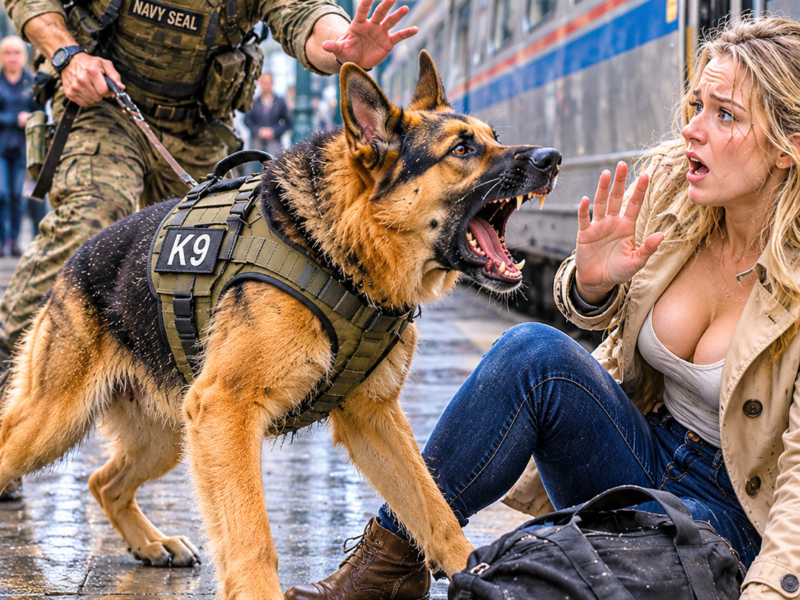
“I was three steps from boarding the Amtrak train at Union Station when a Navy SEAL’s German Shepherd lunged across the platform
Daniel didn’t move.
Neither did the man in the gray coat.
For several seconds, they stared at each other across the crowded station while travelers continued dragging suitcases past them, completely unaware that something from an eleven-year-old military operation had just walked into Union Station.
I looked from Daniel to the stranger.
His hair was almost completely gray now, and he had a slight limp.
But I recognized his face.
I had seen it in the photograph beside my brother.
“That’s Colonel Richard Lawson,” I whispered.
Daniel’s hand tightened around his radio.
“Former Colonel Lawson.”
“Former?”
“He was declared dead during the same operation your brother disappeared.”
The man in the gray coat took another step toward us.
Ranger immediately moved in front of me.
His ears stood straight up.
He wasn’t barking, but every muscle in his body had tightened.
“Daniel,” the stranger called.
His voice was calm.
Almost friendly.
“You’re making a scene.”
Daniel stepped between him and me.
“Stay where you are, sir.”
Lawson glanced at the dog.
“Still using that animal?”
Ranger growled.
I looked at Daniel.
“What is happening?”
He didn’t turn around.
“Get behind me, Emily.”
I had spent eleven years wondering what happened to Michael.
I wasn’t going to spend another minute standing quietly while two men who knew the answer spoke around me.
“No,” I said.
Daniel finally looked at me.
“Emily, please.”
“That man is in my brother’s photograph. You just told me my family was lied to. I’m not going anywhere until someone explains why.”
Lawson gave a faint smile.
“Your brother was a good soldier. He deserved better than what happened.”
I stepped forward.
“Then tell me what happened.”
His expression barely changed.
“Some things are classified.”
“He’s my brother.”
“And I understand that.”
“No, you don’t.”
My voice cracked.
“You don’t understand what it’s like to spend eleven years looking at an empty chair at Thanksgiving because nobody can tell you whether the person you love is dead.”
For the first time, Lawson’s smile disappeared.
Daniel spoke into his radio.
“Security, we have a former military officer at Track Seven. I need assistance immediately.”
Lawson shook his head.
“You’re making a serious mistake, Lieutenant.”
Daniel looked directly at him.
“I made one eleven years ago. I’m not making another.”
That sentence stayed with me.
Before I could ask what he meant, two station security officers approached.
Daniel identified himself and explained that Ranger had indicated a potential security concern involving my luggage.
The officers asked everyone nearby to step back.
A few minutes later, a bomb technician arrived.
They examined my suitcase and eventually opened the small outer compartment.
There was no explosive device.
No weapon.
Nothing that explained Ranger’s behavior.
Only the photograph.
And beneath it, something I had never noticed before.
A narrow black plastic object was tucked into the lining.
It looked like a small electronic storage device.
I stared at it.
“That’s not mine.”
Daniel looked at Lawson.
The older man had stopped smiling.
One of the officers carefully removed the object.
It was a military-grade encrypted memory device, marked with a faded inventory number.
Daniel recognized it immediately.
“Where did that come from?”
“I don’t know,” I replied.
He examined the lining of my suitcase.
“Has this bag been out of your possession?”
I thought about it.
I had taken it to a coffee shop that morning.
I had placed it beside my chair while ordering.
A man had bumped into it near the entrance.
He had apologized and walked away.
I remembered his dark baseball cap.
His brown leather gloves.
And the fact that he had looked directly at me before leaving.
“I think someone put it there,” I said.
Daniel’s eyes narrowed.
“Can you describe him?”
I did.
Lawson suddenly turned toward the station exit.
One of the security officers noticed.
“Sir, don’t leave.”
Lawson stopped.
Then he slowly raised both hands.
“You’re all misunderstanding what’s happening.”
Daniel took a step toward him.
“Then explain the device.”
Lawson looked at the little black object.
For a moment, something resembling regret crossed his face.
Then he said something I will never forget.
“Michael was supposed to destroy that.”
I felt the words hit me harder than I expected.
“What?”
Lawson looked at me.
“Your brother stole classified information during his final deployment.”
“That’s a lie.”
“I wouldn’t be so certain.”
Daniel stepped forward.
“Enough.”
But I wasn’t listening to him anymore.
I looked at Lawson.
“Why would Michael steal anything?”
“Because he discovered something he wasn’t supposed to discover.”
“What?”
Lawson hesitated.
Then he looked at Daniel.
“Tell her.”
Daniel’s face was pale.
I turned toward him.
“Tell me what?”
He took a long breath.
“Eleven years ago, our unit was deployed to a remote facility overseas. We were told the mission involved recovering intelligence from an abandoned communications station.”
He paused.
“Michael was our communications specialist. He discovered that the facility wasn’t abandoned.”
“What was there?”
“Evidence of an operation involving the disappearance of several local informants and the falsification of military reports.”
I stared at him.
“You’re saying the military covered up deaths?”
“I’m saying the records we were given didn’t match what we found.”
Lawson interrupted.
“Careful, Lieutenant.”
Daniel ignored him.
“Michael found names, dates, transport records, and audio files. He believed innocent people had been blamed for something our own command structure had arranged.”
“Why didn’t he report it?”
“He tried.”
Daniel looked down at the photograph in my hand.
“That’s when everything went wrong.”
I felt my knees weaken.
“Go on.”
Daniel hesitated.
Then he told me about the night Michael disappeared.
Their team had been ordered to withdraw from the facility after a sudden attack.
The official report claimed Michael had abandoned his post and fled into hostile territory with sensitive information.
But Daniel said he had never believed that explanation.
“Michael was the most disciplined man in our unit,” he said. “He would never leave his team without a reason.”
“Then why did you let them tell us he was dead?”
Daniel looked at me.
“Because I was told he was.”
“That’s not an answer.”
“No,” he admitted. “It isn’t.”
He rubbed his thumb over the scar across his hand.
“That night, Michael ordered me to take Ranger and leave through the eastern access road. He said he had found something that could expose the operation.”
I glanced at the dog.
“Ranger was with you back then?”
Daniel nodded.
“He was young. Michael trained with him every day before deployment. They were close.”
I looked down at Ranger.
The dog had stopped watching Lawson.
He was looking at the photograph.
Daniel continued.
“Michael handed me a small metal case and told me to get it out. He said he’d meet us at the extraction point.”
“Did he?”
Daniel’s eyes filled with something he struggled to hide.
“No.”
The station seemed suddenly too bright.
Too loud.
I sat down on a nearby bench.
Daniel crouched in front of me.
“I’m sorry.”
I shook my head.
“Don’t apologize yet. You haven’t told me why you have the same scar as the man in that photograph.”
Daniel looked at his hand.
Then at me.
“Because that photograph was taken before the operation. Lawson wasn’t standing beside Michael when it was taken. I was.”
I stared at him.
I looked again.
The man in the photograph had the same dark hair, the same narrow jaw, the same scar across his thumb.
The photograph was old.
Eleven years old.
Daniel looked different now, but the resemblance was unmistakable.
“You’re the man beside my brother.”
He nodded.
“Yes.”
“Then why did you let me think Lawson was that man?”
“Because I didn’t want to assume you remembered me.”
I studied his face.
“Did you know Michael personally?”
His expression softened.
“Better than almost anyone.”
He looked down at Ranger.
“Your brother used to bring this dog a tennis ball every morning. Even when we were exhausted, he’d find five minutes to play with him.”
A small, painful memory surfaced.
Michael had once called home from overseas and spent nearly ten minutes telling me about a stubborn German Shepherd who refused to obey anyone except him.
I had laughed at the time.
I hadn’t understood how important that dog was to him.
I looked at Ranger.
“That’s why he came toward me?”
Daniel shook his head slowly.
“I don’t think he recognized you from your face. I think he recognized something connected to Michael.”
He gestured toward the photograph.
“Ranger had a trained scent association with your brother’s belongings. If something carrying Michael’s scent was in your bag, that could explain his reaction.”
I looked at the photograph.
The edges were worn from years of being handled.
But I still didn’t understand the memory device.
“Why would someone put this in my suitcase?”
Daniel glanced toward Lawson.
“Because they want it found by the wrong people.”
Lawson laughed quietly.
“You’re still trying to play hero, Hayes.”
Daniel stood.
“And you’re still trying to make everyone believe the dead can’t talk.”
The words made Lawson’s face tighten.
One of the security officers stepped closer.
“Sir, we’re going to need you to come with us.”
Lawson didn’t resist.
But as he passed me, he stopped.
“Your brother was alive when I last saw him.”
I grabbed his sleeve.
“WHEN?”
The officer immediately moved between us.
Lawson looked into my eyes.
“Eleven years ago. After the report was filed.”
I could barely breathe.
“Where was he?”
Lawson lowered his voice.
“Ask Daniel what happened at the extraction point.”
Then he walked away.
I turned toward Daniel.
He was staring at the floor.
“Tell me.”
He didn’t answer.
“Daniel.”
His shoulders dropped.
“I saw Michael again after the official extraction.”
My throat tightened.
“You said he never came back.”
“I said he never reached the extraction point.”
“Where did you see him?”
Daniel closed his eyes.
“In a medical facility outside the operational zone. He was injured, but alive.”
I gripped the bench.
“Why didn’t you tell us?”
“Because I was ordered not to.”
“By whom?”
“Lawson.”
I stood.
“And you obeyed?”
Daniel didn’t defend himself.
That hurt more than any explanation could have.
“Yes,” he said.
“I was told that if I contacted your family, the people protecting Michael would be exposed. I believed staying silent would keep him alive.”
I stared at him.
“People protecting him?”
Daniel nodded.
“Michael had evidence that could implicate senior officers and civilian contractors. There were people who wanted him silenced, and others who wanted to get him out safely.”
“Which side were you on?”
“I thought I was on the second side.”
“Thought?”
He looked at me.
“After the medical facility, I was transferred. I never saw Michael again.”
I stepped back.
Eleven years.
Eleven years of birthdays.
Eleven years of unanswered letters to military offices.
Eleven years of telling my mother that maybe we would eventually receive a proper explanation.
And this man had known Michael was alive after the official report.
I wanted to hit him.
I wanted to ask him a thousand questions.
Instead, I whispered, “You let my mother bury an empty box.”
Daniel lowered his head.
“I know.”
I turned away.
Ranger approached slowly and rested his head against my knee.
I reached down and touched his fur.
The dog didn’t move.
For a moment, I remembered Michael kneeling beside a young German Shepherd in that photograph.
He had been smiling.
It was the last time I had seen him look completely carefree.
“What’s on the device?” I asked.
Daniel looked toward the security officers.
“We need to get it examined by someone independent.”
“Why?”
“Because if the information is real, there are people who may still want it buried.”
I looked at the small black device.
Then at the man who had kept my brother’s survival secret.
“I don’t trust you.”
Daniel nodded.
“You shouldn’t.”
That answer surprised me.
He continued.
“But I can give you the name of someone who tried to help Michael. She’s a civilian investigator. Her name is Sarah Mitchell.”
“Where is she?”
“Philadelphia.”
I looked at my train ticket.
My interview was already gone.
The station employee announced another departure over the loudspeaker.
I almost laughed.
I had spent the morning worrying about a job interview while my entire understanding of my brother’s death was falling apart.
“Why was this device placed in my suitcase?”
Daniel glanced at Ranger.
“I don’t know. But I suspect whoever put it there expected him to find it.”
“Why would anyone want a dog to find it?”
Daniel looked at me.
“Because Ranger was the last living member of our team who could identify the scent associated with Michael’s equipment.”
I looked down at the dog.
He was still leaning against my leg.
“And someone knew he would be here?”
Daniel nodded.
“Someone knew we were scheduled to travel through this station today.”
I frowned.
“Why were you here?”
“We were transporting equipment to a training facility in Pennsylvania.”
“And you just happened to be on my platform?”
“Apparently.”
He looked at the device.
“Unless this wasn’t an accident.”
That possibility stayed with me throughout the drive to the station security office.
I insisted that the device remain sealed and that every person who handled it be documented.
Daniel didn’t argue.
For the first time, I noticed that he wasn’t trying to control the situation.
He was letting me make decisions.
Perhaps he understood that he had taken enough choices away from my family.
A few hours later, I received a call from an unfamiliar number.
“Is this Emily Carter?”
“Yes.”
“My name is Sarah Mitchell. Daniel Hayes told me you might contact me.”
I looked across the room.
Daniel was standing near the window with Ranger.
“Do you know what happened to my brother?”
There was a long silence.
Then Sarah said, “I know what happened to the records. I don’t know where Michael is.”
I closed my eyes.
“What records?”
“The original mission logs. They were altered after the operation. I spent six years trying to obtain the unedited versions.”
“Why?”
“Because three other families were given the same explanation your family received.”
My stomach tightened.
“Three other soldiers?”
“No. Three local civilians who disappeared during the operation. Their deaths were blamed on a group that investigators later discovered had never been at the facility.”
I sat down.
“Can you prove that?”
“I can prove the reports were changed. The device you found may contain the original communications.”
I looked toward the black object.
“Why would someone hide it in my suitcase?”
Sarah exhaled.
“Because your brother trusted you.”
I didn’t speak.
“Emily, there is something else you should know.”
“What?”
“Michael contacted me once after the operation. He used a secure line and asked me to protect a copy of the evidence.”
“When?”
“Eleven years ago. Three days after his official death notification.”
My fingers went numb.
“Did he say where he was?”
“No. But he asked me to tell you something if I ever found you.”
I could barely get the words out.
“What?”
Sarah paused.
“He said, ‘Tell Emily I kept the promise.'”
I covered my mouth.
I knew exactly what he meant.
When we were children, our father had left our family after years of drinking and broken promises.
Michael had been sixteen.
I was eleven.
The night Dad left, I had cried on the front porch until Michael sat beside me and wrapped his jacket around my shoulders.
He promised he would never disappear without saying goodbye.
He kept that promise for years.
Even after joining the military, he called every Sunday.
Until one Sunday, he didn’t.
I had always believed he had broken his word.
Now I was learning that he had tried to keep it.
“Where can I meet you?” I asked.
“Philadelphia. Tomorrow morning. There’s something I need to show you.”
I agreed.
Then I ended the call.
Daniel turned toward me.
“What did she say?”
I looked at him.
“She knows about the altered reports.”
He nodded.
“That makes sense.”
“She also said Michael contacted her three days after his death notification.”
Daniel closed his eyes.
“Then he was alive.”
“Yes.”
For a long moment, neither of us spoke.
Then I asked the question that had been sitting inside me since Union Station.
“Why did you really stay silent?”
Daniel looked out the window.
“I was twenty-eight. I thought following orders meant doing the right thing. When Lawson told me Michael was being protected, I believed him.”
“And later?”
“Later, I realized the people making those promises weren’t the people keeping them.”
“Why didn’t you come forward?”
He looked at me.
“Because I was afraid.”
It was the first honest answer I had heard from him.
“I had a career. A family. A future. I convinced myself that saying nothing was the same as staying out of it.”
He glanced at Ranger.
“Michael knew better. He told me once that silence could become a decision you made every day.”
I looked away.
I wasn’t ready to forgive him.
But I understood something about regret.
It didn’t always look like tears.
Sometimes it looked like a man carrying the same guilt for eleven years and still not knowing how to put it down.
The following morning, I met Sarah at a small coffee shop near Philadelphia’s Rittenhouse Square.
She was in her early fifties, with short brown hair and a leather folder resting beside her cup.
Daniel came with me.
Ranger stayed close to his side.
Sarah stood when she saw me.
“Emily.”
She embraced me gently.
“I wish we were meeting under different circumstances.”
“So do I.”
She opened the folder.
Inside were printed copies of old communications, mission reports, and photographs.
One showed Michael standing outside a medical facility.
He was thinner than in the photograph I carried.
His left arm was in a sling.
But he was alive.
I touched the image.
“When was this taken?”
“Six days after the mission.”
I stared at the date.
Six days.
My mother had been told he was dead.
I had spent those six days calling hospitals and military offices, begging someone to check one more time.
And somewhere, my brother had been breathing.
Sarah placed another document on the table.
“This is the original extraction log.”
Daniel leaned forward.
I watched his eyes move across the page.
Then his face changed.
“What is it?”
He pointed to a name.
“Captain Andrew Mercer.”
Sarah nodded.
“He was the operations coordinator.”
Daniel read the line again.
“Mercer was the one who approved the evacuation.”
“Yes.”
I looked between them.
“Why does that matter?”
Daniel slowly sat back.
“Because Mercer was the person who told us Michael never reached the extraction point.”
Sarah slid another page toward me.
It contained a transmission recorded at 11:42 p.m. on the night of the operation.
The message was brief.
One soldier’s voice reported that Michael Carter had been located alive and transferred to a secondary medical site.
The transmission was acknowledged.
Then, twelve minutes later, another order was issued.
The medical transfer was to be removed from the official record.
I read the lines twice.
“Who ordered that?”
Sarah pointed to the signature.
Andrew Mercer.
I looked at Daniel.
“Did you know?”
He shook his head.
“No.”
Sarah continued.
“Mercer left the military several years ago. He now works as a security consultant for a private defense contractor.”
“Where?”
She gave me an address.
A building outside Washington.
I looked at the papers.
The story was beginning to make sense.
But one question remained.
“Why did Lawson say Michael stole the evidence?”
Sarah took a breath.
“Because he didn’t want anyone asking why Michael had the evidence in the first place.”
She opened the leather folder and removed a small photograph.
It showed Michael standing beside a group of civilians outside the communications facility.
A woman held a little boy in her arms.
There were no weapons.
No military uniforms.
Just ordinary people.
“These were the informants Michael was ordered to identify,” Sarah explained. “He discovered that their identities had been leaked before the operation. They were being targeted.”
My throat tightened.
“Did he save them?”
“Some.”
She looked down.
“Others disappeared.”
I stared at the little boy in the photograph.
Michael had been trying to protect people.
That was the brother I knew.
The one who gave away his lunch to children at school.
The one who once drove four hours through a snowstorm because I had a flat tire on the highway.
He had never been interested in medals.
He had always cared about the person standing in front of him.
Sarah closed the folder.
“I think he was trying to get the evidence to an independent investigator. But someone intercepted him.”
I looked at the picture again.
“Was Mercer responsible?”
“We don’t know yet.”
Daniel stood.
“Then we find out.”
Sarah gave him a hard look.
“Not by yourself. The last time someone tried to handle this through military channels, the records disappeared.”
I looked at both of them.
“We need someone outside the chain of command.”
Sarah nodded.
“I have already contacted a federal investigator who specializes in military fraud and evidence tampering. But I need something more than old documents.”
I glanced at the memory device.
“The files.”
“Exactly.”
Over the next several days, the device was examined under controlled conditions.
A forensic specialist recovered multiple encrypted files.
Some contained photographs.
Others held audio recordings and scanned documents.
One recording included Michael’s voice.
The first time I heard it, I had to leave the room.
It was a little distorted.
There was background noise, followed by a familiar laugh.
Then his voice.
“Em, if this ever reaches you, I need you to know I didn’t leave because I wanted to.”
I gripped the edge of the table.
The recording continued.
“I know they’ll tell you I ran. I know they’ll say I betrayed the team. None of that is true.”
There was a pause.
Then he spoke again.
“I found the people they were looking for. I got some of them out. I couldn’t get everyone.”
I closed my eyes.
“I tried to come home. I really did.”
The recording ended with a sound I couldn’t identify.
Then silence.
I listened to it five times.
Each time, I heard something new.
A breath.
A hesitation.
The way he said my name.
It was Michael.
Not a memory.
Not a photograph.
Not an old voicemail I had saved on my phone.
My brother’s voice.
Alive in a room somewhere, speaking to me across eleven years.
The federal investigator eventually obtained authorization to examine the recovered files and reopen parts of the investigation.
The evidence showed that the original reports had been altered, that the medical transfer had been concealed, and that several officials had knowingly misrepresented what happened during the operation.
Colonel Lawson was questioned.
He eventually admitted that he had helped conceal Michael’s survival.
But he claimed he had done so because Mercer threatened to expose the names of the civilians Michael had protected.
That explanation didn’t excuse what he had done.
It did, however, reveal something important.
The cover-up wasn’t built by one person.
It was built by people making separate decisions, each convincing themselves that the next lie would prevent something worse.
Some of those people had protected their careers.
Others had protected their families.
And a few had genuinely believed they were keeping vulnerable people alive.
The investigation moved slowly.
But this time, the evidence had not disappeared.
Mercer was eventually charged with obstruction, conspiracy, and falsifying official records connected to the operation.
Lawson cooperated with investigators and faced consequences for his own role.
Daniel gave a formal statement.
He lost a consulting opportunity and was removed from several military-related assignments while the investigation continued.
He never asked me to defend him.
He never asked for forgiveness.
And I never promised it.
Months passed.
Then, one rainy afternoon, Sarah called.
“Emily, I think we found him.”
I was standing in my mother’s kitchen.
A dish towel was draped over my shoulder.
For several seconds, I couldn’t speak.
“Who?”
“Michael.”
My mother was sitting at the table.
She looked up when she heard his name.
I put the phone on speaker.
Sarah explained that an overseas humanitarian organization had identified a man using a different name who had received medical treatment after the operation.
His records had been incomplete.
But a photograph matched Michael.
He had lived under a protected identity for years after helping investigators recover the remaining evidence.
The reason he hadn’t contacted us was complicated.
He had believed that contacting his family would expose the people he had helped protect.
For a long time, that fear had been justified.
But after the investigation began, he had agreed to cooperate with authorities and return to the United States.
“Where is he?” I whispered.
“He’s at Dulles. His flight landed twenty minutes ago.”
My mother dropped the dish towel she was holding.
I didn’t remember grabbing my coat.
I only remember the drive to the airport and the way every red light seemed personal.
When we reached the arrivals area, Sarah was waiting near the entrance.
Daniel stood a few feet behind her.
Ranger was sitting at his side.
I looked at the dog.
He looked back at me.
Then he stood.
His ears lifted.
He began pulling toward the glass doors.
I followed.
A few passengers came through.
A family with two children.
A businessman talking on his phone.
An older couple holding hands.
Then I saw him.
He was thinner.
His hair was almost completely gray at the temples.
He walked with a slight stiffness in his left leg.
But his eyes were the same.
Michael.
For eleven years, I had imagined this moment in a thousand different ways.
Sometimes I imagined running into his arms.
Sometimes I imagined screaming at him.
Sometimes I imagined not recognizing him at all.
But when he saw me, he stopped.
His suitcase slipped from his hand.
“Em?”
My mother made a small sound beside me.
I couldn’t move for a second.
Then I walked toward him.
He looked older than the brother I remembered.
But he was there.
His face was real.
His hands were shaking.
“Emily,” he whispered.
I hit his chest with both hands.
Not hard enough to hurt him.
Hard enough to make him understand that eleven years had happened.
“You were alive.”
He nodded.
“Yes.”
“You were alive, and we buried you.”
His eyes filled.
“I know.”
“My mother spent eleven years visiting a grave with your name on it.”
He looked toward her.
Then he covered his mouth.
“I am so sorry.”
I wanted to forgive him immediately.
I wanted to hold him and never let go.
But grief doesn’t disappear simply because the person you lost walks through an airport.
It leaves behind questions.
Anger.
Years that cannot be returned.
So I stood there, crying, while he stood in front of me and waited.
Finally, I asked the only question I could manage.
“Why didn’t you call?”
Michael looked down.
“Because the first time I tried, someone intercepted the message. I was told they had your address and knew where Mom worked.”
My mother stepped closer.
“Michael, we would have taken that risk.”
He shook his head.
“I know you would have. That’s why I didn’t send it.”
He explained that after the operation, he had been moved between medical facilities under an assumed identity.
His injuries were serious, and the people helping him were trying to keep the surviving informants from being located.
He had contacted Sarah when he could, but he had never been certain that the communication channels were safe.
The memory device had been his final attempt to preserve the evidence.
He had arranged for it to reach me only when someone could protect the information.
He hadn’t known exactly when that would happen.
Or that Ranger would recognize it.
I looked at Daniel.
He was standing a short distance away.
Michael followed my gaze.
“Daniel.”
Daniel nodded.
“Mike.”
Neither man moved.
Then Michael stepped forward and embraced him.
Daniel held on tightly.
“I’m sorry,” Daniel whispered.
Michael pulled back.
“You should be.”
Daniel nodded.
“I know.”
For a moment, I thought Michael might say something harsher.
Instead, he placed a hand on Daniel’s shoulder.
“You got Ranger out. You saved what I gave you. That matters.”
Daniel looked down.
“I should have done more.”
“Maybe.”
Michael glanced at me.
“Now we do better.”
Ranger had been waiting patiently.
Michael lowered himself carefully and held out his hand.
The dog approached.
He sniffed Michael’s fingers once.
Then he pressed his head against Michael’s chest.
Michael closed his eyes.
His hand moved slowly over the dog’s ears.
“Hey, buddy.”
Ranger let out a soft sound and leaned harder against him.
I watched my brother bury his face in the dog’s fur.
For the first time since I had seen him at the airport, Michael smiled.
It wasn’t a big smile.
It was the same small, crooked one from the photograph.
And I realized that somewhere in all those years, the boy who had trained that dog had never completely disappeared.
The following months were not easy.
Michael had to adjust to ordinary life again.
He had medical appointments, interviews, legal proceedings, and long conversations with people who wanted to understand why he had remained silent.
My mother sometimes cried when she saw him sleeping on the couch.
I did too, though I tried not to let him notice.
There were moments when I became angry over things that seemed small.
A missed birthday.
A family vacation he hadn’t attended.
The eleven Christmas mornings when my mother placed an extra plate on the table before remembering.
Michael never told me I should be grateful he had returned.
He listened.
Sometimes he apologized.
Sometimes he admitted he didn’t have an answer.
That honesty became the beginning of our relationship again.
Not the relationship we had before.
That one was gone.
We had to build something new.
One evening, several months after his return, I found him sitting on the back porch with Ranger.
The dog was sleeping with his head across Michael’s boots.
I handed my brother a cup of coffee.
“Do you ever wish you had made a different choice?”
Michael watched the evening light settle over the yard.
“Every day.”
I sat beside him.
“Would you still have protected those people?”
He thought for a long time.
“Yes.”
Then he turned toward me.
“But I wish I had found a way to protect you and Mom too.”
I looked at him.
For years, I had thought his disappearance meant he had chosen something else over us.
Now I understood that he had been trying to protect us in the only way he believed possible.
That didn’t erase the hurt.
But it changed the shape of it.
A week later, Daniel visited.
He brought Ranger’s old training ball.
Michael laughed when he saw it.
“You kept that?”
Daniel shrugged.
“He never let me throw it far enough.”
Ranger immediately jumped up.
For the next twenty minutes, the two men took turns throwing the ball across the yard while I watched from the porch.
They talked about the old team.
They talked about the people who hadn’t come home.
They didn’t pretend everything had been repaired.
But they no longer had to pretend nothing had happened.
Before Daniel left, he approached me.
“I don’t expect you to forgive me.”
I looked at him.
“I know.”
He nodded.
“But I’m glad he’s home.”
I glanced toward Michael.
“Me too.”
Daniel started walking toward his car.
Then I called after him.
“Daniel?”
He turned.
“Thank you for not ignoring Ranger that morning.”
He looked at the dog.
“He’s the one who knew something was there.”
I smiled faintly.
“Sometimes that’s enough.”
A year after the day at Union Station, Michael and I returned to Washington.
We visited the station together.
The same announcements echoed through the building.
The same crowds hurried past with coffee cups and rolling suitcases.
My brother stood beside me near Track Seven.
Ranger sat between us, his gray muzzle resting against Michael’s knee.
I had brought the old photograph.
The one I had carried for eleven years.
Michael took it carefully.
He stared at the younger version of himself for a long time.
Then he laughed softly.
“I remember this day.”
“What do you remember?”
“Ranger stole my lunch. Daniel blamed me because I was supposed to be watching him.”
I laughed.
“That sounds about right.”
Michael slipped the photograph back into my hand.
“Keep it.”
I looked at the picture.
For so long, I had treated it like the last piece of someone who was gone.
Now it was simply a photograph of two young soldiers and a dog who hadn’t yet learned how complicated the world could become.
My mother had eventually stopped visiting the empty grave.
The military record was corrected.
The people who had falsified the reports faced legal consequences.
And the civilians Michael had tried to protect finally had their names restored to the official record.
Not everything was repaired.
Some people never came home.
Some families never received the answers they deserved.
But the truth was no longer buried.
As we prepared to leave, Michael crouched beside Ranger and rubbed the dog’s chest.
“Good work, buddy.”
Ranger wagged his tail.
I looked at my brother.
“Do you think he knew it was me that morning?”
Michael smiled.
“I think he knew something important was connected to you.”
He stood and placed an arm around my shoulders.
“Maybe he just knew I wasn’t finished coming home.”
We walked toward the station exit together.
And for the first time in eleven years, when I looked at the empty space beside me, I didn’t see the person I had lost.
I saw the brother who had finally come back.
The end.









