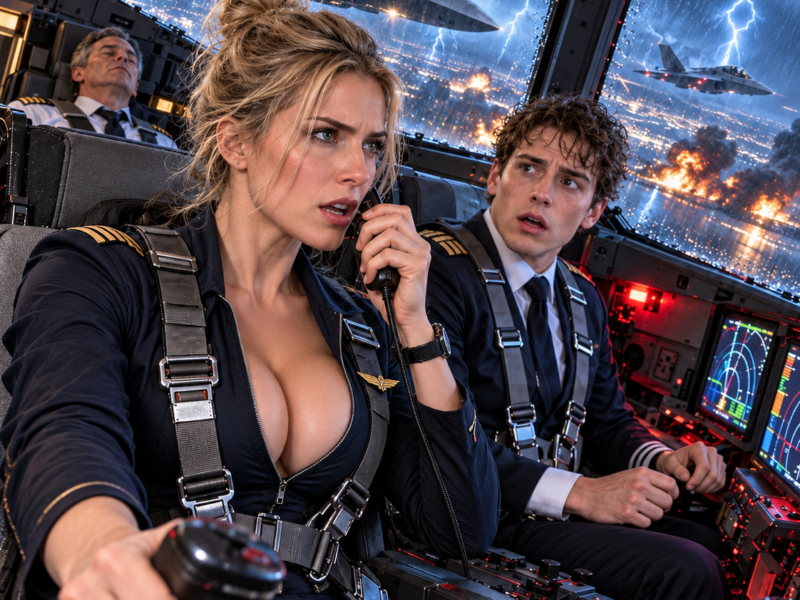
“I was standing in the cockpit of Flight 417 when the captain collapsed, the left engine exploded
The name stayed in my ears long after Emily stopped speaking.
Daniel Hayes.
For several seconds, I couldn’t hear the warning tones, the radio, or even Marcus asking me what was wrong.
I could only see a hospital hallway eight years earlier.
Daniel standing beside a vending machine, holding a tiny pair of blue sneakers that would never fit our son again.
“Anna?”
Marcus’s voice brought me back.
I lowered the handset.
“He’s my former husband.”
Marcus didn’t ask why my ex-husband was aboard the aircraft.
He didn’t ask why I looked as though someone had opened an old wound.
He simply said, “We have an emergency to manage. Can you stay focused?”
I looked at the instruments.
“Yes.”
“Then let’s do that.”
I appreciated him for not pretending to understand.
I also appreciated that he didn’t make me explain.
I returned my attention to the information in front of us.
The unusual indication still bothered me.
I checked the sequence again, compared it with the available readings, and pointed out the discrepancy to Marcus.
He reviewed it carefully.
“You’re right. We need to distinguish the original failure from what we’re seeing now.”
“Exactly.”
He contacted the appropriate support and continued following the aircraft procedures.
I helped organize the information and kept communication clear.
There was no dramatic moment when everything suddenly became easy.
There was only work.
One instruction.
One confirmation.
One decision at a time.
And for the first time in eight years, I wasn’t trying to escape the memory of being a pilot.
I was simply doing the job in front of me.
After several minutes, Marcus glanced at me.
“You’re good at this.”
I almost laughed.
“I used to be.”
“That isn’t what I said.”
I looked away.
The aircraft remained controllable, but we still had a long way to go before landing.
The captain was receiving medical attention.
The physician reported that Bennett was conscious but still in considerable pain.
That was encouraging, although nobody in the cockpit treated it as a reason to relax.
Then Marcus said, “Go check on your passenger.”
I looked at him.
“What?”
“Your ex-husband. You have someone who can cover the communication tasks for a few minutes. Go find out what he wants, then come back.”
“Marcus, I don’t think—”
“Anna, I’m not asking you to resolve eight years of personal history. I’m asking you to find out whether there’s something in that cabin we need to know.”
He was right.
Whatever Daniel had brought aboard, I needed to understand whether it had any relevance to the emergency.
I handed the headset to the other crew member who had come forward.
Then I took a breath and opened the flight-deck door.
The cabin looked nothing like it had before the explosion.
Oxygen masks hung in several rows, passengers were pale and silent, and the aisle was filled with the uneasy stillness of people trying not to frighten one another.
Emily saw me immediately.
She was standing near row eleven.
Her eyes moved from my face to the cockpit door.
“Are you okay?”
“I’m working on it.”
She nodded.
Then she pointed toward the window seat.
A man was sitting there with his hands folded over a brown leather bag.
His hair had turned almost completely gray.
His shoulders looked narrower than I remembered.
But I knew him immediately.
Daniel.
He stood when he saw me.
“Anna.”
I stopped beside the seat.
For a moment, neither of us moved.
Eight years ago, I had loved this man more than I knew how to express.
Eight years ago, I had also blamed him for something neither of us could bear to discuss.
Now he was sitting on an airplane carrying a bag that supposedly contained something belonging to our dead son.
“What are you doing here?” I asked.
Daniel glanced at the passengers around us.
“I didn’t know you’d be working this flight.”
“That’s not an answer.”
“I was trying to get to Anchorage.”
“Why?”
He looked down at the bag.
“Because I found something.”
I felt my jaw tighten.
“You could have called.”
“I did.”
“No, Daniel. You sent messages. You left voicemails. That’s not the same as showing up.”
“I know.”
“Then why now?”
He swallowed.
“Because I don’t think I can keep it from you anymore.”
I looked at the leather bag.
“What is it?”
He unzipped the front pocket and removed a small silver object.
A bracelet.
My knees nearly gave way.
It was identical to the one in my jacket.
Not similar.
Identical.
The same tiny engraving.
The same clasp.
The same little scratch near the edge.
I reached for it but stopped before touching it.
“Where did you get that?”
Daniel’s eyes filled.
“It was in the storage box.”
“What storage box?”
“The one from the accident.”
I stared at him.
There had been a storage box.
The police had collected our belongings after the crash, and I had assumed everything had been returned or documented.
I had received one bracelet.
Half of a pair.
The other half had supposedly been lost.
Daniel turned the bracelet over.
“There’s something engraved on the inside.”
I leaned closer.
The words were tiny.
I had to angle it toward the cabin light to read them.
For Mom, from Eli. Love you to the moon.
I pressed my lips together.
Eli had been four when we bought the bracelets.
He had insisted on having his own engraved because he wanted to give me something that was mine.
Daniel had helped him choose the words.
I remembered Eli sitting at the kitchen table, his tongue sticking out in concentration while he drew a picture of the moon.
“Why do you have this?”
Daniel took a slow breath.
“Because I found the original accident report.”
My eyes lifted.
“What?”
“The complete report, Anna. Not the summary we were given.”
I shook my head.
“We received the report.”
“We received an edited copy.”
The cabin seemed to tilt, though the aircraft was flying steadily.
“What are you talking about?”
Daniel glanced toward the cockpit.
“Not here.”
“You brought me onto an aircraft during an emergency to tell me you found a report?”
“I didn’t know the emergency would happen.”
“Then tell me now.”
He opened the bag again and pulled out a thick envelope.
It had been folded several times.
The edges were worn.
My name was written across the front.
Not Anna Reed.
Clara Hayes.
My old name.
My hand began to shake.
“Who gave you this?”
“An investigator.”
“What investigator?”
“Someone who worked on the original case. He contacted me six months ago.”
I looked at him without speaking.
Daniel continued.
“He said there were inconsistencies in the evidence. He wanted to know whether we had kept anything from that night.”
I couldn’t look away from the envelope.
“What inconsistencies?”
Daniel’s voice dropped.
“The emergency call.”
A cold sensation moved through my chest.
I remembered the accident.
I remembered the rain.
I remembered the road shining beneath the headlights.
I remembered the terrible sound when the car struck the barrier.
And I remembered Eli’s voice.
“Mommy?”
I closed my eyes.
“Don’t.”
“Anna, please.”
“I said don’t.”
Daniel lowered the envelope.
“I know what that night did to you.”
“No, you don’t.”
“I was there too.”
“Then you should know better than to bring it back.”
He looked at the bracelet.
“I brought it because I found out something about the last phone call.”
I opened my eyes.
“What phone call?”
Daniel looked directly at me.
“The one you made before the accident.”
For a moment, I couldn’t breathe properly.
I had made a call.
I remembered that much.
I had been driving home after an exhausting day of flying.
Eli was in the back seat.
Daniel had called me about a problem with the house.
I had been distracted.
Then the rain had become heavier.
The road had disappeared beneath the glare of headlights.
And everything after that was broken into pieces.
I had spent years remembering only what I believed mattered.
The impact.
The hospital.
The empty little bed.
“What did the investigator find?” I asked.
Daniel reached into the envelope.
Before he could answer, Emily hurried toward us.
“Anna, I’m sorry, but they need you forward.”
I looked at her.
“What’s happened?”
“Captain Bennett’s condition has changed. The physician needs assistance, and the first officer has requested you.”
I turned toward the cockpit.
Daniel caught my sleeve.
“Please take the envelope.”
I pulled away gently.
“I can’t do this right now.”
“Then keep it with you until you can.”
I stared at him.
He placed the envelope and bracelet on the empty seat.
“Just don’t throw them away again.”
I wanted to ask what he meant.
But Emily was waiting, and the aircraft still needed us.
I took the envelope.
Then I hurried forward.
When I reached the cockpit, Marcus was speaking with air traffic control.
He glanced at me.
“Captain’s condition is deteriorating. The doctor is monitoring him, but we need to continue preparing for the diversion.”
I placed the envelope in the side pocket of my jacket.
“Understood.”
He pointed toward the relevant information.
“Help me verify this.”
I focused on the work.
The aircraft was still flying.
The radio was active.
The remaining engine was responding.
And I had no intention of allowing a conversation from eight years ago to interfere with the decisions that had to be made now.
I helped Marcus confirm the information.
We communicated with the ground team.
We coordinated the cabin.
The aircraft began its descent toward Anchorage.
The night outside gradually changed.
Black became deep blue.
Then the first faint line of dawn appeared beyond the clouds.
I didn’t notice it until Marcus said, “There it is.”
I looked through the windshield.
The runway lights were visible in the distance.
For the first time since the explosion, I felt my shoulders loosen.
We were going to reach the ground.
Not without consequences.
Not without questions.
But we were going to reach it.
The landing was hard.
The aircraft touched down with a violent shudder, and the remaining passengers gripped their armrests as the wheels met the runway.
I heard someone cry out.
Then the aircraft slowed.
The engines quieted.
And a voice came through the cabin speakers.
“We are safely on the ground. Please remain seated until instructed.”
I didn’t realize I was crying until a tear reached my chin.
Marcus looked at me.
“Good work.”
I nodded.
He offered his hand.
I shook it.
There was no applause in the cockpit.
No dramatic celebration.
Just two exhausted people sitting quietly while emergency vehicles approached.
Captain Bennett was taken off the aircraft by medical personnel.
The doctor accompanied him.
Later, we learned he had suffered a serious cardiac event but had survived.
The damaged engine would require a full investigation.
The passengers were escorted off the aircraft, and the school group was reunited with its teachers.
Owen walked past me holding his airplane drawing.
He stopped.
“Are we still going to fly?”
I crouched to his level.
“Not today.”
He looked disappointed.
“Maybe another day,” I said.
He thought about that.
Then he handed me the drawing.
“You can have it. So you remember the clouds.”
I took it carefully.
“Thank you, Owen.”
His teacher guided him toward the terminal.
I stood there holding a child’s drawing and trying to understand how the world could continue offering ordinary kindness after such a terrible night.
Then I saw Daniel.
He was standing near the baggage area.
The leather bag was over his shoulder.
The envelope was still in my jacket.
He hadn’t left.
I walked toward him.
“Let’s talk.”
We found a quiet seating area near a row of windows overlooking the runway.
The airport smelled of burnt coffee and cleaning products.
For a while, neither of us spoke.
Then I placed the envelope between us.
“Start at the beginning.”
Daniel looked down.
“Six months ago, a retired investigator named Robert Collins contacted me. He had worked with the insurance investigation after the accident.”
“What did he want?”
“He wanted to review a few things that had never made sense.”
“Such as?”
Daniel rubbed his hands together.
“The timeline.”
I waited.
“The original emergency call was logged at 9:42 p.m. But the first report said the collision happened at 9:39.”
I frowned.
“That doesn’t prove anything.”
“No. But the original audio recording was timestamped differently.”
He slid a document toward me.
I opened it.
There were several pages of typed notes and photocopied records.
One line had been highlighted.
Caller reported vehicle obstruction and requested immediate assistance approximately eleven minutes before collision.
I read it twice.
“That’s impossible.”
Daniel said nothing.
I looked up.
“I don’t remember calling anyone eleven minutes before the crash.”
“I know.”
“Then why is this in here?”
“Because it was your voice.”
The words landed harder than I expected.
I stared at the page.
The report included a transcript.
The caller had described a damaged vehicle on the shoulder of the highway.
A vehicle with no hazard lights.
A person standing beside it.
A child in the back seat of the caller’s car.
My child.
My mouth went dry.
“Did I stop?”
Daniel nodded.
“According to the recording, you pulled over.”
I shook my head.
“No.”
“Clara…”
“Don’t call me that.”
He stopped.
I pushed the paper away.
“I don’t remember stopping.”
Daniel leaned forward.
“You called emergency services because you were concerned the vehicle was dangerous. You told them you were going to move your car to a safer position.”
I stared at him.
The memory was faint.
Rain against the windshield.
Eli asking for a snack.
A dark shape beside the road.
A pair of headlights coming toward us.
Then nothing.
“Why wasn’t this in the report?”
Daniel looked toward the window.
“That’s what Robert wanted to find out.”
He opened the envelope and removed another page.
It was a handwritten note.
The signature at the bottom belonged to a state police supervisor who had since retired.
Daniel explained that the original responding officer had documented the roadside vehicle and the emergency call.
But the final accident summary omitted both.
Instead, it focused almost entirely on my vehicle, the weather, and the conclusion that I had lost control on a wet road.
“Why?” I asked.
“Robert thinks someone made a mistake and then tried to simplify the investigation. But he doesn’t know whether it was deliberate.”
I looked at him.
“You’re telling me that for eight years I believed I caused the accident, but there might have been another vehicle involved?”
“I’m telling you we need to find out.”
I pressed my palms against my eyes.
All those years.
The therapy sessions.
The sleepless nights.
The way I had avoided driving in heavy rain.
The way I had changed my name and built a new life because I couldn’t stand hearing people call me the woman who had lost her son.
I had believed I was responsible.
Not because anyone had said it in exactly those words.
But because the evidence had been presented as though there was nothing else to consider.
And because I had no memory to defend myself with.
“Why didn’t you tell me six months ago?”
Daniel’s face tightened.
“I tried.”
“You didn’t try hard enough.”
“You’re right.”
His answer surprised me.
He looked down.
“I was afraid.”
“Of what?”
“Of giving you hope and then taking it away.”
I looked at him.
He continued.
“I spent years blaming you. Not because I knew what happened, but because blaming you was easier than accepting that I couldn’t protect our son.”
My eyes burned.
“And you let me believe I was alone in that guilt.”
“I know.”
“Do you?”
He didn’t answer.
For a long time, we sat in silence.
Then Daniel reached into his bag and took out a small digital recorder.
“Robert gave me this.”
I stared at it.
“The original call?”
He nodded.
“I haven’t listened to it all the way through.”
“Why?”
“Because I wanted you to hear it first.”
I almost laughed.
“You brought me an eight-year-old recording and thought that was kindness?”
“No.”
He looked exhausted.
“I thought it was the only honest thing I had left.”
I picked up the recorder.
My fingers hovered over the button.
Then I pressed play.
Static filled the room.
A woman’s voice followed.
My voice.
Calm, but tired.
“Hello, yes. I’m on the northbound highway, just past the old Miller exit. There’s a vehicle stopped on the shoulder. It doesn’t have hazard lights on.”
A dispatcher asked for more information.
I described the vehicle.
A dark SUV.
A broken rear light.
A person standing beside the driver’s door.
Then the dispatcher asked whether I could see anyone else.
My voice changed.
“There is a child in my car.”
Eli.
I swallowed.
The recording continued.
“Ma’am, please remain at a safe distance. Are you in a safe location?”
“Yes. I’ve pulled farther ahead. I’m not blocking traffic.”
Then came a sound I recognized.
A small voice in the background.
“Mommy?”
I stopped breathing.
It was Eli.
I pressed the recorder closer.
My voice softened.
“One second, sweetheart.”
The dispatcher continued speaking.
Then I heard myself say something I had not remembered in eight years.
“There’s another car coming. It’s driving too fast.”
The recording crackled.
A horn sounded.
Then my voice, suddenly sharp.
“Stop! There’s a child!”
A loud impact followed.
The recording ended in static.
I stared at the recorder.
Daniel was crying silently.
I couldn’t move.
I had remembered the collision as a single terrible moment.
I had never remembered the seconds before it.
The stopped vehicle.
The person beside it.
The other car.
The warning.
“Did anyone investigate the SUV?” I whispered.
Daniel nodded.
“Not properly.”
“Why?”
“Because it disappeared.”
I looked at him.
“What do you mean?”
“Robert found a witness statement from someone who saw a dark SUV leaving the area shortly after the crash. The witness described a damaged rear light.”
My hands began to shake again.
“Did they find it?”
“No.”
“Did they look?”
“Not after the first week.”
I looked down at the bracelet.
For eight years, I had carried half of something that reminded me of a child I thought I had failed.
Now I was holding evidence that the night might not have happened the way I remembered.
But that didn’t bring Eli back.
It didn’t undo the years.
And it didn’t answer the most painful question.
“Daniel, why did you have the other bracelet?”
He took a long breath.
“Because I found it in a box of his things after the accident.”
“You said it was lost.”
“I know.”
“Why?”
His eyes filled again.
“Because I couldn’t give it to you.”
I looked at him.
“Why not?”
“Because the engraving was unfinished.”
He turned the bracelet over and showed me the inside.
The words were exactly as I remembered.
But beside them was a tiny mark.
A little crescent moon.
Daniel explained that Eli had asked the jeweler to add it because he wanted our bracelets to match.
The other bracelet had been returned to him after the accident.
He had kept it.
He hadn’t been able to throw it away.
And he hadn’t been able to give it to me because he knew I would ask why it had been in his pocket.
“I thought if I gave it to you, you’d never stop asking questions,” he said.
I looked at him.
“I should have been allowed to ask.”
“I know.”
That was the first time in eight years that he had said something without trying to defend himself.
It didn’t erase what he had done.
But it gave us somewhere honest to begin.
Three weeks later, I met Robert Collins in a small office outside Anchorage.
He was seventy-one, with a careful manner and a habit of looking at documents before answering questions.
He brought the original investigation file.
He had also found the witness who reported the dark SUV.
Her name was Margaret Lewis.
She had been driving home that night when she saw the collision.
She remembered stopping behind a police cruiser.
She remembered a man standing near a dark SUV.
And she remembered the man leaving before the ambulance arrived.
The vehicle’s right rear light was broken.
The description matched the original emergency call.
Robert had spent months trying to identify the driver.
Eventually, a registration record led him to a man named Peter Lawson.
He had owned a dark SUV at the time.
He had also reported damage to its rear light the following morning.
When Robert contacted him, Lawson initially denied being near the highway.
Then he changed his story.
He admitted that he had been driving on that road.
He said he had stopped because his vehicle had struck a roadside barrier.
He claimed he left before the accident because he was frightened.
But his second statement contained something more.
He had seen my car pull over.
He had seen me move farther ahead.
And he had seen another vehicle approach at high speed.
He told investigators he believed that second vehicle had struck my car.
The original case had never properly examined that possibility.
The information was forwarded to the authorities for a formal review.
It took months.
There were interviews, requests for records, and painful conversations with people who had been involved in the investigation.
There was no magical document that explained everything.
There were only pieces.
Some confirmed.
Some incomplete.
Some impossible to recover after so many years.
The review ultimately established that another vehicle had been involved in the sequence of events before the collision.
However, the evidence could not determine every movement or prove exactly which action would have prevented the crash.
Peter Lawson was not charged with causing Eli’s death.
There was insufficient evidence to establish that he had directly caused the collision.
But he was held accountable for leaving the scene of an incident without properly reporting it.
The case was formally amended to reflect the previously omitted roadside emergency and witness evidence.
For the first time, the official record no longer suggested that the entire tragedy had been explained by my loss of control on a wet road.
It did not give me the certainty I had spent eight years begging for.
But it gave me something I hadn’t had before.
The truth was bigger than the guilt I had carried.
And I was finally allowed to stop pretending otherwise.
Daniel and I met again in the spring.
This time, we didn’t meet in an airport.
We met at the cemetery where Eli was buried.
The grass was newly cut.
Someone had left a small blue pinwheel beside his headstone.
I brought the two bracelets.
Daniel brought a photograph.
It showed Eli sitting on my shoulders at a county fair.
His mouth was open in a laugh.
My hair was a mess.
Daniel was standing behind us, holding three lemonades.
We looked like a family who believed there would always be another summer.
I sat on the grass.
Daniel sat beside me.
For a while, we said nothing.
Then he placed his hand near mine.
Not touching.
Just close enough that I could decide.
I looked at him.
“I don’t know if I can forgive you for keeping that bracelet.”
He nodded.
“I understand.”
“And I don’t know if I’ll ever forgive myself for what happened.”
He looked toward Eli’s name.
“Maybe we don’t have to finish that today.”
I stared at the photograph.
“I spent eight years thinking I had to punish myself because he wasn’t here.”
Daniel’s voice was quiet.
“I did too.”
A breeze moved through the trees.
I took the two bracelets and placed them together on the grass.
For the first time, they looked complete.
I didn’t feel healed.
I didn’t suddenly become the woman I had been before the accident.
There were still nights when rain against a window made my hands tighten.
There were still mornings when I woke expecting to hear a little voice asking for breakfast.
But I no longer believed that suffering was the only way to prove I loved my son.
A month later, I made another decision.
I spoke with an aviation training organization in Seattle and began the process of returning to flight training.
Not because I wanted to forget what had happened.
Not because I wanted to prove anything to Marcus, Daniel, or anyone else.
I wanted to find out whether the woman I had been before the accident was still somewhere inside me.
The first time I entered the simulator, I stood at the cockpit door for nearly five minutes.
My instructor didn’t rush me.
He simply waited.
When I finally sat down, I placed my hands on the controls.
They were trembling.
I let them.
Then I started the exercise.
Months passed.
I completed the required training, medical evaluations, and checks.
I knew I would never be able to return to the cockpit exactly as I had before.
I also knew I didn’t need to.
One afternoon, after a training session, I found a small envelope in my mailbox.
There was no return address.
Inside was a photograph of Eli holding the silver bracelet.
On the back, Daniel had written:
“He wanted you to have this. I should have given it to you a long time ago.”
I placed the photograph beside the half bracelet I had kept in my jacket for eight years.
Then I took both bracelets to a jeweler.
I asked him to connect them with a small silver link, preserving the original engravings.
When he finished, the two halves formed one complete circle.
I wore it on my wrist the next morning.
Not as a reminder of the night I lost my son.
As a reminder of the little boy who had once believed his mother could fly anywhere.
A few weeks later, I received a message from Marcus.
Captain Bennett had recovered and was expected to return to flying after completing his medical evaluation.
Marcus had also written something I read several times.
“Whatever happened before, you belonged in that cockpit that night. I hope you remember that.”
I smiled.
Then I looked out the window.
The sky was clear.
For years, I had thought that returning to the cockpit meant leaving Eli behind.
Now I understood that I could carry him with me without carrying the guilt.
I still missed him every day.
I probably always would.
But when I looked at the clouds, I no longer saw the place where my life had ended.
I saw the place where I had once taught my little boy to dream.
And on my wrist, two small silver bracelets caught the morning light, joined together at last.
ThE end.









