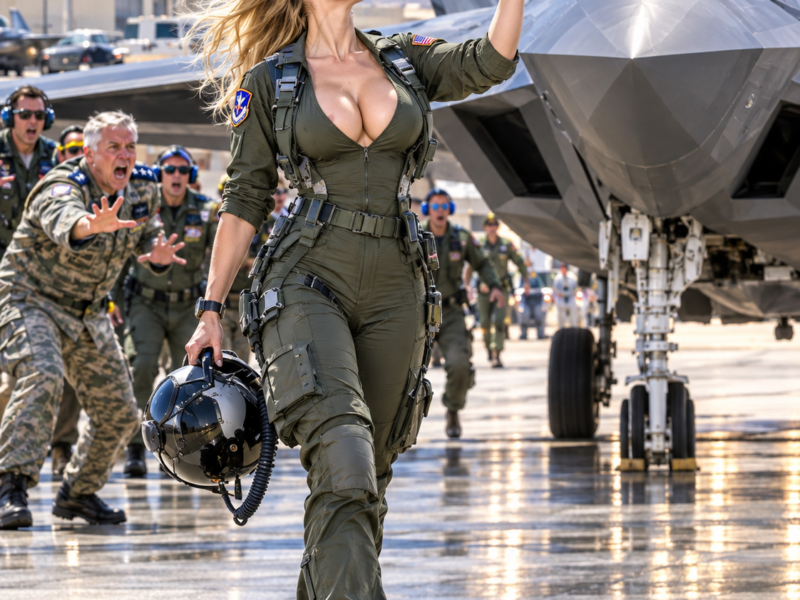
“I was standing behind Lieutenant Fletcher when he mocked me in front of the entire briefing room
I reached Hangar Four at 8:26 a.m., carrying the printed telemetry report in one hand and my phone in the other.
Two security officers stood outside the entrance.
“Captain Ridley, you’re not on the access list.”
“Then call Major Lawson.”
“He’s inside preparing for the flight.”
“Tell him I need five minutes.”
One of the guards glanced at the paper in my hand.
“Ma’am, we have specific instructions not to interrupt the test team.”
I looked past him through the narrow window.
Inside, engineers were moving around Chimera while Major Lawson stood beside the aircraft in his flight suit.
He was laughing at something Chief Croft had said.
The sight made my stomach tighten.
“Listen carefully,” I said. “If that aircraft takes off before I speak to the major, you’re going to have a very long morning explaining why you ignored a safety warning.”
The younger guard hesitated.
The older one reached for his radio.
Before either could respond, a familiar voice came from behind me.
“Captain Ridley?”
I turned.
Ryan Miller was walking toward us, carrying a helmet bag.
He looked surprised to see me.
“What’s going on?”
“I need to speak to Lawson.”
Ryan glanced at the hangar.
“They’re already running preflight checks.”
“Then we’re out of time.”
He studied my expression.
For once, he didn’t make a joke.
“Come with me.”
He showed his identification to the guards and led me through a side entrance.
Inside, the smell of aviation fuel mixed with the sharp scent of hot electronics.
I walked directly toward Croft.
“Shut down the aircraft.”
He barely looked up.
“Captain, this isn’t your program.”
“I know. That’s why I’m asking the people responsible for it to listen before someone gets hurt.”
Croft sighed.
“We have a successful ground-test sequence.”
“Your system is using an incorrect flight-control response.”
His expression hardened.
“Based on what?”
I placed the telemetry report on his workstation.
“Flight 611.”
His face changed.
Not dramatically.
Just enough.
He glanced toward Lawson, then back at me.
“Where did you get this?”
“That’s not the question.”
“Captain, this material is classified.”
“Then explain why my name is attached to a command I never gave.”
Lawson approached us.
“Sarah?”
He had stopped smiling.
“What happened?”
I turned the report toward him.
“Do you know what Chimera is learning from?”
Lawson looked at the screen.
His eyes moved across the flight number, the date, and the final command.
For several seconds, he said nothing.
Then he looked at Croft.
“Richard, shut down the test.”
Croft shook his head.
“David, we can’t do that because of a disputed data field.”
“It’s not disputed,” I said.
“You’re interpreting a corrupted record.”
“No. I’m recognizing it.”
Croft folded his arms.
“Captain, with all due respect, you haven’t flown operationally in years.”
I felt the old familiar pressure behind my ribs.
He was right about one thing.
I hadn’t flown operationally in years.
But that didn’t make the data less dangerous.
“Major,” I said, keeping my eyes on Lawson, “I need you to see the original recording.”
Lawson looked at Croft.
“Bring it up.”
Croft hesitated.
“Sir, the original mission footage isn’t part of the standard test package.”
“Then open it.”
An engineer at the far workstation slowly turned toward us.
“Chief, I still have the archived mission recording from the initial data import.”
Croft’s face tightened.
“Why?”
“Because the system flagged a discrepancy during ingestion. I kept a copy.”
Lawson pointed at the monitor.
“Play it.”
The engineer opened the file.
The screen filled with the grainy image of an aircraft cockpit recording.
My cockpit.
My hands appeared on the controls.
The date in the corner was seven years earlier.
I recognized the mission immediately.
We had been operating over a hostile region when our formation encountered an unexpected surface-to-air missile threat.
My wingman, Captain Daniel Hayes, had been flying approximately two miles to my left.
Daniel was twenty-nine.
He had a wife named Emily and a daughter who was still learning to walk.
He also had a habit of humming old country songs before takeoff.
I used to tell him it was a terrible preflight ritual.
He always answered, “Keeps me from thinking about the landing.”
That morning, he had been the calmest pilot in our formation.
Until the missile warning sounded.
On the recording, the first seconds were ordinary.
Radio calls.
Radar updates.
Routine instructions.
Then the warning tones began.
I heard my younger voice.
“Break right! Missile launch!”
Daniel answered.
“Visual. I’ve got it.”
A few seconds later, another voice entered the recording.
“Ridley, maintain your current heading. Do not alter formation.”
I recognized the voice.
It belonged to Lieutenant Colonel Marcus Hale, the mission’s airborne command officer.
At the time, I had believed he was monitoring the situation from a separate aircraft.
The recording continued.
My aircraft began a hard defensive maneuver.
Daniel’s aircraft remained on its assigned heading.
Then I heard my own voice.
“Control, my wingman is not responding to the threat.”
Hale answered immediately.
“Maintain formation.”
“He’s exposed!”
“Maintain formation, Captain.”
I remembered what happened next.
The missile warning in my cockpit.
The sudden loss of altitude.
The impact that threw my shoulder against the harness.
The sound of Daniel shouting something I couldn’t understand.
And then silence.
I had never heard the rest of the recording.
The screen showed my aircraft shaking violently.
My breathing became ragged.
The instrument panel flickered.
Then the recording caught something I had not remembered.
A command appeared in the flight-control data.
AUTOMATED RESPONSE: FORMATION PRIORITY.
My hands tightened around the edge of the workstation.
“Stop it.”
The engineer paused the video.
Croft looked uncomfortable.
“That’s the software response.”
“No,” I said. “That’s not what I commanded.”
Lawson turned toward me.
“What do you mean?”
I pointed at the screen.
“My aircraft was in manual control. I was fighting to keep it airborne. I never selected formation priority.”
Croft shook his head.
“The system could have interpreted your inputs.”
“Then why did the command originate from the mission network?”
Nobody answered.
The engineer zoomed into the metadata.
There was a second line beneath the automated response.
REMOTE AUTHORIZATION: MH-07.
Lawson stared at it.
“MH?”
I already knew.
Marcus Hale.
The colonel who had ordered us to maintain formation.
The colonel who had later signed the investigation report stating that Daniel had failed to respond appropriately to a missile warning.
The colonel who had testified that my injuries resulted from an unavoidable aircraft malfunction.
I looked at Lawson.
“That command didn’t come from me.”
He slowly nodded.
Then he turned toward Croft.
“Who authorized the original data package?”
Croft didn’t answer immediately.
The engineer looked at his screen.
“Colonel Hale approved the transfer.”
The hangar seemed suddenly much quieter.
Lawson took a step toward Croft.
“Are you telling me this aircraft was trained on a command issued by someone other than the pilot?”
Croft rubbed his forehead.
“The learning architecture was designed to recognize successful survival patterns. We used the mission data because it contained a rare combination of combat stress, degraded instrumentation, and emergency recovery.”
“Did you verify the command source?”
“We verified the telemetry.”
“That wasn’t my question.”
Croft looked away.
I felt anger rising, but beneath it was something worse.
A familiar emptiness.
Seven years earlier, I had spent months wondering whether I’d made the wrong decision.
Whether I should have broken formation sooner.
Whether I could have reached Daniel.
Whether the maneuver that saved my life had cost him his.
Now I was standing in a hangar watching engineers discuss that day as a software training opportunity.
“Why did Chimera keep rejecting the profile?” I asked.
Croft looked at the aircraft.
“Because the system was detecting conflicting outcomes.”
“Explain.”
“It identified two different survival responses in the same event.”
He opened another screen.
“Your aircraft’s defensive maneuver produced a recovery. Daniel’s aircraft remained on the original heading and was lost. The learning layer couldn’t reconcile the mission command with the outcome.”
I stared at the data.
“So it was trying to decide which instruction to follow.”
Croft nodded reluctantly.
“Essentially.”
“And what happens if the system encounters that conflict during flight?”
He didn’t answer.
Lawson did.
“It might prioritize the remote command over the pilot’s actual input.”
My throat tightened.
The test was scheduled to begin in less than half an hour.
“Then you cannot fly it.”
Croft looked irritated.
“Captain, the aircraft is not going to execute an old combat command simply because it exists in the training archive.”
“You’re assuming it understands the difference between an archived command and a current one.”
“That’s what the safeguards are for.”
“Have you tested them?”
He looked at the floor.
That was answer enough.
Lawson removed his flight helmet and placed it on the workstation.
“Test canceled.”
Croft stepped forward.
“Major, the program has congressional oversight. We have representatives arriving this afternoon. We cannot simply cancel the first live demonstration.”
Lawson’s voice became cold.
“We can when I refuse to put a pilot in an aircraft I don’t trust.”
For a moment, I thought that was the end of it.
Then my phone rang.
Unknown number.
I answered.
“Captain Ridley?”
The voice was male, older, and familiar.
“Yes.”
“This is Colonel Marcus Hale. I understand you’ve been asking questions about Project Chimera.”
I looked at the others.
Lawson motioned for me to put the call on speaker.
“Colonel,” I said. “I have a few questions about Flight 611.”
A pause.
“That incident was investigated years ago.”
“Then you’ll have no trouble explaining the remote authorization in the telemetry.”
Another pause.
“You need to be careful about what you’re suggesting.”
“I’m asking why your command was recorded as an automated flight-control instruction.”
Hale’s tone became sharper.
“That information is classified.”
“Was Daniel Hayes ordered to maintain formation after the missile warning?”
“Those decisions were made under operational conditions.”
“Did you authorize the command?”
“I won’t discuss classified operational details over an unsecured line.”
“Then we’ll discuss them somewhere secure.”
He lowered his voice.
“Sarah, I know you’ve spent years trying to make sense of what happened. But your medical condition and the trauma of that mission have affected your judgment.”
The words hit harder than I expected.
He knew exactly where to aim.
I looked at the medical report still folded inside my jacket.
“Don’t use my injury to avoid answering the question.”
Hale exhaled.
“Your career ended because you couldn’t accept what happened.”
For a moment, I couldn’t speak.
Then I said, “My career ended because I survived.”
I disconnected.
Nobody in the hangar moved.
Lawson looked at me with an expression I hadn’t seen before.
Not pity.
Understanding.
“Sarah,” he said quietly, “we’re going to reopen this.”
I nodded.
But I knew Marcus Hale would not make it easy.
And I knew the clock was still running.
By noon, the test had been officially suspended.
The aircraft was secured.
The engineers were instructed not to alter or delete any project data.
A security team had taken possession of the original telemetry files.
I was asked to remain available for questioning.
Fletcher found me outside the simulator building just after lunch.
He was holding a paper cup of coffee.
“Captain?”
I looked up.
“Lieutenant.”
He hesitated.
“I heard the test was canceled.”
“It was.”
“Because of something in the software?”
“Because the software was trained on information nobody properly understood.”
He glanced toward the hangars.
“Was it your mission?”
I didn’t answer.
His expression softened.
“I heard the name. Daniel Hayes.”
I looked at him more carefully.
“Where?”
“One of the engineers mentioned it.”
Fletcher lowered his eyes.
“I’m sorry.”
I wasn’t sure what to say.
He shifted the coffee cup between his hands.
“I used to think the only pilots who mattered were the ones who could win a fight.”
“And now?”
“Now I’m starting to think the ones who know when to stop might be better pilots.”
It was the first sensible thing I’d heard him say in weeks.
“That’s a start,” I told him.
He almost smiled.
Then he asked, “Are you going to fly again?”
The question caught me off guard.
I looked at my hands.
“I don’t know.”
Fletcher nodded.
“Fair enough.”
He started to leave.
“Lieutenant?”
He turned.
“Next time you think an instructor doesn’t belong in the room, remember that you might not know what they’ve already survived.”
His face reddened slightly.
“Yes, ma’am.”
He walked away.
I watched him disappear around the corner.
For the first time, I wondered whether I had spent too much time hiding behind my silence.
Perhaps the truth didn’t need to be announced.
But it did need to be spoken when it mattered.
Three days later, I received an official summons to the investigation office.
Colonel Hale was there when I arrived.
He wore his uniform perfectly.
Not a wrinkle.
Not a misplaced ribbon.
He looked exactly as he had seven years earlier.
“Captain Ridley,” he said.
“Colonel.”
A civilian investigator introduced herself as Special Agent Laura Bennett.
She explained that the investigation concerned unauthorized command transmissions during Flight 611 and the subsequent use of classified mission telemetry in Project Chimera.
Hale sat across from me.
He appeared calm.
“Sarah, I hope we can resolve this professionally.”
I placed my hands on the table.
“Then let’s start with the command.”
Agent Bennett opened a folder.
“We have recovered the original network authorization logs. They indicate that a remote formation-control instruction was transmitted during the engagement.”
Hale leaned back.
“The system was designed to maintain operational integrity.”
“At the expense of a pilot’s ability to respond to an immediate threat?” Bennett asked.
“It was a tactical decision.”
I looked at him.
“Daniel was receiving a missile warning.”
“He was part of a formation.”
“He was a person.”
Hale’s expression tightened.
“Captain, you don’t understand the larger operation.”
“Then explain it.”
For several seconds, he said nothing.
Finally, he leaned forward.
“The mission involved intelligence that could not be compromised. We had a restricted engagement corridor. If your formation broke, we risked exposing the location of a surveillance asset.”
I stared at him.
“So you ordered us to maintain formation.”
“I gave a tactical instruction.”
“Even after the missile warning?”
“Yes.”
“Even after I reported that Daniel was exposed?”
Hale’s eyes moved toward the investigator.
“Yes.”
Agent Bennett wrote something down.
I felt my fingers pressing into my palms.
“Why did you tell the original investigation that Daniel failed to respond?”
Hale’s expression hardened.
“Because the aircraft telemetry showed no authorized maneuver.”
“It showed a remote command.”
“The command was part of the network.”
“Under your authorization.”
He said nothing.
I leaned back.
For years, I had imagined this conversation.
In some versions, I shouted.
In others, I demanded an apology.
Sometimes I asked him why Daniel had to die.
But sitting across from him, I discovered that the question I wanted answered was simpler.
“Did you know Daniel was going to die?”
Hale looked directly at me.
“I knew there was a risk.”
“That’s not what I asked.”
He swallowed.
“I believed maintaining formation was necessary.”
“Did you know he was in danger?”
“Yes.”
The room became very still.
Agent Bennett closed her folder.
“Colonel Hale, your statement is being recorded. We will need the original authorization records and all correspondence relating to Flight 611.”
Hale looked at me.
“You have no idea what this will do to the program.”
I held his gaze.
“Neither did Daniel.”
That ended the conversation.
The investigation lasted several months.
It uncovered more than a faulty software profile.
The original mission network had allowed senior command officers to transmit tactical formation restrictions directly into aircraft systems.
The authorization was legal under certain operational conditions.
But Hale had used it after receiving repeated warnings that Daniel’s aircraft was under immediate threat.
Worse, the original investigation had been given an incomplete record.
Several network logs had been excluded from the official report.
The reason was buried in classified correspondence.
Hale had feared that acknowledging the remote command would expose the surveillance operation and bring questions about his decision-making.
He had chosen to protect the mission.
Then he had chosen to protect himself.
Daniel’s death had been recorded as pilot error.
My injuries had been described as the result of an unavoidable equipment failure.
And Chimera had been built using the same incomplete account.
The project was suspended indefinitely.
The learning architecture was redesigned.
The engineers removed the corrupted training profile and established a rule that no remote tactical instruction could override a pilot’s emergency defensive input without a clearly documented, independently verified authorization.
It was a small change in a massive system.
But it mattered.
Colonel Hale was relieved of his command responsibilities pending formal proceedings.
The original Flight 611 report was amended.
Daniel Hayes was officially cleared of the implication that his failure to respond had caused his death.
When I received the revised report, I read it alone in my quarters.
I read Daniel’s name.
Then I read the sentence beneath it.
“Captain Daniel Hayes acted within the available information and did not have control authority necessary to execute an independent defensive maneuver.”
I read it again.
And again.
Then I folded the document carefully and placed it beside the medical report.
For seven years, I’d carried the belief that I had somehow failed him.
Now I finally understood that the guilt had never belonged to me.
But understanding something and feeling it were two different things.
I still woke some nights hearing the warning tone.
I still remembered Daniel’s voice.
And I still wondered whether there had been a way to save him.
One Saturday morning, I drove to a small cemetery outside Las Vegas.
The desert air was cool.
A few dry leaves moved across the pavement.
Daniel’s headstone stood beneath a tree near the edge of the grounds.
His wife, Emily, had chosen a simple inscription.
Husband.
Father.
Pilot.
I stood in front of it for a long time.
Then I placed the amended investigation report against the base of the stone.
“I’m sorry it took so long,” I whispered.
I had rehearsed a hundred things to say.
None of them seemed right.
“I finally got them to put your name back where it belongs.”
A car door closed somewhere behind me.
I turned.
Emily Hayes was standing several yards away, holding the hand of a young girl.
Their daughter, Lily, was seven now.
She had Daniel’s dark hair and the same serious expression he used to wear when preparing for a mission.
Emily approached slowly.
“I heard they changed the report.”
I nodded.
“They did.”
She looked at the document.
“Does it say he didn’t make a mistake?”
“Yes.”
Her eyes filled.
For a moment, neither of us spoke.
Then she asked, “Did you ever think he could have gotten out?”
I looked at the headstone.
“Every day.”
Emily nodded.
“I did too.”
I expected her to be angry.
Part of me had prepared for it.
Instead, she reached into her coat pocket and pulled out a small photograph.
It showed Daniel sitting beside me on the wing of an aircraft.
We were both younger.
Both smiling.
Both wearing flight suits covered in dust.
I remembered that day.
Daniel had stolen my sunglasses and refused to give them back until I admitted he was the better pilot.
I never admitted it.
Emily handed me the picture.
“He kept this in his desk,” she said. “He talked about you a lot.”
I looked down at the photograph.
“He shouldn’t have had to.”
Emily shook her head.
“Sarah, he never blamed you.”
I couldn’t answer.
She continued softly.
“He told me that if anything ever happened to him, I shouldn’t let anyone turn his death into a reason to stop living.”
My eyes burned.
“Did he really say that?”
“He did.”
Lily tugged at her mother’s sleeve.
“Mom, is this the lady from Dad’s pictures?”
Emily smiled sadly.
“Yes, sweetheart.”
Lily looked up at me.
“Did you fly with my dad?”
I crouched so we were at the same height.
“Yes. He was my wingman.”
“Was he brave?”
I smiled through the tears.
“He was the bravest pilot I ever knew.”
She considered that.
Then she said, “Mom says he would have liked me to learn to fly.”
Emily laughed softly.
“He would have loved that.”
I looked at the little girl.
“Then I hope you learn everything about flying. The good parts, the difficult parts, and the parts that teach you when to listen.”
She nodded as if I had given her an important assignment.
When Emily and Lily left, I remained beside Daniel’s grave for another few minutes.
I no longer felt the need to apologize for surviving.
That didn’t mean I had forgotten him.
It meant I could finally remember him without blaming myself.
A month later, Major Lawson called me into his office.
There was a folder on his desk.
“Sit down, Sarah.”
I took the chair opposite him.
He pushed the folder toward me.
“Command has approved a new training initiative.”
I opened it.
Advanced threat recognition.
Pilot decision-making under degraded conditions.
Human override protocols.
At the bottom was a proposed instructor assignment.
My name.
I looked up.
“You’re offering me the program?”
“I’m asking you to build it.”
I studied the paperwork.
“Chimera?”
“Not the old Chimera. That project is under review. This is a separate training program. We’re starting with the mistakes that should never have been hidden.”
I turned another page.
The curriculum included the original Flight 611 incident, the importance of threat prioritization, and the danger of treating software recommendations as unquestionable commands.
I looked at Lawson.
“You want me to teach pilots how to recognize when a system is wrong.”
“I want you to teach them how to recognize when they are wrong too.”
I smiled slightly.
“That’s going to make me popular.”
Lawson chuckled.
“Something tells me you can live with that.”
I accepted the assignment.
The following Monday, I returned to the simulator room.
Fletcher was already there.
He stood when I entered.
“Morning, Captain.”
“Morning, Lieutenant.”
He looked at the new training schedule.
“Are we running the missile engagement again?”
“Eventually.”
He glanced at the screen.
“What’s the scenario?”
I placed my tablet on the desk.
“You’re going to lose your radar picture, receive conflicting tactical instructions, and have to decide which threat matters most.”
Fletcher raised an eyebrow.
“Sounds pleasant.”
“It isn’t supposed to be.”
He put on his helmet.
Before starting the simulation, he looked at me.
“Captain?”
“Yes?”
“I read the updated report about Flight 611.”
I waited.
“I didn’t know.”
“Most people didn’t.”
He nodded.
Then he said something I hadn’t expected.
“I’m glad you stayed.”
I looked at him.
“Why?”
“Because I think some of us needed to hear what you had to teach.”
For once, I didn’t have a sharp answer ready.
I simply nodded toward the simulator.
“Let’s see if you’ve learned anything.”
He settled into the seat.
The scenario began.
His virtual aircraft entered the engagement zone.
A hostile aircraft appeared on radar.
Fletcher began to pursue.
Then the warning tone sounded.
A missile threat emerged from behind him.
His hands moved toward the controls.
For half a second, I saw the old instinct take over.
Then he stopped.
He checked his instruments.
He assessed the threat.
He broke away from the target.
The virtual aircraft survived.
Fletcher removed his helmet.
“That was better, wasn’t it?”
“Much.”
He smiled.
“Does that mean I finally get a passing score?”
“It means you get another scenario.”
He laughed.
This time, I laughed too.
Outside, the afternoon sun stretched across the runway.
An aircraft lifted into the sky, climbed through the desert light, and disappeared beyond the mountains.
I watched it until the sound faded.
For years, I had believed that the worst thing a pilot could do was lose control of an aircraft.
Now I understood that there was something more dangerous.
Losing the ability to question the person—or the machine—telling you what to do.
Chimera had been built to learn from a pilot’s instincts.
But it had never understood the most important part of mine.
I had not survived because I followed every command.
I had survived because, at the moment it mattered, I trusted what I could see.
And I would spend the rest of my career making sure the next generation of pilots never forgot that their greatest responsibility wasn’t to obey a machine.
It was to bring each other home.
The end.









