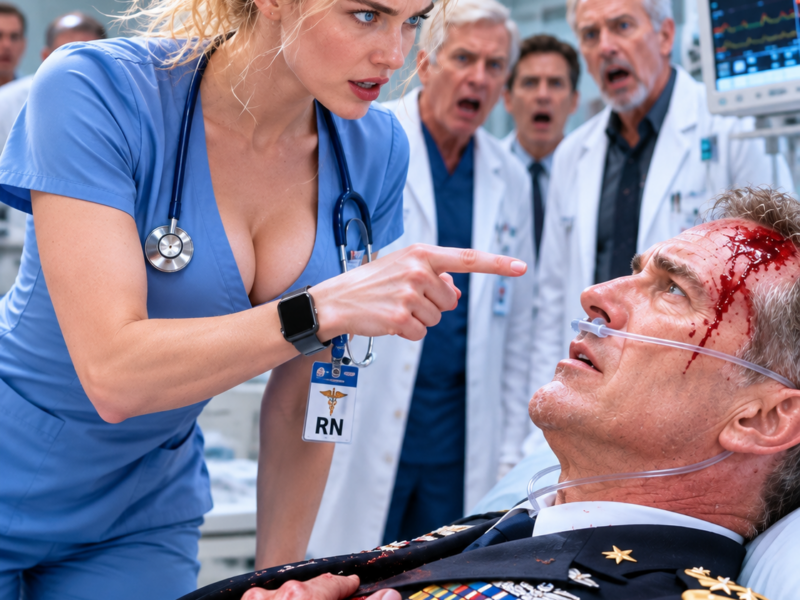
“I was ordered to step away from the dying four-star general at Walter Reed after three senior doctors declared there was nothing more they could do
The colonel opened the sealed authorization.
For several seconds, no one spoke.
Then he turned the document toward Dr. Collins.
“Read the designation aloud.”
Dr. Collins glanced at the page. His expression changed.
He looked at me as if he were seeing a stranger.
“Project Meridian,” he whispered. “Original medical systems architect: Emily Carter. Classification level: Black.”
The room seemed to shrink around me.
I had spent four years making sure nobody said those words in my presence.
Four years pretending I was an ordinary nurse who had never worked in a place that officially did not exist.
And now, with General Richard Hayes fighting for his life, the past had walked straight into Walter Reed.
“That’s enough,” I said.
The woman in the navy suit stepped forward. “I’m Director Helen Ward. The authorization is genuine. Your identity has been verified.”
“I don’t care what your document says.”
“You should. The general’s condition is directly connected to the work you designed.”
I looked at the monitor.
His heart rate was falling again.
“Then stop talking and let me treat him.”
Dr. Collins moved between me and the bed. “You cannot just administer an experimental protocol to a four-star general.”
“It’s not experimental.”
“It was never approved for use outside Meridian.”
“Because Meridian was shut down before the trials were completed.”
“Exactly.”
“No,” I said. “Not exactly.”
I pointed toward the monitor.
“His heart isn’t failing because his heart is damaged. It’s failing because something is preventing his body from regulating its own electrical signals. Every medication you’ve given him is treating the symptoms. None of them is addressing the cause.”
Dr. Collins frowned.
“That conclusion isn’t supported by his tests.”
“His tests were designed to look for ordinary cardiac failure.”
I turned to Director Ward.
“Did you bring the original Meridian telemetry?”
She hesitated.
The colonel beside her opened a black case and removed a small encrypted tablet.
“It’s here.”
“Then show me the seven-minute trace.”
Dr. Collins shook his head. “What trace?”
I ignored him.
The colonel connected the tablet to the diagnostic monitor. A series of encrypted medical readings appeared, followed by a recording from a portable cardiac sensor.
I recognized the pattern immediately.
Three irregular spikes.
A pause.
Then a sudden electrical surge.
My stomach tightened.
“That’s it,” I whispered.
Director Ward leaned closer. “What are we looking at?”
“The same signature we saw at Fort Meridian.”
I enlarged the waveform.
“General Hayes isn’t experiencing a conventional heart attack. He’s suffering from a delayed autonomic cascade. His nervous system is sending contradictory signals to his heart and blood vessels. His body is essentially fighting itself.”
Dr. Collins stared at the screen.
“That’s impossible. His bloodwork doesn’t show—”
“Because the compound responsible breaks down quickly. By the time the samples reached your laboratory, the evidence was gone.”
The colonel exchanged a glance with Director Ward.
I noticed.
“What aren’t you telling me?”
Director Ward’s expression hardened.
“Four years ago, Meridian developed a neural stabilization protocol for military personnel exposed to a classified biological agent. The program was suspended after an incident.”
“An incident?” I repeated.
“Seven patients died.”
“No.”
My voice came out quieter than I intended.
“Seven patients were reported dead.”
The room fell silent.
I remembered the underground treatment room.
The red lights.
The smell of antiseptic mixed with smoke.
Seven men lying beneath white sheets while alarms sounded in the corridor.
I remembered trying to stabilize their nervous systems with a procedure that had never been tested under those conditions.
And I remembered the order that came afterward.
Stop treatment.
Destroy the records.
Report no survivors.
I had refused.
I had saved two of them.
One had been General Hayes.
Dr. Collins looked from me to the general.
“You knew him?”
“I treated him before.”
“When?”
“Fort Meridian.”
Director Ward lowered her voice. “The general was one of the patients recovered during the incident. His medical history was sealed.”
I stared at her.
“Recovered?”
“He survived.”
“That isn’t what your report said.”
“The report was classified.”
“You told the families their sons were dead.”
“I wasn’t in charge of those notifications.”
“But you knew.”
She didn’t answer.
A new alarm sounded.
The monitor showed another dangerous drop in blood pressure.
Dr. Collins rushed to the bedside.
“We’re losing him.”
I stepped forward.
“Prepare the stabilization line.”
He turned sharply. “You don’t have authorization.”
“I have the protocol.”
“You have a document that says you designed it. That doesn’t make it safe.”
I looked directly at him.
“Then tell me what you would do instead.”
He glanced at the monitor.
He had no answer.
I pulled on a fresh pair of gloves.
“Listen carefully. I need a central line, a continuous neurological trace, and the original Meridian compound analysis. No standard cardiac stimulants unless I request them. They could accelerate the cascade.”
Dr. Collins hesitated.
Director Ward spoke.
“Give her what she needs.”
He looked at the general, then at me.
Finally, he nodded.
The room moved.
A nurse prepared the line. Another adjusted the monitor. The colonel opened the encrypted medical file.
I read the original protocol on the tablet.
My own words stared back at me.
The instructions were precise, but the final page was missing.
I scrolled again.
Nothing.
“Where’s the final sequence?”
The colonel looked uncomfortable.
“What?”
“The last stage. The counter-signal. It’s not here.”
Director Ward stepped closer.
“That section was removed.”
“By whom?”
“Your clearance was revoked after Meridian.”
“That’s not an answer.”
She looked at the colonel.
He finally spoke.
“General Hayes ordered the file sealed.”
I stopped moving.
“Why?”
“He believed the protocol could be weaponized.”
I looked at the man lying unconscious on the bed.
“Then why did he request me?”
Director Ward took a breath.
“Because he knew what happened at Meridian wasn’t an accident.”
A cold feeling spread through my chest.
“Explain.”
The colonel brought up another file.
It contained a security recording from the night of the incident.
The image was grainy, but the room was unmistakable.
Fort Meridian.
The underground medical facility.
I watched myself on the screen, younger and exhausted, moving between patients.
Then a man entered.
General Hayes.
He was not wearing the uniform I remembered. He was younger, his face pale, his left arm wrapped in a bloodstained bandage.
He approached the medical console.
The recording had no sound, but I could see him speaking to me.
I remembered that moment.
He had told me the facility’s command system had been compromised.
He had asked me to save the patients before the security team arrived.
Then the recording showed something I had never seen.
A second officer entered behind him.
He placed a small device beneath the diagnostic station.
The device flashed once.
Then the monitor readings began to change.
I leaned closer.
“That device.”
The colonel paused the recording.
“Do you recognize it?”
“Yes.”
I felt my hands go cold.
“It was a signal injector. It could disrupt the neural telemetry and make the patients appear beyond recovery.”
Director Ward nodded.
“Someone used it to sabotage the trial.”
“And you knew?”
“We suspected.”
“You suspected for four years and did nothing?”
“We couldn’t establish who had access.”
I looked at the frozen image.
The officer’s face was partly visible.
I knew him.
I had seen him in the corridor that night.
I had heard him give the order to shut down the medical wing.
“Dr. Malcolm Voss,” I whispered.
Dr. Collins looked up.
“Voss? The former director of Meridian?”
I nodded.
“He told me the patients were beyond saving. He ordered me to stop the protocol.”
Director Ward’s face tightened.
“Voss is dead.”
“When?”
“Two years ago.”
I looked back at the recording.
“Then someone else has been protecting his work.”
The colonel opened another file.
A list of financial transfers appeared.
Several payments had been routed through private medical contractors. The last one was dated three weeks earlier.
The recipient was a company that supplied specialized compounds to military research facilities.
I recognized the compound code.
My eyes moved to the general.
“That’s what he was exposed to.”
Director Ward nodded.
“We believe someone administered a modified version of the original agent during a private briefing.”
“Who had access to him?”
“His security detail. His personal physician. Several senior officers.”
“And the briefing?”
“Only six people attended.”
I studied the timeline.
General Hayes had collapsed less than twenty minutes after the meeting began.
The compound had been designed to trigger a delayed cascade. It would make the victim appear to have suffered an unexplained cardiac event.
Whoever had arranged it knew exactly how to make the death look natural.
And they knew the Meridian protocol was the only treatment that might reverse it.
“Someone wanted him dead,” I said.
Director Ward nodded.
“And wanted the protocol destroyed with him.”
I looked at her.
“Why bring me here?”
“Because the general’s last recorded instruction before losing consciousness was that you had to be brought in.”
The words struck harder than I expected.
“He remembered me?”
“He left a message.”
The colonel opened an audio file.
A familiar voice filled the room.
“If Emily Carter is there, let her work. Do not let anyone stop her. She knows what they did at Meridian. And she knows how to save me.”
The recording ended with a sharp breath.
I stared at the screen.
For four years, I had believed I was the only person left who remembered what happened in that underground room.
I had been wrong.
General Hayes had remembered everything.
“There’s something else,” Director Ward said.
I didn’t look at her.
“The general’s request included a second instruction. If you agreed to treat him, we were to give you the complete authorization.”
“Complete?”
She placed a second document on the counter.
It carried a different seal.
The final page of the protocol was attached.
I read it once.
Then again.
The missing sequence wasn’t simply a medical instruction.
It required a second sensor, a precise timing window, and a controlled counter-signal delivered while the patient’s nervous system was still responsive.
But the final step carried a serious risk.
If the signal was administered too early, it could trigger a fatal arrhythmia.
If it was administered too late, the nervous system could become permanently unstable.
I looked at the monitor.
“We have less than six minutes.”
Dr. Collins stepped beside me.
“Can it work?”
“Yes.”
“What’s the risk?”
I told him.
He looked at the general, then at the protocol.
“And if we do nothing?”
“His heart will stop.”
No one spoke.
I took a breath.
“Prepare the counter-signal.”
Dr. Collins began setting up the equipment.
Director Ward moved toward the door.
“I’m placing the room under restricted access.”
“Do whatever you need to do,” I said. “But nobody interrupts this procedure.”
The colonel stood beside the monitor.
I checked the readings again.
The general’s heart rhythm was deteriorating.
I had to time the final sequence precisely.
I remembered the first time I had used it at Meridian.
One of the patients had been a young medic named Daniel.
He was barely twenty-five. His pulse had become erratic, and the monitor showed the same pattern now appearing on Hayes’s screen.
I had been terrified.
General Hayes had stood beside me and told me to trust the science.
I had administered the counter-signal.
Daniel survived.
The second patient had survived too.
The remaining five had not.
For years, I had carried those five deaths as proof that I had failed.
Now I understood something I hadn’t been able to see then.
The procedure had worked.
Someone had sabotaged it.
“Emily.”
Dr. Collins’s voice brought me back.
“We’re ready.”
I looked at the monitor.
The next electrical spike was approaching.
“Start the infusion.”
The medication entered the line.
The monitor changed.
For a moment, the readings became worse.
A sharp alarm pierced the room.
Dr. Collins moved toward the emergency cart.
“Wait,” I said.
“His rhythm is collapsing.”
“Not yet.”
I watched the waveform.
One second.
Two.
Three.
The pattern shifted.
“Now.”
The colonel activated the counter-signal.
The monitor went silent.
For one terrible second, there was no heartbeat.
Dr. Collins reached for the defibrillator.
Then a faint rhythm appeared.
One beat.
A pause.
Another beat.
The blood pressure began to rise.
The alarm stopped.
No one moved.
I kept my eyes on the monitor.
“Again,” I whispered.
The next heartbeat came stronger.
Then another.
Then another.
Dr. Collins checked the pulse at the general’s wrist.
“It’s there.”
He looked up at me.
“It’s there.”
I stepped back.
My knees felt weak.
The monitor continued to display a stable rhythm.
General Hayes was alive.
But I didn’t feel victorious.
I felt like I had just walked back into a room I had spent four years trying to escape.
Director Ward approached the bedside.
“Emily, you saved him.”
“No,” I said quietly. “I finally got the chance to finish what I started.”
The general’s fingers moved.
Dr. Collins leaned over him.
“General Hayes? Can you hear me?”
His eyelids fluttered.
He opened them slowly.
His gaze moved across the room before stopping on me.
For a moment, he looked confused.
Then recognition appeared in his eyes.
“Carter.”
I stepped closer.
“I’m here, sir.”
His voice was barely audible.
“You came.”
“You asked for me.”
He tried to speak again, but I raised a hand.
“Don’t talk yet. You need rest.”
His eyes shifted toward Director Ward.
“Did you bring it?”
She nodded.
“The full file is secured.”
He looked back at me.
“Then tell her.”
I frowned.
“Tell me what?”
The general swallowed.
“Those seven men.”
I felt my chest tighten.
“They weren’t all dead,” he whispered.
“I know two survived.”
His eyes filled with tears.
“Five more.”
The room went still.
“What?”
General Hayes struggled to breathe.
Director Ward stepped closer.
“Sir, you need to conserve your strength.”
He ignored her.
“The five were transferred before the facility was destroyed. Their records were changed. They were kept in a medical unit outside the program.”
I stared at him.
“Where?”
“Alive.”
My hands began to tremble.
“Where are they?”
He closed his eyes for a moment.
“Three are still receiving treatment. Two have recovered.”
I looked at Director Ward.
“Is that true?”
She nodded.
“We found them six months ago.”
“Six months?”
“I wasn’t authorized to tell you.”
I stepped away from the bed.
For four years, I had remembered five faces beneath white sheets.
I had remembered the cold touch of their hands.
I had remembered the silence after the machines stopped.
And all that time, they had been alive.
I pressed my fingers against my mouth.
General Hayes reached weakly toward me.
“I’m sorry.”
I looked at him.
“You let me believe they were dead.”
“I thought it was the only way to keep them safe.”
“From whom?”
His eyes moved toward the door.
“From the people who wanted Meridian erased.”
The colonel’s radio crackled.
A voice reported that the building’s security system had detected an unauthorized access attempt.
Director Ward turned sharply.
“Where?”
“Restricted medical archive. Someone is trying to access the general’s original treatment records.”
The colonel moved toward the door.
“Lock down the floor.”
Ward looked at me.
“Stay here.”
I almost laughed.
“I’m a nurse. I’m not going anywhere.”
She didn’t smile.
“Emily, whoever did this may know the general survived.”
“Then they should know he isn’t alone.”
The colonel left with two security officers.
Dr. Collins remained beside the bed, monitoring the general.
I stood at the foot of the bed and watched Hayes’s pulse.
It was steady.
For the first time that night, I allowed myself to breathe.
A few minutes later, the colonel returned.
He was carrying a tablet.
“We have a problem.”
Director Ward took it.
“What happened?”
“An officer attempted to remove the Meridian files from the restricted archive. We intercepted the transfer.”
“Who?”
The colonel turned the tablet toward her.
The name appeared on the screen.
Deputy Director Alan Pierce.
Ward’s expression went cold.
“Pierce was at the briefing.”
I looked at the screen.
“He had access to the compound.”
“And to the general’s medical schedule,” the colonel added.
Director Ward made a call.
“Secure Pierce. No contact with outside personnel. Preserve every device and communication record.”
The colonel nodded and left again.
I looked at Hayes.
“Was he the one who ordered the sabotage?”
The general’s eyes were half open.
“Not alone.”
“Who else?”
He struggled to lift his hand.
Director Ward leaned closer.
“Sir?”
“Read… the authorization.”
She opened the document again.
I saw a line at the bottom I hadn’t noticed before.
It was a list of names.
Not just officers.
Medical administrators.
Contractors.
Officials who had approved the original closure of Meridian.
And at the top was the signature of the man who had authorized the entire program.
General Richard Hayes.
I stared at him.
“You signed it?”
He closed his eyes.
“Yes.”
“Why?”
His voice was weak, but his answer was clear.
“I believed the shutdown would protect the survivors. I was told the records would be secured and the patients transferred. I didn’t know they were being used to hide the sabotage.”
“You knew the report was false.”
“I knew parts of it were.”
The room became painfully quiet.
“You let me carry the blame,” I said.
He looked at me.
“I was wrong.”
Those three words did not erase four years.
They did not restore the nights I had spent wondering whether I had failed seven men.
But they were the first honest words I had heard from someone who had been there.
“I should have told you,” he continued. “I should have protected you.”
I looked at the general’s face.
“You should have protected the patients.”
He nodded.
“Yes.”
There was no excuse in his voice.
No attempt to soften what he had done.
That mattered.
Not enough.
But it mattered.
The next morning, the hospital was surrounded by security personnel.
Deputy Director Pierce had been detained before he could leave the building. Investigators recovered communications linking him to the modified compound and to a contractor that had supplied it.
The investigation would take months.
There would be hearings, sealed documents, and arguments over who had known what and when.
But the truth had finally begun to emerge.
The Meridian patients had not died in the underground facility.
They had been transferred under false identities.
The original medical protocol had not failed.
It had been deliberately sabotaged.
And the nurse everyone had dismissed as an ordinary civilian employee had been the person who designed the treatment that could save its victims.
Two days later, General Hayes was stable enough to speak for several minutes.
He asked to see me alone.
I entered his room carrying a chart.
He was sitting upright, pale but alert.
“You look tired, Carter.”
“I’ve had a busy week, sir.”
He gave a faint smile.
“I owe you more than an apology.”
“You owe the patients the truth.”
“I know.”
He reached toward the folder on his bedside table.
Inside was an official document.
It restored my original classification and cleared my name of the accusations made after Meridian.
But I barely glanced at it.
“I don’t want my old title back,” I said.
Hayes looked surprised.
“Then what do you want?”
“I want the five patients found. I want the two who recovered to have their records corrected. I want their families told the truth.”
He nodded.
“And the people responsible?”
“They need to answer for what they did.”
“I’ll make sure they do.”
I studied him.
“Promises are easy when you’re lying in a hospital bed.”
He accepted that without argument.
“Then hold me to it.”
I took the document and placed it back in the folder.
“I will.”
A week later, I was taken to a secure rehabilitation center outside Washington.
I had expected another underground facility.
Instead, I found sunlight pouring through wide windows and a garden filled with trees.
Three men were waiting in the common room.
I recognized one immediately.
Daniel.
The young medic from Meridian.
He was older now, with gray at his temples and a slight limp.
But when he saw me, he stood.
“Emily?”
I couldn’t speak.
He crossed the room and stopped in front of me.
“You saved me.”
I shook my head.
“I thought I lost you.”
He smiled sadly.
“They told us you had disappeared.”
“I thought you were dead.”
For a moment, neither of us moved.
Then he hugged me.
I held on tightly.
The other two men approached.
One had a scar across his neck. The other walked with a cane.
They remembered the medical room.
They remembered the alarms.
And they remembered the nurse who refused to leave them when everyone else had been ordered out.
I sat with them for hours.
We talked about ordinary things.
Food.
Music.
The weather.
The lives they had built after Meridian.
Nobody asked me about my classification.
Nobody called me the original architect.
They called me Emily.
That was enough.
Before I left, Daniel handed me a small envelope.
Inside was a photograph.
It showed the seven patients from the original Meridian team.
I was standing at the back, wearing a white medical coat.
General Hayes stood beside me.
All seven men were alive in the picture.
On the back, someone had written a sentence in blue ink.
We were never just numbers.
I read it twice.
Then I pressed the photograph against my chest.
Months later, the official investigation confirmed what we had uncovered.
Pierce and several associates were charged in connection with the attempted murder of General Hayes and the concealment of the Meridian incident. The original reports were corrected. The surviving patients received new medical records and access to long-term care.
General Hayes testified before a closed congressional committee.
He admitted signing the shutdown order and acknowledged that his failure to challenge the false reports had allowed innocent people to suffer.
He did not ask me to defend him.
He did not ask for forgiveness.
He simply told the truth.
I returned to nursing.
Not to a classified facility.
Not to a secret research program.
To a hospital where patients had names on their charts and families waiting outside their rooms.
On my first night back, a young nurse approached me after a difficult emergency.
She had tears in her eyes.
“I thought I was going to lose him,” she said.
I looked through the glass at the patient resting beneath the monitor.
His heartbeat was steady.
“You stayed,” I told her. “You kept trying. That’s what matters.”
She wiped her face and nodded.
Later, as I walked down the quiet corridor, I passed the framed photograph I had placed in my office.
Seven men.
One nurse.
A general who had finally told the truth.
For years, I had believed my greatest failure was that I couldn’t save everyone at Fort Meridian.
Now I understood that saving lives was not always the same as stopping a heartbeat.
Sometimes it meant refusing to let the truth die.
Sometimes it meant returning to the people who had been erased and giving them their names back.
And sometimes, the person everyone had underestimated was the only one who remembered how to bring them home.
The end.









