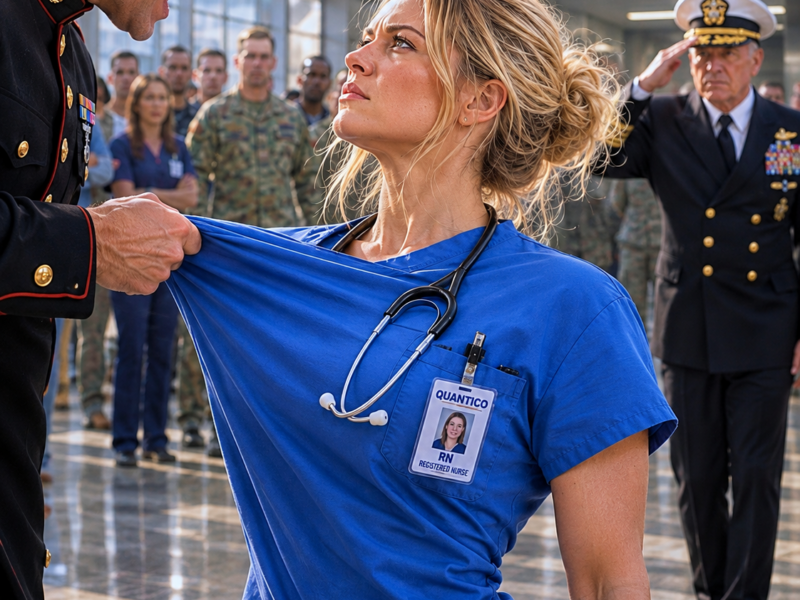
“I was ordered out of the medical tent at CFB Borden in front of two dozen soldiers, and when I tried to explain that I was following a physician’s orders
“Have you told them what happened at Kandahar?”
For a few seconds, I couldn’t find my voice.
The name seemed to hang in the air between us, heavier than the medical equipment scattered across the floor.
Major-General Whitmore was still standing in front of me.
Behind him, Warrant Officer Daniel Mercer had gone unusually quiet.
“No, sir,” I finally answered.
The general nodded slowly.
“Then I think it’s time we corrected that.”
I looked toward Ryan Mitchell.
His breathing had become shallower, and the monitor beside his bed was showing another irregular reading.
“Sir, with respect, this patient needs attention before we discuss anything else.”
Something softened in Whitmore’s expression.
“Of course. Take care of him.”
He turned toward the other medical personnel.
“Someone get Lieutenant Colonel Harris here immediately. And I want the ambulance crew on standby.”
The tent came alive again.
A medic moved toward Ryan.
I dropped the patient file onto the counter, pulled on a fresh pair of gloves, and returned to the examination table.
Mercer stepped aside without saying anything.
For the first time that morning, he wasn’t trying to tell me what to do.
I checked Ryan’s pulse, reviewed his latest readings, and called out the changes to the medic assisting me.
His condition was deteriorating.
Within minutes, Lieutenant Colonel Harris arrived.
He examined Ryan, listened to my assessment, and ordered an immediate transfer to the base medical facility for further evaluation.
The stretcher team arrived just as Ryan began complaining of dizziness.
“Stay with me, Corporal,” I said, adjusting the oxygen mask.
“Am I going to be okay, ma’am?”
I looked directly at him.
“You’re going to get the care you need. That’s what we’re concentrating on right now.”
He nodded weakly.
As the team wheeled him out, I noticed Whitmore watching from the entrance.
He didn’t interrupt.
He waited until the ambulance doors closed before approaching me again.
“Emily, may I speak with you privately?”
I glanced at the clock.
“I need to finish documenting his treatment.”
“Then finish it. I’ll wait.”
That surprised me more than his salute.
Generals weren’t known for waiting around while someone completed paperwork.
But Whitmore sat on a folding chair near the entrance and didn’t move.
Mercer remained standing several feet away.
He looked as though he’d swallowed something unpleasant.
I completed the medical notes, checked the remaining patients, and made sure another nurse had taken over my responsibilities.
Only then did I walk toward the general.
“Ready, sir.”
He stood.
“There’s a conference room in the administration building. We can talk there.”
Before we left, he turned toward Mercer.
“Warrant Officer, you’re coming with us.”
Mercer straightened.
“Yes, sir.”
I followed them outside.
The November air was cold enough to sting my cheeks.
Across the training grounds, soldiers were moving between buildings, carrying equipment and preparing for the afternoon exercise.
Everything looked ordinary.
That almost made the morning feel unreal.
Inside the administration building, Whitmore asked us to sit.
He removed his gloves and placed them beside a folder on the table.
Then he looked at me.
“How long has it been since you were last at Kandahar?”
“Six years, sir.”
“And have you spoken to anyone from the medical evacuation team since then?”
“Not recently.”
“Not even Captain James?”
My eyes moved toward the window.
“No.”
The general exhaled.
“Emily, I’ve wanted to speak with you for a long time.”
I folded my hands in my lap.
“Why?”
He opened the folder.
Inside was an old photograph.
It showed a group of military medical personnel standing beside a damaged field hospital.
I recognized the building immediately.
The photograph had been taken after an attack on the medical compound in Kandahar.
I was standing near the center, my uniform covered in dust.
Beside me was Captain James Bennett.
He had one arm around a young medic and a tired smile on his face.
I hadn’t seen that photograph in years.
Whitmore placed his finger near my image.
“Do you remember what happened that night?”
I nodded.
“I remember every minute.”
“Then you remember why Captain Bennett was never charged for disobeying the evacuation order.”
My throat tightened.
“I remember that too.”
Mercer shifted in his chair.
He looked at the photograph, then at me.
“What does this have to do with her?”
Whitmore turned toward him.
“Everything, Warrant Officer. But you’ll understand in a moment.”
He returned his attention to me.
“Six years ago, an evacuation order was issued after intelligence suggested another attack was imminent. The medical team was instructed to withdraw immediately.”
I nodded.
The memories came back in fragments.
The smell of diesel.
The constant vibration of the generators.
A distant explosion that shook dust from the ceiling.
And the sound of someone shouting my name.
“Captain Bennett refused to leave,” Whitmore continued.
“He said there were still wounded personnel inside the hospital.”
“He was right,” I said quietly.
Whitmore looked at me.
“How many?”
“Seven.”
“Seven patients?”
“Six patients and one local interpreter.”
I remembered their faces.
One had a shattered leg.
Another had burns across his back.
The interpreter had been unconscious when we found him.
There had been no time to move them all before the next evacuation vehicle departed.
Captain Bennett had told me to get aboard.
I had refused.
We argued for nearly a minute.
Then I went back inside.
I didn’t know whether I would make it out.
I only knew those people couldn’t be left behind.
Whitmore turned a page in the folder.
“The official report stated that Captain Bennett had delayed the evacuation to assist the medical team. It also noted that a civilian nurse remained behind voluntarily.”
“That was accurate.”
“Not entirely.”
I looked up.
“What do you mean?”
The general leaned back.
“The original operational report was incomplete.”
He took out another document.
It was a copy of a message sent from the field hospital that night.
I recognized the format, but not the handwriting at the bottom.
Whitmore slid it across the table.
“Read the final paragraph.”
I lowered my eyes.
The words were brief.
The medical evacuation team has confirmed that Nurse Emily Carter assumed responsibility for the remaining patients after the evacuation order. Her actions prevented the abandonment of seven casualties until a secondary transport team arrived.
I read it twice.
Then I looked at the general.
“That’s not what the final report said.”
“No,” he answered.
“It isn’t.”
I felt a familiar tightness in my chest.
“Why?”
Whitmore closed the folder.
“Because someone altered the wording before the report was finalized.”
Mercer leaned forward.
“Are you saying the record was falsified?”
“I’m saying the investigation found discrepancies that were never properly explained.”
He opened another section of the folder.
“There was also a recommendation for a commendation.”
I shook my head.
“I never received one.”
“I know.”
The general looked directly at me.
“Your name was removed from the final recommendation.”
I stared at him.
“By whom?”
He didn’t answer immediately.
Instead, he took out a second photograph.
This one showed several officers standing outside a command building in Kandahar.
I recognized two of them.
Captain Bennett.
And a younger officer standing beside him.
The second man was Daniel Mercer.
My eyes moved slowly from the photograph to the warrant officer sitting across from me.
Mercer had gone completely still.
I remembered him now.
Not clearly.
Not at first.
He had been a junior logistics officer attached to the evacuation coordination team.
I remembered a man with a clipboard, a radio, and a habit of speaking over people who were trying to explain something important.
But I had never known his full name.
“You were there,” I said.
Mercer looked down.
“Yes.”
“At Kandahar?”
“Yes.”
Whitmore placed the photograph on the table.
“Mercer was part of the team responsible for coordinating the secondary evacuation.”
I turned back to him.
“You told us the second transport had been reassigned.”
His face tightened.
“I was following the information I had.”
“You told Captain Bennett there was no vehicle coming.”
“That’s what the dispatch log showed.”
I remembered the moment vividly.
Captain Bennett had been standing beside the radio, demanding confirmation.
The wounded were still inside.
I had asked whether another ambulance was available.
Mercer had said no.
Then Captain Bennett made a decision.
He ordered the remaining team to stay.
We waited for nearly forty minutes.
Eventually, a transport vehicle arrived.
All seven casualties were evacuated.
We survived.
But the investigation afterward had focused on why Captain Bennett had disobeyed the original withdrawal order.
He had been questioned repeatedly.
His career had suffered.
And I had been asked to sign a statement saying I had stayed behind without authorization.
I had signed it.
I thought I was protecting him.
Now I understood there had been something else happening behind the scenes.
Whitmore opened the folder again.
“Emily, the dispatch log was later found to contain an unexplained alteration. The secondary transport had not been reassigned.”
I looked at Mercer.
He didn’t raise his eyes.
“You knew there was a vehicle coming?”
His hands tightened around the edge of his chair.
“I knew there was a possibility.”
“That isn’t what you told us.”
“No.”
“Why?”
He rubbed his forehead.
“I was under pressure.”
I waited.
He looked toward the general.
Whitmore’s expression remained unreadable.
“Explain it,” he said.
Mercer swallowed.
“The evacuation schedule had been changed. There was a conflict between the transport requests and the movement authorization. I was told to prioritize the command staff.”
I frowned.
“Over wounded patients?”
“It wasn’t that simple.”
“It was simple to us. We had seven people who couldn’t walk.”
Mercer looked at me.
“I didn’t know how many were still inside.”
“You were told.”
He didn’t answer.
Whitmore placed a hand on the folder.
“The records suggest that the vehicle was available. A later message indicated that the transport request had been acknowledged before the withdrawal order.”
I looked at the general.
“Then why was Captain Bennett investigated?”
“Because the official report claimed the medical team had delayed its evacuation after being informed that no further transport was available.”
I sat back.
The room seemed suddenly too small.
“Someone made it look like we had ignored a direct order for no reason.”
Whitmore nodded.
“That is one of the questions the review is examining.”
I turned toward Mercer again.
“Did you change the log?”
His lips parted.
Then closed.
For a moment, I thought he would deny everything.
Instead, he stared at the photograph.
“I changed one entry.”
The general’s expression hardened.
“Which entry?”
Mercer looked down at his hands.
“The status of the secondary vehicle.”
The silence that followed was complete.
I felt a chill move along my arms.
“Why?”
He took a breath.
“Because I had been told that the vehicle was needed elsewhere. I didn’t want the command staff to be blamed for the delay.”
“Who told you that?”
Mercer didn’t answer.
Whitmore closed the folder.
“That is now part of a formal review.”
Mercer leaned forward.
“General, I was a junior officer. I was following instructions.”
“You were responsible for the accuracy of an operational record.”
“I understand that.”
“Do you?”
Whitmore’s voice was quiet, but there was no softness in it.
“Because the people whose lives depended on that record were never given the opportunity to understand what happened.”
I looked away.
I didn’t want to see Mercer.
I wanted to remember the patients.
The interpreter whose hand I had held while we waited.
The young soldier who kept asking whether his brother knew he was alive.
Captain Bennett, standing in the doorway with a flashlight, refusing to leave.
For six years, I had carried the memory as a difficult but necessary choice.
Now I was learning that somebody had altered the story afterward.
And the man who had humiliated me that morning had been part of it.
Whitmore stood.
“Emily, there’s something else.”
I looked up.
He removed a smaller document from the folder.
It was a copy of a commendation recommendation.
My name appeared near the top.
So did Captain Bennett’s.
“This was submitted six years ago,” he said. “It was never formally withdrawn. It was simply never processed.”
I stared at the paper.
“Why are you showing me this?”
“Because the review has finally recovered the original submission.”
I ran my thumb along the edge.
For years, I had told myself that recognition wasn’t important.
I still believed that.
But seeing my name beside Captain Bennett’s brought back something I hadn’t expected.
The feeling of being remembered.
Not as a problem.
Not as someone who had refused an order.
But as a nurse who had stayed with her patients.
“Where is Captain Bennett now?” I asked.
Whitmore’s expression changed.
“He left active service three years ago.”
“Is he okay?”
“I believe so. He’s living in Halifax.”
I lowered the document.
“Does he know about this review?”
“Not yet.”
I looked toward the door.
“Then he deserves to hear about it.”
Whitmore nodded.
“I agree.”
Before he could say anything else, there was a knock.
A young staff officer entered carrying a tablet.
“General, Lieutenant Colonel Harris has requested an update. Corporal Mitchell is being transferred to the regional hospital. His condition is stable enough for transport.”
I stood immediately.
“Did they determine what caused the irregular pulse?”
The staff officer looked at his screen.
“Preliminary assessment suggests a significant cardiac issue. They’re conducting further tests.”
I exhaled.
“Thank you.”
The general glanced at me.
“Would you like to return to the medical team?”
“Yes, sir.”
“Then go.”
I gathered my papers.
As I reached the door, Mercer spoke.
“Nurse Carter.”
I stopped.
He looked as though he hadn’t slept in days.
“I owe you an apology.”
I turned around.
He struggled to meet my eyes.
“About this morning. I shouldn’t have spoken to you that way.”
I waited.
He continued.
“And about Kandahar.”
The apology sounded incomplete.
Maybe because it was.
Maybe because six years of silence couldn’t be repaired with a few sentences.
“Your apology doesn’t change what happened,” I said.
“I know.”
“And it doesn’t restore the time Captain Bennett lost.”
“No.”
I held his gaze.
“Then don’t make this about how you feel now. Make sure the truth is recorded correctly this time.”
He nodded.
I left without saying anything else.
The next three days at CFB Borden were difficult.
Corporal Mitchell was transferred to the regional hospital, where further testing confirmed a serious cardiac condition that required specialist treatment.
He was fortunate the medical team hadn’t released him back into training.
His mother called the clinic twice to thank the staff.
The second time, she asked to speak to me.
I remember standing in the hallway with the phone pressed to my ear.
“He’s my only child,” she said. “I know you were doing your job, but I want you to know what that means to a mother.”
I looked through the glass at the empty treatment room.
“He’s a good young man, ma’am.”
“Please tell him we’re proud of him.”
“I will.”
After the call, I sat alone for a few minutes.
I thought about the seven people in Kandahar.
I wondered how many families had received calls like that because someone had refused to leave a patient behind.
On the fourth morning, Whitmore asked me to meet him again.
This time, the folder was thicker.
There were printed emails, revised reports, dispatch records, and signed statements.
He had also contacted Captain Bennett.
I hadn’t spoken to James in six years.
We had exchanged a few messages after the investigation, but eventually the distance between us became too difficult.
He had believed I was angry with him.
I had believed he blamed me for what happened.
Neither of us had known what the other was thinking.
When Whitmore told me James was coming to Borden, I felt my stomach tighten.
“Does he know why?”
“Only that the review has recovered new evidence.”
I nodded.
“All right.”
Captain James Bennett arrived shortly after lunch.
He looked older than the man in the photograph.
His hair was almost entirely gray now, and he walked with a slight stiffness in his right leg.
But when he saw me, he smiled.
“Emily Carter.”
I stood.
“James.”
For a moment, neither of us knew whether to shake hands or embrace.
Then he opened his arms.
I stepped forward.
His jacket smelled faintly of cold air and coffee.
“I’m sorry,” he said quietly.
I pulled back.
“For what?”
“For letting six years go by.”
I shook my head.
“I thought you wanted nothing to do with me.”
He stared.
“Why would you think that?”
“After the investigation, you stopped calling.”
“I stopped calling because I thought you were tired of hearing from me.”
We both laughed once.
Not because anything was funny.
Because the misunderstanding was so painfully ordinary.
James looked at the folder.
“Have they finally found the original records?”
Whitmore nodded.
“They have.”
James pulled out a chair.
“Then let’s hear it.”
The general walked them through the recovered documents.
The altered dispatch entry was there.
So was the original transport confirmation.
And then came the message that changed everything.
It had been sent from the coordination office shortly before the evacuation.
The message confirmed that the secondary transport was available and had been assigned to the medical compound.
The recipient had acknowledged it.
Daniel Mercer.
James leaned back.
For a long time, he didn’t speak.
Then he rubbed his hands over his face.
“All those years.”
I watched him.
“I know.”
He looked at me.
“Do you remember what I told you when we finally got those patients out?”
I smiled faintly.
“You said you were never arguing with me again.”
He shook his head.
“No. I said I was never leaving a nurse behind again.”
I laughed softly.
“That’s what you said.”
He looked down.
“I should have fought harder when they questioned you.”
“You were fighting your own battle.”
“That doesn’t excuse it.”
“No,” I said. “But it explains some of it.”
Whitmore let the silence settle.
Then he spoke.
“The review board has recommended that the official record be corrected. It has also recommended that both of your commendation submissions be reconsidered.”
James looked at me.
“Both?”
I nodded.
“Apparently.”
He smiled.
“I never wanted a medal.”
“Neither did I.”
“But I wanted the record to be right.”
I looked at the photograph again.
“So did I.”
The general folded his hands.
“There’s one more matter.”
I turned toward him.
“Warrant Officer Mercer has submitted a written statement.”
I wasn’t sure how I felt about hearing his name.
Whitmore continued.
“He has acknowledged altering the dispatch status and failing to correct the record afterward. He has also identified the officer who instructed him to prioritize command transport.”
James frowned.
“Who?”
Whitmore looked at the document.
“At the time, it was a senior logistics officer who has since retired.”
He explained that the retired officer had been interviewed and had admitted directing Mercer to move the transport allocation.
The instruction had been given under pressure to ensure a senior command party reached another location before a scheduled briefing.
The medical team’s evacuation had been treated as a secondary concern.
But the transport had never actually been needed for the command party.
The vehicle had remained available.
The decision to mark it as unavailable had been made to hide the misallocation.
Mercer had changed the record.
The senior officer had allowed the false version to stand.
And Captain Bennett had spent years carrying the blame for a delay that had been caused by somebody else’s priorities.
I stared at the table.
It wasn’t one person’s mistake.
It was a chain of people choosing convenience over honesty.
“What’s happening to Mercer?” I asked.
Whitmore answered carefully.
“His conduct is being reviewed under the appropriate military procedures. I can’t promise you a particular outcome.”
I nodded.
“That’s fair.”
James looked toward the general.
“And the retired officer?”
“The review findings will be forwarded to the appropriate authorities.”
Nobody spoke for a while.
Then James turned to me.
“Do you remember the interpreter?”
I looked up.
“Samir?”
“Yes.”
I smiled.
“I remember him.”
“He wrote to me last year.”
My hands went still.
“What?”
James reached into his coat and removed a folded letter.
“He found my address through an old veterans’ association. He lives in Canada now.”
He placed the letter on the table.
“He wanted to thank us.”
I unfolded it carefully.
The handwriting was uneven, but the words were clear.
He wrote that after leaving Afghanistan, he had spent years trying to rebuild his life.
He had married.
He had a daughter.
He had started a small repair business.
And he remembered the nurse who had held his hand while the generators shook the walls.
I read that sentence twice.
Then I covered my mouth.
James looked at me.
“He remembers you, Emily.”
I couldn’t answer.
I had forgotten what his voice sounded like.
But I remembered his hand.
It had been cold.
He had been afraid.
And I had promised him that we weren’t leaving.
For six years, I had wondered whether staying behind had been the right decision.
Now I knew that at least one person had carried that moment with him.
I folded the letter and placed it back on the table.
“Can I keep a copy?”
“Of course,” James said.
That afternoon, Whitmore asked me to attend a small formal gathering at the base.
I almost refused.
I didn’t want a ceremony.
I didn’t want a microphone.
I didn’t want to stand in front of a room full of people while someone read out a list of things I’d done years earlier.
But James persuaded me.
“Sometimes the record needs witnesses,” he said.
So I went.
The gathering took place in a modest auditorium.
There were military personnel, medical staff, and several senior officers.
I stood near the front beside James.
Mercer was not present.
The general stepped up to the microphone.
He spoke about the importance of accurate records, medical independence, and the responsibility that came with authority.
He didn’t turn the gathering into a public trial.
He didn’t name people who weren’t there.
He simply acknowledged that the original account of the Kandahar evacuation had been incomplete and that the corrected findings recognized the decisions made by the medical team.
Then he read our commendation recommendations.
When he said my name, I felt my shoulders tense.
I walked forward.
Whitmore presented the certificate.
I accepted it with both hands.
He looked at me and spoke quietly enough that only I could hear.
“This is not for the salute.”
I met his eyes.
“I know, sir.”
“It’s for the people you refused to leave behind.”
I looked down at the certificate.
For years, I had thought that the most important thing about Kandahar was that all seven casualties had survived.
That remained true.
But standing there, I understood something else.
The truth mattered too.
Not because it made me look good.
Not because I needed strangers to admire me.
Because people deserved to know what had actually happened.
After the gathering, I stepped outside.
James joined me near the parking area.
The sky was beginning to turn orange over the training grounds.
He held two paper cups of coffee.
“One sugar,” he said, handing me a cup.
I smiled.
“You remembered.”
“Some things are hard to forget.”
We stood quietly for a while.
Then James asked, “Are you going to forgive Mercer?”
I looked toward the auditorium doors.
“I don’t know.”
He nodded.
“That’s fair.”
“I don’t want to spend the rest of my life being angry with him.”
“Neither do I.”
“But forgiveness doesn’t mean pretending it didn’t happen.”
James took a sip of coffee.
“No. It doesn’t.”
A week later, I received an email from Mercer.
The subject line read: A Personal Apology.
I nearly deleted it.
Instead, I opened it.
He wrote that he had spent several nights thinking about Kandahar.
He admitted that he had allowed his fear of being blamed to influence a decision that had affected other people’s lives.
He also admitted that his behavior toward me at Borden had come from the same place.
He had mistaken authority for respect.
He had believed that if people questioned him, he was losing control.
He said he was sorry.
He didn’t ask me to forgive him.
I read the message once.
Then I read it again.
I didn’t reply that day.
I didn’t owe him immediate comfort simply because he had finally found the words.
But a few days later, I wrote back.
I told him I appreciated the apology.
I told him I hoped he would be honest during the review.
And I told him that respect wasn’t something a person earned by making others afraid.
It was something they demonstrated when nobody was watching.
I never heard from him again.
The review continued for several months.
The official record was corrected.
Captain Bennett’s service history was amended to reflect the circumstances of the evacuation.
The recommendations were formally reconsidered, and the commendations were approved.
The senior officer’s actions were documented in the final findings.
Mercer’s own career consequences were handled through the appropriate process.
I didn’t follow every detail.
By then, I had learned that I didn’t need to spend my days waiting for justice to become a personal victory.
Some things were simply bigger than my anger.
Ryan Mitchell eventually recovered enough to return home.
He sent the medical team a handwritten card.
There was a photograph inside.
He was standing beside his mother in a hospital garden, looking thinner but smiling.
On the back, he had written:
“Thank you for not letting them send me back out there.”
I pinned the photograph above my desk.
It sat beside a copy of Samir’s letter.
Two pieces of paper.
Two lives that had continued because somebody had stopped long enough to listen.
A month after the ceremony, I returned to the medical tent at CFB Borden.
The same folding tables were there.
The same supply cabinets.
Even the old examination light still flickered when someone turned it on.
I stood near the spot where my tray had fallen.
For a moment, I could almost hear the metal instruments hitting the floor again.
Then I noticed a young nurse struggling with a supply box.
I walked over and helped her lift it.
“Thanks,” she said. “I’m still getting used to how things work around here.”
I smiled.
“It takes time.”
She hesitated.
“Can I ask you something?”
“Of course.”
“Is it true that a general once saluted a nurse in this tent?”
I looked at her.
“Yes.”
“Why?”
I thought about the question.
I could have told her about Kandahar.
I could have told her about the seven casualties, the altered records, the missing commendation, and the years of silence.
Instead, I glanced at the patient beds.
“Because he knew what had happened when someone needed help and everyone else was being told to leave.”
She considered that.
Then she nodded.
“That’s a pretty good reason.”
“It is.”
I returned to the desk and opened the day’s patient list.
Outside, soldiers were moving across the training grounds.
Inside, the monitor beside the nearest bed began its steady rhythm.
I checked the next name on the list, washed my hands, and reached for a fresh pair of gloves.
The certificate was still in my office.
The photograph was still above my desk.
But the moment I remembered most clearly wasn’t the general raising his hand.
It was the young corporal asking me whether he was going to be okay.
And the simple promise I had given him.
“You’re going to get the care you need.”
That was why I had become a nurse.
That was why I had stayed in Kandahar.
And that was why, no matter whose voice was loudest in the room, I would never forget whose life mattered most.
The end.









