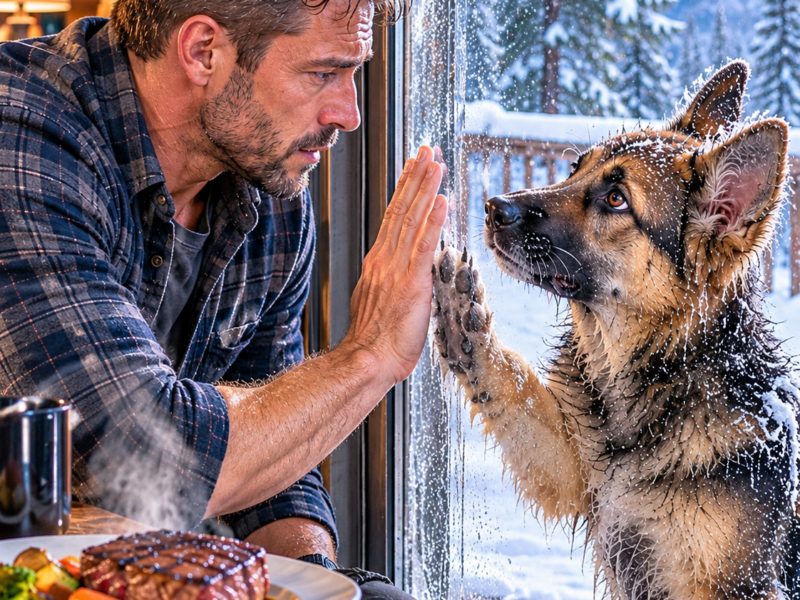
“I was halfway through my dinner at a roadside diner in northern Maine when a shivering puppy pressed both paws against the freezing window,
The man took another step toward us, and the headlights behind him illuminated his face.
He was in his late forties, wearing a dark green winter jacket and work boots covered in snow.
In his right hand was a flashlight.
In his left was a set of keys.
“Move away from the shed,” he repeated.
I didn’t move.
The brown puppy pressed himself against my leg, his entire body trembling beneath my coat.
“What’s your name?” I asked.
The man frowned.
“That’s none of your business.”
“Then tell me why there’s a puppy locked inside that shed.”
He glanced at the door.
For just a second, his expression changed.
It wasn’t surprise.
It was irritation.
“Those dogs belong to me. They’re always getting out.”
“Then why is one of them locked in a shed?”
“They’re being kept safe.”
I looked down at the brown puppy.
He had begun making a low, almost inaudible sound in his throat.
The man noticed.
“That’s enough, Buddy. Come here.”
The puppy backed away.
“Interesting,” I said. “You called him Buddy.”
The man shrugged.
“That’s what I call him.”
I pulled the small metal tag from beneath the puppy’s fur and held it where the flashlight could reach.
“Then why does this say something different?”
His eyes fixed on the tag.
For the first time, he looked genuinely unsettled.
“Where did you get that?”
“It was around his neck.”
He took another step.
“Give it to me.”
“Not until I understand what’s happening.”
His jaw tightened.
“You don’t understand anything. You’re a stranger who found two dogs and decided to play hero.”
“I found one puppy nearly frozen outside a diner and another locked inside a shed.”
I pointed toward the door.
“That’s what I understand so far.”
He looked past me toward the road.
I could hear the engine of his truck idling.
Then he lowered his voice.
“Listen, I’m going to give you one chance to walk away. You don’t want to get involved in this.”
I had heard that tone before.
Not from frightened men.
From men who believed nobody would question them.
I kept my voice calm.
“Then you should have called animal control before locking them in there.”
He swore under his breath.
At that moment, headlights appeared farther down the maintenance road.
Karen had called someone.
I hoped it was the authorities.
The man looked toward the lights and stepped backward.
“You have no idea what you’ve just done.”
He turned toward his truck.
I didn’t follow him.
I wasn’t interested in starting a confrontation in the woods with two frightened puppies nearby.
I was interested in making sure nobody could take them again.
“Stay where you are!” I called.
He ignored me.
By the time the approaching vehicle reached the clearing, his truck was already pulling away.
A few seconds later, the taillights disappeared behind the trees.
Karen climbed out of the arriving vehicle.
Behind her was a woman wearing a navy animal control jacket.
“I’m Officer Melissa Grant,” she said. “Karen told me you found two puppies.”
I nodded toward the shed.
“One’s inside. The door is locked.”
Melissa examined the padlock.
“Did you see anyone put them here?”
“Not directly. But a man just left. He claimed they belonged to him.”
“Did you get his license plate?”
I shook my head.
“Unfortunately, no.”
She took photographs of the shed, the tracks, and the note I’d found.
Then she crouched beside the brown puppy.
“Hey, sweetheart. Can I see your collar?”
He moved behind my boot.
Melissa didn’t force him.
Instead, she sat down in the snow and waited.
It took almost a minute before he approached her.
“Good boy,” she whispered.
She examined the red cord and carefully removed the tag.
Her expression changed when she read the name.
“Where did you find this?”
“On him.”
She turned the tag over.
Then she looked at me.
“Do you know who Daniel Mercer was?”
“I recognize the name.”
Melissa nodded slowly.
“Daniel Mercer was a local volunteer who worked with abandoned animals. He disappeared six months ago. His truck was found near the Penobscot River.”
“I remember reading about him.”
“They eventually ruled it an accidental drowning.”
I looked toward the road where the man had disappeared.
“And you’re telling me his name is on this dog’s tag?”
“Yes.”
Melissa turned the tag over again.
“But there’s something else.”
She pointed to a small engraving beneath the phone number.
It was a date.
June 14.
The day Daniel had disappeared.
Before I could ask anything else, a faint scratching came from inside the shed.
The white puppy was still waiting.
Melissa used a pair of bolt cutters from her vehicle to remove the padlock.
The door opened with a long metallic groan.
The smell inside was unpleasant.
There were old blankets, a plastic water bowl, and a torn bag of dog food.
The white puppy lifted its head.
Its eyes were crusted, and one of its front paws was wrapped in a dirty piece of cloth.
Melissa immediately called for veterinary assistance.
I removed my coat and placed it on the floor.
The little animal crawled onto it.
The brown puppy hurried inside and touched noses with the white one.
Then he curled beside it.
For several seconds, neither moved.
It was the first time that evening I’d seen the brown puppy stop watching the door.
Melissa looked at the note again.
“Please don’t let him take them back.”
She photographed the handwriting.
“Someone knew these puppies were in danger.”
“Could it have been Daniel?”
“Possibly. But we need to establish when this was written.”
She looked at the red cord.
“And we need to find out who that man was.”
I glanced at the phone number on the tag.
“Can you trace this?”
“We can try. But first, let’s get these two somewhere warm.”
The puppies were taken to a nearby veterinary clinic.
I followed in my truck.
I told myself I was only staying until they were examined.
That was what I said when the veterinarian placed the white puppy on a heated blanket.
It was what I said when the brown one refused to eat unless his companion was within sight.
And it was what I said when Melissa asked whether I could remain available as a witness.
But somewhere between the examination room and the parking lot, I had stopped thinking about going home.
The veterinarian, Dr. Emily Foster, came out carrying a clipboard.
“The brown one is dehydrated and underweight, but he’ll recover. The white one is in worse shape. He’s got an infected paw and needs antibiotics.”
“Will they both be okay?”
She gave me a reassuring smile.
“If we can keep them warm and get them eating regularly, their chances are good.”
I looked through the glass at the two little animals.
“Are they brothers?”
“We can’t know for certain, but they have a strong bond.”
She paused.
“The brown puppy keeps positioning himself between the other one and anyone who approaches. Even when he’s exhausted.”
I nodded.
“He’s been doing that all night.”
Dr. Foster glanced at the tag Melissa had placed in an evidence bag.
“That’s an unusual collar.”
“Why?”
“The cord is handmade. And that tag looks older than the puppies.”
I studied the little red string in the bag.
“Could someone have transferred it from another dog?”
“Certainly.”
A few minutes later, Melissa returned from speaking with her supervisor.
She had a name.
The man in the green jacket was named Richard Hale.
He owned a small property maintenance company outside Camden.
According to local records, he had previously worked with Daniel Mercer at a private animal rescue operation.
That didn’t make him guilty of anything.
But it gave the investigation somewhere to start.
“Did Daniel have family?” I asked.
“His daughter, Sarah. She’s twenty-seven. She lives in Portland.”
“Did she report him missing?”
Melissa nodded.
“She did. She never accepted the accidental drowning ruling.”
I looked at the tag again.
“Then perhaps she should see this.”
Melissa agreed.
She called Sarah the following morning.
By noon, Sarah was standing in the veterinary clinic.
She was a slender woman with dark hair tied loosely behind her head.
Her eyes were red, and she held her purse with both hands as if it were the only thing keeping her steady.
When Melissa showed her the tag, Sarah didn’t speak.
She simply touched the glass of the puppy enclosure.
“That’s my dad’s.”
“You’re sure?” Melissa asked.
Sarah nodded.
“He made that himself. He used to put one on every dog he rescued.”
She stared at the red cord.
“He said it was so they would always have a way home.”
I watched her face.
“Do you recognize the name?”
Sarah looked down.
“Oliver.”
She pointed at the brown puppy.
“That’s Oliver.”
Then she looked at the white one.
“His brother’s name is Finn.”
She took a shaky breath.
“My dad rescued them when they were barely three weeks old. Their mother had been killed on a road near his property.”
“Did your father ever mention Richard Hale?” Melissa asked.
Sarah’s expression tightened.
“Richard worked with him. At least, he used to.”
“What happened?”
Sarah looked at the floor.
“They argued a few weeks before Dad disappeared.”
“About what?”
“Money.”
She rubbed her thumb against the edge of her purse.
“My dad ran a small rescue operation. Richard handled some of the transportation and supply purchases. Dad discovered that several donations had disappeared.”
Melissa wrote something down.
“Did he confront Richard?”
“Yes. He told me he was going to report him.”
Sarah swallowed.
“But Richard said it was all a misunderstanding. Dad didn’t believe him.”
I remembered the man standing beside the shed.
His irritation.
His demand for the tag.
His warning that I didn’t know what I’d gotten involved in.
“Did your father ever tell you he was afraid of Richard?”
Sarah shook her head.
“Not afraid. Disappointed.”
She looked at Oliver.
“He used to say that the hardest thing was realizing someone you trusted had been taking advantage of the people you were trying to help.”
For a moment, nobody spoke.
Then Sarah asked the question that had been bothering me.
“Where did you find them?”
I told her about the diner.
About Oliver standing against the glass.
About the food.
And about the shed.
When I mentioned the note, Sarah covered her mouth.
“That handwriting…”
She reached into her purse and pulled out her phone.
She opened a photograph.
It showed a handwritten letter on a kitchen counter.
I recognized the uneven letters immediately.
“That’s my dad’s handwriting,” she whispered.
Melissa leaned closer.
“Can you send us that photograph?”
Sarah nodded.
Then she looked at me.
“Did Oliver lead you to the shed?”
“Yes.”
She stared at the puppy for a long moment.
“My dad used to tell me something about him.”
“What?”
Sarah smiled sadly.
“When Oliver was little, he wouldn’t eat unless Finn was beside him. Dad said he was the smallest dog he’d ever seen with the biggest heart.”
She wiped her cheek.
“He must have been trying to get someone to help his brother.”
I looked through the glass.
Oliver had his head resting on Finn’s back.
For the first time, I understood that the little dog hadn’t been begging for my dinner.
He had been asking me to notice that someone else was hungry.
And that someone else was running out of time.
The investigation moved quickly over the next several days.
Melissa obtained permission to search the abandoned rescue property Daniel had operated.
Sarah accompanied her.
I stayed at the clinic, helping Dr. Foster with the puppies.
I hadn’t planned to become involved.
But I found myself returning every morning before breakfast.
Oliver recognized my footsteps.
He would lift his head whenever I entered.
Finn was slower to recover.
He needed medication, careful cleaning, and small meals throughout the day.
Sometimes Oliver would refuse his food until Finn had eaten.
The veterinarian finally started feeding them from separate bowls, with both placed side by side.
It worked.
On the fourth day, Finn managed to stand without falling.
Oliver wagged his tail so hard that his whole body seemed to move.
I laughed.
It was the first genuine laugh I’d had in longer than I cared to admit.
Meanwhile, Melissa found something at Daniel’s property.
A locked filing cabinet.
Inside were invoices, donation records, and several handwritten notes.
One of the documents showed payments made to a company registered under Richard Hale’s name.
The amounts were small enough to escape attention individually.
Together, they totaled nearly forty thousand dollars.
But the most important discovery was a notebook.
Daniel had written down dates, names, and descriptions of several transactions.
At the bottom of the final page was a sentence.
“Richard has been moving the animals without authorization. I have copies of everything.”
Sarah read the sentence twice.
Then she sat down.
“Why didn’t Dad tell me?”
Melissa spoke gently.
“Maybe he was trying to protect you.”
Sarah shook her head.
“I don’t need protection from the truth.”
She turned another page.
There was a reference to a storage unit outside town.
And beneath it, Daniel had written a phone number.
The same number engraved on Oliver’s tag.
Melissa arranged a warrant.
Inside the storage unit, investigators found old rescue equipment, several boxes of paperwork, and a small portable recorder.
The recorder contained two saved audio files.
The first was a conversation between Daniel and Richard.
I wasn’t present when they listened to it, but Sarah later told me what it contained.
Daniel had accused Richard of taking money from the rescue donations and arranging unauthorized transfers of animals to an unlicensed breeding operation.
Richard denied it.
Then Daniel said he had evidence.
Richard’s voice became quieter.
He told Daniel to leave things alone.
The second recording was shorter.
Daniel was speaking alone.
“Sarah, if you’re hearing this, I need you to know I tried to do the right thing. I made copies of the records. The originals are in the office. If anything happens to me, please don’t let Richard near the dogs.”
There was a long pause.
Then Daniel added something that made Sarah cry.
“Tell Oliver and Finn I didn’t forget them.”
The recording ended.
It didn’t prove what had happened to Daniel.
But it changed the investigation.
The police reopened the case and began looking into Richard’s movements during the night Daniel disappeared.
They also discovered that Richard had recently sold his maintenance company and planned to leave Maine.
He was arrested two days later at a motel near Bangor.
At first, he denied everything.
Then investigators presented him with the financial records, the recordings, and evidence from the shed.
Richard finally admitted that he had been using the rescue operation to move animals illegally and divert donations.
He also admitted that Daniel had confronted him on the night he disappeared.
But he insisted he had not killed him.
According to Richard, they had argued beside the river.
Daniel had slipped on the wet bank and fallen into the water.
Richard claimed he panicked and left.
He said he had been too afraid to report what happened because he knew his own financial crimes would be discovered.
It was a terrible explanation.
But it was the first truthful account anyone had heard in six months.
Investigators later found evidence supporting parts of his statement.
Richard was charged with fraud, animal cruelty, and several related offenses.
The case involving Daniel’s death remained under investigation.
For Sarah, the arrest brought no immediate relief.
She had spent six months imagining every possible ending to her father’s disappearance.
Now she had an explanation, but no chance to ask him why he hadn’t come home.
One afternoon, I found her sitting outside the clinic.
She was holding a paper cup of coffee.
“Do you ever get used to losing people?” she asked.
I sat beside her.
“No.”
She looked at me.
“That’s not very encouraging.”
I gave a small shrug.
“I’ve learned that getting used to something and learning how to live with it are two different things.”
She stared toward the parking lot.
“My dad always said that if he could save one animal, the day wasn’t wasted.”
“Sounds like a good man.”
“He was.”
Her voice cracked.
“I just wish I had answered his last phone call.”
I didn’t know what to say.
She continued.
“He called me the evening he disappeared. I was at work, and I let it go to voicemail. I thought I’d call him back later.”
She pressed the coffee cup between her palms.
“That voicemail is still on my phone.”
I looked at her.
“Have you listened to it?”
“Too many times.”
She gave a sad smile.
“He was asking if I could come over for dinner.”
We sat quietly.
There are things you cannot repair by saying the right sentence.
Sometimes the only decent thing you can do is stay.
So I stayed.
A week later, Dr. Foster told us Finn was healthy enough to leave the clinic.
Oliver had already recovered.
Sarah was preparing to take both puppies home.
She had arranged a small space in her apartment and bought two beds, food bowls, toys, and a ridiculous number of chew treats.
But when she came to collect them, she hesitated.
“I don’t know if they’ll be okay without me all day.”
“They’ll adjust,” Dr. Foster said.
Sarah nodded.
Then she looked at me.
“I was wondering…”
She stopped.
“What?”
“Would you consider adopting them?”
I looked at Oliver and Finn.
They were asleep beside each other.
I rubbed the back of my neck.
“I’ve never owned a dog.”
Sarah smiled.
“Neither had my dad, before he started rescuing them.”
I laughed quietly.
“That’s not exactly a convincing argument.”
“I know.”
She knelt beside the puppies.
“They remind me of him. But I think they’d have a good life with you.”
I glanced at the animals.
Oliver opened one eye.
Then he got up and walked toward me.
He sat on my boot.
Finn followed, moving a little more carefully.
I looked at Sarah.
“You sure?”
She nodded.
“I want them to go somewhere they feel safe.”
I thought about my empty house.
The quiet kitchen.
The cold mornings.
The nights when I left the television on simply because I didn’t like how silent everything became.
Then I looked down at the two puppies.
“All right,” I said. “But I should warn you. I have absolutely no idea what I’m doing.”
Sarah laughed.
“Neither did my dad.”
I adopted them that afternoon.
The first few nights were difficult.
Oliver barked at the refrigerator.
Finn refused to sleep unless his bed was close to mine.
They chewed one of my boots and knocked over a lamp.
I found myself buying toys I didn’t understand and reading articles about puppy behavior at two in the morning.
But slowly, the house began to change.
There were paw prints across the kitchen floor.
There were toys beneath the couch.
There was always someone waiting near the door when I came home.
And for the first time in years, I had a reason to get out of bed before sunrise that had nothing to do with nightmares.
Sarah visited often.
She brought treats and old photographs of her father.
One afternoon, she gave me a picture of Daniel holding Oliver and Finn when they were tiny.
He was sitting on the floor of the rescue office, smiling at the camera.
On the back, he’d written:
“Two small lives. A whole lot of hope.”
I framed it and placed it on the shelf above the fireplace.
Three months after the night at Millie’s, I returned to the diner.
Karen recognized us immediately.
“Well, look who’s back!”
Oliver pulled toward the entrance.
Finn followed, his tail wagging.
I ordered a turkey sandwich and sat by the same window where Oliver had first appeared.
Karen brought two small bowls of plain chicken.
“On the house,” she said.
I looked at the dogs.
“Don’t get used to this.”
She laughed.
Outside, snow was falling again.
A young boy at the next table noticed Oliver sitting beside my chair.
“Is he your dog?”
“Both of them are.”
The boy looked at the two puppies.
“Which one is the brave one?”
I glanced down at Oliver.
Then at Finn.
“That’s a difficult question.”
The boy tilted his head.
“Why?”
“Because sometimes being brave doesn’t mean you’re not scared.”
I scratched Oliver behind the ears.
“Sometimes it just means you keep going because someone else needs you.”
The boy seemed to think about that.
Then he smiled and returned to his hot chocolate.
As I reached for my coffee, I noticed something beneath the window.
A small red cord had been tied around the wooden frame.
Karen saw me looking.
“Sarah put that there yesterday. Said she wanted to leave something for her dad.”
I touched the cord gently.
There was no metal tag attached.
Just a simple knot.
I sat there for a long moment, listening to the wind outside and the soft breathing of the two dogs beside me.
I had spent years believing that the important things in life were the missions we completed, the people we brought home, and the promises we managed to keep.
But that little brown puppy had taught me something I hadn’t expected.
Sometimes the most important thing you can do is notice someone who has been standing outside in the cold, waiting for anybody to care.
Oliver nudged my hand.
Finn rested his head against my boot.
I broke off a tiny piece of chicken and placed it in each bowl.
This time, nobody was left waiting outside.
And when I looked through the diner window at the falling snow, I realized that the little dog who had once begged to share my dinner had given me something far greater than a reason to rescue him.
He had given me a home that finally felt alive again.
The end.









