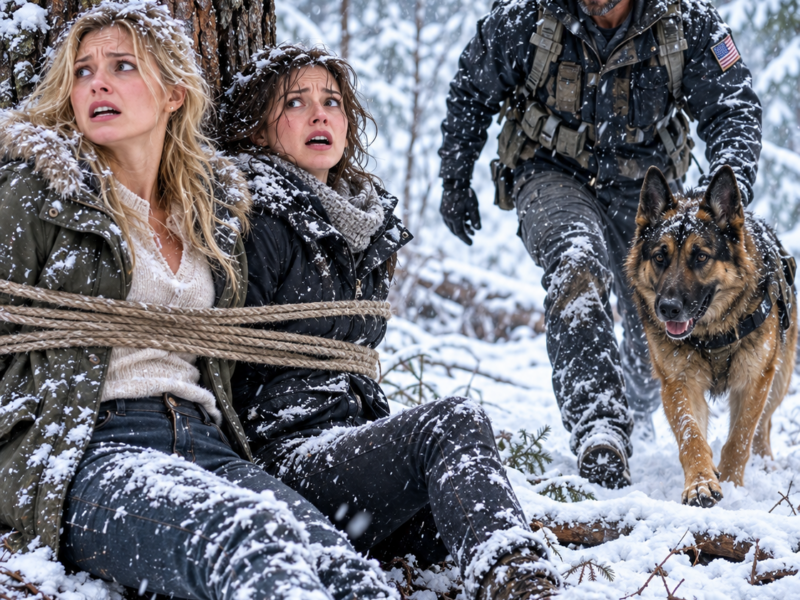
“I was halfway through calling 911 when my German Shepherd began clawing at the snow beside an abandoned logging road in Maine
I held the red mitten beneath my jacket, feeling the hard object sewn into its lining, while the stranger’s footsteps drew closer through the snow.
Ranger stood between me and the logging road, his lips pulled back just enough to reveal his teeth.
“Jack,” the man called again. “I’m not here to hurt anybody. Just give me what you found, and you can go home.”
I had heard that tone before.
Men who intended no harm rarely needed to announce it twice.
I looked down at the two women. Sarah, the older one, was struggling to stay conscious. The younger woman had managed to push herself onto one elbow, but her trembling arms could barely support her weight.
“Can you both walk?” I whispered.
Sarah shook her head.
The younger woman tried to answer, but a coughing fit cut her off.
I had less than a minute to make a decision.
The ambulance was still coming, but the truck on the road blocked the easiest route back to mine. Whoever this man was, he knew my name, knew Ranger, and seemed certain I’d found something he wanted.
I eased the mitten into my pocket and took out my phone.
No signal.
Of course.
“Stay low,” I whispered to the women. “Whatever happens, don’t run toward the road.”
Sarah caught my sleeve.
“He’s not alone.”
I studied her face.
“What do you mean?”
She glanced toward the trees beyond the road.
“There’s another one.”
A sharp crack sounded somewhere in the woods.
Not a branch breaking under snow.
A gunshot.
Ranger lunged toward the sound, barking so fiercely that the man on the road cursed.
I pulled the women behind a fallen tree and crouched beside them.
“Did he shoot at you?” I asked.
Sarah shook her head, tears gathering at the corners of her eyes.
“No. He shoots to make people do what he wants.”
Before I could ask another question, a second voice called from the road.
“Caleb, we’ve got company coming.”
Caleb.
The name meant nothing to me at first.
Then the man stepped into the edge of my flashlight beam.
He was tall, broad-shouldered, and dressed in a dark winter coat. Snow clung to his beard, and a thin scar ran from his left temple toward his ear.
I recognized him.
Not from Maine.
From a photograph buried in an old military intelligence file I’d seen during my final deployment.
His name was Caleb Voss.
Four years earlier, Voss had reportedly died in a vehicle accident overseas while working as a civilian security contractor.
The official report said his vehicle had caught fire.
No remains had been positively identified.
At the time, I hadn’t questioned it. Contractors disappeared from records more often than people wanted to admit.
Now he was standing twenty yards away, calling my name in a Maine forest.
“That’s impossible,” I whispered.
Sarah heard me.
“You know him?”
“I know who he’s supposed to be.”
She closed her eyes.
“Then you understand why we can’t let him take that mitten.”
Caleb took another step toward us.
“Jack, I know what you’re thinking. You’re remembering an old report and trying to fit me into it.”
His voice carried easily through the trees.
“Don’t make this more complicated than it needs to be.”
I kept my pistol trained toward the ground near his feet, ready to respond if he forced the situation.
“You know my name,” I called back. “You know my dog. Start explaining.”
He smiled without warmth.
“Four years in the service teaches you to recognize useful people. Four years outside it teaches you how easy it is to find them.”
“Who are these women?”
“People who made some very bad decisions.”
The younger woman pushed herself upright.
“That’s a lie.”
Caleb turned toward her.
For the first time, the pleasant expression disappeared from his face.
“Emily, you should save your strength.”
She flinched at the sound of her name.
That told me more than anything else he had said.
He knew them.
They knew him.
And whatever had happened between them, these women had been terrified enough to crawl into a freezing forest rather than stay where he’d left them.
I heard an engine approaching on the logging road.
Caleb looked over his shoulder.
A second vehicle was coming.
His companion swore.
“Caleb, we need to leave. Now.”
Caleb’s eyes returned to me.
“Last chance, Jack.”
I didn’t move.
He stared at Ranger, then slowly raised both hands as if to show he wasn’t a threat.
“You’re making a mistake over two strangers.”
“Maybe.”
I shifted my weight, watching his hands.
“But I’m comfortable with that.”
For a moment, I thought he might rush us.
Instead, he backed away toward the road.
“This isn’t over,” he said.
Then he disappeared behind the trees.
The second vehicle stopped beside the pickup.
Doors slammed.
An engine roared, and both vehicles pulled away in opposite directions.
I didn’t follow them.
I had two women losing body heat, an approaching ambulance, and a strange object hidden inside a child’s mitten.
Chasing Caleb Voss would have been the easiest way to make a bad night worse.
I turned to the women.
“Tell me your names.”
The younger one swallowed.
“Emily Hayes.”
The older woman took a shaky breath.
“Sarah Bennett.”
“All right, Sarah. Emily. Help is coming. But I need to know if anyone else is out here.”
Sarah looked toward the road where Caleb had vanished.
“Not anymore.”
Her answer wasn’t reassuring.
A few minutes later, Ranger began barking at the sound of sirens.
The first emergency vehicle reached my truck, followed by a sheriff’s SUV. Two paramedics hurried into the woods with a stretcher and medical bags.
I holstered my pistol before the deputy approached.
He was a heavyset man in his fifties with silver hair and a weathered face. His nameplate read HARRIS.
“Jack Mercer?”
“That’s me.”
“We got a call about two hypothermia victims. You see anybody else out here?”
“One man. Caleb Voss.”
Harris stopped walking.
For a moment, the only sound was the crunch of his boots.
“Say that again.”
“Caleb Voss. He came looking for the women.”
The deputy glanced at the ambulance crew, then back at me.
“Did you get a good look at him?”
“Good enough.”
Harris rubbed his jaw.
“That name isn’t one I expected to hear tonight.”
“You know him?”
He hesitated.
“I know the name from an old investigation.”
“Which investigation?”
Harris looked toward the women as the paramedics lifted Emily onto the stretcher.
“Let’s get them to the hospital first.”
It wasn’t an answer, and we both knew it.
I rode behind the ambulance to Eastern Maine Medical Center in Bangor. Sarah and Emily were taken into separate treatment rooms, where doctors worked to warm them slowly and check for internal injuries.
I sat in the waiting room with Ranger curled against my boots.
The little mitten rested in my coat pocket.
I kept touching it to make sure it was still there.
At 2:17 a.m., a nurse came out and told me both women were stable.
Emily had severe hypothermia and several older injuries, but the doctors expected her to recover. Sarah had a concussion and a badly sprained wrist.
“Can I speak to them?”
“One at a time, and only briefly.”
I went to Sarah first.
She lay beneath a white blanket, her face pale against the pillow. Without the snow and dirt, she looked younger than she had in the woods.
Her eyes opened when I entered.
“Did you give him the mitten?”
“No.”
She let out a breath that seemed to come from somewhere deep inside her.
“Thank you.”
I pulled a chair beside her bed.
“Sarah, I need the truth. Who is Caleb Voss, and why did he leave you in the woods?”
She stared at the ceiling.
For several seconds, I thought she wouldn’t answer.
Then she turned her head toward me.
“Because he believes my daughter died four years ago.”
I glanced at the red mitten in my hand.
“Your daughter?”
She nodded.
“Her name was Lily. She was six when the accident happened at Miller’s Bridge.”
I remembered the old news reports.
A vehicle had crashed through the bridge railing during a winter storm. The driver was pronounced dead at the scene after the car was recovered downstream. His wife and daughter had never been found.
The reports had identified the driver as Daniel Bennett.
Sarah’s husband.
“You’re Daniel Bennett’s wife?”
“Yes.”
“But the police searched for you.”
“They searched the riverbanks. They searched the woods near the bridge. They searched our house.”
She swallowed.
“They didn’t search the places Caleb told them not to.”
I leaned forward.
“What does that mean?”
Sarah looked at the door before answering.
“Caleb was Daniel’s business partner. They worked in private security, transporting sensitive equipment for government contractors. I didn’t know much about the work. I knew they traveled often, and I knew Daniel had started coming home afraid.”
“Afraid of Caleb?”
“At first, he said Caleb was under pressure. Then he stopped using his name at all.”
She closed her eyes briefly.
“Three days before the bridge accident, Daniel came home with a red mitten. Lily had lost the other one at school, and he promised he’d find it. He told me to keep the mitten safe because he might need it someday.”
My gaze dropped to the small knitted object.
“This one?”
“Not that one. The original was buried with the evidence from the accident, or so Caleb believed.”
She paused.
“The mitten you found tonight belonged to Lily. I made it myself. I knitted her a new pair after the first set disappeared.”
My fingers tightened around the wool.
“Why was it with you?”
“Because I put something inside it.”
“What?”
“A memory card.”
The room seemed to grow quieter.
Sarah watched my face.
“Daniel discovered that Caleb was using their company to move equipment that wasn’t listed in the contracts. There were payments to shell companies, falsified manifests, and records of shipments that never reached their stated destinations.”
She took a shallow breath.
“Daniel copied what he could prove. He hid the memory card inside Lily’s mitten because he knew Caleb would search our belongings if he suspected anything.”
“And Miller’s Bridge?”
“Daniel staged the accident to make Caleb believe he was dead.”
I stared at her.
“Staged?”
“He drove the vehicle over the railing after moving Lily and me to a safe place. He knew the river would destroy most of the evidence. But Caleb had arranged for the road to be watched. Daniel didn’t know how much of the plan Caleb had uncovered.”
Her voice broke.
“The car went into the river. Daniel didn’t come back.”
I sat very still.
“Did he survive?”
Sarah’s eyes filled with tears.
“I don’t know.”
That was the first answer she’d given me that sounded like the whole truth.
She wiped her cheek with the edge of the blanket.
“Caleb found us two days later. He told me Daniel had died and Lily was safe. He said he could protect us if I handed over the evidence.”
“Did you believe him?”
“I was terrified, and I wanted to believe someone could help me.”
She looked down at her injured wrist.
“He moved us between houses and told us never to contact the police. He said the people involved had friends everywhere. I couldn’t tell which parts were true anymore.”
“How did you escape?”
“Emily helped me.”
“Who is Emily to you?”
“She worked for Caleb. She handled paperwork and travel arrangements. At first, she believed the company was legitimate. Then she found Daniel’s name in a shipment file dated months after his supposed death.”
Sarah’s voice dropped.
“She started asking questions. Caleb noticed.”
I thought of the bruises around Emily’s wrists.
“What happened to her?”
“He locked her in a storage room for two days. When he finally let her out, he told her she would disappear if she tried to leave.”
Sarah looked toward the window.
“Last night, she found a chance. We took a truck from one of his properties and drove until the engine overheated. We walked through the woods, hoping to reach the main road. Then Caleb found us.”
“And left you to freeze?”
“He wanted us frightened enough to give up the mitten. He thought we’d buried it near the bridge. When he realized we still had it, he decided to make us believe we wouldn’t survive the night.”
My jaw tightened.
“That’s not something a man does just to recover a memory card.”
“No,” Sarah whispered. “It’s something a man does when he’s afraid of what the card will prove.”
I took the mitten from my pocket.
“Then let’s find out.”
Sarah reached for my hand.
“Jack, before you look at what’s inside, there’s something else you need to know.”
I waited.
“Caleb didn’t recognize you because of your military record.”
She glanced toward Ranger, who was lying outside the open doorway.
“He recognized you because Daniel knew you.”
I stared at her.
“I never met Daniel Bennett.”
“You might not remember him. But four years ago, before the bridge accident, Daniel contacted a man in your unit. He needed help moving his family somewhere safe. He was told the request would be handled.”
I felt an old memory shift in the back of my mind.
A late-night briefing.
A name on a document.
A request for assistance that had been classified as an unverified civilian matter.
I’d been deployed overseas at the time, and I hadn’t been involved in the decision.
“Who handled it?” I asked.
Sarah shook her head.
“Daniel never told me.”
I looked at the mitten again.
Whatever was hidden inside it had already reached farther into my life than I could have imagined.
The next morning, I met Emily in her hospital room.
She was sitting upright, wearing a gray sweatshirt someone had brought her. A cup of untouched coffee rested on the bedside table.
She watched me enter.
“Sarah told you about the card?”
“Some of it.”
Emily nodded toward the chair.
“Then you should know Caleb won’t stop looking for us.”
“He’s going to have a hard time finding you in a hospital full of deputies.”
“You think that will stop him?”
She didn’t sound sarcastic.
She sounded tired.
I sat down.
“Tell me what you know.”
Emily rubbed her wrists.
“Caleb kept two sets of records. The official company files and a private archive. The official records were designed to survive an audit. The private archive showed who actually authorized the shipments and where the money went.”
“Did you see the archive?”
“Not all of it. I copied fragments before he caught me.”
“Where are they?”
She looked toward her bag on the floor.
“On a flash drive hidden in the lining.”
I didn’t reach for it.
“Why didn’t you tell the police?”
“Because the last time I tried, the officer I spoke to called Caleb before I finished explaining.”
I waited for her to continue.
“I don’t know whether that officer was corrupt or simply knew him. But Caleb arrived at my apartment less than an hour later.”
“Did you report that?”
“To whom? The same people?”
Her question hung between us.
I couldn’t tell her that every officer was trustworthy.
I couldn’t tell her that none of them were.
Instead, I said, “We’ll make sure the evidence goes to someone who can’t quietly bury it.”
Emily studied me.
“Why are you helping us?”
I looked at the bruises on her wrists.
“Because I found you in the snow.”
She shook her head.
“That’s not enough.”
“Maybe not. But it’s where I’m starting.”
For the first time, she seemed to relax.
Then she told me about a photograph she’d found among Daniel’s copied files.
It showed a man standing beside a warehouse loading dock, his face partly hidden by the shadow of a baseball cap.
The photograph had been taken six months after the Miller’s Bridge accident.
The man was Daniel Bennett.
Alive.
I felt the room tilt beneath me.
“You’re sure?”
“I compared it with family photographs Sarah kept. Same scar on his chin. Same crooked left ear.”
“Where was the picture taken?”
“An industrial property outside Portland. The date was printed on the back.”
I stared at her.
“Why would Caleb keep a photograph of a man he supposedly watched die?”
“Because Caleb wasn’t sure Daniel was dead.”
Emily lowered her voice.
“He told someone on the phone that if Daniel surfaced, the entire operation would collapse.”
A knock came at the door.
Deputy Harris stood in the hallway.
He looked as though he’d spent the night awake.
“Jack, I need a word.”
I stepped outside and pulled the door closed behind me.
Harris glanced toward the nurses’ station before speaking.
“I ran the name you gave me. Caleb Voss’s death was recorded overseas, but the documentation has inconsistencies. The local department never received a confirmed identification.”
“So the death report could have been false.”
“Could have been.”
He rubbed his eyes.
“I also checked the Miller’s Bridge case. The original investigator retired two years ago. The file contains a sealed evidence supplement that was never entered into the public record.”
“What was in it?”
“A witness statement from a gas station attendant who claimed he saw Daniel Bennett driving away from the bridge that night.”
I stared at him.
“Why wasn’t that followed up?”
“According to the file, the witness recanted the next morning.”
“Did anyone ask why?”
Harris gave me a tired look.
“The notes say he was afraid for his family.”
I thought of Sarah’s shaking hands, Emily’s bruised wrists, and the man who had called me by name in the forest.
“Can you reopen the case?”
“I’ve requested it. But if the records were deliberately altered, this goes beyond a missing-person investigation.”
He paused.
“I need to ask you something. When you found those women, did you take anything from them?”
I held his gaze.
“A mitten with a memory card inside.”
Harris exhaled slowly.
“Then don’t plug it into a computer, don’t make copies on your personal devices, and don’t let it out of your sight. We’ll arrange a documented transfer to the state investigators.”
“Are you sure we can trust the process?”
He didn’t take offense.
“No,” he said. “I’m sure we have to make it harder for anyone to manipulate.”
That answer earned my respect.
By noon, a state investigator arrived at the hospital. Her name was Rebecca Cole, and she had a quiet manner that made people speak more carefully around her.
She interviewed Sarah and Emily separately, then met with Harris and me.
When I showed her the mitten, she didn’t touch it.
“We’ll photograph it, document the chain of custody, and have the card examined by our digital forensics team,” she said. “If it contains what you believe it contains, we’ll need corroboration.”
“From where?”
“Financial records, shipment manifests, witness statements. Whatever can be independently verified.”
She looked at me.
“Mr. Mercer, I need you to understand something. If Voss has been operating under a false identity, he may have access to resources that make this investigation dangerous.”
“I understand.”
“Good. Then don’t try to find him yourself.”
I almost smiled.
“I wasn’t planning to.”
She gave me a look that suggested she had heard that promise before.
The card was removed under controlled conditions and placed in a sealed evidence container.
Two hours later, Cole returned with a laptop and a printout.
“The card contains several encrypted folders,” she said. “One was accessible without a key. It includes photographs of shipping manifests, partial bank records, and audio files.”
“Can you tell what the shipments were?”
“Some of them. Most are ordinary equipment on paper. But the declared weights don’t match the shipping logs, and several payments went to companies with no verifiable operations.”
She laid the printout on the table.
“There’s also a spreadsheet listing individuals who authorized specific transfers.”
I scanned the names.
Most meant nothing to me.
Then I saw one that did.
Commander Robert Hale.
My former commanding officer.
For several seconds, I couldn’t speak.
Hale had been the man who signed my separation paperwork. He’d written a recommendation that helped me get my first civilian security job. He’d sent a condolence letter when my father died.
He was the closest thing I’d had to a mentor in the service.
“Is this verified?” I asked.
“Not yet. A name on a spreadsheet isn’t proof of criminal conduct. We need to establish whether this is the same person and what the authorization actually means.”
I nodded, but my hands had gone cold.
I remembered Sarah saying Daniel had contacted someone in my unit.
I remembered the request for assistance I’d seen years ago.
Suddenly, those memories no longer felt unrelated.
That evening, Cole brought me a second report.
One of the audio files had been partially recovered.
The recording was dated two days before the bridge accident.
A man’s voice filled the small interview room.
I recognized Daniel Bennett’s voice from the short recording Cole had obtained from an old family video.
“If you’re listening to this, then Caleb knows I copied the files. I don’t know who I can trust anymore. I asked for help through a military contact, but someone leaked the request.”
A second voice responded.
“Then you need to disappear.”
Daniel spoke again.
“Sarah and Lily aren’t part of this. They have to be kept safe.”
The recording ended abruptly.
Cole paused the playback.
“We’re still trying to recover the rest.”
I stared at the laptop screen.
“That confirms someone knew about the request.”
“It confirms Daniel believed someone had leaked it,” she corrected. “We still need to establish who.”
I appreciated her precision.
I also hated what it meant.
The evidence was pointing toward people I’d trusted, but it hadn’t yet proved who had betrayed Daniel or why.
The next morning, Sarah asked to see me.
She was sitting by the window, watching snow slide from the hospital roof.
“Did you find anything?”
“Yes.”
I told her about the spreadsheet and the audio recording, including Daniel’s warning that someone had leaked his request for help.
She listened without interrupting.
When I finished, she pressed her lips together.
“Daniel always said he was afraid of the wrong person being in the right place.”
“What did he mean?”
“I thought he meant Caleb. Now I’m not sure.”
She looked down at her hands.
“I spent four years believing my husband had abandoned us or died trying to protect us. Then I spent another four years believing I had to keep running because he might still be alive.”
Her voice wavered.
“I don’t know which possibility hurts more.”
I pulled the chair closer.
“You don’t have to decide that today.”
She gave a small, weary laugh.
“That’s what people say when they don’t know how to help.”
“You’re right. I don’t know how this ends. But I know you don’t have to face it alone.”
She looked at me for a long moment.
Then she asked the question I’d been avoiding.
“If Daniel is alive, what do I say to him?”
I had no answer.
Neither of us knew whether the man in the photograph was still alive, whether he had stayed away willingly, or whether Caleb had found him first.
Three days later, the investigation took a turn.
Cole called me before sunrise.
“We found the property in the photograph,” she said. “It’s an abandoned warehouse outside Portland. The title is held by a company connected to one of the accounts on the card.”
“Any sign of Daniel?”
“Not at the warehouse. But we found a storage unit rented under a false name. Inside was a box of documents, several old phones, and a photograph of Sarah and Lily taken after the bridge accident.”
My throat tightened.
“How recent?”
“Four years old. The photograph appears to have been taken within weeks of the crash.”
“Was Daniel there?”
“No. But there’s a handwritten note on the back.”
She read it aloud.
“Tell Sarah I did what I had to do.”
I sat on the edge of my bed, staring at the wall.
Four years of silence reduced to eight words.
“Could the note be a fake?”
“Possibly. The handwriting is being examined. There’s also a phone number written beneath it. It’s disconnected, but the records show it was active for several months after the accident.”
“Can you trace where it was used?”
“We’re working on that.”
She paused.
“Jack, there’s something else. We recovered another section of the audio file.”
I waited.
“This part mentions Commander Hale.”
She played the recording for me later that afternoon.
Daniel’s voice sounded exhausted.
“Hale told me the request was never forwarded. He said the people who could help us had been reassigned. But someone knew our location before we even reached the bridge.”
A second voice asked, “Do you think Hale was involved?”
Daniel was silent for several seconds.
“I don’t know. I want to believe he wasn’t. But wanting to believe something doesn’t make it true.”
The recording stopped.
I leaned back and rubbed my face.
I had spent years believing that service meant knowing who stood beside you.
Now I was learning that trust could survive for a long time on nothing more than a familiar name and a good memory.
Cole watched me carefully.
“We’re not accusing your former commander based on a recording. But we are going to interview him.”
“Will he know about the card?”
“Not from us.”
I hoped she was right.
That night, Caleb made his next move.
At 9:42 p.m., Sarah received a text from an unknown number.
It contained a photograph of the hospital’s side entrance.
Below it were seven words.
YOU CAN STOP RUNNING. BRING THE MITTEN.
Sarah showed it to Cole, who immediately arranged for the women to be moved to a secure location.
Before they left, Sarah asked me to stay with her for a moment.
“He’s trying to make me believe he can reach us anywhere.”
“He’s trying to make you afraid.”
“Is there a difference?”
I thought about the night in the woods, the gunshot, and the calm voice calling her name.
“Sometimes,” I said. “Fear tells you someone is dangerous. It doesn’t tell you they’re invincible.”
She looked at me, then nodded.
Emily joined us at the door.
“I’ve been thinking about the photograph,” she said. “The one of Daniel.”
“What about it?”
“The warehouse had a clock above the loading bay. In the photograph, it showed 10:15. I remember seeing that same clock in a company video from a different site.”
“Where?”
“An old maintenance building near Miller’s Bridge. Caleb used it as a temporary office.”
Cole immediately called her team.
By midnight, investigators had secured the building.
They found no one inside.
But behind a false panel in a storage room, they discovered a small radio, a box of medical supplies, and a stack of letters addressed to Sarah.
The letters had never been mailed.
The handwriting matched the note found in the storage unit.
Daniel had written them.
The first letter was dated three weeks after the accident.
Sarah,
I don’t know if this will ever reach you. I don’t know if you’re safe, and I can’t risk finding out by contacting you directly.
Caleb believes I’m dead. For now, that is the only reason you and Lily have a chance.
I need you to know that I didn’t leave because I stopped loving you.
I left because every time I came close, someone knew where I was.
The letter ended there.
Sarah read it twice in the investigator’s office.
Then she folded it carefully and pressed it against her chest.
She didn’t cry.
Not at first.
She just stared at the paper as if she were trying to recognize the man who had written it.
When the tears finally came, they were quiet and relentless.
“I waited for him,” she whispered. “Every birthday. Every Christmas. I kept thinking there would be a knock at the door.”
I sat beside her without speaking.
After a while, she wiped her face.
“If he’s alive, I need to hear him say it himself.”
Cole promised that the team would follow every lead.
The next two days brought little progress.
The letters established that Daniel had survived the crash, but they didn’t reveal where he’d gone. The recovered phone records suggested he had traveled north, then vanished from the system.
Caleb’s financial accounts had begun to freeze under court orders. Several of his known associates were being questioned, and federal investigators had joined the case.
But Caleb himself remained missing.
On the third evening, I received a call from a blocked number.
I answered without speaking.
A man’s voice came through, thin and cautious.
“Is this Jack Mercer?”
“Who is this?”
“My name is Daniel Bennett.”
For a moment, I couldn’t find my voice.
Then I moved to the far end of the room.
“Where are you?”
“I can’t tell you that over the phone.”
“Your wife has been looking for you.”
Silence.
When Daniel spoke again, his voice cracked.
“I know.”
“She’s alive. She’s safe. And she’s spent four years believing you were dead.”
“I know that too.”
Anger rose in me before I could stop it.
“Then why didn’t you come back?”
He breathed out slowly.
“Because the first time I tried, Caleb found me. The second time, someone who claimed to be helping me gave him my location.”
“Who?”
“I don’t know. That’s the truth. I stopped trusting names and started trusting patterns. Every time I contacted someone, Caleb appeared within days.”
I thought of Commander Hale.
“Did you ever contact Robert Hale?”
Daniel went quiet.
“Yes.”
“What happened?”
“He told me to stay hidden until he could arrange safe passage for my family. Two days later, Caleb was waiting outside the place where I was staying.”
“Do you believe Hale betrayed you?”
“I don’t know. I never found proof.”
I leaned against the wall.
“Daniel, your wife doesn’t need another promise from a stranger. She needs to know whether you’re coming home.”
His breathing changed.
“I want to.”
“Then let the investigators arrange it. Don’t make her wait another four years.”
He was silent for so long that I thought the call had dropped.
Finally, he said, “Tell Sarah I’m sorry.”
“You can tell her yourself.”
The call ended.
I immediately contacted Cole and gave her the number and time of the call. The number had been routed through several temporary services, but the digital team began tracing it.
Two days later, they found a location.
A small rental cabin near Millinocket, less than an hour from the woods where Ranger and I had found Sarah and Emily.
Cole organized a controlled operation with state police.
I was told to stay behind.
For once, I agreed.
Sarah deserved to see her husband without a dozen armed people turning the moment into another nightmare.
I waited at the secure residence with Ranger, watching the clock and trying not to imagine what might go wrong.
At 4:36 p.m., Cole called.
“We found him.”
I stood up so quickly that Ranger lifted his head.
“Is he alive?”
“Yes. He’s alive.”
I closed my eyes.
“Is he coming back?”
“He’s asked to see Sarah. We’re bringing him in now.”
When Sarah heard the news, she didn’t move.
She sat at the kitchen table with both hands wrapped around a mug of tea.
“He’s alive,” she repeated.
“Yes.”
She stared at the steam rising from the cup.
“I don’t know whether to hug him or hit him.”
I pulled out the chair across from her.
“You can decide when he gets here.”
She let out a shaky laugh that turned into a sob.
For four years, she had lived with an absence that had no edges. Now the absence had a face, a voice, and a door she would have to choose whether to open.
Daniel arrived just after six.
He was thinner than the man in the photographs, with gray threaded through his dark hair and a scar along his chin. He stopped in the doorway when he saw Sarah.
Neither moved.
Sarah stood slowly.
Daniel took one step forward.
“Sarah.”
She looked at him as though she were trying to match his voice to a memory that had changed shape over time.
“You let me bury you in my mind,” she said.
His eyes filled.
“I know.”
“You let me tell Lily you weren’t coming home.”
“I know.”
“You let me wonder whether you were dead or whether you had simply decided we weren’t worth coming back for.”
Daniel lowered his head.
“I thought staying away was the only way to keep you safe.”
“Did you ever ask what I thought?”
He opened his mouth, then closed it.
“No.”
The honesty hurt more than an excuse would have.
Sarah crossed the room and struck his chest with both fists.
Once.
Twice.
Then her hands fell, and she pressed her forehead against him.
Daniel wrapped his arms around her, but he didn’t ask her to forgive him.
He just held her while she cried.
I stepped outside with Ranger.
Some reunions were too private to witness.
Through the window, I saw them remain together for a long time, neither pretending the lost years could be restored by one embrace.
Later, Daniel told investigators everything he could remember.
He had copied the shipment records because he suspected Caleb was moving restricted equipment through fraudulent contracts. He’d discovered payments that appeared to be linked to a network of shell companies, but he couldn’t determine the ultimate recipients.
When he tried to report the activity, his request was leaked.
He staged the crash to make Caleb believe his family and he had disappeared, then tried to gather evidence from a distance.
But every contact he made seemed to expose his location.
He believed Sarah and Lily were safer if he stayed away.
He had been wrong about what that silence would cost them.
The investigation also uncovered the reason Caleb had been so desperate to recover the mitten.
The memory card contained an audio recording in which Caleb discussed falsifying shipping records and arranging payments to hide unauthorized transfers. It also contained photographs of documents bearing signatures that appeared to connect several contractors to the scheme.
The files did not prove every suspicion, but they gave investigators a trail they could follow.
Among the recovered financial records was a payment to a company that had once employed a relative of Commander Hale.
That connection raised serious questions, but it wasn’t proof that Hale had knowingly betrayed Daniel.
When investigators interviewed him, Hale denied helping Caleb and said he’d believed Daniel’s request had been handled through proper channels.
His statements were examined against call logs, emails, and financial records.
Eventually, investigators found evidence that Hale had received an unauthorized payment after the bridge accident and had concealed a meeting with one of Caleb’s associates. He was charged with obstruction and conspiracy-related offenses, while the larger investigation continued.
I read the report twice.
I wanted a clean answer, a single moment when a good man had become a bad one.
Instead, there were documents, missed warnings, money, fear, and decisions that had consequences long after the people who made them thought the matter was over.
Caleb was arrested six weeks later while attempting to cross into Canada under a false identity.
He was charged with multiple offenses connected to the fraudulent contracts, evidence tampering, and the kidnapping and unlawful confinement of Emily.
The charges concerning Daniel and Sarah’s disappearance took longer to establish, but the investigation continued with testimony from both women and the evidence recovered from the storage unit.
Emily cooperated with prosecutors.
Sarah did too.
Neither of them was required to pretend that telling the truth was easy.
The trial took nearly a year to begin.
During that time, Sarah and Daniel attended counseling, separately at first, then together when Sarah felt ready.
They didn’t move back into their old house.
Too many memories lived there, and not all of them were good ones.
Instead, they rented a modest home outside Bangor with a small backyard and a maple tree that cast long shadows across the grass.
Daniel found work repairing equipment for a local company.
Sarah returned to nursing part-time.
They built a life around ordinary things: grocery lists, bills, morning coffee, and conversations that sometimes ended in silence.
Trust came back in small pieces, when it came at all.
There were nights when Sarah woke from dreams about the bridge and found Daniel sitting at the kitchen table, unable to sleep.
There were days when Daniel started to explain why he’d stayed away, and Sarah asked him to stop because she already understood the reasons but still needed time to live with the consequences.
He learned not to mistake her willingness to hear him for forgiveness.
She learned that loving him didn’t require her to erase what had happened.
Emily moved to another state after giving her testimony.
Before she left, she visited Sarah and brought a small gift wrapped in brown paper.
Inside was a pair of red knitted mittens.
“I can’t knit,” Emily admitted, smiling awkwardly. “I bought these at a craft fair.”
Sarah ran her fingers over the wool.
“They’re beautiful.”
“I thought Lily might have liked them.”
Sarah’s smile faded slightly, but she didn’t look away.
“She would have.”
Emily hugged her, then turned to me.
“Thank you for stopping that night.”
I shook my head.
“Ranger found you.”
She glanced down at the German Shepherd, who was sprawled beside the porch.
“Then thank him for me.”
I scratched behind his ears.
He thumped his tail once, apparently satisfied with the arrangement.
The following winter, Sarah invited me to dinner.
Snow had begun falling that afternoon, soft flakes settling on the branches outside the kitchen window. Daniel was preparing a roast, and Sarah was setting plates on the table.
For the first time since I’d met her, she looked rested.
Not untouched by what she’d survived.
Just no longer waiting for the next terrible thing to happen.
After dinner, she brought out a small wooden box.
Inside was Lily’s original red mitten, the one Daniel had recovered from the belongings left behind before the bridge accident.
The matching mitten had never been found.
Sarah had kept this one for years, first as a memory of her daughter, then as a reminder of the night she’d almost lost everything else.
She placed it in my hand.
“I want you to have it.”
I shook my head.
“I can’t take this from you.”
“You’re not taking it. I’m giving it to you.”
She glanced toward Ranger, who was asleep beside the fireplace.
“If he hadn’t found us, Caleb would have gotten the card, and no one might have learned what happened.”
I looked at the tiny stitches, each one made by a mother who had never imagined the object would one day become evidence in a criminal investigation.
“I only followed my dog,” I said.
Sarah smiled.
“Sometimes that’s how people find their way home.”
I returned the mitten to the box and handed it back to her.
“Keep it for Lily.”
She nodded, and for a moment we sat quietly while the fire settled into glowing embers.
Outside, the snow kept falling.
It covered the road, softened the fence posts, and gathered on the branches of the maple tree.
But this time, no one was alone in the woods.
And when I drove home that night, Ranger rested his head against my arm, his eyes half closed as the truck moved through the winter darkness.
I thought about the two women he’d found beneath that torn blanket, the man who had mistaken disappearance for protection, and the truth hidden inside a child’s mitten.
I had spent years believing courage meant moving toward danger without hesitation.
That winter taught me something harder.
Sometimes courage meant staying when someone was angry with you, telling the truth when it could cost you everything, or admitting that the people you loved had paid for choices you made in their name.
And sometimes, it meant following a German Shepherd into the snow because he had noticed someone the rest of the world had already given up on.
THe end.









