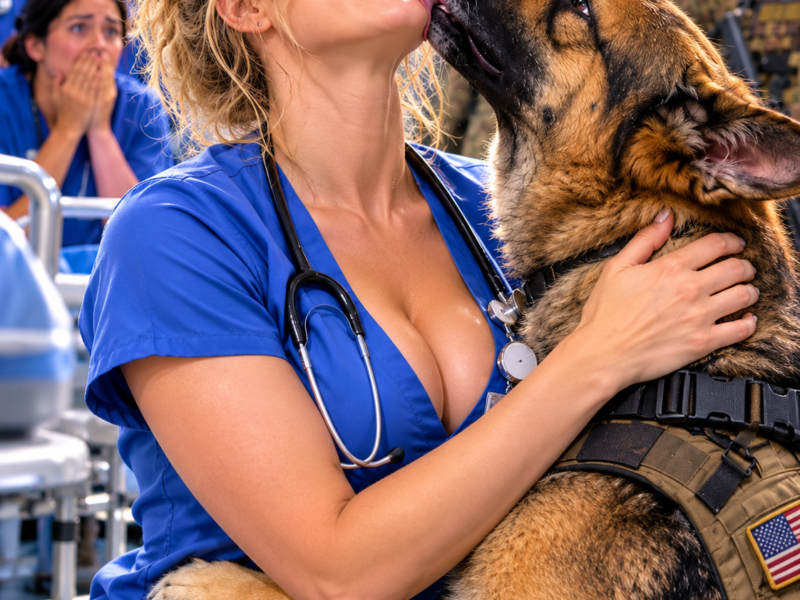
“I was being laughed at by three senior doctors in the middle of the ER when a police K9 suddenly broke away from his handler
“Your mother was right.”
Walter Bennett’s voice was so weak that I almost thought I had imagined it.
But Officer Brooks heard him too.
He immediately raised one hand toward the doctors.
“Nobody moves him. I need another officer in here, now.”
Dr. Hayes looked furious.
“This is an emergency department, not a police interrogation room. The patient needs medical attention.”
“And he will get it,” Officer Brooks replied. “But something about this situation isn’t right.”
Ranger stood beside my legs, his body tense, his eyes moving between Walter and the silver tag in my hand.
I stared at the small object.
The blue ribbon was worn and frayed, and the metal tag had several scratches across its surface.
There were tiny letters engraved along the bottom.
I rubbed my thumb over them.
MERCY.
My mother’s old service dog’s name.
I remembered that name from childhood.
Before she became sick, Mom had shown me pictures of herself standing beside a German Shepherd in a police training yard.
She used to tell me that Mercy had saved her life once.
But I had never understood what she meant.
“Officer Brooks,” I whispered. “Why does this dog recognize me?”
He looked at Ranger.
Then he looked at the tag.
“Because Ranger was trained by your mother.”
I couldn’t breathe for a moment.
“What?”
“Your mother was Sergeant Laura Carter, wasn’t she?”
I nodded slowly.
Officer Brooks lowered his voice.
“She wasn’t just a police officer. She helped establish our department’s search-and-rescue K9 program. Ranger was one of the last dogs she trained before she retired.”
My fingers tightened around the tag.
My mother had died six months earlier.
Why was a dog she had trained carrying something that belonged to her?
And why had he come straight to me?
Dr. Hayes interrupted us.
“This is ridiculous. We have an unstable patient, an uncontrolled animal, and a rookie nurse who apparently knows the police department’s dog.”
He gestured toward the entrance.
“Get the animal out.”
Ranger immediately moved closer to my side.
His ears flattened.
Officer Brooks shook his head.
“He’s not going anywhere until we understand what he’s reacting to.”
“You’re not in charge of this hospital.”
“No,” Brooks replied. “But I am responsible for this K9, and I’ve never seen him behave like this.”
I looked at Walter.
His eyes were open now, though his breathing remained shallow.
He was watching me with an expression that was difficult to describe.
It wasn’t fear.
It looked almost like relief.
“Mr. Bennett?” I said softly. “You said my mother was right. What did you mean?”
His lips moved.
I leaned closer.
“She told you,” he whispered.
“Who told me what?”
He swallowed painfully.
“She said… one day… you’d come.”
Before I could ask another question, the heart monitor began sounding an alarm.
A nurse rushed toward the bed.
“His blood pressure is dropping!”
Everything changed instantly.
Dr. Hayes took command, ordering medication and additional tests.
I moved to the other side of the stretcher, checking Walter’s IV line and helping the team stabilize him.
For several minutes, there was no room for questions.
There was only the patient.
Eventually, his numbers began improving.
Dr. Hayes looked at me.
“Emily, take a break. You’ve had enough excitement for one shift.”
It sounded like an order.
But his eyes remained on the silver tag.
I knew he wanted me away from Walter.
And for the first time since I had started working at St. Mary’s, I didn’t automatically obey him.
“I’d like to stay with the patient,” I said.
His jaw tightened.
“That wasn’t a request.”
Officer Brooks stepped forward.
“She stays. I need to speak with her, and I need a clear record of what happened.”
Dr. Hayes looked between us.
Then he walked away without another word.
A few minutes later, Marcus appeared beside me.
He had heard the commotion and was carrying a small security radio.
When he saw Ranger, he stopped.
Then his eyes moved to the silver tag.
His expression changed.
Not dramatically.
Just enough for me to notice.
“Emily,” he said quietly, “we need to talk.”
I looked at him.
“Do you know something about my mother?”
Marcus glanced toward Officer Brooks.
The officer seemed to understand.
“I’ll be outside,” he said. “But don’t let anyone take that tag.”
He walked toward the entrance with Ranger.
The dog looked back at me twice before following.
I turned to Marcus.
“What is happening?”
He rubbed his forehead.
“I was hoping this day would never come.”
That sentence made my stomach tighten.
“Come where? What are you talking about?”
Marcus glanced toward the hallway.
“Not here.”
He led me into the small security office beside the emergency department.
Once the door closed, he pulled a chair away from the desk.
“Sit down.”
I remained standing.
“Marcus, I am not in the mood for another person telling me half a story.”
He nodded.
“Fair enough.”
He opened a drawer and removed a thick brown envelope.
My name was written across the front.
Emily Carter.
I stared at it.
“Where did that come from?”
“Your mother left it with me about eight months ago.”
I felt the floor shift beneath my feet.
“You knew my mother?”
“Not well. But I worked security at the police training center before I came here.”
He paused.
“She trusted me with something.”
I reached for the envelope, but Marcus kept his hand on it.
“She made me promise not to give it to you unless Ranger brought you the tag.”
I looked at him.
“Why?”
“She said you’d understand when the time came.”
I almost laughed, but nothing about the situation felt funny.
“My mother was dying. Why didn’t she just tell me herself?”
Marcus lowered his eyes.
“Because she didn’t want you dragged into something dangerous.”
He finally released the envelope.
Inside was a photograph.
My mother stood in a training yard, younger and healthier than I remembered her during those final months.
Beside her was a German Shepherd.
Mercy.
And standing behind them was a man I recognized immediately.
Walter Bennett.
I turned the photograph over.
On the back, my mother’s handwriting read:
“Some people wear uniforms to protect others. Some wear them to hide what they’ve done.”
I looked up.
“Who is Walter Bennett?”
Marcus took a slow breath.
“He was a police department evidence technician. He worked closely with your mother during an investigation involving stolen medical supplies and falsified reports.”
“Medical supplies?”
“Controlled medications, mostly. But the investigation uncovered something much larger.”
He sat down.
“Someone was using emergency calls and hospital transfers to move stolen evidence without attracting attention.”
I thought of the ambulance reports, the hospital records, the police officers who came and went.
“Was my mother investigating it?”
“Yes.”
“Did she find out who was responsible?”
Marcus didn’t answer immediately.
Then he pointed to the envelope.
“Keep reading.”
There was a folded letter beneath the photograph.
I recognized Mom’s handwriting before I even opened it.
My hands began shaking.
My dearest Emily,
If you’re reading this, it means Ranger has found you, and Walter is finally somewhere safe enough to speak.
I wish I could have told you everything myself.
But I made a promise to protect you, and I intend to keep that promise even after I’m gone.
Years ago, Walter discovered that someone inside the department was altering evidence records.
At first, he believed it was a clerical mistake.
Then he found the same names appearing on reports that had supposedly been completed months apart.
He tried to report it.
The evidence disappeared.
The people who knew about it began receiving threats.
Your mother has never been good at pretending not to notice things.
I smiled despite the tears gathering in my eyes.
That sounded exactly like her.
I continued reading.
Walter kept a backup record of the missing files.
He hid it somewhere only Mercy could locate.
If he ever comes to you, it means the people involved have found him again.
Do not trust the first person who tells you they are helping.
And Emily, please remember something.
You do not have to be brave every minute of your life.
You only have to be honest when it matters.
Love,
Mom.
I lowered the letter.
My mother had known something was coming.
She had prepared for it.
And somehow, she had placed a piece of that responsibility in my hands.
“Where is the backup record?” I asked.
Marcus shook his head.
“I don’t know.”
“But you said Walter kept it.”
“He did. Your mother never told me where.”
I looked again at the photograph.
Mercy was sitting beside my mother.
The dog’s collar had a small metal compartment attached to it.
I remembered seeing that same compartment in an old family photograph.
“Where is Mercy now?”
Marcus looked at me.
“She died two years ago.”
My eyes fell to the silver tag.
Then why was Ranger carrying it?
Before I could ask, the security office radio crackled.
“Marcus, we have a problem in the ER.”
He grabbed the radio.
“What kind of problem?”
A nurse answered.
“Dr. Hayes has ordered the patient transferred to the intensive care unit. The police officer is asking for a security escort, and the patient is refusing to leave.”
Marcus looked at me.
“Stay here.”
But I was already moving.
When we returned to the emergency department, Walter was gripping the bedrail.
Officer Brooks stood beside him.
Ranger was lying on the floor, his head resting on his paws.
Dr. Hayes was arguing with another physician.
“His condition is stable enough for transfer. We are wasting time.”
Walter shook his head.
“No.”
His voice was stronger now.
“Not until she sees it.”
He pointed toward me.
Dr. Hayes turned.
“Mr. Bennett, you are confused. You need treatment.”
Walter’s eyes remained on mine.
“Your mother said you would understand the dog.”
I stepped closer.
“Understand what?”
He looked toward Ranger.
“Mercy found the first box. Ranger found the second.”
Officer Brooks crouched beside the dog.
“Sir, what box?”
Walter closed his eyes briefly.
“The training center. Locker seventeen.”
The number seemed to hang in the air.
Marcus stiffened.
I noticed.
“What’s wrong?” I asked him.
He shook his head.
“Nothing.”
But I had learned something during my eleven days at St. Mary’s.
When people said nothing too quickly, it usually meant something.
Officer Brooks stood.
“I’m calling this in. We need to secure the training center.”
Dr. Hayes stepped between him and the bed.
“You’re not taking this patient anywhere until I authorize it.”
Brooks stared at him.
“He’s asking for police protection.”
“And I’m responsible for his medical care.”
“Then take care of his medical needs. Don’t interfere with an active investigation.”
For a few seconds, neither man moved.
Then Walter reached out and caught my wrist.
His fingers were surprisingly strong.
“Emily.”
I leaned down.
He whispered something that made the blood drain from my face.
“Your mother’s accident wasn’t an accident.”
I stared at him.
My mother had died after her car left a wet road on a quiet highway.
The official report said she lost control during heavy rain.
There had been no other vehicle.
No suspicious circumstances.
I had accepted that explanation because I couldn’t bear to question it.
Now Walter was telling me something else.
“Why would you say that?”
He swallowed.
“She found the second ledger.”
“What ledger?”
“The one with the names.”
He looked toward Dr. Hayes.
Then he looked back at me.
“One of them works here.”
A silence settled over the room.
Dr. Hayes took one step forward.
“That’s enough. The patient is delirious.”
But Walter shook his head.
“No. I’m not.”
Officer Brooks moved between them.
“Doctor, step away from the bed.”
For the first time, I noticed something in Dr. Hayes’s expression.
It wasn’t simply irritation.
It was fear.
And he was trying very hard not to let anyone see it.
That night, I didn’t go home.
Officer Brooks arranged for a patrol unit to accompany us to the old police K9 training facility.
Marcus came too.
He said he wanted to make sure we were safe.
I didn’t know whether to trust him.
Mom’s letter had warned me not to trust the first person who offered help.
The warning kept repeating in my head.
The training center was nearly twenty miles outside Columbus.
It had been closed for renovations, but Officer Brooks still had access to the property.
Rain tapped against the windshield as we pulled through the gates.
Ranger became restless before we even reached the building.
He stood in the back of the police SUV, whining softly.
Officer Brooks opened the rear door.
“Easy, boy.”
The dog jumped down and headed toward the old kennel area.
He stopped beside a row of storage lockers.
Then he sniffed the floor.
He moved to locker sixteen.
Passed seventeen.
And stopped at eighteen.
Officer Brooks frowned.
“Walter said seventeen.”
Ranger scratched at the bottom of locker eighteen.
I crouched.
There was a small metal plate attached to the door.
The number had been changed.
Underneath the newer plate, I could just make out the outline of an older number.
Seventeen.
My hands went cold.
Marcus stepped closer.
“Don’t open it yet.”
I turned toward him.
“Why?”
He looked uncomfortable.
“Because we don’t know what we’re dealing with.”
Officer Brooks removed a set of bolt cutters from his equipment bag.
He worked on the lock until it finally snapped.
Inside was a small metal box wrapped in an old police training jacket.
Ranger sat down immediately.
His tail moved once against the concrete.
I carefully lifted the box.
It was heavier than I expected.
Inside were several notebooks, a flash drive, and a sealed envelope.
The first notebook contained handwritten dates and inventory numbers.
The second contained names.
I recognized one immediately.
Dr. Richard Hayes.
My throat tightened.
Beside his name were dates corresponding to medication shipments that had disappeared from two hospitals.
There were also handwritten notes about altered patient transfer records.
“Why is a hospital doctor in a police evidence ledger?” I whispered.
Officer Brooks took the notebook.
“Because somebody was moving stolen medication through legitimate medical transfers.”
He turned another page.
His expression darkened.
“Emily, look at this.”
There was a photograph tucked between two sheets.
It showed my mother standing beside a black sedan.
The date printed on the back was two days before her accident.
Underneath, she had written:
“He knows I’ve found the records.”
I felt sick.
Then Marcus spoke behind me.
“That’s enough.”
I turned.
He was standing near the doorway.
His face had lost all its usual softness.
“Put the box down, Emily.”
Officer Brooks immediately reached for his radio.
“Marcus, step away.”
Marcus didn’t move.
“You’re making a mistake.”
I looked at him.
“You knew about the locker.”
He glanced at the box.
“I knew your mother was looking for it.”
“Then why did you pretend you didn’t?”
He rubbed his face.
“Because I was trying to keep you out of this.”
“By lying to me?”
His eyes filled with something that looked like regret.
“Your mother asked me to protect you. I didn’t know how else to do it.”
Officer Brooks moved closer.
“Marcus, I need you to put your hands where I can see them.”
Marcus raised both hands slowly.
Then he looked directly at me.
“Emily, there’s something else you need to know.”
I didn’t answer.
He took a shaky breath.
“Your mother called me the night before the accident.”
I stared at him.
“What?”
“She said someone had followed her from the training center. She wanted me to meet her and take the evidence somewhere safe.”
“Did you?”
“No.”
The answer came out almost too quietly to hear.
“Why not?”
He looked down.
“Because I was afraid.”
For a moment, all I could hear was the rain.
“She died the next morning,” I said.
Marcus nodded.
“I know.”
“You could have helped her.”
His face crumpled.
“I know.”
I wanted to shout.
I wanted to hit him.
But what hurt most was that he hadn’t told me the truth while I was spending months wondering whether my mother had been alone during her final hours.
Officer Brooks took a step toward Marcus.
“You’re coming with us.”
Marcus didn’t resist.
But before he turned around, he looked at me one last time.
“There’s a reason Hayes has been watching you at the hospital.”
I swallowed.
“What reason?”
Marcus hesitated.
“Your mother left one final copy of the evidence with you.”
I stared at him.
“Where?”
He pointed toward the silver tag in my hand.
“Inside the ribbon.”
I looked down.
The small metal tag had a narrow seam along its edge.
Officer Brooks took a closer look.
Using a small tool from his pocket, he carefully opened the casing.
A tiny memory card slipped into his palm.
For several seconds, none of us spoke.
Then he sealed it in an evidence bag.
“That’s what they were looking for.”
I thought of Walter’s words.
The missing ledger.
The altered reports.
My mother’s accident.
And Dr. Hayes.
The man who had spent eleven days telling me I didn’t know what I was doing.
Suddenly, his dismissive comments didn’t seem so harmless.
Officer Brooks called for backup.
By sunrise, the memory card had been delivered to the department’s digital evidence unit.
The files contained scanned documents, photographs, audio recordings, and copies of financial transactions.
There was enough evidence to reopen the investigation.
But there was one recording that Officer Brooks asked me to listen to privately.
It was dated three days before my mother’s death.
I sat in a small interview room at the police station.
The screen showed a file labeled:
LAURA_CARTER_FINAL_MESSAGE.
Officer Brooks placed a pair of headphones beside me.
“You don’t have to listen if you’re not ready.”
I picked them up.
“I’ve been waiting six months to hear her voice again.”
I pressed play.
At first, there was only static.
Then my mother’s voice came through.
“Emily, if this reaches you, I need you to know that none of this was your fault.”
I covered my mouth.
Her voice sounded tired.
But it was unmistakably hers.
“I know you sometimes think you should have noticed how frightened I was. You shouldn’t have. I spent my whole life trying to protect you from the parts of the world that aren’t kind.”
There was a pause.
Then she continued.
“I found evidence that someone was using medical records to conceal the theft of controlled medications. Walter helped me copy everything. I thought I had enough to expose them.”
Another pause.
“If anything happens to me, don’t let anyone convince you that being careful means being weak.”
My eyes filled.
“Your instinct to ask questions is not a flaw, sweetheart. It’s the reason I know you’ll be a good nurse.”
I lowered my head.
For eleven days, I had allowed people at St. Mary’s to make me feel like I didn’t belong.
And my mother had understood something about me long before I did.
The recording continued.
“There’s one more thing. The man who has been helping you at the hospital isn’t the only person I trusted. There is a detective who knows the whole story. His name is Daniel Brooks.”
I looked up.
Officer Brooks stood on the other side of the glass.
My mother continued.
“Daniel was the youngest officer I ever trained. If he is there, listen to him. He has always been a good man.”
I glanced toward Brooks.
He looked down at the floor.
Then Mom said something that made me cry harder than anything else.
“Emily, I wish I could be there when you finally stop apologizing for taking up space.”
The recording ended.
I sat there long after the screen went dark.
For the first time since her funeral, I didn’t feel like I had lost every part of her.
I had her voice.
Her handwriting.
Her faith in me.
And I had the truth.
The investigation took several weeks.
Dr. Hayes was placed on administrative leave while authorities examined the hospital’s medication records.
The police discovered that he had been falsifying transfer documentation and helping conceal shipments of stolen medication.
The evidence also revealed that someone had accessed my mother’s vehicle records shortly before her fatal crash.
Investigators could not immediately prove who had caused the accident.
But the original report was reopened, and the circumstances were no longer dismissed as an ordinary loss of control.
Marcus admitted that he had withheld information from the investigation.
He cooperated with detectives and provided messages showing that he had been contacted by people connected to the stolen medication scheme.
He was eventually charged with obstruction related to his handling of evidence.
He lost his security job.
I didn’t speak to him for months.
I wasn’t sure I ever could.
Walter survived.
After several days in the hospital, he was transferred to a protected rehabilitation facility.
Before he left, he asked to see me.
I walked into his room carrying a small paper bag.
Inside was a photograph of my mother and Mercy.
I placed it on his bedside table.
He studied it for a long time.
“She was a good woman,” he said.
“She was.”
He looked at me.
“I should have come forward sooner.”
I pulled a chair beside his bed.
“Why didn’t you?”
He stared at his hands.
“Because I thought staying alive was the same thing as being safe.”
I understood that fear more than I wanted to.
But I also knew what my mother had sacrificed trying to protect people who couldn’t protect themselves.
“I wish you had trusted her,” I said.
“So do I.”
He touched the photograph gently.
“She told me you were going to be a nurse.”
I smiled through my tears.
“She was right about that.”
Walter chuckled softly.
“She was right about most things.”
A month later, I returned to St. Mary’s.
The first person I saw was Dr. Hayes.
He was standing near the elevators, carrying a cardboard box.
His hospital badge was gone.
For a moment, neither of us spoke.
Then he looked at me.
“I suppose you got what you wanted.”
I stopped.
“I wanted to do my job.”
His jaw tightened.
“You don’t understand how complicated things were.”
I thought about the missing medication.
The altered records.
The people whose care had been put at risk.
And the mother I had buried without knowing the truth.
“You’re right,” I said. “I didn’t understand everything. That’s why I kept asking questions.”
He looked away.
I walked past him.
I didn’t feel victorious.
I didn’t feel the need to say anything else.
The hospital had already begun an internal review, and the police investigation was moving forward.
My responsibility was to the patients in front of me.
And I finally understood that I didn’t need Dr. Hayes to approve of the nurse I had become.
Three months later, I was assigned to a different emergency department team.
On my first night back after completing additional training, a young nurse named Olivia approached me near the medication cart.
She held a chart in one hand.
“Emily, can I ask you something?”
I smiled.
“Of course.”
She hesitated.
“I think this dosage might be wrong, but Dr. Patel already signed the order. I don’t want everyone thinking I’m difficult.”
For a second, I saw myself standing in that same hallway.
The red cheeks.
The lowered eyes.
The apology I had been preparing before anyone even accused me of anything.
I took the chart.
“Let’s check it together.”
We reviewed the patient’s weight, kidney function, and medication history.
The order needed clarification.
I called the attending physician, and we corrected it before the medication was administered.
Olivia looked relieved.
“Thank you. I thought I was just being paranoid.”
I shook my head.
“Being careful isn’t the same as being afraid.”
She smiled.
Then she returned to the patient’s room.
That evening, I went home and placed my mother’s photograph on the shelf beside my nursing certificate.
The silver tag sat in a small glass case next to it.
I had considered keeping it in a drawer.
But I decided it belonged somewhere I could see it.
A few weeks later, Officer Brooks called.
He had a question about Ranger.
The dog had been temporarily reassigned after the investigation, but he had been struggling to settle into his new routine.
“He still goes to the old training yard every morning,” Brooks explained. “He waits by the lockers.”
I looked at the photograph on my shelf.
“Does he still have Mercy’s old tag?”
“Yes.”
“Could I see him?”
There was a pause.
“I was hoping you’d ask.”
The following Saturday, I drove out to the training center.
Ranger was waiting near the entrance with Officer Brooks.
The moment he saw me, his ears lifted.
Then he ran across the yard.
I knelt just before he reached me.
He pressed his head against my chest and let out a low, familiar whine.
I wrapped both arms around his neck.
For a while, I didn’t say anything.
I simply held him.
The wind moved through the trees, and somewhere behind us, another dog barked during training.
Officer Brooks stood a few feet away, giving us time.
Eventually, Ranger stepped back.
He looked at the silver tag hanging from my hand.
Then he gently nudged it with his nose.
I smiled.
“She would’ve liked you coming to visit.”
Brooks approached.
“Your mother used to say that a good K9 never forgets the person who taught him to trust.”
I scratched Ranger behind the ears.
“Maybe that’s why he found me.”
Brooks nodded.
“Maybe.”
I looked toward the old locker building.
For months, I had thought my mother’s final gift to me was the truth about her death.
But standing there, with Ranger’s head resting against my knee, I realized it was something else.
She had left me a reason to trust the part of myself I had spent so long trying to silence.
The part that noticed the small things.
The part that asked questions.
The part that refused to walk away simply because someone with a louder voice told me I was wrong.
I still missed her every morning.
I still wished I could call her after a difficult shift and tell her what had happened.
But I no longer imagined her telling me to be quieter, easier, or less troublesome.
I could almost hear her laughing at that thought.
Before I left, I placed the silver tag against Ranger’s old training collar.
He sniffed it once, then leaned into my hand.
And for the first time in a long time, remembering my mother didn’t feel like standing beside an empty hospital bed.
It felt like carrying her with me into the next room, where someone needed a nurse who wasn’t afraid to notice.
The End.









