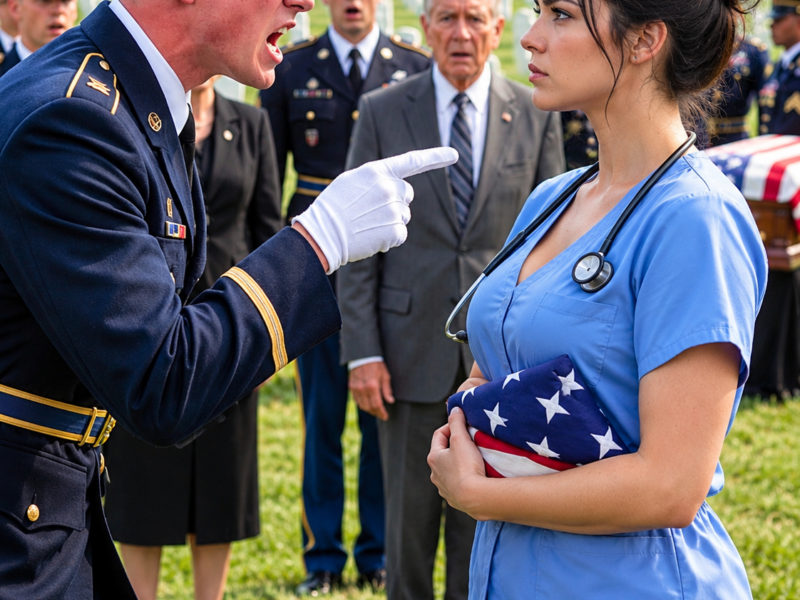
““GET OUT, BTCH!” the admiral’s armed security guard shouted at me in the middle of a packed military hospital lobby,
I took the envelope.
Admiral Brooks moved toward me again, but this time I stepped behind Walter’s wheelchair and held the yellowed paper against my chest.
“Don’t come any closer,” I said.
My voice sounded steadier than I felt.
The admiral stopped.
Around us, the hospital lobby had become painfully quiet. A woman at reception had her hand over her mouth, and one of the officers accompanying Brooks had turned toward the security guard as if he no longer trusted him to speak.
Walter’s knees began to tremble.
I caught his elbow and guided him back into his wheelchair before his injured hip could give way.
“Easy, Mr. Hayes.”
He lowered himself into the seat, breathing through clenched teeth.
“Sorry, sweetheart,” he muttered. “I wanted to stand when I told you.”
“You don’t have to apologize.”
I looked at the envelope again.
My father’s handwriting had not changed in my memory. The capital T in Thomas always leaned too far to the right, and he had a habit of pressing his pen so hard that his words left grooves in the paper.
This was his handwriting.
There was no question about it.
“Admiral,” I said, turning toward Brooks, “why did you tell him not to let me open this?”
Brooks glanced at the security guard.
“Because this is a military matter, and Mr. Hayes is a patient under this facility’s care. We need to handle this appropriately.”
“That isn’t an answer.”
His expression hardened.
“You have no idea what you’re dealing with.”
“Then explain it.”
He looked around at the gathering crowd.
“Not here.”
Walter let out a short, humorless laugh.
“That’s what they said thirty-one years ago.”
Brooks closed his eyes for a moment.
When he opened them, he looked older than he had a few minutes earlier.
“Mr. Hayes, you were never supposed to be here today.”
“I didn’t schedule my fall, Admiral.”
“That’s not what I meant.”
“Then perhaps you should start saying what you mean.”
A murmur passed through the lobby.
The security guard shifted his weight, looking toward Brooks for instructions.
The admiral finally turned to him.
“Return to your post. No one touches this nurse or her patient.”
The guard opened his mouth.
“Sir, she was interfering with—”
“That will be enough.”
The guard went silent.
Brooks looked at me.
“Miss Mitchell, I would like you to accompany me to a private conference room. We can discuss your father’s service record without disturbing the hospital.”
I thought about the badge lying on the floor.
I thought about the way he had watched the guard humiliate me without saying a word.
“No,” I said.
His eyebrows lifted.
“No?”
“You can speak to me here, with witnesses, or you can leave me alone.”
I had spent three years trying to understand why my father’s death had left so many unanswered questions.
I wasn’t going to let another powerful man move me into a room where nobody else could hear what he said.
Brooks studied me, then nodded once.
“Very well.”
He stepped back.
I slipped the envelope into the pocket of my scrubs and bent to retrieve my badge.
The guard moved aside.
Nobody laughed this time.
I took Walter back to his room, asked another nurse to check his hip, and waited until the physician confirmed that standing had aggravated the injury but hadn’t caused any additional damage.
Only then did I close the door and turn toward him.
“Tell me everything.”
Walter sat on the edge of his bed, his hands folded over the blanket.
For a long time, he said nothing.
Then he looked at my father’s watch.
“Your dad gave me that watch.”
I stared at him.
“No. My mother gave it to me after he died.”
“Your mother kept it for years. But before she died, she told you it had belonged to him, didn’t she?”
I nodded slowly.
Walter rubbed a thumb over the worn fabric of his hospital bracelet.
“Thomas was my closest friend in the service. We served together during a deployment in Afghanistan, long before either of us had gray hair. He was a Navy corpsman attached to a special operations unit. He could be stubborn as a mule, but if someone was hurt, he didn’t care whose orders he had to ignore to get them help.”
I pulled a chair closer to his bed.
“My father was a Marine.”
“He was. But he worked alongside Navy personnel during that deployment. That’s where I met him.”
Walter paused to catch his breath.
“Admiral Brooks was a young lieutenant at the time. Talented, ambitious, and convinced that every problem could be solved if people followed the plan.”
“Was my father part of his team?”
“Not exactly. Thomas was assigned to the medical support element that worked with Brooks’s unit. They respected each other, but they didn’t always agree.”
“What happened in Kandahar?”
Walter looked toward the window.
“The helicopter went down during a night evacuation. There was a fire, ammunition cooking off, and wounded men trapped inside. Brooks was one of them.”
He swallowed.
“I pulled him out. Your father helped treat him before the second evacuation helicopter arrived.”
I remembered my father telling me stories about his time overseas.
He had always skipped the details that frightened him, preferring to talk about the ridiculous food, the broken air conditioners, and the soldiers who could turn any miserable day into a reason to laugh.
He had never mentioned saving a future admiral.
“Why would that be a secret?”
“That part wasn’t.”
Walter looked back at me.
“What happened afterward was.”
He told me that several weeks after the crash, my father discovered discrepancies in a classified medical supply inventory.
Emergency equipment had been marked as delivered to remote treatment facilities, but some of it had never arrived.
Other items had been listed as damaged or destroyed despite having been signed for by personnel who claimed they had never received them.
At first, Thomas assumed it was a clerical problem.
Then he found duplicate shipping numbers and signatures that appeared on documents for two different locations.
“He reported it through the proper channels,” Walter said. “Nothing happened. So he began keeping copies.”
I thought of the envelope in my pocket.
“Copies of what?”
“Inventory sheets, transfer orders, maintenance records. Anything he believed might show where the supplies had gone.”
“Was someone stealing medical supplies?”
“We suspected it. We didn’t know how far it went.”
“Did Admiral Brooks know?”
Walter took a long breath.
“He knew your father had raised concerns. Whether he understood the full extent of them is something I can’t tell you.”
I remembered Brooks’s face when Walter mentioned the helicopter crash.
The color leaving his cheeks.
The way he had stared at the envelope.
“What happened to my father?”
Walter’s eyes lowered.
“Three months after he began documenting those discrepancies, Thomas was killed in what the military called a training accident.”
The room seemed to tilt.
I knew those words.
I’d read them in the official report.
I’d repeated them to friends who asked how my father died.
“You’re saying it wasn’t an accident.”
“I’m saying the investigation was incomplete.”
I leaned forward.
“That’s not the same thing.”
“No, sweetheart. It isn’t.”
His answer was gentle, and that made it harder to hear.
Walter didn’t claim to know who had caused my father’s death.
He didn’t tell me that the admiral had ordered it.
He simply described what he had witnessed and what had disappeared afterward.
The medical supply records were collected.
Several witnesses were interviewed, then reassigned.
My father’s request for an independent review was marked as resolved.
And the day after his death, Walter was ordered to surrender the documents he had been helping Thomas preserve.
He complied with the order, believing the evidence would be reviewed.
Instead, the copies vanished into a restricted archive.
“I should have fought harder,” he said.
“Why didn’t you?”
His face tightened.
“Because I had a wife and two little boys. Because I’d watched good men lose their careers for asking the wrong questions. Because I convinced myself that if I kept my head down, the truth would come out through someone else.”
He looked at me.
“Then the years passed, and every year made it harder to admit that I had been afraid.”
I didn’t know what to say.
I wanted to be angry with him.
Part of me was.
But I also understood the terrible arithmetic of fear: a family to protect, a paycheck to keep, and the belief that one person’s silence couldn’t possibly change anything.
Sometimes silence was a choice.
Sometimes it became a habit.
And sometimes a person spent the rest of his life trying to undo it.
“Why now?” I asked. “Why did you wait thirty-one years?”
Walter reached for a glass of water.
“Because I didn’t know where you were for a long time. Then I found you through a veterans’ outreach program. I saw your name on a hospital staff page and recognized it immediately.”
“You knew I was a nurse?”
“I knew Thomas’s daughter had become a nurse. He used to say you had his hands and your mother’s patience.”
My eyes stung.
Walter continued.
“I intended to contact you weeks ago. Then I fell, ended up here, and discovered that Brooks was coming for a hospital briefing. I never expected to see him in person.”
“Did you plan the confrontation?”
“No.”
He gave a tired smile.
“I can barely get out of this bed without help. Standing up in that lobby wasn’t a plan. It was something I should have done years ago.”
I took the envelope from my pocket.
The flap had been sealed with an old strip of yellowing tape.
I carefully opened it.
Inside were three folded sheets of paper and a small photograph.
The first sheet was a handwritten letter.
I recognized my father’s writing immediately.
The date at the top was three days before he died.
I began to read.
Grace,
If you’re reading this, it means I wasn’t able to explain everything to you myself. I hope that isn’t the case. I hope I’m home, sitting at the kitchen table, listening to you tell me about school while your mother reminds me that I’m supposed to be fixing the back porch.
I stopped.
That was exactly how our kitchen had sounded.
My mother talking from the sink.
My father pretending not to hear her.
Me sitting at the table with a glass of milk, trying to finish my homework before he asked to see it.
I pressed my lips together and continued.
There are things happening at work that I don’t understand yet. I’ve found records that don’t match what people tell me, and I’ve been asked to stop asking questions.
I am not writing this because I want you to be afraid. I am writing it because you deserve to know that asking a reasonable question is not a betrayal.
If anything happens to me, don’t assume you have the whole story just because someone in uniform tells you they do.
My hands began to shake.
The letter continued for another page, but it contained no names, no accusation, and no explanation of the accident.
Instead, my father wrote about ordinary things.
He asked me to keep helping my mother with the garden.
He reminded me that the old pickup needed new tires.
He told me he was proud of the woman I was becoming.
At the bottom, he had written one final sentence.
Trust the people who can admit what they don’t know.
I lowered the paper.
For three years, I had kept my father’s death certificate in a folder with the folded flag from his funeral.
I had never questioned the people who delivered the official report because I believed questioning them meant questioning his service.
Now his own words sat in my hands, reminding me that loyalty had never meant blind obedience to him.
The second sheet was a handwritten inventory of documents and their corresponding reference numbers.
The third was a list of names.
I recognized none of them.
But one name appeared twice.
Nathaniel Brooks.
Beside the first entry was a date from the year of the helicopter crash.
Beside the second was a date three days before my father’s death.
I stared at the page.
“Walter, what does this mean?”
He leaned forward, but his eyes were too tired to read the small writing.
“I don’t know. Thomas never explained the list to me.”
I turned the page over.
A short note had been written across the back.
Ask Nate what happened to the original inventory.
I read it again.
Nate.
Not Admiral Brooks.
Not Lieutenant Brooks.
Nate.
My father had known him well enough to use his first name.
The hospital room door opened before I could say anything else.
Admiral Brooks stood in the doorway, alone this time.
He had removed his jacket, and the sleeves of his white uniform shirt were rolled neatly to his forearms.
He looked at the papers in my hands.
“I see you’ve opened it.”
“Yes.”
His gaze moved to Walter.
“May I speak with Grace?”
“You may speak with both of us,” Walter replied.
Brooks accepted that with a small nod.
He stepped inside and closed the door.
“I owe you an apology,” he said to me.
I didn’t answer.
“I heard the guard insult you. I should have intervened immediately. There was no justification for what happened in that lobby.”
“Why didn’t you?”
He looked down at his hands.
“Because I recognized Mr. Hayes, and I knew what he might say. For a few seconds, I was more concerned about what would happen to my reputation than about the person standing in front of me.”
The honesty caught me off guard.
It didn’t excuse his silence, but at least he wasn’t asking me to pretend it hadn’t happened.
“That’s not a small thing to admit,” I said.
“No.”
He looked at the envelope.
“May I see the letter?”
“No.”
He accepted the answer without protest.
“Then let me tell you what I know.”
He sat in the chair beside Walter’s bed.
“Your father and I worked together during that deployment. He was an exceptional medic. He saved my life after the helicopter crash, and I never forgot it.”
“What happened to the medical supplies?”
Brooks took a breath.
“At first, I believed the discrepancies were administrative. When your father showed me the records, I agreed that they deserved an investigation. I forwarded his concerns to my commanding officer.”
“And then?”
“I was told the matter had been reviewed. I was also told that your father had misunderstood the records.”
“Did you believe that?”
“At the time, I wanted to.”
His answer was quiet.
He explained that he had been a young officer with a promising career and a unit depending on him.
He had no direct evidence that anyone was stealing supplies or falsifying records.
He had trusted the senior officers who told him the investigation was complete.
Then the helicopter accident occurred.
He had survived, but several members of his team had not.
The investigation consumed his attention, and the medical supply inquiry slipped out of sight.
“When I learned that Thomas had died, I asked whether his earlier report had been reviewed,” Brooks said. “I was told the matter was closed and that the documents had been accounted for.”
“Did you believe that too?”
He looked at me.
“Yes.”
The word hung in the room.
“I spent years believing that the system had handled it. It wasn’t until a records audit several months ago that I learned key documents were missing.”
“What made you look?”
“A retired logistics officer contacted my office. He had kept copies of shipping records that didn’t match the official inventory. When we compared them with the archived files, we found evidence that the original review had been incomplete.”
I glanced at the list in my hand.
“Why is your name on this page?”
Brooks looked at the handwriting.
“I don’t know.”
“You were involved in the inquiry.”
“I was one of several officers who received reports about the discrepancies. That doesn’t mean I know what happened to the original inventory.”
“But my father thought you might.”
Brooks remained silent for several seconds.
Then he said, “I may have seen it.”
Walter sat straighter.
“What?”
Brooks rubbed a hand across his face.
“Three days before Thomas died, he asked me to meet him in a maintenance office. He showed me a document comparing the supply orders with the actual deliveries. He said someone had altered the records.”
“What did you do?” I asked.
“I told him to submit it through the proper channels. I believed the inquiry would be handled.”
“And the original?”
“He said he had placed it somewhere safe.”
“Did you ask where?”
“No.”
“Why not?”
“Because I was afraid that if I knew too much, I’d be forced to make a choice I wasn’t ready to make.”
He looked at Walter.
“After Thomas died, I asked Harlan’s office about the document. I was told it had been recovered and that no discrepancies remained. I accepted that answer.”
“Did you ever see the document again?” I asked.
“No.”
I looked down at my father’s list.
For years, I had imagined the truth as something hidden behind one person’s deliberate lie.
But what I was hearing sounded worse in a different way.
One man had falsified records, perhaps for money or influence.
Other people had looked away because the evidence was incomplete, because they trusted the chain of command, or because they feared the cost of challenging it.
And a man I loved had died while trying to make them look.
“Do you know who caused my father’s accident?” I asked.
Brooks met my eyes.
“No. And I won’t tell you that I do.”
I appreciated the answer, even though it offered no comfort.
“Do you believe it was an accident?”
He paused.
“I believe the original investigation was inadequate. I believe important evidence was withheld or lost. I believe your father was right to question the records. I cannot honestly tell you that I know what caused his death.”
The room was quiet.
Walter reached for his water, and I helped him lift the glass.
When he had finished, I turned back to Brooks.
“What happens now?”
“I’ve requested an independent review of the original investigation and the missing supply records. The review will include the evidence you have, if you agree to submit it.”
“And if the review finds that someone deliberately hid the documents?”
“Then the findings will be referred to the appropriate authorities.”
I studied him.
“Will you put that in writing?”
“Yes.”
“Will you make sure the guard’s conduct is addressed too?”
He nodded.
“I’ve already reported the incident to hospital security and my staff. The guard’s behavior was unacceptable.”
I thought about how easily the man had shouted at me, how confidently he had assumed that his authority made cruelty permissible.
“Good,” I said.
Brooks stood.
“I know you have no reason to trust me, Grace. I’m not asking you to.”
He paused at the door.
“I’m asking you to let the evidence speak, even if it tells us things neither of us wants to hear.”
Then he left.
I sat beside Walter for a long time after the door closed.
The letter rested on my lap.
I had wanted answers for three years, but I had never considered that the truth might arrive without the certainty I craved.
My father might have been killed deliberately.
He might have died in an accident that someone later used to hide misconduct.
Or the missing records might have revealed a scandal unrelated to the circumstances of his death.
I couldn’t know yet.
For the first time, I understood that the most honest answer was sometimes a question that had not been fully investigated.
Over the next several months, I worked with the independent review team.
I submitted my father’s letter, the inventory list, and the envelope itself.
They made copies, documented the condition of each page, and gave me a signed receipt.
Walter provided a formal statement about the documents he had helped preserve.
Admiral Brooks submitted his own account, including his failure to follow up after the original report was supposedly closed.
That admission had consequences.
His superiors removed him from direct oversight of the review to avoid a conflict of interest, and he was required to cooperate with investigators.
He did not fight the decision.
When I saw him again, he told me that being relieved of the assignment was appropriate.
“I can’t ask people to trust a process if I insist on controlling it,” he said.
I didn’t forgive him immediately.
I wasn’t sure forgiveness was the right word for what I felt.
But I respected that he had finally allowed someone else to examine his decisions.
The investigation found evidence of a sustained effort to conceal discrepancies in medical supply deliveries.
Several shipments had been diverted through an unauthorized contractor, and financial records linked the contractor to a former logistics officer who had approved the transfers.
That officer had since died, but investigators recovered correspondence showing that he had instructed subordinates to alter inventory entries and avoid creating duplicate records.
The findings established that my father’s concerns had been legitimate.
They also showed that his report had been marked resolved without the required review.
However, the investigation could not establish who had caused his death.
The training accident had occurred during a complex exercise, and the available physical evidence was insufficient to prove deliberate interference.
The report acknowledged that the original inquiry had been compromised by missing documentation and that investigators had failed to examine whether the supply investigation had contributed to the events preceding his death.
It was not the answer I had wanted.
But it was the first official document that admitted the people who had told me to stop asking questions had never had all the answers themselves.
The day the report was released, I sat alone in my car outside the hospital and cried.
Not because everything had been resolved.
Because my father had been right about the records, and he had never lived to see anyone acknowledge it.
A week later, Admiral Brooks requested permission to meet with me.
I agreed to see him in the hospital courtyard, where a row of oak trees had begun turning brown at the edges.
He arrived without security.
“I’ve written something,” he said, handing me a sealed envelope.
I opened it.
It was a letter of apology.
He acknowledged that he had failed to intervene when the guard humiliated me, and that his silence had repeated a pattern he should have challenged decades earlier.
He also acknowledged that he had accepted assurances about my father’s report without demanding proof that the evidence had been preserved and reviewed.
At the bottom, he had written that he would cooperate with any further investigation and would not ask me to forgive him.
I folded the letter.
“Thank you for writing this.”
He nodded.
“I know it doesn’t repair anything.”
“No, it doesn’t.”
He looked toward the hospital windows.
“But I hope it means I can stop pretending I did everything I could.”
I considered that.
“That’s something you have to live with, Admiral. I can’t decide it for you.”
He accepted my answer.
Before he left, he asked whether I had found anything else in the envelope.
I told him about the note referring to the original inventory.
He said he would continue cooperating with investigators, but he couldn’t promise the missing document would ever be found.
I believed him.
Somewhere along the way, I had stopped expecting every person who had failed me to provide the closure I needed.
A month later, Walter was discharged from rehabilitation.
His hip was healing, though he still needed a cane and complained bitterly about the exercises he was required to do at home.
I helped him pack his belongings.
The old veteran folded his cardigan carefully and tucked it into his bag.
“Do you think your father would be proud of you?” he asked.
I looked at him.
“I don’t know.”
Walter raised an eyebrow.
“That’s a surprising answer.”
“I think he’d be proud that I kept asking questions. I don’t think he’d be proud that I spent three years believing I had to handle everything alone.”
Walter smiled faintly.
“Thomas wasn’t perfect, sweetheart. He could be stubborn, and he had a habit of trying to carry problems that belonged to other people.”
I laughed despite myself.
“That sounds familiar.”
“He’d be glad you know the difference now.”
I helped him stand and guided him toward the door.
At the nurses’ station, he paused and looked back at the room where he’d spent the last several weeks.
“One thing about getting old,” he said. “You start to realize how much time you wasted being afraid of what other people might think.”
“You’re not that old.”
“Seventy-eight is old enough to know better.”
We both laughed.
Then he grew serious.
“Thank you for listening to me.”
I squeezed his hand.
“Thank you for finally telling me.”
He left the hospital that afternoon.
Before he went, he asked me to visit him once he had settled into his apartment.
I promised I would.
And this time, I kept the promise.
The following Sunday, I drove to Walter’s apartment with a container of chicken soup and a fresh battery for the small radio beside his recliner.
He was sitting by the window when I arrived, watching a group of children ride bicycles along the sidewalk.
I set the soup on the kitchen counter.
“How’s the hip?”
“Terrible.”
“That’s what you said last week.”
“And it remains true.”
I shook my head and began putting the soup into the refrigerator.
When I returned to the living room, he was holding a small photograph.
It showed my father standing beside a younger Walter, both of them wearing fatigues and grinning at something outside the frame.
I had never seen the picture before.
Walter handed it to me.
“Your father gave me that after the helicopter crash. Said it was proof that even the worst day could produce a decent photograph.”
I traced the edge of the image.
For the first time, I could look at my father in uniform without immediately seeing the folded flag from his funeral.
He was young.
He was laughing.
He was a man who had saved people, made mistakes, worried about his daughter, and believed that the truth mattered even when telling it was dangerous.
He was more than the way he died.
I placed the photograph beside my father’s letter in the small wooden box where I kept his watch.
The cracked glass caught the afternoon light.
I had once thought that preserving his memory meant protecting the official story of his death.
Now I understood that loving him meant allowing the truth to be more complicated than the story I had been given.
I still didn’t know exactly what happened on the day he died.
I might never know.
But I knew what he had tried to do, and I knew that his final words to me were not about fear.
They were about asking questions.
Several months after the confrontation in the hospital lobby, I passed the security desk on my way to the rehabilitation unit.
The same guard was no longer assigned to the hospital.
I heard through administration that his contract had been terminated after a review of the incident and other complaints about his conduct.
I felt no satisfaction at the news.
I hoped he would learn to treat people differently, but I didn’t need to see him punished to know that what he had done was wrong.
At the nurses’ station, a young nurse was struggling with a patient’s medication order.
She looked toward the attending physician, then back at the chart, clearly afraid to challenge the discrepancy.
I recognized the hesitation.
I walked over and stood beside her.
“Let’s check it together,” I said.
We reviewed the order, confirmed the patient’s history, and called the physician to clarify the dosage.
The error was corrected before the medication was given.
The nurse exhaled.
“I thought I was going to get in trouble.”
“You might get questions,” I told her. “But asking a reasonable question is part of doing the job.”
She nodded and returned to the patient’s room.
I watched her go, thinking of my father, Walter, and all the years when fear had convinced good people to stay quiet.
Then I touched the old watch beneath my sleeve and returned to work.
My father had not left me a perfect answer, a final confession, or a name I could blame for everything.
He had left me something harder to carry and more useful than certainty: the reminder that authority could be wrong, silence could have consequences, and the truth deserved to be examined even when it made everyone uncomfortable.
I could not change the day he died.
I could not recover the years Walter spent regretting his silence, or undo the moment Admiral Brooks chose to look away.
But I could decide what I did when the next person stood in front of me, frightened to speak.
And when I saw that fear in someone’s eyes, I would make sure they never had to stand alone.
The end.









