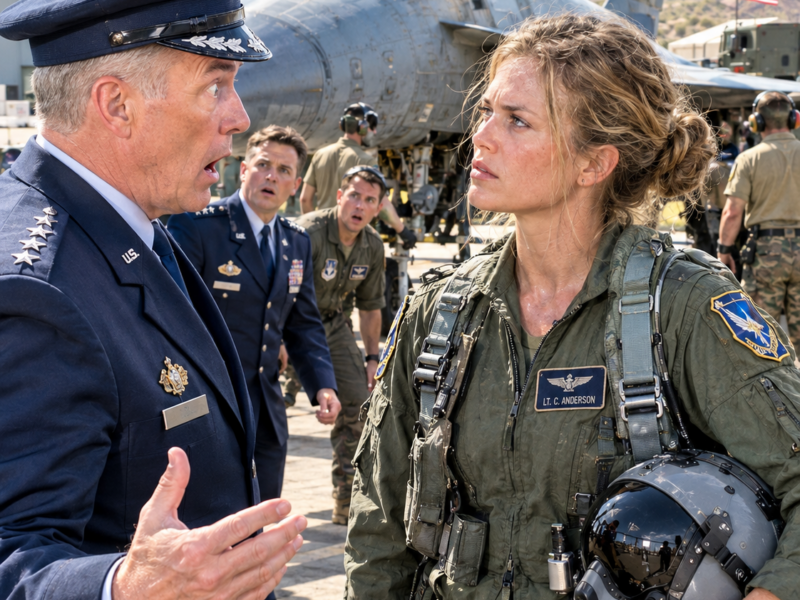
“General Robert Whitmore ordered me to abort the mission in front of an entire command room, insisting that a woman couldn’t survive a landing behind enemy lines
The ridge came at me faster than the warning lights could count down.
I pulled the stick hard, but the fighter answered with a shudder that traveled through the seat and into my spine. The left engine was losing power. My navigation display blinked twice, filled with static, and went black. Somewhere beneath the canopy, metal groaned as if the aircraft itself were protesting the impossible position I had put it in.
“Falcon Ridge, this is Captain Rebecca Hayes. I have multiple system failures and no reliable navigation. Request immediate vectors to the extraction corridor.”
Only static answered.
I tried again on the emergency frequency. Nothing.
Then a voice crackled through my headset, faint and distorted.
“—do not return to base. Repeat, do not return to base.”
I froze for half a second.
That was not command procedure. It was not a standard warning, and it certainly was not the kind of message a pilot expected to hear from a friendly frequency.
“Identify yourself,” I demanded.
The voice vanished.
The fighter dropped another hundred feet. I had no time to wonder who had spoken. I was flying over hostile territory in a damaged aircraft, with no working navigation and a ridge rising ahead of me like a wall.
I had two choices: eject and hope the terrain did not kill me, or try to put the aircraft down somewhere it could not be seen.
Neither option appeared in the mission briefing.
I thought of General Robert Whitmore standing in the command room, his hands clasped behind his back as he looked at me with the expression of a man who had already decided how my story would end.
“Combat flying is not a place to prove a point, Captain,” he had said. “It is a place to follow orders.”
I had followed orders for most of my career. I had studied every procedure, memorized every emergency checklist, and learned to keep my voice steady when people in command mistook confidence for arrogance.
But my instruments were failing, the ridge was closing, and something was sending a warning from a frequency that should not have been active.
So I did what training had taught me to do when the plan collapsed.
I made a decision.
I rolled the fighter toward a narrow valley cutting through the mountains and lowered the nose. The aircraft screamed as I forced it into a descent. I could see a dry riverbed, a patch of pale earth, and a strip of flat ground barely wide enough to accommodate the machine I was trying to save.
The landing gear indicator flashed red.
“Come on,” I whispered. “Just one more thing. Give me one more thing.”
I leveled the wings, eased the throttle, and held the aircraft as steady as I could. The ground rushed up. I felt the first impact, then another, harder than the first. The fighter bounced, veered left, and tore through a line of scrub before grinding to a stop in a cloud of dust.
For several seconds, I heard nothing but the ringing in my ears.
Then the warning siren began.
I shut down what remained of the engine, released my harness, and pulled myself free of the cockpit. My legs nearly buckled when my boots hit the ground. The air smelled of scorched wiring and hot metal. Behind me, smoke curled from the left side of the aircraft.
I was alive.
The fighter was not going anywhere.
I looked up at the mountains surrounding the valley. There were no friendly aircraft, no rescue lights, no road leading toward a safe zone. Only jagged rock, dry brush, and the uneasy silence of a place that had never been meant to receive me.
I checked my radio. Dead.
My navigation unit. Dead.
The encrypted communications case strapped behind my seat had survived the landing, though its outer shell was dented. That case was the reason I had been sent into this region in the first place. According to the briefing, it contained a replacement communications module for a remote observation post. I had also been instructed to locate three American servicemen whose emergency beacon had gone silent two nights earlier.
The briefing had described the area as sparsely monitored.
Now, standing beside my smoking fighter, I noticed a thin trail of tire marks cutting across the dry riverbed.
Someone had been here recently.
I crouched beside the tracks and touched the edge of one. The dirt had not yet settled into the grooves. A second set of marks ran toward a narrow opening between two rock walls.
Then I heard a voice.
“Hands where I can see them!”
I turned slowly.
A man stood on the ridge above me, his rifle aimed at my chest. He wore a dusty uniform with no visible insignia, and a dark scarf covered the lower half of his face. Two more figures emerged from the rocks behind him.
I raised my hands.
“I’m an American pilot,” I said. “My aircraft went down. I’m not looking for trouble.”
The man with the rifle gave a short, humorless laugh.
“Then you chose a strange place to land.”
He motioned for me to move away from the fighter. I did as he asked, careful not to make any sudden movements. My survival training had taught me that panic made people unpredictable, and unpredictability was dangerous when someone else held the weapon.
As I walked toward them, I noticed a small blue strip of fabric tied around the wrist of the second man.
It was the same color used on the emergency identification bands carried by our missing personnel.
My pulse quickened.
“Where did you get that band?” I asked.
The man glanced down at his wrist. His expression changed before he could hide it.
The rifleman noticed.
“Quiet,” he snapped at me.
But I had already seen enough to know that this encounter was connected to my mission.
They bound my hands and led me through the rock opening. Beyond it, the valley widened into a concealed basin. A cluster of low buildings stood against the far wall, their roofs covered with camouflage netting. A truck sat beneath a rocky overhang. Several men moved between the buildings, carrying crates and equipment.
This was no random patrol.
It was an operating site.
And someone had known I would come.
Inside the largest building, they pushed me into a chair beneath a hanging lamp. The room smelled of dust, fuel, and old coffee. A table occupied the center, covered with maps and radio equipment. On the wall behind it hung a large regional map marked with colored lines and small numbered circles.
I recognized the route I had flown.
Someone had drawn it in red.
Beside the route was a handwritten note in English: SECONDARY ARRIVAL CONFIRMED.
I stared at those words.
Secondary arrival.
Not emergency landing. Not unexpected contact.
Arrival.
A man entered from the adjoining room. He was in his late thirties, with a narrow face and a scar running from his left temple to his jaw. Unlike the others, he wore no scarf. He studied me with the calm interest of someone examining an object that had finally been delivered.
“Captain Hayes,” he said in clear English. “You have caused us a considerable inconvenience.”
I kept my voice level. “Who are you?”
“Someone who was told you would be more cooperative.”
“Then whoever told you that doesn’t know me.”
For the first time, he smiled.
“That may be the only accurate thing your superiors have said about you.”
He nodded toward my flight suit. One of the guards had removed my survival knife and sidearm, but my identification tags remained around my neck.
“Do you know why your aircraft lost navigation?” he asked.
“I know I had a systems failure.”
“No, Captain. You experienced an intervention.”
He placed a small electronic unit on the table. It was black, compact, and marked with a serial number I recognized from the equipment list attached to my mission briefing.
My mouth went dry.
“That unit was supposed to be installed at an observation post,” I said.
“It was supposed to be delivered to us.”
He let the words settle.
I stared at the device, searching for a reason to dismiss what I was hearing. “You’re lying.”
“Perhaps. But your aircraft’s navigation system did not fail by accident. The signal that drew you toward this valley was transmitted by equipment your own command authorized.”
My mind raced back to the unexplained signal near the eastern edge of the corridor. It had been too strong to be a stray transmission and too precisely timed to be random.
“Who authorized it?”
The man leaned forward.
“General Robert Whitmore.”
For a moment, the room seemed to tilt around me.
I had expected a trap. I had expected a hostile unit, perhaps even an ambush. I had not expected the name of the man who had ordered me out of the command room to be spoken by an enemy officer.
“Prove it,” I said.
He opened a folder and slid a photograph across the table. It showed two men standing beside a communications vehicle. One was the scarred man sitting across from me. The other wore an American uniform.
I recognized the second man immediately.
Lieutenant Colonel Mark Daniels.
The pilot Whitmore had selected to replace me.
But Daniels had supposedly been unavailable due to a medical issue. That was what Major Sarah Collins had told me after he was pulled from the mission roster.
In the photograph, Daniels looked healthy. He was shaking the scarred man’s hand.
“When was this taken?” I asked.
“Three weeks ago.”
“Why would Daniels meet with you?”
“That is a question you should ask him.”
The scarred man stood and walked to the wall map. He tapped a red circle near the valley.
“Your three missing servicemen discovered this facility while surveying a communications relay. They were not supposed to be here. They found evidence of a transfer operation, and they transmitted a report before we could stop them.”
“Where are they?”
“Alive, when last I checked.”
“Take me to them.”
“You are in no position to make demands.”
“No,” I said. “But if your plan depends on keeping me quiet, you should know I’m a terrible person to leave alive with questions.”
He regarded me for a long moment, then gave a small nod to one of the guards.
“Bring the prisoners.”
The guard disappeared through a side door. I kept my breathing slow and my eyes moving. There were four men in the room, two exits, a radio on the table, and a window high on the far wall. My hands were tied behind the chair, but the rope was loose enough to allow a little movement.
I could not overpower all of them.
I did not need to.
I needed information, a chance to communicate, and a way to keep whatever was happening here from being erased.
The door opened.
Three men were led inside, dirty and exhausted. The first had a bandage wrapped around his forehead. The second limped. The third looked as if he had not slept in days.
But they were alive.
The man with the bandage stared at my uniform.
“Captain?”
“I’m Rebecca Hayes,” I said. “I was sent to find you.”
He almost laughed. “They actually sent someone?”
“Apparently, I took the scenic route.”
His expression tightened. He looked toward the scarred man, then back at me.
“Captain, you need to get out of here. This whole operation is compromised.”
“I’m beginning to notice.”
The scarred man gestured for the guards to take them away.
Before they could move, the wounded serviceman spoke again.
“Tell Major Collins about the relay logs. She knows what they mean.”
The scarred man struck him across the face.
I lunged forward so violently that the chair tipped sideways. It hit the floor with a crack, sending a sharp pain through my shoulder. The guards seized me, but not before I saw the wounded man look directly at me.
His message was clear.
Major Collins knew.
The guards dragged me into an adjoining room and shoved me against the wall. One tightened the restraints around my wrists. The other searched my flight suit again, checking every pocket and seam.
They did not find the tiny emergency transmitter sewn into the lining near my left shoulder.
It was old equipment, a backup beacon my father had helped me learn to repair when I was young. It was not powerful enough to contact a distant base through the mountains, but it could send a short burst if I could get a clear signal.
My father had once told me that the best equipment in the world was useless if you forgot the simple things.
“Know what you have,” he used to say. “And never assume the person who built it thought of everything.”
He had spent thirty years repairing aircraft for the military, working long shifts under hangar lights while I sat nearby with homework spread across an empty tool chest. He was the first person who had encouraged me to fly. He had also been the first person to tell me that people would sometimes mistake their own fear for a judgment about my ability.
“They may underestimate you,” he had said. “That’s their mistake. Don’t make it yours.”
I had carried his brass compass through flight school, combat training, and every mission that frightened me enough to make me question why I had volunteered.
Now, in a room full of men who believed I was trapped, I needed to remember everything he had taught me.
The guards left me alone for less than a minute.
It was enough.
I worked my wrists against the edge of a broken metal bracket on the wall until the rope loosened. When I freed one hand, I reached into the lining of my suit and pressed the beacon’s activation switch twice.
A tiny light blinked beneath the fabric.
I sent the shortest signal I could manage: my identification code, the valley coordinates I had memorized from the map, and three words.
WHITMORE COMPROMISED.
Then I waited.
The response would not come quickly, if it came at all.
A door slammed somewhere outside. Boots crossed the floor. I tucked the transmitter back into the lining and pulled the rope around my wrists again, making it look as though nothing had changed.
The scarred man returned with a portable radio.
“You have a remarkable talent for making a bad situation worse,” he said.
“I’ve been told that before.”
He placed the radio on a shelf and turned its volume up. A voice emerged through the static. I recognized it before the first sentence was complete.
General Whitmore.
“Confirm that the pilot has been secured. The aircraft must be destroyed, and the personnel must not leave the valley.”
The scarred man pressed the transmit switch.
“Pilot secured. The three men are alive. We can transfer them tonight.”
There was a pause.
“And the communications unit?”
“Recovered.”
“Good. Ensure the evidence is removed before sunrise. No witnesses.”
The radio clicked off.
I looked at him. “You’re taking orders from an American general.”
“I take orders from people who pay for results.”
“And when the people paying you decide you’re the evidence they need removed?”
His smile disappeared.
I had hit something real.
He picked up the radio and left without another word.
I did not know whether my beacon had reached anyone. I did not know whether Collins had received the message, whether she had been involved from the beginning, or whether Whitmore’s orders would reach the valley before help could arrive.
But I knew one thing now.
The mission had never been about delivering a communications unit.
It had been about delivering the unit to the wrong hands, recovering the missing servicemen only if they could be controlled, and making sure the person who discovered the truth did not return.
I had been chosen because I was expendable.
And Whitmore had believed I would die before I could prove it.
A low rumble rolled through the building. Outside, an engine started.
I shifted toward the window and peered through a gap in the covering. Two trucks were being loaded with crates. Armed men moved quickly beneath the camouflage netting. The three American servicemen were being marched toward the rear vehicle, their hands bound.
The scarred man appeared beside them, speaking to a guard. He pointed toward the road that ran out of the basin.
They were leaving.
If the prisoners disappeared into the mountains, the evidence might disappear with them.
I pulled at the rope around my wrists again. The knot loosened, but not enough. I searched the floor with my eyes and found a thin shard of metal near the wall. I hooked it with the toe of my boot and dragged it closer.
A shadow passed across the window.
Someone was coming.
I had just enough time to wrap the rope around my wrists and lower my head before the door opened.
It was the wounded American serviceman.
His forehead was still bleeding, but he stood straighter now. He closed the door behind him and stared at my hands.
“You sent a signal,” he whispered.
I went still.
“How do you know?”
“Because the radio operator just received a burst on a military emergency band. They think it was equipment interference.”
“Did it get through?”
“I don’t know. But they’re moving us early, which means someone’s worried.”
He crouched beside me and cut the rope with a small blade hidden inside his sleeve.
“My name is Sergeant Daniel Price,” he said. “The other two are Corporal Evan Brooks and Specialist Luis Ortega. We found the relay logs. They prove the communications system was used to redirect aircraft and expose patrol positions.”
“Why would Whitmore want that?”
“Money, access, leverage. Take your pick. We found records of equipment transfers and flight plans being sold to people on the other side. Daniels was the liaison. Whitmore made sure the right missions went through the right corridors.”
I thought of the signal that had drawn me off course, the equipment failure, the red line on the map.
“And the missing beacon?”
Price nodded. “We tried to send our findings. The moment we transmitted, they came after us.”
“Why didn’t you destroy the logs?”
“Because the original records are encrypted. We copied what we could, but the key is stored on the communications unit you were carrying.”
The dented case.
I glanced toward the main room. “Then we need that unit.”
“And a way out.”
I flexed my hands, feeling the blood return to my fingers. “I have a fighter that can’t fly, a dead radio, and an enemy base full of armed men.”
Price gave a tired smile. “That sounds like the kind of situation the brass sends a pilot into when they don’t want to send anyone important.”
For the first time since the landing, I laughed.
It was brief and almost painful, but it steadied me.
“Can you get us to the equipment room?” I asked.
“I can get you there. Getting out is another problem.”
“Let’s solve one problem at a time.”
We slipped into the corridor as the guards gathered near the vehicles. Price led us through a narrow service passage behind the building. The air grew cooler as we descended into a storage area cut into the rock. Crates lined the walls. Several were marked with military inventory numbers, and others had their labels scraped away.
At the far end stood a metal cabinet with an electronic lock.
Price pointed to it.
“The relay logs are inside. The communications unit should unlock the archive.”
I retrieved the case from a shelf where it had been placed beside several other devices. The casing was damaged, but when I opened it, the unit’s status light blinked green.
I connected it to the cabinet’s interface.
A small screen came alive.
ENCRYPTION KEY REQUIRED.
I entered the mission authorization code I had memorized before takeoff.
ACCESS DENIED.
I tried the secondary code.
ACCESS DENIED.
“Maybe Daniels changed it,” Price whispered.
“No,” I said slowly. “The briefing included a note about emergency access. A legacy override.”
I remembered the code printed on the back of the maintenance sheet, a code I had assumed was a routine technical detail. It was the kind of thing pilots skimmed because it looked like paperwork.
My father would have made me read it twice.
I entered the override.
The screen flickered.
ARCHIVE OPEN.
A list of files appeared. Flight paths. Communications logs. Transfer records. Names, dates, and coordinates. The same corridor I had flown was listed under a code marked SECONDARY ARRIVAL.
At the bottom of the screen was a file labeled COMMAND AUTHORIZATION.
I opened it.
The first page showed General Whitmore’s authorization signature. The second contained a list of mission adjustments, including the deliberate rerouting of friendly aircraft into monitored zones. The third included a message chain between Whitmore and Daniels.
I read only a few lines before the meaning became clear.
Daniels had helped create the false maintenance reports that would explain away the aircraft failures. Whitmore had approved the operation and authorized the use of a signal jammer to force selected pilots off their assigned routes. The pilots who returned would be told their equipment had malfunctioned. Those who did not return would be listed as losses in hostile territory.
My name appeared in a message dated two days earlier.
HAYES IS A LOW-RISK SELECTION. LIMITED COMMAND SUPPORT. LIKELY TO FOLLOW PROCEDURE UNTIL SYSTEM FAILURE.
Below it, Daniels had written:
WHITMORE WANTS THIS CLOSED BEFORE THE REVIEW.
I stared at the screen until the letters blurred.
They had not doubted my ability by accident.
They had used that doubt as cover.
The general’s contempt had made it easier to send me into a trap. If I failed, they could call it proof that I had been unfit for the mission. If I died, the story would end before anyone asked why the aircraft’s systems had failed.
Price touched my shoulder.
“Captain. We have to move.”
I copied the archive to the encrypted unit and pulled the device free. A red indicator flashed on the cabinet.
UNAUTHORIZED ACCESS DETECTED.
An alarm sounded overhead.
“So much for leaving quietly,” Price muttered.
We ran.
At the top of the passage, voices erupted from the corridor. Someone shouted that the archive had been breached. Boots thundered down the stairs.
Price pointed toward a side door.
“Service exit. It leads to the dry riverbed.”
We pushed through it into the night. The air was colder now, and clouds had swallowed most of the stars. We ran along the edge of the basin, staying low behind boulders as searchlights swept across the ground.
Brooks and Ortega were waiting behind an abandoned truck, having slipped away when the guards were distracted by the alarm. Brooks carried a stolen radio. Ortega had a small medical kit and a limp that had grown worse.
“Please tell me you have a plan,” Brooks said.
“I have evidence,” I answered. “That’s almost the same thing.”
The radio in his hand crackled. A voice called out a series of coordinates, followed by instructions to seal the western exit.
Price looked toward the ridge. “They’re cutting off the road.”
I glanced at the dark outline of my fighter, visible beyond the rocks. The aircraft was badly damaged, but its emergency transmitter and power systems might still work. If I could get the communications unit connected to the aircraft’s remaining electrical bus, I might be able to send the archive through a high-power burst.
It was a desperate plan.
It was also the only plan I had.
“We need to reach my aircraft,” I said.
Ortega looked at the smoking silhouette. “You’re going to fly that?”
“No. I’m going to make it useful.”
We moved through the riverbed, crossing open ground whenever the searchlights turned away. Twice, voices sounded close enough that we dropped flat against the dirt. Once, a truck rolled past less than fifty yards away, its headlights crawling over the rocks above us.
At the wreck, I climbed into the cockpit. The canopy was cracked but intact. The left engine had been damaged beyond use, and the navigation display remained dead. Yet the auxiliary power unit still responded when I switched it on.
I connected the communications unit to the emergency data port. The screen lit, then dimmed.
“Come on,” I whispered.
A warning appeared.
TRANSMISSION POWER INSUFFICIENT.
I looked at the damaged auxiliary system, then at the small emergency battery beside the seat. I could use the battery to power the transmitter, but it would give me only one attempt.
Price climbed onto the wing. “How long?”
“Long enough to regret this.”
I rerouted the power, checked the connection, and opened the emergency transmission menu. The system required a valid recipient code. I entered the command frequency I had memorized during briefing, then paused.
Whitmore might be listening.
If I sent the archive on the standard channel, he could intercept it. If I used a public emergency band, the transmission might be too weak to reach anyone beyond the valley.
I thought of Major Sarah Collins.
She had told me to stay ready when Daniels was pulled from the roster. She had known something was wrong. But knowing something was wrong did not mean she had been part of it. The wounded serviceman had said she knew about the relay logs, not that she had helped conceal them.
I entered her secure operations identifier.
Then I attached the archive and began the transmission.
The system counted down from ten.
A flashlight beam swept over the cockpit.
“Captain!” Price shouted. “We’ve been spotted!”
I pressed SEND.
The transmitter surged. The cockpit lights went dark. For one terrifying second, I thought the power had failed before the data could leave the aircraft.
Then the display flashed:
TRANSMISSION COMPLETE.
A burst of gunfire struck the rocks beyond the wing.
We dropped behind the fuselage as armed men rushed into the clearing. The scarred man came with them, his rifle raised.
“Step away from the aircraft!” he shouted.
I stood slowly, keeping my hands visible.
“You’re too late,” I said.
He looked toward the cockpit. “What did you send?”
“The truth.”
His face hardened. “Truth is only useful if someone believes it.”
“Then you should have made sure no one could read it.”
He raised his weapon.
A distant engine roared across the mountains.
Everyone looked up.
A pair of lights appeared beyond the ridge, moving low and fast. Then came a second aircraft, followed by the sharp, unmistakable thump of rotor blades. The searchlights around the basin swung wildly toward the sky.
The scarred man hesitated.
That was all the time we needed.
Price tackled him from the side. Brooks pulled Ortega behind the wreck while I ran for cover. The armed men scattered as the first helicopter descended into the basin, its lights flooding the ground. A loudspeaker ordered everyone to drop their weapons.
For a moment, I could not believe what I was seeing.
The aircraft markings were American.
A team of soldiers emerged from the helicopter, moving with disciplined speed. Behind them, a second team secured the buildings and disarmed the men near the trucks.
The scarred man tried to flee toward the western exit. He made it three steps before two soldiers brought him to the ground.
I remained beside the fighter, breathing hard, unable to stop shaking now that the danger was beginning to pass.
A woman in a flight jacket crossed the clearing toward me.
Major Sarah Collins.
Her face was pale with exhaustion, and her eyes searched mine as if she had been afraid the answer might be too painful to ask.
“Rebecca.”
I swallowed. “You got the message.”
“We received your first burst, but it was incomplete. Then your transmission came through with the archive.” She looked toward the aircraft, then back at me. “You sent everything?”
“Every file I could access.”
She closed her eyes briefly, as though a weight she had been carrying for weeks had finally shifted.
“I’m sorry,” she said.
I stared at her. “For what?”
“For not telling you what I suspected. I had seen irregularities in the flight logs. I reported them through the proper channels, but the reports disappeared. When Daniels was pulled from your mission, I knew the change made no sense. I should have pushed harder.”
“Did you know Whitmore was involved?”
“No. I suspected someone in command was altering mission records, but I didn’t have proof. I was trying to identify the source without alerting whoever was responsible.” She looked down. “I thought I had more time.”
I wanted to be angry. Part of me was angry. I had spent hours believing I had been abandoned by every person who could have helped me.
But Collins had come.
And she had brought people who were willing to risk their lives to get us out.
“Where’s Whitmore?” I asked.
“Under investigation. Your transmission reached a joint command oversight office outside his chain of command. They froze his authority and dispatched the rescue team as soon as the archive was verified.”
“And Daniels?”
“Taken into custody at the air base less than an hour ago.”
I looked at the mountains, their dark ridges fading into the first gray hint of dawn.
“So it’s over?”
Collins followed my gaze.
“The operation is over. The rest will take time.”
She was right. There would be interviews, hearings, arguments over jurisdiction, and people who would insist that the truth was more complicated than the evidence made it appear. There would be officials who would call the operation a misunderstanding and others who would say that the people responsible had acted alone.
But the archive was real.
The missing servicemen were alive.
And I had come back.
As the rescue team prepared to evacuate us, Sergeant Price approached with Brooks and Ortega. He had a fresh bandage over the cut on his forehead.
“You know,” he said, “when we heard a female pilot was coming, we figured someone at headquarters had finally run out of men to send.”
I raised an eyebrow. “And now?”
“Now I’m going to tell everyone you landed a fighter in a riverbed, broke into an enemy archive, and got us rescued without a working radio.”
“Leave out the part where I nearly hit a mountain.”
“Absolutely not. That’s the best part.”
I laughed, and this time it did not hurt.
The helicopter lifted us out of the valley just after sunrise. From the open side door, I watched the hidden facility shrink beneath us. The trucks stood abandoned. Soldiers moved between the buildings. My fighter remained on the ground, its wings scorched and its nose buried in scrub.
I had never felt so grateful to leave an aircraft behind.
At Falcon Ridge, the debriefing lasted nearly twelve hours.
I told the story from the beginning: the unexplained signal, the system failures, the forced landing, the prisoners, the archive, and the transmission. Investigators asked the same questions in different ways, checking my account against the recovered records. I answered as precisely as I could.
They did not ask me whether I had been frightened.
Perhaps they assumed the answer was obvious.
I had been frightened. I had been furious. I had been certain, more than once, that I would never see home again.
But fear had not made the decisions for me.
Training had. Judgment had. The knowledge that three people were still alive and waiting for someone to find them had.
Two days later, General Whitmore was escorted into a secure hearing room. He wore his uniform, but without the confident posture I remembered from the command room. His eyes moved across the table and stopped on me.
For the first time, he looked uncertain.
The panel reviewed the records in silence. The authorization signatures were genuine. The communications logs matched the archive. Daniels’s messages confirmed that the system failures had been planned, and the transfer records showed that classified flight information had been sold through intermediaries.
Whitmore’s defense was that he had approved a covert intelligence operation that had exceeded its original boundaries.
The evidence told a different story.
He had knowingly exposed American personnel to hostile forces, manipulated mission records, and attempted to conceal the operation when it became clear that the missing servicemen had discovered it.
When the panel asked whether he had anything to say to me, he remained silent for several seconds.
Then he spoke.
“Captain Hayes, I believed you were not suited to that mission.”
I met his gaze.
“No, sir. You decided I wasn’t suited before you knew what the mission required.”
His jaw tightened.
“I made an assessment based on the information available to me.”
“You had information about the operation that you never gave me. You had information about the danger you were sending me into. You knew my aircraft could be compromised, and you sent me anyway.”
The room remained still.
“I followed my training,” I continued. “When the systems failed, I made decisions based on what I could see. I found the people you left behind. I recovered the evidence you wanted destroyed. And I returned alive.”
Whitmore looked down.
For years, I had imagined that if I ever proved myself to someone who doubted me, the moment would feel triumphant. I thought I would feel vindicated, perhaps even satisfied.
Instead, I felt tired.
Because I had never needed him to believe in me as much as he had needed me to fail.
The panel suspended Whitmore’s command authority pending formal proceedings. Daniels was charged with conspiracy, corruption, and the deliberate compromise of classified operations. The investigation expanded to include the personnel who had falsified maintenance records and diverted equipment through the hidden valley.
The three servicemen received medical treatment and were later reunited with their families. Sergeant Price sent me a message a few weeks afterward. It contained a photograph of the three of them standing outside a hospital, all looking healthier and smiling awkwardly at the camera.
Below it, he had written: We owe you one, Captain.
I kept the message.
My own return to flying was not immediate. Investigators examined the wreckage of my fighter and confirmed that the navigation failure had been caused by deliberate interference combined with tampering in the aircraft’s systems. The official report cleared me of any violation of orders. It described my landing as an emergency maneuver under extreme conditions and credited my actions with recovering critical evidence and saving three American personnel.
I read the report once.
Then I put it away.
The words mattered, but they were not what I would remember.
I would remember the quiet valley before the riflemen appeared. The faces of the three men when they realized someone had come for them. The green light on the communications unit. The second before I pressed SEND, when I had no guarantee that anyone would hear me.
And I would remember my father’s compass, still in my pocket when the rescue team lifted me into the helicopter.
Its glass had cracked during the landing. The needle still moved, though it trembled before settling.
I took it to a repair shop near the base. The technician offered to replace the glass and straighten the bent casing, but I asked him to preserve the scratches.
“They tell part of the story,” I said.
A month after the hearing began, I was assigned to a new squadron. The first morning I walked into the briefing room, the conversations faded. Several pilots looked up from their tablets. Some had heard the official version. Others had heard the exaggerated one, which included details about a spectacular dogfight that had never happened.
A young lieutenant approached me after the briefing.
“Captain Hayes?”
“Yes?”
“I wanted to ask you something. People keep saying you survived behind enemy lines because you were lucky.”
I considered that.
“Luck helped,” I said. “So did preparation. So did the people who kept going when they were afraid. But don’t confuse surviving a bad decision with proof that the bad decision was acceptable.”
He nodded slowly.
“Did you ever think about refusing the mission?”
“Before takeoff? No. I thought the mission was dangerous, not dishonest. Once I understood what was happening, my job changed.”
“What did it change into?”
I looked toward the flight line, where aircraft sat beneath the morning sun.
“Getting people home. And making sure the truth got home with them.”
He thanked me and left.
Later that afternoon, Major Collins found me beside the hangar. She carried a folder containing the final operational review and an offer to join a small team responsible for auditing mission-routing and aircraft systems across the squadron.
“You have a talent for noticing when something doesn’t fit,” she said. “We could use that.”
I studied the offer.
“I’m a pilot, Major.”
“You are. And I’m not asking you to stop being one. I’m asking you to help make sure the next pilot doesn’t get sent into a trap because somebody decided the paperwork mattered more than the person in the cockpit.”
I thought about the red line on the valley map. About the phrase SECONDARY ARRIVAL CONFIRMED. About the men who had decided my life was an acceptable cost.
Then I signed.
Not because I wanted to spend my career proving anyone wrong. Not because I believed one investigation could repair every failure in the system. I signed because I knew what it felt like to be isolated inside a cockpit, hearing a command that no longer made sense and wondering whether the people on the other end of the radio were telling the truth.
I wanted the next pilot to have a better chance than I had.
Weeks later, I returned to the flight line for my first mission since the incident. My new aircraft gleamed beneath the hangar lights, its systems checked and rechecked by a maintenance crew whose work had been independently verified.
Before climbing into the cockpit, I took out my father’s compass.
The needle settled toward north.
For years, I had carried it as a reminder of home. Now it meant something else: that direction was not always the same as obedience, and the person giving orders was not always the person showing the way.
I tucked it away and climbed into the aircraft.
The ground crew signaled that I was clear. I completed the checklist, tested the controls, and listened as the tower gave me permission to taxi.
My radio crackled.
“Captain Hayes, you are cleared for departure.”
I eased the throttle forward.
The aircraft rolled toward the runway, and the morning opened in front of me.
I did not need General Whitmore’s approval. I did not need the people who had underestimated me to admit they had been wrong. I had learned that confidence built on their judgment would always be fragile, because they could withdraw it whenever they chose.
What I needed was my training, my judgment, my crew, and the courage to question an order when the evidence no longer supported it.
As the runway lights streamed past, I thought of the three men who had waited in the valley and of the families who had nearly been told they were gone forever.
Then I lifted the nose.
The aircraft rose into the sky, steady and responsive, and the mountains fell away beneath me.
Behind enemy lines, I had learned that survival was not simply the act of coming home alive. Sometimes it meant bringing back the truth that powerful people had tried to bury. Sometimes it meant refusing to let someone else decide what you were capable of before you had the chance to show them.
And sometimes, the most important landing was the one that brought you back with the truth still intact.
THE END.









