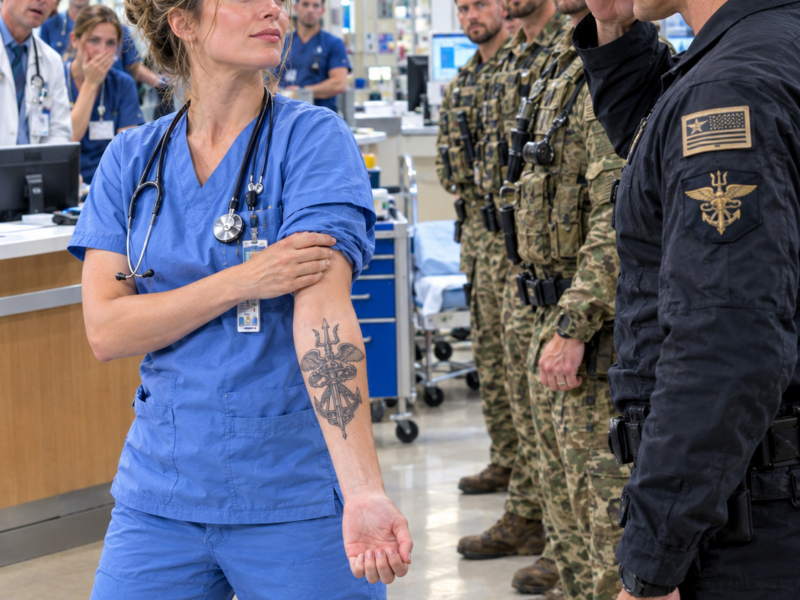
“Everyone in the briefing room laughed when they saw the strange tattoo on my wrist, but the moment a SEAL commander walked through the door
For a moment, I couldn’t make myself speak.
Daniel Cross was dead.
That was the official conclusion. Six years earlier, after a classified operation overseas, his name had appeared on a casualty list. The report said his team had been compromised, the extraction had failed, and no remains could be recovered.
I had read those words in a windowless room while a Navy officer watched me sign a nondisclosure agreement.
I had carried them home like a second set of dog tags.
And now Commander Elias Ward was standing in front of me, asking whether I knew a man who was supposed to be buried beneath six years of silence.
“Where did you hear that name?” I asked.
Ward studied me carefully.
“Answer my question first.”
“Yes, sir. I knew Daniel Cross.”
“Knew?”
I swallowed.
“He was my team leader.”
Ward’s jaw tightened at the word *was*.
“Then you understand why I need to know about that tattoo.”
I glanced down at my wrist. The three black lines crossed by a silver crescent looked exactly as they had yesterday. Small. Harmless. Almost ridiculous.
But they had not started as decoration.
Daniel had drawn the symbol on a folded map during our final week together. Three lines for three routes out. The crescent meant the fourth route, the one that existed only if every planned exit failed.
It had been a private contingency marker used by a handful of people on a mission that officially never happened.
Afterward, Daniel had told me to remember it.
“If someone shows you this mark,” he’d said, “don’t assume they’re on our side. Find out what they know first.”
I had never forgotten.
“I need to see your identification, Commander,” I said.
One of the officers outside shifted at the sound of my voice through the door.
Ward didn’t take offense.
Instead, he reached into his uniform pocket, removed a credential, and placed it on the table between us.
I checked it carefully.
The photograph matched. The identification number matched the one in the restricted personnel directory I remembered. The security hologram was intact.
Still, I didn’t relax.
“Why are you here?” I asked.
“Because a shipment record was altered last night, and the change points to a sealed operation from six years ago.”
My stomach tightened.
“The equipment case?”
“Yes.”
“Then the inventory discrepancy isn’t a clerical mistake.”
“No.”
Ward opened a thin folder and turned it toward me. Inside were three printed pages: a tracking record, a transfer authorization, and a screenshot from a secure database.
The case number on the first page matched the one I had noticed in the briefing.
The second document contained a transfer approval attributed to a logistics officer who had retired years earlier.
The third showed a user account accessing the record at 0217 that morning.
I recognized the account.
It belonged to me.
“I didn’t access this file,” I said.
“I know.”
I looked up sharply.
“You know?”
“The access pattern doesn’t match your normal activity. Your credentials were used from a terminal in a restricted annex while you were logged into a different workstation across the building.”
Someone had copied my login.
Or had found a way to make the system believe I had been there.
“What was in the case?”
Ward closed the folder.
“That’s what we’re going to establish.”
I almost laughed. Not because anything was funny, but because it sounded like the beginning of another official investigation in which everyone knew more than they were willing to say.
“Commander, with respect, I spent six years being told that Daniel Cross was dead and that I was never to discuss the operation. If his name is connected to this, I want to know why.”
Ward’s expression softened by a fraction.
“You deserve answers. But I can’t promise you all of them today.”
“That sounds familiar.”
“I imagine it does.”
He paused, then continued.
“There’s a security team waiting outside. You’re not under arrest, and you aren’t being accused of anything. But until we know who used your credentials, I need you to stay available and avoid discussing this with anyone who isn’t cleared to hear it.”
I stared at him.
“And if I refuse?”
“Then I’ll document your refusal and proceed without your assistance.”
It was the first honest answer anyone had given me about the situation.
I nodded.
“Fine. But I’m not signing anything that says I volunteered to forget Daniel Cross again.”
“You won’t be asked to.”
Ward opened the door.
Two security personnel stood in the hallway, along with a woman in civilian clothes carrying a tablet. She introduced herself as Special Agent Rebecca Sloan, a naval criminal investigator assigned to the case.
She was in her forties, with close-cropped hair and an expression that suggested she had learned not to confuse confidence with truth.
“Petty Officer Brooks,” she said, “I’d like to speak with you somewhere private.”
I looked at Ward.
He gave me a small nod.
“Tell her what you told me.”
So I did.
Not everything. Not yet.
But I told Agent Sloan that Daniel had been my team leader, that the symbol on my wrist came from our operation, and that I had never authorized access to the equipment record.
She listened without interrupting.
When I finished, she asked, “Did Daniel ever suggest he might survive the operation?”
“No.”
“Did he ever tell you to preserve evidence?”
I hesitated.
“Yes.”
“What kind?”
“Records that couldn’t be changed after the fact. Original route approvals. Communications logs. Anything that could establish who made a decision and when.”
Sloan made a note.
“Did you preserve any?”
I thought of a small envelope in the back of a locked drawer at home. Inside it was a handwritten page Daniel had given me during our final briefing. I had kept it because it was the only thing that still sounded like him.
I had never shown it to anyone.
“I might have something,” I said.
Ward’s eyes sharpened.
“Where?”
“At home.”
“Don’t retrieve it yourself,” Sloan said immediately. “Don’t move it, photograph it, or tell anyone else about it. We’ll arrange a documented collection if it becomes relevant.”
I nodded.
She studied me for another second.
“Petty Officer, I’m going to ask you something directly. Did you tattoo that symbol on your wrist before or after Daniel’s death was officially reported?”
“After.”
“How long after?”
“Three weeks.”
“Why?”
Because I had been angry.
Because I had been grieving.
Because everyone had told me the mission was over, and I had felt in my bones that the story wasn’t finished.
I gave her the simplest honest answer.
“Because I didn’t want to forget what happened.”
Sloan closed her tablet.
“Then we need to find out what actually happened.”
For the first time that morning, I believed someone might mean it.
But the truth did not arrive all at once.
It arrived in pieces.
And the first piece was waiting in a room I had been told never to enter again.
The equipment case had been transferred to a secure evidence facility on base. Ward, Sloan, and I were escorted there shortly before noon. I wasn’t allowed to handle the case, but I was permitted to observe the inventory team as they documented every seal and label.
The outer tracking sticker was new.
Under ultraviolet light, a second label appeared beneath it.
The original case number.
The one that had been erased from the standard record.
An evidence technician photographed the label, recorded its location, and compared it with the archived shipping manifest.
“There’s a discrepancy in the weight,” she said. “The original manifest lists the case at twenty-eight kilograms. The current reading is just over twenty-four.”
“What was removed?” Ward asked.
“We won’t know until we open it.”
The technician checked the authorization and cut the seal.
Inside were layers of foam, a damaged radio component, and a sealed metal cylinder about the size of a flashlight. The radio part was listed on the public inventory sheet. The cylinder wasn’t.
It had no standard barcode.
Only a small silver crescent stamped into the end.
My breath caught.
Ward saw my reaction.
“Recognize it?”
I nodded.
“Daniel used that mark on anything he wanted us to notice without writing it down.”
“Could someone else have copied it?”
“Of course.”
I forced myself to look at the cylinder instead of imagining Daniel’s face.
The technician photographed it from every angle before opening it under controlled conditions. Inside was a compact data module, wrapped in protective material.
Sloan leaned toward the screen as the technician connected a forensic reader.
A directory appeared.
Most of the files were encrypted or damaged. One was an ordinary text file with a timestamp from six years earlier.
Its first line contained a route designation.
The second line listed an extraction window.
The third named the officer who had approved the change.
Commander Elias Ward.
I looked at him.
He did not move.
“That’s impossible,” I said.
Ward’s expression had gone cold.
“I never approved that change.”
The technician stopped typing.
Sloan immediately instructed her to preserve the screen state and create a forensic image of the module.
No one touched the file again.
“Commander,” Sloan said, “I need you to understand that your name is now part of the evidence.”
“I understand.”
“Until the approval is authenticated, you’ll need to step away from the review.”
Ward nodded once.
He didn’t argue, and that made me trust him more than any speech could have.
He turned toward the door.
Before leaving, he looked at me.
“Brooks, whatever that file says, don’t let it decide what you believe before we know whether it’s genuine.”
Then he was gone.
I remained beside Sloan, watching the technician create a verified copy of the data.
The name on the file bothered me, but the timestamp bothered me more.
It was earlier than the time the original mission report said our team had requested the route change.
If the file was genuine, someone had changed the plan before the official request existed.
If it was forged, someone had gone to extraordinary lengths to frame the commander who was now trying to investigate it.
Either possibility meant the equipment case was never supposed to be found.
And somebody had used my credentials to bring it back into the system.
That afternoon, Sloan arranged a controlled search of the archived mission records. She kept the investigation narrow, with access logged and every document copied under observation.
The first discrepancy was small.
A communications entry had been added to the archive two days after the operation.
The second was harder to explain.
A route approval carried two timestamps: one from the original system and one from a later migration. The approval appeared to have been signed by Ward, but the signature metadata did not match the credentials he had used at the time.
The third discrepancy was a personnel status change.
Daniel Cross had been listed as missing for eleven hours before his status was changed to presumed deceased.
That change had been made by a duty officer who claimed he had received confirmation from the field.
There was no recorded confirmation.
No authenticated message.
No verified identification.
Only a summary entered after the fact.
I read the page twice.
“Why would they declare him dead without confirmation?”
Sloan folded her hands.
“There are legitimate reasons for a provisional casualty status during an active operation. But this record doesn’t explain the final change. That’s why we’re treating it as a question, not a conclusion.”
“Someone could have corrected it later.”
“Someone could have. But the correction trail is missing.”
I felt anger rising beneath my ribs.
Six years of grief, built on a record that could not explain itself.
I wanted to accuse someone. I wanted to point at the names on the page and demand that they answer for every birthday, every anniversary, every night I had spent wondering whether Daniel had known we were trying to find him.
Instead, I forced myself to ask the only question that mattered.
“What happens next?”
“We authenticate the records, identify who had access, and establish whether Daniel Cross died during that operation.”
The words left no room for the answer I desperately wanted.
That evening, I returned to my quarters with an escort and instructions not to use my personal devices to discuss the investigation. I didn’t go home. I didn’t call anyone from the old team.
I sat on the edge of my bed and looked at the tattoo.
Three lines.
One crescent.
A reminder that there had always been another way out.
I thought of the envelope in my locked drawer. I could still picture Daniel’s handwriting on the page inside, the letters slanting sharply to the right because he always wrote while standing.
I had carried that envelope through two transfers and one move.
I had never opened it after the first year.
Now I wondered whether I had been protecting a memory or guarding the last piece of a warning.
The next morning, Agent Sloan arrived with a chain-of-custody officer and a written authorization to collect the document.
I watched as they retrieved the envelope from my home, photographed it, sealed it, and recorded every transfer.
The page inside was exactly as I remembered.
A rough map.
Three lines.
A crescent.
And a sentence written in Daniel’s blocky hand:
*If the official route changes after approval, preserve the original. Trust the time, not the signature.*
Sloan read it twice.
“Did you ever tell anyone you had this?”
“No.”
“Did Daniel explain what he meant?”
“He said a signature could be copied. A timestamp was harder to fake if the original system was preserved.”
“Was he talking about this operation?”
“I believe so.”
She nodded slowly.
“This may be relevant, but we still need independent corroboration. A handwritten note can tell us what someone feared. It can’t prove what actually happened.”
“I know.”
And I did.
The hardest part was no longer learning that the official story might be wrong.
It was accepting that my memories, my anger, and even Daniel’s own words would not be enough to establish the truth.
Evidence would have to do what grief could not.
For the next four days, the investigation moved quietly.
Ward recused himself from decisions involving his own name. Sloan’s team secured the relevant server backups and obtained access logs from the communications archive. A separate technical unit compared the old signatures against authenticated records from the same period.
I was interviewed twice more.
Each time, Sloan asked about the final operation.
Each time, I answered what I remembered and said when I didn’t know.
On the fifth day, she called me into a small conference room.
Ward was there, seated at the far end of the table. He was no longer directing the investigation, but he had been invited because the technical team had completed its preliminary comparison.
Sloan placed two documents side by side.
“The route change attributed to Commander Ward was not authenticated by his original credentials,” she said. “The signature appears to have been inserted during a later record migration. We have not yet established who did it.”
Ward exhaled through his nose.
“And the timestamp?”
“The earliest verifiable record shows that the route alteration existed in a separate planning system before the final approval was entered in the main archive.”
I stared at the pages.
“So the plan changed before anyone officially approved it.”
“That’s what the records currently indicate,” Sloan said. “We’re still checking whether the clocks were synchronized and whether the systems recorded the same event. We won’t claim more than the evidence supports.”
I appreciated that she said it.
For six years, certainty had been used as a substitute for proof.
I didn’t want another version of that.
“What about Daniel?” I asked.
Sloan’s expression changed.
“We found a secondary personnel entry linked to an emergency medical transfer. The entry was created under a temporary identifier, not his name. The medical transport record indicates that one unidentified male was moved from a field treatment point to a regional facility several hours after the operation’s official casualty window.”
My mouth went dry.
“Was he alive?”
“The transport record indicates that the patient had a pulse when he was transferred. We can’t yet confirm that the patient was Daniel Cross.”
“Where was he taken?”
“A medical facility that has since been reorganized. The archived records are incomplete, but we’ve requested the remaining material.”
I gripped the edge of the table.
“He could have survived.”
“Yes,” Sloan said. “He could have. But I need you to understand the difference between a possibility and a verified identification.”
I nodded, though my eyes had begun to sting.
For the first time in six years, hope felt more frightening than grief.
Grief had rules. It hurt, but it had an ending I understood.
Hope could open a door and leave me standing in front of another locked room.
Two days later, Sloan called again.
The medical facility had preserved a scanned admission photograph from the relevant date. The patient’s name had been entered incorrectly, but the face was clear enough for a comparison.
She asked me to come to the evidence office.
A technician displayed the photograph on a secure monitor.
The man in the image was thinner than I remembered. His hair had been shaved close, and a bandage crossed his forehead. There was swelling around his left eye, and his mouth was partly hidden by an oxygen mask.
But I knew the shape of his face.
I knew the small notch in his right eyebrow from the time a metal hatch had caught him during training.
I knew him.
“Daniel,” I whispered.
Sloan did not celebrate. She let the photograph remain on the screen while the technical team documented my identification.
“Your recognition is important,” she said, “but we will need independent confirmation before we can formally identify him.”
I wiped my cheek with the back of my hand.
“Where is he now?”
“We’re following the records. There is a later transfer entry, but it points to a rehabilitation network that changed names twice. We have contacted the appropriate authorities.”
“Can I speak to him?”
“Not yet. We need to confirm his current identity and location, and we need to make sure contact won’t compromise his safety.”
I hated the answer.
I also knew it was reasonable.
So I waited.
For six years, I had waited without knowing what I was waiting for.
This time, at least, there was a photograph.
Three days after that, Sloan came to find me in person.
She carried no folder.
No tablet.
Just a small piece of paper with a phone number written on it.
“We’ve confirmed his identity through medical records and an independent biometric comparison,” she said. “Daniel Cross is alive.”
The room seemed to tilt.
I sat down before my legs could give out.
“Where is he?”
“He is receiving long-term care at a rehabilitation center in Virginia. He has significant injuries and memory gaps from the incident. He’s been informed that the Navy is reviewing the circumstances surrounding his transfer. He has agreed to speak with you, if you still want that.”
I pressed my fingers against my mouth.
For a long time, I couldn’t say anything.
Then I managed, “Yes.”
Sloan nodded.
“We’ll arrange a secure call. You can decide afterward whether you want an in-person visit.”
I looked at the number in her hand.
“Does he know about the tattoo?”
“He asked whether you still had it.”
I laughed once, a broken sound that surprised me.
“Of course he did.”
The call was scheduled for the following afternoon.
I arrived early and waited in a private room with a secure video connection. Ward stood outside the door, giving me space. Sloan had explained that the first conversation would be recorded for verification and then stopped if Daniel requested privacy, subject to the requirements of the investigation.
I had prepared questions.
Why didn’t you come back?
Who changed the route?
Why did they tell us you were dead?
Were you trying to reach me?
I had rehearsed them until every question sounded like an accusation.
Then the screen flickered.
A man appeared, sitting beside a window in a quiet room. His hair was gray at the temples now. His shoulders were narrower. A faint scar ran from his cheek toward his jaw.
His eyes were still his.
For several seconds, neither of us spoke.
Then he looked at my wrist.
“You kept it,” he said.
I began to cry.
“You’re alive.”
Daniel gave me a tired, crooked smile.
“Apparently.”
I pressed a hand over my mouth, trying to stop the sound that came out of me.
He waited.
He had always been good at waiting when words were too difficult.
Finally, I leaned toward the screen.
“They told us you died.”
“I know.”
“Six years, Daniel.”
“I know, Hannah.”
I wanted to be angry. I was angry. But seeing him breathe, seeing his fingers move against the armrest, made the anger too large to fit into a sentence.
“Why didn’t you contact me?”
His smile faded.
“I tried, once. I don’t know if the message ever left the facility. After the operation, I was moved under a temporary identifier. I woke up in a hospital with no clear memory of how I’d gotten there. By the time I could answer questions, the records said I was an unidentified casualty from a different unit.”
“Who moved you?”
“I don’t know.”
“Did you know they had declared you dead?”
“Not at first. Later, I saw a copy of the report. I asked for it to be corrected. The request disappeared.”
He looked down at his hands.
“I was injured badly, Hannah. I couldn’t remember the full operation, and I didn’t have proof of what I thought I remembered. Every time I asked about the transfer, I got another explanation. Eventually, I stopped believing anyone would listen.”
I swallowed hard.
“You could have told me.”
“I could have,” he said. “If I had known where you were. If I had known who I could trust. If I had understood what was happening.”
His honesty hurt more than an excuse would have.
I looked at the crescent on my wrist.
“Why did you give me the note?”
“Because I saw the route change before we moved out. I didn’t have time to prove it. I wanted someone to preserve the original record in case I couldn’t come back.”
“Did you know Commander Ward?”
“I knew of him. I didn’t know whether he was involved. The symbol wasn’t a signal to trust him. It was a way to recognize the original planning notes.”
I glanced toward the closed door.
“His name was on the altered approval.”
“Then someone wanted you to believe he signed it.”
Daniel leaned closer to his camera.
“Listen to me. Don’t let the investigation become a hunt for one person you can blame. We had a bad route, incomplete communications, and people making decisions under pressure. Someone may have deliberately changed the record, but we need proof of who did it and why.”
I let out a shaky breath.
“You sound exactly the same.”
“I’m older.”
“You still tell me not to jump to conclusions.”
“Somebody has to.”
For the first time, I smiled.
Then the questions returned.
“Are you coming back?”
Daniel’s expression became careful.
“I don’t know what coming back means yet. I have treatment to finish. I need to understand what happened. And I need to learn how to live with the years I lost.”
I nodded, fighting the urge to demand more than he could give.
“I won’t ask you to solve everything today.”
“Good.”
“But I’m not going to disappear again.”
He looked at me for a long moment.
“I’d like that.”
The call ended forty minutes later.
I stayed in the room long after the screen went dark.
Outside, Ward was waiting in the hallway.
He didn’t ask what Daniel had said.
He only asked, “Are you all right?”
“No,” I answered honestly. “But I think I will be.”
He nodded.
“That counts for something.”
The investigation continued for months.
The evidence established that the route approval in the archive had been altered after the original planning event and that my credentials had been used without my authorization. Investigators traced the copied access token to a compromised terminal associated with a contractor whose account had been improperly retained after his assignment ended.
That discovery explained how my credentials had been used.
It did not, by itself, prove who had ordered the access or who had changed the original mission records.
The investigation also confirmed that Daniel had been transported alive after the operation. His later medical records had been separated from the original casualty file during a series of administrative transfers. The reasons for that separation remained under review.
Commander Ward was formally cleared of authorizing the disputed route change after the signature was shown to have been inserted during the archive migration. He was not cleared simply because I trusted him; he was cleared because the evidence supported it.
Other questions remained open.
Who had first changed the route?
Why had Daniel’s medical transfer been recorded under a temporary identifier?
Who had allowed the casualty report to stand without the required confirmation?
The Navy corrected Daniel’s personnel status and reopened the relevant operational review. Several officials were referred for administrative examination over their handling of the records, but no final finding was announced about deliberate misconduct.
I learned to live with that unfinished part.
Justice, I discovered, did not always arrive as a dramatic confession in a room full of witnesses.
Sometimes it arrived as a corrected file.
A verified timestamp.
A name restored to the right line.
And a man who had been declared dead getting to decide for himself what happened next.
Three months after our first call, I visited Daniel at the rehabilitation center.
I stood outside his room for nearly a full minute before knocking.
When he opened the door, he looked more like the man I remembered. Still thinner. Still carrying pain in the way he moved. But his eyes were clearer.
He glanced at my wrist.
“You know,” he said, “that’s a terrible tattoo.”
I laughed so hard I had to wipe my eyes.
“You gave me the design.”
“I gave you a map symbol. I never told you to put it on your body.”
“You could have mentioned that six years ago.”
“I was a little busy.”
We sat by the window and talked about small things first. The people we had lost contact with. The food he hated at the facility. The books he had started and abandoned because he couldn’t concentrate for long.
We did not solve the mission over lunch.
We did not suddenly recover six lost years.
We began with what was possible.
Before I left, Daniel touched the tattoo lightly with one finger.
“I meant it as a reminder to preserve the truth,” he said. “Not as a reminder to keep hurting.”
I looked at the crescent.
For years, I had treated it like a memorial. I had believed that if I kept it visible, I would somehow keep faith with the man I thought I had lost.
Now I understood that remembering someone did not require living inside the worst day of their life.
I could keep the symbol.
I could also let myself move forward.
When I returned to the base, some of the same people who had laughed at me in the briefing room avoided my eyes. Others offered awkward apologies. Lieutenant Parker was among them.
“I shouldn’t have made fun of you,” he said. “I didn’t know what it meant.”
“You didn’t need to know what it meant to show respect,” I replied.
He lowered his gaze.
“No. I didn’t.”
It wasn’t a perfect apology, but it was an honest beginning.
I went back to work.
The inventory system still had problems. Equipment still arrived late. Forms still came back with missing signatures, and people still blamed logistics when a plan failed.
But I no longer confused keeping quiet with being safe.
When I found a discrepancy, I documented it.
When I didn’t know something, I said so.
And when someone asked about the tattoo, I no longer pulled my sleeve down in a hurry.
I told them it was a symbol from a mission that had been misunderstood, and that it reminded me to question records when the evidence didn’t add up.
I didn’t tell every stranger Daniel’s story.
Some things belonged to him as much as they belonged to me.
But I stopped treating the truth like a dangerous object that had to be hidden forever.
One afternoon, Commander Ward passed me in the corridor. He paused, looked at my wrist, and gave a small nod.
“Still keeping the mark visible, Brooks?”
“Yes, sir.”
“What does it mean to you now?”
I considered the question.
“It means a signature isn’t the same thing as proof. And silence isn’t the same thing as loyalty.”
Ward thought about that.
“Good answer.”
Then he continued down the corridor, leaving me with the quiet hum of the building and the faint silver crescent on my skin.
I used to believe the tattoo was the last piece of Daniel I had left.
I was wrong.
The last piece wasn’t the ink.
It was the lesson he had trusted me to carry: preserve what happened, question what doesn’t make sense, and never let an official story replace the truth simply because it is easier to accept.
Everyone had mocked the mark because they saw a strange drawing on a junior sailor’s wrist.
Commander Ward recognized it because he knew what it had been created to protect.
And Daniel, after six years of silence, was alive to tell his own story.
The case was not closed. The missing years could not be returned. Some questions might take years to answer, and others might never be settled completely.
But the record had begun to change.
Daniel’s name was no longer filed among the dead.
My own name was no longer attached to an access I had never made.
And the symbol I had once worn like a wound had become something else.
A reminder that the truth could be buried, altered, and delayed.
But if someone kept the original, it did not have to disappear.
THE END.









