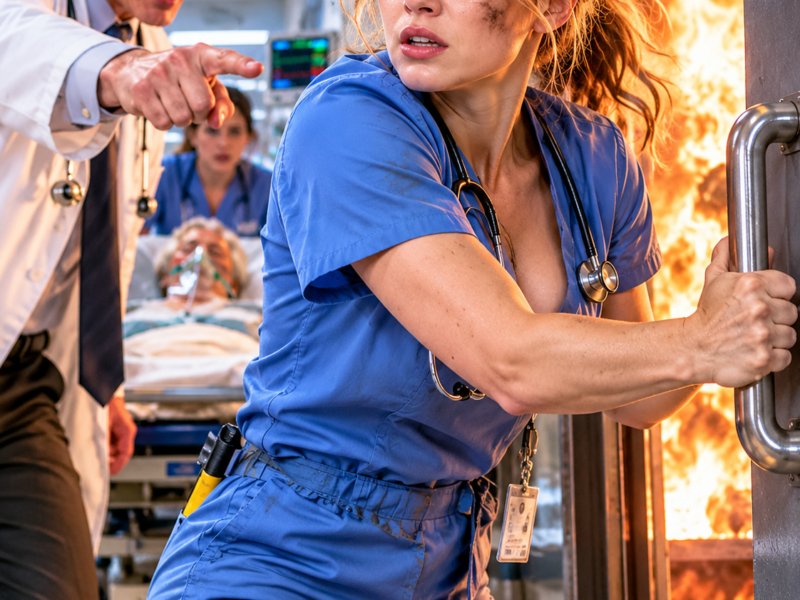
“Dr. Richard Hayes laughed when I warned him that six patients on the night shift were showing the same strange symptoms
The general’s words seemed to silence the entire lobby.
Dr. Hayes gave a nervous laugh.
“General, I think there’s been some confusion. Natalie Brooks is a civilian nurse. Whatever her previous employment may have been, it has nothing to do with the incident last night.”
General William Mercer didn’t look at him.
“That’s exactly what concerns me, Doctor. You have no idea who she is, do you?”
I felt every pair of eyes turn toward me.
“General, please,” I said quietly. “Not here.”
He studied my face.
For a moment, his stern expression softened.
“Of course, Captain.”
Then he turned to the hospital administrator.
“I need access to the six patients who were affected last night, along with every record connected to that infusion equipment. And I want the equipment preserved exactly as it was removed.”
The administrator nodded quickly.
“Absolutely, General.”
Dr. Hayes stepped forward.
“That equipment has already been sent to biomedical services.”
“Then make sure nobody touches it.”
“With respect, this is a hospital matter.”
Mercer finally looked at him.
“Six patients nearly died. Two are active-duty service members. That makes it a matter I intend to understand.”
He handed his aide a folder.
“Start with the installation records.”
I watched him walk away.
My hands were trembling.
I hadn’t heard anyone call me Captain in almost four years.
And I had spent those four years making sure nobody ever would again.
The general found me in the small family consultation room twenty minutes later.
He came alone.
“May I sit?”
I nodded.
He placed his cap on the table.
“How long have you been working here?”
“Eleven years.”
“Eleven years as a civilian nurse?”
“Yes.”
“Does anyone here know about your service?”
“No.”
He looked down.
“I suppose I should have expected that.”
I folded my hands.
“Why are you here, General?”
“One of the patients from last night is a member of a Navy medical support unit. His commanding officer called me when he learned what happened. He mentioned a nurse who identified the equipment problem before anyone else.”
I stared at him.
“That doesn’t explain why you recognized me.”
“No. It doesn’t.”
He opened his folder and removed an old photograph.
It showed a dusty field hospital, several exhausted medical personnel, and a younger version of me standing beside a tent.
I remembered that day.
I remembered the heat.
I remembered the blood on my sleeves.
And I remembered the man standing behind me in the photograph.
Colonel James Whitaker.
He had been a brigadier general by the time I left the service.
Mercer tapped the photograph.
“Do you remember Operation Silver Ridge?”
My throat tightened.
“Yes.”
“Then you remember why your record was sealed.”
I looked away.
“I remember what happened.”
“That’s not the same thing.”
For four years, I had told myself the past was finished.
But some memories don’t stay buried just because you stop speaking their names.
Before I became Natalie Brooks, I had been Captain Natalie Brooks, a nurse assigned to a military medical evacuation unit.
During Operation Silver Ridge, our team had been deployed to a temporary treatment facility after an explosion injured dozens of service members and civilians.
The situation was chaotic.
Our supplies were limited, communications were unreliable, and incoming casualties arrived faster than we could process them.
I was responsible for triage and emergency stabilization.
That night, a transport helicopter was expected to bring several critically injured soldiers.
But the aircraft never arrived.
The official report later stated that the landing site had been compromised and that the medical team had failed to follow evacuation instructions.
Three people died before help reached them.
One of those people was Lieutenant Daniel Mercer.
The general’s son.
I had been the last nurse to speak with him.
I remembered his hand gripping mine.
I remembered him asking whether his team would make it home.
I had promised him I would do everything possible.
And I had failed to get him out.
The military investigation found that the evacuation plan had been altered without proper authorization.
But the original communications log disappeared.
A senior officer claimed I had ignored a revised instruction and delayed the evacuation.
I knew that wasn’t true.
I had followed the orders transmitted to our medical unit.
But I couldn’t prove it.
The investigation eventually cleared me of criminal wrongdoing, yet the report remained classified.
I was offered a chance to continue serving.
I declined.
I couldn’t walk into another treatment tent without seeing Daniel’s face.
So I left.
I moved to Florida, changed my routines, and became a civilian nurse.
I never told anyone at St. Augustine about the uniform I had once worn.
I wanted to be known for the work I did in front of me, not for a past I couldn’t change.
Now General Mercer was sitting across from me with the photograph between us.
“Daniel trusted you,” he said.
I swallowed.
“I know.”
“He told me about you in his last letter.”
I looked up sharply.
“What letter?”
Mercer opened the folder again.
“He wrote it before the operation. He said that if anything happened, I should remember the people who stayed with him when he was afraid.”
His finger rested on the photograph.
“He mentioned you by name.”
I couldn’t look at him.
“I should have saved him.”
The general was silent for a long moment.
Then he said, “You did save people that night, Captain. The report never told the whole story.”
I felt my chest tighten.
“What are you saying?”
“That I didn’t come here only because six patients were in danger.”
He leaned forward.
“I came because I received new evidence about Silver Ridge three days ago.”
The hospital administrator arranged a private meeting that afternoon.
Dr. Hayes attended, along with the chief of nursing, the hospital’s compliance director, and two representatives from the military medical command.
I was invited as a witness.
Hayes looked displeased when I entered.
“Surely we can conduct this review without a nurse who has already been relieved of duty.”
General Mercer pulled out a chair for me.
“She is the person who identified the problem. She stays.”
The administrator cleared his throat.
“We understand the seriousness of last night’s events. However, our preliminary review suggests the infusion equipment malfunctioned during normal use.”
“Have you examined it?” Mercer asked.
“Our biomedical department is reviewing it.”
“Who installed it?”
The compliance director answered.
“An outside contractor, MedCore Systems.”
“Who approved the purchase?”
Dr. Hayes spoke before anyone else could.
“I did.”
The general looked at him.
“Did you inspect the equipment before it was connected to patient lines?”
Hayes shifted.
“I’m the chief physician. I approved the installation based on the technical documentation.”
“Did you read that documentation?”
“Of course.”
“Then you should have no difficulty explaining why the equipment was configured differently from the manufacturer’s specifications.”
Hayes said nothing.
The general slid a photograph across the table.
It showed the equipment’s internal tubing.
A small component had been installed in the wrong position.
The result was that the machine could deliver a concentrated cleaning solution into the medication line under certain operating conditions.
I leaned forward.
“That’s what caused the symptoms?”
Mercer nodded.
“The substance entered the infusion system during the overnight cycle. The investigation is still determining the exact exposure levels.”
I remembered the chemical smell.
The unfamiliar service sticker.
The six patients who had all received treatment through the same station.
“Was the machine serviced that afternoon?” I asked.
The compliance director looked at the document in front of him.
“Yes.”
“By whom?”
“MedCore Systems.”
“Did the technician run a full safety test?”
The room went quiet.
The director checked another page.
“The report says the test was completed.”
“Who signed it?”
He hesitated.
Then he turned the document around.
The signature was Dr. Hayes’s.
Hayes immediately shook his head.
“I did not sign that.”
The general’s expression didn’t change.
“Your name is on the form.”
“Someone must have copied it.”
I looked at the signature.
It was too neat.
Too uniform.
The real Dr. Hayes always signed his name with a long, hurried stroke that nearly cut through the paper.
This signature looked like it had been typed or digitally inserted.
I pointed to the bottom corner.
“There’s a service ticket number missing.”
The compliance director frowned.
“What?”
“Every maintenance report I’ve seen has a ticket number in this box. This one doesn’t.”
Mercer turned to his aide.
“Get the contractor’s original copy.”
Dr. Hayes looked at me.
“You’re speculating.”
“I’m asking why the original ticket number is missing.”
He leaned back.
“You’ve always had difficulty staying within your role, Natalie.”
The general closed the folder.
“And that attitude is precisely why we need an independent review.”
The next morning, I received a call from Elaine, the overnight pharmacist.
Her voice sounded strained.
“Natalie, I found something.”
“What is it?”
“I checked the pharmacy logs from last night. The infusion equipment wasn’t supposed to be used for medication preparation at all.”
I sat upright.
“What do you mean?”
“It was installed for a separate cleaning process. Someone connected it to the medication station.”
“Who authorized that?”
“I don’t know. But there’s an electronic access record.”
She paused.
“Your employee ID was used.”
I stared at my phone.
“That’s impossible.”
“I know. You were on the floor all night.”
“Send the record to the investigator.”
“I already tried. The compliance director told me to wait.”
“Elaine, don’t wait.”
She lowered her voice.
“There’s something else. The record was accessed from Dr. Hayes’s office.”
I felt a chill move through me.
“Are you sure?”
“That’s what the system shows.”
I called Commander Bennett, the general’s investigative liaison.
She asked me not to discuss the matter with anyone at the hospital.
An hour later, she arrived with a forensic specialist.
They examined the electronic logs and confirmed that my credentials had been used to authorize the equipment connection.
But the access had come from a terminal assigned to the chief physician’s office.
The time stamp was 9:42 p.m.
At that time, I had been administering medication in Room 305.
A second nurse confirmed it.
Someone had used my credentials to make it appear that I had authorized the connection.
The same way someone had tried to make it appear that I had caused the problem.
Bennett looked at me.
“Do you have any idea who would have access to your login?”
“My login is private. But the hospital recently installed a shared workstation in the medication room.”
“Who had access to it?”
“Most of the staff.”
She nodded.
“Then we need to find out whether this was a simple credential misuse or part of a larger effort to conceal what happened.”
Before she left, she asked me one question.
“Did you notice anything unusual about Dr. Hayes before the equipment was installed?”
I thought about it.
“He was unusually eager to get the new system running.”
“Did he mention why?”
“He said it would reduce preparation time and improve patient throughput.”
Bennett wrote something down.
“Thank you.”
I watched her leave.
The more evidence we found, the less this looked like a single mistake.
That afternoon, General Mercer asked me to meet him at the hospital’s military liaison office.
A sealed envelope sat on his desk.
“This came from the archives,” he said.
He opened it carefully.
Inside was a copy of a communications transcript from Operation Silver Ridge.
My name appeared near the top.
So did the time of the evacuation order.
I read the first few lines.
Then I stopped.
The transcript showed that our medical unit had received an instruction to move to an alternate landing zone.
But the instruction had arrived after the helicopter had already been redirected.
It was not the message I remembered receiving.
“That’s not what we heard,” I whispered.
Mercer nodded.
“There’s another version.”
He placed a second transcript beside it.
The second version contained the original message.
It instructed the helicopter to land at the designated medical zone.
It had been altered after the operation.
I felt my hands grow cold.
“Who changed it?”
“An officer named General Thomas Vance. He was overseeing the communications network.”
I knew the name.
Vance had been responsible for the operation’s logistical coordination.
He had testified during the investigation.
He had claimed the medical team received the wrong instructions because of a transmission failure.
“Why would he change it?”
“Because the helicopter was redirected after a private request from a contractor working with the operation.”
I looked at the general.
“A contractor?”
“An outside company had been transporting specialized medical equipment. They wanted the landing zone cleared for a shipment.”
I stared at the papers.
“People died because someone wanted a delivery window?”
Mercer didn’t answer immediately.
“That’s what the new evidence suggests.”
He turned another page.
“The same contractor later became a major supplier to civilian hospitals.”
I looked at the name.
MedCore Systems.
The company that had installed the faulty equipment at St. Augustine.
For a moment, the two parts of my life seemed to collide.
“You’re saying the same company was connected to Silver Ridge?”
“Not necessarily the same people. But the ownership structure overlaps.”
He placed a final document on the desk.
A corporate registration.
The name of the current MedCore director was listed beside a former military procurement officer.
I recognized the officer’s name.
General Thomas Vance.
I stood up.
“Then this wasn’t an accident.”
“We’re still establishing what happened,” Mercer said. “But the connection is serious.”
I looked at the photograph from Silver Ridge.
Daniel’s face seemed to look back at me.
For four years, I had carried the belief that I had failed him.
Now I wondered whether someone had deliberately made me carry the blame.
The hospital’s emergency review began two days later.
All six patients had recovered enough to speak with investigators.
The first patient, an elderly man named George, remembered a sharp chemical smell shortly before he became dizzy.
A woman in Room 312 described a burning sensation in her throat.
Another patient said the infusion pump had made an unusual clicking sound.
Their accounts matched the technical findings.
The equipment had been improperly connected.
The hospital’s own records showed that the contractor had skipped the required safety inspection.
Worse, the installation had been approved despite a warning from a biomedical technician.
The technician, a young man named Aaron, had written that the machine should not be connected to patient medication lines.
His warning had been deleted from the final report.
When investigators found him, he admitted that he had been pressured to change the document.
“Dr. Hayes told me the system had already been approved,” Aaron said. “He said I was holding up a project that would help hundreds of patients.”
“Did he threaten you?” Bennett asked.
Aaron looked down.
“He said my contract renewal depended on being a team player.”
I felt sorry for him.
He had been afraid of losing his job.
I understood that fear better than most.
But the patients had paid the price.
The investigation also revealed that MedCore had offered the hospital a discount if it installed the equipment before the end of the quarter.
The discount was tied to a performance target.
The faster the hospital processed patients, the more money it received.
Dr. Hayes had been responsible for meeting that target.
His emails showed he had pushed for the installation despite the technician’s warning.
However, the investigators found no evidence that he had knowingly intended to harm anyone.
He had made reckless decisions, trusted false assurances, and ignored warnings.
That was serious enough.
The hospital placed him on administrative leave.
But there was another discovery.
The electronic access log showed that the forged authorization under my name had been created after the six patients began showing symptoms.
Someone had tried to make me responsible for the equipment connection.
The log traced the activity to the compliance director’s office.
When confronted, the director admitted that he had been instructed to “clean up the documentation” by a senior administrator.
That administrator was the hospital’s chief operating officer.
And the chief operating officer had received payments from a consulting company connected to MedCore.
The fraud was bigger than one doctor.
It had been built into the hospital’s business relationships.
The general’s investigation into Silver Ridge moved in parallel.
A former communications technician came forward with a copy of the original transmission.
He had kept it because he believed the official report was wrong.
The recording confirmed that the evacuation helicopter had been redirected after the original landing instructions were issued.
The medical team had followed the correct order.
I had followed the correct order.
The delay had not been caused by me.
It had been caused by an unauthorized change made at a higher level.
General Vance had been questioned and relieved of his current advisory duties while the investigation continued.
The old report was reopened.
When General Mercer told me, I didn’t feel the triumph I had imagined.
I felt tired.
“Does this mean my record will be corrected?” I asked.
“Yes.”
“And Daniel?”
Mercer looked at the photograph on his desk.
“His record will be corrected too. He deserves to be remembered for what he did, not for what someone wrote afterward.”
I nodded.
I had spent four years believing that Daniel’s death was a failure I had to carry alone.
Now I knew the truth.
But the truth didn’t bring him back.
The day the hospital held its formal review, the six patients were invited to attend.
Some came with family members.
Others joined by video.
I sat in the back of the conference room, uncomfortable with the attention.
General Mercer stood beside the board chair.
He spoke about the emergency response, the investigation, and the importance of listening to medical professionals who raised concerns.
Then he turned toward me.
“Captain Brooks identified a pattern that others dismissed. She acted when patients were in danger, even after being ordered to stop.”
I lowered my eyes.
I didn’t need applause.
I needed to know the patients were safe.
George, the elderly patient from Room 308, raised his hand.
“Can I say something?”
The board chair nodded.
George stood slowly.
“I don’t know anything about military records or hospital contracts. But I know that nurse came into my room every hour. She noticed I was getting worse before I did.”
He looked at me.
“She didn’t give up on us.”
A woman beside him nodded.
“She stayed with me when I was scared.”
My throat tightened.
I had spent so long believing that my worth was something I had to prove.
That morning, six people reminded me why I had chosen nursing in the first place.
After the meeting, Dr. Hayes approached me in the corridor.
He looked older than he had a week earlier.
“Natalie.”
I stopped.
“I owe you an apology.”
I waited.
“I dismissed your concerns. I let my position make me think I couldn’t be wrong.”
He looked down.
“And I signed off on equipment I hadn’t properly reviewed. People were hurt because I wanted the project completed on time.”
His voice faltered.
“I don’t expect you to forgive me.”
I studied him.
“Then don’t ask me to.”
He nodded.
“I understand.”
For the first time, I believed he did.
He was not a monster.
He was a doctor who had allowed pride and pressure to replace judgment.
That did not erase what he had done.
But it made the apology feel real.
Three weeks later, the hospital offered me the position of night-shift nursing supervisor.
I almost laughed when I read the letter.
The same hospital that had once treated my questions as insubordination was now asking me to lead the unit.
I accepted, with one condition.
Every nurse would have direct access to the patient safety reporting system.
No supervisor could remove a report because it embarrassed a department.
No employee could be disciplined for raising a good-faith safety concern.
The hospital board agreed.
A new equipment review process was also established.
MedCore’s contract was terminated.
The affected patients received independent follow-up care, and the hospital began notifying every person who might have been exposed to the faulty equipment.
The investigation into the contractor and its connections to the old military operation continued.
As for my military record, the correction arrived in a plain envelope.
It stated that I had followed the evacuation order issued to my unit and had not been responsible for the delay that led to Daniel’s death.
My service record was officially amended.
There was no grand ceremony.
No speech.
Just a few lines on paper.
I read them twice.
Then I put the letter in a drawer beside Daniel’s photograph.
I wasn’t sure I would ever feel completely free of that night.
But I no longer had to carry someone else’s lie.
On my first night as nursing supervisor, I walked through the same corridor where Dr. Hayes had once mocked me.
The new equipment station was still empty.
A bright red notice hung above it, reminding staff that no device could be connected to patient medication lines without independent inspection.
I stopped outside Room 312.
The woman who had nearly stopped breathing was back for a follow-up appointment.
She recognized me immediately.
“You’re the nurse who kept telling everyone something was wrong.”
I smiled.
“I suppose I was.”
She reached for my hand.
“I’m glad you didn’t listen to them.”
I squeezed her fingers gently.
“So am I.”
Near midnight, General Mercer appeared at the nurses’ station.
He was dressed in uniform, but without the aides and ceremony that had surrounded him on his first visit.
He handed me a small envelope.
Inside was Daniel’s letter.
The one he had written before Silver Ridge.
The general had kept it for years.
I unfolded it carefully.
Dad, if you ever meet Captain Brooks again, tell her she did more for us than she knows. When things got bad, she stayed calm. She made us feel like we mattered. I hope she remembers that.
I read the words once.
Then again.
My eyes filled.
The general waited without speaking.
“Why didn’t you give this to me before?” I whispered.
“Because I didn’t know where you were. And because I needed to be certain the truth was ready to come with it.”
I folded the letter and held it against my chest.
For years, I had remembered Daniel’s final question.
Would his team make it home?
I had never known what he remembered about me.
Now I did.
He hadn’t remembered my failure.
He had remembered that I stayed.
The general touched my shoulder.
“He would have been proud of you.”
I looked toward the patient rooms.
Six people had gone home because someone had noticed a pattern.
One old wound had finally been given the truth.
And a hospital that had once tried to silence a nurse was beginning to understand that questions were not the enemy of good medicine.
They were part of it.
I placed Daniel’s letter in my locker, beside my corrected service record.
Then I walked back onto the floor.
A call light was blinking at the end of the hallway.
Someone needed help.
I headed toward the room without hesitation.
I had spent four years trying to forget the captain I used to be.
But that night, I finally understood.
I had never stopped being her.
The end.









