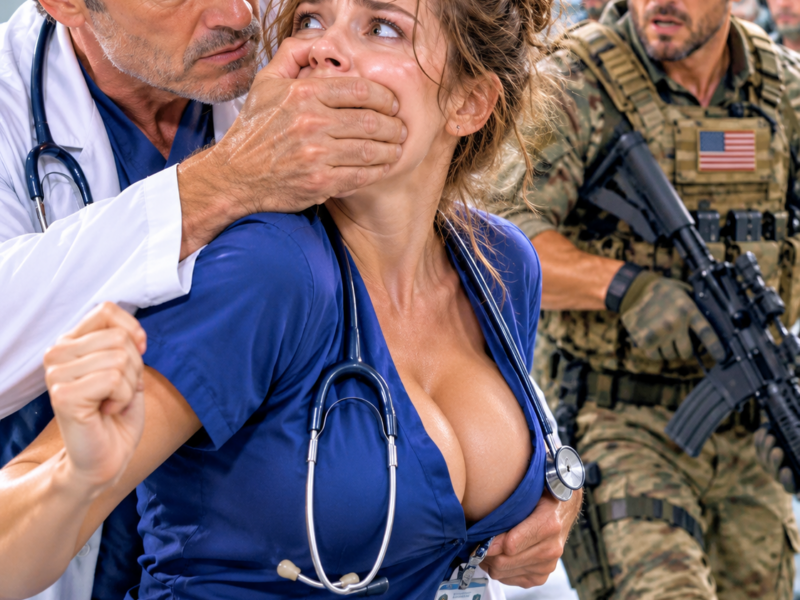
“Dr. Mitchell grabbed my wrist in front of the entire operating room and told me to stop questioning him
The photograph trembled slightly in the commander’s hand.
I recognized the face before he turned it toward me.
Staff Sergeant Daniel Brooks.
My Daniel.
He was standing beside an armored medical evacuation vehicle, wearing the same dusty uniform I remembered from our last deployment.
His left arm was wrapped in a bandage, and there was a small cut above his eyebrow.
But he was alive.
At least, he was alive in the photograph.
I reached for the edge of the desk to steady myself.
“Where did you get that?”
The commander studied my face.
“Three hours ago, this photograph was recovered from a secure military communications device belonging to Sergeant Reed.”
I looked at Mason.
He was still fighting for every breath.
“Is Daniel alive?”
The commander didn’t answer immediately.
And that silence hurt more than anything he could have said.
“Commander, please.”
“My name is Colonel Thomas Walker. I was the medical operations commander during Iron Lantern.”
I remembered him.
He had been responsible for coordinating the evacuation teams during the mission that changed my life.
He was older now, with gray at his temples, but his eyes were unmistakable.
He looked toward Dr. Mitchell.
“We need to speak privately.”
Dr. Mitchell folded his arms.
“Not until I understand why my patient is deteriorating.”
For the first time, the colonel’s voice became sharp.
“Then perhaps you should start by listening to the nurse who recognized the injury you missed.”
Dr. Mitchell’s face reddened.
“I have twenty years of surgical experience.”
“And this soldier has approximately five minutes if the vascular injury continues progressing.”
The room went silent.
I stepped toward the monitor.
“Sir, the fragment near the subclavian artery could be causing a rapidly expanding hematoma. If the injury is connected to the metal object in his shoulder, moving him without stabilizing the bleeding could make it worse.”
Dr. Mitchell looked at the scan again.
His expression changed.
He leaned closer.
“Show me exactly where you’re seeing that.”
I pointed.
He enlarged the image.
For several seconds, nobody spoke.
Then he called for the vascular surgeon.
“Get Dr. Patel in here. Now.”
It was the first time he had asked me to show him something instead of telling me to stop talking.
But I barely noticed.
My eyes remained fixed on the photograph.
Daniel had been declared dead three years earlier.
I had attended a memorial service.
I had held a folded flag.
I had spent months waking up from dreams in which I could still hear his voice through the radio.
And now someone was showing me a photograph that suggested the story I had been told might not be complete.
Colonel Walker moved closer.
“Claire, I need you to stay calm.”
I gave him a bitter look.
“You bring me a photograph of a dead man and tell me to stay calm?”
He lowered his voice.
“I understand.”
“No, you don’t.”
I turned away.
“Not unless you’ve spent three years believing you watched someone die.”
He accepted the words without defending himself.
Then he said something that made me turn back.
“We never recovered Daniel’s body.”
My throat tightened.
“What?”
“During the final evacuation, the transport carrying Daniel was struck. The vehicle burned, communications failed, and the remaining personnel were forced to withdraw.”
I stared at him.
“But the Air Force casualty office told me—”
“They identified him based on the recovered equipment and the reports from the evacuation team.”
“Then why did you tell me he was dead?”
The colonel’s expression darkened.
“Because at the time, that was the information we had.”
I shook my head.
“That’s not an answer.”
He looked at the photograph.
“No. It isn’t.”
Before he could say anything else, Dr. Mitchell called my name.
“Claire!”
I turned.
Mason’s blood pressure had dropped again.
The vascular surgeon had arrived, and the team was preparing an emergency procedure.
Dr. Patel studied the images.
“We have an arterial injury. We need to control the bleeding before this gets worse.”
I moved toward the equipment.
Dr. Mitchell stopped me.
“You’re not assisting.”
I looked at him.
“Doctor, I know this injury pattern.”
“I heard you the first time.”
“Then let me help.”
He hesitated.
Dr. Patel glanced at the colonel.
“Is she military medical?”
Colonel Walker nodded.
“Former Air Force flight medic. Eight years of service.”
Dr. Patel looked back at Mitchell.
“Then put her on the team. We don’t have time for ego.”
The words landed harder than a shouted insult.
Dr. Mitchell stepped aside.
I washed my hands, changed into the appropriate surgical attire, and entered the operating room.
The familiar smell of antiseptic filled my nose.
The lights above the table were painfully bright.
For a moment, I was back overseas.
A helicopter waiting on a dusty landing zone.
A wounded soldier.
Daniel’s voice over the radio.
“Claire, stay with me. Don’t look at the blood. Look at me.”
I blinked.
Not now.
Mason needed me.
Dr. Patel began the procedure while Dr. Mitchell assisted.
I monitored the patient’s vital signs, prepared the necessary equipment, and followed the team’s instructions.
The damage was worse than the initial scan suggested.
A small metallic fragment had penetrated tissue near the artery, causing an injury that had been temporarily contained by surrounding swelling.
As the team worked, Dr. Patel discovered that the object was not ordinary shrapnel.
It was part of a military communications transmitter.
He looked toward Colonel Walker, who was observing from behind the designated viewing area.
“Do you know anything about this?”
The colonel’s face tightened.
“Yes.”
I looked at him.
“Then tell us.”
He didn’t answer.
Dr. Patel continued working.
Minutes passed.
The bleeding was controlled.
Mason’s blood pressure began to improve.
When the procedure finally ended, Dr. Patel stepped back and removed his gloves.
“He’s stable. He’s not out of danger, but we’ve bought him time.”
I exhaled slowly.
For the first time that night, I allowed myself to feel the exhaustion in my legs.
Dr. Mitchell looked at me.
“You were right about the fragment.”
I waited.
He seemed uncomfortable.
“I should have listened earlier.”
It wasn’t much.
But it was the first apology I had heard from him.
I nodded.
“Thank you, Doctor.”
Then I walked out of the operating room.
Colonel Walker was waiting in the hallway.
“Claire, we need to talk about Daniel.”
I looked at him.
“Now.”
He led me into a private consultation room.
There was a folder on the table.
He opened it and removed several documents.
The first contained a military incident report.
The second was a photograph of the damaged evacuation vehicle.
The third was a printed communications log.
I recognized the date immediately.
October 14.
The night Daniel had died.
Colonel Walker pointed to a section of the report.
“During the evacuation, Daniel transmitted a message that wasn’t included in the final casualty summary.”
I leaned forward.
“What message?”
The colonel read from the document.
“Transport compromised. Medical cargo missing. Possible insider involvement.”
I looked up.
“What medical cargo?”
“An experimental trauma stabilization system. It was being transported between military facilities for evaluation.”
I frowned.
“What does that have to do with Mason?”
Colonel Walker removed another page.
“Sergeant Reed was part of a team investigating missing military medical equipment. The same equipment that disappeared during Iron Lantern.”
I felt a chill move through me.
“You’re saying Daniel was investigating stolen medical supplies?”
“Yes.”
“And somebody knew?”
“We believe so.”
He showed me a second communications log.
This one was dated three days before Mason’s injury.
A message had been sent from an unidentified device.
It contained a single sentence.
THE FLIGHT MEDIC REMEMBERS.
I read it twice.
My hands began to shake.
“Who sent this?”
“We don’t know yet.”
I looked toward the operating room.
“Why would anyone involve Mason?”
“Because he was carrying the original communications fragment when he was injured.”
The colonel closed the folder.
“Claire, I need you to understand something. We believe the training accident was staged.”
I stared at him.
“Someone attacked an Army Ranger during a training exercise?”
“Possibly. We haven’t established exactly what happened.”
“And you think it connects to Daniel?”
“I think someone has spent three years trying to keep the truth buried.”
I sat down.
The room felt smaller than it had a moment earlier.
I had spent three years rebuilding my life around one painful certainty.
Now that certainty was gone.
“Why didn’t you tell me any of this before?”
Colonel Walker looked genuinely ashamed.
“Because the investigation was classified, and because I believed the initial casualty report.”
I studied him.
“Did you ever question it?”
He didn’t answer.
That was answer enough.
I stood.
“I’m going to see Mason.”
“Claire—”
“I need to hear what he knows from him.”
The colonel nodded.
“Of course.”
Mason was in the intensive care unit.
His condition was stable, but he was heavily medicated and still recovering from the surgery.
I stood beside his bed.
Ranger.
Army Ranger.
The title suddenly felt more personal than it had when he first arrived.
His eyes opened slowly.
“You’re the medic.”
I smiled faintly.
“Used to be.”
He moved his head a little.
“Daniel’s medic.”
My smile disappeared.
“How do you know Daniel?”
Mason swallowed.
“He told me about you.”
I leaned closer.
“Where is he?”
Mason closed his eyes.
For a moment, I thought he was too exhausted to answer.
Then he whispered:
“He’s alive.”
The words were so quiet that I almost missed them.
I grabbed the bedrail.
“Where?”
Mason’s breathing became uneven.
“Safe house. Somewhere in Texas. He said… if anything happened to me, find Claire.”
I looked at Colonel Walker, who had just entered the room.
“Did you know?”
He shook his head.
“No.”
Mason tried to raise his hand.
I gently helped him settle it back onto the blanket.
“Don’t strain yourself.”
He looked at me.
“There’s something you need to know.”
I waited.
“Daniel didn’t abandon you.”
My eyes filled.
“I know.”
“No,” Mason whispered. “You don’t.”
He took a shallow breath.
“Before the mission, he found out someone had been stealing medical equipment. He had evidence. He believed one of the people involved was feeding information to the enemy.”
I stared at him.
“Who?”
Mason’s gaze shifted toward the doorway.
Colonel Walker followed his eyes.
Nobody was there.
But Mason seemed frightened.
“Not here.”
Colonel Walker pulled the curtain around the bed.
“You’re safe. Tell us.”
Mason shook his head.
“Not on a hospital network. Not with anyone who hasn’t been cleared.”
The colonel nodded slowly.
“Understood.”
Mason looked back at me.
“He told me something else.”
“What?”
“He said you would recognize the code.”
I frowned.
“What code?”
Mason’s fingers moved toward the bedside table.
I noticed a small paper envelope tucked beneath his phone.
I opened it.
Inside was a photograph of an old military medical transport.
On the back was a handwritten sequence of numbers.
14-06-22-09.
I stared at it.
Then I looked at Mason.
I recognized the sequence.
It was a field evacuation code Daniel and I had used during our last deployment.
A code that identified the medical crew, the transport, and the evacuation route.
But there was something unusual about it.
The final two digits had been changed.
Daniel would never have made that mistake.
Unless he wanted someone to notice it.
I turned the photograph over again.
There was a second line beneath the numbers.
“Check the place where the flight ends.”
I read it aloud.
Colonel Walker frowned.
“Do you know what that means?”
I nodded slowly.
“Yes.”
Three years earlier, Daniel and I had made a promise.
If one of us ever disappeared during an operation, the other would look for the backup medical log at the place where our last evacuation flight had been scheduled to land.
It was a small civilian airfield outside San Antonio.
An airfield that had been abandoned after the base reduced its operations.
I looked at the colonel.
“We need to go there.”
He studied the note.
“Not until we know whether the location is secure.”
I understood.
But I also knew that whoever had attacked Mason might already be searching for the same information.
And there was another reason I wanted to go.
If Daniel was alive, I had waited three years to see him.
I wasn’t going to let another report, another sealed file, or another person tell me to stop asking questions.
The following morning, Colonel Walker arranged a small security team.
We traveled to the abandoned airfield in two unmarked vehicles.
The weather was clear, but the wind carried the smell of dry grass and fuel.
I remembered the place from our final deployment.
Daniel had once joked that the runway was so short he’d rather land a helicopter on a highway.
I had laughed.
I hadn’t heard his laugh in three years.
We entered the old maintenance building.
Most of the equipment had been removed.
Dust covered the desks, and several broken fluorescent lights hung from the ceiling.
Colonel Walker assigned two officers to secure the entrances.
I searched the old flight records cabinet.
Nothing.
Then I noticed a small metal plate on the wall behind a damaged filing shelf.
It was marked with the same evacuation code.
14-06-22-09.
I pulled the shelf away.
Behind it was a narrow compartment.
Inside was a black medical equipment case.
I opened it carefully.
There were several notebooks, a small encrypted drive, and a folded piece of paper.
The first notebook contained a list of missing medical devices.
The second contained names of military personnel and civilian contractors.
I recognized one of the names.
Colonel Thomas Walker.
My head lifted.
The colonel was standing across the room.
He saw the open notebook.
His expression changed.
“Claire, step away from that case.”
I looked at the page again.
His name appeared beside a series of transfers.
I felt something cold settle in my stomach.
“Why is your name in Daniel’s notebook?”
He moved closer.
“Those records are incomplete.”
I took one step backward.
“Then explain them.”
“Not here.”
I shook my head.
“That’s what everyone keeps saying.”
His jaw tightened.
“You’re making a mistake.”
I looked toward the officers at the entrance.
One of them had disappeared from his post.
The other was speaking into his radio.
Colonel Walker glanced at the case.
Then he looked directly at me.
“Daniel was supposed to destroy those records.”
I stared at him.
“Why?”
“Because they could compromise an ongoing investigation.”
“Or because they prove you’re involved.”
His expression hardened.
For a few seconds, the man who had once commanded an entire medical evacuation operation looked like a stranger.
Then he reached into his jacket.
I instinctively stepped back.
But he didn’t pull out a weapon.
He removed a small photograph.
It showed Daniel standing beside a young man in civilian clothes.
The young man was smiling.
I recognized him.
It was Daniel’s younger brother, Michael.
I hadn’t seen Michael since the memorial service.
Colonel Walker placed the photograph on the table.
“There’s something you don’t know about Daniel’s disappearance.”
I stared at him.
“Tell me.”
He took a breath.
“Daniel was never officially declared dead because of a body identification. The casualty office used an administrative presumption based on the destroyed transport and the testimony of the evacuation team.”
I felt my stomach twist.
“Who gave that testimony?”
The colonel looked at me.
“I did.”
The room went silent.
“You told them you saw him die?”
“I told them the transport was destroyed, and that no one survived.”
“But you knew there was a possibility he escaped.”
He looked down.
“Yes.”
I couldn’t believe what I was hearing.
“Why?”
“Because Daniel had discovered that the stolen equipment was being diverted through a private contractor. He believed someone in the military chain of command was protecting the operation.”
“And you?”
“I was trying to find out how far it went.”
I shook my head.
“You let me bury him.”
“I thought keeping you uninformed would protect you.”
“Protect me?”
My voice cracked.
“You let me stand beside an empty coffin and say goodbye to a man who might still have been alive.”
The colonel lowered his eyes.
“I know.”
I wanted to hate him.
But I also wanted answers.
“What happened to Daniel?”
Before he could respond, the building’s side door opened.
A man stepped into the room.
He was wearing a faded gray jacket and carrying a small medical bag.
He looked thinner than I remembered.
His hair was shorter.
There was a scar along his jaw.
But I knew his face.
Daniel.
For a moment, neither of us moved.
The air seemed to disappear from my lungs.
He looked at me with eyes I had dreamed about for three years.
“Claire.”
I couldn’t speak.
He took one step forward.
Then stopped.
“I know I don’t deserve to ask you to listen.”
I stared at him.
“You were alive.”
He nodded.
“I was.”
“You let me believe you were dead.”
His face crumpled.
“I didn’t have a choice at first.”
I shook my head.
“There is always a choice.”
He looked down.
“You’re right.”
The room felt too small for all the things I wanted to say.
I wanted to run to him.
I wanted to hit his chest.
I wanted to ask why he hadn’t called, why he hadn’t written, why he had let me spend three years learning how to live without him.
Instead, I asked the question that mattered most.
“Why?”
Daniel looked toward the medical case.
“Because the people behind the stolen equipment operation knew about you.”
I stared at him.
“What?”
“During Iron Lantern, I found evidence that military medical devices were being diverted to a private network. Some were sold. Others were being used to conceal unauthorized transfers of sensitive materials.”
He swallowed.
“I discovered that the person coordinating the operation had access to our evacuation routes.”
“And you thought they would come after me?”
“They already had.”
He pointed toward the photograph.
“Two days before the mission, someone accessed your personnel file. I found a message warning that you would be used as leverage if I didn’t hand over the records.”
My eyes filled.
“So you disappeared.”
“I was injured during the evacuation. A civilian medical team found me after the vehicle burned. By the time I could communicate, the investigation had become compromised.”
He looked at Colonel Walker.
“Thomas helped hide me while we tried to identify everyone involved.”
I turned toward the colonel.
“Why didn’t you tell me?”
Daniel answered before he could.
“Because I asked him not to.”
I closed my eyes.
That hurt more than I expected.
“You made that decision for me.”
“I know.”
“You decided I couldn’t handle the truth.”
“No. I decided I couldn’t bear the thought of losing you.”
I looked at him.
“And what about the person I became while you were gone?”
He had no answer.
For several seconds, the only sound was the wind moving through the broken windows.
Then Daniel stepped closer.
“I listened to your old medical recordings. The ones from the evacuation.”
I looked up.
“What?”
“I found them in the backup drive. I heard you talking to me while the transport was burning.”
My throat tightened.
I remembered those recordings.
The radio transmissions.
The desperate instructions.
The moment I had realized his voice was gone.
Daniel continued.
“You kept telling me to stay awake. You kept telling me we were going home.”
He wiped his eyes.
“I heard every word.”
I couldn’t hold back my tears.
“I thought you were dead.”
“I know.”
“I waited for you.”
“I know.”
“I stopped wearing my uniform because every time I saw it, I remembered the last time I heard your voice.”
He looked at me.
“I am so sorry.”
I wanted those words to fix something.
They didn’t.
But they were the first honest words I had heard from him in three years.
Colonel Walker quietly stepped away, giving us space.
I wiped my face.
“Are you in danger now?”
Daniel nodded.
“Not if we finish this.”
He pointed to the medical case.
“The drive contains the complete transfer records. It identifies the contractor and the people who authorized the diversions.”
I looked at the notebook.
“Your brother’s name is in here too.”
Daniel’s expression changed.
“Michael?”
I nodded.
He looked at the page.
Then he closed his eyes.
“That’s why I couldn’t come home.”
I frowned.
“What do you mean?”
“Michael worked for the contractor. He didn’t know what the equipment was being used for at first. When he discovered the truth, he tried to leave.”
Daniel opened the notebook to another page.
There was a copy of an email.
It showed Michael warning someone that the equipment transfers were illegal.
The response was short.
YOU KNOW WHAT HAPPENS TO PEOPLE WHO WALK AWAY.
I looked at Daniel.
“Your brother was trying to help you?”
“He was trying to stop them.”
For the first time, I understood why Daniel had been so determined to protect the evidence.
It wasn’t only about military equipment.
It was about people who had been threatened, manipulated, and silenced.
And Mason had been carrying the last piece of that evidence when someone attacked him.
Colonel Walker returned.
“We need to secure the drive and contact the federal investigators. This goes beyond the military.”
Daniel nodded.
“Agreed.”
But before anyone could move, the radio on one of the officers crackled.
“Colonel, we have an unauthorized vehicle approaching the east entrance.”
Everyone turned.
A black SUV was moving slowly toward the building.
Daniel immediately recognized it.
“That’s the contractor’s security vehicle.”
The colonel reached for his radio.
“All units, take positions.”
I looked at Daniel.
“Are they here for the drive?”
“Yes.”
He grabbed the medical case.
“Claire, stay behind me.”
I almost laughed at the familiar command.
Three years ago, I would have obeyed without question.
But I was no longer the frightened young medic waiting for someone else to decide what happened next.
“I can help,” I said.
He looked at me.
Then he nodded.
We moved toward the rear corridor as the officers secured the front entrance.
A man appeared near the side door.
He wore civilian clothes and held a phone in one hand.
“Colonel Walker,” he called. “We need to discuss the records.”
The colonel stepped into view.
“There is nothing to discuss.”
The man smiled.
“You’re making a mistake. This evidence is incomplete, and you know it.”
Daniel raised his voice.
“Michael?”
The man’s smile disappeared.
It was Daniel’s brother.
Michael looked at him for a long moment.
Then he lowered his phone.
“You’re supposed to be dead.”
Daniel didn’t move.
“I know.”
Michael’s eyes shifted toward me.
“And you brought her into this?”
Daniel stepped between us.
“She has nothing to do with your choices.”
Michael laughed bitterly.
“That’s what you always said. You thought you could save everyone.”
The colonel raised his hand.
“Michael, you’re surrounded. Put the phone down.”
Michael looked at the medical case.
“Give me the drive.”
Daniel shook his head.
“No.”
For a moment, I thought Michael might attack him.
Instead, he looked exhausted.
“You don’t understand. They told me they’d destroy my family if I didn’t cooperate.”
Daniel’s expression softened.
“Michael, you could have come to me.”
“I tried.”
His voice broke.
“You were gone.”
The words hung between them.
Then Michael slowly placed the phone on the floor.
“I have copies of everything. Names, payment records, transfer orders. I can give you all of it.”
The colonel stepped forward.
“Then start talking.”
Michael looked at Daniel.
“Will you help me?”
Daniel didn’t answer immediately.
“I’ll tell the truth. That’s all I can promise.”
Michael nodded.
It wasn’t forgiveness.
But it was a beginning.
Federal investigators arrived less than an hour later.
The records from the medical case were secured.
Michael was taken into custody for questioning, but his cooperation became a major part of the investigation.
The contractor’s senior executives were eventually charged with conspiracy, theft of government property, and obstruction.
Several military personnel were also investigated.
Colonel Walker was removed from his command while an independent review examined his role in concealing Daniel’s survival.
He later admitted that he had allowed classified restrictions and his own fear of the investigation’s collapse to override his responsibility to the families involved.
He apologized to me in person.
I listened.
But I didn’t tell him it was okay.
Some things deserve accountability before forgiveness.
Mason recovered.
He spent several weeks in rehabilitation and eventually returned to limited duty.
When I visited him, he was sitting beside the window with his right arm in a sling.
He smiled when he saw me.
“Still telling surgeons what to do?”
I laughed.
“Only when they need it.”
He shook his head.
“Daniel said you were stubborn.”
“Daniel would know.”
Mason grew quiet.
“Thank you for not giving up on me.”
I pulled a chair closer.
“You don’t have to thank me for doing my job.”
He smiled.
“Maybe that’s what makes you good at it.”
I returned to Riverside Memorial after taking several weeks away from work.
Dr. Mitchell was still there, although his position had changed.
He had been formally counseled after the operating room incident and was required to complete additional training on interdisciplinary communication.
I didn’t expect an apology.
But one evening, he approached me near the nurses’ station.
“Claire.”
I turned.
He looked uncomfortable.
“I reviewed the surgical notes from Mason’s case.”
I waited.
“You recognized a complication I overlooked. You also pushed for the information that ultimately changed the treatment plan.”
He paused.
“I was wrong to silence you.”
I studied his face.
“Yes, you were.”
He nodded.
“I hope you understand that I wasn’t trying to put the patient at risk.”
“I believe you.”
He looked surprised.
“But when someone raises a concern, Doctor, you don’t have to agree immediately. You just have to listen long enough to understand why they’re concerned.”
He lowered his eyes.
“That’s fair.”
It wasn’t a friendship.
It wasn’t a dramatic reconciliation.
But it was a necessary conversation.
And I no longer needed his approval to know I belonged in that hospital.
Daniel and I didn’t immediately return to the life we had planned before Iron Lantern.
Too much had happened.
We had to learn how to speak to each other without pretending the missing years could simply disappear.
Some nights, he woke from nightmares.
Some mornings, I couldn’t bear to hear the sound of a helicopter overhead.
We started seeing a counselor who worked with military families and veterans.
There were difficult conversations.
There were silences.
There were days when love wasn’t enough to make the past feel smaller.
But Daniel stopped making decisions for me.
And I stopped pretending I wasn’t hurt just because I was grateful he had survived.
One evening, nearly a year after Mason’s surgery, we visited a small memorial garden near the hospital.
Daniel carried a folded photograph.
It was one from our last deployment.
We stood beside a helicopter, both of us smiling like the world couldn’t touch us.
He placed it beneath a small plaque honoring military medical personnel.
“I thought I lost the right to come home,” he said.
I took his hand.
“You lost time. You didn’t lose the right.”
He looked at me.
“Do you think we can ever get back what we had?”
I considered the question.
The old version of our relationship belonged to two people who had never known how much pain life could hold.
We couldn’t go back to them.
But perhaps we could build something stronger and more honest.
“I don’t want to go backward,” I said. “I want to know who we can be now.”
He squeezed my hand.
“Then I’ll start there.”
A few weeks later, I was working another night shift when a young nurse approached me.
Her name was Olivia.
She had been on the job for less than a month.
She stood beside my medication cart holding a chart.
“Claire, can I ask you something?”
I smiled.
“Of course.”
She lowered her voice.
“I think there’s something wrong with this order, but Dr. Mitchell already approved it.”
I glanced at the chart.
Then I looked at her.
“Have you checked the patient’s latest lab results?”
She nodded.
“Yes. That’s why I’m worried.”
I pulled up a chair.
“Then let’s look together.”
We reviewed the information and contacted the physician.
The order was corrected before the medication was administered.
Olivia exhaled.
“I was afraid he’d get angry.”
I thought about that night in the trauma bay.
The hand around my wrist.
The laughter.
The command to stop questioning people who supposedly knew better.
Then I thought about Mason’s heart monitor and the photograph of Daniel.
I placed the chart back on the counter.
“Never confuse someone’s confidence with proof that they’re right.”
Olivia smiled.
And I realized that perhaps this was how the best lessons survived.
Not through speeches.
Not through titles.
But through one person making room for another person to speak.
Later that night, I opened the small drawer in my locker.
Daniel’s old dog tags were still wrapped in the faded blue handkerchief.
I had carried them for years.
This time, I placed them beside my hospital identification badge.
Not because I needed to remember the worst day of my life.
Because I wanted to remember the woman who had walked into that operating room and refused to stay silent.
I was no longer the flight medic who had lost someone she loved.
I was no longer the new nurse waiting for permission to trust her instincts.
I was Claire Bennett.
And I had finally learned that starting over didn’t mean leaving every part of your past behind.
Sometimes, the very thing you thought had broken you was the thing that taught you how to save someone else.
Outside, an ambulance pulled into the emergency entrance.
The doors opened.
A paramedic called for help.
I clipped my badge into place and stepped forward.
There would always be another patient.
Another question.
Another moment when someone needed a person willing to speak up.
And this time, I knew I wouldn’t apologize for being that person.
ThE END.









