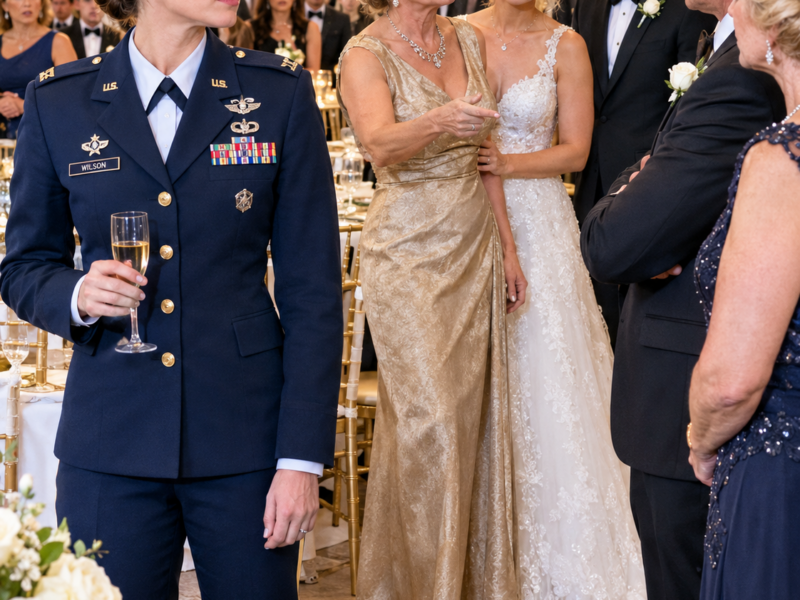
“At my brother’s wedding, my own father raised his glass and announced that I had never been on a real mission
“Captain Hayes, I need you to tell me something. Did you ever find out what happened to the last man we left behind?”
Lieutenant Colonel James Carter’s voice came through the phone, rough and exhausted, and the reception hall seemed to shrink around me.
For two years, I had trained myself not to hear that question in my sleep.
Now, standing beneath crystal chandeliers at my brother’s wedding, I heard it again.
I closed my eyes for one second.
Then I answered.
“No, sir. I never found out.”
On the other end, James breathed out slowly.
“Then I’m sorry. You deserve to know the truth.”
My hand tightened around the phone.
“What truth?”
Before he could answer, the call crackled and dropped.
Margaret stared at the screen.
“James? James!”
She tried calling back, but the line went straight to voicemail.
Around us, nearly two hundred wedding guests remained frozen in their seats. The string quartet had stopped playing. A waiter stood motionless beside a tray of champagne glasses.
My father was still staring at me.
“What does he mean, the last man you left behind?”
I handed the phone back to Margaret.
“I need to speak with Lieutenant Colonel Carter privately.”
“You’re not going anywhere until you explain what happened,” Dad said.
For most of my life, those words would have stopped me.
I would have stayed, defended myself, and tried to persuade him that I was worth listening to.
But I was no longer the girl who had stood in the kitchen at seventeen, explaining why she wanted to attend the military academy while her father told her she was choosing a life she wasn’t strong enough to handle.
I was thirty-six years old.
I had served in places my parents couldn’t locate on a map.
I had watched people make decisions they regretted for the rest of their lives.
And I had learned that some explanations belonged to people who had earned the right to hear them.
“I’m leaving the reception for a few minutes,” I said. “I’ll come back if I can.”
Dad stepped into my path.
“Rebecca, I’m your father.”
“I know.”
“Then you owe me an explanation.”
I looked directly at him.
“You just told two hundred people that my life was a lie. You can wait until I’m ready to speak.”
For once, he had nothing to say.
I walked through the tall doors into the garden.
The night air was cool, and the distant sound of the ocean drifted over the estate’s stone walls. I could still hear the reception inside, a low murmur of voices beginning to rise as people attempted to understand what they had witnessed.
I took out my own phone and called the secure contact number I had kept for James.
He answered on the second ring.
“Hayes.”
“Sir, it’s Rebecca. You said I deserved to know the truth.”
“I did.”
“What happened to Sergeant Daniel Price?”
There was a long silence.
Then James said, “He survived.”
I gripped the stone railing.
For a moment, I couldn’t understand the words.
“I’m sorry, sir. What?”
“Sergeant Daniel Price survived. He was recovered by a local medical team after your aircraft left the area. He spent months in a rehabilitation facility, then returned to the United States under a different assignment.”
I stared into the darkness beyond the garden.
“Why wasn’t I told?”
“Because the report we received said he had been killed.”
“That report was wrong.”
“Yes.”
The single word carried two years of consequences.
I had known Daniel Price as a twenty-eight-year-old combat medic with a crooked smile and a habit of keeping candy in his medical bag. He had been the youngest member of the team, but he had carried himself with the quiet confidence of someone who understood that courage did not need an audience.
During the operation, he had stayed behind to help two injured men reach an extraction point.
I had promised him we’d come back.
Then the mission had fallen apart.
The extraction corridor was compromised. Our aircraft had taken damage, communications were failing, and another wounded soldier was losing blood so quickly that we had minutes to get him to medical care.
I had made the decision to withdraw the aircraft and coordinate another recovery attempt.
I had believed we would have another chance.
By morning, the official report listed Daniel Price among the dead.
I had spent months reviewing the mission records, asking questions through every authorized channel, and searching for any indication that the report was wrong.
Eventually, the investigation closed.
I was told there was no evidence Daniel had survived.
I never truly believed it.
But believing something and proving it were two different things.
“Who knew?” I asked.
“Your commanding officer at the time. The recovery team. A small number of medical personnel. And me, once the information was confirmed.”
“Why wasn’t I contacted?”
“Because the initial recovery report was incomplete. When Price was found, he was badly injured and unable to identify himself. He was treated under an emergency designation while the local team worked to establish his identity. By the time his identity was confirmed, he had been transferred into a medical program connected to a separate investigation.”
“What investigation?”
“I can’t discuss all of it over an ordinary phone line.”
I closed my eyes.
“Sir, I spent two years thinking he died because I ordered the withdrawal.”
“You made the decision you had to make with the information available at the time.”
“That doesn’t change what happened.”
“No,” James said quietly. “It doesn’t.”
He wasn’t trying to comfort me with a convenient lie.
That was one reason I trusted him.
“Where is Daniel now?” I asked.
“He’s in Charleston.”
I turned toward the estate.
“What?”
“He’s been living here for almost six months. His mother is in Mount Pleasant. He wanted to reconnect with his family before he contacted anyone from the operation.”
“Does he know I’m here?”
“He does now.”
My throat tightened.
“Why did he call you?”
“He didn’t call me. He called his mother. She told him what happened at the wedding, and she contacted me because she was worried about the way the conversation had unfolded.”
I rubbed my forehead.
“Does he want to see me?”
“He asked me to make sure you knew he was alive. What happens after that is up to him.”
For the first time all evening, I felt something inside me loosen.
Not happiness.
Not yet.
But a knot I had carried for two years had finally begun to give way.
“Thank you for telling me, sir.”
“Rebecca?”
“Yes, sir?”
“You did not abandon Daniel Price. You made a command decision during a compromised extraction. You can regret the outcome without rewriting the circumstances.”
I swallowed hard.
“I’ll remember that.”
“I hope you do.”
The call ended.
I remained in the garden for several minutes, listening to the ocean and trying to adjust to a world in which Daniel Price was alive.
Then the door opened behind me.
Emily stepped outside.
Her wedding dress caught the light from the reception hall, and her makeup was streaked beneath her eyes.
“Can I sit with you?”
“Of course.”
She lowered herself onto the stone bench beside me, careful not to damage the dress.
For a while, neither of us spoke.
Then she said, “I’m sorry.”
I looked at her.
“You didn’t say anything.”
“I didn’t stop him.”
“Emily, it was your wedding.”
“That doesn’t excuse it.”
She looked down at her hands.
“When I first met Daniel, he told me that his sister was the bravest person he knew. I assumed he meant his sister-in-law, or someone from his unit. I never realized he was talking about you.”
“Your husband?”
She nodded.
“Daniel told me he had served with someone who made a decision that saved the rest of his team. He said she carried the blame for losing one person even though she had saved several others. He never gave me your name because he wasn’t ready to talk about the mission.”
I felt a strange ache in my chest.
“That sounds like him.”
Emily wiped her cheeks.
“My mother recognized your name when Dad started talking. She had told me about the letter before, but she didn’t know what you looked like until tonight.”
I looked toward the reception doors.
“Your mother didn’t have to do that.”
“Yes, she did.”
Emily’s voice was stronger now.
“My father is a colonel’s widow’s nightmare when he gets angry. He believes his military connections make him an expert on every person who wears a uniform. My mother has spent years listening to him dismiss people whose service he doesn’t understand.”
She paused.
“Tonight, he went too far.”
I couldn’t argue with that.
“Is Daniel angry with me?” I asked.
Emily looked up quickly.
“No. He’s angry about what happened to you. He said he couldn’t believe your father would humiliate you in front of everyone.”
I gave a small, humorless laugh.
“He’s not the first person to misunderstand me.”
“Maybe,” Emily said. “But he might be the first person who can explain what happened without asking you to defend yourself.”
Before I could respond, the reception doors opened again.
Daniel stood there, still wearing his tuxedo, his bow tie loose around his neck.
He looked from Emily to me.
“Rebecca?”
I rose so quickly that the bench scraped against the stone.
For one suspended second, I saw the man I remembered from the mission: young, tired, and grinning as he handed out candy from his medical bag.
Then I noticed the slight limp.
The stiffness in his right shoulder.
The faint scar that disappeared beneath his collar.
He was older than the man I remembered, and so was I.
But he was alive.
“Daniel,” I whispered.
He walked toward me.
I didn’t know whether to salute him, shake his hand, or apologize.
In the end, I did none of those things.
I simply stood there, unable to move.
Daniel stopped a few feet away.
“You look exactly the same,” he said.
I let out a broken laugh.
“No, I don’t.”
“No,” he admitted. “I guess you don’t.”
His smile faded.
“I’ve wanted to find you for a long time.”
“Why didn’t you?”
“I tried. After I recovered, I was moved between medical facilities. By the time I could give a clear account of the operation, the investigation had become complicated. I was advised not to contact members of the team until the review was complete.”
“Who advised you?”
“My doctors first. Then the investigators. Later, I made the decision myself.”
“Why?”
He looked away.
“Because I didn’t know how to explain that I was alive while you believed I was dead.”
I felt the words land like a physical blow.
“I searched for you.”
“I know.”
“I reviewed every report I could access.”
“I know that, too.”
“I thought I had left you behind.”
Daniel’s expression softened.
“You did leave me behind.”
I flinched.
He took another step forward.
“But you didn’t abandon me.”
I looked at him, and the distinction nearly undid me.
Daniel continued.
“You had a wounded man in the aircraft who needed immediate treatment. The extraction point was compromised. You had seconds to decide whether to risk the lives of everyone onboard or withdraw and request another recovery attempt.”
“I should have found another way.”
“Maybe. Maybe not. That’s what makes command so hard. You don’t get to choose between a good decision and a bad one. Sometimes you choose between two terrible outcomes, and you live with whichever one happens.”
He paused.
“You made the call with the information you had. I was angry when I woke up and learned the aircraft had left. I was injured, disoriented, and convinced I’d been forgotten. For a while, I blamed you.”
I forced myself to meet his eyes.
“You had every right.”
“No. I had every right to be angry. That’s not the same thing.”
He glanced at Emily, who had begun crying again.
“Your father doesn’t know what happened out there. He doesn’t know what it feels like to have a teammate disappear in the middle of an operation. He doesn’t know what it means to make a decision when every option carries a cost.”
Daniel looked back at me.
“But I do. And I need you to hear this from someone who was there.”
He took a slow breath.
“You did not kill me, Rebecca. You gave me a chance to survive.”
My eyes filled with tears.
For two years, I had replayed the mission in my head. I had examined every radio transmission, every weather report, every decision. I had imagined alternate outcomes until I could barely remember the real one.
I had never allowed myself to consider that Daniel might understand my decision better than I did.
“I am so sorry,” I whispered.
He nodded.
“I know.”
Then he opened his arms.
I stepped forward and held him.
He was warm, solid, and alive.
For the first time since the mission, I allowed myself to cry.
Not the controlled tears I had shed alone in my apartment after the official report was closed. Not the brief moments of grief I swallowed before a briefing.
These were the tears of someone who had finally been given permission to stop imagining the worst.
Daniel held me until my breathing steadied.
When we finally separated, he gave me a small smile.
“Also, for the record, you owe me about three years’ worth of candy.”
I laughed through my tears.
“I thought you were the one who kept candy in his medical bag.”
“I did. You confiscated half of it.”
“Because you kept eating it during briefings.”
“Medical necessity.”
For a moment, we were back there, arguing over something small while the world outside our unit continued to turn.
Then the reception doors opened again.
My father stood in the doorway.
He had removed his jacket, and his champagne glass was gone. He looked older than he had an hour earlier.
“Rebecca,” he said.
Daniel stepped slightly aside, giving me room to decide whether I wanted to speak to him.
I appreciated that more than he knew.
Dad approached slowly.
“Can we talk?”
I looked at Daniel.
He nodded once.
“I’ll be inside with Emily.”
When they left, my father stopped several feet away from me.
For the first time in my adult life, he seemed uncertain how to begin a conversation with his own daughter.
“I didn’t know,” he said.
I stared at him.
“You didn’t know what?”
“About the mission. About Daniel. About any of it.”
“You didn’t ask.”
He lowered his eyes.
“I know.”
“You didn’t ask where I’d served. You didn’t ask what I did. You never asked why I sometimes came home and couldn’t sleep for days.”
His jaw tightened.
“I thought you didn’t want to talk about it.”
“I didn’t want to discuss classified operations over Thanksgiving dinner. That isn’t the same as not wanting my father to care.”
He nodded, slowly.
“I thought you were pushing us away.”
“I was trying to do my job and come home when I could. Every time I tried to tell you something about my life that wasn’t classified, you found a way to explain why it didn’t count.”
Dad looked toward the garden wall.
“I wanted you to have a normal life.”
“Why did you think I didn’t?”
He didn’t answer.
I took a breath.
“You praised Daniel because you understood his life. He works in an office, earns a salary you can explain, and buys things you can point to. You understand that kind of success. My life is different, so you decided it was less important.”
“That’s not what I meant.”
“Maybe it isn’t what you meant. But it’s what you did.”
He rubbed his face.
“I was proud of your brother.”
“You can be proud of Daniel without humiliating me.”
“I know.”
“And you can ask questions without deciding you already know the answers.”
He nodded again.
For a long moment, he looked like he wanted to defend himself. I could see the old argument gathering behind his eyes: that he was only being honest, that I was too sensitive, that he had a right to speak his mind because he was my father.
But none of those words came.
Instead, he said, “I was wrong.”
The admission was so quiet I almost missed it.
I had imagined hearing those words for years.
I had imagined them after academy graduation, after my first promotion, after the first time my mother told relatives I had taken a job in an office because she didn’t know how else to explain my work.
I had imagined them so often that I had stopped expecting them.
Now that they had finally arrived, they didn’t fix everything.
They simply opened a door.
“I appreciate you saying that,” I told him.
He looked up.
“Can you forgive me?”
I studied his face.
“I don’t know yet.”
His expression fell.
“But I want to see whether we can have a different relationship,” I continued. “That means you have to stop treating my life like a competition with Daniel’s. It means you ask before you judge. And it means you don’t use me as the punchline of a speech ever again.”
He swallowed.
“I can do that.”
“You’ll have to prove it.”
“I understand.”
I wasn’t sure he did.
But for the first time, he seemed willing to try.
We returned to the reception together.
The room had changed while we were outside. The guests were talking again, but the atmosphere was strained. Some looked at me with curiosity; others looked embarrassed that they had applauded my father’s speech.
Daniel and Emily stood near the head table. Margaret was beside them, her eyes still bright with tears.
When I entered, several people stopped talking.
Dad walked to the microphone.
I felt a sudden wave of dread.
He glanced at me, then at the guests.
“I owe everyone an apology,” he began.
He paused, visibly struggling with the words.
“What I said earlier about my daughter was wrong. I spoke about a life I don’t understand, and I humiliated her in front of people who deserved better from me.”
He looked at me.
“Rebecca, I’m sorry.”
No one applauded.
That was good.
This wasn’t a performance that needed applause.
It was a beginning that needed work.
Dad stepped away from the microphone.
I walked to Daniel and Emily, and Emily wrapped her arms around me carefully so she wouldn’t crush the flowers pinned to her dress.
“I’m sorry your wedding turned into this,” I whispered.
She pulled back.
“Don’t be. I think we’ll remember it for a long time.”
Daniel grinned.
“Hard to forget the wedding where my sister became the most interesting person in the room.”
“Daniel,” Emily warned.
“What? I’m trying to lighten the mood.”
I shook my head, laughing.
For the rest of the reception, I stayed with my brother and his new wife. Margaret joined us, and eventually a few relatives came over to apologize for remaining silent during Dad’s speech.
I accepted their apologies without pretending the evening had been harmless.
Some people asked about my service. I told them I worked with a team and that I couldn’t discuss the details of every operation.
This time, nobody demanded proof.
Later, after the cake had been cut and the music had started again, Margaret asked if I would meet her for coffee the following morning.
“I’d like to hear about the person my son has spoken so highly of,” she said. “Not the classified details. Just you.”
“I’d like that.”
Daniel promised to join us.
And for the first time in two years, I looked forward to talking about the mission without feeling that I had to defend every decision I had made.
The following morning, Charleston was washed in pale sunlight.
I arrived at the café early and chose a table near the window. Daniel came in a few minutes later, walking more easily than he had the night before.
He set a paper bag on the table.
“Peace offering.”
I peered inside.
Candy.
An absurd amount of it.
“You’re still carrying this stuff around?”
“Some traditions deserve to survive.”
Margaret arrived shortly afterward, and the three of us sat together for nearly two hours.
Daniel told me about his recovery: the months of physical therapy, the frustration of having to relearn movements he had once taken for granted, and the quiet fear that he might never feel useful again.
He told me about the local medical team that had found him, and the people who had kept him alive before his identity could be confirmed.
I listened without interrupting.
For two years, I had imagined the final moments of his life.
Now I was hearing the beginning of the life he had continued to live.
When he finished, he leaned back in his chair.
“I want to be clear about something,” he said. “I’m not telling you this because I think you need to stop feeling guilty on command. I know that’s not how guilt works.”
I nodded.
“But I don’t want you to keep punishing yourself for a decision that gave other people a chance to live. You can remember what happened. You can wish things had gone differently. You can carry the lesson forward.”
He met my eyes.
“But you don’t have to carry the blame for every part of it.”
Margaret reached across the table and touched my hand.
“My son is alive because people refused to give up on him. You were one of those people.”
I looked down at our hands.
“Thank you.”
After coffee, Daniel and I walked along the waterfront.
We talked about the people from our old unit, the ones who had left the service, the ones who had stayed, and the ones we had lost.
Eventually, he stopped near the railing.
“There’s one more thing you should know.”
I turned toward him.
“What is it?”
“The review into the operation was reopened after I was identified. The investigators found that several communications had been logged incorrectly. Some of the information you relied on was never included in the final report.”
I felt my stomach tighten.
“What kind of information?”
“Details about the extraction corridor and the condition of the recovery aircraft. The report didn’t change the fact that you had to make a decision, but it did confirm that your options were more limited than the original summary suggested.”
I looked out at the water.
“So the record is being corrected?”
“It already has been.”
For the first time, I felt the weight of that old report shift.
Not disappear.
Shift.
The truth did not erase what had happened, but it put the decision back into its proper context.
I had acted with incomplete information in an impossible situation.
I had made the call I believed would save the most lives.
And I had spent two years treating the outcome as if it were the only evidence that mattered.
Daniel nudged my shoulder.
“You know, you can stop looking like you’re waiting for someone to sentence you.”
I let out a breath.
“I’ll work on it.”
“Good. Because I have a list of people from the unit I’d like to reconnect with, and I refuse to do all the emotional work myself.”
I laughed.
“Some things never change.”
“Nope.”
We exchanged numbers again, despite already having each other’s contact information in the old team directory. This time, we made plans to stay in touch.
Not because we were trying to recreate the past.
Because we were finally ready to let the future exist.
Over the next several weeks, my relationship with my family changed in small, uneven ways.
My father called me on a Tuesday evening without asking about promotions or awards. He asked what I had been reading.
My mother sent a message asking when I would next be home, then added that she wanted to hear about my life if I felt comfortable sharing what I could.
Neither of them transformed overnight.
There were awkward silences. There were conversations that ended too soon. Once, Dad started explaining my career to a neighbor using information he had heard from someone else, and I had to correct him.
He apologized.
Then he tried again.
It wasn’t enough to repair years of dismissiveness in a few weeks.
But it was different.
Daniel called every Sunday. Sometimes we talked about the operation; more often we talked about ordinary things. He complained about physical therapy, sent me terrible jokes, and asked whether I had finally replaced the coffee machine in my apartment.
He also began speaking publicly, in general terms, about the importance of medical teams and recovery personnel. He never revealed sensitive details. He simply made sure people understood that surviving a mission was rarely the work of one person.
When I returned to Virginia, I requested a meeting with my commanding officer to discuss the corrected record.
The meeting was brief.
My commander confirmed that the official review had been amended and that the findings supported the decisions I had made under the circumstances.
I thanked him and left.
I didn’t ask for a ceremony.
I didn’t ask for an award.
I wanted the record to be accurate, and now it was.
For the first time, that was enough.
Months later, I returned to Charleston for a family dinner.
My father had invited a few relatives, and the evening began with the familiar sound of plates being passed around the table.
At one point, my uncle asked what I had been doing at work.
Dad looked at me.
The old version of him might have answered on my behalf, minimizing my responsibilities or making a joke about paperwork.
Instead, he said, “You should ask Rebecca. I don’t know enough about her work to explain it properly.”
I met his eyes.
He gave a small, uncertain smile.
It was a simple sentence.
But I understood what it cost him to say it.
Later, after dinner, he found me on the back porch.
“I’ve been thinking about what you said,” he told me.
“Which part?”
“About asking before judging.”
I leaned against the railing.
“That’s a good place to start.”
He looked out toward the dark yard.
“I used to think being a good father meant protecting you from things I couldn’t understand. I thought if I could steer you toward a life that made sense to me, I’d be doing my job.”
“And now?”
“Now I think I confused understanding your life with deciding what your life should be.”
I remained quiet.
He swallowed.
“I can’t change what I said at the wedding. I can’t give you back all the times I made you feel like your work didn’t matter.”
“No,” I said. “You can’t.”
“But I can stop doing it.”
“Yes,” I told him. “You can.”
He nodded.
Then, after a long silence, he asked, “Are you happy, Rebecca?”
The question surprised me.
Not because it was difficult.
Because he had never asked it before.
I thought about the team I worked with, the responsibilities I carried, the friends who understood the parts of my life I couldn’t always explain, and the brother who had come back from the edge of death.
I thought about the mission, too.
I would never forget it.
I would never stop wishing the outcome had been different for everyone involved.
But the memory no longer felt like a verdict I had to serve every day.
“Some days,” I said honestly. “And some days are hard.”
Dad nodded.
“I’d like to understand more, if you’ll let me.”
I looked at him.
“We can try.”
He didn’t reach for a dramatic apology or ask me to promise that everything was forgiven.
He simply stood beside me in the quiet.
That was the first conversation we had ever shared that didn’t end with one of us trying to win.
A year after Daniel and Emily’s wedding, I received an invitation to their first anniversary dinner.
The card included a handwritten note from Daniel.
*Bring your uniform. Not because you need to prove anything. Because I’d like my family to see you the way my team saw you.*
I stared at the note for a long time.
Then I called him.
“Are you sure?”
“Absolutely.”
“Daniel, I don’t want to turn your anniversary into a military event.”
“You won’t. We’re having dinner. People will eat too much, my mother will take a hundred pictures, and Emily will pretend she isn’t planning the entire evening down to the last fork.”
In the background, Emily shouted, “I heard that!”
Daniel laughed.
“See? Normal family stuff.”
So I brought my uniform.
At dinner, Margaret raised a glass to her son, to Emily, and to the people who had helped Daniel return home.
She didn’t tell the story of the mission in detail. She didn’t need to.
She simply said that courage was often invisible to the people who benefited from it, and that gratitude should never depend on whether a sacrifice could be explained at a dinner table.
My father sat quietly beside my mother.
When Margaret finished, he raised his glass.
“To Rebecca,” he said.
Then he stopped, looked at me, and corrected himself.
“To my daughter. I’m proud of the life she’s chosen, even when I don’t understand every part of it.”
His voice wavered.
“And I’m proud that she’s given me the chance to learn.”
I felt my eyes sting.
Not because the sentence erased the past.
Because it acknowledged that the past had happened, and that we were trying to do something different with what remained.
I lifted my glass.
“Thank you, Dad.”
Daniel grinned from across the table.
“And to the person who still owes me candy.”
Everyone laughed.
For once, the laughter didn’t come at my expense.
Later that evening, as I drove back to my hotel, my phone buzzed with a message from Daniel.
*You know what the best part of all this is?*
I typed back, *What?*
His reply came almost immediately.
*I get to be annoying to you for the next forty years.*
I laughed alone in the car.
Then I put the phone away and continued driving.
The road ahead was dark, but it no longer felt like the road back to a place I had lost.
It felt like a road I was allowed to keep traveling.
I still served.
I still carried memories I couldn’t share with everyone.
I still woke some nights thinking about the people who hadn’t made it home, and I still wondered whether a different decision might have changed their stories.
But I had stopped confusing grief with guilt.
I had stopped treating silence as proof that no one cared.
And I had stopped waiting for my father to decide whether my life was worth respecting.
That was the truth I wished I had understood at the wedding.
My service did not become meaningful because a letter arrived, or because a wounded soldier returned, or because two hundred people watched my father fall silent.
It had mattered before any of them knew.
It mattered when the decisions were difficult, when the outcome was uncertain, and when there was no audience to applaud.
I had never needed to be called a hero.
I had only needed the people I loved to understand that my life was real.
And at last, some of them were learning to see it.
THE END.









