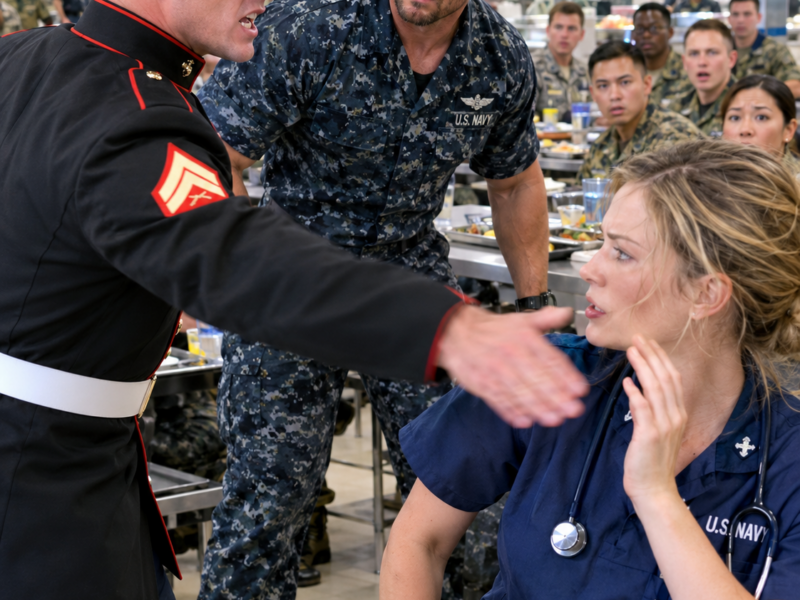
“At 12:17 p.m. in the crowded Marine Corps chow hall at Camp Pendleton, I watched a Marine sergeant slap a quiet nurse so hard her tray crashed to the floor
The paper trembled once between Ryan Mercer’s fingers before he folded it again.
I held out my hand and waited.
Around us, Marines and sailors sat frozen at their tables, pretending not to watch while missing absolutely nothing. The smell of fried chicken, coffee, and industrial floor cleaner hung in the air. Somewhere behind me, a serving tray clattered against the counter.
Mercer finally placed the request in my palm.
“You’re making a serious mistake, Commander.”
I unfolded the document.
My cheek still burned, but I forced myself to concentrate on the printed lines, the dates, and the signatures. Anger could wait. Evidence couldn’t.
The request authorized the transfer of a wounded Navy corpsman from Camp Pendleton to a civilian medical facility in San Diego. The listed reason was a specialized neurological evaluation. The receiving physician’s name appeared beneath it, followed by a confirmation number.
At the bottom was Mercer’s signature.
But something was missing.
“Chief,” I said, “what time did your team bring the patient in last night?”
“Approximately 2310, ma’am.”
“And who gave you the medical transport instructions?”
“An operations officer attached to the recovery team. We were told the patient was to remain under military medical supervision until your department completed an independent assessment.”
I looked at Mercer.
“Then why does this document authorize civilian transfer before that assessment?”
He crossed his arms.
“Because the situation changed.”
“When?”
“This morning.”
“Who authorized the change?”
“I already told you. The situation changed.”
He was answering questions without giving answers, a habit I had encountered in enough command briefings to recognize immediately.
I turned the form over.
A handwritten note had been added to the back in blue ink.
Patient not to be interviewed without prior approval.
There was no name beside it.
I read it twice.
“Who wrote this?”
Mercer’s jaw tightened.
“I don’t know.”
“You submitted the request.”
“I submitted the transfer paperwork. I didn’t write every note on it.”
The Navy SEAL stepped closer.
His name tape read HARRIS, and the gold warfare insignia on his uniform caught the overhead light as he leaned toward the document.
“That’s not the original version,” he said.
I looked at him. “Explain.”
“Last night, the paperwork we received specifically said the patient was not to leave the base until a medical officer reviewed his condition. There was no civilian destination listed.”
“Do you have a copy?”
“Not on me. The original should be in the incident packet.”
“Where is that packet?”
“With the duty officer, unless someone moved it.”
Mercer let out a short, irritated breath.
“Chief Harris, you’re a member of an operational team. You are not responsible for medical administration. You don’t know what changes were made after your mission ended.”
Harris didn’t argue.
He simply looked at the note on the back of the form.
“Maybe not, Staff Sergeant. But I know what I was told to protect.”
Something about that sentence made the room feel smaller.
I folded the request carefully.
“Nobody is going to resolve this in a chow hall. Chief Harris, accompany me to the medical department. Staff Sergeant Mercer, you will remain available for questioning by the duty officer.”
Mercer stepped toward me.
“You can’t order me around just because someone called you Commander.”
I met his gaze.
“Actually, I can. But right now, I’m asking you to cooperate voluntarily.”
His eyes flicked toward the people watching us.
He knew he had already lost control of the room.
“Fine,” he muttered.
I turned to leave, then stopped.
“One more thing.”
He looked up.
“Do not contact the patient, his family, or anyone involved in this transfer until the duty officer gives you further instructions.”
His face changed at the word family.
It lasted less than a second.
But I saw it.
So did Harris.
I walked out without giving Mercer the satisfaction of seeing me react.
The corridor beyond the chow hall was cooler, quieter, and smelled faintly of disinfectant. Harris fell into step beside me, keeping a respectful distance.
For nearly twenty yards, neither of us spoke.
Then he said, “Your cheek needs to be checked.”
“I’ve had worse.”
“That doesn’t make it less of an injury.”
I glanced at him.
He wasn’t looking at me with pity. If anything, he looked annoyed that I had dismissed it so casually.
“I’ll have it documented,” I said.
“Good.”
We continued toward the medical building.
After another moment, he added, “You know Mercer has friends here.”
“I assumed so.”
“More than friends. People who owe him favors.”
I stopped outside the security doors.
“Chief, if you’re about to tell me that people may obstruct an investigation, I need specifics.”
He considered his answer.
“Three weeks ago, our team received an updated extraction plan less than an hour before departure. The new route exposed us to a threat that wasn’t on the original intelligence brief.”
I waited.
“One of our corpsmen, Petty Officer Daniel Reeves, was injured during the extraction. We got him out, but he kept asking why the route had changed.”
“Was the change documented?”
“It was. The version we received didn’t match the one later entered into the mission record.”
“Who changed it?”
“We don’t know.”
“And you think Mercer is involved?”
“I think he was the person who delivered the revised paperwork to our staging area.”
That was different from proof.
I wanted him to understand that I knew the distinction.
“Chief Harris, I won’t accuse someone based on suspicion. If the records were altered, we need to establish when, how, and by whom.”
“Understood, Commander.”
“And if the patient is in danger, we protect him first.”
For the first time, Harris’s expression softened.
“That’s why I wanted to talk to you.”
Before I could ask what he meant, my phone vibrated.
A message from the medical department appeared on the screen.
Commander Bennett, urgent. Patient Reeves has requested to see you. He says he has information concerning last night’s transport request.
I showed Harris.
He read it, then looked toward the doors.
“That’s him.”
I swiped my access card.
“Then let’s hear what he has to say.”
Daniel Reeves was in a monitored room at the far end of the medical ward.
He was twenty-eight, according to the intake record, with a fractured left forearm, several deep bruises, and a concussion that required observation. His right leg was immobilized, and an IV line ran from his arm to a bag hanging beside the bed.
He looked younger than his file photograph.
When I entered, he tried to sit up.
“Don’t,” I said gently. “You need to stay still.”
“Commander Bennett?”
“Yes. I’m Dr. Bennett, the officer overseeing your assessment.”
His eyes shifted to Harris, who remained near the door.
“Is he allowed to hear this?”
I glanced at Harris.
“He’s here because you were brought in by his team. But you decide what you’re comfortable sharing. If you need to speak privately, he’ll step outside.”
Reeves studied Harris for a moment.
“No. He should hear it.”
I pulled a chair beside the bed.
“Tell me what happened.”
He swallowed.
“After the extraction, I heard two people arguing outside the treatment room. I couldn’t see them clearly. One was Staff Sergeant Mercer.”
“What did you hear?”
“Mercer said the original route had been approved. The other guy told him the approval had come after the mission started.”
Harris’s posture changed.
“Did you recognize the second person?”
“No. But he called Mercer by his first name.”
“Ryan?”
Reeves nodded.
“Then he said, ‘If Reeves talks, we’re both finished.'”
The monitor beside the bed continued its steady rhythm.
I kept my voice even.
“Daniel, are you certain you heard those exact words?”
“As certain as I can be. I had medication in me, and I was hurt, but I remember that sentence.”
“Did either person know you were awake?”
“I don’t think so.”
He looked down at his bandaged arm.
“I didn’t tell anyone because I thought it was just people arguing about paperwork. Then this morning, a nurse told me I was being transferred off base.”
“Did you request the transfer?”
“No.”
“Did you consent to it?”
“No.”
He drew a careful breath.
“They said it was for a specialist. But when I asked which hospital, the person arranging it told me not to worry about the details.”
“Who told you that?”
“I didn’t see his name. He had a clipboard, and he said the transport had already been approved.”
I wrote down his statement, noting the time and the medication listed in his chart. I asked the attending nurse to verify his current orientation and ability to participate in an interview, then paused to let him rest.
“Daniel, I need you to understand something. You aren’t responsible for proving what happened. Your job is to tell us what you remember, as accurately as you can.”
He nodded, though he didn’t look reassured.
“Am I in trouble?”
The question caught me off guard.
“No.”
“But if I tell you what I heard, someone could say I made it up because I’m angry about getting hurt.”
“That’s why we’re documenting the evidence and preserving the records. Your statement will be assessed alongside everything else.”
He stared at the ceiling.
“My mom thinks I’m coming home next week.”
I waited.
“She already bought a ticket to visit me. I told her everything was fine because I didn’t want her worrying.”
His voice broke slightly on the last word.
I knew that kind of calculation. The little lies people told the people they loved because the truth felt too heavy to hand over.
“Let us take care of the medical side,” I said. “You can decide what to tell your mother when you’re ready.”
He nodded again.
As I stood, his hand reached toward my sleeve.
“Commander?”
“Yes?”
“There’s something else.”
I sat back down.
“Before they brought me here, someone took my phone.”
“Who?”
“I don’t know. I was in and out of it. But I remember seeing it on the table when I woke up. Then a man came in and said the device had to be held for operational security.”
“Did you give permission for that?”
“No.”
“Do you know where it is now?”
He shook his head.
I wrote that down, too.
When Harris and I stepped into the corridor, he shut the door quietly behind us.
“That matches the timeline,” he said.
“Parts of it do.”
“You think the route change and the transfer are connected.”
“I think someone may be trying to control what Reeves can say before the records are reviewed.”
Harris nodded.
“And the phone?”
“If it contains relevant messages, its disappearance matters. But we need to establish who took it and under what authority.”
He looked toward the room.
“He’s scared.”
“He’s injured, far from home, and worried that telling the truth could damage his career. I’d be surprised if he weren’t.”
I returned to my office and called the duty officer.
Lieutenant Commander Susan Patel answered on the second ring.
“Bennett.”
“I need to report an assault and request immediate preservation of records relating to Petty Officer Reeves’s transport authorization.”
Her tone sharpened.
“Are you injured?”
“A minor facial injury. I’ve requested documentation.”
“Who assaulted you?”
“Staff Sergeant Ryan Mercer.”
There was a pause.
“Are you certain?”
“Yes.”
“Did anyone witness it?”
“The chow hall was occupied. Chief Harris intervened, and there should be security footage.”
“Good. Don’t contact anyone about the footage yourself. I’ll send a preservation request through the proper channel.”
I gave her the details of the altered paperwork and Reeves’s statement, making sure to distinguish what I had personally seen from what others had reported.
Patel listened without interrupting.
When I finished, she said, “Do not assume the transport issue is criminal. We need the original records, the authorization chain, and an explanation for every discrepancy.”
“Agreed.”
“But if someone is attempting to move an injured service member without valid authorization, we need to stop that transfer now.”
“It has not occurred yet.”
“Then I’ll issue a hold pending medical review and command authorization. You remain responsible for Reeves’s medical status. I will handle the administrative investigation.”
“Understood.”
“Claire?”
She rarely used my first name on duty.
“Yes, ma’am?”
“Get your cheek examined. You cannot demand that people follow medical procedures while refusing to follow them yourself.”
Despite everything, I almost smiled.
“Yes, ma’am.”
The next two hours passed in a blur of documentation, phone calls, and carefully worded requests.
The transfer was placed on hold.
The duty officer ordered the relevant paperwork preserved.
Security personnel confirmed that the chow hall cameras had recorded the incident, although the footage still needed to be formally retrieved and reviewed.
Mercer was directed to report for questioning.
And I finally allowed a medical officer to examine my face.
The injury wasn’t serious, but the skin was already swelling.
When the physician asked whether I wanted pain medication, I declined. I didn’t need to prove anything by enduring discomfort, but I wanted a clear head for the interviews ahead.
At 3:40 p.m., Harris returned to my office carrying a sealed evidence envelope.
“We found the mission packet,” he said.
I looked up from my desk.
“Where?”
“In the operations records room. It had been filed under the wrong date.”
“Who found it?”
“An administrative specialist. She noticed the serial number didn’t match the index.”
He placed the envelope on my desk but didn’t release it immediately.
“The packet was already sealed when she located it. The duty officer has authorized its review.”
I read the label, verified the seal, and called Patel before opening it.
She instructed me to wait until an authorized investigator could examine the records with me.
By four fifteen, Lieutenant Commander Patel had arrived with a legal officer and a base investigator.
We opened the packet together.
Inside were two versions of the extraction plan.
The first showed the original route and the original approval time.
The second showed a different route, with an approval timestamp entered earlier than the digital transmission record indicated.
A handwritten amendment appeared on the last page.
The initials were R.M.
Mercer.
I leaned closer.
“Could those initials have been added by someone else?”
The investigator, Special Agent Cole, answered carefully.
“Possibly. Initials alone don’t establish authorship. We’ll compare the handwriting, access records, and electronic audit trail.”
Patel turned to the digital log.
“The revision was transmitted at 21:46. The approval field says 20:58.”
“So the approval appears to predate the transmission by nearly fifty minutes,” I said.
“Correct,” Cole replied. “That could reflect a clerical error, a delayed upload, or an improper alteration. We need the system logs before drawing a conclusion.”
Harris stood at the other side of the table, silent.
I glanced at him.
“Is this the discrepancy you noticed?”
“Yes, ma’am. The plan we received at staging was the revised version. We were told it had been approved.”
“Did anyone on your team question the change?”
“One operator did. We were assured the approval had been confirmed through command.”
“By whom?”
“Mercer delivered the packet. Another officer relayed the verbal confirmation.”
“Name?”
“Lieutenant Aaron Walsh.”
Patel wrote it down.
“Where is Walsh now?”
“Operations, last I knew.”
Cole photographed the pages and placed them in protective sleeves.
“Nobody contacts either individual about the details until we’ve reviewed the access records. We’ll conduct separate interviews.”
I looked again at the initials.
The paperwork suggested Mercer might have been involved, but it didn’t tell us why the route had changed, who had approved it, or whether the discrepancy had contributed to Reeves’s injury.
It certainly didn’t prove a conspiracy.
I had seen too many investigations damaged by people deciding what the evidence meant before they had all of it.
Still, I couldn’t shake the memory of Mercer’s face when Reeves’s family had come up in conversation.
At 5:06 p.m., my office phone rang.
The caller ID showed the medical ward.
“Commander Bennett,” I answered.
A nurse spoke quickly.
“Ma’am, Petty Officer Reeves has received a phone call from someone claiming to be his commanding officer. The caller asked him to confirm that he wanted the civilian transfer.”
I stood.
“Did Reeves speak to the caller?”
“Only briefly. He said he didn’t request the transfer. Then the caller told him he needed to cooperate if he wanted to protect his team.”
My fingers tightened around the receiver.
“Did the caller identify himself?”
“He gave a name, but Reeves wasn’t certain he heard it correctly.”
“Is Reeves safe?”
“Yes, ma’am. He’s in his room, and no one has entered without staff authorization.”
“Please document the call and preserve any available call records. Do not speculate about who made it.”
“Understood.”
I hung up and immediately contacted Patel.
She was already coordinating the investigation, but the new information changed the urgency of the patient-protection plan.
“Someone is trying to obtain consent after the transfer has been halted,” I said. “We need to establish who called him and ensure he isn’t pressured into changing his statement.”
“I agree,” Patel replied. “I’ll arrange a formal contact restriction through the appropriate command channel. Until then, medical staff should direct all nonmedical inquiries to me.”
“There’s one more issue. Reeves says his phone was taken.”
“That will be included in the investigation.”
I hesitated.
“Ma’am, I know we don’t have enough evidence to conclude the call was connected to the missing phone or the transport request.”
“Good. Keep that distinction clear.”
She paused.
“But your instincts are telling you the events may be related.”
“Yes.”
“Then follow the evidence until it either confirms the connection or rules it out.”
After the call, I went to see Reeves again.
He looked more exhausted than he had earlier. His dinner tray sat untouched on the bedside table.
“Someone called you?”
He nodded.
“They said I was making things harder for everyone.”
“Did they threaten you?”
“Not exactly.”
He rubbed his thumb against the edge of his blanket.
“They said my team could lose its next deployment if the investigation turned into a public mess. They said I should think about the men who were counting on me.”
I pulled the chair closer.
“Daniel, nobody should ask you to change a truthful statement to protect a deployment schedule.”
“I know.”
“But you look like you don’t believe that.”
He let out a tired breath.
“I’ve spent years being told that the team comes first. You don’t complain. You don’t make things difficult. You take care of your own.”
“Those can be good values.”
He looked at me.
“Then why does telling the truth feel like I’m betraying them?”
I didn’t answer immediately.
Because there was no simple answer that would make the burden disappear.
“Taking care of your team means protecting its people, too,” I said. “If someone changed an order improperly, pretending it didn’t happen won’t protect anyone from the consequences. It will only make it harder to prevent the same thing from happening again.”
He looked toward the window.
“I don’t want anyone else getting hurt.”
“Neither do I.”
He finally picked up his fork.
It was a small thing, but I took it as a sign that he was ready to let the medical team do its job.
When I returned to my office, Harris was waiting outside.
He held two cups of coffee.
“I wasn’t sure how you take it,” he said.
“Black.”
“Good guess.”
He handed me one.
For a few minutes, we sat in the small conference room adjoining my office, listening to the building settle into the quieter rhythm of evening.
Then Harris said, “I owe you an apology.”
I turned toward him.
“For what?”
“For what happened in the chow hall. I should have intervened sooner.”
“You intervened when you saw it.”
“I saw Mercer approaching your table. I heard him raising his voice. I thought it was an argument about paperwork, and I waited to see whether you’d handle it.”
I watched the steam curl from my coffee.
“You didn’t know he was going to hit me.”
“No. But I knew he was trying to intimidate you.”
His honesty made it difficult to dismiss him.
“I’ve been underestimated before,” I said. “I know how to handle myself.”
“I believe you.”
“Then you understand why I don’t need someone stepping in every time a man raises his voice.”
“I do.”
He paused.
“But I also know what happens when everyone decides a problem isn’t serious enough to interrupt their lunch.”
I looked down at my cup.
That was the part I couldn’t argue with.
“I appreciate what you did,” I said finally. “Next time, though, let me give the order when there’s time to do so.”
A faint smile crossed his face.
“Yes, Commander.”
For the first time that day, I laughed.
It wasn’t much, but the tension in my shoulders eased.
Then his phone vibrated.
He checked the screen, and his expression changed.
“What is it?”
“Agent Cole wants us in the records room.”
“Why?”
“They recovered the digital audit trail.”
We found Patel and Cole standing beside a computer terminal.
On the screen was a series of access events associated with the revised extraction plan.
Cole pointed to a line near the bottom.
“The initial approval field was populated using an account assigned to Lieutenant Walsh. But the account was accessed from a workstation assigned to Staff Sergeant Mercer.”
“Could Walsh have been logged in remotely?” Patel asked.
“That’s possible. We’re checking the network records and authentication history. We can’t attribute the change to Mercer solely because his workstation was involved.”
I studied the timestamps.
“Was the original approval actually granted?”
“Not at the time shown on the revised plan,” Cole said. “The approval record was created later, and the system’s audit trail indicates the timestamp field was manually edited.”
Harris exhaled slowly.
“So somebody made it look as if the route had been approved before the change was sent.”
“That is what the logs currently suggest,” Cole replied. “But we still need to identify the user and establish whether the edit was authorized.”
Patel folded her arms.
“Where is the account owner?”
“Lieutenant Walsh has been notified to report for an interview. He hasn’t arrived yet.”
I looked at the screen again.
A second access event appeared beneath the edited approval record.
It showed that the medical transport request had been opened from the same workstation the following morning.
The event was timestamped 07:12.
The handwritten note on the back of Mercer’s form had no digital equivalent.
Someone had added it after the document was printed.
“Can we identify who printed it?” I asked.
“Not from this log alone,” Cole replied. “The printer has a separate job history, and we’re retrieving it.”
I thought of the folded paper in Mercer’s hand and the speed with which he had tried to put it away.
“Then that’s our next step.”
At 7:30 p.m., Mercer finally appeared for his interview.
He entered the conference room with his shoulders squared and his face carefully composed.
Patel explained that the interview concerned the revised extraction plan, the medical transport request, and the assault in the chow hall.
Mercer denied altering the mission record.
He said he had delivered the paperwork as instructed and had no knowledge of the manual timestamp change.
When asked about the note prohibiting interviews with Reeves, he claimed he had never seen it before the chow hall.
When asked why he had attempted to conceal the transport request, he said he had folded it because people were crowding around him.
Some of his answers were plausible.
Others were inconsistent with the timeline.
But an inconsistency wasn’t a confession, and anger wasn’t proof.
Cole placed a copy of the digital access report on the table.
“Your assigned workstation accessed the revised plan shortly before the approval field was edited. Can you explain that?”
Mercer glanced at the report.
“I use that workstation regularly. Other people have access to the operations room.”
“Were you logged in at the time?”
“I don’t remember.”
“Did you use Lieutenant Walsh’s account?”
“No.”
“Did you print the transport request?”
“No.”
“Do you know who added the handwritten note?”
“No.”
Cole let the silence sit for a moment.
Then he asked, “Why did you tell Commander Bennett the situation had changed when she asked who authorized the transfer?”
Mercer shifted in his chair.
“Because I was told the patient needed specialized care.”
“By whom?”
“Lieutenant Walsh.”
“Did you verify that authorization?”
“Walsh said it was handled.”
“Did you speak directly with the medical department?”
“No.”
“Did you confirm the receiving facility had accepted the patient?”
“I assumed that was part of the process.”
Cole closed the folder.
“Assumptions are not authorization, Staff Sergeant.”
Mercer’s jaw flexed.
“With respect, Agent, I followed the instructions I was given.”
Patel leaned forward.
“Then your task now is to tell us who gave them to you.”
For the first time, Mercer looked genuinely uncertain.
“I already told you.”
“Then provide the details and supporting records.”
He glanced toward the door.
“I’d like to speak to counsel before continuing.”
Patel nodded.
“That is your right. The interview is suspended.”
Mercer stood.
As he reached the door, he turned toward me.
“You think you know what happened, Commander. You don’t.”
I held his gaze.
“Then the evidence should help us both understand it.”
He left without answering.
By the following morning, the investigation had widened.
Lieutenant Walsh had failed to report for his scheduled interview, and his command had been unable to reach him at his office or quarters.
A vehicle assigned to his unit was found in the parking lot, but his personal effects were gone.
No one could say whether he had left the base, and no one was willing to guess why.
Patel issued the appropriate notifications, and the investigative team continued reviewing access records.
Meanwhile, Reeves’s condition improved.
His concussion symptoms were easing, his pain was manageable, and he was able to speak for longer periods without fatigue.
I arranged for an independent medical officer to reassess his readiness for transport and ensured that his consent would be obtained without pressure.
The civilian transfer remained on hold.
At 10:15 a.m., the records specialist called with an update about the printer history.
The transport request had been printed at 7:08 a.m. from the operations office.
The account used belonged to Walsh.
Four minutes later, the document was scanned into the medical system.
The handwritten note appeared in the scanned version, meaning it had been added before the scan.
A second scan, created at 7:19, showed the same document without the note.
I studied the two images.
“Who submitted the second scan?”
“The system records the same user account,” the specialist said. “But that doesn’t necessarily tell us who was physically at the workstation.”
“Can we recover the original document file?”
“We’re trying.”
I thanked her and forwarded the information to Cole.
For the first time, the pattern was becoming clearer.
Someone had created a transfer request, added a handwritten restriction, scanned the document, then produced a second version without the restriction.
The question was whether the second scan was an innocent correction, an attempt to conceal the note, or part of something more deliberate.
I went to Reeves’s room just before lunch.
He was sitting upright, reading a message on a temporary hospital device.
“How are you feeling?”
“Better. Still sore.”
“That’s progress.”
He set the device aside.
“Did they find anything?”
“We’ve identified discrepancies in the paperwork. Investigators are reviewing them.”
He looked relieved, then immediately guilty about feeling relieved.
“Does that mean Mercer did it?”
“It means the records don’t match. We haven’t established who made every change or why.”
He nodded.
“I keep thinking about that argument I heard. If I’d just stayed awake longer, maybe I’d know more.”
“Daniel, you were injured. You aren’t responsible for what other people said outside your room.”
He looked at me for a long moment.
“You’re good at making things sound simple.”
“They aren’t simple. But responsibility still belongs to the people who made the choices.”
His eyes dropped to his hands.
“Can I tell you something that isn’t in my statement?”
“Of course.”
“Before the mission, one of the guys joked that the new route didn’t make sense. He said it looked like someone wanted us to go through a place we were specifically told to avoid.”
“Did you report the concern?”
“No. I didn’t see the final plan until we were already preparing to move. By then, everyone was busy, and the officer in charge said the change had been cleared.”
“Who was that officer?”
“Walsh.”
I made a note of the statement.
“Would you be willing to share that with Agent Cole in a formal interview?”
He hesitated.
“Yes.”
“Good. We’ll arrange it when you’re medically ready.”
As I left the room, I saw Harris standing near the nurses’ station.
He had been waiting for an update, but when he saw my expression, he didn’t ask for one immediately.
We walked together toward the courtyard.
“I’ve been thinking about something,” he said.
“That usually means I’m about to get another piece of the puzzle.”
“Maybe.”
He leaned against the railing.
“Walsh was responsible for the route approval. Mercer carried the paperwork. If Walsh altered the timestamp, Mercer may have known the approval wasn’t valid. But that doesn’t tell us whether Mercer was part of the decision or just afraid to challenge an officer.”
I watched a pair of sailors cross the courtyard, talking quietly.
“That’s the question the investigation has to answer.”
“And if he was afraid?”
“Then fear might explain his behavior. It doesn’t excuse assaulting me or submitting a transfer without proper authorization.”
Harris nodded.
“I thought you’d say that.”
“Why?”
“Because you don’t seem interested in making anyone a villain. You just want the truth.”
I looked at him.
“Villains are convenient. They make complicated situations feel simple.”
He smiled faintly.
“And the truth?”
“Usually takes longer.”
For a moment, neither of us spoke.
Then Harris said, “For what it’s worth, I think Reeves trusts you.”
“He’s my patient. Trust is part of the job.”
“Not everyone treats it that way.”
I let that pass without answering.
At 1:42 p.m., Agent Cole called us back to the records room.
The system administrator had recovered an archived message thread from the operations network.
The messages concerned the extraction plan.
One was from Walsh to Mercer, sent the evening before the mission.
Use the revised route. The approval will be entered before deployment.
Mercer’s reply appeared beneath it.
I thought the original route was still in effect.
Walsh’s response came three minutes later.
Not anymore. Do what you’re told.
The final message was from Mercer.
Understood.
No one spoke for several seconds.
The messages didn’t establish why Walsh had ordered the route change, but they suggested Mercer had known the approval was not yet recorded.
Cole continued scrolling.
A later message, sent the following morning, referred to the medical transfer.
Walsh had written:
Get Reeves moved before he talks to anyone about the route discrepancy.
Mercer’s reply was brief.
He hasn’t made a formal statement.
Walsh answered:
Then keep it that way.
I stared at the screen.
The note on the back of the transport request. The pressure on Reeves. The missing phone.
The pieces were no longer isolated.
Patel’s expression hardened.
“Preserve the entire thread and all associated metadata. Notify the appropriate command authorities and legal counsel. We need to establish the authenticity of these messages and determine whether any additional records have been altered.”
Cole nodded.
“I’ll coordinate that now.”
Harris stood motionless beside the table.
“Walsh was trying to get him off base before he could speak.”
“That’s what the messages suggest,” I said. “But we still need to know why.”
The answer arrived later that afternoon.
Walsh was located at a hotel outside the base after his vehicle had been identified during a routine records check. He returned voluntarily for questioning after being contacted by investigators.
He denied intending to obstruct an investigation.
He said the route change had been made because he believed the original plan exposed the team to an unacceptable risk. The approval process, he claimed, had been delayed by an administrative problem.
When asked why he instructed Mercer to enter the approval before deployment, Walsh said he expected the approval to be granted and believed the timing discrepancy could be corrected afterward.
When asked about the message concerning Reeves, he said he wanted the corpsman transferred to a specialist who could better assess his injuries.
Cole placed the two statements side by side.
“Then why did you write, ‘before he talks to anyone about the route discrepancy’?”
Walsh stared at the page.
“I was worried he’d make an incomplete statement while he was still under medication.”
“Did you ask the medical department to assess his ability to participate in an interview?”
“No.”
“Did you obtain valid authorization for the civilian transfer?”
“I believed the transfer could be approved.”
“That wasn’t my question.”
Walsh lowered his eyes.
“No. Not before the request was submitted.”
It was the first direct admission we had received.
But it was not the end of the investigation.
The team still had to determine whether Walsh’s route change had been justified, whether the approval process had been deliberately bypassed, and whether anyone had intentionally altered records to hide the decision.
Mercer’s role also remained under review.
He had followed an order, but the messages showed that he knew the approval had not yet been entered. His decision to submit a transfer request without proper authorization and his conduct in the chow hall would be assessed separately.
The assault was documented, the witnesses were interviewed, and the security footage was preserved.
The evidence was no longer dependent on my account alone.
By the end of the week, Reeves had recovered enough to be discharged from inpatient care and continue rehabilitation under an approved medical plan.
His mother arrived on Friday morning.
I was in the corridor when I heard her voice.
“Daniel?”
He turned toward the doorway.
A woman in her early sixties stood there with a small suitcase and a paper bag from a bakery. Her hair was silver at the temples, and her eyes filled as soon as she saw him.
For a moment, neither of them moved.
Then Reeves reached for her.
She crossed the room and wrapped her arms around him carefully, avoiding the injured side.
“I told you not to worry,” he murmured.
She pulled back enough to look at his face.
“You’ve been telling me not to worry since you were twelve. It has never once worked.”
He laughed, then winced.
She immediately loosened her grip.
“Sorry.”
“Don’t be.”
I stepped quietly toward the door, but Reeves noticed.
“Commander Bennett?”
I stopped.
“I want my mom to meet you.”
His mother turned.
“You took care of my son?”
“I helped coordinate his medical care.”
She took my hand in both of hers.
“Thank you.”
There was nothing grand in her voice. Just the exhaustion of a parent who had spent days imagining possibilities she couldn’t control.
I felt the familiar tightness behind my ribs.
“Your son did a good job speaking up about what he remembered,” I said. “That wasn’t easy for him.”
She looked at Daniel.
“He always thinks he has to handle everything alone.”
He stared at the blanket.
“Mom.”
“I’m allowed to say it.”
I smiled.
“He’s not handling everything alone now.”
When I left the room, Harris was waiting at the end of the corridor.
“That looked like a good visit,” he said.
“It was.”
He fell into step beside me.
“Reeves asked whether you’ll be at his follow-up appointment.”
“If my schedule allows it.”
“He’ll be glad.”
I glanced at him.
“You’ve become his spokesperson.”
“Someone has to make sure he remembers to follow medical instructions.”
“He’s an adult, Chief.”
“So are most of the people who ignore them.”
I laughed again, more easily this time.
Outside, the afternoon sun stretched across the pavement.
The investigation continued for several weeks.
The digital records were authenticated. The handwritten note was examined. Witness statements were compared with the system logs, and the transport authorization was reviewed by medical, legal, and command personnel.
The findings established that Walsh had directed Mercer to submit the transfer request before the required authorization was complete. The messages also showed that Walsh wanted Reeves moved before he could formally discuss the discrepancy in the extraction plan.
The inquiry found that Walsh had improperly bypassed the approval process and attempted to influence a potential witness.
Mercer’s actions were examined separately.
Investigators concluded that he had knowingly submitted a transport request that lacked the required authorization. They also found that he had assaulted me in the chow hall, an incident supported by witness accounts and the security footage.
He maintained that he had been following orders when he handled the paperwork.
The reviewing authority considered that claim alongside the evidence, including his own messages and his failure to verify the transfer.
His military command took disciplinary action, and the assault was referred through the appropriate process. The consequences were handled formally, without a public spectacle or a verdict announced in the middle of a cafeteria.
Walsh was relieved of his operational duties while the remaining administrative and command reviews proceeded. His conduct was referred for further action under the applicable military procedures.
The investigation also determined that the revised route had been entered into the record with an approval timestamp that did not reflect when the approval was actually granted. Whether the route itself had been tactically justified was reviewed separately from the improper handling of its authorization.
That distinction mattered.
The mission had been dangerous, and decisions made under pressure were not always simple. But a dangerous situation did not give anyone permission to falsify the record afterward or pressure an injured service member into silence.
As for me, I received a formal acknowledgment of the assault report and continued in my medical assignment.
I did not ask for a transfer.
I did not request that Mercer be publicly humiliated.
I wanted the process to work as it was supposed to, and I wanted the next injured service member to be able to speak honestly without wondering whether doing so would endanger his career.
One month after the incident, I returned to the chow hall for lunch.
For a few seconds, standing beside the serving counter, I could almost hear the slap again.
The tray hitting the floor.
The sudden silence.
Mercer’s voice telling me nobody would believe me.
I took my food to the corner table where I’d eaten before, but I didn’t sit alone for long.
Harris appeared with a tray in each hand.
“Is this seat taken?”
I looked at the empty chair across from me.
“That depends. Are you planning to interfere with my lunch?”
“Only if someone throws a tray.”
I shook my head, smiling despite myself.
“Sit down, Chief.”
He settled into the chair.
For a while, we ate without talking. Around us, conversations rose and fell, and the serving line continued moving as if the room had never witnessed anything unusual.
Eventually, Harris set down his fork.
“I’ve been meaning to ask you something.”
“Go ahead.”
“When Mercer hit you, why didn’t you tell him who you were?”
I considered the question.
“I could have. But I didn’t think my rank should be the reason he understood that hitting someone was wrong.”
Harris looked down at his tray.
“Fair point.”
“If I’d identified myself immediately, he might have apologized because he was afraid of the consequences. That wouldn’t have told me much about what he believed he could do to someone with less authority.”
“And now?”
“Now I know what he did, and the record reflects it. That’s enough.”
Harris nodded slowly.
Then he looked at me with the same steady expression he’d worn when he first stood between Mercer and me.
“You know, Commander, you never once asked me to make him pay.”
“I asked you to preserve evidence and notify the duty officer.”
“Exactly.”
I took a sip of water.
“Justice isn’t the same thing as revenge.”
“No,” he said. “I suppose it isn’t.”
We finished lunch and walked out together.
At the doors, Harris paused.
“One last question.”
“You’re getting ambitious.”
He smiled.
“Why did you become a nurse?”
I thought about the answer.
There had been no single moment, no dramatic childhood promise. Just years of watching people in pain discover how frightening it was to depend on strangers, and how much difference it made when one of those strangers treated them like a person rather than a problem.
“Because people deserve someone who listens when they can’t make themselves heard,” I said.
Harris was quiet for a moment.
“That’s a good reason.”
“It’s the only one I’ve ever needed.”
We went our separate ways at the corridor.
Later that evening, I completed my final chart review and signed the medical documentation for Reeves’s follow-up care.
His condition was improving. His rehabilitation plan was in place. His mother had arranged to stay nearby for several days, and he had finally stopped apologizing every time he needed help reaching something on the bedside table.
Before I left, I checked the day’s messages.
One was from Reeves.
Commander, my mom says I should stop trying to act like I’m made of steel. I’m working on it. Thank you for listening.
I read it twice.
Then I typed a short reply.
Your job is to heal. Let other people carry their share.
I put the phone away and walked toward the exit.
The evening air was cool, and the sky above the base had turned a soft shade of blue-gray.
I thought about the chow hall, about the moment the room had gone silent, and about how easily a crowd could become an audience rather than a group of people capable of helping.
Harris had stood up when he could have stayed seated.
Reeves had spoken when silence would have been easier.
The records specialist had questioned a mismatched serial number instead of filing it away.
And Patel and Cole had followed the evidence even when it pointed in directions that were inconvenient.
None of them had solved the problem alone.
That was what stayed with me.
Not the slap, not Mercer’s expression when he learned my rank, and not even the moment Harris called me Commander.
It was the fact that the truth had survived because enough people had refused to let someone else’s authority replace the evidence.
The next time I entered the chow hall, I knew some people would still remember what had happened.
I also knew I didn’t have to hide in the corner anymore.
I carried my tray to the center of the room, sat down among the other service members, and began to eat.
THE END.









