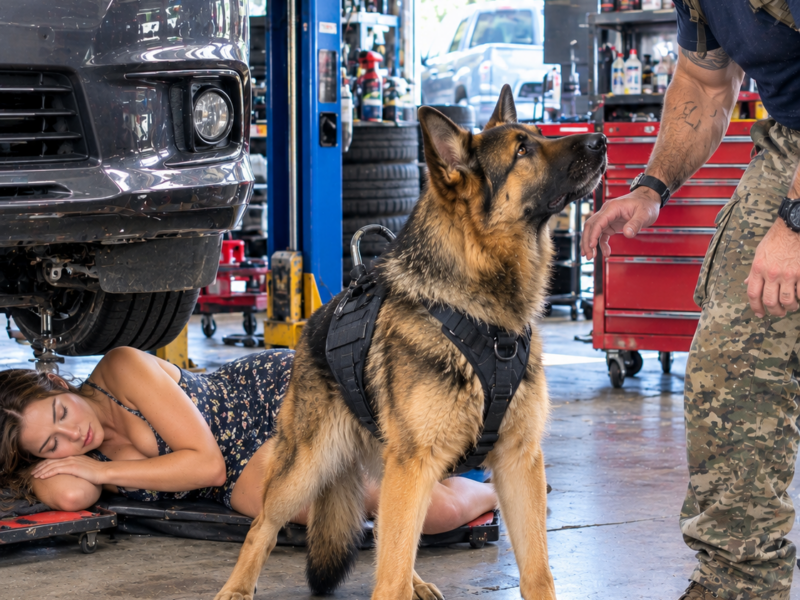
A Woman Slept Under a Former Navy SEAL’s Car—Then His Dog Blocked Him
Michael Hayes stood halfway up my driveway, wearing a dark coat and polished shoes that had no business being on a muddy Montana road. Behind him, his black SUV idled beside my mailbox.
My German Shepherd, Ranger, stood between us.
“Beautiful dog,” Michael said, offering a smile that never reached his eyes. “Does he always behave this way around strangers?”
“Only when he has a reason.”
Michael glanced at Ranger, then at my truck.
Beneath it, Anna Hayes was curled around her five-year-old daughter, Lily. The child was wrapped in a faded blanket, her face pale from the cold. Anna had just handed me a silver key and whispered something that changed everything.
If he gets that key, he’ll know who really killed his brother.
I had served as a Navy SEAL long enough to recognize a threat even when it arrived wearing a friendly expression.
Michael’s next words only strengthened my suspicion.
“My wife isn’t well,” he said. “She’s been making accusations about my family. She may have convinced you that she’s in danger, but this is a private matter. I just want to take my wife and daughter home.”
“Your daughter needs medical attention.”
“She needs her father.”
“She needs to get warm.”
His smile disappeared for a fraction of a second.
Then he glanced at the silver key in my hand.
“Whatever she gave you, Daniel, it doesn’t belong to you.”
I closed my fist around it.
“You should leave.”
Michael’s jaw tightened. He looked at Ranger, who answered his stare with a deep growl.
“Fine,” he said. “But when you learn the truth, don’t expect me to forgive you for helping her.”
He returned to his SUV and drove away.
I watched until the vehicle disappeared around the bend. Then I crouched beside my truck.
“Anna, we’re going inside.”
She shook her head, trembling so violently that she could barely speak.
“He’ll come back.”
“Maybe. But we’re not leaving your daughter out here to freeze.”
I lifted Lily carefully. Anna crawled out after her, tried to stand, and collapsed against my arm. Ranger pressed his nose to her hand, then followed us toward the house.
For the first time that morning, I understood that the woman hiding beneath my truck wasn’t simply afraid of her husband.
She was afraid of what he would do if he found out what she knew.
And the silver key in my pocket was the first piece of a mystery that had remained buried for five years.
I wrapped Lily in blankets, turned up the heat, and called emergency services.
Anna protested when I told the dispatcher about the child’s condition, but she stopped arguing when Lily began shivering uncontrollably.
By the time the ambulance arrived, the little girl was barely awake. The paramedics checked her temperature and breathing before wrapping her in warming blankets.
“She needs to be monitored at the hospital,” one of them told me. “She’s cold, dehydrated, and exhausted.”
Anna immediately stood.
“I’m going with her.”
“Of course,” the paramedic replied.
Then Anna grabbed my sleeve.
“Please don’t tell Michael where we’re going.”
The paramedic exchanged a glance with her partner.
“We’ll notify the appropriate authorities. You don’t have to contact him yourself.”
Anna looked unconvinced, but she climbed into the ambulance beside her daughter.
Before the doors closed, she reached through the opening and caught my hand.
“Don’t lose that key.”
“I won’t.”
“Daniel, there’s something you need to understand. Michael doesn’t just want it because it belongs to his brother.”
“What does he want?”
Anna glanced toward the road.
“Because it opens the door to everything he’s spent five years trying to hide.”
Then the doors closed.
I stood in the driveway until the ambulance disappeared.
Ranger remained beside me, watching the road.
I had a dozen questions, but one name kept returning to my thoughts.
Jonathan Hayes.
I’d read about his death years earlier. He’d been a civilian logistics specialist working with a support team overseas when the vehicle he was traveling in exploded. The official report described a tragic accident involving damaged equipment.
Yet something about the report had bothered me.
A witness had reported seeing Jonathan leave the vehicle carrying a small metal case shortly before the explosion. That detail didn’t fit the official timeline, and the discrepancy had never been satisfactorily explained.
I had no idea whether Anna’s story was connected to the incident.
But I knew someone who might.
I called Marcus Reed, a former teammate who now worked as a criminal investigator.
When I mentioned Jonathan’s name, Marcus went quiet.
“Where did you hear about him?”
“I found his wife and daughter hiding beneath my truck. Her husband came looking for them. He knows I have a key that belonged to Jonathan.”
“Daniel, listen carefully. Don’t open anything, don’t confront the husband, and don’t try to investigate this yourself.”
“I wasn’t planning to.”
“Good. Contact local law enforcement and preserve anything you’ve received. If this involves the old logistics case, there may be records that need to be handled properly.”
I told him about the silver key and Michael’s threat.
Marcus promised to check what he could through appropriate channels.
“Until we know more, your job is to make sure Anna and Lily are safe.”
After we hung up, I put the key in a lockbox and called the deputy who had responded to my report.
I explained what happened, provided Michael’s phone number, and told the deputy about the photographs I’d seen him take of my house.
The deputy recorded everything.
He couldn’t tell me what Michael had done or whether the key proved anything. But he assured me that Anna’s safety concerns would be documented and assessed.
It wasn’t a dramatic promise.
It was the first honest answer I’d heard all day.
At the hospital, Lily was resting beneath a warm blanket with a stuffed rabbit beside her pillow.
I had bought the rabbit from the gift shop downstairs.
When she saw me, she smiled weakly.
“Where’s your dog?”
“At home. He’s guarding the house.”
“From the bad man?”
I glanced at Anna.
“We’re going to make sure you’re safe,” I told Lily.
She hugged the rabbit and returned her attention to the television.
Anna sat beside her bed with her hands folded tightly in her lap. Her hair had been brushed, and a nurse had given her a clean sweatshirt, but she still looked like someone who expected danger to appear whenever a door opened.
When the nurse stepped out, Anna began to explain.
Her full name was Anna Hayes. She had married Michael seven years earlier, before Lily was born. He had been charming, ambitious, and attentive. He worked as a logistics consultant for companies handling government contracts.
His older brother, Jonathan, worked in the same industry.
The brothers had been close, though they were very different men. Jonathan was methodical and cautious. Michael was persuasive, ambitious, and exceptionally good at getting people to agree with him.
When Jonathan died, Michael told everyone that a transport operation had gone wrong. He said his brother had made a mistake and paid the ultimate price.
Anna believed him.
For years, she had accepted the official explanation.
Then, three months earlier, she found an envelope among Jonathan’s old belongings.
Inside were photocopies of shipping records and a handwritten note.
If anything happens to me, check the second manifest. The first one is a lie.
Anna didn’t understand the significance of the note. But she recognized Jonathan’s handwriting.
She showed the papers to Michael.
He studied them for a long time, then asked where she’d found them.
The next morning, the envelope had disappeared.
When Anna asked about it, Michael said he’d destroyed the papers because they were old and meaningless.
After that, his behavior changed.
He began asking where she went, who she called, and why she kept looking into his brother’s death. He accused her of becoming obsessed. He told her that reopening the investigation would destroy their family.
Then the threats began.
Sometimes he threatened her directly. Other times, he spoke about what happened to people who made accusations they couldn’t prove.
Once, while Lily was asleep upstairs, he told Anna that if she ever tried to take their daughter away, he would make sure no one believed her.
“I kept thinking he would calm down,” Anna said. “I kept remembering the man I married. I thought if I gave him enough time, he’d come back.”
“What changed?”
“I found the key.”
She explained that Michael had kept Jonathan’s belongings in a rented storage unit. When he mentioned clearing it out, Anna went there first.
Inside an old tool case, she found a key taped beneath the lining. A note beside it contained a storage number and a name: Evelyn Shaw.
Anna called the number from a pay phone.
A woman answered. When Anna mentioned Jonathan, the woman began crying.
“She said she’d been waiting five years for someone to find the key,” Anna told me. “She said Jonathan had evidence that his death wasn’t an accident.”
“Did she tell you what was in the storage locker?”
“No. She told me to be careful. She said some of the people involved still had connections in the industry.”
Anna found the locker two weeks later.
Inside were folders, financial ledgers, a small digital recorder, and a sealed envelope addressed to her.
She took the recorder and envelope but left the larger files because she heard a vehicle approaching.
When she returned home, Michael was waiting in the kitchen.
He had the envelope.
“I don’t know how he got it,” Anna whispered. “Maybe someone followed me. Maybe he’d been watching the storage unit. He held it up and asked if I wanted to know how Jonathan really died.”
“What did you say?”
“I told him yes.”
Anna’s hands trembled.
“He laughed. He said Jonathan had been warned to stop investigating. He said his brother could have walked away, but he refused. Then he told me that if I continued looking, Lily and I would end up just like him.”
She tried to leave with Lily that evening. Michael grabbed her, and a struggle followed. Anna managed to get out with her daughter and the recorder, but she had no coat, no proper shoes, and nowhere safe to go.
She walked through the woods until she saw my truck.
When she heard Michael’s SUV approaching, she crawled beneath it.
She thought she could hide until he passed.
She hadn’t expected him to stop.
“Why didn’t you go to the police sooner?” I asked gently.
“I tried once. I reported that Michael had threatened me, but I didn’t have enough evidence to explain the connection to Jonathan’s death. Two days later, Michael knew exactly what I’d told them.”
That was why she had stopped trusting anyone.
“I don’t know how he found out,” she said. “But after that, he took my phone, changed the locks, and told me he’d have me evaluated if I kept making accusations.”
I looked toward Lily.
The little girl was asleep, one hand curled around the stuffed rabbit.
“Anna, you don’t have to prove everything today. The immediate priority is keeping you and Lily safe.”
She nodded, but her eyes remained troubled.
“There’s one more thing,” she said.
“What?”
“Jonathan’s note mentioned a second manifest. I think the original records are still in that locker.”
“Then we let investigators retrieve them.”
She looked at me.
“What if the records prove Michael is telling the truth about something?”
“Then the evidence will show that. We can’t decide what happened before we see the evidence.”
Anna took a slow breath.
For the first time, she seemed to understand that she didn’t have to solve the mystery alone.
The next morning, Marcus called.
He had located references to Jonathan’s old employer in public filings. The company had handled shipments of specialized communications equipment. Several shipments had been reported as damaged or missing, and replacement payments had been issued.
Yet some financial records suggested that equipment listed as destroyed had later appeared in private warehouses.
Someone might have been paid twice for the same shipment.
The records had been amended after Jonathan’s death. A complaint he filed shortly before the explosion had been marked as resolved, but there was no evidence that a full investigation had taken place.
The officer who closed it was named Peter Lang.
“Do investigators believe Michael was involved?” I asked.
“They’re looking at the surviving records,” Marcus replied. “Michael worked for one of the subcontractors. That establishes a connection, not guilt.”
“What about Evelyn Shaw?”
“She’s listed as a former accounts manager. She left the company shortly after Jonathan died. I’m checking whether investigators have already spoken to her.”
I glanced at the lockbox on my kitchen counter.
“What happens to the key?”
“Law enforcement should take custody of it and document the transfer. Don’t try the lock yourself. The storage facility may have original records that need to be preserved.”
I agreed.
That afternoon, a deputy collected the key and documented the handover. Anna’s advocate helped arrange a confidential temporary placement for her and Lily while the threats were assessed.
Anna was reluctant to leave with strangers.
“I don’t want to cause you trouble,” she told me.
“You didn’t cause the trouble. You asked for help.”
She looked at the floor.
“I don’t know how to trust people anymore.”
“Then don’t force yourself to trust everyone. Start by watching what people do.”
She thought about that, then nodded.
Before leaving, she thanked me for calling the ambulance.
It seemed like a small thing to thank someone for.
But I realized she had spent months being told that her concerns were unreasonable. Every ordinary act of kindness had become something she was afraid to expect.
I watched her leave with Lily and the advocate.
Ranger sat beside the front door until the vehicle disappeared.
That evening, Michael sent me a text.
I understand you helped Anna. Thank you for looking after my family. I’d like to speak privately and clear up this misunderstanding.
I showed it to the deputy.
Then another message arrived.
You have no idea what she’s put you in the middle of. If you care about that little girl, give me the key and let me handle this.
I didn’t respond.
The deputy added the messages to the report and reminded me not to meet Michael alone.
For the next two days, nothing happened.
Then a woman in a long coat appeared at my door.
She looked to be in her late fifties. She carried a canvas bag and kept glancing toward the road.
“My name is Evelyn Shaw,” she said. “Anna told me where to find you.”
I opened the door but remained on the porch.
“Anna is safe.”
“I’m glad. I’ve been worried about her.”
“Why did you come here?”
Evelyn looked at Ranger, who stood quietly behind me.
“Because I heard the key had been found. And because I’ve kept something for five years that should have been given to investigators long ago.”
I called the deputy before inviting her inside.
Once the officer arrived and documented her information, Evelyn opened her canvas bag.
Inside were old invoices, handwritten notes, copies of shipping records, and a scratched digital recorder.
“I worked in accounting for the company that handled Jonathan’s shipments,” she explained. “He discovered that equipment was being reported as lost or destroyed, even when it had been delivered. The company claimed replacement payments, then sold some of the original equipment through private channels.”
“Who was involved?”
“I can’t name everyone. But Michael helped coordinate the paperwork.”
She pointed to a delivery receipt.
The signature at the bottom was Michael’s.
Evelyn explained that Jonathan had confronted his brother and filed an internal complaint. He believed the original transport logs would expose the scheme.
“He came to me the night before he died,” she said. “He asked me to keep copies of the records somewhere safe. He thought someone was trying to stop him.”
“Did you report what you knew?”
“I gave copies to an internal investigator. He promised to review them. Then Jonathan died, and Michael told me to stop making accusations.”
She had been warned that she could lose her job and face legal consequences for spreading unverified allegations.
“I was afraid,” she admitted. “I left the company and kept the documents. I told myself I was waiting for the right time.”
“Why come now?”
“Because Anna found the key. Jonathan told me that if anything happened to him, the key would lead to another set of records. He wanted an independent investigator to receive them.”
Evelyn placed the recorder on the table.
“Jonathan gave me this the day before he died. He said it contained a conversation I might need someday. I tried to play it years ago, but it wouldn’t turn on.”
I resisted the urge to examine it.
The recorder and documents needed to be handled properly, not passed around a kitchen table.
The deputy contacted the relevant investigators, who arrived later that afternoon. They documented the material, arranged secure collection, and interviewed Evelyn about the company’s records and Jonathan’s final days.
Before leaving, she turned to me.
“Do you think Jonathan will ever get justice?”
“I think the truth has a better chance now than it did yesterday.”
She nodded, clutching her coat.
“That will have to be enough.”
The silver key opened the storage locker.
Inside, investigators found original shipping records, financial ledgers, and an envelope addressed to a federal investigator. The materials were secured and compared with the documents Evelyn had preserved.
The investigation began to move.
A former employee confirmed that shipments had been entered into the system more than once. Financial records showed payments that could not be explained by the company’s official account. Michael’s signature appeared on documents authorizing several disputed transfers.
But the question of Jonathan’s death remained unresolved.
Marcus warned me not to confuse evidence of fraud with proof of murder.
“The records may establish that Michael was involved in the scheme,” he said. “They don’t automatically establish that he caused the explosion. Investigators need evidence for each allegation.”
“I understand.”
“Good. And don’t discuss the details with Anna or Evelyn outside the formal process. They need to tell investigators what they know, not what they think investigators want to hear.”
I followed his advice.
A few days later, an envelope appeared on my porch.
It had no stamp or return address. My name was written across the front.
Ranger sniffed it, then backed away.
I photographed the envelope, called the deputy, and waited until an officer arrived to document it.
Inside was a single sheet of paper.
You are interfering in a family matter. You have no idea what Anna has done. If you continue helping her, you will regret it.
Below that was a second line.
Ask her what she did with the original file.
I reported the letter immediately.
That afternoon, Anna called through the confidential number provided by her advocate.
“Michael contacted my sister,” she said. “He told her I was hiding an original file that could clear his name.”
“Is that true?”
There was a pause.
“Yes. But not the way he means.”
Anna explained that the night she found the storage locker, she had discovered a sealed envelope beneath the folders. Inside were a memory card and a handwritten note.
She had given both to her advocate for safekeeping, but she had not yet handed the memory card to investigators because she wanted to understand what it contained.
“Anna, let the investigators collect it,” I said. “Don’t try to examine it yourself.”
“I know. I was just afraid it might be the only thing that could prove what happened to Jonathan.”
“If it contains evidence, they need to preserve it properly.”
The next morning, the memory card was handed over.
It contained scanned documents, photographs of original shipping labels, and a short video recorded inside a warehouse. The audio was unclear, and one man’s face was partly obscured.
Investigators began authenticating the files.
Michael’s attorney released a statement claiming that the documents had been taken out of context and that Michael had cooperated with legitimate inquiries.
But the records contradicted several of his earlier explanations.
The investigation widened.
A week later, Marcus called with an update.
“They’ve recovered part of the audio from Jonathan’s recorder.”
I stopped what I was doing.
“What does it contain?”
“Investigators believe it includes a conversation between Jonathan and Michael. I can’t give you the details, but the recording raises questions about what Michael knew before the transport operation.”
“Does it mention the explosion?”
“Yes.”
I gripped the counter.
“Was it an accident?”
“That’s what investigators are working to establish. The original vehicle evidence is being reviewed alongside the transport records and the recovered audio. We need to be careful about what the evidence actually proves.”
Over the next several days, investigators searched business offices connected to Michael’s consulting work. They seized electronic devices, invoices, and financial records. A former employee agreed to provide a statement about how shipments had been documented.
Peter Lang, the former contracting officer who had closed Jonathan’s complaint, also agreed to an interview.
He acknowledged that he had marked the complaint as resolved without conducting the full review he had originally promised. He claimed that senior figures had pressured him to close the matter.
That did not excuse his actions, but it helped investigators understand how the original inquiry had been mishandled.
Meanwhile, Anna and Lily remained in a confidential location.
The family support advocate helped Anna replace identification documents, find longer-term housing, and arrange counseling for Lily.
Anna was still frightened. She checked the locks before bed and startled whenever a dark vehicle passed the house. Sometimes she woke in the middle of the night convinced she could hear Michael’s footsteps.
But she no longer had to hide beneath a truck.
I visited once, with the advocate’s approval.
Lily ran toward me when I arrived.
“Where’s Ranger?”
“At home.”
“Can he come next time?”
“If your mom and the people helping us say it’s okay.”
She nodded seriously, as though she had been entrusted with an important mission.
When Lily returned to her coloring book, Anna turned to me.
“The investigator asked me about the night Michael came home with Jonathan’s letter. I told them everything.”
“Good.”
“I was afraid they’d blame me for not reporting it sooner.”
“What did they say?”
“That fear can make people stay quiet. They said what matters now is that I’m telling the truth.”
Anna looked toward her daughter.
“I spent five years believing Jonathan had died because he’d made a mistake. Michael told everyone his brother had ignored safety rules and caused the accident himself.”
She wiped her eyes.
“If that’s a lie, then we’ve been grieving the wrong man.”
“Evelyn never stopped trying to find the truth,” I said.
Anna nodded.
For the first time, she seemed comforted by the thought that other people had remembered Jonathan as more than a name on an old report.
The breakthrough came on a Friday morning.
I was clearing snow from the porch when Marcus called.
“Michael Hayes has been taken into custody.”
I stopped moving.
“For what?”
“Investigators obtained additional evidence related to the fraudulent shipments, financial transactions, and threats made against Anna. He’s facing charges connected to the fraud and witness intimidation. Prosecutors are also reviewing evidence related to Jonathan’s death.”
“Does that mean they proved Michael caused the explosion?”
“No. The arrest doesn’t establish that. The investigation into the death is continuing.”
I took a slow breath.
“What happened?”
“A former employee provided records linking Michael to unauthorized equipment transfers. The recovered audio also contradicts parts of his earlier statements about his contact with Jonathan. Investigators believe they have enough evidence to pursue the current charges.”
I looked out at the road where Michael had parked his SUV.
For days, I had imagined what it would feel like to hear that he had been stopped.
I expected relief.
Instead, I felt exhausted.
Tired of the lies. Tired of the fear. Tired of the years people had spent trying to make the truth disappear.
“What about Anna?” I asked.
“She has been notified through her advocate. Her safety plan remains in place.”
“Good.”
Marcus paused.
“Daniel, you did the right thing by helping her. You also did the right thing by letting the evidence speak for itself.”
“I had help.”
“I’m sure Ranger will want credit.”
“He’s already getting extra treats.”
Marcus laughed.
“Keep doing that.”
When we ended the call, I looked down at Ranger, who was waiting beside the porch steps.
I scratched behind his ears.
“You hear that, buddy? You might be the only member of this team who’s getting paid in treats.”
His tail wagged.
But Michael’s arrest was only the beginning.
The legal process took months. Investigators compared the recovered records with company accounts, interviewed witnesses, and reconstructed the transport operation. Michael’s attorneys argued that several transactions had legitimate explanations. Prosecutors responded with financial records, communications, and testimony from people who had worked with him.
The evidence established that equipment had been falsely reported as damaged or destroyed, replacement payments had been claimed, and some of the original equipment had been diverted through private warehouses.
Michael had played a central role in coordinating several disputed transactions.
Jonathan had discovered the discrepancies and tried to report them.
Investigators also found a message in which Michael warned an associate that Jonathan was carrying records that could expose the scheme. The message did not prove, by itself, that Michael had caused the explosion, but it contradicted his claim that he knew nothing about Jonathan’s investigation.
The death inquiry was formally reopened.
Specialists reviewed the original vehicle evidence and compared it with the recovered transport records. Their findings indicated that the explosion had not been the simple mechanical accident described in the original report. Evidence pointed to deliberate interference with the vehicle before the journey.
Prosecutors reviewed the findings, and additional charges followed.
The case involved more than one person. Some witnesses cooperated; others denied knowing anything about the scheme. Peter Lang acknowledged his failure to properly investigate Jonathan’s complaint and provided information about the pressure he had received.
The process was neither quick nor easy.
But the old report was no longer the final word.
When the principal fraud case reached trial, I attended with Marcus.
The courtroom was smaller than I expected. There were no dramatic confessions or sudden revelations. There were exhibits, testimony, legal arguments, and long periods of waiting.
Evelyn testified about Jonathan’s efforts to expose the false shipping records. Former employees described how equipment transfers had been documented. Financial records showed payments that could not be reconciled with the company’s official explanations.
Anna testified about the threats Michael had made and the circumstances that led her to flee with Lily.
She did not exaggerate. She did not try to explain things she hadn’t witnessed. She simply told the truth about what she had seen, heard, and experienced.
When the jury found Michael guilty on the principal fraud counts and witness-intimidation charge, he stared straight ahead.
He did not look at Anna.
He did not look at Evelyn.
For a moment, he looked toward the back of the courtroom, where I sat beside Marcus.
Then he looked away.
The separate proceedings connected to Jonathan’s death continued as prosecutors presented the evidence of deliberate interference and concealment. The court considered each allegation on its own evidence, rather than treating the fraud verdict as proof of every accusation.
Eventually, the evidence established that the explosion had involved deliberate interference with the vehicle and that the original investigation had been compromised by false information and concealed records. The proceedings resulted in further legal consequences for Michael and others connected to the scheme.
Michael received a lengthy prison sentence for the offenses established in court.
Not everyone involved was held accountable. Some records were missing, and some people who might have known more refused to cooperate. But Jonathan’s death was no longer officially dismissed as an ordinary accident caused by his own carelessness.
Outside the courthouse, reporters gathered near the steps.
Anna emerged with her advocate, holding Lily’s hand.
A reporter called her name and asked whether she felt vindicated.
Anna stopped.
“I’m relieved that the truth was taken seriously,” she said. “But this was never about winning against my husband. It was about protecting my daughter and making sure the people who tried to expose wrongdoing weren’t forgotten.”
Then she continued down the steps.
I followed at a respectful distance.
When we reached the sidewalk, she turned toward me.
“Do you remember what I said under your truck?”
“I remember.”
“I was so certain he would find us. I thought the whole world belonged to him.”
She looked at Lily, who was swinging their joined hands.
“Now I know he was just one man. A frightening man, maybe. But still just one man.”
She squeezed her daughter’s hand.
“He couldn’t control everyone forever.”
Lily tugged at her sleeve.
“Mom, can we get ice cream?”
Anna laughed.
It was a small, surprised laugh, but it was real.
“I think we can manage that.”
We went to a diner a few blocks away. Lily ordered chocolate ice cream and got it all over her face. Anna laughed so hard she had to put down her spoon.
For months, every decision had been about evidence, safety, and survival.
Now Lily was worrying about sprinkles.
A child was being a child.
And her mother was allowed to enjoy it.
When we finished, Anna thanked me.
“I don’t know how to repay you.”
“You don’t have to.”
“You could have believed Michael when he said I was unstable. You could have handed him the key and told yourself it wasn’t your problem.”
I thought about that.
“I didn’t know what was happening,” I said. “But I knew Lily needed help.”
Anna reached across the table and squeezed my hand.
“That’s more than enough.”
Lily met Ranger properly two weeks later.
Anna had moved into a small rental home in a town about forty minutes away. With the necessary safety arrangements in place, her advocate approved a visit to my property.
Lily arrived carrying a paper bag of dog treats and a drawing she’d made.
The moment she saw Ranger, she ran toward him, then stopped a few feet away.
“Can I pet him?”
I looked at Ranger.
He approached slowly, sniffed her hand, and sat down.
“You can. Gently.”
She stroked his head.
Ranger leaned against her knee.
Anna watched them with tears in her eyes.
“I was so afraid he’d bite you,” she whispered to Lily.
“He won’t,” Lily said confidently. “He’s a good dog.”
Ranger’s tail thumped against the floor.
We spent the afternoon walking around the yard. Lily collected pinecones, asked why the mountains looked blue in the distance, and insisted that Ranger needed a blanket because his nose looked cold.
Anna sat on the porch with a cup of tea.
For the first time since I’d met her, she didn’t keep checking the road.
Before they left, Lily handed me her drawing. It showed a blue truck, a brown house, and a very large German Shepherd. A little woman and a smaller child stood beside him.
Across the top, in uneven letters, she had written:
THE PLACE WHERE WE GOT WARM.
I put it on the refrigerator.
Anna stood beside me, looking at it.
“Do you ever think about that morning?” she asked.
“Every day.”
“Does it frighten you?”
“Sometimes.”
She nodded.
“I used to think the worst thing that could happen to us was losing everything. Our home, our family, the life I thought we had.”
“What do you think now?”
She watched Lily laugh as Ranger sniffed a patch of grass.
“I think the worst thing would have been staying somewhere we were afraid to breathe.”
She took a slow breath of the spring air.
“I lost the marriage I thought I had. I lost the future I planned. But I didn’t lose my daughter. And I didn’t lose the chance to build something better.”
“You’re doing that already.”
“I’m trying.”
A few months later, Anna began working part-time at a community center that helped families leaving abusive situations. She helped people find temporary housing, complete paperwork, and understand their options. She wasn’t ready to tell her own story publicly, and no one pressured her to do so.
Evelyn volunteered with an organization that helped people report wrongdoing safely. She continued speaking about Jonathan, careful to distinguish what she knew from what she suspected.
Lily started kindergarten.
She loved drawing, disliked broccoli, and believed every German Shepherd should have a job protecting children.
Whenever she visited, she brought Ranger treats.
Sometimes she brought him pictures, too.
One drawing showed Ranger standing beside a blue truck beneath a sky full of yellow stars. A woman and a little girl stood beside him, smiling.
At the bottom, Lily had written:
RANGER KNOWS WHEN SOMEONE NEEDS HELP.
I framed that one and hung it beside the front door.
On the anniversary of the morning I found Anna and Lily, I woke before sunrise.
Frost covered the driveway. The air was bitterly cold, and the mountains beyond my property were hidden behind a thin veil of mist.
I stood at the kitchen window with a cup of coffee and watched Ranger walk toward the truck.
For a moment, the memory returned so clearly that I could almost hear the faint breathing beneath the vehicle.
I remembered the command I’d given him.
Get away from the car, Ranger.
I remembered his refusal.
I remembered thinking he was disobeying me.
Only later did I understand that he had been asking me to pay attention.
I put on my coat and went outside.
Ranger stood beside the passenger door, looking at me expectantly.
“You know,” I told him, “you made a lot of trouble for me that morning.”
His tail wagged.
“Paperwork. Phone calls. Investigators. Lawyers. More paperwork.”
He tilted his head.
“And you got an unreasonable number of treats out of the deal.”
His tail wagged harder.
I laughed and crouched to rub the scar across his muzzle.
“You did good, buddy.”
He leaned against me.
I stayed there for a while, watching the sunrise spread across the mountains.
I’d spent years believing that the hardest part of being a soldier was learning when to act. Training had taught me to move quickly, assess threats, and make decisions under pressure.
Those skills had saved lives.
But that morning had taught me something different.
Sometimes courage isn’t about moving toward danger. Sometimes it’s about recognizing that the person everyone else has dismissed may be the one who needs help most.
Sometimes the bravest thing you can do is refuse to accept the first explanation you’re given.
And sometimes the one who notices the truth isn’t the person with the most experience, the highest rank, or the best equipment.
Sometimes it’s a dog who simply refuses to move.
I looked down at Ranger.
“Come on, buddy. Let’s go for a walk.”
He trotted toward the gate, then stopped and looked back to make sure I was following.
I was.
For years, I had believed my life after the military would be defined by quiet routines and the absence of emergencies. I thought peace meant nothing unexpected would ever happen again.
I was wrong.
Peace wasn’t the absence of trouble. It was knowing that when trouble came, you didn’t have to look away. It was having people you could trust, even if you hadn’t known them yesterday.
It was a little girl laughing in the back seat of a car, a woman learning to live without fear, and a dog who watched the road as if he had a responsibility to the entire world.
Ranger climbed into the passenger seat and settled down.
I started the engine.
The sun was rising over the mountains, turning the frost on the windshield into tiny points of light.
I had spent years believing my heart was safest when it stayed guarded.
But that morning, beneath an ordinary truck in an ordinary driveway, a frightened mother and her child had reminded me of something I should have known all along.
A guarded heart can survive many things.
An open one can help save a life.
And sometimes, all it takes to change the course of someone’s future is one stubborn dog who refuses to move—and one man willing to listen.
THE END.









