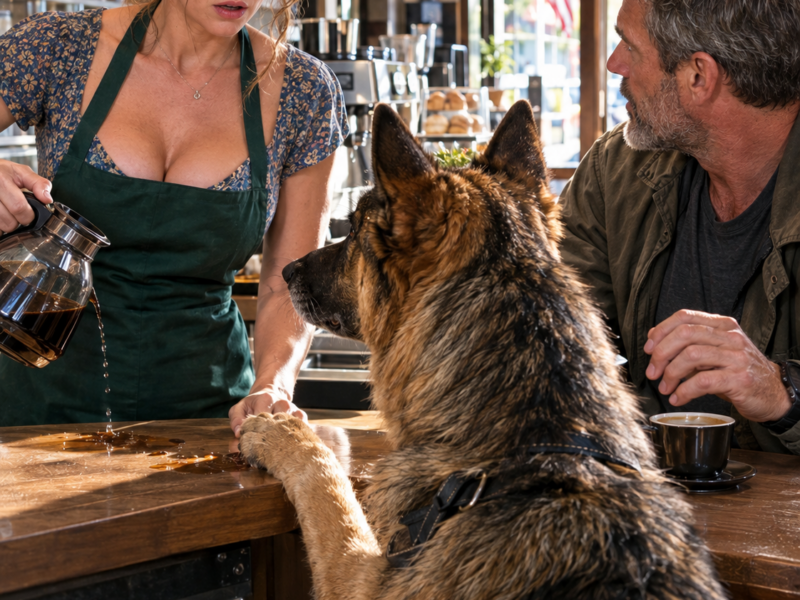
A Navy SEAL Stopped for Coffee… Then He Froze at a Familiar Voice Behind the Counter
I stared at the photograph until the edges began to blur.
The signature at the bottom belonged to Commander Thomas Reed, the man who had trained me, promoted me, and stood beside me when the Navy folded a flag over the coffin of a man who had never come home.
Daniel Brooks.
Reed had signed Daniel’s death report three days before our final mission.
Three days.
I checked the date again, hoping exhaustion had made me misread it. But the numbers remained exactly the same.
The report was dated October 14.
Our mission had begun October 17.
According to the official story, Daniel had died in an explosion during a classified operation overseas. His body had never been recovered. We had been told the blast had been so powerful that there was nothing left to identify.
For eleven years, I had carried that story like a stone in my chest.
Now I was holding proof that someone had written the ending before the story had even begun.
I looked at the brass key Daniel had pressed into my hand.
The same number appeared on the back of the photograph, written in Daniel’s unmistakable block letters.
Below it were four words.
THE PLACE WE BEGAN.
I knew exactly where that was.
A training compound in the mountains of North Carolina. It had been decommissioned years ago, but our original SEAL team had spent six months there preparing for the mission that destroyed our lives.
If Daniel was right, the truth had been waiting there all along.
And if Commander Reed had arranged his death before the mission even began, then the man I had once called my mentor had spent eleven years making sure I never discovered why.
I folded the photograph and slipped it inside my jacket.
Then I started the engine.
I had no idea where Daniel had gone after disappearing behind that coffee shop. I didn’t know whether he was wounded, whether the two men in the black SUV had caught him, or whether I would ever hear his voice again.
But I knew one thing.
I wasn’t going to lose him twice.
The drive to North Carolina took nearly four hours.
I avoided the interstate, changed direction twice, and stopped at a gas station long enough to study the vehicles entering and leaving the lot. No black SUV. No familiar faces. No obvious tail.
That didn’t mean I was alone.
Professional surveillance rarely announced itself.
I had spent enough years in the military to know that the most dangerous person in a room was often the one who looked like he belonged there.
By late afternoon, rain had settled over the mountains. The road narrowed, winding between dark pine trees and steep embankments. My headlights swept across an old wooden sign half hidden beneath vines.
NAVAL TRAINING ANNEX — PROPERTY RESTRICTED.
Someone had taken a chainsaw to the sign years ago. Only the first and last letters remained visible.
I parked a quarter mile away and approached on foot.
The compound looked smaller than I remembered.
The main barracks stood behind a rusted fence. Windows had been boarded up. Weeds covered the obstacle course, and the old training tower leaned slightly to one side. The place had once been filled with shouting instructors, exhausted recruits, and the constant rhythm of boots hitting gravel.
Now the only sounds were rain and wind.
I slipped through a gap in the fence.
My memories came back in fragments.
Daniel laughing as he beat me to the top of the climbing wall.
Daniel throwing a towel at my face after I lost a bet.
Daniel sitting beside me on the steps one night, telling me that one day he wanted a house near the ocean and a daughter who would never have to wonder whether her father was coming home.
He had met Rachel a year later.
Emily had been born not long after that.
I remembered holding the baby in the hospital, terrified I would break something so small. Daniel had stood beside the bed, exhausted and grinning.
“Look at her, Mike,” he had whispered. “That’s the only mission that matters now.”
I had promised him I would always look after his family.
And for eleven years, I had believed that promise meant helping his widow move forward.
Now I understood how little I had known.
The key led me to the old equipment building behind the barracks. A faded number had been painted above the door.
14.
The lock was newer than the building around it.
I inserted the brass key.
It turned smoothly.
Inside, the air smelled of damp concrete and old metal. Empty shelves lined the walls. At the back of the room stood a steel cabinet with a combination lock.
The lock clicked open.
There was a single black case inside.
My hands tightened around its handle.
I set it on the workbench and opened it.
Inside lay a compact hard drive, a stack of documents, and a sealed envelope bearing my name.
Not Captain Carter.
Not Lieutenant Carter.
Just:
MIKE.
I recognized Daniel’s handwriting immediately.
I opened the letter.
Mike,
If you’re reading this, then I either failed to reach you or I finally ran out of places to hide.
Before you read anything else, understand this: I did not disappear because I was afraid to come home.
I disappeared because coming home would have gotten you killed.
I stopped breathing for a moment.
Then I forced myself to continue.
The mission we were sent on was never a rescue operation. The intelligence was fabricated. The location was compromised before we landed. Our objective was to recover a weapons ledger and a digital archive connected to a private defense contractor called Aegis Meridian.
The archive contained records of illegal weapons transfers, falsified operational reports, and payments to people inside our own chain of command.
Aegis wasn’t selling equipment to approved buyers. It was moving restricted weapons through shell companies and black-market intermediaries. Every shipment had been disguised as legitimate military procurement.
Someone had discovered the records.
Someone else decided the records could never reach an investigator.
I looked up from the letter.
Rain hammered against the roof.
The name Aegis Meridian meant nothing to me at first. Then I remembered a briefing room, eleven years earlier, and a slide showing the contractor’s logo beside a list of logistical partners.
Our commander had called them a trusted supplier.
I read on.
Our team was chosen because we were capable, disciplined, and easy to discredit if things went wrong. The orders came through official channels. The intelligence carried legitimate signatures. Every safeguard that should have protected us had been bypassed by people who knew exactly how the system worked.
I found the ledger before the ambush.
I also found a second set of orders.
Those orders identified our team as expendable.
My jaw clenched.
I read the sentence again.
Expendable.
Not compromised. Not unfortunate casualties. Not a mission that had gone wrong.
Expendable.
I tried to warn the others. We were already under fire. Two men were killed before we reached the extraction point. Another was wounded so badly that we couldn’t move him.
You remember the explosion.
Of course I remembered it.
I remembered the shock wave throwing me against a wall. I remembered dust swallowing the corridor. I remembered Daniel shouting my name. I remembered the sudden, impossible silence afterward.
The explosion was not what killed our team, Daniel had written. The orders did.
I lowered the letter.
A cold, familiar anger settled inside me. It was the kind of anger that had once helped me stay calm under fire. It was also the kind that could make a man do something stupid if he allowed it to become his only guide.
I turned to the documents.
The first pages were copies of shipping manifests. The second group contained transaction records routed through companies registered in several countries. The final set included internal messages, signed authorizations, and a list of military personnel whose approval codes had been used to release the shipments.
Commander Thomas Reed appeared repeatedly.
So did the name Victor Shaw, the security executive whose company had provided contractors for the operation.
At the bottom of one page was a line that made my stomach tighten.
SURVIVOR CONTINGENCY: CARTER.
My name.
Beside it was a short note.
Preserve credibility. One surviving operator required to validate official narrative.
I read it once.
Then again.
They had not merely expected us to die.
They had planned for one of us to live.
Me.
I had been selected to return home, tell the truth as I understood it, and unknowingly help them bury the real one.
The worst part was that it had worked.
I had repeated the official version during debriefings. I had defended the operation when outsiders questioned it. I had told grieving families that the mission had been necessary and that their loved ones had died serving their country.
I had not lied deliberately.
But my words had become part of the lie.
I gripped the workbench until my knuckles hurt.
A faint sound came from outside.
Gravel shifting under tires.
I extinguished my flashlight.
Through a crack in the boarded window, I saw headlights moving across the trees.
A black SUV rolled to a stop near the fence.
Two men got out.
One was tall, wearing a dark raincoat. The other had a broad frame and a shaved head.
The same men from the coffee shop.
They had followed me.
I slid the documents into the case and reached for the hard drive.
Then I heard a third door open.
A familiar voice cut through the rain.
“Search the building first. Carter will be here.”
Commander Reed.
He was older than I remembered, his hair now almost entirely silver. But I recognized the posture, the clipped movements, the confidence of a man accustomed to being obeyed.
I stood motionless in the dark.
Reed had known I would come.
Or someone had told him.
Either possibility was bad.
I slipped the hard drive into my inside pocket and moved toward the rear exit. The door opened onto a narrow maintenance path leading downhill through the trees.
I was three steps outside when the voice behind me stopped me cold.
“Mike.”
I turned.
Commander Reed stood at the corner of the building, a pistol held low beside his thigh.
He looked neither surprised nor angry.
He looked disappointed.
“You always were too curious for your own good,” he said.
“Funny. I remember you telling me that curiosity kept good operators alive.”
“It does. When they know what questions not to ask.”
I glanced at the pistol.
“You signed Daniel’s death report before we left.”
Reed’s expression didn’t change.
“So you found the file.”
“You knew he was alive.”
“I knew he had escaped.”
“Escaped from whom? You?”
Reed sighed as if we were discussing a minor administrative mistake.
“You don’t understand the scale of what you’re touching.”
“Then explain it.”
“Put the case down.”
“No.”
The word came out before I could reconsider it.
For a second, we stood facing each other in the rain, two men who had once trusted one another with their lives.
Reed raised the pistol a few inches.
“Do you remember what I told your class on the first day of advanced training?”
I didn’t answer.
“Loyalty is not blind obedience,” he said. “It’s understanding which lives must be protected so the rest can continue.”
“You used that line to justify murder?”
“I used it to keep this country from being dragged into a scandal that would have destroyed careers, agencies, and international relationships.”
“You mean you protected the people making money.”
“You have no idea what those transactions prevented.”
“I know what they caused.”
His eyes narrowed.
“Daniel should have stayed dead.”
The words landed between us like a gunshot.
I felt something inside me go very still.
“Then why didn’t you finish the job?”
For the first time, Reed looked genuinely irritated.
“Because I wasn’t on the ground when the situation collapsed. Shaw’s people were supposed to retrieve the archive and eliminate the remaining witnesses. Daniel got out through a drainage channel. We believed he died later from his injuries.”
“But you never found a body.”
“No.”
“So you falsified the report.”
“I closed an operation that had become uncontrollable.”
“You declared a man dead before the operation began.”
Reed’s mouth tightened.
“That report was a contingency document. If the mission went wrong, the outcome had already been approved.”
“And I was the contingency survivor.”
He did not answer.
He didn’t need to.
The truth was written all over his face.
I took one step backward.
Reed’s pistol rose.
“Don’t.”
“I’m not going to let you bury this.”
“You think the truth will save you? You think a hard drive and a handful of documents will make people believe you over me?”
“I don’t need everyone to believe me.”
“Then what do you need?”
“To get the evidence somewhere you can’t reach it.”
His eyes flicked toward my jacket.
He knew I had the drive.
“Mike,” he said, his voice suddenly softer. “You served honorably. You came home. You built a life. Don’t throw all of that away because Daniel has convinced you he is the victim.”
“Isn’t he?”
“He made choices.”
“So did you.”
For a moment, neither of us moved.
Then a gunshot cracked through the trees.
The bullet struck the metal door beside Reed’s head.
He ducked.
I ran.
I heard shouting behind me, followed by two more shots. I plunged down the maintenance path, slipped on wet leaves, and caught myself against a tree before continuing downhill.
Another shot struck the ground near my boot.
Someone was firing from the upper slope.
I reached the drainage ditch and followed it beneath a collapsed section of fencing. Beyond it lay an abandoned service road, barely visible beneath the brush.
I kept moving until the sound of pursuit faded.
Only when I reached the car did I allow myself to breathe.
My phone showed three missed calls from an unknown number.
A fourth call arrived before I could start the engine.
I answered without speaking.
A young woman’s voice came through, shaky but controlled.
“Is this Michael Carter?”
“Who is this?”
“My name is Emily Brooks.”
For a moment, the world seemed to stop.
Daniel’s daughter.
The little girl I had held in a hospital room eleven years earlier had become a woman, and somehow she was now standing in the middle of the nightmare her father had tried to keep from her.
“Emily,” I said carefully. “Where are you?”
“I can’t tell you that yet.”
“Are you safe?”
A pause.
“Not really.”
I tightened my grip on the phone.
“Listen to me. Your father is alive.”
“I know.”
Her answer was so quiet that I almost missed it.
“You know?”
“He contacted me three weeks ago. He said if anything happened to him, I should call you.”
“Why didn’t you call earlier?”
“Because I didn’t know if you were part of it.”
The words stung, but I couldn’t blame her.
“I’m not.”
“That’s what Dad hoped.”
“Hoped?”
“He said there was a chance you might have been kept in the dark. He also said if you came looking for him, someone would try to stop you.”
“They already have.”
“I know. They came to my apartment last night.”
My blood turned cold.
“Who?”
“Two men. They said they were investigators. They knew my name, my work schedule, where I parked, everything. They wanted to know whether Dad had contacted me.”
“What did you tell them?”
“That I hadn’t heard from him in years.”
“Good.”
“They didn’t believe me.”
“Where are you now?”
“Somewhere Dad arranged. I have the original files.”
I looked at the black case on the passenger seat.
“What original files?”
“The ones he took from the mission. Not copies. The actual archive. There’s something in it that he never told me about.”
“What?”
“Your name.”
I closed my eyes.
“Emily, I found a file at the training compound. It says I was supposed to survive.”
Silence.
Then she whispered, “Dad told me that too.”
A chill moved through me.
“What else did he tell you?”
“He said the mission wasn’t designed to kill everyone. It was designed to create a hero.”
I stared through the windshield at the rain.
“Me.”
“Yes.”
“And you have the original archive?”
“I have something better. A video recording from before the mission.”
“Where are you?”
“I’ll send you a location. But you need to understand something first.”
“What?”
“My father didn’t just disappear after the operation.”
Her voice trembled.
“He came back to us.”
I couldn’t speak.
“Not immediately,” she continued. “Mom never told me. She thought it would put us in danger. But when I was twelve, I found letters hidden inside an old box. Dad had written to her for years. He was alive, and he was trying to prove what happened.”
“Did Rachel know?”
“She knew he was alive. She didn’t know where he was most of the time. He said he couldn’t risk being seen with us. Then, about six months ago, the letters stopped.”
I thought of Daniel’s face behind the coffee counter. The scars. The exhaustion. The desperate warning.
“What happened six months ago?”
“I don’t know. But the last letter said he had found the one person who could prove everything.”
“Who?”
“You.”
The call ended.
A moment later, a message appeared on my phone with an address outside Asheville.
Below it was a second message.
Come alone. And don’t trust anyone wearing a uniform.
I looked back toward the training compound.
Somewhere in those woods, Commander Reed was searching for me. He knew I had the hard drive. He might also know that Emily had the original archive.
I started the car.
This time, I wasn’t driving to find a missing teammate.
I was driving to expose a conspiracy that had used my loyalty as its most effective weapon.
And I was beginning to suspect the worst secret wasn’t that Daniel had been framed.
It was that the people responsible had spent eleven years preparing for the day I finally learned the truth.
Emily was waiting inside a small roadside motel on the outskirts of Asheville.
I parked behind the building and approached the room from the side, keeping to the shadows. Before knocking, I checked the windows and listened for movement.
“It’s Michael,” I said quietly.
The door opened a few inches.
A young woman with dark hair and tired eyes studied me through the gap. She looked like Daniel around the eyes, but the resemblance went deeper than that. She had the same guarded stillness, the same habit of watching a person’s hands before looking at their face.
“You look older,” she said.
I almost smiled.
“So do you.”
She opened the door.
For several seconds, neither of us knew what to say.
Then she stepped forward and hugged me.
It caught me completely off guard.
I had expected suspicion, maybe anger. Instead, she held on to me as though she had been waiting years for someone to confirm that the world she had grown up in wasn’t entirely a lie.
“I’m sorry,” I said.
She pulled back.
“For what?”
“For not finding him sooner.”
“You didn’t know.”
“I should have questioned the report.”
“Dad said you would blame yourself.”
“He knows me too well.”
“He said that was why he trusted you.”
She moved aside and let me in.
The room was bare except for two chairs, a small table, and a duffel bag placed beside the bed. The curtains were closed. A laptop sat on the table beside a portable drive and a thick envelope.
Emily locked the door behind me.
“Did you bring it?” she asked.
I took out the hard drive.
Her expression changed the instant she saw it.
“That’s his.”
“You recognize it?”
“He showed me a picture of it. He said the copies could prove corruption, but the original archive would prove intent.”
She opened the duffel bag and removed a small encrypted storage device.
“This is what he gave me.”
“How long have you had it?”
“Two months.”
“Why wait until now?”
“Because Dad told me not to use it unless someone came for him. And because I wanted to believe he was wrong about how far this went.”
She connected the device to the laptop.
A folder appeared on the screen. Inside were dozens of files, including scanned documents, audio recordings, and several video clips.
Emily opened one.
The image was grainy, apparently captured by a security camera in a military office. A timestamp appeared in the corner.
October 14, eleven years earlier.
Commander Reed sat at a desk. Across from him was Victor Shaw, younger but unmistakable.
The audio began halfway through their conversation.
“Once the team reaches the site, the archive is to be secured,” Shaw said.
“And the operators?” Reed asked.
“Your authorization specifies containment.”
“That’s not an answer.”
Shaw leaned forward.
“The team cannot return with the ledger. If they do, people will ask why the weapons were transferred. They will ask who approved the shipments. They will ask why our contractors were operating outside their mandate.”
“I’m aware of the consequences.”
“Then we’re agreed.”
Reed looked down at a document.
“One survivor.”
Shaw nodded.
“Carter.”
I felt the blood drain from my face.
Shaw continued, “He has the right reputation. If he returns with a credible account of an enemy ambush, the investigation will close. His testimony will carry weight because he was there.”
“And Brooks?”
“Brooks has already accessed the archive. He’s a liability.”
The video ended.
For a few seconds, I couldn’t move.
I had seen the plan in writing. I had suspected what the words meant. But hearing Reed say my name in that room, knowing he had discussed my survival as part of an operation designed to conceal a crime, was different.
Emily watched me.
“That’s not all.”
She opened another file.
This time the video showed Daniel.
He looked younger, uninjured, and furious. He was sitting in a dimly lit room, speaking directly into the camera.
“If this recording reaches Emily,” he said, “then the people I tried to stop have found a way to silence me. I need her to know that none of this was her fault. None of it was Rachel’s fault.”
He paused, rubbed his face, and looked back at the camera.
“Mike, if you’re seeing this, I need you to listen carefully. The archive contains a second ledger. The first proves the transfers happened. The second proves who ordered them. But there is one final piece of evidence that ties everything together.”
He leaned closer.
“The original authorization was signed by someone who had no legal authority to approve the operation. Someone above Reed.”
Emily froze the frame.
“Who was it?” I asked.
“Dad never said.”
“Did he leave anything else?”
She hesitated.
“There was one more letter.”
She reached into the envelope and removed a folded page.
“Mom gave it to me after she died.”
My chest tightened.
“Rachel is dead?”
Emily nodded.
“Cancer. Three years ago.”
I looked down.
I had known Rachel was ill, but I hadn’t known how bad it had become. She had never told me. I had visited once during her treatment, and she had smiled through the pain, insisting she was going to be fine.
I had believed her because I wanted to.
“I’m sorry,” I said.
Emily wiped her eyes.
“She never stopped loving him. Even when she was angry. Even when she was afraid. She kept every letter.”
She handed me the page.
Emily,
If you ever have to open the archive, look for the authorization bearing the code 0714. That code was never just our team’s designation. It was the number assigned to the first classified operation that Aegis Meridian helped conceal.
The original signature is hidden in a place no one would think to search.
The person who signed it is still protected by the same people who protected Reed.
Don’t expose the documents until you know who can be trusted.
Your father.
I stared at the number.
The key. The training room. The code on the archive.
It wasn’t merely a team identifier.
It was the name of the operation that had started everything.
“Do you know where the original authorization is?” I asked.
Emily shook her head.
“Dad said he’d tell me when it was safe.”
“Then we need to find him.”
A knock came at the door.
Three firm raps.
Emily went pale.
“Did anyone see you come here?” she whispered.
“No.”
The knock came again.
“Federal agents,” a man called from the hallway. “We need to speak with Emily Brooks.”
I moved between Emily and the door.
“Don’t answer.”
A pause.
Then the voice changed.
“Michael. I know you’re in there.”
Commander Reed.
Emily’s eyes widened.
I pulled the laptop closed and unplugged both storage devices.
Reed spoke again.
“This doesn’t have to become ugly. Open the door, give me the archive, and we can all walk away.”
I looked at Emily.
She shook her head.
I scanned the room. One window. Second floor. A narrow exterior staircase at the back of the building, visible through a gap in the curtains.
“Do you have another way out?” I whispered.
“There’s a service balcony.”
“Go.”
She grabbed the duffel bag.
I slipped the hard drive into my jacket and moved toward the window.
The door handle turned.
“Last chance, Mike.”
I raised my voice.
“You’re going to have to do better than that, Commander.”
The lock clicked.
A sharp impact shook the door.
Emily climbed onto the balcony first. I followed, pulling the window shut behind us.
The motel’s exterior staircase was slick with rain. We descended quickly, then crossed the back lot toward a line of trees.
Behind us, the door burst open.
“Stop!”
A gunshot cracked overhead.
We ran.
At the edge of the lot, a pickup truck sat beside a dumpster, its driver door open. I had no idea whose vehicle it was, and I had no intention of stealing it. Instead, I pulled Emily behind a concrete retaining wall as two men came around the building.
One carried a pistol.
The other held a phone, speaking rapidly into it.
“We have the drive,” he said. “They’re heading east.”
He had no idea whether that was true.
I waited until the men split up, then guided Emily through a drainage culvert that emerged on a side road.
We reached my car several minutes later.
I unlocked the doors, and she climbed in.
“Where are we going?” she asked.
I thought of Daniel’s letter.
The place we began.
The training compound had been a trap, but it had also revealed something important: Reed was frightened enough to expose himself personally. He wasn’t merely trying to recover evidence. He was trying to prevent us from finding the original authorization.
That meant it still existed.
And if Daniel had hidden it somewhere connected to the code 0714, there was only one place I could think of.
The old command center.
A building beneath the training compound that had been sealed after our mission.
“Back to the compound,” I said.
Emily stared at me.
“Are you insane?”
“Possibly.”
“They’ll be waiting.”
“Probably.”
“Then why go back?”
“Because Reed thinks we have the evidence he wants. He doesn’t know we’ve figured out what the code means.”
I pulled onto the road.
“And because I think your father left us a message he expected me to understand.”
We returned to the compound after midnight.
This time, I didn’t approach the main gate. I drove through a narrow service road and parked beside the old maintenance shed.
Emily stayed in the car while I scouted the perimeter.
The compound was dark.
Too dark.
No guards. No vehicles. No sign that anyone had been there since our earlier escape.
I didn’t trust it.
I returned to the car and handed Emily a small flashlight.
“If you hear anything, leave. Drive to the nearest public place and call the FBI’s public corruption hotline. Don’t call anyone from the old command structure.”
“What about you?”
“I’ll meet you outside.”
She looked at me for a long moment.
“You know, Dad used to say that.”
“Say what?”
“That you always promised you’d come back.”
I swallowed.
“Your father was usually right about me.”
She took my hand.
“Bring him home, Mike.”
I nodded once.
Then I went inside.
The old command center lay beneath the equipment building, accessible through a steel hatch hidden behind a row of storage cabinets. I had used it during training exercises, but I had never been allowed into the deeper rooms.
The hatch was locked.
The brass key turned in it.
Below, a narrow staircase descended into darkness.
I moved slowly, flashlight sweeping across concrete walls and old wiring. At the bottom stood a corridor with three doors. Two were sealed with chains. The third had a faded label.
RECORDS — AUTHORIZATION ONLY.
The lock had been replaced recently.
I used the key.
The door opened.
Inside was a small archive room with metal cabinets and a desk bolted to the floor. Dust covered everything except one cabinet near the back.
Someone had opened it recently.
I approached and pulled the drawer.
Inside lay a thin folder marked 0714.
The original authorization.
I removed it carefully.
The first page listed the mission objective. The second contained the weapons transfer codes. The third carried the approval signatures.
Commander Reed’s signature was there.
So was Victor Shaw’s.
But neither signature was the final one.
At the bottom of the page was a name I recognized from every major defense briefing I had attended during the last decade.
Deputy Secretary of Defense Malcolm Vance.
I sat down hard.
Vance had become a public figure after the mission. He had led congressional hearings on military procurement, announced reforms to prevent contractor fraud, and repeatedly praised the courage of fallen service members.
He had stood before cameras and spoken about Daniel’s sacrifice.
He had helped fund the memorial where Daniel’s name was engraved.
And he had personally signed the order that sent our team into a kill zone.
I turned the page.
A handwritten note had been attached to the back.
The authorization was issued under emergency authority that did not legally exist. The operation was designed to destroy the ledger and eliminate anyone who could authenticate it.
The only reason the cover story survived was that Carter returned alive.
If Carter ever learns the truth, use the survivor narrative to discredit him.
The final line was written in different handwriting.
Daniel’s.
MIKE — DON’T LET THEM MAKE YOU THE LIAR.
A sound came from the corridor.
Footsteps.
I slid the folder inside my jacket and switched off the flashlight.
Someone entered the archive room.
A beam of light crossed the desk.
“Carter,” Reed called softly. “I know you’re here.”
I stayed still.
“You have the original authorization. That’s what you came for, isn’t it?”
He stepped farther into the room.
“You have no idea what happens if you release that document. Vance will deny it. Shaw will destroy anything connected to it. The Navy will open an investigation into your conduct. They’ll question every decision you made on that mission.”
“Let them.”
“They’ll say you fabricated evidence to cover your own failure.”
“Then I’ll show them the recording.”
“Recordings can be altered.”
“The original documents?”
“Stolen.”
“The signatures?”
“Forged.”
I heard him move closer.
“You think the public wants the truth? They want a story they can understand. A decorated SEAL who returns from a disastrous mission and later accuses his superiors of conspiracy? They won’t see a whistleblower, Mike. They’ll see a man who broke under pressure.”
I stepped from the shadows.
“That’s what you planned from the beginning.”
Reed looked at me, his pistol lowered but ready.
“I planned to preserve the institution.”
“You preserved criminals.”
“I preserved stability.”
“You murdered my friends.”
His jaw tightened.
“Your friends died because Daniel refused to follow orders.”
“Daniel found evidence of illegal weapons transfers.”
“He found information that could have triggered an international crisis.”
“So you decided he had to die.”
“I decided the mission had to end.”
“And I had to survive.”
Reed looked away.
For the first time, he seemed tired.
“I never wanted you to know.”
“That isn’t an apology.”
“No,” he said. “It isn’t.”
He lifted the pistol.
“Give me the folder.”
I held it out slightly, keeping one hand on the papers.
“Tell me where Daniel is.”
Reed’s expression changed.
“You haven’t found him?”
“Not yet.”
“Then perhaps he’s smarter than I thought.”
“Where is he?”
Reed hesitated.
That hesitation told me more than his words ever could.
“You know,” I said. “You know where he went after the coffee shop.”
“I know where he was supposed to go.”
“Where?”
“An old safe house west of here. But if Shaw’s people reached him first, he’s already dead.”
A burst of static crackled from the radio clipped to Reed’s belt.
A man’s voice came through.
“Target located. Repeat, target located. We have Brooks.”
Reed froze.
I didn’t.
I lunged for his weapon.
The pistol discharged into the ceiling. We crashed against the desk, and the folder slid across the floor. Reed struck me in the ribs with his elbow. Pain flared, but I held on until the pistol fell from his hand.
He shoved me away and scrambled for it.
I kicked it beneath the cabinet.
He reached inside his coat.
I caught his wrist and twisted it behind his back, pinning him against the wall.
“Where is Daniel?”
Reed struggled.
“I don’t know!”
“Who has him?”
“Shaw’s men!”
I tightened my grip.
“Where?”
“An old paper mill near the river. They were watching the safe house.”
I released him just enough to pull a zip tie from my pocket and secure his wrists.
He glared at me.
“You’re making a mistake.”
“I’m making a choice.”
I took the folder and ran.
The old paper mill stood on the outskirts of a small mountain town, its broken windows glowing faintly beneath the moonlight.
I found Emily waiting near the road, exactly where I had told her to stay if anything went wrong. She had tracked my location through the emergency beacon on my phone.
When she saw my face, she didn’t ask whether I had found the evidence.
She asked whether I had found her father.
“Not yet.”
She looked toward the mill.
“Then he’s in there.”
“How do you know?”
“Because the last message he sent me said that if he ever disappeared again, I should look for the river.”
She handed me her phone.
The message contained a photograph of the mill and a single line.
THE LAST WITNESS ISN’T THE ONE YOU THINK.
I studied the image.
A light flickered behind one of the broken windows.
“We need help,” Emily said.
“I agree.”
I pulled out my phone and called a number I hadn’t used in years.
A retired federal investigator named Sarah Collins had worked with military prosecutors on contractor fraud cases. She had once approached me after a public hearing, asking whether I had noticed inconsistencies in the official account of our mission.
At the time, I had defended the report.
Now I hoped she would answer.
She picked up on the third ring.
“Carter?”
“Sarah, I need you to listen carefully. I have original evidence of a conspiracy involving a classified military operation, illegal weapons transfers, and a falsified death report. I have the original authorization and recordings of the people who arranged it.”
Silence.
“Where are you?”
“Near Asheville. I have a witness with me, and a missing service member may be inside an abandoned paper mill.”
“Do not enter that building.”
“I’m afraid that’s not an option.”
“Michael, listen to me. If this evidence is real, there are people who will do anything to keep it from reaching a prosecutor. I need the exact location.”
I gave it to her.
“I’m sending a team,” she said. “Stay outside. Don’t confront anyone.”
“I’ll wait as long as I can.”
“Carter.”
“Yeah?”
“If you go in there and die, the evidence dies with you.”
I looked at Emily.
“No,” I said. “It won’t.”
I ended the call.
Emily studied me.
“You’re going in.”
“Yes.”
“Then I’m coming too.”
“No.”
“Dad is in there.”
“Which is exactly why you stay here.”
She stepped closer.
“I’ve spent eleven years being told my father was dead. I’ve spent three years watching my mother die without knowing whether he would ever come home. I’m done being told to wait somewhere safe while other people decide what happens to my family.”
I had no answer for that.
I handed her the original authorization.
“Keep this. If I don’t come back, give it to Sarah Collins. Don’t hand it to anyone else.”
Emily took the folder.
“And you?”
I checked the flashlight and the small medical kit in my pocket.
“I’m going to bring your father home.”
Then I crossed the road and entered the mill.
The building smelled of wet timber, rust, and stagnant water. Machinery stood abandoned along the production floor. Narrow catwalks crossed overhead, and the river roared beneath the far wall.
I moved toward the light.
Voices drifted from a room near the loading bay.
“Where’s the second drive?” a man demanded.
“I told you. I don’t have it.”
Daniel.
His voice was rougher than I remembered, but unmistakable.
“You’re running out of time.”
“Then you should stop wasting it.”
A slap echoed through the room.
I tightened my grip.
There were at least three men inside. One stood near the door. Another was moving around behind Daniel. The third was the one speaking.
Victor Shaw.
I recognized his voice from the recording.
“Your daughter has the archive,” Shaw said. “We know she has it. You can make this easy.”
Daniel laughed weakly.
“If you knew where it was, you wouldn’t be asking me.”
Shaw struck him again.
I stepped through the doorway.
“That’s enough.”
All three men turned.
Daniel sat tied to a metal chair, his face bruised and one eye swollen. When he saw me, his expression changed from exhaustion to disbelief.
“Mike?”
“Hey, Danny.”
For one brief second, he looked like the man I had known before the mission.
Then Shaw reached for his gun.
I moved.
The room erupted into chaos.
A shot shattered a window. I dropped behind a steel worktable as one of the men rushed toward me. He was bigger than me, but he moved carelessly. I caught his arm, drove him into the table, and forced him to the floor.
The second man came from the side.
I barely avoided his first strike. We crashed into a stack of pallets. Pain flashed through my shoulder. He reached for my throat, and I drove my knee into his stomach before shoving him backward.
Shaw had already reached Daniel.
He held a pistol against Daniel’s head.
“Drop it!” he shouted.
I froze.
Daniel’s hands were still tied behind the chair. Blood ran from a cut above his eyebrow.
Shaw pressed the weapon harder against him.
“You should have stayed retired, Carter.”
“I’ve heard that before.”
“You don’t understand what you’ve done. You have no idea how many people will fall if this evidence comes out.”
“Maybe they should have thought of that before signing the orders.”
Shaw’s face twisted.
“Do you think Vance is going to let a retired operator destroy everything he built?”
“That’s not my concern.”
“It will be when he comes after you.”
“He already has.”
Shaw glanced toward the doorway.
That was his mistake.
Daniel drove his chair backward into Shaw’s legs. The gun went off, striking a pipe overhead. I rushed forward and slammed Shaw into the wall.
We fought for control of the pistol.
He was stronger than he looked, and for a moment the weapon pointed directly at my chest.
Then Daniel, still tied to the chair, threw his full weight against Shaw’s knees.
Shaw stumbled.
I twisted the pistol away and struck his wrist against the wall. The weapon dropped to the floor.
I kicked it aside and forced him down.
“Stay there.”
He spat blood onto the concrete.
“You think this is over?”
“No,” I said. “I think it’s finally beginning.”
I cut Daniel’s restraints.
He nearly collapsed when he stood. I caught him by the shoulders.
For several seconds, we just looked at each other.
Eleven years of grief, anger, and unanswered questions stood between us.
Then Daniel grabbed the back of my jacket and pulled me into a hard embrace.
“You came,” he whispered.
“I told you I would.”
“You didn’t know I was alive.”
“Apparently, I had a few things to learn.”
He laughed, then winced.
I held him upright.
“Can you walk?”
“Ask me again in ten minutes.”
“That’s a yes.”
“That’s a complaint.”
I almost smiled.
Then we heard sirens.
Sarah’s team was arriving.
Shaw looked toward the window, and for the first time, genuine fear crossed his face.
“You don’t understand,” he said. “Vance will destroy you both. Reed will deny everything. The whole system will close ranks.”
Daniel looked at him.
“Then we make it impossible to close ranks.”
He nodded toward my jacket.
“You found the authorization.”
“Yeah.”
“And Emily has the original archive.”
“Yeah.”
Daniel let out a slow breath.
“Then we finally have enough.”
I looked at him.
“Enough for what?”
“To prove who signed the order.”
Before he could explain, a voice came through the mill’s loudspeaker.
“Federal agents! Put your hands where we can see them!”
Sarah’s team flooded the building.
They secured Shaw and the other men, then called for medical assistance. Daniel was taken outside on a stretcher, protesting loudly that he could walk on his own.
I followed him into the cold night air.
Emily ran toward us.
For a moment, she seemed afraid to believe what she was seeing.
Daniel turned his head.
“Em?”
She stopped.
Her hands rose to her mouth.
“Dad?”
Daniel reached for her.
She ran the last few steps and threw herself into his arms.
He held her with the desperate strength of a man who had spent eleven years imagining that he would never feel his daughter’s heartbeat against his own again.
“I thought you were dead,” she sobbed.
“I know.”
“Why didn’t you come home?”
He closed his eyes.
“Because I was afraid they’d hurt you.”
“You should have trusted me.”
“You were a child.”
“I’m not now.”
“No,” he whispered. “You’re not.”
He pressed his face against her hair.
“I’m sorry, sweetheart. I’m so sorry.”
I turned away, giving them the privacy I could.
For the first time in eleven years, Daniel Brooks was alive in front of the people who loved him.
But the night wasn’t over.
Sarah approached with a phone in her hand.
“Carter, you need to see this.”
She showed me a breaking news alert.
DEPUTY SECRETARY MALCOLM VANCE ANNOUNCES RESIGNATION AMID UNDISCLOSED FEDERAL INVESTIGATION.
Below it was a statement from Vance’s office denying any knowledge of illegal weapons transfers.
Sarah shook her head.
“He’s moving before we can reach him.”
“Can you arrest him?”
“Not on a headline. We need the chain of evidence, the original authorization, and testimony from people who were directly involved.”
“We have all three.”
“We have the beginning of all three. But there’s a problem.”
She turned her phone around.
A second alert had appeared.
FORMER NAVY COMMANDER THOMAS REED REPORTED MISSING AFTER QUESTIONING.
I stared at the screen.
Reed had been in the archive room. I had left him restrained. Federal agents should have found him.
“How did he disappear?”
“We don’t know yet.”
“Then somebody helped him.”
Sarah’s expression hardened.
“Or someone was already waiting.”
She looked toward the ambulance, where Daniel was being treated.
“Your friend is going to have to testify. So are you. This won’t be quick, and it won’t be clean. Vance has allies in government, in the defense industry, and probably in places we haven’t identified yet.”
“Then we keep going.”
She studied me.
“You understand that once you go public, there’s no going back.”
I thought of the memorial, the folded flag, the years I had spent telling Daniel’s family that he had died a hero.
I thought of the mission report signed before we had even left.
And I thought of the man who had planned my survival because he believed I would be easier to manipulate than to kill.
“I’ve spent eleven years protecting a lie,” I said. “I’m done.”
Sarah nodded.
“Then let’s do it properly.”
The investigation lasted seven months.
Seven months of interviews, sealed hearings, legal battles, threats, and long nights spent reviewing documents that should never have existed.
The first breakthrough came when Sarah’s team matched the original authorization to a series of encrypted payment records held by a former Aegis Meridian accountant. Those records connected the weapons transfers directly to shell companies controlled by Victor Shaw.
The second breakthrough came from Commander Reed.
He was arrested three days after disappearing from the training compound. He had attempted to leave the country using a false identity, but an investigator tracked the financial account that had paid for his travel.
At first, Reed refused to speak.
Then prosecutors showed him the video from the command center.
He watched himself discussing my survival.
He watched himself approve Daniel’s death before the mission began.
And he watched Victor Shaw describe our team as expendable.
When the recording ended, Reed sat in silence for nearly a minute.
Then he asked for a lawyer.
Two weeks later, he agreed to cooperate.
His testimony confirmed what the documents already showed: Vance had authorized the operation to destroy the archive, Shaw had arranged the contractor support, and Reed had used his command authority to conceal the plan.
Reed also revealed something we hadn’t known.
The mission had not been the first attempt to suppress the ledger.
An earlier team had been sent to recover it. Their operation had been canceled at the last moment after one member discovered that the target location was a civilian warehouse.
That operator had filed a report.
The report had disappeared.
The operator had been reassigned.
Within a year, he had died in what was officially described as a training accident.
The pattern was older than our team.
The mission that killed our brothers had been the culmination of a system designed to erase anyone who came too close.
When the evidence became public, the reaction was immediate.
News outlets ran the recordings. Congressional committees opened hearings. Aegis Meridian’s offices were raided, its contracts suspended, and its executives charged with conspiracy, bribery, and illegal arms trafficking.
Malcolm Vance was arrested at his home outside Washington.
He denied everything.
For a while, his lawyers tried to argue that the documents were forged, the recordings manipulated, and the witnesses motivated by revenge.
Then Sarah released the original authorization, the payment records, and the full sequence of internal messages.
The evidence was too consistent to dismiss.
Vance was indicted on multiple federal charges.
Victor Shaw agreed to testify in exchange for a reduced sentence. His cooperation exposed additional illegal shipments and implicated several officials who had previously been considered untouchable.
Commander Reed pleaded guilty to conspiracy and obstruction of justice.
He never apologized to me.
He never apologized to Daniel.
During his sentencing hearing, he said only that he had believed he was protecting the country from a greater danger.
I watched the proceedings from the back of the courtroom.
I had heard that excuse too many times.
A country is not protected by hiding crimes from its citizens. A uniform does not turn corruption into duty. And loyalty does not mean surrendering your conscience to someone with a higher rank.
Reed had spent his life confusing obedience with honor.
I wasn’t going to make the same mistake.
Daniel’s testimony was the hardest part.
He described the ambush, the second set of orders, and the desperate escape through the drainage channel. He explained how he had survived with a serious injury, then learned that his team had been officially declared dead.
He had tried to contact military investigators through secure channels, but the reports never reached anyone outside Reed’s circle. When he attempted to return home, he discovered that people were watching Rachel and Emily.
So he stayed away.
He sent letters through intermediaries. He changed locations. He kept copies of the evidence hidden in places no one would think to search.
For years, he believed he could expose the truth without putting his family in danger.
He was wrong about one thing.
Silence had not protected them from the conspiracy.
It had only forced them to live inside it.
After Rachel died, Daniel had nearly given up. He had lost the person who had anchored him to the life he wanted to return to. The only thing that kept him moving was the knowledge that Emily deserved to know what had happened.
When he finally reached me at the coffee shop, it was because he had learned that Shaw’s men were closing in on him.
He had one chance to pass the evidence to someone who could carry it forward.
He chose me.
Not because I was the most powerful person he knew.
Because I was the man who had once promised to bring him home.
The court hearings lasted months. The final verdict came on a gray Thursday morning.
Vance was found guilty on the principal conspiracy charges. Shaw was convicted of bribery, illegal weapons trafficking, and obstruction. Reed’s cooperation reduced his sentence, but it did not erase his responsibility.
Several other officials resigned or were charged as investigators followed the money.
The official report on our mission was formally withdrawn.
A public review concluded that the operation had been deliberately compromised and that the deaths of our teammates could have been prevented.
For the first time in eleven years, their names were no longer attached to a lie.
But the verdict could not give them back.
It could not return the birthdays we had missed, the children who had grown up without their fathers, or the years Daniel had spent hiding in the shadows.
Justice was not a time machine.
It was simply the first honest thing that had happened since the day we were sent into that mission.
A year after the coffee shop, Daniel and I stood together at a small memorial near the coast.
The morning was clear, and the ocean stretched toward the horizon in long bands of blue and silver.
The names of our fallen teammates had been engraved on a new stone. Beneath them were the dates of the operation and the words:
THEY SERVED WITH HONOR. THE TRUTH WILL NOT BE FORGOTTEN.
Daniel stood beside me, one hand resting on a cane. His injuries had healed enough for him to walk short distances, though he still carried pain that would probably never disappear completely.
Emily stood on his other side.
She had started working with a veterans’ legal support organization, helping families navigate cases involving misconduct and classified operations. She said she wanted to make sure no one else had to spend years wondering whether the official story was true.
Daniel had told her she didn’t need to dedicate her life to his past.
She had told him that her future was hers to choose.
He had smiled and admitted she had a point.
We stood quietly before the memorial.
“I used to think the worst day of my life was the day we lost the team,” Daniel said.
I looked at the names.
“And now?”
“Now I think it was the day I decided my family was safer without me.”
He took a slow breath.
“I thought disappearing was an act of love.”
“Sometimes it was the only choice you had.”
“Maybe. But I still wish I’d found another way.”
I understood that feeling.
For years, I had told myself I was protecting Daniel’s family by accepting the official report. I had avoided difficult questions because I believed questioning the mission would dishonor the men who had died.
In truth, I had been afraid of what the answers might demand from me.
“I should have looked harder,” I said.
Daniel shook his head.
“You were one of the people they manipulated. They built the lie around the things they knew about you. Your loyalty. Your sense of duty. Your need to believe that our sacrifice meant something.”
“It did mean something.”
“Of course it did.”
He turned toward me.
“Not because Reed said so. Not because Vance put our names in a report. It meant something because we chose to protect each other when it mattered.”
I looked at the memorial again.
The men we had lost were not expendable.
They were sons, brothers, husbands, and fathers. They were men who laughed too loudly, complained about bad coffee, and argued about sports. They were men who had trusted their commander to send them into danger for a reason worth the risk.
They deserved the truth.
And now, finally, they had it.
Emily placed a small bouquet at the base of the stone.
Then she turned to her father.
“Ready?”
Daniel looked at the memorial one last time.
“Yeah,” he said. “I’m ready.”
We walked toward the parking lot together.
Halfway there, Daniel stopped and looked at me.
“You know, I never actually got to finish my coffee that day.”
I stared at him.
“That’s what you’re thinking about?”
“Eleven years of hiding, one conspiracy, several attempted murders, and the only thing I regret about that morning is the coffee.”
I laughed.
It came out rusty, almost unfamiliar, but it was real.
“Next one’s on me.”
“Make it good.”
“I’ll find somewhere better than that roadside place.”
“Good. Because if you drag me into another diner with burnt coffee, I’m telling Emily everything about your disastrous first mission.”
Emily grinned.
“I already know most of it.”
“You do?” I asked.
“Dad has letters.”
Daniel’s expression changed.
“Oh, those letters are classified.”
“Not anymore,” she said.
We laughed again.
For the first time in years, the sound didn’t feel like something stolen from the past. It felt like something we were allowed to have.
Two weeks later, I returned to the coffee shop.
The place looked exactly as it had that morning: faded booths, scratched tables, and a bell above the door that rang whenever someone entered.
I sat at the counter.
The waitress approached with a pot of coffee.
“Just coffee?”
“Black, please.”
She filled the cup and moved away.
I looked at the empty stool beside me.
For eleven years, I had believed Daniel was dead. I had learned to live with the absence, though I had never really accepted it. His voice had remained in my memory, attached to old jokes, difficult missions, and the promise I had made to protect his family.
Then, one ordinary morning, I had heard that voice behind a counter and watched my entire understanding of the past collapse.
I had stopped for coffee.
I had left with the truth.
My phone vibrated.
A message from Daniel.
Found a better coffee shop. Come by Saturday. Emily says you’re paying.
I smiled and typed back.
Only if you promise not to disappear before the check arrives.
His reply came almost immediately.
No promises.
I shook my head, laughing quietly.
Then I put the phone away and took a sip.
The coffee was terrible.
For once, I didn’t mind.
Because the men who had tried to bury the truth had finally been exposed. The families who had been lied to could begin to heal. Daniel was alive, Emily had her father back, and the names of our fallen teammates had been cleared.
I had spent years believing that a good soldier followed orders.
Now I understood something more important.
A good soldier protects the people who cannot protect themselves—even when the threat comes from someone wearing the same uniform.
And sometimes, the bravest thing a man can do is refuse to stay silent.
THE END.









