You’re not invited,” my mother said across the rooftop at The Rutledge, lifting her champagne glass
Part 2
At exactly 8:15, the Hartwell Prize livestream went live.
The announcement took less than a minute.
The Hartwell Prize for The Quiet Daughter went to CJ Vesper.
The room on my parents’ rooftop changed before anyone fully understood why.
Phones lit up.
People gasped.
The jazz trio kept playing for a few awkward seconds before the music finally died.
A culture reporter standing near the bar looked down at her screen and froze.
“It’s her,” she whispered.
“They found Vesper.”
Then she looked at the anniversary banner.
“Wait.”
Her face went pale.
“Aren’t these the hosts?”
The name spread across the rooftop.
People who had spent the last year reading a fictional family began looking at the real one standing under the lights.
My mother went still.
My father stopped smiling.
Spencer lowered his phone.
Adele Hartwell slowly set down her glass.
Then she looked directly at my parents.
The same people who had spent the evening praising a novel about an invisible daughter were suddenly standing in the middle of that daughter’s real story.
My phone rang at 8:17.
Whitney.
I answered.
Her voice was shaking.
“Why did you hide this from the family?”
“Mom and Dad just saw the news.”
“Everyone is looking at them.”
I closed my eyes.
“I didn’t hide anything, Whitney.”
“I published books under a pen name.”
“That is allowed.”
“You all just never asked me a real question.”
There was silence.
Then Whitney whispered the words I knew she had been carrying since five o’clock.
“The kitchen.”
“The yellow clock.”
“It was us, wasn’t it?”
“Yes.”
She started crying.
“I knew it.”
“I knew some part of me knew.”
“I just kept looking away.”
“You’ve been looking away your whole life,” I said gently.
“You learned it from professionals.”
Behind her, I could hear my mother’s voice rising.
“There must be another Kora.”
“Someone has made a mistake.”
“It’s not her.”
Whitney breathed in sharply.
“Kora, Mom is losing it.”
“I know.”
“Let her.”
I sat alone at my kitchen table with cold tea and my own name moving across a livestream.
For the first time in years, I felt something inside me become strangely quiet.
Not because I had won.
Because I was finally done trying to convince them I existed.
Then Francis texted.
“Adele is holding the room.”
“It’s yours if you want it.”
“Your call.”
I looked at Laya’s drawing on the refrigerator.
Then I looked at Nathan.
“Whatever you decide,” he said, “I’ll drive.”
I stood up.
I made tea.
I poured the last of the Earl Grey into a steel thermos and felt the old scent rise through the kitchen.
For six years, bergamot had been the smell of solitude.
That night, it became the smell of movement.
I put the thermos in my bag.
I slipped the steel pen into my coat pocket.
Then I grabbed my keys.
I was not going to the party to scream.
I was not going to humiliate my mother.
I was not going to take revenge.
I was going because one hundred and twenty strangers were standing inside a story I had written, and for the first time in my life, I was no longer willing to stand outside it.
The drive downtown took twenty-five minutes.
The harbor stayed on my left, black water reflecting gold lights.
Nathan drove without saying much.
He knew this was not a night for speeches.
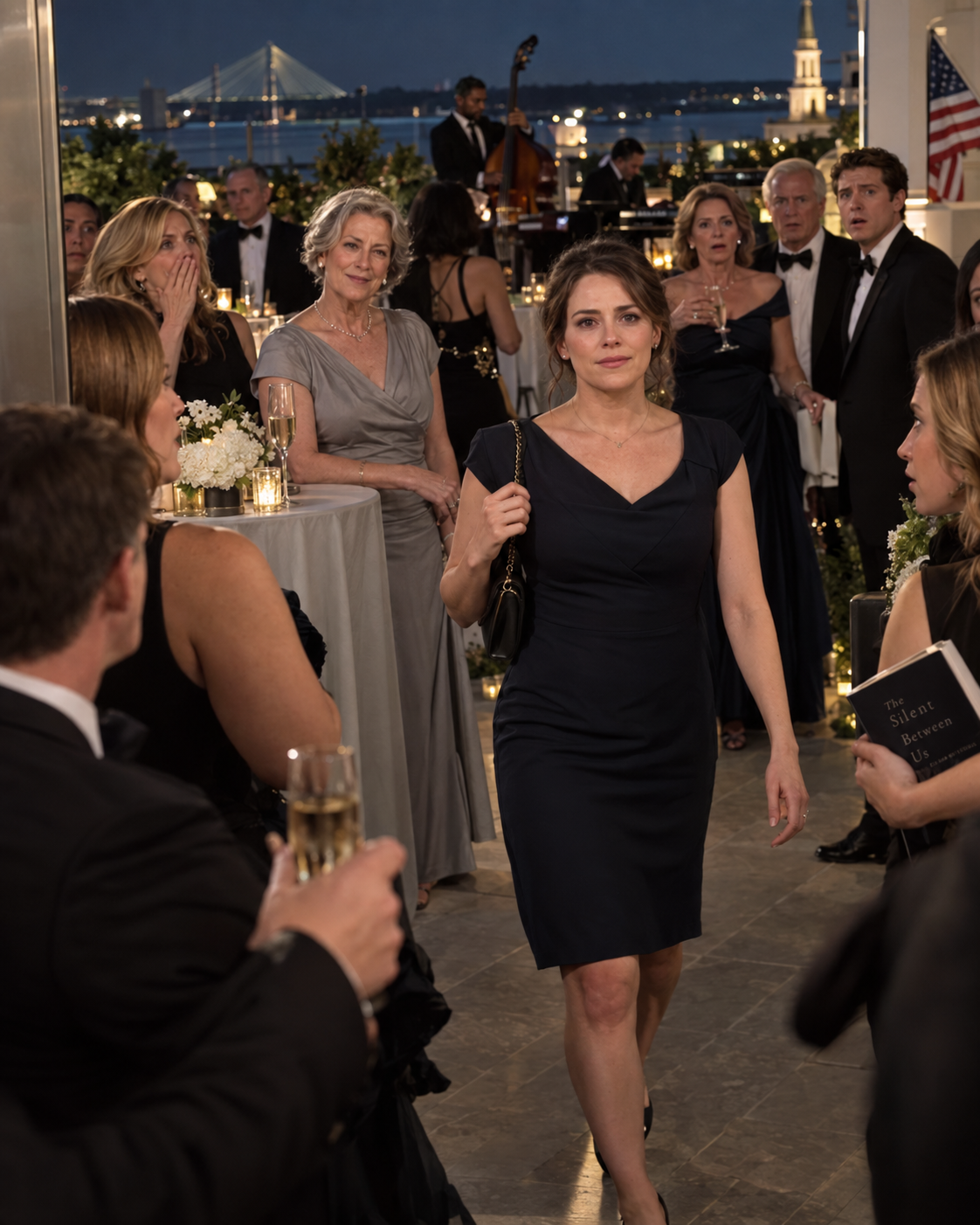
At 8:50, the elevator opened onto the rooftop.
Warm air rushed toward me.
Music had stopped.
People were gathered in small clusters.
Then a woman near the bar saw me.
Her hand flew to her mouth.
“That’s her.”
“That’s Vesper.”
The words moved through the crowd.
People stepped aside.
I had not asked them to.
I walked forward anyway.
I was five-foot-four.
I wore flats.
I had chosen a plain navy dress.
I did not look like someone arriving to collect a throne.
I looked like a woman arriving to collect her own name.
My mother saw me.
The champagne in her hand tilted.
A thin line of it ran down her wrist.
She didn’t notice.
My father looked ten years older than he had that morning.
Spencer stood completely still.
His sponsor was already putting on his coat.
Adele Hartwell smiled.
This was the first genuine smile anyone would later tell me she had shown all night.
She gave me a small nod.
I walked to the center of the rooftop.
Then I stopped a few feet from my parents.
“Sorry I’m late,” I said.
“I wasn’t on the list.”
My mother’s voice cracked.
“You did this.”
“You planned this to humiliate us.”
I shook my head.
“I didn’t plan anything.”
“The prize committee picked a night.”
“The studio filed a contract.”
“I answered the phone when my own name finally rang.”
“You always wanted attention,” she snapped.
“You always wanted to be dramatic.”
That sentence hung in the silence.
Then I said, “You called me dramatic?”
My mother looked away.
“You called me many things.”
“Do you remember what you told me when I was twenty-four?”
She said nothing.
I continued.
“I had just sold my first story.”
“You looked at me and said, ‘You’re a woman with a hobby, Kora, not a writer.’”
No one moved.
“I put that line in the book.”
My mother’s lips parted.
“Reviewers thought I invented it.”
“They said no mother would really speak that way to her own child.”
I looked at my father.
“And you told me, ‘When you’ve actually published something, we’ll talk.’”
He stiffened.
“I’ve published three.”
“One is taught two miles from your front door.”
I opened one hand toward the room.
“Here I am.”
“Let’s talk.”
My father had no answer.
My mother began to cry.
I knew those tears.
They were the kind she used when she needed a room to turn toward her.
But no one moved.
The room had already read the book.
The whispers had finally met witnesses.
Then Adele Hartwell stepped forward.
“Forgive me,” she said.
The entire rooftop went still.
“I came here tonight hoping to meet a writer.”
“I did not expect to meet the family who spent her childhood trying to erase her.”
She turned toward me.
“Miss Uli, the Hartwell Prize is the highest honor my foundation gives.”
“As of tonight, it is yours.”
Applause started near the bar.
It was hesitant for half a second.
Then it became real.
I looked at my mother.
She had spent forty years learning how to command a room.
For once, nobody was looking at her.
Adele turned back toward my parents.
“Mrs. Uli, I understand you have been interested in a seat on our board.”
My mother straightened.
For one second, hope returned to her face.
“You’ve been generous to the foundation for many years.”
“I came here tonight intending to give your request serious consideration.”
She paused.
“But I am extending that invitation to the writer whose work this foundation exists to protect.”
My mother’s face changed.
It was not rage.
It was the expression of someone watching a door close that she had spent her whole life trying to unlock.
Adele looked at me.
“If you will accept.”
I nodded.
“I will.”
No triumph.
No smile.
Just a quiet answer.
Spencer’s sponsor approached him.
I could not hear what he said.
But I watched the sponsor shake his hand for less than a second and then walk toward the elevator.
Spencer stood alone beneath the lights.
The man who had spent years pretending he had a future in publishing had just watched his sister become the person everyone in the room had actually come to see.
Then Whitney crossed the rooftop.
Her mascara was ruined.
For once, she was not managing anyone’s feelings.
She was simply crying.
“Kora,” she said.
“I knew.”
“The kitchen.”
“The clock.”
“I knew and I looked away.”
She swallowed.
“I was a coward.”
I looked at my little sister.
I believed her.
“I believe you’re sorry.”
Her eyes filled again.
“But that doesn’t mean everything is fixed.”
She nodded.
It was not forgiveness.
It was not reconciliation.
It was simply the first honest thing we had ever placed between us.
Then I turned toward my parents.
“I’m not here to ruin your anniversary.”
“Forty years is forty years.”
“But the book everyone has spent tonight praising?”
“I wrote it.”
“The prize they announced?”
“It’s mine.”
“And now I’m going home to my husband and my daughter.”
“She will never be made to feel like somebody’s hobby.”
A woman standing nearby held a copy of The Quiet Daughter.
She hesitated.
“Would you sign it?”
I took the book.
Then I pulled out the steel pen.
The fifty-dollar pen my mother once called a toy.
For the first time in my life, I signed my full name in public.
Kora Uli.
Not CJ Vesper.
Not the quiet daughter.
Not the woman with a hobby.
Just me.
The woman held the book to her chest.
I smiled.
“Turns out the hobby paid for itself.”
Then I walked toward the elevator.
Part 3
Nathan was waiting in the car when I came downstairs.
The harbor lights stretched behind him like a trail of stars.
I got in.
I did not look back.
For years, I had imagined what victory would feel like.
I thought it might feel loud.
I thought there would be some perfect sentence that would finally make my mother understand what she had done.
There wasn’t.
There was only relief.
The fallout came quietly.
Within a week, Charleston society had stopped orbiting my parents the way it once had.
The board seat went to me.
I accepted it.
The film moved forward.
The Quiet Daughter remained on shelves, only now people knew the woman behind the name.
Spencer’s brand folded by summer.
The sponsor who had come to rescue him never returned.
He eventually went into real estate.
My mother told everyone the party had been a misunderstanding.
She told people she had always supported my writing.
Some believed her.
Some pretended to.
Those rooms had been built for that kind of pretending.
My father never called.
I knew he probably never would.
Admitting he had been wrong would have cost him the identity he had spent his entire life protecting.
A month later, Whitney asked to meet me for coffee.
We sat at a small table with no parents, no party, and no audience.
She apologized again.
This time, she did not explain herself.
She did not blame our mother.
She did not ask me to make her feel better.
She simply said, “I was wrong.”
I believed her.
“The door isn’t locked,” I told her.
“But it isn’t open either.”
She nodded.
“That’s fair.”
It was the first fair thing anyone in my family had ever offered me.
So I accepted it carefully.
Like something fragile.
I did not suddenly become close to Whitney.
I did not forget what had happened.
I did not pretend a prize could repair fifteen years of neglect.
Some wounds need more than one night under bright lights.
And some doors should only open when both people know how to enter without bringing the old furniture inside.
A few weeks later, I opened the old family group chat.
The same one where my mother had once told me not to come.
The same place where I had spent two years sitting silently while everyone else planned birthdays, holidays, dinners, and my own absence.
I looked at the screen for a long time.
Then I tapped the words at the bottom.
Leave Group.
There was no announcement.
No final speech.
No dramatic exit.
My name simply disappeared.
And strangely, that tiny action felt bigger than standing on the rooftop.
Because this time, I was not being erased.
I was choosing where I no longer belonged.
I had spent most of my life waiting for my family to recognize me.
I thought I needed them to say, “We were wrong.”
I thought their apology would somehow rewrite the old years.
But the truth was harder and better than that.
I did not need them to rewrite anything.
The years had already happened.
The words had already been spoken.
The photographs had already been cropped.
The silence had already done its damage.
What I could change was what happened next.
I started taking Laya to bookstores with me.
I let her watch me sign books.
I told her stories about the steel pen.
I told her that sometimes the people closest to you can misunderstand who you are.
“But that doesn’t make them right,” I said.
She was six, so she thought about that for approximately three seconds.
Then she asked if the pen still worked.
I laughed.
“Yes.”
“Good,” she said.
“You need it.”
I keep that moment with me.
Because children do not need perfect parents.
They need parents who teach them that their worth does not depend on applause.
They need to know that love is not a prize handed out to the child who performs correctly.
And I needed to know that too.
For years, I had been trying to become worthy in a room that had already decided not to see me.
The strangest part is that I did not need to become someone else.
I only needed to stop shrinking.
My mother once called my work a hobby.
She was wrong.
But that is not the most important thing she was wrong about.
She was wrong to believe that being quiet meant being powerless.
She was wrong to believe that silence meant emptiness.
She was wrong to believe that if she refused to name what I was, I would eventually stop becoming it.
She was wrong.
And I was wrong too.
I thought I needed permission.
I thought recognition would heal me.
I thought success would finally make my family understand my value.
It didn’t.
The bestseller list did not do it.
Two million readers did not do it.
The film contract did not do it.
The prize did not do it.
What changed me was much smaller.
I signed my own name.
I stopped asking the door to recognize me before I walked through it.
I stopped auditioning for love.
And I stopped confusing someone else’s inability to see me with proof that I was invisible.
Sometimes the people who reduce you to a hobby are telling you far more about themselves than they are about you.
Sometimes the quietest person in the room is simply the one who has learned to build without witnesses.
And sometimes the most powerful thing you can do is refuse to spend another year arguing with someone who has already decided not to listen.
My family spent years deciding who I was.
They called me difficult.
They called me fragile.
They called me unstable.
They called me a woman with a hobby.
But they never once called me a writer.
So I became one anyway.
Not for them.
For the girl who used to sit alone in the kitchen beneath a yellow clock and wonder why everyone else seemed to deserve a place at the table.
For the young woman who framed a fifty-dollar check because she needed proof that her words had touched something outside her own house.
For my daughter, who will never grow up believing she has to earn a seat beside the people who claim to love her.
And finally, for myself.
The steel pen still sits on my desk.
It is scratched now.
The silver has worn thin around the cap.
It still leaves a little uneven line when I press too hard.
I like that.
It reminds me that the things that changed my life were never perfect.
The pen was cheap.
The first check was fifty dollars.
The first book was anonymous.
The family I wrote about never recognized themselves.
But the truth remained true anyway.
That is what I learned.
You do not always get justice in the form you imagined.
Sometimes you do not get an apology.
Sometimes the people who hurt you never become wise enough to understand what they lost.
Sometimes healing looks less like reconciliation and more like walking away without hatred.
And sometimes the greatest revenge is not making someone regret underestimating you.
It is building a life so honest that their opinion no longer has a place inside it.
I spent thirty-five years waiting for my family to read me.
Then I realized I had been writing the answer all along.
I just needed to put my real name on the page.
And this time, I did not ask anyone for permission to be seen.
I signed.
Then I went home.
And for the first time, home felt like mine.