My father gave my older brother the cattle barn I had spent years building and paying for.
Walter looked from the certified deed to my father, then back at me.
“What exactly am I supposed to be looking at?”
I slid my phone across the table and pressed play.
Dad’s voice filled the dining room.
“He’ll sign eventually. He always does what we need.”
Then Bryce laughed.
“And if he doesn’t?”
“He won’t have much choice once Walter pays us. By then, the money will be gone, and he’ll have to fight us to get it back.”
The recording continued for another thirty seconds. It was enough.
Nobody touched their food.
Walter slowly removed his reading glasses. His wife, Linda, stared at my father as if she were seeing him for the first time.
Dad’s face had turned an ugly shade of red.
“Turn that thing off!” he snapped.
I stopped the recording.
“Why?” I asked calmly. “You sounded pretty confident when you were making those plans.”
Dad pushed his chair back.
“You had no business recording private conversations on this property.”
“Actually, Dad, I own the property. Remember?”
That was when Nora placed a second document beside the deed.
“Gerald, perhaps you should read this before you say anything else.”
My father looked at her.
“What is that?”
“An official title search, completed last week. It confirms that the five acres, including the cattle barn, remain legally registered to your son.”
Dad snatched the paper.
He scanned the first page, then the second.
His hands began to shake.
But what happened next was something none of us had anticipated.
Walter stood up, buttoned his jacket, and looked directly at my father.
“Gerald, I think you and I need to have a serious conversation.”
Dad forced a smile.
“Walter, don’t let this get out of hand. We can explain everything.”
“Explain what? That you offered to sell me property you don’t own?”
“It’s family business.”
“No,” Walter replied. “The moment you put my money on the table, it became my business.”
He turned to me.
“I’m sorry. I had no idea.”
I nodded.
“Neither did I, until recently.”
Walter took the unsigned purchase agreement from his folder, tore it in half, and placed the pieces on the table.
Then he did something that surprised everyone.
He pulled out a checkbook.
“I want to make one thing clear. I was interested in buying that barn because I need additional space for my cattle. If you’re ever willing to sell, I’d rather negotiate with the actual owner.”
Dad slammed his palm against the table.
“That’s enough!”
Mom jumped.
“Gerald, sit down.”
It was the first time that evening she’d raised her voice.
My father stared at her, apparently stunned that she had spoken against him.
But the real confrontation hadn’t even started.
I reached into my jacket and pulled out a thick envelope.
Inside were copies of the original construction loan, receipts for building materials, contractor invoices, bank statements, and the original property deed.
I placed everything in front of Walter.
“I don’t want anyone thinking this is some misunderstanding about a family gift. I paid for that barn. I built it. And the land was transferred into my name years ago.”
Bryce scoffed.
“You’re acting like we robbed you.”
I turned toward him.
“Didn’t you?”
He opened his mouth, but nothing came out.
For the first time in my life, my older brother had no clever response.
Dad stood up and pointed at me.
“You have no idea what you’ve done. That ranch has supported this family for three generations. Everything we’ve built belongs to the family.”
I looked at the man who had taught me to repair fences, drive tractors, and never walk away from hard work.
“Then why was I the only one doing the work?”
Silence.
I continued.
“Where were you when I poured the concrete? Where was Bryce when I installed the electrical panels? Who made the loan payments? Who spent two winters finishing that building while everyone else told me it was a waste of money?”
Dad’s jaw tightened.
“You did those things because you’re part of this family.”
“And apparently Bryce gets the reward because he’s part of it, too.”
Mom started crying.
Tessa, who had been sitting quietly beside me, reached for my hand.
I squeezed it.
I had spent years imagining a moment when my father would finally acknowledge what I’d contributed. I had imagined praise, gratitude, maybe even a simple handshake.
Instead, I was standing in my mother’s dining room explaining why I deserved to keep something I’d already paid for.
Walter closed his folder.
“I’m leaving. And Gerald, don’t contact me about this property again unless your attorney has spoken with the actual owner.”
He and Linda walked out.
Nora followed them after giving me a reassuring nod.
That left my parents, Bryce, Tessa, and me.
Dad stared at the torn agreement.
“You’ve embarrassed me in front of everyone.”
I almost laughed.
“You were willing to sell my property behind my back. But you’re upset because people found out?”
Bryce suddenly stood.
“You think you’re better than me because you have a barn?”
“No. I think I deserve better than having my property taken from me.”
He stepped toward me.
“You’ve always been Dad’s favorite, anyway.”
I looked at him in disbelief.
“Your favorite? Bryce, you were given the house renovation, the newer truck, the best equipment, and now Dad tried to give you my barn. What exactly have you been denied?”
His expression changed.
For a moment, I thought he might finally tell the truth.
Instead, he muttered something under his breath and walked out.
Tessa and I left shortly afterward.
In the truck, she rested her hand on my shoulder.
“Are you okay?”
I watched the farmhouse disappear in the rearview mirror.
“I don’t know.”
And that was the honest answer.
I had won the argument. I had protected my property. But something inside me felt like it had been broken beyond repair.
The next morning, my phone started ringing.
Dad called six times.
Mom called four.
Bryce sent a message that simply read, YOU’RE GOING TO REGRET THIS.
I didn’t respond.
Instead, I called an attorney named Melissa Grant, whose office specialized in agricultural property disputes.
She agreed to review my documents.
Three days later, I sat across from her desk while she studied the deed.
“This is straightforward,” she said. “The property was transferred to you through a properly executed and recorded deed. There is no subsequent deed transferring it back.”
“So Dad can’t sell it?”
“Not legally. And the fact that he paid no part of the construction costs makes his position even weaker. The building is part of the real property, so ownership generally follows the land.”
She flipped through the financial records.
“However, I want to understand something. Why did your father believe he could sell this property?”
I hesitated.
“I think he assumed I’d never challenge him.”
Melissa nodded slowly.
“That’s not uncommon in family disputes. People confuse informal family arrangements with legal ownership. Sometimes they also confuse authority with permission.”
She recommended placing a formal notice with the county and sending my father a letter demanding that he stop representing himself as the property’s owner.
I authorized both.
Then she made another discovery.
“There’s something else,” she said.
She turned her computer screen toward me.
“Your brother has several outstanding agricultural equipment loans. One of the lenders filed a lawsuit against him last month.”
I leaned forward.
“How much?”
She showed me the amount.
It was nearly $180,000.
I felt my stomach tighten.
Melissa continued.
“Your parents co-signed at least two of these loans. If Bryce defaults, the lender may pursue them for payment. I suspect that’s why your father was so desperate to sell the barn.”
Suddenly, the pieces began falling into place.
Bryce had been buying equipment he couldn’t afford. New tractors, upgraded machinery, a custom trailer, and an expensive combine attachment.
Meanwhile, Dad had been telling everyone that Bryce was building a future for the ranch.
The future, apparently, was being financed with money none of them had.
I asked Melissa to investigate whether anyone had attempted to use my property as collateral.
She said she’d check.
That afternoon, I drove to the barn.
I walked through the main entrance and stood beneath the steel beams.
The concrete floor still showed faint marks where I’d dragged materials across it. The electrical panels were exactly where I’d installed them. The doors opened smoothly despite the winter wind.
I remembered every long day.
I remembered working until my hands were numb.
And I remembered my father telling me that Bryce had a better work ethic.
For the first time, I wondered whether he’d ever actually believed that.
Two days later, Melissa called.
“There’s a problem,” she said.
My stomach dropped.
“What kind of problem?”
“Someone submitted a financing application listing your five acres as collateral. The application wasn’t approved, but the property description and your name were included.”
“Who submitted it?”
“Your brother.”
I gripped the steering wheel.
“Did he forge my signature?”
“That’s what we’re investigating. The lender has provided us with a copy of the application. The signature appears to be electronically inserted.”
I closed my eyes.
It wasn’t just a family disagreement anymore.
Bryce had tried to use my property to secure his debts.
And Dad had known.
Melissa advised me to preserve every document, avoid confronting them directly, and let her communicate with the lender.
I agreed.
Then I did something I’d never imagined doing.
I changed the locks on the barn, updated the access codes, and installed a separate security system connected to my phone.
I also notified the sheriff’s office that nobody had permission to enter the property without my authorization.
For the next week, nothing happened.
Then, on a Tuesday afternoon, I received an alert from one of the cameras.
A pickup truck had pulled up outside the barn.
It was Bryce.
He stepped out carrying a toolbox and walked toward the side entrance.
He tried the keypad.
It didn’t work.
He tried again.
Then he looked directly at the camera.
I watched him take out his phone and call someone.
A minute later, Dad’s truck appeared.
The two of them stood beside the entrance, arguing.
I couldn’t hear everything, but the camera captured enough.
Dad pointed at the keypad.
Bryce kicked the bottom of the door.
Then Dad looked toward the camera and shouted something I couldn’t make out.
They eventually left.
I saved the footage and sent it to Melissa.
That evening, Dad appeared at my house.
He didn’t knock.
He walked straight up to the porch and started pounding on the door.
Tessa looked through the window.
“It’s your father.”
“I know.”
I opened the door but stayed behind the threshold.
Dad looked exhausted. His shirt was wrinkled, and his eyes were bloodshot.
“We need to talk.”
“Talk.”
“Your brother is in trouble.”
I waited.
“He’s behind on his loans. The equipment company is threatening to repossess his machinery. The bank is asking questions about the ranch.”
“That’s unfortunate.”
Dad stared at me.
“Don’t talk like that. He’s your brother.”
“He’s also the man who tried to use my property as collateral.”
“He made a mistake.”
“Did you know about the loan application?”
Dad looked away.
That was answer enough.
I felt something cold settle in my chest.
“How long have you known?”
“Your mother and I were trying to help him.”
“By stealing my land?”
“We weren’t stealing anything. We were trying to keep the ranch together.”
I stepped outside and closed the door behind me.
“Dad, listen carefully. You gave Bryce something that wasn’t yours. Then you tried to get me to sign it over. Then you arranged a sale without telling me. Now I find out he tried to borrow money against it.”
Dad rubbed his forehead.
“You don’t understand what it means to run a ranch. Sometimes you have to make difficult decisions.”
“I understand difficult decisions. I’ve been making them since I was eighteen.”
“You’ve always had it easier.”
I stared at him.
That sentence hurt more than I expected.
“Easier?”
“You had a steady income. You had Tessa. You had the barn project. Bryce has always struggled.”
I took a breath.
“Dad, I worked two jobs to afford that construction loan. I skipped vacations. I drove a truck with a broken heater for three winters. Tessa and I delayed having children because we couldn’t afford to take on another expense while I was building that barn.”
Dad looked at me.
For a second, I thought he might understand.
Instead, he said, “Well, that’s your choice.”
I shook my head.
“No, Dad. That was the price of building something you decided to give away.”
He stood silently for a moment.
Then he said the words that finally ended whatever hope I still had.
“If you don’t help your brother, don’t expect to be welcome at this ranch again.”
I nodded.
“Then I guess I won’t be welcome.”
He walked away without another word.
The following week, things got worse for Bryce.
The equipment lender filed for repossession. The county sent a notice regarding unpaid property taxes on the original ranch acreage. And Melissa received confirmation that Bryce’s financing application had been rejected because he couldn’t establish ownership of the collateral.
My parents were now facing serious financial pressure.
Then came the letter.
It was handwritten by Mom.
She asked me to come to the farmhouse alone.
Tessa read it twice before handing it back.
“You don’t have to go.”
“I know.”
“But if you do, don’t let them make you feel guilty for protecting yourself.”
I kissed her forehead.
“I won’t.”
When I arrived, Mom was waiting in the kitchen.
Dad was sitting at the table, staring into a cup of coffee.
Bryce wasn’t there.
Mom looked older than I remembered.
“Thank you for coming,” she said.
I sat down.
For a while, nobody spoke.
Then she placed a photograph on the table.
It showed Dad standing beside the old barn with his father, my grandfather.
“Your grandfather built this ranch with almost nothing,” she said. “When your father inherited it, he promised he’d never let it fall apart.”
I looked at the photograph.
“I know.”
“Your father thinks giving Bryce the barn was the only way to keep him from leaving.”
I frowned.
“What does that mean?”
Mom hesitated.
“Bryce wanted to move away. He’d been talking about selling his equipment and taking a job in another state. Your father was terrified of losing him.”
I leaned back.
“So Dad gave him something he didn’t own to keep him here?”
Mom lowered her eyes.
“I think your father believed that if Bryce had a bigger responsibility, he’d finally become the man Gerald always wanted him to be.”
I let out a slow breath.
“And what about me?”
She looked up.
“You’ve always been dependable. Your father thought you’d understand.”
There it was.
The explanation I’d spent years waiting for.
Because I was responsible, I was expected to sacrifice.
Because I was capable, I was expected to accept less.
Because I rarely complained, everyone assumed I didn’t hurt.
I looked at Mom.
“Do you know what the worst part is?”
She shook her head.
“I would have helped Bryce if he’d asked. I would have sat down with him, looked at his finances, helped him sell equipment, even helped him find work. But nobody asked me. They just decided my work belonged to someone else.”
Mom began crying.
“I know.”
I looked toward Dad.
He hadn’t moved.
“Do you know that Bryce tried to use my land as collateral?”
Dad nodded.
“He said he could repay the loan.”
“Could he?”
No answer.
“Did you know he was going to sell the barn?”
Dad finally looked up.
“I thought we’d be able to straighten it out.”
“How?”
He rubbed his face.
“I don’t know.”
For the first time, my father looked genuinely small.
But an apology didn’t come.
Instead, he said, “The family needs money. If you sold the barn to Walter, we could pay off Bryce’s debts and keep the ranch.”
I stared at him.
“You’re still asking me to fix this?”
“I’m asking you to help.”
I stood.
“Dad, I can’t keep rescuing people who believe my sacrifices are theirs to spend.”
Mom reached for my hand.
“Please don’t let this destroy our family.”
I gently pulled away.
“I didn’t destroy it, Mom. I just stopped pretending nothing was wrong.”
I left.
Three days later, Melissa called with another update.
The lender had agreed to provide the original financing application for review. It contained an electronic signature that Bryce had copied from an old document.
The county had also confirmed that no transfer of my property had ever been recorded.
Melissa sent a formal demand letter to Bryce and my father.
It instructed them to stop using my name, property description, or ownership information in any financial transaction.
The matter could have become criminal.
I was given a choice about whether to pursue a formal complaint.
I didn’t make that decision immediately.
I wanted accountability, but I didn’t want revenge.
There was a difference, and I needed to be certain I understood it.
A week later, Bryce called.
I almost ignored it.
Then I answered.
“What?”
His voice sounded different.
“I need to talk.”
“About what?”
“The barn. The loan. Everything.”
I said nothing.
He took a breath.
“I messed up.”
That was the first honest sentence I’d heard from him in years.
He continued.
“I bought equipment because I wanted Dad to see me as someone who could run the ranch. Every time I got something new, he told everyone how successful I was. I thought if I kept going, eventually I’d prove I deserved the responsibility.”
“And when the payments became too much?”
“I borrowed more.”
“And when that didn’t work?”
He was silent.
“You tried to use my property.”
“I know.”
I waited for him to defend himself.
He didn’t.
“I didn’t think you’d find out,” he finally said.
I laughed bitterly.
“That’s not an apology.”
“I know.”
His voice cracked.
“I don’t expect you to forgive me. I just wanted you to know I’m sorry.”
I looked out the kitchen window.
Tessa was in the backyard, watering the small garden we’d planted that spring.
“Bryce, do you remember when we were kids and Grandpa’s old tractor broke down?”
“Yeah.”
“We spent an entire Saturday trying to fix it. You were holding the flashlight, and I was underneath the engine. When we finally got it running, Grandpa gave us both a dollar.”
Bryce chuckled faintly.
“I remember.”
“That’s what I miss. When we were brothers instead of competitors.”
He didn’t answer.
“I don’t hate you,” I said. “But I’m not giving you my property, and I’m not paying your debts.”
“I understand.”
“Do you?”
“Yes.”
For once, I believed him.
I ended the call without making any promises.
Over the next month, Bryce sold several pieces of equipment to cover his outstanding balances. My parents sold an older tractor and reduced the size of their cattle operation.
It wasn’t pretty.
They lost money, pride, and some of the comforts they’d grown accustomed to.
But they survived.
Walter eventually contacted Melissa again.
He made a formal offer to purchase the barn and the five acres.
This time, everything was handled correctly.
I didn’t accept immediately.
Tessa and I spent several evenings discussing what we wanted our future to look like.
We could keep the barn and expand our own cattle operation. We could lease it. Or we could sell it and invest the money elsewhere.
For the first time, the decision was entirely ours.
In the end, I decided not to sell.
Instead, I offered Walter a long-term lease with clear terms, proper insurance, and an agreement that gave him the storage and cattle space he needed.
He accepted.
The income would cover maintenance and property taxes while allowing me to retain ownership.
Melissa reviewed the contract before we signed anything.
When Dad heard about the arrangement, he called.
“You’re leasing it to Walter?”
“Yes.”
“Why wouldn’t you sell it?”
“Because I don’t have to.”
He sighed.
“You always have to do things your own way.”
I looked at the barn through the window.
“That’s what happens when something belongs to you.”
He hung up.
Months passed.
The ranch slowly adjusted to its new reality.
Dad stopped calling me to fix machinery. Bryce took a job with a local agricultural contractor and began rebuilding his finances.
Mom occasionally visited Tessa and me, usually bringing homemade bread or vegetables from the garden.
Dad stayed away.
Until one cold Saturday in early December.
I was checking the barn’s roof when I saw his truck pull into the driveway.
He got out carrying a small cardboard box.
“Got a minute?” he asked.
I nodded.
He looked around the barn.
“Still standing.”
“It’s built well.”
He almost smiled.
Then he handed me the box.
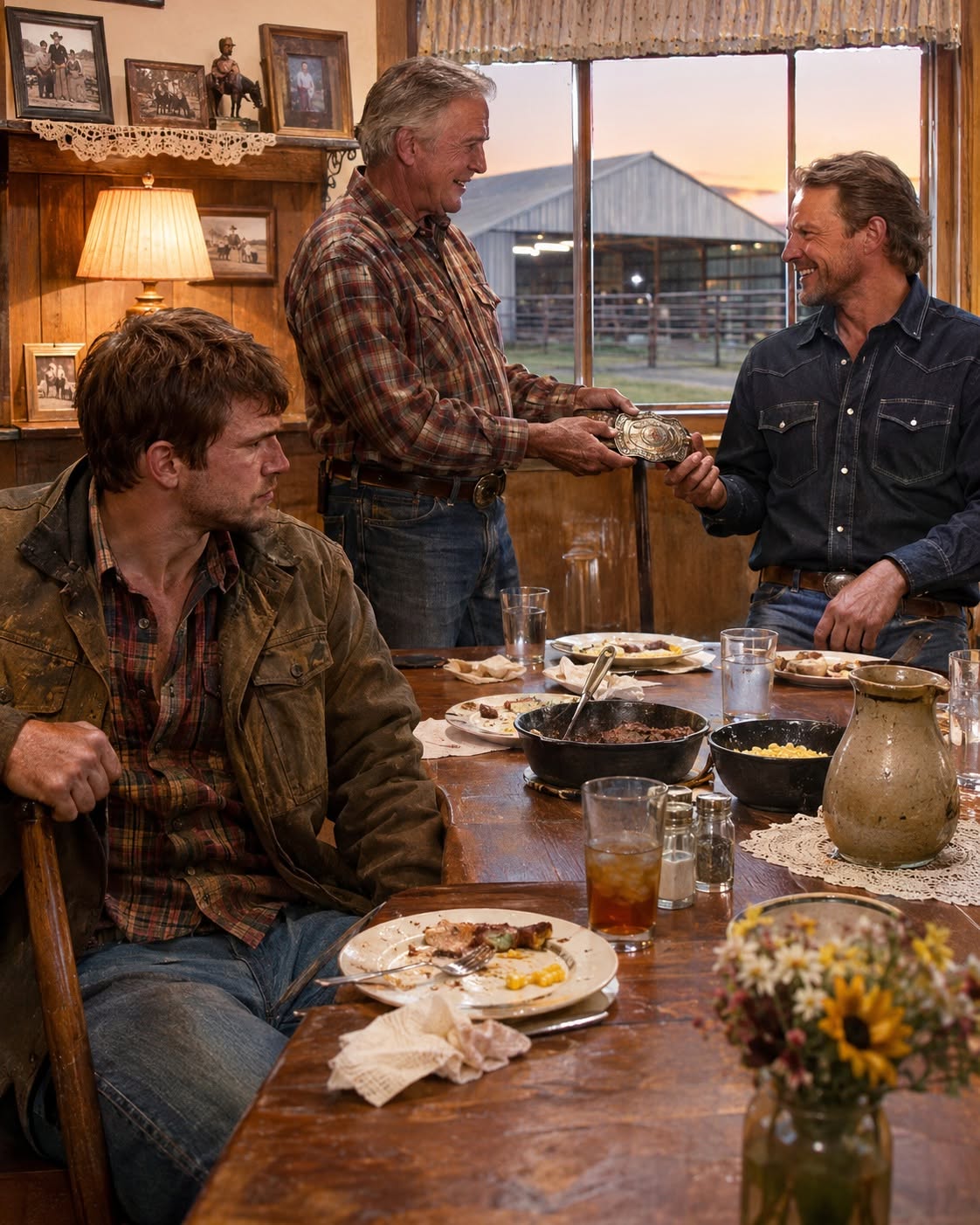
Inside was the shiny belt buckle he’d given Bryce at that dinner.
I stared at it.
“What am I supposed to do with this?”
Dad shoved his hands into his jacket pockets.
“I found it in Bryce’s room. He didn’t want it anymore.”
I turned the buckle over in my hand.
The words were engraved across the front:
HARDEST-WORKING MAN ON THE RANCH.
I felt an old bitterness rise.
Dad noticed.
“I know,” he said quietly. “I shouldn’t have given it to him.”
I looked at him.
“That’s all?”
He nodded.
“I was wrong.”
It wasn’t much.
But it was more than I’d heard from him in years.
He looked toward the barn.
“I thought you didn’t need anything from me. You always seemed to have everything under control.”
I let out a breath.
“Dad, I didn’t need a prize. I needed you to see me.”
His eyes dropped.
“I know that now.”
We stood together in silence.
Then he said something I hadn’t expected.
“Your grandfather used to tell me that a ranch doesn’t belong to the person who talks the loudest about it. It belongs to the people who take care of it.”
I nodded.
“Sounds like Grandpa.”
Dad swallowed.
“I forgot that somewhere along the way.”
I didn’t rush to forgive him.
I didn’t invite him inside.
I didn’t pretend one conversation could erase years of favoritism.
But I accepted the belt buckle and placed it on the workbench.
“I’m glad you came,” I said.
He nodded and walked back to his truck.
That evening, Tessa found me looking at the buckle.
“Are you going to keep it?”
I turned it over in my hands.
“I think so.”
“Why?”
“Because I don’t want to forget what happened.”
She sat beside me.
“Does it still hurt?”
I thought about it.
“Sometimes. But not the way it used to.”
The following spring, Bryce showed up at the barn.
He was wearing work boots covered in mud and driving an older pickup.
He had a small toolbox in the back.
“I heard Walter’s having trouble with one of the sliding doors,” he said. “Thought I’d take a look if you want.”
I studied him.
“Walter’s paying someone to repair it.”
Bryce nodded.
“Fair enough.”
He started to leave.
“Wait.”
He turned.
“You can help him if you want. But talk to him first. He’s the one leasing the barn.”
Bryce smiled faintly.
“Right. I understand.”
For the next two hours, I watched him work alongside Walter.
No grand speeches. No applause. No shiny buckle.
Just a man doing a job.
When he finished, Walter paid him for his time.
Bryce accepted the money without boasting.
As he walked toward his truck, he stopped beside me.
“Thanks.”
I nodded.
He hesitated.
“I know things aren’t the same.”
“No,” I said. “They’re not.”
“But maybe they could be different.”
I looked at him for a moment.
“Maybe. But different takes time.”
He nodded and drove away.
That summer, Tessa and I finally took the vacation we’d postponed for years.
We spent ten days near the mountains, far away from the ranch, the arguments, and the endless pressure to prove ourselves.
On the last evening, we sat outside our cabin watching the sunset.
Tessa rested her head on my shoulder.
“Do you ever wish you’d just signed the property over and avoided all this?”
I considered the question.
“No.”
“Not even a little?”
“Sometimes I wish my family had treated me differently. But I don’t regret standing up for myself.”
She smiled.
“Good.”
When we returned home, I drove past the ranch one last time before heading to the barn.
The old farmhouse looked smaller than I remembered.
For years, I’d believed that keeping my family together meant making myself smaller. I’d accepted unfair treatment because I thought being a good son meant never saying no.
But I’d learned something important.
Love doesn’t require you to surrender your dignity.
Family doesn’t give anyone the right to take what you’ve worked for.
And being dependable doesn’t mean you must become everyone’s safety net.
My father had once handed my brother a belt buckle and called him the hardest-working man on the ranch.
I used to think that was the moment I lost something.
Now I understood that the real turning point came later, when I stopped waiting for someone else to recognize my worth.
The barn was still standing.
The land was still mine.
My marriage was stronger than ever.
And, slowly, my relationship with my brother was beginning to heal.
As for Dad, we were learning how to speak to each other without pretending the past hadn’t happened.
It wasn’t the perfect ending I’d imagined when I was younger.
There was no grand family reunion. No dramatic apology in front of everyone. No sudden transformation that made years of hurt disappear.
There was simply a new understanding, built one honest conversation at a time.
I eventually hung the old belt buckle on a nail above the workbench.
Not as a trophy.
Not as a reminder of who had been favored.
But as a reminder of the difference between being praised for looking successful and actually doing the work.
One afternoon, Walter stopped by and noticed it.
He read the engraving and chuckled.
“Who won that?”
I smiled.
“That’s a long story.”
He looked around the barn.
“Well, whoever built this place certainly earned it.”
I shook my head.
“I don’t need the buckle.”
Then I picked up my tools and went back to work.
Because the greatest thing I’d ever built wasn’t the barn.
It was the life I had finally learned to protect.
And if there’s one lesson I hope my children will understand someday, it’s this:
You can love your family without letting them take advantage of you. You can forgive someone without giving them another opportunity to hurt you. And you can walk away from an unfair situation without being the person who destroyed the family.
Sometimes the strongest thing you can do is stop asking people to value what they’ve already decided to take for granted.
Your worth doesn’t become real when someone finally recognizes it.
It was always there.
You just have to stop giving it away to people who refuse to see it.