The woman who once promised to stand beside me laughed when she saw me walk into family court wearing muddy boots. Then she offered me money to disappear from her life forever.
Julian stood frozen behind the security barrier.
The jet’s engines were still winding down when Grant Whitaker walked toward me. He wasn’t alone. Two board members and several investors followed him across the tarmac.
Grant extended his hand.
“Good morning, Mr. Founder. We’ve been waiting for you.”
I shook his hand.
“Sorry to keep everyone waiting.”
“You’re worth waiting for,” he replied with a smile.
Behind us, Julian looked as if someone had just pulled the ground out from beneath him.
Camille stared at Grant, then at me.
“Founder?” she whispered.
Nobody answered immediately.
Grant turned toward the group.
“Everyone, I’d like to introduce the man responsible for Northstar Meridian Aerospace. Our founder and majority shareholder.”
He placed a hand on my shoulder.
“Mr. Thorne.”
For a moment, the only sound was the wind sweeping across the runway.
Camille took one step closer to the barrier.
“That’s impossible.”
I turned toward her.
“Is it?”
She looked at the old pickup parked beside the hangar. Its faded paint was covered in road salt. One headlight was slightly cloudy, and the passenger door still had a dent from an accident years earlier.
Then she looked at me.
“Why?” she asked.
Her voice cracked.
“Why would you live like this if you owned a company like that?”
I looked at the truck.
It had carried my daughter to school when I couldn’t afford a newer vehicle. It had taken me to the hospital on nights Maya was sick. It had driven me through snowstorms, long workdays, and years when I wasn’t sure whether my little engineering project would ever become anything.
“I never needed an expensive truck to prove I was successful,” I said.
Camille lowered her eyes.
“That doesn’t make sense.”
“It makes perfect sense to me.”
Grant glanced at his watch.
“We should get inside. The investors are ready.”
I nodded.
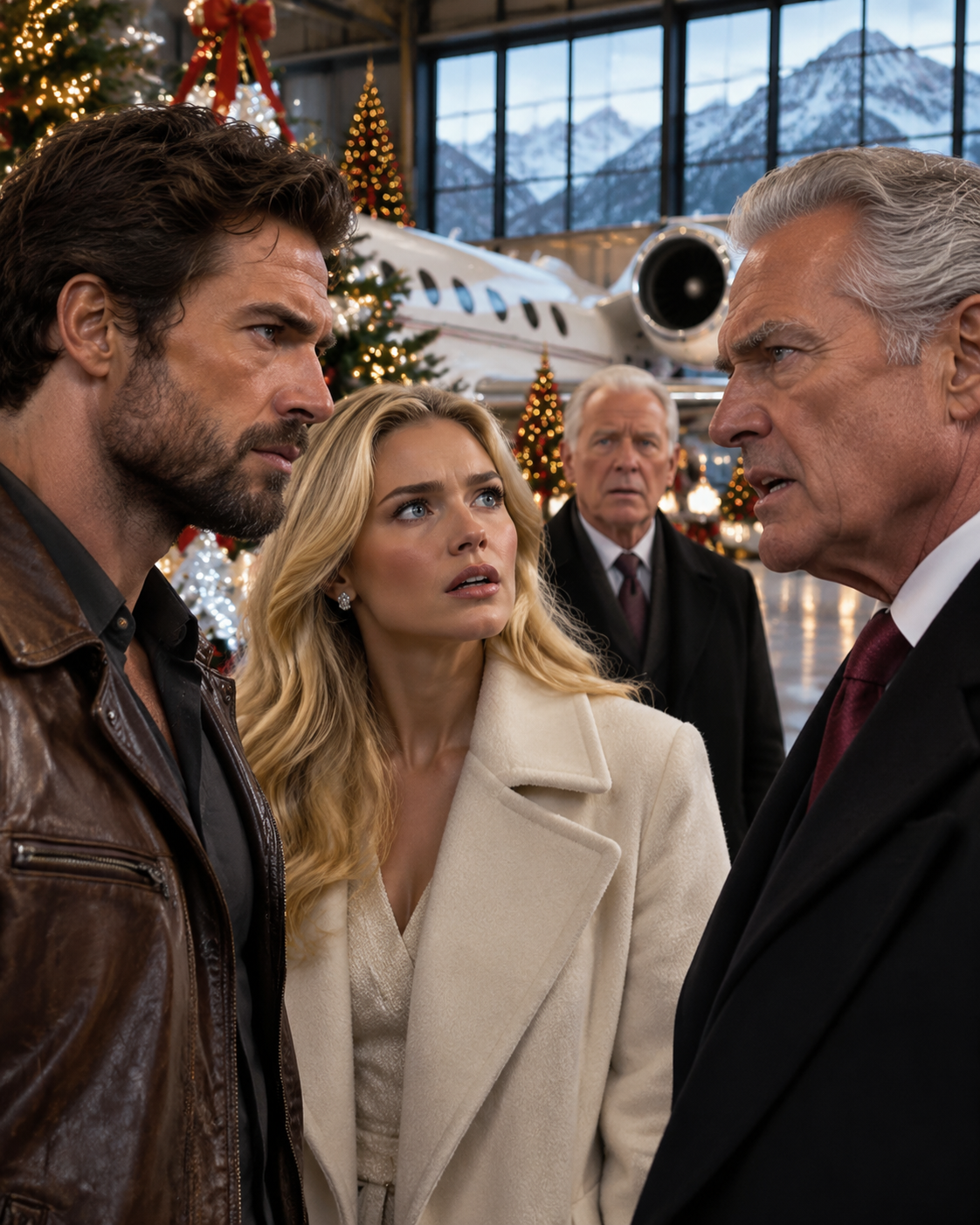
But before following him, I turned back toward the security gate.
“Let them come in.”
The guards looked at Grant.
He gave a small nod.
The gate opened.
Julian entered first, followed by Camille and Arthur.
For the first time that morning, Julian wasn’t leading the conversation.
He was following someone else’s instructions.
***
The conference room at Northstar’s private terminal overlooked the runway.
A long glass table occupied the center of the room. Beyond the windows, aircraft moved slowly between hangars, their wings shining beneath the winter sun.
I took the seat at the head of the table.
Grant sat beside me.
Camille and Julian remained standing until Grant invited them to sit.
Julian adjusted his expensive watch.
“I think there’s been a misunderstanding,” he began. “My firm has been negotiating with Northstar for several months. We have a substantial financial commitment on the table.”
Grant folded his hands.
“We know.”
“Then perhaps we should continue our discussion.”
“We won’t.”
Julian blinked.
“Excuse me?”
Grant looked toward me.
I answered.
“All acquisition discussions with your firm have been suspended.”
Julian laughed nervously.
“You can’t make that decision over a personal disagreement.”
“This isn’t personal.”
“Then what is it?”
I opened a folder.
“It’s about your company’s conduct.”
His expression changed.
Lydia entered the room carrying another set of documents. She had arrived directly from the courthouse after coordinating with Northstar’s legal department.
She placed the folder in front of Grant.
“These are the materials we discussed,” she said.
Julian leaned forward.
“What materials?”
“Evidence concerning the unauthorized transfer of confidential engineering documents, undisclosed financial arrangements, and possible misuse of proprietary information.”
Arthur immediately reached for the folder.
“These allegations are premature.”
Lydia didn’t move it.
“Then you shouldn’t have any problem allowing the appropriate investigators to examine them.”
Julian looked at Camille.
“Tell them this was a misunderstanding.”
Camille stared at the folder.
“I don’t know what you’re talking about.”
Lydia opened it.
Inside were copies of the old email, the photographs, payment records, and a timeline connecting the transactions to Julian’s investment firm.
“We can establish that the photographs originated from a device registered to Mrs. Thorne,” Lydia said. “We can also establish that the receiving account belonged to an employee of Mercer’s firm.”
Julian pushed his chair backward.
“That’s not proof of anything.”
“No,” Lydia replied. “That’s why we intend to preserve the evidence and allow the proper authorities to examine it.”
He turned toward me.
“You’ve been planning this.”
I shook my head.
“I’ve been building airplanes.”
“Don’t play innocent. You knew exactly what you were doing.”
“I knew what you were doing when you offered me money to walk away. I knew what you were doing when you threatened to destroy my career. And now I know what happened to the documents I trusted my wife to leave alone.”
Camille’s face had become pale.
“Please,” she whispered. “Can we talk privately?”
I looked at her.
“About what?”
“About us.”
I sat back.
“There hasn’t been an us for a long time.”
She looked down at her hands.
For several seconds, nobody spoke.
Then Grant closed the folder.
“Northstar will issue a formal statement regarding the suspended negotiations. Our legal department will handle all further communication.”
Julian stood.
“You’ll regret this.”
Grant didn’t even look up.
“That’s enough, Mr. Mercer.”
Julian grabbed his briefcase and walked toward the door.
Arthur followed.
Camille remained seated.
She was staring at the old photographs Lydia had placed on the table.
One showed my engineering desk.
Another showed the first flight-control prototype.
And the last showed a handwritten note beside a small photograph of Maya.
Camille touched the edge of the picture.
“I remember this,” she said.
I didn’t answer.
“I remember you working on this project.”
“Yes.”
“You told me it might never work.”
“It almost didn’t.”
She looked up.
“Why didn’t you tell me when it started succeeding?”
I considered the question.
“Because by then, you had stopped asking.”
***
The story of Northstar Meridian began in a rented hangar outside Denver.
It wasn’t impressive.
The roof leaked during heavy rain. The heating system worked only when it felt like it. The office furniture came from a liquidation sale, and our first conference table was an old workbench.
Caleb Vance and Noah Pike were the only people who understood how much the project meant to me.
We had spent years studying the same problem.
Aircraft systems relied on sophisticated sensors and control software, but unexpected changes in flight conditions could still create dangerous situations. We believed a more advanced predictive control system could help aircraft respond earlier and more intelligently.
It was a difficult idea.
The first prototype failed.
The second performed better but couldn’t handle certain combinations of turbulence and sensor errors.
The third almost destroyed our test equipment.
There were nights when Caleb wanted to quit.
Noah usually reminded us that failure was simply another piece of information.
I kept going.
Not because I imagined becoming wealthy.
I wanted to build something that mattered.
Something that could help pilots make better decisions and give passengers another layer of safety.
When we finally achieved a successful controlled demonstration, we didn’t celebrate with champagne.
We ordered pizza.
Caleb stood beside the prototype and laughed.
“Do you realize what we’ve just done?”
Noah nodded.
“Yeah. We’ve created another reason to lose sleep.”
I smiled.
It was enough.
The project eventually attracted interest from aviation researchers and early investors. Grant Whitaker was among the first people who understood its potential.
He didn’t ask how much money I wanted.
He asked what the technology could become.
That conversation changed everything.
Northstar Meridian Aerospace was formed soon afterward.
I retained majority ownership and brought Caleb and Noah into the company as founding partners.
We hired engineers, established testing facilities, and began working with aviation organizations.
The business grew.
But my life didn’t change as dramatically as people might have expected.
I still lived in the same ranch.
I still drove the same truck.
And I still made breakfast for Maya whenever she visited.
Because those things were more important to me than the number printed beside my name on a financial statement.
***
After Camille left the airfield, I didn’t see her again for several days.
The legal process continued.
Lydia filed the necessary documents with the court, and Northstar’s attorneys began an independent review of the suspected information breach.
The company also commissioned a security audit to determine whether any confidential engineering material had been improperly shared.
Julian’s investment firm was informed that the acquisition process would not resume while the allegations remained unresolved.
I didn’t celebrate.
I wasn’t interested in destroying anyone.
I wanted the truth established and the company protected.
More importantly, I wanted Maya to know that standing up for yourself didn’t require becoming cruel.
A few days later, I was sitting in my kitchen when my daughter called.
“Dad?”
“Hey, sweetheart.”
“Are you okay?”
I looked through the window at the snow covering the yard.
“I’m fine.”
“I saw something online about Northstar. Is that your company?”
I smiled.
“Apparently, people are starting to notice.”
She laughed.
“Apparently? Dad, everyone is talking about it.”
I leaned back.
“Well, it’s been a busy week.”
There was a pause.
Then she asked the question I had been expecting.
“Is it true that Camille didn’t know?”
I looked at the coffee mug in my hand.
“She knew I worked in aerospace. She knew I was developing something. But she never really knew what it meant to me.”
“That’s sad.”
“Sometimes people stop listening long before they actually leave.”
Maya was quiet.
Then she said, “I’m proud of you.”
Those four words meant more to me than every congratulatory message I had received that week.
“Thank you, sweetheart.”
“And Dad?”
“Yes?”
“Please don’t buy a ridiculous sports car.”
I laughed.
“Wasn’t planning to.”
“Good. Your truck is part of the family.”
I looked toward the driveway.
For the first time in days, I felt completely at peace.
***
The following Monday, Camille contacted Lydia.
She wanted a meeting.
I initially refused.
Then Lydia explained that Camille had agreed to provide additional information concerning the financial transactions and the transfer of my confidential documents.
I agreed to hear her out.
We met in a quiet conference room at Lydia’s office.
Camille arrived alone.
She wasn’t wearing the expensive coat from court. Her hair was tied back, and she carried a plain folder.
She looked tired.
“Thank you for coming,” she said.
I nodded.
“What’s this about?”
She opened the folder.
“These are copies of the original payment records. I also brought messages between Julian and me.”
Lydia took the documents.
“We’ll need to review these independently.”
“I understand.”
Camille looked at me.
“I want to explain something.”
I waited.
“When I started working for Julian, I thought I was finally becoming someone important. Everyone around me had money, connections, beautiful houses, expensive vacations. They talked about success as if it were something you could measure by looking at someone’s driveway.”
She swallowed.
“And I started looking at our life differently.”
“Our life?”
“Your work clothes. The ranch. The truck. The way you could spend an entire evening fixing something instead of going somewhere expensive.”
I looked at her.
“That was the life you fell in love with.”
“I know.”
“Was it?”
She lowered her eyes.
“I don’t know anymore.”
I let the silence remain.
She continued.
“Julian told me that you were wasting your potential. He said you were too stubborn to recognize what your work was worth. He said your technology would never become a real business without people like him.”
“And you believed him.”
“At first, yes.”
She looked at the folder.
“Then he started asking me questions. About your research. Your meetings. Your designs.”
“Did he ask you to photograph my schematics?”
She nodded slowly.
“He said he needed to understand what you were developing. He promised there was no harm in it.”
I felt something tighten in my chest.
“You knew those documents were confidential.”
“Yes.”
“Then why did you do it?”
Her eyes filled with tears.
“Because I wanted him to think I was useful. I wanted to belong in his world.”
I looked away.
For years, I had wondered whether she had simply fallen out of love with me.
Now I understood that there had been more to it.
But understanding a reason didn’t erase a decision.
“You could have asked me about the project,” I said.
“I know.”
“You could have told me you wanted a different life.”
“I know.”
“You could have left without taking something that wasn’t yours.”
She covered her face.
“I’m sorry.”
I didn’t respond immediately.
Then I said, “An apology doesn’t undo what happened.”
“I understand.”
“And I can’t promise you’ll get the forgiveness you want.”
She nodded.
“I didn’t come here to ask for that.”
For the first time since the courthouse, she seemed to be telling the truth without trying to control how I responded.
She pushed the folder toward Lydia.
“I want to cooperate with the investigation.”
Lydia accepted it.
“That decision is yours. We’ll make sure the information is handled properly.”
Camille stood.
Before leaving, she turned toward me.
“Do you ever wonder what would have happened if I had stayed?”
I considered it.
“Sometimes.”
“What do you think?”
“I think we would have had to learn how to become different people together.”
She waited.
“But you chose to leave.”
She nodded.
Then she walked out.
I didn’t follow her.
***
The investigation took months.
Northstar’s independent review confirmed that confidential engineering materials had been transferred outside the company without authorization.
The financial records also raised serious questions about the consulting payments Camille had received and the relationship between those payments and Julian’s investment firm.
The company turned over its findings to the appropriate authorities.
Julian’s firm withdrew its acquisition proposal.
Its board began reviewing the conduct of senior executives involved in the negotiations.
Arthur Pendelton eventually stopped representing Julian in matters related to Northstar.
Camille continued cooperating with the investigation.
The divorce proceedings resumed, this time without the public insults and theatrical settlement offers.
Lydia made sure the financial disclosures were properly examined.
Judge Halstead ordered further documentation and established a clear process for resolving the remaining financial issues.
I didn’t ask for revenge.
I asked for fairness.
And that was what the court was there to determine.
***
Six months later, Northstar held a major engineering demonstration at its Colorado testing facility.
The event attracted aviation researchers, investors, journalists, and representatives from several aerospace organizations.
Our predictive flight-control system had completed another series of demanding tests.
The results were encouraging.
It had demonstrated the ability to identify certain developing flight disturbances earlier and provide timely control recommendations under the conditions of our testing program.
We were careful about our claims.
Aircraft safety wasn’t something to advertise with exaggerated promises.
Every system needed extensive evaluation, independent verification, and proper certification before it could be used in operational aircraft.
Still, the demonstration represented years of work.
Caleb stood beside me as the guests arrived.
“Look at this,” he said.
I followed his gaze.
The hangar was full.
The same place where we’d once struggled to keep rain off our equipment now held representatives from organizations that had previously refused to return our calls.
Noah approached with two coffees.
“Remember when the heating system broke during our first demonstration?”
Caleb laughed.
“Remember when you told us the prototype was going to work?”
“It did work,” Noah replied.
“Eventually.”
I smiled.
Grant walked toward us.
“Ready?”
I nodded.
“Let’s show them what we’ve built.”
The demonstration went smoothly.
Our engineers explained the technology, the testing process, and the limits of the current system.
Questions followed.
Some were difficult.
We answered honestly.
When it was over, the room erupted in applause.
Grant leaned toward me.
“You should say something.”
I stepped onto the small stage.
I looked around at the people who had gathered.
Then I saw Maya near the back.
She was smiling.
I cleared my throat.
“Thank you for being here. This project started with three engineers, one rented hangar, and an idea that seemed too ambitious for our budget.”
A few people laughed.
“We didn’t know whether it would succeed. We only knew the problem was worth trying to solve.”
I looked toward Caleb and Noah.
“I want to thank the people who stayed when things were difficult. The people who challenged our assumptions, questioned our results, and helped us improve.”
Then I looked at Maya.
“And I want to thank my daughter. She reminded me that the value of a person’s work isn’t measured by how much attention it receives.”
Maya wiped a tear from her cheek.
I finished.
“We still have a long way to go. But today proves that an idea doesn’t have to begin in a beautiful building to become something meaningful.”
The applause grew louder.
For a moment, I remembered the courtroom.
The muddy boots.
The old truck.
Julian’s smile.
Camille’s laughter.
And the little settlement offer sitting on the table.
I hadn’t known then that my life was about to change.
But I had known one thing.
I wasn’t going to sell my dignity.
***
After the demonstration, Maya found me outside the hangar.
“That was a good speech,” she said.
“Only good?”
“Pretty good.”
I laughed.
She wrapped her arms around me.
“I’m proud of you, Dad.”
“You’ve said that before.”
“I’ll keep saying it.”
We stood together, watching the engineers prepare for the next round of testing.
Then Maya pointed toward the parking lot.
“Is that your truck?”
I turned.
The old pickup was parked near the fence.
Its paint was still faded. The dent was still there. The passenger window still made a strange noise when it rolled down.
“Of course.”
“You’re never getting rid of that thing, are you?”
“Probably not.”
She shook her head.
“Unbelievable.”
I smiled.
“That truck has earned its place.”
She walked toward it.
“Then let’s take it home.”
***
A year after the courtroom confrontation, I received a letter from Camille.
It arrived at the ranch on an ordinary Tuesday.
The envelope had no return address.
I recognized the handwriting.
I set it on the kitchen counter and finished making coffee before opening it.
The letter was short.
She wrote that she had been thinking about the choices she made.
She admitted that she had confused wealth with worth and attention with respect.
She acknowledged that she had treated my work as something insignificant because it didn’t look like the world she wanted to enter.
She also apologized for involving herself in the transfer of my confidential designs.
There was no demand for forgiveness.
No request to meet.
No mention of money.
Just an apology.
I read it twice.
Then I folded it and placed it in a drawer.
I didn’t hate Camille.
I didn’t wish her a miserable life.
But I also didn’t need her to understand me anymore.
That was the difference.
For years, I had thought that being misunderstood by someone I loved meant I had somehow failed to explain myself.
Now I knew better.
Sometimes people understand exactly who you are.
They simply decide they want something else.
***
The final divorce hearing took place several weeks later.
The atmosphere was different from the first.
Camille arrived with her attorney.
I arrived with Lydia.
There were no jokes about my clothes.
No comments about my truck.
No attempts to embarrass anyone.
Judge Halstead reviewed the remaining financial documents and addressed the court.
The process was completed according to the applicable legal requirements.
When the hearing ended, Camille approached me outside.
“Can I ask you something?”
I stopped.
“Sure.”
“Do you ever think about the beginning?”
“Sometimes.”
“About when we were happy?”
I nodded.
“Those memories were real.”
She looked relieved.
“I was afraid you’d decided none of it mattered.”
“It mattered. It just wasn’t enough to make the ending different.”
She looked toward the courthouse steps.
“I wish I had understood that earlier.”
“So do I.”
We stood quietly for a moment.
Then she extended her hand.
I shook it.
There was no dramatic reconciliation.
No sudden declaration that everything had been forgiven.
Just two people acknowledging that a chapter had ended.
She walked toward her car.
I headed for the parking lot.
My old pickup was waiting beneath the winter sky.
***
Northstar continued growing.
We hired more engineers and expanded our research facilities.
Caleb became head of advanced systems development.
Noah led our testing and validation teams.
Grant remained chairman and helped guide the company through the challenges of expansion.
We didn’t forget the early days.
The original rented hangar remained part of our company history.
I even kept a photograph of our first prototype in my office.
It reminded me that success rarely arrives looking impressive.
Sometimes it arrives covered in dust, with a leaking roof and a broken heating system.
One afternoon, a young engineer named Daniel approached me after a meeting.
He was holding a notebook and looked nervous.
“Mr. Thorne, can I ask you something?”
“Of course.”
“How did you keep going when people didn’t believe in you?”
I leaned back.
“Who didn’t believe in me?”
He smiled awkwardly.
“People who thought your project was too small. People who thought you couldn’t compete with the big companies.”
I considered his question.
“Did you think I was going to give you a motivational speech?”
He laughed.
“Maybe.”
I pointed toward the window.
“See that hangar?”
He nodded.
“That’s where we started. We didn’t have the best equipment. We didn’t have a famous name. We didn’t have investors lining up to give us money.”
I paused.
“But we had a problem worth solving, and we kept working until our results became stronger than people’s opinions.”
Daniel nodded.
“That’s good advice.”
“One more thing.”
“Yes?”
“Don’t confuse being underestimated with being right. You still have to prove your work. Test it. Challenge it. Let other people question it.”
He smiled.
“I’ll remember that.”
As he left, I glanced at the photograph of our first prototype.
I thought about how many people had once looked at that machine and seen nothing important.
Then I thought about Maya.
She had never needed a corporate title to be proud of me.
She had never needed an expensive house or a luxury car to believe I was worth something.
She had seen the man who drove her to school, packed her lunches, and stayed up when she was sick.
That was the person I had always wanted to be.
***
One Saturday morning, Maya came to visit the ranch.
She had finished college and was beginning her own career.
She arrived carrying a small cardboard box.
“What’s that?” I asked.
“Something I found while cleaning.”
She placed it on the kitchen table.
Inside were old photographs.
There was one of her as a little girl sitting in the passenger seat of my pickup.
Another showed me standing beside the first prototype in the rented hangar.
The last photograph was of the two of us outside the ranch.
I picked it up.
“You kept these?”
“Of course.”
She smiled.
“I wanted to show you something.”
She reached into the box and pulled out a small metal keychain.
It was shaped like an old pickup truck.
“I saw it at a little shop and thought of you.”
I turned it over in my hand.
“That’s pretty nice.”
“Now you can carry your truck everywhere.”
I laughed.
“Don’t give me any ideas. I’ll put it on the ignition.”
She sat across from me.
“Can I ask you something?”
“Anything.”
“Do you regret staying in that old house? Keeping the truck? Not changing your life when you became successful?”
I looked around the kitchen.
The same wooden cabinets.
The same scratched table.
The same window overlooking the driveway.
“No,” I said.
“Not even a little?”
“There’s nothing wrong with enjoying nice things. If I ever want a newer truck, I’ll buy one. But I don’t want things because I think they’ll make people respect me.”
Maya nodded.
“That’s what I thought.”
I put the keychain beside my coffee.
Then I looked at her.
“There’s something I want you to remember.”
She leaned forward.
“What’s that?”
“Never let somebody convince you that you need to become smaller or pretend to be someone else just to fit into their world.”
She smiled.
“Okay.”
“And never measure your worth by the things someone else owns.”
“I know, Dad.”
I reached across the table and squeezed her hand.
“Good.”
***
That evening, I drove the old pickup down the familiar country road.
The snow had melted, and the mountains were visible in the distance.
Maya sat beside me with the window slightly open.
The engine made its usual rough sound.
She looked at me.
“You know, you could afford a new truck now.”
I laughed.
“We’ve discussed this.”
“I’m just saying.”
“I know.”
“Something with heated seats would be nice.”
“Your mother used to say the same thing.”
The words slipped out before I could stop them.
Maya smiled softly.
“I wish I’d known her longer.”
I looked toward the road.
“She would have loved seeing you now.”
“Would she have liked Northstar?”
“She would have liked the people who helped build it. She always cared more about people than buildings.”
Maya rested her head against the seat.
We drove in silence for a while.
The radio played quietly.
The mountains grew darker as the sun lowered behind them.
I thought about everything that had happened.
Losing my first wife.
Raising Maya.
Building something from almost nothing.
Loving someone who eventually decided my life wasn’t good enough.
Being laughed at in a courtroom.
And finally understanding that I had never needed to prove my worth to the people who couldn’t see it.
My truck wasn’t valuable because it was old.
It was valuable because of where it had taken us.
It carried me through the hardest years of my life.
It carried Maya through her childhood.
It carried dreams that had seemed impossible.
And it reminded me that a person’s worth was never determined by the price of the things they owned.
When we reached the ranch, Maya climbed out and walked toward the front door.
I stayed beside the truck for another moment.
The evening air was cold.
The driveway was quiet.
And for the first time in a very long time, I wasn’t thinking about what anyone else thought of me.
I was simply grateful.
Because I had kept the things that mattered.
And I had finally stopped worrying about the things that never did.