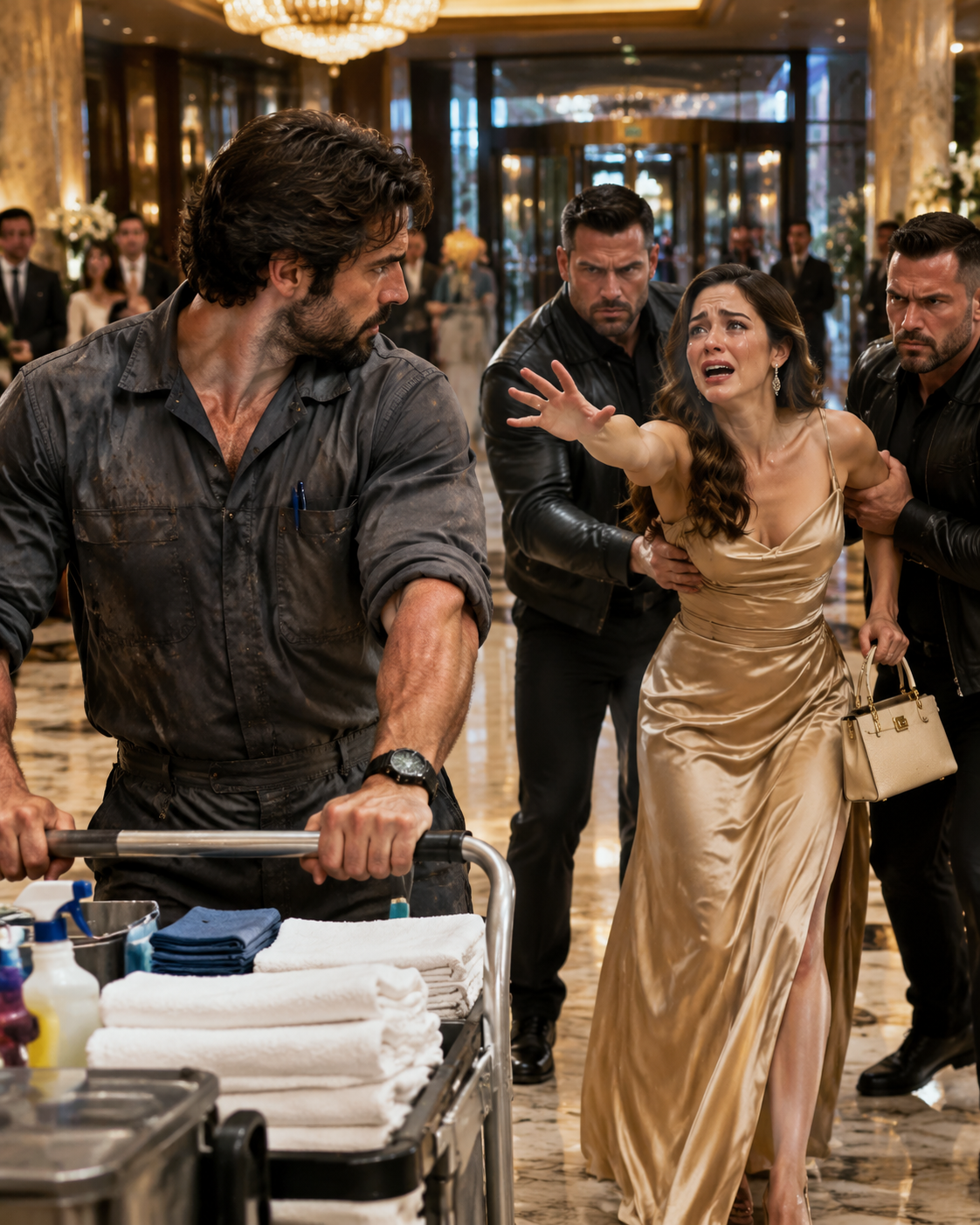
The first man pulled a gun in the hotel lobby. The second grabbed the CEO by the arm. And I was standing there with a mop
The recovered message was only three lines long.
But those three lines changed everything.
I leaned closer to the screen as Agent Grant Miller opened the file. The message had been recovered from an archived military communications server. It was damaged, and several sections were missing, but the sender’s name was clear.
Mateo Ruiz.
The timestamp was from the evening before our final mission.
I read the first line twice.
ROUTE COORDINATES DO NOT MATCH APPROVED EXTRACTION PLAN.
The second line was even more troubling.
BRIARWOOD LOGISTICS HAS ISSUED AN UNAUTHORIZED CHANGE.
The final line contained a request for an immediate review.
I sat back slowly.
“He knew,” I whispered.
Grant nodded. “It appears he noticed the problem before your team deployed.”
For years, I had carried the belief that Mateo and the others had died because of a bad decision made in the confusion of combat. We had been sent into a dangerous area, and our extraction route had failed. That was the explanation we had received.
Now we were looking at evidence that the route had been changed before we ever left.
Someone had known.
Someone had allowed us to go anyway.
“Why wasn’t this warning included in the original investigation?” I asked.
Grant folded his hands. “That’s what we’re trying to establish. The message was never delivered to the operational review team. It was flagged, then buried in a restricted archive.”
I stared at Mateo’s name.
He had tried to warn us.
My best friend had seen something wrong and done exactly what he was supposed to do. He had raised the alarm. He had followed the rules.
And somebody had made sure nobody listened.
Genevieve was standing near the window. She had been quiet since the file appeared.
“The money,” she said. “Those transfers from the relief foundation. They weren’t random payments.”
Grant turned toward her.
“Explain.”
She opened the audit records again. The foundation had been created to fund emergency supplies, medical equipment, and reconstruction projects in areas affected by conflict. It had received millions in donations from corporate partners and private supporters.
But the financial records showed that a portion of that money had been moved through several subcontractors before reaching Briarwood Strategic Solutions.
Some transfers were described as transportation expenses. Others were listed as equipment purchases or emergency logistics fees.
The problem was that the foundation had never received the services it had paid for.
“The same depot code appears in several of these transactions,” Genevieve explained. “I thought it was an accounting reference. I didn’t know it connected to a military supply operation.”
Grant studied the documents.
“Someone was using a charitable foundation to move money into a defense logistics network.”
“And my uncle had access to the accounts,” she replied.
The room went quiet.
Arthur Sterling had been a senior figure in the company for decades. He had helped build its reputation, cultivated powerful relationships, and presented himself as the person who could keep the business stable during difficult times.
To the outside world, he was a respected businessman.
To Genevieve, he was family.
And now the evidence was pointing directly toward him.
“We can’t assume he’s responsible just because he had access,” Grant said. “We need records that establish who authorized the transfers and where the money went.”
Genevieve nodded, but I could see the hurt in her face.
She had already begun to understand what the investigation might cost her.
Her company was not simply facing a financial scandal. It was facing a betrayal from inside its own leadership.
That morning, Arthur called an emergency board meeting.
He did not invite Genevieve to discuss the allegations privately. Instead, he sent a formal notice to every director, claiming that she had mishandled confidential financial information and endangered the company’s reputation.
He demanded that she be suspended immediately.
Fiona Vance arrived at the precinct shortly after receiving the notice.
She placed a folder on the table and looked at Genevieve.
“He’s moving faster than we expected,” she said.
“He wants to get rid of me before the investigators finish,” Genevieve replied.
“Exactly. If he can convince the board that you’re unstable or reckless, he can take control of the records and the company.”
I looked at the folder.
“Can he do that?”
Fiona shook her head. “Not without a fight.”
She explained that the company’s governance rules required independent review before any executive could be removed for alleged misconduct. Arthur had enough influence to make the meeting uncomfortable, but he could not simply take over.
Genevieve closed her eyes for a moment.
“He raised me after my father died,” she said quietly. “I trusted him with everything.”
Fiona softened her voice.
“Trust doesn’t make evidence disappear. And evidence doesn’t become false because it hurts.”
I understood that feeling better than I wanted to.
Losing Mateo had left me with questions I could never ask him. Discovering that someone might have deliberately sent us into danger was like reopening a wound that had never truly healed.
But I had another responsibility now.
Clara.
I checked my phone. Mrs. Novak had sent a picture of my daughter eating breakfast at the secure hotel. She was smiling, with a little bit of jam on her cheek.
I saved the picture.
For a moment, I could breathe again.
Then another message arrived from Detective Morales.
The surveillance vehicle outside the hotel had been identified.
It was registered to a company connected to Briarwood.
The investigators were tracing the people who had been using it. They believed the vehicle had been monitoring Genevieve and me since the lobby incident.
Rosa called a few minutes later.
“We’ve got officers watching the secure location,” she said. “Clara is protected. But I want you to stay where we can reach you.”
“Understood.”
“Daniel, one more thing. Don’t contact anyone connected to Briarwood. Don’t try to investigate this yourself.”
I looked at the old mission file on the screen.
“I won’t,” I said.
I meant it.
This time, I wasn’t going to let anger make decisions for me.
The board meeting began that afternoon.
Genevieve attended with Fiona. Grant and his team stayed outside the meeting room, ready to preserve any evidence that might be discussed. I remained at the precinct, where Rosa had arranged a secure room for me.
The meeting was not public, but Genevieve later described what happened.
Arthur arrived with a polished presentation and a stack of printed emails. He claimed Genevieve had acted without authorization, exposed confidential financial information, and allowed a routine accounting review to become a public security crisis.
He spoke calmly.
He made the accusations sound reasonable.
Then he suggested that her emotional involvement in the hotel incident had clouded her judgment.
“The company cannot be managed through personal feelings,” he told the directors.
Genevieve listened without interrupting.
When he finished, she asked the board to review the original transaction records rather than his presentation.
Arthur objected.
He said the records were incomplete and that sharing them could create legal exposure.
Fiona stood.
“The records have already been preserved for independent review,” she said. “The company has a duty to cooperate with the investigation.”
Arthur turned toward her.
“You’re an attorney, Fiona. You should understand the danger of making unsupported accusations.”
“I do,” Fiona replied. “That’s why I brought supporting documents.”
She distributed a report showing payments that had been approved through Arthur’s executive authorization channel. Several transfers had gone to companies with no clear business purpose. Others had been routed through intermediaries connected to Briarwood.
The directors began asking questions.
Arthur tried to dismiss the payments as routine operational expenses.
Then one of the independent directors, Evelyn Cross, spoke.
Evelyn had spent years overseeing corporate compliance. She was not easily impressed by titles or polished presentations.
“Arthur,” she said, “you personally approved several of these transfers after the compliance department had placed them on hold.”
Arthur’s expression changed.
“I approved them because the business required it.”
“Then why were the supporting documents altered after approval?”
He had no immediate answer.
Evelyn placed another set of records on the table. They showed that payments had been split into smaller amounts to avoid internal review thresholds. The recipients included entities associated with Briarwood Strategic Solutions.
The room went silent.
Genevieve later told me that she had never seen her uncle look so uncertain.
The board voted to freeze Arthur’s access to company accounts and suspend his financial authorization while the independent investigation continued.
They did not declare him guilty.
They did not remove him from every position.
But for the first time, he could no longer control the money or the records.
When Genevieve left the building, she called me.
“We stopped him from moving the funds,” she said.
“That’s good.”
“I don’t know if it feels good.”
I understood.
Sometimes, the first step toward the truth feels like losing everything you thought you knew.
That evening, federal investigators brought Warren Pike in for questioning.
Pike was Briarwood’s operations director. He had worked in military logistics for years and had been responsible for coordinating several supply and transportation contracts.
He was not the kind of man who attracted attention. He dressed plainly, spoke carefully, and seemed comfortable letting other people do the talking.
But his name appeared repeatedly in the financial records.
The investigators had found payments connected to him, along with evidence that he had accessed the mission planning system before our deployment.
Grant led the interview with another federal investigator.
At first, Pike denied everything.
He said the payments were legitimate consulting fees. He claimed the route changes were ordinary adjustments made because of shifting conditions in the field.
He insisted that he had never spoken with Arthur about our mission.
But the investigators had more than financial records.
They had the archived warning from Mateo.
They had system access logs.
They had evidence that the extraction coordinates had been changed through Pike’s authorization credentials before the operation began.
And they had recovered communications between Pike and an intermediary who had received money from accounts linked to Arthur.
When Grant showed him the documents, Pike stopped speaking.
For a long time, he stared at the table.
Then he asked for his attorney.
The interview ended.
But the investigation did not.
Over the next several days, federal agents traced the money through additional companies and bank accounts. They discovered that Briarwood had been operating an illicit supply network, moving restricted equipment and supplies through contracts that appeared legitimate on paper.
The relief foundation transfers helped cover the costs and conceal parts of the operation.
The altered mission route had served another purpose. It helped keep certain shipments and transportation records away from the attention of the team operating in the area.
Mateo had noticed the discrepancies.
He had recognized that the coordinates did not match the approved plan. He had filed an urgent warning through the proper channel.
But the warning was suppressed.
The operation continued.
Our team entered the area with incorrect extraction information. When the attack began, the route we had been told to use was no longer safe.
We fought to survive.
Mateo never made it out.
I did.
And for years, I had believed that was the end of the story.
The investigators eventually offered Pike a chance to cooperate with prosecutors. Faced with the evidence, he began providing details about the network.
His statement confirmed what the records had suggested.
He had altered our team’s extraction coordinates before the mission. He had done it to hide the movement of supplies through an unauthorized logistics route.
He had received payments connected to the arrangement.
And he knew Mateo had discovered the change.
Pike admitted that Mateo’s warning had been intercepted and suppressed because allowing the mission to proceed was considered less dangerous to the network than exposing the altered route.
I listened to the summary in Grant’s office.
I had imagined many possible explanations for Mateo’s death.
I had never imagined that he had been trying to save all of us while people with access to the system worked to silence him.
“Did he know they were going to ignore him?” I asked.
Grant paused.
“We can’t know exactly what he believed at the time. But the warning was clear. He did everything he could to raise the issue.”
I lowered my head.
For a moment, the room seemed too small.
I remembered Mateo sitting beside me before missions, making jokes about terrible coffee and promising to retire somewhere warm. I remembered him teasing me about my plans to start a family. I remembered his voice over the radio.
And I remembered the last time I saw him alive.
There were questions I would never get to ask.
But now I had an answer to the one that mattered most.
Mateo had not abandoned us.
He had not made a careless mistake.
He had warned the people responsible for protecting us.
They had failed him.
The next morning, federal agents moved on the remaining members of the operation.
Gavin Thorne, the man who had led the attempted abduction at the hotel, was arrested along with the members of his crew. Investigators connected them to the effort to intimidate Genevieve and interfere with the inquiry.
Arthur Sterling was arrested after prosecutors presented evidence of his financial involvement and his role in the network.
Warren Pike was also taken into custody after cooperating with the investigation and providing information about the altered coordinates and illegal supply operation.
There were additional arrests as investigators identified other people who had helped move the money, conceal the records, or threaten witnesses.
The hotel incident was no longer being treated as an isolated attempted kidnapping.
It was part of a larger effort to stop Genevieve from exposing what had happened.
When Grant called to tell me the arrests had been made, I did not cheer.
I simply closed my eyes.
The people responsible could no longer hide behind their money, their company titles, or their connections.
That mattered.
But it did not bring Mateo back.
It did not give the families of the other men their loved ones back.
And it did not return the years I had spent wondering whether I could have done something differently.
A few days later, I went to visit Clara.
She was drawing at the little table in the hotel room. Mrs. Novak sat nearby, reading a book.
When Clara saw me, she jumped from her chair.
“Daddy!”
I caught her as she ran into my arms.
She held on tightly.
“Can we go home now?”
I looked at her face.
There was no way to explain financial networks, military investigations, or the people who had tried to use her as leverage.
So I gave her the answer she needed.
“Soon, sweetheart. We just have a few more things to take care of.”
She nodded and returned to her drawing.
It was a picture of our apartment, with two people standing outside and a little sun in the corner.
I recognized myself and Clara.
Beside the drawing, she had written two words in uneven letters.
MY HOME.
I put my hand over my mouth.
For months, I had worked long shifts, cleaned rooms, and pushed carts through hotel hallways because I wanted to give her a safe life. I had believed that keeping my past hidden was the best way to protect her future.
But the past had found us anyway.
The difference was that this time, I had people standing beside me.
Detective Rosa continued coordinating our protection until the immediate threat was gone. Mrs. Novak had refused to leave Clara alone for even a minute. Fiona helped Genevieve manage the legal and corporate aftermath. Grant kept me informed as the federal case moved forward.
And Genevieve did something I had not expected.
She came to see us.
She brought a small package for Clara and apologized for the danger that had reached our family.
“You don’t owe me an apology,” I told her. “You didn’t create this.”
“But my company helped make it possible,” she replied. “I can’t change what happened, but I can make sure we don’t pretend it never happened.”
She explained that the board had appointed an independent oversight team to examine the foundation’s finances and review every contract connected to Briarwood.
The company would cooperate with the federal investigation. Suspicious payments would be reported, and the foundation’s remaining funds would be protected from further misuse.
She also promised to work with independent auditors to rebuild the relief program so donations would reach the people they were intended to help.
I respected that.
It would have been easy for her to focus only on saving her position or protecting the company name.
Instead, she was accepting responsibility for what came next.
A week later, she asked if I would meet her at the hotel lobby.
The place looked almost exactly as it had on the day of the attack. The marble floor had been polished. The front desk was busy. Guests moved through the entrance carrying suitcases and coffee cups.
Hannah was working at reception.
When she saw me, she smiled.
“I still can’t believe you took down those men with a cleaning cart,” she said.
I smiled back.
“It was a good cart.”
She laughed.
Genevieve was waiting near the windows with Fiona. She thanked me again, but this time she did not speak as if I were simply a man who had saved her from an attack.
She spoke as someone who understood that the events had changed both our lives.
“The board wants to offer you a position,” she said.
I looked at her.
“What kind of position?”
“A security and operations role. You’d help us review our protection procedures, coordinate with our independent compliance team, and make sure the people who work for us aren’t exposed to the same kind of danger.”
I was quiet.
I had spent years trying to leave my old life behind. I had no desire to return to the kind of work that had taken Mateo away from me.
Genevieve seemed to understand.
“You don’t have to decide today,” she said. “And I don’t want you to accept because you feel you owe me anything.”
I looked across the lobby.
A father was kneeling beside his little boy, helping him tie his shoes. A couple was checking in. Hannah was answering another guest’s question.
Ordinary people, going about ordinary lives.
That was what I wanted to protect.
But I also knew I needed a job that would let me be present for Clara. I had spent too much of her childhood working late and carrying worries I never shared with her.
“Would the hours allow me to be there for my daughter?” I asked.
Genevieve nodded.
“That would be part of the arrangement. We can make the schedule work.”
I did not say yes immediately.
I told her I needed time.
And for once, I had the freedom to take it.
Several weeks later, the federal case continued moving through the courts. Arthur, Pike, and the members of Thorne’s crew faced charges connected to their roles in the scheme. The investigators were still tracing the wider network, and some details remained sealed while prosecutors prepared their cases.
Genevieve returned to her position with stronger oversight and a board that understood it could no longer rely on trust alone.
The relief foundation began a full review of its programs. Independent auditors examined the records, and the company started rebuilding the process for approving contractors and distributing funds.
I accepted the position Genevieve had offered, with one condition.
Clara came first.
The company agreed.
I no longer had to choose between working enough hours to support my daughter and being there when she needed me.
On my first official day, I wore a clean shirt instead of a janitor’s uniform. I walked through the same lobby where everything had started.
Hannah waved from the front desk.
“Good morning, Mr. Hayes.”
I smiled.
“Morning, Hannah.”
I still noticed the exits. I still checked the corners of rooms. Some habits never leave you.
But I was no longer standing there waiting for the next threat.
I was building something different.
That evening, Clara and I visited a small park near our apartment. She ran ahead to the swings while I sat on a bench and watched her.
The sun was going down.
For the first time in years, my phone was quiet.
I thought about Mateo.
I wondered what he would have said if he could see me now. He probably would have made fun of my new office clothes. He would have told me I looked too serious and needed to smile more.
I smiled at the thought.
Then I remembered his warning.
He had noticed something wrong. He had spoken up. Even when the system failed him, he had tried to protect the people beside him.
I couldn’t change what happened to him.
But I could make sure his courage was no longer buried with the evidence.
A few days later, Grant sent me confirmation that Mateo’s warning had been formally included in the reopened investigation record. His actions were recognized as an attempt to prevent the loss of his team.
I printed the document.
I placed it in a folder at home, beside an old photograph of Mateo and me.
Clara found me looking at it one night.
“Who’s that, Daddy?” she asked.
“His name was Mateo. He was my best friend.”
She studied the photograph.
“Was he nice?”
I nodded.
“He was one of the bravest people I ever knew.”
She thought about that for a moment.
“Then I’m glad he was your friend.”
I pulled her close.
“Me too, sweetheart. Me too.”
I had once believed that being strong meant never showing fear, never asking for help, and carrying every burden alone.
I knew better now.
Strength was asking Mrs. Novak to protect my daughter when I couldn’t be there. It was trusting Rosa and Grant to do their jobs. It was allowing Genevieve to stand beside me instead of trying to fight every battle alone.
And sometimes, strength was simply going home.
That night, I tucked Clara into bed. She asked me to leave the hallway light on, just as she always did.
I kissed her forehead and stood in the doorway for a moment.
She was safe.
The truth had finally come into the open. The people responsible were facing the consequences, and Mateo’s warning had not been forgotten.
There would still be difficult days. The legal process would take time. The wounds left by betrayal would not disappear overnight.
But we had a future again.
I switched off the bedroom light, leaving the hallway lamp glowing softly.
Then I went to the kitchen, set my phone on the counter, and allowed myself to rest.
For years, I had fought to survive the past.
Now, at last, I could focus on the life waiting for me and my daughter.