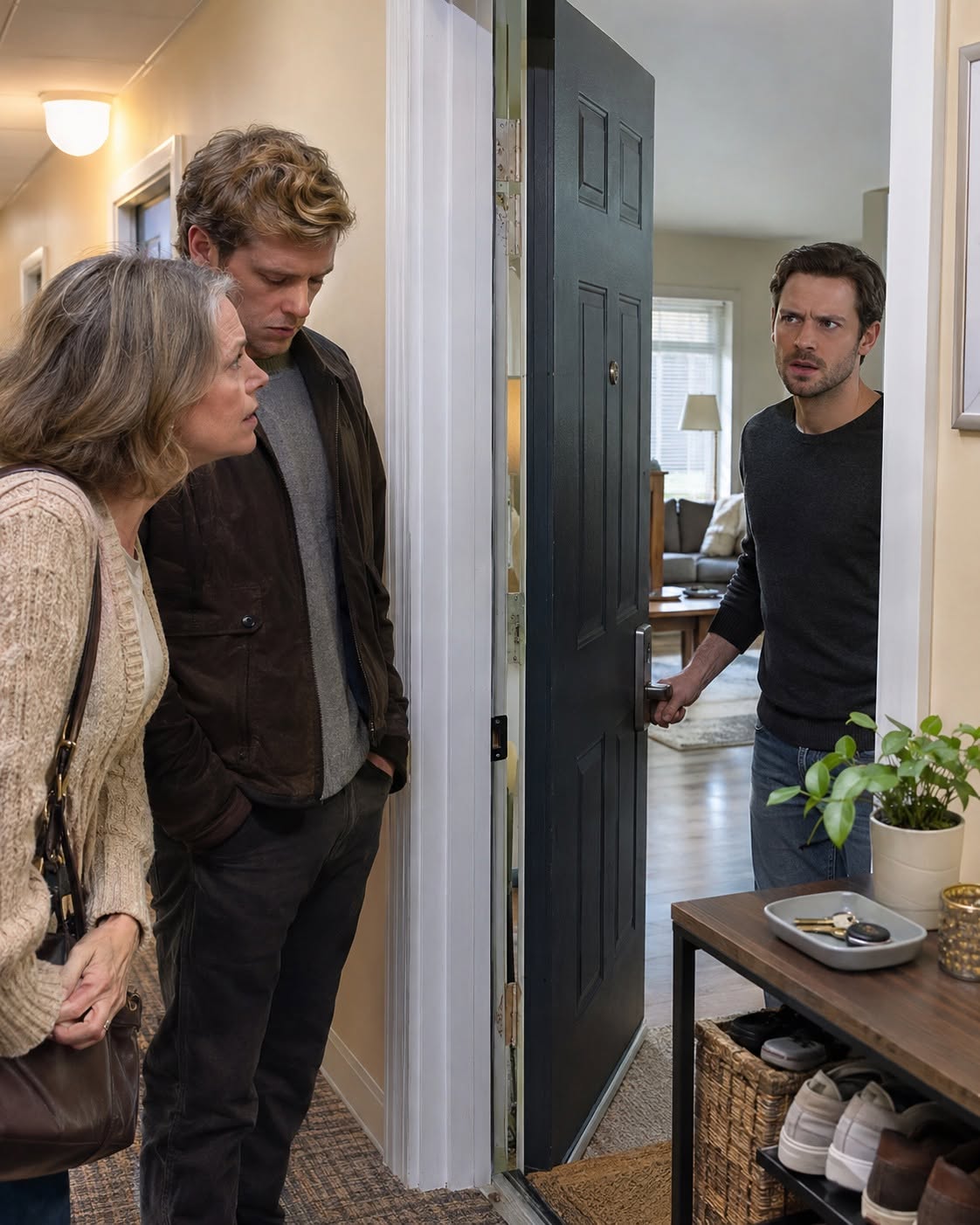
Three weeks after I caught my younger brother in bed with my girlfriend, he showed up at my new apartment with our parents.
I thought that conversation with my father would be the end of it.
I was wrong.
Two days later, I received an email from Camille.
The subject line read: “You deserve to know the truth.”
I stared at it for several minutes before opening it.
The message was short.
” I know you hate me, and I don’t expect you to forgive me. But Connor isn’t telling you everything. Your parents have been making promises on your behalf, and I think you should know what they’re planning. Please call me.”
I almost deleted it.
What could she possibly have to say that would make any difference?
Then I noticed an attachment.
It was a photograph of a document.
At the top were the words “Family Financial Support Agreement.”
My name appeared beneath the heading.
So did Connor’s.
I opened the image.
The document described an arrangement in which I would provide $80,000 toward housing and childcare expenses. In exchange, Connor and Camille would supposedly repay me over ten years, beginning after the baby was born.
There was even a signature line.
My signature.
Or something that looked remarkably like it.
I immediately called Camille.
She answered on the second ring.
“Thank you for calling,” she said.
“Where did you get this?”
“Your mother sent it to me.”
“Why?”
“She said your father was working on a compromise and that you’d probably agree once you saw the repayment plan.”
I leaned back in my chair.
“Did you sign anything?”
“No. I told her I wasn’t comfortable with it.”
“Did Connor?”
There was a pause.
“I don’t think he knows about this version.”
That made my stomach tighten.
“Camille, what exactly is going on?”
She took a shaky breath.
“Your parents have been telling people that you’re going to help us. They told my parents, too. They said the $80,000 was basically settled, and we just needed to work out the details.”
I closed my eyes.
“They told your parents I agreed?”
“Yes.”
I felt my jaw tighten.
“Why didn’t you tell me sooner?”
“Because I thought you might assume I was trying to get money from you. And honestly, I was embarrassed.”
For a moment, neither of us spoke.
Then she said something that changed the entire situation.
“There’s something else. Your mother has been asking me to put the baby on your health insurance after it’s born.”
I sat up straight.
“What?”
“She said you have good insurance through your employer. She thought it would save everyone money.”
I laughed, but there was nothing funny about it.
“Camille, I’m not the baby’s parent.”
“I know.”
“And I’m not agreeing to any of this.”
“I know that, too.”
Her voice broke.
“I just thought you should know before they made more promises.”
I thanked her and ended the call.
Then I forwarded the document to an attorney.
By the following morning, I had received a response.
My lawyer, Daniel Price, asked me to come in as soon as possible.
When I arrived, he had already printed several pages.
“This isn’t necessarily a valid agreement,” he explained. “But the use of your signature is concerning. Did you authorize anyone to sign on your behalf?”
“No.”
“Did you provide a copy of your signature to your mother recently?”
I thought about it.
A few months earlier, Mom had asked me to help complete some paperwork for an insurance policy. I’d emailed her a scanned document containing my signature.
Daniel nodded.
“That may explain where they obtained it. I recommend that you formally dispute this document and notify anyone who has received it that you have not agreed to provide financial support.”
He also suggested checking my credit reports and placing fraud alerts with the major credit bureaus.
I agreed.
Then he asked me a question I hadn’t considered.
“Do you know whether your parents have any financial interest in your property?”
“No. I own my apartment outright.”
“Any joint accounts?”
“No.”
“Any co-signed loans?”
“Absolutely not.”
“Good. Let’s keep it that way.”
I left his office with a list of things to do and a feeling that my family had crossed a line I couldn’t ignore.
That afternoon, I called my mother.
She answered cheerfully.
“Hello, sweetheart.”
“Did you send Camille a financial agreement with my signature?”
Silence.
Then she said, “We were just trying to find a solution.”
“Did you forge my signature?”
“Don’t use that word.”
“Then explain why my signature is on a document I never approved.”
Mom sighed.
“Your father and I were trying to make things easier for everyone. Connor has enough stress right now.”
“Then why did you tell people I’d agreed to pay $80,000?”
“Because we knew you would eventually understand.”
I gripped the phone.
“You don’t get to decide what I agree to.”
“You’re making this much worse than it needs to be.”
“No, Mom. You made it worse when you started signing my name.”
She became defensive.
“It wasn’t a legal contract. It was just a proposal.”
“Then you shouldn’t have put my signature on it.”
She started crying.
I didn’t soften.
“Mom, I’m contacting my attorney. Do not use my name or signature on anything again.”
I hung up.
For the first time, I wasn’t worried about hurting her feelings.
I was worried about protecting myself.
Three days later, my father showed up at my apartment.
He was alone.
I considered not opening the door, but eventually stepped outside.
“Your mother is devastated,” he said.
“She should be thinking about what she did.”
“She didn’t mean anything by it.”
“She put my signature on a financial agreement.”
Dad rubbed the back of his neck.
“It was supposed to be a way to get everyone on the same page.”
“Whose page? Because nobody asked me.”
He looked toward the parking lot.
“Connor’s under a lot of pressure.”
I shook my head.
“You’re still doing it.”
“Doing what?”
“Making his problems more important than everyone else’s boundaries.”
Dad sighed.
Then he said, “Your mother and I have been thinking. Maybe if you gave Connor a smaller amount, say twenty thousand, we could get past all this.”
I stared at him.
He had come to my apartment to apologize for an unauthorized $80,000 agreement and was now negotiating it down to $20,000.
I almost admired the persistence.
“Did you come here to apologize or make another offer?”
He looked uncomfortable.
“I came because I don’t want to lose my son.”
“Then stop asking him to sacrifice his future.”
Dad looked up sharply.
“That’s not fair.”
“Neither was what happened with Camille. Neither was the document. Neither was the pressure you’ve put on me since.”
He had no answer.
I returned inside.
That night, I received a text from Connor.
“You’re taking this way too far. Mom is having panic attacks because of you.”
I read it twice.
Then I replied:
“Your mother is responsible for her own actions. You’re responsible for yours. I’m not discussing money with you again.”
He responded almost immediately.
“Fine. Just remember this when you want to be part of your niece or nephew’s life.”
I put the phone down.
That message hurt.
Not because I thought he had the right to control my relationship with the baby, but because I realized he was willing to use an innocent child as leverage.
I decided not to answer.
Over the next two weeks, I focused on work.
My accounting firm was preparing for its quarterly reporting cycle, and I had plenty to occupy my mind.
Then, one Friday morning, my manager called me into her office.
She closed the door.
“There’s something I need to discuss with you.”
My stomach tightened.
“Is everything okay?”
She turned her computer toward me.
It showed an email from an unfamiliar address.
The sender had claimed to be a family member and had asked the firm to verify my employment and income for a private loan application.
The email included my full name, job title, and a reference to my annual salary.
I stared at the screen.
“Who sent this?”
“We’re investigating. We haven’t provided any information.”
I felt a cold wave move through me.
It wasn’t enough that my family wanted my savings.
Now someone was trying to use my employment information.
I immediately contacted Daniel.
He advised me to preserve the email and avoid making accusations until we had more evidence.
But I already had a pretty good idea where it had come from.
That evening, I called Dad.
He didn’t answer.
I called Mom.
She picked up.
“Did you or Connor contact my employer?”
“What are you talking about?”
“Someone requested employment verification using my personal information.”
She went quiet.
Then she said, “Your brother was trying to arrange a loan.”
“Using my income?”
“He said the bank needed a family reference.”
“Mom, a family reference is not the same as pretending I agreed to guarantee a loan.”
She began speaking quickly.
“He was desperate. He was trying to find a way to get an apartment before the baby arrives.”
“Then he needs to find a way that doesn’t involve me.”
She started crying again.
I ended the call.
The following morning, Daniel sent a formal notice to my parents and Connor.
It stated that I had not authorized any financial agreement, loan guarantee, or use of my personal information. It also instructed them to preserve all related communications.
For several days, there was silence.
Then Connor called.
This time, I answered.
“Did you contact my employer?”
He sounded angry.
“I didn’t ask them for money.”
“That wasn’t my question.”
“I needed proof of income for the apartment application. Mom said you wouldn’t mind.”
“Mom doesn’t get to decide that.”
“You’re my brother!”
“And that doesn’t give you access to my identity.”
He laughed bitterly.
“You know what? Camille was right about you.”
I felt my stomach turn.
“What did she say?”
“She said you only care about yourself.”
I paused.
“That’s interesting, considering she’s the one who told me about the document with my forged signature.”
Connor went silent.
Then he said, “You talked to her?”
“Yes.”
“She’s always been dramatic.”
“Connor, I saw the document.”
He began swearing.
I let him finish.
Then I said, “I’m not going to argue. Don’t contact my employer or use my personal information again.”
I ended the call.
The next few days were quiet.
Until a letter arrived from Camille’s parents.
It was handwritten and addressed to me.
Her father, Richard, asked whether we could meet.
I almost threw it away.
But something about the tone made me reconsider.
I agreed to meet him at a coffee shop near my office.
Richard arrived carrying a thick envelope.
He looked tired.
“First, I want to apologize,” he said.
I frowned.
“For what?”
“For believing what your mother told us.”
He opened the envelope and removed several printed messages.
My mother had sent Camille’s parents a series of texts explaining that I had promised to provide the $80,000.
She had even claimed I wanted to help because I felt guilty about the breakup.
Richard shook his head.
“We should have asked you directly.”
I looked through the messages.
Then I noticed something else.
One message from my mother said:
“Once the baby arrives, he’ll come around. He won’t want his niece or nephew to suffer.”
I felt sick.
Richard leaned forward.
“I want you to understand something. We never expected you to support Connor. We have savings. Camille has a job, and we were willing to help them within reason.”
“Then why did you believe my mother?”
“Because she sounded so certain. She said the family had already discussed everything.”
I nodded slowly.
Richard took a breath.
“There’s another reason I wanted to meet.”
He hesitated.
“Camille is reconsidering her relationship with Connor.”
I wasn’t surprised.
“Because of the money?”
“Not just the money.”
He explained that Connor had become increasingly angry since I refused to help. He blamed Camille for revealing the agreement and accused her of ruining his chances of getting financial support.
Richard also told me that Connor had been spending money on things he couldn’t afford even after learning about the pregnancy.
There had been late-night gambling sessions, expensive purchases, and unexplained withdrawals from their joint account.
I stared at him.
“Are you sure?”
“Camille showed me the statements.”
I sat back.
Suddenly, the $80,000 made even less sense.
If Connor was already struggling financially, giving him more money wouldn’t solve anything.
It would only give him more room to continue.
Richard reached across the table.
“I’m not asking you to get involved. I just thought you deserved to know that Camille is trying to make decisions based on what’s best for the baby.”
I thanked him.
For the first time in weeks, I felt someone understood the difference between helping a person and enabling them.
A month later, Camille called again.
She was crying.
Connor had moved out of my parents’ house after a major argument.
He had taken the remaining money from their shared account and left.
Camille was now staying with her parents.
I listened as she explained what happened.
“He said he needed money for a business opportunity. When I asked questions, he told me I was trying to control him.”
“Did he leave you any money?”
“Not much.”
I closed my eyes.
“Have you talked to a lawyer?”
“Yes. My parents are helping me.”
She paused.
“I know I don’t have any right to ask you for anything. But I wanted to apologize.”
I said nothing.
“I hurt you terribly. I know that. And I don’t expect you to forget it. But I also don’t want our child growing up believing that what happened was normal.”
Her voice cracked.
“I made a terrible decision. I know that now.”
I stared at the kitchen counter.
For months, I’d imagined hearing an apology from her.
I had thought it might make me feel better.
Instead, it made me realize how much had changed.
“Camille, I appreciate you saying that. But I can’t be the person you turn to every time Connor makes a mess.”
“I understand.”
“And whatever happens between you two, please make sure the baby is protected.”
“I will.”
We ended the call.
A week later, Connor appeared at my apartment.
It was late.
I opened the door only after checking the peephole.
He looked awful.
His clothes were wrinkled, his beard was untrimmed, and he had dark circles beneath his eyes.
“Can I come in?”
“No.”
He stared at me.
“Seriously?”
“We can talk here.”
He looked down the hallway, then back at me.
“I need help.”
I waited.
“The bank rejected my loan. I owe money on my car. The equipment I bought is worth less than I paid for it, and now Camille’s parents are threatening to take me to court over the money I took.”
I crossed my arms.
“What do you want from me?”
“Just a loan.”
I almost smiled.
“How much?”
“Twenty-five thousand.”
I shook my head.
“Connor, we already had this conversation.”
“This is different.”
“How?”
He looked frustrated.
“Because I’m actually in trouble now.”
I took a breath.
“You were in trouble when you spent your inheritance. You were in trouble when you cheated with Camille. You were in trouble when you tried to use my signature. Every time, someone else was expected to rescue you.”
His eyes reddened.
“I’m your brother.”
“I know.”
“Then why won’t you help me?”
I looked at him for a long moment.
“Because I finally understand that helping you financially has never made you responsible. It has only made it easier for you not to be.”
He shook his head.
“You really don’t care what happens to me.”
“That’s not true. I care what happens to you. But I won’t pay to keep you from facing the consequences of your choices.”
He looked away.
Then he said something I never expected.
“Dad says you’ve changed.”
I nodded.
“I have.”
“Mom cries about you almost every night.”
I felt a familiar sting.
“Then maybe she should think about why.”
He stood there for another moment.
Finally, he turned and walked away.
I watched him disappear down the stairs.
I closed the door and leaned against it.
I wasn’t happy.
I wasn’t victorious.
I was just tired.
But I knew I had done the right thing.
Two months later, my mother called with news.
Camille had given birth to a healthy baby girl.
Her name was Olivia.
I stared at the phone when Mom told me.
“She’s beautiful,” she said through tears. “You should come meet her.”
I didn’t answer immediately.
“Connor’s there?”
“Yes.”
“Then I don’t think that’s a good idea.”
Mom sighed.
“Please don’t punish the baby for what happened.”
That sentence hit harder than she probably intended.
“I’m not punishing anyone, Mom. I’m trying to avoid another confrontation.”
“She’s your niece.”
“I know.”
“She deserves to know her family.”
I looked out the window.
“Then let her know a family that doesn’t have to lie to each other.”
Mom began crying.
I told her I’d think about it.
That night, I couldn’t sleep.
I kept thinking about Olivia.
She hadn’t done anything wrong.
She hadn’t asked to be born into a family full of unresolved anger and financial problems.
And I didn’t want my refusal to support Connor to become a reason I never had a relationship with her.
The next morning, I called Richard.
I asked whether I could visit Camille and the baby without Connor being present.
He said he’d speak with her.
A few days later, Camille agreed.
I arrived at her parents’ house carrying a small gift bag.
Inside was a soft blanket and a children’s book about animals.
Camille opened the door.
She looked exhausted but peaceful.
“Thank you for coming,” she said.
I nodded.
“How are you?”
“Getting there.”
She led me into the living room.
Olivia was sleeping in a small bassinet beside the couch.
I stood over her quietly.
She was tiny.
Her fingers curled around the edge of the blanket, and her chest rose and fell with the calm rhythm of sleep.
For a moment, all the anger I’d carried seemed distant.
Camille handed me the baby.
I held her carefully.
“She’s beautiful,” I whispered.
Camille smiled.
“Thank you.”
We sat together for nearly an hour.
We didn’t discuss the affair in detail. We didn’t pretend everything was forgiven.
But we talked about Olivia, her health, and the future.
Before I left, Camille said, “I don’t expect you to be involved financially. I just hope someday you can be part of her life.”
I looked at the baby.
“I’d like that.”
And I meant it.
When I got home, I received a message from Connor.
“Mom says you visited Olivia. Don’t think that means you can act like everything is fine.”
I read it twice.
Then I replied:
“Nothing is fine yet. But Olivia deserves better than the mistakes we made.”
He didn’t respond.
A few weeks later, my father called.
He sounded older.
“Your mother and I need to talk to you.”
I almost said no.
Then he added, “It’s about the money. All of it.”
We met at a restaurant near their house.
Mom and Dad were already seated.
There was no folder this time.
No handwritten budget.
No list of demands.
Just two cups of coffee and a silence that felt uncomfortable.
Dad spoke first.
“We made a mistake.”
I waited.
“We thought if we kept helping Connor, eventually he’d become independent. Every time he got into trouble, we stepped in. We told ourselves we were protecting him.”
Mom nodded.
“We also thought you’d understand because you were always the responsible one.”
I looked at her.
“That’s exactly what made it unfair.”
She began crying.
“I know.”
Dad looked down at his hands.
“Your mother and I have been talking to a financial counselor. We’re going to stop covering Connor’s debts. We can’t afford to keep doing it, and it isn’t helping him.”
I nodded.
“That’s probably a good decision.”
He looked up.
“We also wanted to apologize for the agreement.”
Mom reached into her purse and handed me a folded piece of paper.
It was a written statement confirming that I had never agreed to provide financial support and that the document containing my signature had been created without my authorization.
Both of them had signed it.
“We’re willing to send it to anyone who received the original,” Dad said.
I studied the paper.
“Thank you.”
Mom reached for my hand.
“Can we start over?”
I gently placed my hand beside hers.
“We can start being honest. But starting over doesn’t mean pretending none of this happened.”
She nodded.
For once, she didn’t argue.
Then Dad said something that surprised me.
“Your grandfather would have been proud of how you handled yourself.”
I looked at him.
“Grandpa taught me to be responsible. He also taught me not to spend money I don’t have.”
Dad smiled faintly.
“He did.”
We sat together for another half hour.
It wasn’t a dramatic reconciliation.
But it was the first conversation we’d had in years that didn’t revolve around Connor’s needs.
Over the following months, things slowly changed.
Connor eventually found work at a used-car dealership. He sold his luxury vehicle and moved into a small rental apartment.
He began making payments toward the money he owed Camille.
It wasn’t enough to solve everything immediately, but it was a start.
He also began attending counseling after a particularly difficult conversation with our father.
I didn’t ask for details.
I wasn’t responsible for managing his recovery.
My parents started setting boundaries of their own. They stopped paying his monthly bills and refused to cover his unnecessary purchases.
At first, Connor was furious.
Then, gradually, he adjusted.
One afternoon, he sent me a message.
“Hey. I know you probably don’t want to hear from me. But I got a promotion at work. Just wanted to tell you.”
I stared at it for a while.
Then I replied:
“Congratulations. Keep going.”
It was a small exchange.
But it felt healthier than all the long arguments we’d had before.
Several months later, my family gathered for Olivia’s first birthday.
I wasn’t sure whether to attend.
Tessa, a close friend who had supported me through the entire ordeal, encouraged me to go.
“You don’t have to make peace with everyone to celebrate a little girl’s birthday,” she said.
She was right.
I arrived with a wrapped gift and a card.
Connor was standing near the kitchen, talking to Dad.
When he saw me, he looked uncomfortable.
Then he walked over.
“Thanks for coming.”
“Happy birthday to your daughter.”
He nodded.
For a moment, neither of us knew what to say.
Then he looked at me.
“I owe you an apology.”
I waited.
“Not just for Camille. For everything. For spending the inheritance, for letting Mom and Dad keep bailing me out, for trying to make you pay for my life.”
He swallowed.
“I was jealous of you. You had your finances together. You didn’t need anyone. I kept telling myself you were lucky, but the truth is, you worked for what you had. I just didn’t want to admit that.”
I looked at him.
“That doesn’t make what happened okay.”
“I know.”
“And I’m not going to lend you money.”
He gave a small, sad smile.
“I wasn’t going to ask.”
I nodded.
“Good.”
He looked toward Olivia, who was sitting in her high chair, laughing as someone waved a colorful toy in front of her.
“I don’t want her growing up thinking she has to be like me.”
I considered that.
“Then show her something different.”
He nodded.
We didn’t hug.
We didn’t suddenly become best friends.
But we stood together for a moment, watching Olivia laugh.
And that was enough.
As the months passed, I began to understand that the real victory wasn’t proving my family wrong.
It was learning that I could love them without allowing them to control my decisions.
My savings remained untouched.
I kept my apartment.
I continued working, investing, and planning for my future.
I also began volunteering once a month with a local financial literacy program, helping young adults understand budgeting, debt, credit, and the importance of building an emergency fund.
One evening, after a session, a young man approached me.
He told me his parents constantly pressured him to lend money to his older brother.
He asked how I’d handled it.
I thought about Connor, my parents, Camille, and the $80,000 folder.
Then I gave him the simplest answer I could.
“Never confuse being financially responsible with being financially responsible for everyone else.”
He smiled.
“That’s good advice.”
I hoped he’d remember it.
A year after that Sunday afternoon when my parents first arrived with their folder, I received a package from Mom.
Inside was a photograph of Grandma and Grandpa sitting together on their porch.
On the back, she’d written:
“They would have wanted us to treat each other better. I’m sorry we forgot that.”
I placed the photograph on my bookshelf.
Not because everything was forgiven.
But because I wanted to remember where I came from without being trapped by what had happened.
My relationship with my parents was improving, slowly and imperfectly.
My relationship with Connor was cautious but civil.
And I was becoming someone who no longer measured his worth by how much he could sacrifice for other people.
Sometimes, I still thought about the day I walked into my bedroom and found my brother with Camille.
I remembered the groceries on the kitchen counter, the dinner I never cooked, and the suitcase I packed without saying another word.
I used to think that day had taken three years of my life away.
Now I saw it differently.
It had ended a relationship, but it had also exposed a pattern that had been hurting me long before Camille entered the picture.
I had spent years believing that being the good son meant being agreeable, being generous, and never making anyone uncomfortable.
But generosity without boundaries eventually becomes an obligation.
And love without respect becomes another way of controlling someone.
I didn’t give Connor the $80,000.
I didn’t buy him a car, pay his debts, or provide him with a place to live.
I didn’t even promise to rescue him if things went wrong again.
What I did give him was something he had rarely been required to face: the opportunity to take responsibility for his own life.
And what I gave myself was permission to stop feeling guilty for having built a stable future.
Today, Olivia knows me as her uncle.
She knows I bring her books instead of expensive toys. She knows I show up for her birthday and cheer when she takes her first steps.
One day, when she’s old enough to understand, I hope she’ll learn that family isn’t measured by the amount of money someone gives you.
It’s measured by honesty, consistency, and the way people treat each other when nobody is watching.
As for Connor, I hope he continues becoming a better man.
Not because I owe him another chance, but because I genuinely want him to have a good life.
And if there’s one thing this entire experience taught me, it’s this:
You can forgive someone without funding their mistakes.
You can care about a child without accepting responsibility for the choices of their parents.
You can love your family and still say no.
Sometimes, saying no is the first honest thing a family needs to hear.
That $80,000 never left my account.
But I gained something worth far more than the money.
I finally understood that protecting the future you’ve worked hard to build isn’t selfish.
It’s a responsibility, too.
And this time, it was one I was finally willing to honor.