The first thing I noticed at the Grand Crest Hotel was that the smoke detectors weren’t working. The second was that someone had deliberately made sure they wouldn’t.
Colonel Hale didn’t raise his voice. He didn’t need to.
“Mr. Sterling, step away from the table.”
Harrison looked at him as though the order were an insult. For a moment, I thought he might refuse. Then he glanced at the two Marines standing near the command post entrance and slowly moved backward.
Richard Cole gathered his papers.
“Colonel, my client is the president of a private hotel. You have no authority to interrogate him without proper legal procedures.”
“I’m not interrogating anyone,” Hale replied. “I’m securing a potential crime scene involving missing regulated equipment and a fire that may have been deliberately facilitated. Your client is welcome to cooperate through the appropriate channels.”
Tessa remained seated, one hand resting on the edge of the building map.
“Colonel, I want every access record preserved. Not just the contractor logs. Everything. Fire controls, ventilation, security cameras, maintenance overrides, and the equipment inventory.”
“Agreed.”
Richard looked at her.
“Ms. Vance, I would strongly recommend discussing this with your company’s legal department before making any requests.”
Tessa finally turned toward him.
“I am the legal department’s client, Richard. I know what I just asked for.”
He said nothing.
Owen was still standing beside the table. He looked exhausted, and I could tell he was struggling with a decision.
I recognized the expression.
It was the look of someone who had spent too long convincing himself that staying quiet was safer than telling the truth.
I pulled out a chair.
“Sit down, Owen.”
He glanced at Harrison.
“Don’t look at him,” I said. “Look at me. Tell them what happened.”
Owen sat.
He explained that several weeks earlier, management had instructed the engineering department to reduce the number of automatic emergency alerts. Some of the changes were presented as routine adjustments to prevent unnecessary evacuations during the summit preparations.
At first, the instructions seemed harmless.
Then the requests became more specific.
Certain smoke detectors were to be placed in maintenance mode. The ventilation system’s emergency response settings were changed. The east-wing fire-door inspection was marked complete despite a failed seal.
Owen had questioned the decisions.
He had even sent an internal email warning that the combined changes could create a dangerous situation during an actual fire.
His supervisor told him the changes had been approved by the executive office.
“Who in the executive office?” Hale asked.
Owen hesitated.
“Mr. Sterling’s office.”
Harrison shook his head.
“This is absurd. I approve budgets. I don’t program ventilation systems.”
“Nobody said you personally programmed anything,” Tessa replied. “The question is who authorized the instructions.”
Owen continued.
He said the maintenance override could duplicate credentials belonging to authorized contractors. That meant someone could create an access record showing that I had entered the electrical control room without my knowledge.
Richard immediately objected.
“That’s speculation.”
“No,” Owen said quietly. “It’s a feature of the system. I can demonstrate it.”
Hale nodded to one of the technical personnel.
“Preserve the original logs and make a forensic copy. Nobody changes anything.”
The technician left with two Marines.
I looked at the map again.
The fire had started near the electrical distribution area, but the location alone didn’t explain why someone had been moving specialized equipment through the service corridor shortly before the emergency.
There were two possibilities.
Someone had used the fire to cover the theft, or the theft and the fire were connected in a way we hadn’t yet understood.
I pointed to the service lift.
“The man carrying the case used this route. The hallway camera had been shifted before the fire. I saw him enter the corridor, and I saw him leave with the same case.”
Tessa leaned forward.
“Was he wearing a hotel security uniform?”
“Yes.”
“Did you recognize him?”
“No.”
She looked toward her security director, who had just arrived.
“Show me the contractor and temporary security roster.”
The director opened a tablet.
They reviewed the names of everyone assigned to the hotel during the summit preparations. Some were employees. Others were outside security personnel brought in for the event.
After several minutes, Tessa pointed to a photograph.
“That’s Daniel Rusk.”
“Who is he?” Hale asked.
“Former logistics contractor. His company provided temporary personnel for our equipment demonstrations. His contract ended two months ago.”
“Why was he here?”
Tessa’s security director scrolled through the records.
“He’s not on the current roster.”
That was the first solid indication that the man hadn’t simply been an employee caught in the confusion of an evacuation.
Hale instructed his team to circulate the description and photograph to the officers securing the surrounding area.
But I wasn’t satisfied.
“There’s something else.”
Everyone looked at me.
“The case had your company crest, but the man wasn’t carrying it like someone transporting delicate equipment. He was moving quickly, but he wasn’t protecting it from impact. He knew exactly where he was going.”
Tessa nodded slowly.
“The equipment inside may be more important than the case itself.”
She explained that her company had brought several pieces of demonstration equipment to the hotel. Most were ordinary presentation hardware, but one module was different.
It was a compact encrypted tactical communications component used in a restricted defense system. It wasn’t something that could simply be purchased or replaced.
The module was designed to work with a larger system, and its value came from the software, configuration, and protected data it contained.
Without it, the demonstration couldn’t proceed.
More importantly, if it had fallen into unauthorized hands, the consequences could extend beyond the hotel.
“Could someone use it independently?” I asked.
“Not easily,” she replied. “But that doesn’t mean it would be harmless.”
Hale folded his arms.
“Then we’re treating this as a security incident, not merely a property theft.”
A Marine returned with an update.
They had located a vehicle matching the description of one registered to Rusk’s former contracting company. It had been parked two blocks away, but it was empty.
The officers had secured the vehicle and were waiting for a specialist team.
Harrison immediately seized on the information.
“Then clearly this is an outside criminal matter. There’s no reason to involve the hotel executives.”
Tessa looked at him.
“Except that someone changed the fire systems, someone manipulated access records, and someone allowed an unauthorized person into a restricted area. Those are not outside matters.”
Harrison’s face tightened.
I could see that he wanted to argue, but his attorney whispered something to him.
For the first time, I wondered whether Harrison knew more than he was admitting.
Not necessarily about the theft.
But about the changes that had made the building dangerous.
My phone vibrated.
I looked down.
Harper.
I had forgotten to call her back after the evacuation.
I stepped away from the table and answered.
“Hey, sweetheart.”
“Are you coming home?”
Her voice was small.
I closed my eyes for a moment.
“I’m working on it.”
“You promised dinner.”
“I know.”
“Mom always said you keep your promises.”
The words hit harder than the smoke had.
My wife, Claire, had been gone for years, but Harper still carried pieces of her into ordinary conversations.
I had been deployed when Claire died. I hadn’t been there when she needed me, and there was nothing I could do to change that.
When I returned, I found a little girl trying to understand why her mother wasn’t coming home.
I left the military shortly afterward.
People asked whether I regretted walking away from the service. Some assumed I had lost my nerve. Others thought I was wasting my experience working as a civilian consultant.
They didn’t understand.
I hadn’t stopped caring about protecting people.
I had simply decided that the person who needed me most was waiting at home.
“Listen, Harper. I’m safe. I promise I’ll call you again as soon as I can.”
“Can you still come?”
“I’ll do my best.”
She was quiet for a second.
“Okay, Daddy.”
When the call ended, I remained standing in the corner of the command post.
Colonel Hale approached.
“Family?”
“My daughter.”
“How old?”
“Nine.”
He nodded.
“That’s a difficult age.”
“Especially when your father keeps missing dinner.”
Hale looked at me for a moment.
“You did what you had to do tonight.”
“I know.”
“Do you?”
I glanced toward the hotel.
People were still being treated outside. Firefighters were checking the structure, and investigators were moving through the building.
“I went back because somebody was still upstairs. That’s all.”
Hale gave a small nod.
“That’s never all.”
The forensic team returned shortly after midnight.
They had preserved the hotel system logs and discovered something important.
The access record showing my credentials in the electrical distribution room had been created through a remote administrative override.
It hadn’t originated from the contractor access terminal.
It had come from an executive-level workstation.
The workstation was registered to the hotel’s president’s office.
Harrison was immediately separated from the others.
Richard objected, but his objections had changed in tone. He was no longer accusing me of interfering with the investigation.
He was asking for copies of every document.
Tessa requested that the technical team identify the administrator account responsible for the override.
The initial result was inconclusive.
The account had been shared by several senior hotel employees, which meant the record identified the workstation but not necessarily the individual sitting in front of it.
Harrison seized on that distinction.
“You have nothing connecting me personally to any of this.”
Tessa didn’t answer.
She was studying the timeline.
The fire had begun at 8:17 p.m.
The system override had been used at 7:42 p.m.
The camera had been repositioned at 7:51 p.m.
The equipment case had been moved at approximately 8:03 p.m.
That was a narrow window.
And it suggested the people involved had planned their movements around the summit’s schedule.
Tessa pointed to another entry.
“What happened here?”
The technician leaned closer.
“That’s a temporary maintenance authorization. It was issued under an account belonging to Northstar Facilities.”
Owen looked up.
“Northstar?”
He explained that Northstar had been hired to provide additional building support before the summit. Its workers had access to certain service corridors and technical areas.
“Who was supervising them?” Hale asked.
Owen looked toward the hotel president’s attorney.
“Mr. Sterling’s office handled the contract.”
Harrison rubbed his forehead.
“Every large event uses subcontractors. That proves nothing.”
“No,” Tessa replied. “But it gives us somewhere to look.”
At 1:15 a.m., the specialist team reported that the empty vehicle contained several items of interest.
There were disposable gloves, a partially burned work badge, and a printed floor plan of the Grand Crest’s service corridors.
The badge belonged to Daniel Rusk.
The floor plan included handwritten markings around the twelfth-floor suite area and the electrical distribution room.
But the most important discovery was a small piece of paper tucked into the vehicle’s center console.
It contained a short list of numbers.
Tessa recognized the format.
“They’re equipment inventory identifiers.”
One number matched the missing module.
Another matched a second unit that was still accounted for.
The third number belonged to a storage container that hadn’t been included in the hotel’s public equipment inventory.
Hale looked at her.
“What storage container?”
Tessa hesitated.
“My company uses a secure transport system for restricted demonstration equipment. There was supposed to be an additional container delivered tomorrow morning.”
“Was it delivered?”
“No.”
“Where is it now?”
“We don’t know.”
That changed the investigation.
The missing module might not have been the only target.
Someone could have intended to remove an entire package of regulated equipment while the fire created confusion around the building.
Tessa asked her security director to contact the transport company.
The director stepped outside to make the call.
Meanwhile, I returned to the floor plan.
There was something about the markings that bothered me.
I traced the route from the suite to the loading dock with my finger.
“Why would someone move the equipment through the twelfth-floor corridor when there are shorter routes to the service dock?”
Owen studied the diagram.
“They couldn’t use the main service corridor during the summit setup. It was blocked by temporary staging equipment.”
“Then why use the east wing?”
He pointed to a maintenance passage.
“Because this door connects to the loading dock corridor.”
I examined the location.
The passage was close to the area where the fire had started.
“Was this door part of the fire-door inspection?”
Owen’s expression changed.
“Yes.”
“Did it pass?”
He looked away.
“No.”
Hale called the technical team over.
They photographed the door, its damaged seal, and the surrounding control panel.
A few minutes later, another discovery emerged.
The door’s electronic access system had been placed in manual mode shortly before the fire.
Someone had made sure it would remain accessible even if the building entered an emergency lockdown.
The fire had not simply created an opportunity.
Someone had prepared a route.
At 2:00 a.m., I finally sat down.
My throat hurt, my shoulders ached, and my hands were still trembling slightly from carrying Tessa down the stairwell.
A paramedic had examined me earlier and recommended a hospital evaluation because of possible smoke inhalation.
I had refused until the initial evacuation was complete.
Hale wasn’t pleased.
“You’re not much use to anybody if you collapse.”
“I’ll get checked.”
“That’s what you said twenty minutes ago.”
Before I could answer, Tessa approached.
She had been treated for smoke inhalation and was wearing a borrowed jacket over her clothes.
“Can I speak with you?”
We moved a few feet away from the others.
“I owe you an apology,” she said.
“For what?”
“For not taking your inspection seriously when you first warned us.”
“You didn’t have all the information.”
“I had enough.”
She looked toward the hotel.
“I’ve spent years building a company where people trust us with equipment that can affect the safety of others. I should have taken a fire inspection more seriously than a presentation schedule.”
I didn’t know what to say.
She continued.
“I also need to know something. When you called that emergency code, you said there might be a compromise of regulated equipment. How did you know what procedure to use?”
“I served in the Marine Corps. I worked with units responsible for specialized equipment and secure logistics. I recognized the warning signs.”
“How long were you in?”
“Long enough.”
She smiled faintly.
“That’s not an answer.”
“Long enough to know that when something doesn’t make sense, you don’t ignore it.”
She nodded.
“Your daughter must be proud of you.”
I looked down at my phone.
“I hope she still is.”
The next lead came from the transport company.
Their dispatcher confirmed that a secure equipment container had been scheduled for delivery to the Grand Crest at 6:00 a.m.
The shipment had been canceled through an online authorization system at 7:35 p.m.
The cancellation had come from an account associated with Tessa’s own company.
That was troubling.
Someone had access to internal company credentials.
Tessa’s security director returned with a name.
A logistics manager named Paul Mercer had authorized the cancellation.
He was not related to me.
More importantly, he had not reported for work that evening.
Tessa immediately contacted her company’s security office.
They confirmed that Mercer had been on leave for three days.
His credentials, however, had remained active.
“Could Rusk and Mercer be working together?” Hale asked.
“Possibly,” Tessa replied. “But we need evidence.”
A second call came in.
The transport company had located the missing container.
It was sitting in a temporary storage facility outside the city, where it had been redirected after the cancellation.
The container had not been opened.
A team was dispatched to secure it.
That was the first genuinely good news of the night.
But the missing tactical module was still unaccounted for.
At 3:20 a.m., a security officer contacted the command post.
Daniel Rusk had been located.
He had been stopped at a highway checkpoint after a patrol officer noticed that his vehicle matched the description circulated during the incident.
He was carrying a bag with a change of clothes, cash, and a hotel employee badge.
He had no equipment case.
Hale received the report and immediately arranged for the appropriate investigators to interview him.
Tessa asked whether she could attend.
Hale refused.
“You’re a potential victim and a company representative. You should let the investigators do their work.”
She didn’t like the answer, but she accepted it.
The officer then mentioned something that caught my attention.
Rusk had been stopped while driving toward a small regional airport.
He had no checked luggage and had purchased his ticket shortly before the fire.
I asked Hale to have investigators compare the airport’s access records with the hotel timeline.
“If he planned to leave immediately, he may have expected the equipment to be waiting for him somewhere.”
Hale nodded.
“Good thought.”
A short time later, the airport team found a locker rented under a false name.
It contained a second phone and a small electronic storage device.
The device was secured for forensic examination.
The phone had received several calls from an unregistered number.
The last call had been placed at 8:11 p.m., six minutes before the fire.
The number belonged to a prepaid phone.
It could not yet be connected to a specific person.
But the call record gave investigators another timeline to work with.
By dawn, the Grand Crest was still closed.
The fire department had declared portions of the east wing unsafe pending structural and electrical inspections.
Guests were being relocated to other hotels.
The summit organizers were scrambling to find a new venue.
Harrison had been taken away for a formal interview.
His attorney had left with him.
Before they departed, Harrison approached me.
“You have no idea what you’ve done.”
I looked at him.
“I helped get people out of your building.”
“You’ve exposed my company to millions in damages.”
“Your company disabled the alarms.”
“You can’t prove that.”
“Owen can.”
Harrison’s expression hardened.
“You think people like you get to walk away from something like this?”
I almost laughed.
People like me.
He still saw me as a contractor who had wandered into a situation beyond his authority.
He didn’t understand that I wasn’t interested in his position, his hotel, or his money.
I wanted to go home.
“Have a good morning, Mr. Sterling.”
I turned away.
At 6:45 a.m., a Marine brought me a cup of coffee.
Hale sat across from me.
“You look terrible.”
“I’ve had better nights.”
He glanced at my phone.
“Your daughter?”
“She’ll be awake soon.”
“Go home after the medical evaluation. We can handle the rest.”
I shook my head.
“Not yet. The equipment hasn’t been recovered.”
“That’s not your responsibility anymore.”
“I know.”
I looked at the map.
“But I was the one who saw the case. I know the route he used. If there’s another location, I might be able to help identify it.”
Hale studied me.
Then he nodded.
“One more hour. After that, you get checked out.”
It was a compromise.
I accepted it.
The technical team eventually recovered the missing module.
It had been placed inside a small equipment bag and left in a rented storage unit near the airport.
There was no obvious damage.
The device was secured and transferred to the appropriate specialists for examination.
Tessa received confirmation that the module had been recovered, but she didn’t celebrate.
Instead, she asked whether the storage unit had been rented by Rusk.
It hadn’t.
The rental agreement used a false identity, and the payment had been made through an account linked to Northstar Facilities.
That meant the investigation was moving beyond one former contractor.
Someone had financed the operation.
Someone had arranged access.
And someone had prepared the hotel before the fire.
Owen returned with another set of maintenance records.
He had found the original inspection report for the east-wing fire door.
The report showed that the seal had failed two weeks earlier.
It also showed that the replacement had been ordered but never installed.
The work order had been closed electronically.
The person who approved it was listed as a facilities supervisor named Martin Keene.
Owen recognized the name.
Keene had been employed by the hotel for years, but he had resigned unexpectedly three days before the summit.
His resignation paperwork had been approved by Harrison’s office.
Tessa looked at the records.
“Does Keene have any connection to Northstar?”
Owen searched the maintenance directory.
After a few minutes, he found an old contractor registration.
Martin Keene had worked for Northstar before joining the Grand Crest.
The connection was becoming difficult to dismiss.
At 8:30 a.m., I finally went to the hospital.
The doctor confirmed that I had suffered mild smoke inhalation and needed observation.
He was less interested in my explanation of the incident than in the fact that I had delayed treatment.
“You could have made things considerably worse,” he said.
“I understand.”
“Do you?”
I smiled.
“I’ve heard that question twice today.”
He didn’t smile back.
After a few hours, I was discharged with instructions to rest and return if my breathing worsened.
When I stepped outside, my phone was full of missed calls.
Harper had left three messages.
The last one was simple.
“Daddy, I made you breakfast.”
I called immediately.
“Hey, sweetheart.”
“Are you okay?”
“I’m okay.”
“Mom said people sometimes don’t come home when they promise.”
I closed my eyes.
“Your mom was talking about things that were outside our control. I’m here, Harper. I’m coming home.”
“Really?”
“Really.”
I ordered a ride.
For the first time in twelve hours, I stopped thinking about the hotel.
Harper was waiting at the kitchen table when I arrived.
She had made toast and placed two plates beside it.
One was empty.
The other had a piece of toast cut into uneven triangles.
She stood up when I entered.
“Daddy!”
I dropped my bag and hugged her.
She held on tightly.
“You smell funny.”
“That’s because I had a very bad night.”
“Did you get hurt?”
“A little.”
She looked at my face.
“Are you going away again?”
The question was so quiet that I almost missed it.
I crouched in front of her.
“No, sweetheart. I’m not going anywhere.”
She studied me.
Then she touched the small bandage on my hand.
“Mom wouldn’t want you to get hurt.”
“I know.”
We sat together at the kitchen table.
The toast was cold, the coffee was terrible, and Harper insisted that I eat the entire breakfast because she had made it herself.
I didn’t argue.
For a while, the world was small enough to fit inside that kitchen.
But the phone rang again.
It was Colonel Hale.
I didn’t answer immediately.
Harper noticed.
“You have to go?”
I looked at the screen.
Then at my daughter.
“No. I don’t.”
I sent a short message explaining that I was home and unavailable until later.
Hale replied with a single sentence.
Understood. Call me when you’re ready.
I put the phone down.
Two days later, Tessa contacted me.
The investigation had uncovered a connection between Northstar Facilities and a private security subcontractor.
The subcontractor had been hired to provide temporary personnel during the summit.
Several of its workers had access to service areas.
One of those workers had been Daniel Rusk.
Investigators had also found financial transfers between a Northstar account and an intermediary company connected to Martin Keene.
The evidence suggested that Keene had helped arrange the access routes and that Rusk had been responsible for moving the equipment.
But the question of the fire remained.
Why would someone deliberately compromise the building’s safety systems?
Tessa had a theory.
The theft had required a distraction.
The fire created one.
But there was another possibility.
The people involved might have wanted the equipment stolen while making the entire incident look like an accident caused by poor hotel maintenance.
If that happened, investigators could spend weeks focusing on the building’s safety failures while the people responsible for the equipment theft disappeared.
It was a clever plan.
But it depended on nobody looking too closely at the timeline.
Unfortunately for them, several people had.
Owen had preserved the maintenance emails.
I had noticed the shifted camera and the suspicious movement of the case.
Tessa had recognized the equipment inventory numbers.
And Colonel Hale had understood the significance of the emergency code.
The investigation was no longer about a hotel fire.
It was about a coordinated attempt to compromise regulated equipment and conceal the people responsible.
Tessa asked me to meet her at her company’s regional office.
I agreed, but only after arranging for Harper to spend the afternoon with her grandmother.
The office was quieter than I expected.
There were no dramatic security displays or rows of people wearing tactical equipment.
Just ordinary desks, glass conference rooms, and employees trying to get through a difficult week.
Tessa met me near reception.
“Thank you for coming.”
“How’s the investigation?”
“Moving.”
She led me into a conference room.
On the table was a copy of my original inspection report.
Beside it sat a second document.
It was an internal review of the hotel’s emergency systems.
Tessa explained that her company had commissioned an independent audit of every venue used for future defense events.
The review had already identified weaknesses in its contractor oversight procedures.
“We should have verified the hotel’s fire systems before bringing our equipment inside,” she said.
“That’s the hotel’s responsibility.”
“It was their responsibility to maintain the systems. It was ours to make sure we weren’t placing sensitive equipment in an unsafe environment.”
She wasn’t trying to shift blame.
She was acknowledging that the company had made a decision based on assumptions rather than verification.
I respected that.
She pushed the second document toward me.
“We’d like to offer you a position as an independent safety and security consultant.”
I looked at the document.
“What kind of position?”
“Reviewing facilities used for our events. Assessing emergency procedures, access controls, equipment transport, and contractor security.”
“Would I be expected to work with your internal security teams?”
“Yes.”
“Would I have authority to stop an event if I found a serious safety issue?”
She paused.
“That’s something we would need to put in writing.”
“Then it needs to be in writing.”
She nodded.
“Agreed.”
I looked through the proposal.
The compensation was generous.
The work was familiar.
And the responsibilities were meaningful.
But there was one thing I needed to understand.
“How much travel?”
Tessa glanced at the schedule.
“Initially, probably several days each month.”
I put the document down.
“I have a daughter.”
“I know.”
“She’s nine. Her mother passed away while I was deployed. I left the military because I didn’t want her growing up with a father who was always somewhere else.”
Tessa didn’t interrupt.
“I can travel occasionally. I can handle difficult assignments. But I won’t build another life where my daughter has to wonder whether I’m coming home.”
She looked at the proposal.
“Then we’ll revise it.”
“That simple?”
“No. But it should be possible.”
I didn’t accept the offer that day.
I took the documents home.
The following week, the hotel investigation entered a new phase.
Martin Keene was located and interviewed.
His initial statement denied any involvement in the fire or the missing equipment.
But investigators had recovered messages between him and Rusk discussing the building’s maintenance access and the equipment transport schedule.
Those messages were being examined alongside the financial records.
Harrison’s position also deteriorated.
The hotel had claimed that the disabled smoke detectors were part of routine maintenance.
However, internal emails showed that senior management had repeatedly requested that certain alarms remain silenced during the summit preparations.
Owen’s earlier warnings had been included in the same email chain.
The hotel’s president had been copied on at least two of those messages.
That didn’t automatically establish every element of criminal responsibility, but it made his earlier claim that he knew nothing about the changes much harder to defend.
The hotel board placed Harrison on administrative leave.
He was no longer in charge of the investigation response.
Richard Cole continued to represent him, but his statements to the press became increasingly cautious.
The hotel’s public relations department issued a statement expressing concern for the guests and promising full cooperation.
It said nothing about the disabled detectors.
It said nothing about Owen.
And it said nothing about the fact that I had warned them before the fire.
I didn’t expect an apology.
But I did expect the truth to be recorded accurately.
Owen called me one evening.
He sounded different.
Less frightened.
More tired than anything else.
“They asked me to give a formal statement,” he said.
“That’s good.”
“I told them everything.”
“Good.”
“I should have done it earlier.”
I leaned back in my chair.
“Probably.”
He laughed weakly.
“You could at least pretend to make me feel better.”
“I could. But you already know the truth.”
There was a long silence.
Then he said, “They’re going to investigate the entire engineering department.”
“That’s what should happen.”
“I might lose my job.”
I looked toward the living room, where Harper was coloring at the coffee table.
“Maybe. But you won’t have to explain to your family why you stayed quiet if someone gets hurt.”
Owen breathed out.
“You’re right.”
We spoke for another few minutes.
Before hanging up, he told me that the hotel board had requested a full independent review of its safety systems.
I told him to make sure the review included every maintenance override, every alarm setting, and every fire-door inspection.
He promised he would.
A month after the fire, I received an email from Tessa.
She had revised the consulting proposal.
The new arrangement allowed most of the work to be performed remotely, with travel limited to scheduled inspections and major security reviews.
It also gave me written authority to issue immediate safety recommendations and suspend an assessment when a facility presented an unacceptable risk.
I read it twice.
Then I called Harper into the kitchen.
“What do you think about Dad taking a new job?”
She looked up from her homework.
“Does it mean you have to go away?”
“Sometimes. But not very often.”
“Will you still pick me up from school?”
“Yes.”
“Will you still come to my soccer games?”
“Yes.”
“Even when you have work?”
I smiled.
“Especially when you have work.”
She thought about it.
“Then I think you should take it.”
I laughed.
“That’s a pretty big decision for a nine-year-old.”
She shrugged.
“You’re always telling me to do work that helps people.”
I looked at her.
“That’s true.”
“Then do it. Just don’t forget dinner.”
I signed the agreement the following morning.
The final investigation took several months.
Daniel Rusk was charged in connection with the unauthorized removal of the regulated equipment and related offenses.
Martin Keene was investigated for his role in arranging access and falsifying maintenance documentation.
The financial trail connecting Northstar Facilities to the operation became a central part of the case.
The recovered tactical module was examined by specialists, who confirmed that it had not been activated or materially compromised.
The larger equipment container was also recovered before anyone could access it.
That was important.
The theft had been serious, but the equipment had been secured before the situation became even more dangerous.
Harrison faced scrutiny over the hotel’s safety practices and the approval of maintenance changes.
The hotel board eventually replaced him.
The Grand Crest remained closed for an extended period while its fire systems, electrical distribution equipment, and emergency procedures were rebuilt and independently inspected.
Owen kept his job through the initial investigation, though he later chose to move into a different role.
He told me he wanted to work somewhere that didn’t treat safety warnings as inconveniences.
I understood.
Tessa’s company revised its event-security policies and stopped relying on venue assurances without independent verification.
She also sent a formal letter acknowledging that my initial inspection report had identified critical risks before the fire.
I didn’t frame the letter.
I kept it in a folder with the original inspection report.
The documents mattered because they established what had happened.
Not because I needed anyone to call me a hero.
One Saturday afternoon, Harper and I drove past the Grand Crest.
The building was surrounded by construction fencing.
Workers were replacing sections of the east-wing exterior and repairing damaged utility systems.
Harper looked out the window.
“Is that where the fire happened?”
“Yes.”
“Was it scary?”
I thought about the smoke, the stairwell, the guests trying to find their families, and the sound of the alarm finally ringing after I had pulled the manual station.
“Yes. It was.”
“Were you scared?”
I glanced at her.
“Of course.”
She frowned.
“But you went inside.”
“Someone needed help.”
She looked down at her hands.
“Mom would have been proud.”
I didn’t answer immediately.
There were things about Claire that I still couldn’t talk about without feeling the loss all over again.
But Harper had a way of bringing her into ordinary moments.
I reached over and squeezed her hand.
“I think she would have been proud of you, too.”
“Why?”
“Because you waited for me. And because you remembered that people matter more than buildings.”
She smiled.
Then she asked whether we could get ice cream.
I said yes.
The following Monday, Tessa called with a new assignment.
A conference center was preparing to host a regional defense technology event. The organizers wanted an independent assessment before equipment deliveries began.
She asked whether I could review the building.
I checked the calendar.
The inspection was scheduled for Thursday.
Harper had a school event on Friday.
I could do the work without missing it.
“I’ll take it,” I said.
Tessa sounded pleased.
“Thank you. I’ll send the details.”
Before hanging up, she added something.
“I’ve been thinking about what you said at the hotel. About not wanting your daughter to grow up waiting for you.”
I waited.
“We need more people who understand that responsibility isn’t limited to the job description.”
I looked at the calendar on the wall.
Harper had drawn a small star beside Friday’s school event.
“Then make sure the people you hire can actually do their jobs without sacrificing everything else.”
Tessa laughed.
“I’ll remember that.”
On Thursday, I arrived at the conference center early.
The building was newer than the Grand Crest, with modern access controls and a recently installed fire-suppression system.
The facility manager met me in the lobby.
He handed over the maintenance records and walked me through the emergency procedures.
Everything looked good.
Then I noticed a fire exit with a temporary storage rack positioned directly in front of it.
I pointed it out.
The manager immediately called his staff and had it removed.
It was a small problem.
Nothing like the failures at the Grand Crest.
But that was the point.
A safety inspection wasn’t about waiting for a disaster.
It was about catching the small things before they became something larger.
I completed the assessment that afternoon and sent my report to Tessa.
Then I drove home.
Harper was sitting on the porch with her backpack beside her.
“You’re early!”
“I promised.”
She ran toward me.
I caught her in my arms.
For a moment, I remembered the phone call from the hotel, the smoke, and the promise I hadn’t known whether I could keep.
Then I remembered the breakfast she had made while waiting for me.
I had spent years believing that leaving the military meant I had walked away from the work that defined me.
The Grand Crest had reminded me that protecting people wasn’t a uniform, a rank, or a title.
Sometimes it was recognizing a disabled alarm.
Sometimes it was telling a powerful person that a building wasn’t safe.
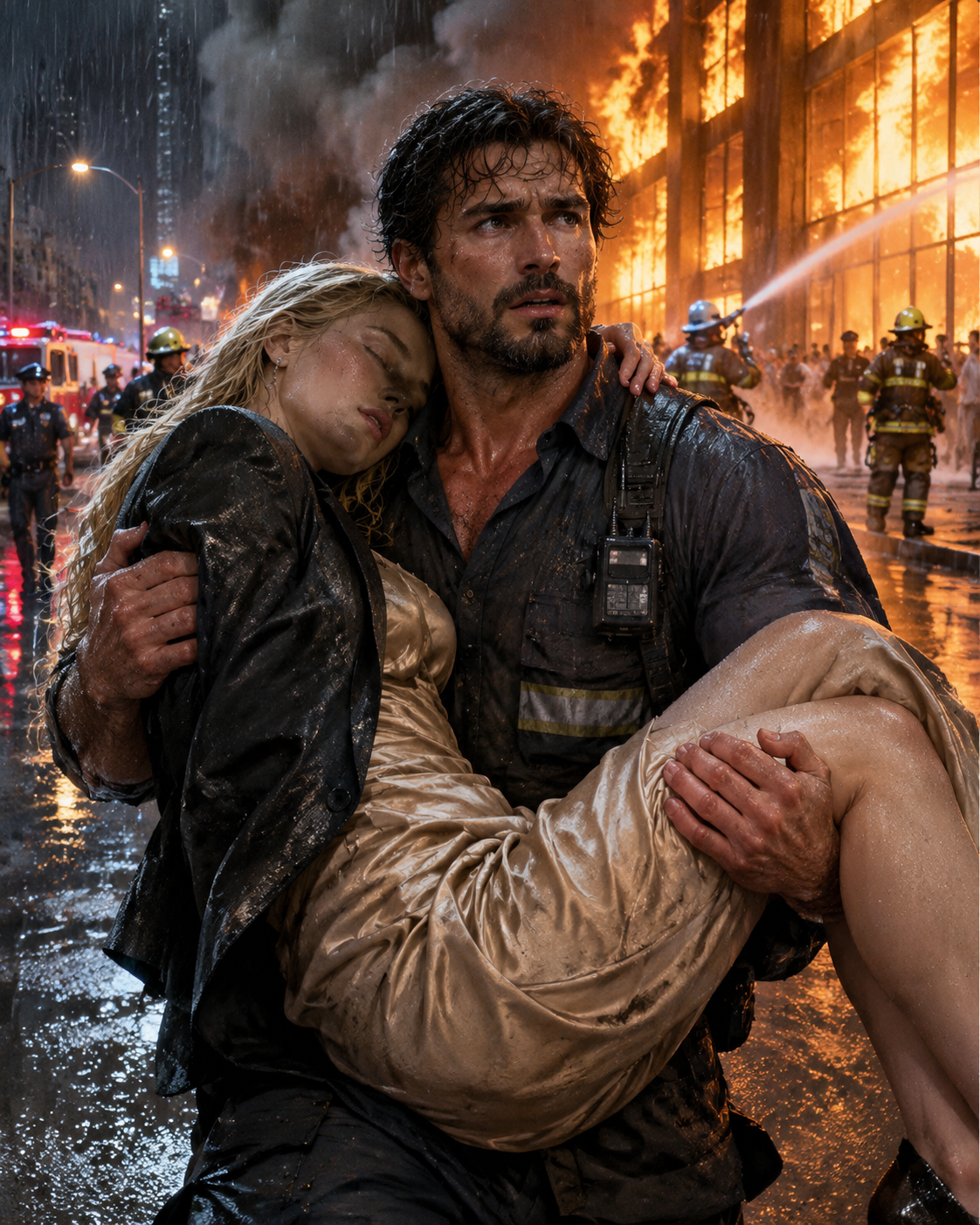
Sometimes it was carrying a frightened woman down twelve floors while smoke filled the corridor.
And sometimes it was putting your phone down when your daughter needed you.
That evening, Harper and I made dinner together.
She wanted spaghetti.
I burned the garlic bread.
She laughed so hard that she nearly spilled her juice.
After dinner, we sat at the kitchen table and worked on her school project.
She was writing about people who helped others.
I asked whether she wanted to write about firefighters, doctors, or teachers.
She shook her head.
“I want to write about you.”
I looked at her.
“Why me?”
“Because you helped people even when the hotel boss told you not to.”
I smiled.
“That’s not really what the project is about.”
“Then what is it about?”
She thought for a moment.
“Doing the right thing even when nobody wants you to.”
I didn’t have an answer.
She returned to her paper.
I watched her write for a while, then quietly went to the sink and washed the dishes.
Later that night, after she had gone to bed, I found her project on the kitchen table.
At the top, she had written:
“My dad helps people stay safe. But he also helps me feel safe. That’s why I think he’s a hero.”
I stood there for a long time.
Then I folded the paper carefully and placed it beside the letter from Tessa and the original inspection report.
The Grand Crest incident had changed my career.
It had exposed people who believed money and influence could make safety rules optional.
It had reminded me that the skills I learned in the military still had a place in civilian life.
But the most important thing it had done was bring me back to the reason I had left in the first place.
Harper.
The next morning, I drove her to school.
At the entrance, she turned around.
“Daddy?”
“Yeah?”
“You’re coming to my presentation tomorrow, right?”
I smiled.
“I wouldn’t miss it.”
She ran inside.
I waited until she disappeared through the doors before returning to my car.
My phone buzzed with another work email.
I glanced at it, then put the phone away.
There would always be another inspection.
Another building.
Another person who needed someone willing to speak up.
But there was only one childhood Harper would ever have.
And I wasn’t going to miss it.
I started the engine and drove home, knowing that for the first time in a long while, I had found a way to do both: protect the people who needed me at work and be there for the little girl who needed me most at home.