My younger sister stood in front of hundreds of people at our college graduation, delivering a speech I had written.
“I believe there’s someone here we need to hear from.”
My hands began to shake.
Dr. Vance looked down at the original document, then slowly raised his eyes toward the graduating class.
“The speech submitted to our office three weeks ago was written by a graduating student named Emily Parker. The original submission includes her name, her student identification number, and the timestamp of the file’s creation.”
A murmur spread through the auditorium.
My name.
He had said my name.
Chloe stood frozen beside the podium.
Dr. Vance continued.
“Our records also show that the speech was submitted by Emily herself, reviewed by Dr. Sutton, and approved for consideration as the student commencement address. However, the final version presented to our office was submitted under a different student’s name.”
He paused.
“That student is Chloe Parker.”
Hundreds of heads turned toward my sister.
My mother immediately stood up.
“There’s been a misunderstanding,” she called.
Dr. Vance looked in her direction.
“Ma’am, please allow us to finish.”
My mother’s face turned red.
Chloe stepped toward the microphone.
“I didn’t steal anything. Emily gave me permission to use it.”
I felt my stomach drop.
That was the lie I had been expecting.
Dr. Vance glanced at Dr. Sutton.
She stood, holding a folder.
“Emily did not give permission,” she said firmly. “I worked directly with her on the original speech. I have the drafts, revision history, email correspondence, and the recorded feedback sessions.”
Chloe’s expression changed.
Dr. Sutton continued.
“Emily wrote this speech over several weeks. She discussed her experiences working overnight shifts, helping support her education, and struggling to balance her academic responsibilities with financial obligations. Those experiences were central to the piece.”
She looked directly at Chloe.
“None of those experiences belong to you.”
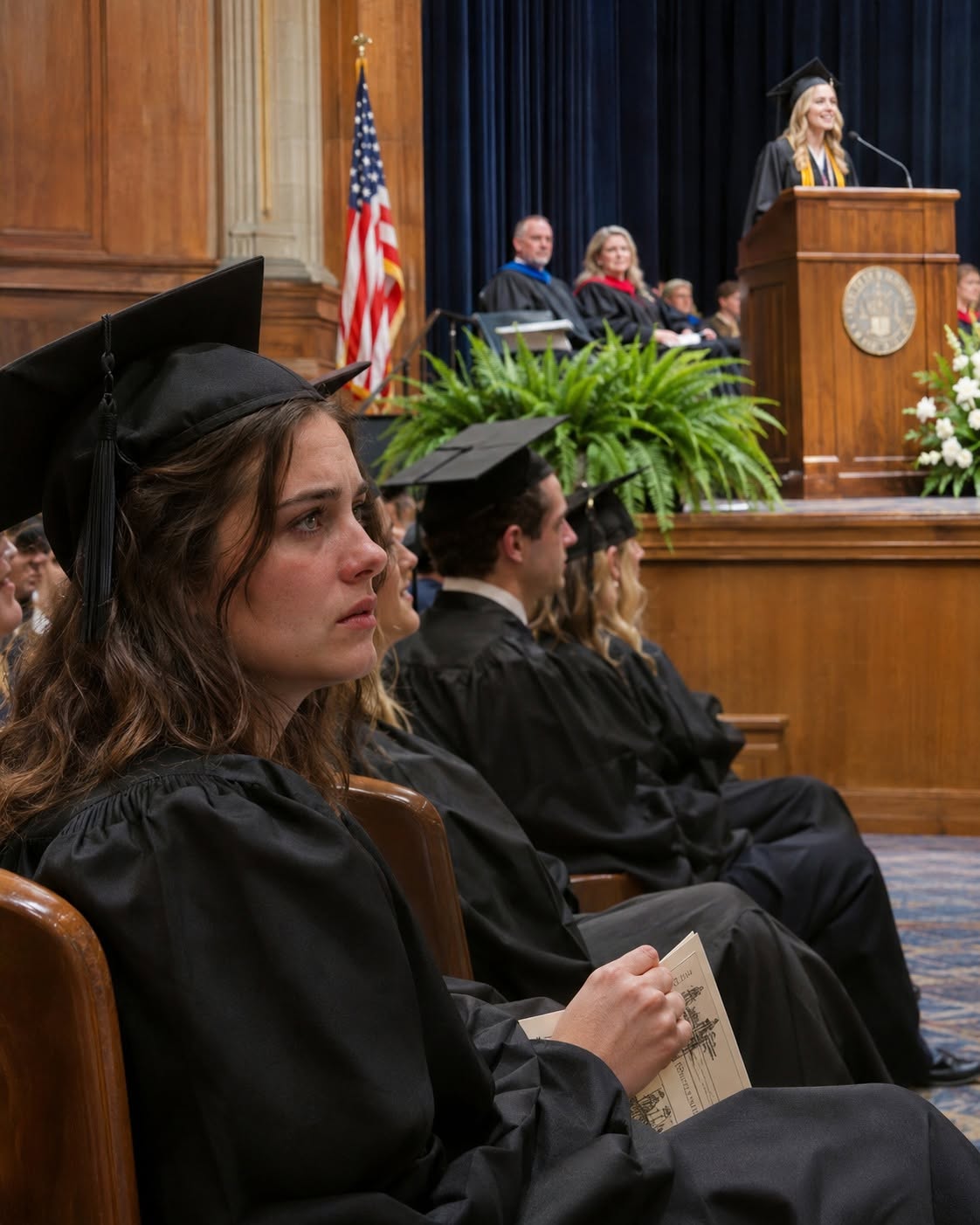
The auditorium became completely silent.
Then Dr. Vance turned toward me.
“Emily Parker, would you please join us at the podium?”
For a moment, I couldn’t move.
My classmates began turning in their seats.
A girl from my economics class reached over and squeezed my hand.
“Go,” she whispered.
I stood on unsteady legs.
My parents watched me walk toward the stage.
Mom looked furious.
Dad looked as though he wanted to disappear.
Chloe stepped away from the microphone as I climbed the stairs.
When I reached the podium, Dr. Vance shook my hand.
“I’m sorry this happened,” he whispered.
I looked out at the audience.
Hundreds of people were staring at me.
Some were curious. Some looked uncomfortable. Others seemed genuinely angry on my behalf.
I could see my parents in the third row.
I could see Chloe standing behind the podium, gripping the edge of the stage.
I took a breath.
“I don’t know exactly what I’m supposed to say right now.”
A few people laughed softly.
I looked down at the pages Dr. Vance had handed me.
It was my original speech.
My handwriting was visible in the margins.
Then I looked up again.
“But I do know that I wrote something because I wanted people like me to feel seen.”
My voice trembled.
“And I don’t want what happened today to take that away.”
The auditorium remained quiet.
I unfolded the first page.
Then I began reading.
“Some of us came to class after working all night.
Some of us learned to calculate tuition payments before we learned to calculate our dreams.
Some of us studied in break rooms, on buses, and at kitchen tables while the rest of the world slept.”
I paused.
“I wrote those words because I know what it feels like to be exhausted and still have to keep going.”
My voice grew stronger.
“I know what it feels like to watch classmates leave campus for vacations while you’re heading to another shift. I know what it’s like to wear the same shoes for three semesters because buying a new pair means delaying a textbook purchase.”
A few students nodded.
I continued.
“But I also know that those experiences don’t make us less deserving of being here. They don’t make our accomplishments smaller. And they certainly don’t make our voices less important.”
I looked toward the back of the auditorium.
My mother was whispering urgently to Dad.
I forced myself to look away.
“Today, we’re all graduating with different stories. Some of us had support. Some of us had to create our own. Some of us had people cheering for us from the beginning. Others had to learn how to cheer for themselves.”
My throat tightened.
“But every person sitting in this room earned the right to be here.”
I reached the final paragraph.
“Never be ashamed of the road that brought you here. The nights you spent studying, the jobs you worked, the sacrifices nobody saw, and the moments you almost gave up are all part of your story.”
I looked at my classmates.
“And don’t let anyone convince you that your story is theirs to tell.”
I lowered the pages.
For one second, there was silence.
Then the auditorium erupted.
People stood.
Students applauded.
Several professors rose from their seats.
I saw Dr. Sutton wiping her eyes.
I hadn’t expected any of it.
I stood at the podium, overwhelmed, listening to hundreds of people applaud words that had finally been spoken by the person who wrote them.
Then I noticed Chloe.
She was crying.
But I couldn’t tell whether she was ashamed or simply upset that the attention had shifted away from her.
Dr. Vance waited for the applause to settle.
“Thank you, Emily. And congratulations on an extraordinary speech.”
He turned toward the audience.
“Our university takes academic integrity seriously. We will review the circumstances surrounding the submission and address them through the appropriate process. But today, I want to make one thing clear.”
He gestured toward me.
“This student’s achievement deserves recognition.”
The applause began again.
I stepped away from the microphone.
As I descended the stairs, Dr. Sutton hugged me.
“You did beautifully,” she whispered.
I started crying.
Not because I was embarrassed.
Because for the first time in a long time, I felt like somebody had actually seen me.
But the day wasn’t over.
And neither was the damage my family had caused.
The confrontation after graduation
I had barely reached the hallway when my mother caught up with me.
“What on earth was that?”
I turned around.
“What was what?”
“You humiliated your sister in front of the entire university!”
I stared at her.
“Mom, she was standing at a podium reading my speech.”
“She was nervous! She didn’t know how to handle the pressure!”
“She had weeks to prepare.”
Dad approached from behind her.
“Emily, we need to talk privately.”
I laughed in disbelief.
“Privately? You were perfectly comfortable letting her take credit for my work publicly.”
Mom grabbed my arm.
“Lower your voice.”
I pulled away.
“No. I’m done lowering my voice so everyone else can pretend nothing happened.”
Chloe appeared at the end of the hallway.
Her makeup was smeared, and her graduation gown was hanging crookedly.
“You got what you wanted,” she said.
I looked at her.
“What exactly did I want, Chloe?”
“To make me look like a thief.”
I stared at her for several seconds.
“You took my work, put your name on it, and delivered it to hundreds of people. What would you call that?”
She looked toward Mom.
Mom immediately stepped between us.
“Your sister has always admired you. She thought you would be happy to share something special with her.”
I couldn’t believe what I was hearing.
“Admiring me doesn’t mean stealing from me.”
Dad finally spoke.
“Enough. This is a family matter.”
I turned toward him.
“No, Dad. It became a university matter when she submitted my work under her name.”
He lowered his voice.
“You could have handled this without making a scene.”
I looked at him.
“Would you have said the same thing if I’d stood up there and accepted an award for something Chloe created?”
He didn’t answer.
I nodded.
“That’s what I thought.”
Then I walked away.
I didn’t attend the family lunch they’d planned.
I didn’t pose for the photographs my mother had arranged.
Instead, I went with Dr. Sutton and a few classmates to a small restaurant near campus.
We ordered burgers, fries, and milkshakes.
Nothing fancy.
But when someone raised a glass to celebrate my graduation, I smiled for the first time that day.
That evening, I received a message from Chloe.
It was a long paragraph.
She said she was sorry things had gotten out of control, but she insisted she hadn’t intended to hurt me.
She explained that our mother had suggested she deliver the speech because she was more confident in front of crowds.
Apparently, my parents believed Chloe had a better chance of being noticed by university officials and potential employers.
She ended with:
“You know how Mom and Dad are. They just wanted both of us to succeed.”
I read it twice.
Then I replied:
“You succeeded by taking something I created. I succeeded by telling the truth. Those are not the same thing.”
I blocked her number for the night.
The next morning, I received an email from the university.
The academic integrity office wanted to meet with me.
I wasn’t surprised.
Dr. Vance had promised an investigation, and now it was beginning.
I gathered every document I had.
The original drafts.
The emails.
The timestamps.
The notes from Dr. Sutton.
Even the photograph I’d taken of my printed speech on the kitchen table the night Chloe had picked it up.
At the meeting, two administrators asked me to explain how the speech had ended up in my sister’s possession.
I told them everything.
I explained that I’d brought the printed copy home because I wanted my parents to read it.
Chloe had taken an interest in it.
My mother had made a comment about how the speech might sound better coming from someone comfortable with public speaking.
At the time, I’d assumed it was just another dismissive remark about my personality.
I hadn’t realized they’d already been planning something.
One administrator asked whether I had ever given Chloe permission to use the speech.
“No.”
“Did you know she was submitting it?”
“No.”
“Did your parents know the speech was yours?”
I hesitated.
Then I answered honestly.
“Yes. They knew.”
The administrators exchanged a glance.
The investigation continued for another week.
During that time, Chloe began posting vague messages on social media about jealousy, family loyalty, and people who couldn’t stand seeing someone else succeed.
Several relatives contacted me.
One aunt said I should have protected my sister.
A cousin asked why I had to ruin her big day.
I stopped responding.
Then something unexpected happened.
A former classmate named Jordan sent me a screenshot.
It showed a message Chloe had posted in a private group chat several days before graduation.
She had written:
“Mom says the speech will make me look really good. Emily doesn’t care about this stuff anyway. She’d rather work than get attention.”
Another person had replied:
“Does Emily know you’re using it?”
Chloe answered:
“She’ll get over it.”
I stared at the screenshot.
It wasn’t proof of every detail, but it confirmed something important.
Chloe hadn’t accidentally crossed a boundary.
She had knowingly decided that my work was hers to use.
I sent the screenshot to the university.
Three days later, Dr. Sutton called.
“They’ve completed the initial review,” she said.
“And?”
“Chloe admitted that she submitted your speech without your permission.”
I sat down.
“She admitted it?”
“Yes. She initially claimed you had approved it, but the evidence contradicted her account.”
“What happens now?”
“Her graduation status isn’t affected because she’s already completed her academic requirements. However, the university has withdrawn the recognition associated with the student speaker selection and issued a formal finding regarding the unauthorized submission.”
I felt strangely empty.
I had expected to feel victorious.
Instead, I just felt tired.
Dr. Sutton continued.
“There’s something else. The president wants to meet with you.”
I frowned.
“Why?”
“He has an opportunity he’d like to discuss.”
The opportunity nobody expected
The following Monday, I met Dr. Vance in his office.
He stood when I entered and offered me a seat.
“Emily, first, I want to apologize.”
I shook my head.
“You didn’t do anything wrong.”
“Perhaps not personally, but the university should have verified the final speaker’s identity more carefully.”
He opened a folder.
“We’ve been discussing ways to recognize students whose educational journeys are often overlooked. Your speech brought an important issue to our attention.”
He explained that the university was considering a new annual program for students balancing employment, family responsibilities, and education.
They wanted to feature real student stories and provide additional support for those facing financial difficulties.
Then he looked at me.
“We’d like to invite you to help us develop the program.”
I was stunned.
“You mean write something?”
“Write, advise, speak, and help us reach students who might otherwise believe their struggles make them less capable.”
I looked down at the folder.
There was a modest paid fellowship attached to the position.
It wasn’t a fortune.
But it would give me experience, professional connections, and an opportunity to continue writing.
I accepted.
Over the following months, I worked with Dr. Sutton to develop the program.
We called it the Night Shift Scholars Initiative.
It provided small emergency grants, academic mentoring, and flexible support for students who worked substantial hours while attending school.
The first student we helped was a young mother named Denise.
She worked at a hospital cafeteria during the evening and attended classes during the day.
When she received her grant, she started crying.
“I was thinking about dropping out,” she admitted.
I sat beside her.
“I know how that feels.”
She looked at me.
“Does it get easier?”
I thought about the years I’d spent stocking shelves, counting every dollar, and trying to stay awake in morning lectures.
“Sometimes. But you get better at remembering why you started.”
She smiled.
That conversation meant more to me than the applause at graduation.
For the first time, my writing had become something larger than a personal achievement.
It was helping someone else keep going.
But back home, my family was struggling to accept what had happened.
Mom called nearly every Sunday.
At first, she wanted to discuss the university’s decision.
Then she wanted to know why I hadn’t defended Chloe publicly.
Eventually, she started asking when I planned to forgive everyone.
I always gave the same answer.
“I don’t know yet.”
One Sunday, she said, “Your sister feels like you stole something from her.”
I almost dropped my phone.
“What did I steal?”
“Her opportunity.”
I took a slow breath.
“Mom, she had an opportunity to write her own speech. She chose to use mine.”
“You know she’s always struggled with confidence.”
“So did I.”
Mom went quiet.
I continued.
“Do you remember how many times I asked you to come to my school events? How many times you said you were busy because Chloe had something more important?”
She sighed.
“That’s not fair.”
“Do you remember when I won the regional writing competition in high school?”
Silence.
“You told me not to make Chloe feel bad because she hadn’t won anything.”
Mom whispered, “I remember.”
“I worked hard for that award. I wanted you to be proud of me. Instead, I spent the evening reassuring my sister.”
She started crying.
I didn’t interrupt.
Then I said something I’d wanted to say for years.
“I don’t think Chloe is the only person who believes my accomplishments are less important than hers. I think you and Dad taught her that.”
Mom didn’t respond.
I ended the call gently.
That night, I cried.
Not because I regretted what I’d said.
Because I finally understood how long I’d been carrying it.
The truth about the family favorite
Several weeks later, Dad called.
He asked whether I could meet him for coffee.
I agreed.
When I arrived, he was already seated.
He looked older than I remembered.
For a while, we discussed ordinary things.
Work.
The weather.
The university program.
Then he put down his cup.
“Your mother and I argued about Chloe last night.”
I looked at him.
“About what?”
“About the graduation.”
He rubbed his forehead.
“She says you should have handled it privately. I told her I didn’t think you had much choice.”
I didn’t say anything.
Dad continued.
“I knew the speech was yours.”
I felt my stomach tighten.
“What?”
He looked down.
“When your mother suggested Chloe deliver it, I told her it was a bad idea. But she said Chloe needed something to feel proud of. She said you’d understand.”
I stared at him.
“And you let it happen?”
He nodded.
“I did.”
“Why?”
He took a long breath.
“Because your sister has always been difficult to reassure. Whenever she felt overlooked, the entire house revolved around making her feel better.”
I looked away.
“And I was easy to overlook.”
Dad’s eyes filled.
“Yes.”
For a moment, I couldn’t speak.
Then he said, “I thought you were strong enough to handle it.”
I laughed quietly.
“That’s what everyone says when they don’t want to help.”
He nodded.
“I know.”
He reached into his jacket and placed a small envelope on the table.
Inside was an old photograph.
It showed me at twelve years old, sitting at the kitchen table with a notebook.
I remembered that afternoon.
I’d written a short story about a girl who wanted to become a journalist.
Dad had taken the photograph.
On the back, he’d written:
“Emily, our future writer.”
I stared at it.
“I found it in the garage,” he said. “I should have encouraged you more.”
My eyes began to sting.
“You could have.”
“I know.”
He didn’t ask me to forgive him.
He didn’t defend Chloe.
He simply sat there, looking genuinely sorry.
And somehow, that made the conversation easier.
We finished our coffee.
Before leaving, he said, “I’m proud of you.”
I nodded.
“Thank you.”
I didn’t hug him.
Not yet.
But I kept the photograph.
The day Chloe finally told the truth
About two months later, Chloe contacted me.
Her message was short.
“Can we meet? Just the two of us. No Mom. No Dad.”
I almost ignored it.
Then I agreed.
We met at a small café near the university.
She arrived ten minutes late.
She looked different.
Less polished.
Less confident.
She sat across from me and wrapped both hands around her coffee cup.
“I know you probably hate me.”
“I don’t hate you.”
She looked surprised.
“I just don’t trust you right now,” I added.
She nodded.
“That’s fair.”
For several minutes, she stared at the table.
Then she spoke.
“I didn’t think the speech would become such a big deal.”
I raised an eyebrow.
“Chloe.”
“I know. That sounds terrible.”
She rubbed her eyes.
“Mom told me the university was looking for a speaker. She said you had written something really good and that I could deliver it better because I wasn’t nervous in front of people.”
I waited.
“She said you didn’t care about recognition. That you were happy just writing things privately.”
I felt something twist inside me.
“Did you believe her?”
Chloe looked up.
“Yes.”
“Why?”
She swallowed.
“Because it was easier than admitting I wanted something that belonged to you.”
That answer surprised me.
She continued.
“Everyone always said you were the responsible one. You got good grades. You worked. You paid your own way. People trusted you. I was always the one who needed help.”
I looked at her.
“So you took the one thing I had?”
She nodded.
“I wanted people to clap for me the way they clap for you when you do something impressive.”
I shook my head.
“Chloe, nobody was stopping you from doing something impressive.”
“I know that now.”
She reached into her purse and pulled out a folded sheet of paper.
It was a handwritten letter.
“I wrote this because I didn’t know how to say it.”
I unfolded it.
She apologized for taking the speech, for lying about my permission, and for letting our parents convince her that my work was something the family could redistribute.
She also acknowledged that she had benefited from years of favoritism.
At the bottom, she’d written:
“I wanted to be you for one day, and I ended up showing everyone exactly who I was.”
I read the sentence twice.
Then I folded the letter.
“Thank you for writing this.”
She began crying.
“Can you forgive me?”
I looked at her.
“I don’t know yet.”
She nodded.
“I understand.”
We sat together for another twenty minutes.
Before leaving, she asked whether I still planned to write.
I smiled faintly.
“Every day.”
She looked down.
“Good. You should.”
It was the first time she’d ever said that without comparing herself to me.
A different kind of graduation
The following spring, the university held its first Night Shift Scholars celebration.
We invited students, faculty, donors, and families.
I was asked to deliver the opening remarks.
When I walked onto the stage, I noticed something that made me stop.
In the front row sat my father.
Beside him was my mother.
And beside them was Chloe.
They hadn’t told me they were coming.
For a moment, I considered changing my speech.
I could have written something about forgiveness.
About family.
About second chances.
But I decided to keep it simple.
I looked out at the students.
“Last year, I stood in this auditorium and listened to someone else read my words.”
The room grew quiet.
“I remember feeling invisible. I remember wondering whether all those years of working, studying, and sacrificing had mattered if the people closest to me couldn’t recognize what I’d accomplished.”
I paused.
“Then I realized something. My story didn’t become valuable because someone applauded it. It was valuable because I lived it.”
A few students nodded.
I continued.
“There will be people who misunderstand your dreams. There may even be people who love you but don’t know how to support you. Some will underestimate you. Others may try to take credit for the work you do.”
I glanced briefly toward my family.
“But don’t let that make you smaller. Don’t let it turn you bitter. And don’t let anyone convince you that your voice belongs to them.”
I looked toward Denise, who was sitting with her young daughter.
“Your experiences matter. Your effort matters. And the work nobody sees still counts.”
The audience applauded.
This time, I didn’t need to look toward my parents to see whether they were proud.
I already knew what I’d done.
After the event, Chloe approached me.
“That was beautiful,” she said.
“Thank you.”
She hesitated.
“I’m glad you kept writing.”
I smiled.
“So am I.”
Mom hugged me.
Dad shook my hand before pulling me into an awkward embrace.
We took a photograph together.
It wasn’t perfect.
Nobody pretended the past hadn’t happened.
But it was honest.
And that was more than we’d managed in years.
What I learned about being heard
A year after graduation, I published an essay about working through college.
I titled it “The Hours Nobody Sees.”
I wrote about grocery store shelves, cold coffee, crowded buses, and the strange loneliness of being surrounded by people who didn’t understand how hard you were working just to stay in the room.
The essay was published in a regional magazine.
A few weeks later, it was shared by the university.
Then something unexpected happened.
I received an email from a woman in another state.
She was a single mother working two jobs while studying nursing.
She wrote that she’d been considering dropping out, but reading my essay made her feel less alone.
She ended with:
“Thank you for reminding me that my story isn’t something I need to hide.”
I printed the email and placed it beside the photograph Dad had given me.
Sometimes I still think about that graduation ceremony.
I remember Chloe standing at the podium, confidently reading words she hadn’t written.
I remember my mother’s warning look.
I remember Dad lowering his eyes.
And I remember Dr. Vance unfolding the original document.
For a long time, I believed the most important part of that day was the moment the truth came out.
But now I think it was something else.
It was the moment I walked toward the microphone.
I could have stayed seated.
I could have allowed the embarrassment to swallow me.
I could have let everyone else’s decisions determine whether I deserved to be heard.
Instead, I stood up and read my own words.
That changed more than my relationship with my sister.
It changed the way I saw myself.
My family still has difficult days.
My mother sometimes slips into old habits. Chloe occasionally struggles with feeling compared to me. Dad is still learning that being a good parent means showing up for both daughters, not simply praising the one who asks the least.
Forgiveness hasn’t made everything perfect.
It has simply given us a chance to build something more honest.
I don’t resent Chloe for having confidence anymore.
I only hope she learns that confidence doesn’t require taking something away from someone else.
And I don’t resent my parents for the applause they gave her.
I just wish they’d understood that I needed their encouragement, too.
Today, I still work hard.
I still write.
I still save money and drink too much coffee.
But I no longer feel that I have to earn the right to take up space.
My words belong to me.
My achievements belong to me.
And my voice is not something I have to surrender to keep the peace.
At the end of the day, that’s what I hope every student who hears my story remembers:
You don’t have to be the loudest person in the room to have something worth saying.
You don’t have to be the most confident person on stage to deserve the microphone.
And you should never allow someone else’s desire for recognition to erase the effort you’ve put into becoming who you are.
Because the people who truly love you won’t need you to disappear so they can shine.
They’ll make room for both of you.
And if they don’t, you can still stand up, take a breath, and tell your own story.
I spent years thinking my greatest accomplishment would be making my parents proud.
Now I know it was learning to be proud of myself, even when they weren’t watching.
That graduation day, my sister borrowed my words.
But she couldn’t take the life behind them.
And she couldn’t take away the voice I’d finally found.