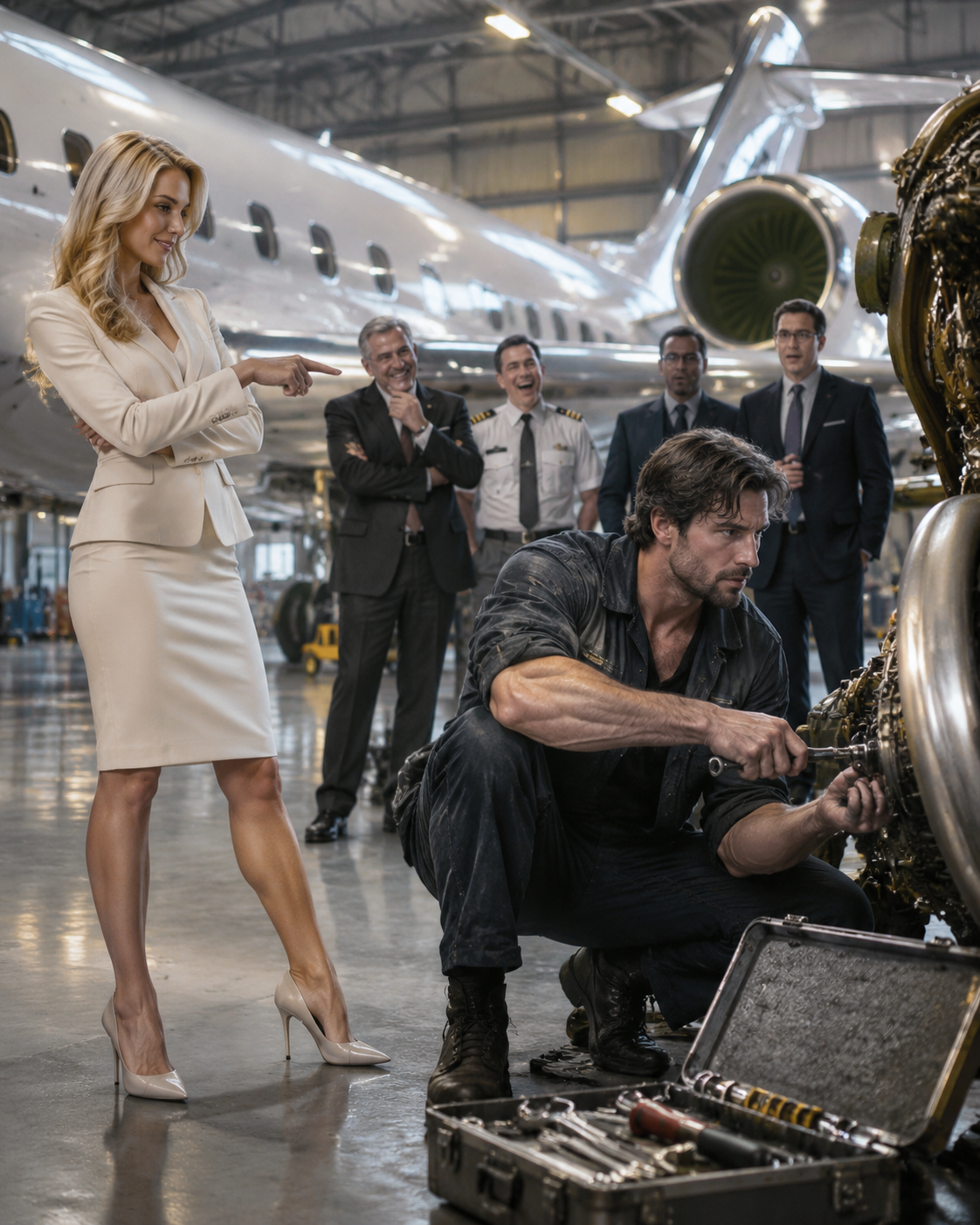
Three engineering teams had spent six hours trying to start an $85 million private jet. Then a billionaire CEO looked at my grease-stained uniform
I didn’t move for several seconds.
The hangar was still full of people, but suddenly I could barely hear them. The only thing I could focus on was the school secretary’s voice coming through my phone.
“Mr. Vance? Are you still there?”
“Yes. I’m here. Did you say a woman came to see me?”
“That’s right. She says she knows you from your previous work. She seems quite determined to speak with you.”
I looked at Genevieve.
She shook her head slowly.
“I haven’t sent anyone to the school,” she said.
I believed her. She might have been arrogant that morning, but she didn’t look like someone who was pretending to be confused.
“Can you tell me her name?” I asked.
The secretary paused.
“She gave us the name Eleanor Reed.”
My grip tightened around the phone.
For a moment, I forgot how to breathe.
Eleanor Reed.
I hadn’t heard that name in almost nine years.
“Mr. Vance?”
“Please don’t let her take Maya anywhere. Nobody leaves with my daughter unless I authorize it. I’ll be there as soon as I can.”
“Of course. Maya is safe in the office.”
I thanked her and ended the call.
The chief engineer was watching me.
“Is everything okay?”
“No,” I answered honestly. “I need to leave.”
Genevieve stepped forward.
“Lucas, I think we should talk.”
“Not now.”
“That name you mentioned. Adrian Vale. And this woman at your daughter’s school. Are they connected?”
I looked down at the photograph still in her hands.
“I don’t know. But I intend to find out.”
I collected my tools, secured the toolbox, and headed toward the employee parking area.
Genevieve followed.
“Take my car. Your truck will be slower.”
“I have my own transportation.”
“Lucas, please. This is important.”
I stopped beside my old pickup.
“Your meeting in New York is important. My daughter is important. Right now, only one of those things needs me.”
She looked at me for a moment, then nodded.
“You’re right.”
I drove away before anyone could ask another question.
The school was about twenty minutes from the hangar. I made it in fifteen.
Maya was sitting in the secretary’s office when I arrived. Her pink backpack was on the floor beside her chair, and she was drawing something on the back of an old worksheet.
She looked up as soon as I opened the door.
“Dad!”
I crossed the room and hugged her.
“Hey, peanut. You okay?”
She nodded against my shoulder.
“There’s a lady who says she knows you.”
“I heard.”
“She said you used to build airplanes.”
I pulled back slightly.
“What else did she say?”
Maya thought for a moment.
“She said you were really important a long time ago. Then she asked if I had any pictures of you when you were younger.”
My stomach tightened.
“Did you show her anything?”
“No. I told her all my pictures were at home.”
“Good.”
The secretary cleared her throat.
“She is waiting in the conference room. We asked her to remain there until you arrived.”
I thanked her.
Maya slipped her hand into mine.
“Are you in trouble, Dad?”
“No, sweetheart.”
“Then why do you look worried?”
Children notice more than adults think they do.
I crouched until we were eye level.
“Sometimes people from a long time ago come back. That doesn’t mean anything bad is going to happen. It just means I need to have a conversation.”
“Can I come?”
“Not this time. You can stay here with Ms. Carter. I’ll be right down the hall.”
Maya frowned but nodded.
I kissed her forehead and walked toward the conference room.
Eleanor Reed stood when I entered.
She was in her early sixties, with silver hair cut just below her ears. She wore a navy coat and carried a leather folder that looked as if it had been used for years.
She had barely changed.
“Lucas.”
“Eleanor.”
For a moment, neither of us said anything.
Then she looked toward the door.
“Is your daughter here?”
“She’s safe. That’s all you need to know.”
Eleanor accepted that answer.
“I understand.”
“You have some nerve showing up at my daughter’s school.”
“I know. I should have contacted you first.”
“Yes, you should have.”
She looked down at the folder in her hands.
“I didn’t know how else to find you. Your old address is gone. Your previous phone number no longer works. The company records say you left the industry years ago.”
“I did.”
“Adrian has been looking for you.”
I felt something cold settle in my chest.
“Adrian Vale is dead.”
“No.”
I stared at her.
Eleanor opened the folder and removed a letter.
“He is alive. He’s been living under medical supervision in Colorado for the last two years. His condition has become more complicated, and he asked me to find you.”
I didn’t take the letter.
“Why now?”
“Because he saw something.”
She placed a printed photograph on the table.
It was a picture of the private jet from the hangar. Someone had photographed it during an earlier development phase, when its exterior still carried the experimental registration markings.
Beneath the image was a technical document.
I recognized the layout immediately.
It was a revision record from the original engine control architecture.
My signature was at the bottom.
Eleanor continued.
“Adrian reviewed the aircraft’s maintenance history after hearing that it had been grounded. He recognized the prototype identifier. When he learned someone had repaired the fault using the original grounding architecture rather than replacing the computer modules, he asked whether the mechanic was Lucas Vance.”
I sat down.
“He remembered?”
“He never forgot you.”
I looked at the document again.
There were things about those years I hadn’t thought about in a long time. Long nights in engineering labs. Test flights that ended with everyone waiting silently for a single reading. Adrian’s habit of carrying a battered notebook everywhere.
And the last conversation we had.
I had been standing in his office with a resignation letter in my hand.
He had asked me to wait.
I had told him I couldn’t.
Maya’s mother, Sarah, had been diagnosed with an aggressive illness. Our daughter was barely a year old, and the treatment schedule had turned our home into a place of appointments, medication, and sleepless nights.
I was being offered a position that would have taken me overseas for months at a time.
I declined it.
Then Sarah died.
And the world I had built around airplanes suddenly felt very far away from the world I needed to survive.
Adrian had offered help. He had even suggested that I bring Maya to live near the research facility.
But I couldn’t keep asking people to rearrange their lives around my tragedy.
I left.
I sold what I could, moved closer to family, and eventually found work maintaining aircraft.
The pay was modest, but the hours were predictable enough to raise my daughter.
I had never regretted choosing Maya.
I had regretted how abruptly I disappeared from the lives of people who had once mattered to me.
“Why didn’t he contact me himself?” I asked.
Eleanor lowered her eyes.
“Because he was ashamed.”
“Of what?”
“Of what happened to the program.”
I looked up.
She took another paper from the folder.
“After you left, Adrian continued working on the next generation of engine control systems. The project was eventually acquired by a consortium that wanted to commercialize the architecture. Several modifications were made without his approval. He raised concerns about electrical isolation and fault protection.”
I felt my shoulders stiffen.
“That system was never supposed to operate with those modifications.”
“I know. Adrian tried to stop it.”
“What happened?”
“A test aircraft experienced an electrical failure during ground testing. Nobody was seriously injured, but the incident ended the program. The company blamed Adrian for approving the original architecture.”
“That makes no sense.”
“He had refused to approve the final modifications. But the documentation was changed.”
I stared at her.
I remembered the original design. I remembered Adrian insisting that every modification be documented, every revision independently checked, and every safety-critical connection physically verified.
He was difficult to work with because he refused to accept convenient answers.
He had taught me that the smallest electrical irregularity deserved as much attention as a failed engine.
That lesson had helped me find the fault in Genevieve’s jet.
“Why are you telling me this?”
“Because the consortium is now involved in Genevieve Thorne’s expansion deal. They want to use the updated version of that architecture in a new fleet of aircraft.”
I leaned back.
There it was.
The real reason someone had finally come looking for me.
“Does Genevieve know?”
“Not yet. But she will.”
I looked toward the hallway where Maya was waiting.
“I don’t want to be involved in another corporate fight.”
Eleanor nodded.
“I understand.”
“No, I don’t think you do. I have a child. I can’t disappear for six months to help someone repair their reputation. I can’t spend every evening arguing with lawyers or executives. I already know what happens when a career becomes more important than the people waiting at home.”
“Lucas, Adrian isn’t asking you to abandon your daughter.”
“Then what is he asking?”
Eleanor pushed the letter toward me.
“He’s asking you to read this.”
I finally picked it up.
The handwriting was shaky but familiar.
Lucas,
If Eleanor has found you, I suppose I have run out of excuses.
I owe you an apology. You were right to leave when you did. I should have understood that the work could wait and your family could not.
I have spent years telling myself that the original project would be remembered accurately once the facts came out. That was foolish.
I was wrong about several things. I was wrong to believe that good engineering would always be protected by good people. I was wrong to assume that the truth would defend itself.
But I was never wrong about you.
You understood the machine better than anyone I ever trained. More importantly, you understood that every machine eventually carries someone else’s life in its hands.
I need you to look at the records before the next aircraft leaves the ground.
Not for me.
For the people who will be inside it.
Adrian.
I read it twice.
Then I folded it carefully.
“I’ll think about it.”
Eleanor nodded.
“That’s all he asked.”
I stood and walked back toward Maya.
She immediately noticed the paper in my hand.
“Is it bad news?”
“Not exactly.”
“Then what is it?”
I smiled faintly.
“An old friend needs some help.”
Maya picked up her backpack.
“Are you going to help him?”
“I don’t know yet.”
She considered that answer.
“Can he wait until after dinner?”
I laughed for the first time that afternoon.
“That’s a pretty good question.”
We went home together.
That evening, I made grilled cheese sandwiches and tomato soup. Maya sat at the kitchen counter, telling me about a science project involving small electric motors.
She had built a cardboard model of a wind turbine.
The blades were uneven, and the little motor barely turned, but she was proud of it.
“Look, Dad. If I blow on it, it spins.”
I leaned over.
“That’s a good start. But see this connection here? It’s loose.”
She frowned.
“Can you fix it?”
“Let’s fix it together.”
We spent twenty minutes adjusting the wires and securing the motor.
When the blades finally turned, Maya clapped.
“You’re the best mechanic in the world.”
I looked at the little machine.
“No, I’m just your dad.”
She grinned.
“Same thing.”
After she went to bed, I sat at the kitchen table with Adrian’s letter.
I hadn’t realized how much I missed engineering until I held those old documents again.
Not the money. Not the prestige. Not the long meetings or the expensive offices.
I missed solving problems that mattered.
But I also knew that going back into that world could change everything.
My phone rang at 9:43 p.m.
The number was unfamiliar.
I answered.
“Lucas Vance.”
A man’s voice came through.
“Lucas. It’s Adrian.”
I closed my eyes.
“Hello, old man.”
He laughed weakly.
“I was beginning to think you would never answer.”
“I didn’t know you were looking.”
“I should have looked sooner.”
We were silent for a moment.
Then he said something I hadn’t expected.
“Did you fix the jet?”
“Yes.”
“How?”
I described the connector, the recessed terminal, and the intermittent grounding fault.
He listened without interrupting.
When I finished, he gave a quiet laugh.
“Of course. You always did have an eye for the things everyone else stepped over.”
“How are you, Adrian?”
“Not as good as I would like.”
“I’m sorry.”
“Don’t be. I’ve had a long life and a stubborn head. Both have served me reasonably well.”
I smiled.
Then his voice became serious.
“Lucas, the aircraft you repaired is part of something bigger. I don’t want to frighten you, but the new control architecture has been modified again. There are reports of intermittent electrical faults in two other aircraft.”
“Have they been grounded?”
“One has. The other is scheduled for a demonstration flight next week.”
I stood up.
“Who approved it?”
“That’s what we need to find out.”
I looked toward Maya’s bedroom.
“Adrian, I can’t promise anything.”
“I know.”
“I won’t travel constantly. I won’t let anyone use my name without my permission. And my daughter comes first.”
“Good.”
He sounded almost relieved.
“Those are the conditions I should have asked you to make years ago.”
The following morning, Genevieve arrived at the maintenance hangar before I did.
She was standing beside the aircraft with the chief engineer when I walked in.
“Lucas.”
“Morning.”
“I postponed my meeting in New York.”
I looked at her.
“You didn’t have to do that.”
“I did after reviewing the original technical records.”
She handed me a folder.
Inside were copies of the aircraft’s original design documentation, several maintenance reports, and a list of recent electrical irregularities reported by other operators.
“These came from the consortium,” she said. “They were supposed to be routine technical reviews. But the reports are incomplete.”
I examined the pages.
There were familiar signatures and unfamiliar revision numbers.
One document had been altered after approval.
I looked up.
“Who gave you these?”
“Our engineering department. I requested a complete audit after your repair.”
“Why?”
“Because you found a fault three teams missed. And because the photograph made me realize I might be looking at someone who understands the original system better than the people currently responsible for it.”
She paused.
“I also owe you an apology.”
I waited.
“What I said yesterday was disrespectful. I judged you by your clothes and your job title. That was wrong.”
“Thank you.”
“I’d like you to help us review these reports.”
“I have conditions.”
She nodded.
“I assumed you would.”
“I work on a schedule. I have a daughter. I won’t travel without planning, and I won’t put my name on a technical decision unless I have personally reviewed the evidence.”
“Agreed.”
“And I don’t work for free.”
A small smile crossed her face.
“That would have been my next question.”
She offered me a consulting agreement with a reasonable hourly rate, a limited schedule, and no obligation to accept work outside my availability.
I read every page.
For once, nobody seemed offended that I wanted to understand the details before signing.
I took the agreement home.
Maya was at the kitchen table doing homework when I showed her the papers.
“What’s that?”
“A job opportunity.”
“Does it mean you’ll be away?”
“Not much. And only when we plan it.”
She studied my face.
“Do you want to do it?”
I thought about the aircraft, the design documents, and the people who might eventually depend on the system.
“I think I do.”
“Then you should.”
I smiled.
“Just like that?”
“Well, you can still pick me up from school.”
“That’s an important condition.”
She nodded seriously.
“It is.”
I signed the agreement the following morning.
The first week was difficult.
I spent several hours reviewing the original control architecture and comparing it with the newer revisions. The changes looked small on paper, but several affected how electrical faults were isolated and detected.
Some modifications were reasonable improvements.
Others were not.
The most concerning issue involved a diagnostic bypass that had been introduced to reduce nuisance warnings during testing.
The original design required the system to remain sensitive to certain grounding irregularities, even when they appeared briefly.
The newer revision allowed those warnings to be suppressed under specific operating conditions.
On paper, the change made the system look more reliable.
In practice, it could hide an intermittent fault.
I called the chief engineer.
“We need to stop the demonstration until this is reviewed.”
He sounded uncomfortable.
“That’s a major decision.”
“It’s a safety decision.”
“Genevieve has investors arriving.”
“Then she can explain why she chose caution over a demonstration.”
He was silent.
I sent Genevieve the report.
She called ten minutes later.
“How serious is it?”
“Serious enough that I won’t approve the aircraft for demonstration until the review is complete.”
“Can we repair it?”
“Possibly. But first we need to understand why the modification was approved.”
She sighed.
“The consortium says the revision was reviewed by its technical committee.”
“Then we need the committee’s records.”
“You’re asking me to challenge a partner in the middle of a major deal.”
“I’m asking you not to put people in an aircraft when we haven’t established whether the system can identify a known fault.”
She didn’t answer immediately.
Then she said, “The demonstration is postponed.”
That afternoon, the consortium sent two representatives to the hangar.
One was a lawyer.
The other was a senior technical director named Martin Hale.
He looked at my work clothes and then at my name badge.
“You’re the mechanic who raised the concern?”
“I’m the engineer reviewing the original architecture.”
He gave a thin smile.
“Your employment records say maintenance technician.”
“My employment records also say I haven’t worked in aerospace development for several years. That doesn’t change what I know.”
Genevieve stood beside us.
“Mr. Hale, Lucas has identified a discrepancy in the approved revisions.”
Martin opened his briefcase.
“Our committee has already reviewed those revisions.”
“Then it should be easy to provide the supporting records,” I said.
He looked irritated.
“These documents are proprietary.”
“I’m not asking for your entire company archive. I’m asking for the revision history and the test evidence supporting a safety-critical change.”
He closed the briefcase.
“We’ll get back to you.”
They left without providing anything.
Genevieve watched them walk away.
“That wasn’t encouraging.”
“No.”
“Do you think they knew?”
I looked at the documents.
“I think someone knew enough to avoid asking questions.”
For the next several days, I worked through the available records. Adrian joined remotely when his health allowed. Sometimes we spent an hour discussing a single technical detail.
He remembered the original design better than anyone.
But his memory wasn’t enough.
We needed records.
Eleanor eventually arranged a meeting with the retired engineers who had worked on the original program.
Several had kept private notebooks and archived correspondence.
One of them, a former electrical systems specialist named Thomas Bell, remembered the disputed modification.
He had objected to it during the original review.
His notes showed that the change had been introduced after a failed test, when the company was under pressure to meet a delivery deadline.
The warning suppression had been described as temporary.
It was never removed.
Worse, the final approval document listed Adrian as having accepted the change.
Thomas’s notebook contained the original meeting notes showing that Adrian had refused.
That was the first concrete evidence that the records had been altered.
I brought the documents to Genevieve.
She read them quietly.
“Can we prove this?”
“With the original files and the testimony of the people who attended the meeting, yes. But we’ll need an independent technical review.”
“How long?”
“Long enough to do it properly.”
She nodded.
“I’ll arrange it.”
Then she asked something unexpected.
“Lucas, if all this becomes public, are you prepared for what follows?”
I looked at her.
“What do you mean?”
“Your name will be everywhere. People will want interviews. The company may challenge you. Investors will ask questions. Adrian’s history will become news again.”
I thought about Maya’s school, our little house, and the quiet routine we had built.
“No.”
Genevieve seemed surprised.
I continued.
“I’m prepared to tell the truth. I’m not prepared to turn my daughter into part of a public story.”
She nodded slowly.
“Then we keep her out of it.”
That was the first time I began to respect her.
Not because she was wealthy or powerful, but because she finally understood that not every person wanted to be seen.
The independent review began the following week.
The team confirmed that the diagnostic bypass could conceal certain intermittent grounding faults under specific conditions. They recommended suspending use of the affected configuration until the system could be corrected and verified.
The consortium disputed the findings.
Its representatives argued that the system had passed previous tests.
But passing a test did not prove that every possible failure condition had been addressed.
The review team requested the original approval records.
That was when the altered documentation became impossible to ignore.
Thomas Bell provided his notebook.
Two retired engineers supplied matching meeting records.
Adrian’s archived correspondence showed that he had formally rejected the modification years earlier.
And the consortium’s final approval document carried a digital revision date that did not match the original file history.
The investigation widened.
Several aircraft were temporarily grounded while their configurations were reviewed.
No one was celebrating.
The process was expensive, inconvenient, and uncomfortable for everyone involved.
But the airplanes stayed on the ground until the necessary checks were complete.
Genevieve’s expansion deal was delayed.
Investors complained.
Her board questioned the decision.
And Martin Hale publicly maintained that the company had acted responsibly.
Then he requested a private meeting with me.
I refused.
I had no interest in discussing technical findings behind closed doors with someone whose organization had withheld the supporting records.
My lawyer advised me to keep all communication documented.
I followed that advice.
For the first time in years, my name appeared in industry publications.
They called me the missing engineer.
Some described me as a forgotten genius. Others wrote about the mechanic who had embarrassed a billionaire.
I disliked both descriptions.
I wasn’t a genius.
I was a father who had spent years learning how to keep machines working.
And I hadn’t embarrassed Genevieve.
She had done that to herself.
One afternoon, Maya came home from school holding a newspaper clipping.
“Is this you?”
I looked down.
It was an article with a photograph of me standing beside the jet.
The headline mentioned the retired aerospace engineer who had returned to challenge a major aviation company.
I sighed.
“Yes.”
Maya read the headline again.
“Why does it say you’re a mechanic?”
“Because I am.”
“But you also build airplanes.”
“I helped design part of one.”
She looked puzzled.
“Then why don’t they just say that?”
I laughed.
“Newspapers like short descriptions.”
She placed the clipping on the refrigerator.
“Can I keep this?”
“Sure.”
She stepped back to examine it.
“Mom would have liked this.”
The words caught me off guard.
Maya didn’t mention her mother every day, but when she did, I never wanted to rush past the moment.
“I think she would have,” I said.
“She always said you were good at fixing things.”
I swallowed.
“She did.”
Maya went back to her homework.
I stood in the kitchen for a while, looking at the photograph.
For years, I had thought leaving aerospace meant leaving that part of myself behind.
Maybe it hadn’t.
Maybe I had simply been using the same skills in a different way.
A month later, the independent review reached its preliminary conclusion.
The affected aircraft required software and hardware revisions, followed by extensive verification testing. The original architecture itself was sound, but the undocumented modifications had introduced weaknesses that could not be ignored.
The consortium agreed to implement corrective measures under independent supervision.
The deal Genevieve had been negotiating was not abandoned, but it was restructured. The safety requirements became part of the contract rather than a separate technical promise.
Martin Hale resigned before the final review was published.
The company announced an internal investigation into the altered records.
Adrian’s name was formally cleared of responsibility for the original incident.
When Genevieve called to tell me, I was sitting on the floor helping Maya assemble a science project.
“Lucas, it’s official.”
I set down the screwdriver.
“What is?”
“Adrian has been cleared. The technical record has been corrected. The review board acknowledged that he objected to the modification.”
I closed my eyes.
“Good.”
“He wants to speak with you.”
“Put him through.”
A familiar voice came over the speaker.
“Well, Lucas. It appears we finally managed to get something right.”
I smiled.
“Only took us a few years.”
He laughed, then began coughing.
I waited.
When he recovered, he said, “I want you to come to Colorado.”
“I can’t promise a long visit.”
“I wasn’t asking for one.”
“Then what are you asking?”
“Come have dinner. Bring Maya if she’d like to meet the old man who taught her father how to read wiring diagrams.”
I looked at my daughter.
She had stopped working and was listening.
“Can I go?” she whispered.
I smiled.
“We’ll see what the schedule looks like.”
We arranged a weekend visit.
The flight to Colorado was Maya’s first time traveling on a private aircraft. Genevieve had offered to arrange transportation, but I declined the private jet and booked ordinary commercial tickets.
She teased me about it.
“After everything you’ve done, I thought you’d want the luxury.”
“I want a flight that gets us there safely and on time.”
“Fair enough.”
Adrian was waiting at the rehabilitation center when we arrived.
He looked older than I remembered. His shoulders were thinner, his hands trembled slightly, and he moved with the help of a cane.
But his eyes were the same.
When he saw me, he stood.
For a second, neither of us spoke.
Then he held out his hand.
I shook it.
“Good to see you.”
“Good to see you too.”
He looked at Maya.
“And you must be the young woman who kept your father away from the rest of us.”
Maya frowned.
“I didn’t keep him away. I just needed him.”
Adrian’s expression softened.
“That’s a very good reason.”
She shook his hand.
“Are you the airplane man?”
He laughed.
“One of them.”
“My dad says you taught him things.”
“I did. But he taught me a few things too.”
Maya looked at me.
“Like what?”
Adrian thought for a moment.
“How to listen when a machine tells you something is wrong, even when the numbers say everything is fine.”
I smiled.
“That’s not exactly how I remember it.”
“That’s because you were usually too busy arguing with me.”
Maya giggled.
We spent the afternoon talking.
Adrian showed her photographs from the early development days. He explained how engineers tested small components before assembling larger systems.
Maya was fascinated by the photographs of the experimental aircraft.
At one point, she pointed to a picture of me standing beside Adrian.
“Dad, you look so young.”
“I was.”
“Were you always wearing those shirts?”
Adrian laughed so hard that he had to sit down.
I shook my head.
“Some things never change.”
Before we left, Adrian asked to speak with me privately.
Maya stayed with Eleanor in the common room.
He handed me a small wooden box.
Inside was a collection of old engineering notes, a few photographs, and a brass nameplate from the original research facility.
The plate read:
LUCAS VANCE
ENGINE CONTROL SYSTEMS
I stared at it.
“You kept this?”
“I thought you might want it.”
“I don’t know what I’d do with it.”
“Put it somewhere you can see it.”
I turned the nameplate over in my hands.
“Adrian, I don’t want to go back to the life I had before.”
He nodded.
“I wouldn’t ask you to.”
“I don’t want to become a public figure. I don’t want to run a company. I don’t want to spend every waking hour proving something to people who don’t know me.”
“Then don’t.”
I looked at him.
He continued.
“Lucas, the mistake I made was thinking that the work was the most important thing. It wasn’t. The work mattered because people mattered. You understood that before I did.”
He leaned back.
“I’d like you to help train the next generation of engineers. Not full-time. Not as a corporate executive. Just teach them how to think carefully. How to question a reading. How to respect a maintenance technician who notices something everyone else missed.”
I looked down at the box.
“That’s something I could consider.”
He smiled.
“Good.”
On the flight home, Maya fell asleep against my shoulder.
I watched the clouds pass outside the window.
My life wasn’t suddenly perfect.
I still had bills to pay. I still worked long shifts. Maya still needed help with homework, lunches, and the occasional science project that seemed to require an unreasonable number of cardboard boxes.
But something had changed.
I no longer felt that the person I had been before Sarah died was someone I needed to hide.
I could be a father and an engineer.
I could maintain aircraft and teach people how to design them.
I could have a past without allowing it to take away the present.
Three months later, I began teaching one afternoon each week at a small aerospace training program.
The students came from different backgrounds. Some had engineering degrees. Others had worked in maintenance shops for years.
I treated them all the same.
I started with the basics.
Read the records.
Understand the system.
Check the obvious things before replacing expensive components.
And never assume that a warning light is the problem itself.
One student asked me why I spent so much time talking about maintenance.
I told him that the person who designed a system and the person who maintains it should never be treated as strangers.
They are both responsible for the people who depend on it.
He wrote that down.
I hoped he remembered it.
Genevieve eventually offered me a permanent position as an independent technical adviser.
I declined the full-time role but agreed to continue consulting under my own terms.
She didn’t argue.
Instead, she asked whether I would consider helping her establish a program that gave experienced maintenance workers a path into engineering development.
The idea interested me.
Too many talented people were overlooked because their job titles didn’t match their abilities.
We began planning a pilot program with several technical schools and aviation maintenance facilities.
It wasn’t glamorous.
There were funding meetings, scheduling problems, disagreements over course materials, and more paperwork than I cared to read.
But it was useful work.
And it allowed people who had spent years solving real problems to bring that experience into the design process.
Genevieve also changed.
Not overnight.
She was still demanding, impatient, and sometimes difficult to work with. But she began asking more questions before making decisions.
And whenever someone dismissed a mechanic’s concern because of a uniform or job title, she remembered our first meeting.
One afternoon, I found her standing beside the photograph of my toolbox that had been included in the training program’s opening presentation.
“Is that Maya?” she asked.
“Yes.”
“She’s grown.”
“Children do that.”
Genevieve smiled.
“She looks happy.”
“She is.”
We stood quietly for a moment.
Then she said, “I was wrong about you.”
I shook my head.
“You were wrong about what a mechanic could be.”
She considered that.
“That’s fair.”
The program’s first class graduated the following spring.
Maya attended the small ceremony with me.
She was ten now, and she had become increasingly interested in engineering. She still liked drawing, but she also enjoyed building little electronic projects.
When the students received their certificates, she clapped louder than anyone.
Afterward, one of the graduates approached me.
He was a young man who had worked in aircraft maintenance for six years before joining the program.
“Mr. Vance, I wanted to thank you.”
“For what?”
“For not making me feel like I had to pretend I was someone else to become an engineer.”
I didn’t know what to say.
So I shook his hand.
“Keep asking questions. That’s the important part.”
He smiled.
“I will.”
On the drive home, Maya asked whether I was proud of the graduates.
“Very.”
“Are you proud of yourself?”
I glanced at her in the rearview mirror.
“Sometimes.”
“Why only sometimes?”
I thought about it.
“Because there are still things I wish I’d done differently.”
She was quiet for a moment.
Then she said, “You can’t fix everything.”
I smiled.
“That’s true.”
“But you fix what you can.”
I looked at her in the mirror again.
She had been listening all those years.
More than I realized.
When we got home, she helped me carry the toolbox from the truck.
The old photograph of her was still taped inside the lid.
It had faded around the edges, and one corner had begun to peel away.
Maya noticed.
“That’s a really old picture of me.”
“It is.”
“Can we put a new one there?”
I looked at the photograph.
“Sure.”
She ran inside and returned with a picture from the graduation ceremony.
It showed the two of us standing together, her arm around my waist and my hand resting on her shoulder.
I removed the old photograph carefully.
For a moment, I hesitated.
That little picture had been with me through some of the hardest years of my life.
Then I placed it in the wooden box Adrian had given me and taped the new one inside the toolbox.
Maya stepped back to admire it.
“Much better.”
I closed the lid.
That evening, I received a message from Adrian.
It was short.
He had seen the graduation photographs and wanted to know whether I had finally stopped arguing with students about wiring diagrams.
I laughed and sent back a picture of Maya’s science project.
His reply came a few minutes later.
Tell her to keep asking questions. The world needs more people like that.
I showed Maya the message.
She smiled.
“Tell him I will.”
I did.
A week later, Adrian called again.
His health had declined, and he wanted to thank me for helping restore his name.
I told him he didn’t need to thank me.
He disagreed.
“Lucas, you gave me something I thought I’d lost.”
“What?”
“The chance to know that the work mattered for the right reasons.”
I sat quietly.
Then he added, “And you reminded me that leaving something unfinished isn’t always the same as failing.”
I thought about those words for a long time.
Adrian passed away several months later.
I attended his memorial service with Maya.
There were former engineers, students, colleagues, and people whose lives had been touched by his work. Some spoke about his brilliance. Others remembered his stubbornness.
I remembered both.
But what stayed with me most was something he had told me during our last visit.
The best engineer isn’t the person who can make the most complicated machine.
It’s the person who remembers why the machine needs to work.
After the service, Maya held my hand as we walked toward the parking lot.
“Are you sad?”
“Yes.”
“Because you lost your friend?”
“Yes.”
She squeezed my fingers.
“I’m sorry, Dad.”
I looked down at her.
“Thank you, sweetheart.”
We drove home in silence for a while.
Then Maya asked whether I could help her build another little motor project.
I told her we could start on Saturday.
And we did.
The project was messy. We made mistakes. One wire was too short, another connection came loose, and the first version didn’t work at all.
But we kept going.
When the little motor finally turned, Maya cheered.
I laughed.
And for a moment, the world felt wonderfully simple.
I still work in aircraft maintenance.
I still wear the same kind of boots. My hands are still covered in grease more often than not, and I still prefer a well-organized toolbox to an expensive office.
Genevieve and I continue working together on the training initiative.
The company eventually completed the safety revisions, and the affected aircraft returned to service only after the required inspections and verification.
The industry moved on.
That is what industries do.
But I never forgot the morning an $85 million jet refused to start and a billionaire decided that my clothes told her everything she needed to know about me.
She had been wrong.
And I had almost been wrong too.
For years, I believed that choosing fatherhood meant giving up the person I had once hoped to become.
I understand now that those two parts of my life were never enemies.
My daughter didn’t take me away from my purpose.
She gave me a reason to understand it.
I still keep her photograph in my toolbox.
Not because I need a reminder of what matters.
Because every time I open that lid, I want to remember that the most important thing I ever built wasn’t an aircraft, an engine control system, or a career.
It was a life with my daughter.
And no amount of money, no prestigious title, and no billion-dollar contract could ever replace that.
Sometimes, when I teach new technicians, I tell them about the tiny recessed connector that grounded an entire aircraft.
They expect me to explain the technical details.
I do.
But I also tell them something else.
Never judge the value of a person by the dirt on their hands.
Sometimes the person who understands the problem best is the one everyone else has walked past.
And sometimes, the most important thing you can do is stop long enough to listen.
Because machines are complicated.
People are even more so.
And the things worth protecting are rarely the things with the highest price tag.