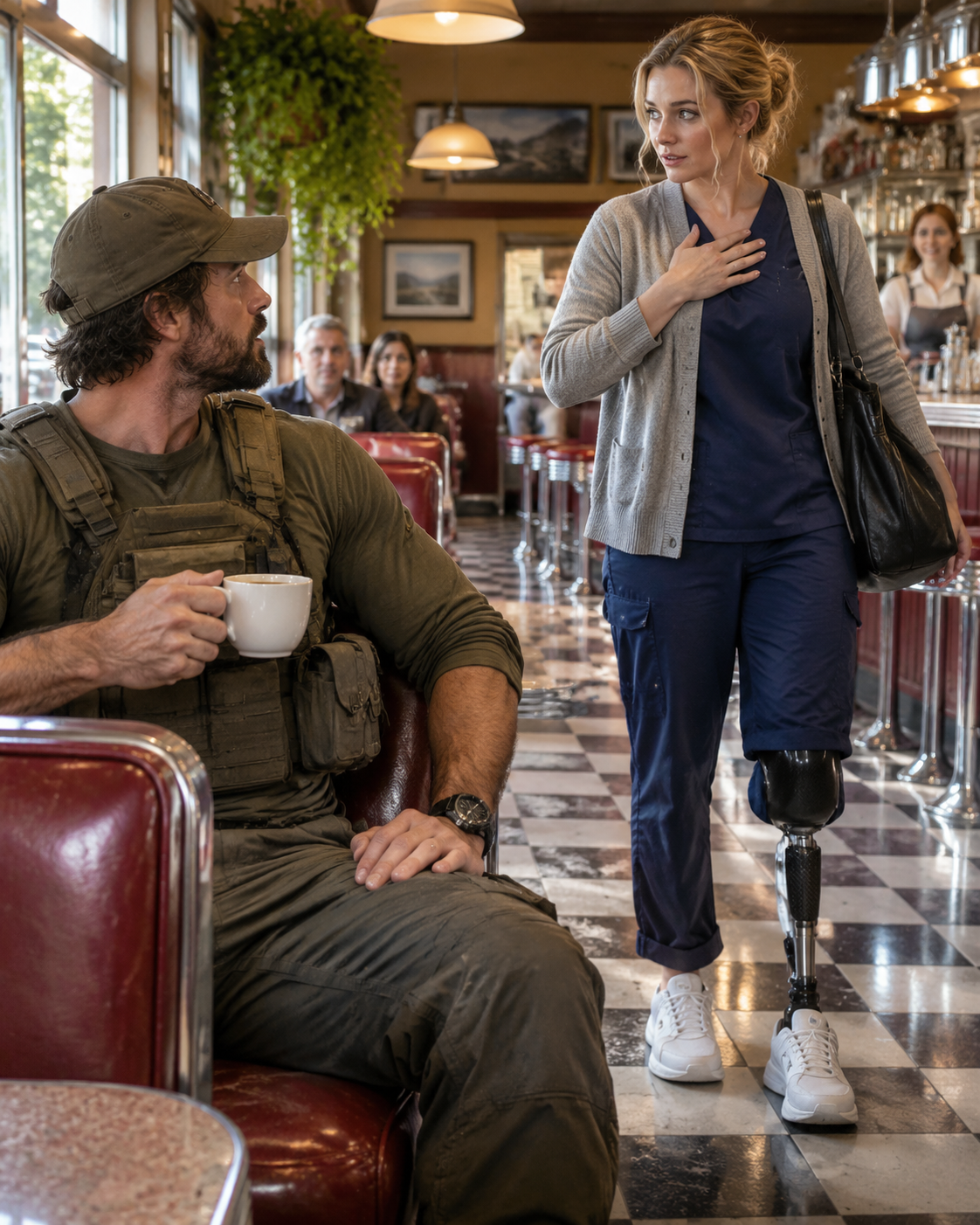
The man at the diner looked at the nurse’s prosthetic leg, then at the empty chair beside him, and laughed.
I arrived at the hospital twenty minutes before Clara’s meeting was scheduled to begin.
I didn’t walk straight into the administration building. I parked near the emergency entrance and waited, watching staff members come and go. Nurses pushed medication carts down the corridor. A maintenance worker wheeled a toolbox toward the service elevators. An ambulance pulled up, its rear doors opening as two paramedics carefully transferred a patient onto a hospital stretcher.
Everything looked ordinary.
That was what bothered me.
Hospitals depend on thousands of small things working correctly. A nurse needs the right medication at the right time. A monitor needs to display an accurate reading. A defibrillator needs to function when someone collapses unexpectedly.
Most patients never think about those things. They shouldn’t have to.
The people responsible for maintaining that trust should understand the weight of their jobs.
I checked my phone. Clara had not replied to my last message.
Then I saw her.
She came through the main entrance carrying a folder against her chest. She wore navy-blue scrubs beneath a gray cardigan, and her hair was pulled back into a simple ponytail. Her steps were steady, although I noticed the slight adjustment she made when approaching the automatic doors.
She saw me standing near the entrance.
“You came,” she said.
“I said I would.”
“I wasn’t sure you meant it.”
I glanced at the folder.
“Did you bring everything?”
“Copies. The original records are stored securely.”
“Good.”
She looked toward the elevators.
“Martin wants this handled internally. Arthur will be there, along with someone from human resources.”
“Anyone independent?”
“No.”
“Then remember something. You’re there to explain what you documented. You’re not there to defend your personality, your disability, or your right to ask questions.”
She gave a small, tired smile.
“You make it sound easy.”
“It isn’t. But it can be simple.”
We walked toward the conference room together.
Before entering, Clara stopped.
“Caleb?”
“Yes?”
“If they ask whether you’ve been helping me, what should I say?”
“The truth. I’m not your lawyer, your supervisor, or your investigator. I’m someone who believes safety concerns deserve to be examined.”
She nodded.
Then she opened the door.
Martin Pike sat at the head of the table. He was a broad-shouldered man in his late fifties with silver hair and the permanently tired expression of someone who had spent years managing competing departments.
Arthur sat to his right.
He recognized me immediately.
“Well,” he said, leaning back. “This is becoming quite a social gathering.”
Martin looked between us.
“Mr. Vance, I don’t believe you’re part of this meeting.”
“You’re correct. I’m here to accompany Clara. I’ll stay out of the discussion unless someone asks me a question.”
Arthur smiled without warmth.
“That’s probably best. This is a technical matter.”
Clara took her seat.
Martin opened a folder.
“We’re here because certain concerns have been raised regarding the maintenance contract with Sterling Medical Services. We’ve reviewed the initial report, and there are some questions about the source and interpretation of the information.”
Clara placed her folder on the table.
“I brought the equipment identifiers, the inspection dates, and the corresponding maintenance records.”
Arthur folded his hands.
“Before we get into paperwork, I’d like to clarify that nursing staff don’t have access to every part of our maintenance process. What appears incomplete to someone unfamiliar with the system may simply be recorded elsewhere.”
Clara looked directly at him.
“Then it should be easy to verify.”
His expression changed.
She continued.
“These are the serial numbers of the devices. These are the dates on which the records indicate service was completed. And these are the dates I personally checked the equipment during my assigned shifts.”
Martin turned a page.
Arthur leaned forward.
“Did you personally inspect every component?”
“No. I documented the discrepancies I could verify. I’m not claiming to be a biomedical engineer.”
“Then perhaps you should leave the technical conclusions to people who are.”
Clara’s fingers tightened around her pen.
I remembered what I had told her.
Don’t apologize for noticing danger.
She took a breath.
“I’m not making technical conclusions about components I haven’t examined. I’m reporting equipment whose service status cannot be independently confirmed. That’s precisely why I asked for an inspection.”
For a moment, nobody spoke.
Martin looked down at the records again.
“Arthur, can your company provide the corresponding work orders?”
“Of course. We’ll need time to assemble them.”
“How much time?”
“Two weeks, perhaps.”
Clara looked up.
“Some of the devices are currently listed as ready for emergency use.”
Arthur turned toward her.
“And you think that’s your decision to make?”
“No. I think someone qualified needs to verify it.”
That was the first time Martin seemed genuinely uncomfortable.
He closed the folder.
“We’ll arrange an internal review. Until then, I expect everyone to follow the established reporting procedures.”
Clara nodded, but her expression told me she understood what that meant.
The meeting was over.
Arthur passed us in the hallway.
“Be careful, Clara,” he said quietly. “Hospitals are small professional communities. Reputations matter.”
She didn’t answer.
I waited until he was out of earshot.
“That sounded like a warning,” I said.
“It was.”
“Did you get a copy of the meeting notes?”
“No.”
“Request one.”
She looked at me.
“You really don’t let things go, do you?”
“Not when someone’s life might depend on them.”
The following week was difficult.
Clara’s schedule changed twice. A supervisor who normally greeted her every morning suddenly became distant. Her request to review equipment logs was redirected through three different departments.
Nobody openly accused her of wrongdoing.
They didn’t need to.
The atmosphere around her had changed.
Brenda kept her informed about what was happening behind closed doors. She told Clara that Martin had received several calls from Arthur’s representatives. There were also rumors that the board wanted to avoid a public dispute with a contractor that had served the hospital for years.
Then came the email.
It arrived late on a Thursday afternoon.
The subject line read: PERFORMANCE AND PROFESSIONAL CONDUCT REVIEW.
Clara forwarded it to me.
The message stated that her recent actions had raised concerns about departmental communication, appropriate use of internal records, and professional judgment.
It also requested a formal evaluation of her ability to perform her duties.
I read it twice.
They weren’t addressing the equipment.
They were putting Clara on trial.
I called her.
“Have you contacted the independent oversight office?”
“Not yet.”
“Why?”
“Because I was hoping Martin would do the right thing.”
I understood that hope. Most people want to believe that someone higher up will eventually notice the problem and fix it.
But hope is not a safety procedure.
“Clara, you gave them the opportunity to investigate internally. They chose to investigate you instead.”
She was silent.
“I know.”
“Then it’s time to take the next step.”
She sighed.
“I’m scared, Caleb.”
It was the first time she had said it so plainly.
I leaned back in my chair.
“Of course you are. Being afraid doesn’t mean you’re doing the wrong thing.”
“What if they ruin my record?”
“Then we’ll make sure your documentation tells the story accurately.”
“What if nobody believes me?”
“Then we’ll make sure the evidence is available to people who have the authority to examine it.”
She didn’t answer immediately.
Finally, she said, “I’ll send the complaint tomorrow.”
That night, after Maya had gone to bed, I took the photograph out of my desk drawer again.
The edges had become soft from years of handling.
It had been taken during an evacuation operation overseas. I remembered the heat, the dust, the noise of the helicopter blades and the frantic shouting around the landing zone.
I remembered being injured.
I remembered the medic who had worked beside me.
What I didn’t remember clearly was her face.
The photograph showed her kneeling beside a wounded soldier. Her sleeves were rolled up, her hands were steady, and one knee was pressed into the dirt. Her face was turned away from the camera.
For years, I had assumed the photographer had simply captured an ordinary moment.
But there was something about the posture.
The way the woman balanced her weight.
The way she kept one hand close to the patient while reaching for equipment with the other.
I had seen that same movement at the diner.
I picked up my phone and called an old friend from my unit, Daniel Mercer.
He answered on the third ring.
“Vance. You still alive?”
“Unfortunately for you.”
He laughed.
We exchanged the usual greetings before I mentioned the photograph.
“Do you remember the evacuation near the eastern ridge? The one where I was brought in with the leg injury?”
Daniel went quiet for a moment.
“Which evacuation?”
“The one where a female corpsman worked on me before we reached the field hospital.”
“That was a long time ago.”
“I know.”
“What about it?”
I described the photograph.
He asked me to send him a copy.
I did.
A few minutes later, he called back.
“Caleb, I remember that medic.”
My grip tightened around the phone.
“Who was she?”
“I don’t remember her full name. We called her Specialist Clara. She had a prosthetic on her lower leg, if I remember correctly.”
I stopped breathing for a second.
“You’re sure?”
“Pretty sure. She was attached to the medical support team. Tough woman. Didn’t talk much. I remember her because she refused to let the evacuation crew move a wounded guy until his airway was secured.”
I looked down at the photograph.
“Did she work with our unit?”
“Not directly. She was assigned to the medical team supporting the operation.”
“Do you remember what happened to her?”
Daniel paused.
“She got hurt during an earlier deployment. Came back anyway. I remember people talking about it. But Caleb, why are you asking?”
I looked toward the hallway where Maya’s bedroom door stood slightly open.
“I think I know someone who might be her.”
Daniel was quiet.
“Well, I’ll be damned.”
I thanked him and ended the call.
I sat there for a long time.
If Clara was the same medic, she had once helped save my life.
And I had invited her to sit at my table without recognizing her.
I didn’t know whether to tell her immediately.
The last thing she needed was another unexpected emotional burden while fighting for her career.
So I put the photograph away.
For now.
Friday morning, Clara submitted her complaint to the hospital’s independent safety office and the appropriate external reporting channel.
She attached the records, her written timeline, and copies of the earlier communications.
She also requested that the equipment in question be independently evaluated before anyone relied on its recorded service status.
Brenda helped her verify that the submission had been received.
At 11:42 a.m., Clara sent me a message.
“Officially submitted.”
I replied with three words.
“Good. Stay steady.”
I was halfway through preparing an emergency response training session when my phone rang again.
This time, it was Clara.
“They’ve taken me off the cardiac response rotation.”
“Did they give you a reason?”
“They said it’s temporary while they review my conduct.”
“Are you still assigned to other duties?”
“For now.”
“Have they told you the equipment is safe?”
“No.”
That answer stayed with me.
A hospital could change an employee’s schedule in an afternoon. It could issue emails, schedule meetings, and create committees.
But none of that established whether a defibrillator would work when someone needed it.
I contacted an attorney I knew through my professional network, a woman named Rebecca Sloan who had experience with workplace retaliation and healthcare compliance.
I didn’t ask her to represent Clara. I asked whether she could recommend an independent resource that understood both whistleblower protections and patient safety reporting.
She agreed to speak with Clara directly.
When I passed along the contact information, Clara hesitated.
“I can’t afford an expensive legal battle.”
“Then start with a consultation. Find out what your options are before making decisions.”
She thanked me.
I could hear how exhausted she was.
Two days later, Brenda called.
Her voice was lower than usual.
“Something happened in the maintenance department.”
I stepped away from the training room.
“What?”
“One of the technicians asked whether Clara had submitted copies of the records. He said several work orders were being reconstructed.”
“Reconstructed?”
“That’s the word he used.”
I felt my jaw tighten.
“Did he say who ordered it?”
“He didn’t know. But he said the dates on some of the new documents didn’t match the original entries.”
I asked Brenda not to confront anyone or access anything outside her responsibilities.
“Keep your own notes. Don’t alter records. Don’t take information you’re not authorized to access. If the technician is willing to report what he saw, he should use the appropriate channel.”
She agreed.
I called Rebecca.
She advised that any suspected alteration should be reported through the investigators handling the complaint, with the source and chain of custody preserved.
No accusations without evidence.
No dramatic confrontation.
Just documentation.
That afternoon, Clara received a request for an additional interview.
She was asked to attend alone.
She forwarded the invitation to Rebecca, who advised her to request the meeting’s purpose and ask whether she could have a representative present.
Clara did exactly that.
The response came back twenty minutes later.
The meeting was postponed.
For the first time in days, she sounded almost relieved when she called me.
“Maybe they’re finally taking this seriously.”
“Maybe.”
“You never sound very optimistic.”
“I’ve learned to wait for actions.”
She laughed softly.
Then she said something that stayed with me.
“Thank you for not treating me like I need saving.”
I didn’t know what to say.
So I told her the truth.
“You don’t.”
The next development came from the independent review team.
They requested access to the relevant maintenance documentation and arranged for qualified biomedical engineering personnel to examine the equipment identified in Clara’s report.
The hospital was instructed to verify the readiness of the affected devices and use alternative equipment where necessary until their status could be confirmed.
The review wasn’t an announcement that everything was broken.
It wasn’t proof that Arthur had personally ordered anyone to falsify a record.
But it was confirmation that Clara’s concerns deserved a serious examination.
That mattered.
Martin sent a message to department staff stating that the hospital was cooperating with the review and that employees should direct questions through the designated safety office.
Arthur’s company issued its own statement, insisting that its maintenance procedures met contractual requirements.
Clara read both messages at the kitchen table while Maya colored beside her.
“They still haven’t admitted anything,” she said.
“An investigation takes time.”
“What if they find nothing?”
“Then at least the equipment has been checked.”
She looked at me.
“And if they find something?”
“Then people will have to answer for it.”
Maya looked up from her drawing.
“Are you talking about the bad man from the restaurant?”
Clara smiled.
“Something like that.”
Maya considered this for a moment.
“Mommy used to say that telling the truth is important even when people get mad.”
The words landed gently but heavily.
Clara reached across the table and squeezed her hand.
“Your mommy sounds like she was a very wise person.”
I looked down at my coffee.
Elena had been wise.
She had also been stubborn in the best possible way.
When she was alive, she had never been impressed by titles or expensive suits. She cared about how people treated the person who couldn’t do anything for them.
I missed that about her every day.
The first formal findings arrived three weeks later.
The independent review identified inconsistencies between recorded maintenance activity and the documentation available to support it. Several devices required additional servicing or verification before being returned to unrestricted use.
The investigators also identified gaps in the contractor’s documentation process.
Some records could be explained by incomplete data transfers. Others required further examination.
The hospital temporarily restricted use of equipment whose service status had not been established and arranged replacement units where needed.
Clara read the summary twice.
Then she put it down.
“That’s it?” she asked.
“That’s the first report.”
“But it doesn’t say who was responsible.”
“No. That comes later, if the investigation establishes it.”
She looked exhausted rather than victorious.
I understood.
People imagine that being proven right feels wonderful.
Sometimes it just feels like discovering how close you came to being ignored.
The report also noted that Clara’s original concerns had been sufficiently specific to warrant the investigation.
Her supervisor received a copy.
Martin sent her an email acknowledging that the initial internal response had not adequately addressed the reported discrepancies.
It wasn’t a complete apology.
But it was a start.
Arthur, meanwhile, became less visible around the hospital.
His company was asked to provide additional documentation and explain several discrepancies. The hospital suspended approval of certain invoices pending verification.
His position with the board had not disappeared, but his ability to dismiss Clara’s concerns as a misunderstanding had weakened.
For the first time, the conversation was about the records.
Not Clara’s leg.
Not her attitude.
Not whether she had been difficult to manage.
The records.
One afternoon, I drove to the hospital to pick up Clara after her shift.
She was waiting outside with a paper bag containing two sandwiches.
“I thought Maya might like one,” she said.
“She’ll probably ask for both.”
Clara laughed.
We walked toward the truck.
Then she stopped.
“Caleb, can I ask you something?”
“Of course.”
“Why did you get involved? Really.”
I considered giving her the simple answer.
Because patient safety mattered.
Because she deserved to be heard.
Because Arthur had behaved like a bully.
All of those things were true.
But there was another reason.
I opened the passenger door and reached into the center console. The photograph was still inside the protective sleeve.
I handed it to her.
She looked down.
At first, she seemed confused.
Then her expression changed.
She turned the photograph slightly toward the light.
“Where did you get this?”
“It was taken during a medical evacuation overseas. Years ago.”
Her fingers moved toward the edge of the photograph.
“That’s me.”
I watched her carefully.
She looked at the woman kneeling beside the wounded soldier.
Then she looked at me.
“Caleb?”
I nodded.
She stared at the picture for several seconds.
“I remember that operation.”
“I thought you might.”
She swallowed.
“You were the injured operator.”
“Yes.”
Her eyes moved back to the photograph.
“You were losing a lot of blood. The helicopter crew was trying to move you, but your condition wasn’t stable. I remember arguing with them.”
“Daniel remembered that.”
She gave a small, disbelieving laugh.
“I thought nobody remembered that day.”
“I did. I just didn’t know who you were.”
For a moment, neither of us spoke.
Then she looked at me.
“I didn’t know you survived.”
I felt something shift in my chest.
“I did.”
She nodded slowly.
“Good.”
That was all she said.
And somehow, it was enough.
We sat in the truck while the afternoon rain began tapping against the windshield.
Clara told me what she remembered.
She had been part of the medical support team attached to the operation. She had already lost part of her leg in an earlier deployment and had returned to service after rehabilitation.
She remembered the evacuation because the conditions were difficult and the injured men kept arriving faster than the team could prepare for them.
She remembered a young operator who kept trying to move despite his injuries.
She remembered telling him to stay still.
I smiled.
“That sounds like me.”
“It was definitely you.”
Then she grew quiet.
“I remember thinking that if we could get you onto the helicopter, you’d have a chance.”
I looked at the photograph again.
“You gave me that chance.”
She shook her head.
“We all did our jobs.”
“That’s true.”
I paused.
“But I never got to thank the person who was kneeling beside me.”
Her eyes filled slightly.
“Well, now you have.”
I didn’t try to make the moment bigger than it was.
We had both lived through difficult things. Neither of us needed to turn gratitude into a debt.
I folded the photograph carefully and put it back in its sleeve.
Then I drove her home.
The investigation continued over the following month.
The hospital’s independent review team completed additional inspections and requested more documentation from Sterling Medical Services.
The findings identified repeated failures in the contractor’s documentation and verification procedures. Some devices had not received the service that their records appeared to indicate. Others had incomplete records that prevented the hospital from confirming their maintenance history.
The hospital required additional inspections and strengthened its equipment verification procedures.
Arthur’s company was placed under further contract review.
There was no dramatic courtroom scene.
No television cameras waiting outside the hospital.
Just a series of meetings, written findings, revised procedures, and people who suddenly had to answer questions they had previously avoided.
Clara was eventually returned to her regular clinical rotation.
Martin met with her privately.
He apologized for allowing the initial response to focus too heavily on her conduct instead of the substance of her report.
He also acknowledged that the hospital should have had a clearer independent reporting process from the beginning.
Clara listened.
She didn’t argue.
She didn’t ask for a public announcement.
She simply requested written confirmation that the complaint would remain part of the official safety record and that her work schedule and professional evaluation would not be negatively affected because she had raised the concern.
Martin agreed to review the request.
When Clara told me, I asked whether she believed him.
She shrugged.
“I believe he understands that people are watching now.”
“That’s different.”
“I know.”
She smiled faintly.
“I’m learning.”
Arthur eventually requested a meeting with Clara.
She asked Rebecca to review the invitation and agreed to attend with an appropriate representative present.
I didn’t go.
It wasn’t my meeting, and Clara didn’t need me standing behind her every time someone challenged her.
She was capable of speaking for herself.
Afterward, she called me.
“He apologized.”
I waited.
“Was it sincere?”
“I don’t know.”
“What did he say?”
“He said things had become unnecessarily personal and that he regretted the way our disagreement had developed.”
I looked out at the backyard, where Maya was trying to teach Admiral to sit.
“And what did you say?”
“I told him I hoped the investigation would continue independently.”
I smiled.
“Good answer.”
“He also said his company had a long history with the hospital.”
“That may be true.”
“He wanted me to understand that contracts and reputations take years to build.”
“And?”
“And I told him patient safety shouldn’t depend on how long someone has held a contract.”
I laughed quietly.
“Sounds like you.”
There was a pause.
Then Clara said, “I don’t hate him, Caleb.”
“I didn’t think you did.”
“I just don’t want the next nurse to have to fight this hard.”
That was the difference between Clara and Arthur.
He had spent much of his energy protecting his position.
She was trying to make sure the problem didn’t happen again.
By the time winter arrived, the hospital had begun implementing new procedures.
Maintenance records were subject to additional verification. Staff had clearer instructions for reporting equipment concerns. Questions involving patient safety could be escalated outside the immediate department when necessary.
The changes weren’t perfect.
There were still delays, disagreements, and administrative frustrations.
But people had started paying attention.
Brenda remained one of Clara’s closest colleagues. She had supported her quietly throughout the process, even when doing so made her own position uncomfortable.
One evening, she joined us for dinner.
Maya made everyone wear paper crowns she had cut from construction paper.
Brenda’s crown had a crooked purple star.
Clara’s had a drawing of a dog.
Mine had the words BEST DAD written backward.
Admiral received the largest crown of all.
We laughed until Maya started hiccupping.
For a little while, the hospital, the investigation, and Arthur Sterling seemed very far away.
After dinner, Clara helped Maya clear the table.
I watched them from the kitchen doorway.
It occurred to me that the little girl who had once made room for a stranger’s prosthetic leg had never thought she was doing anything unusual.
To Maya, Clara was simply a person who needed a chair.
Children sometimes understand things adults spend decades complicating.
One Saturday morning, Clara came over to help Maya with a school project.
The assignment was about people who made a difference in their communities.
Maya had chosen firefighters, nurses, and military service members.
She wanted to include Clara.
“What should I write about you?” she asked.
Clara looked uncomfortable.
“Just say I’m a nurse.”
“But that’s not enough.”
“Why not?”
“Because you helped people when you were far away, and then you helped people at the hospital.”
Clara looked at me.
I raised my eyebrows.
“She’s got a point.”
Maya began writing.
After a few minutes, she held up the paper.
At the top, she had written:
SOME PEOPLE HELP WHEN THINGS GO WRONG. SOME PEOPLE MAKE SURE THINGS ARE READY BEFORE THEY GO WRONG.
Clara read it twice.
Then she smiled.
“That’s actually very good.”
Maya beamed.
“I know.”
We all laughed.
Later, after Maya had gone to play with Admiral, Clara stood beside the kitchen window.
“Do you ever think about going back?” she asked.
“Back where?”
“To the work you used to do.”
I shook my head.
“Sometimes. But not in the way people think.”
“How so?”
“I miss the people. I miss knowing that everyone around me understood the importance of the next decision. But I don’t miss the danger.”
She nodded.
“I understand that.”
I looked toward the living room.
“Elena used to tell me I spent too much time trying to protect everyone.”
“What did you tell her?”
“That it was my job.”
“And what did she say?”
I smiled.
“She said I should remember that letting people help me was part of the job, too.”
Clara looked down.
“She sounds like someone I would have liked.”
“You would have.”
For the first time, I found myself talking about Elena without feeling that I was betraying the life I had built after her.
Grief doesn’t disappear.
But sometimes it makes room for other people.
A few weeks later, Clara received the final notice regarding her professional review.
The hospital confirmed that her original concerns had been submitted in good faith and that the review had found no basis for the disciplinary allegations raised against her.
Her employment record would reflect that the matter had been resolved without a finding of misconduct.
It was not a grand victory.
It was a document.
But Clara held it in both hands as if it weighed more than paper.
“I thought they were going to take everything from me,” she said.
I nodded.
“I know.”
“Some days I almost wish I had stayed quiet.”
I looked at her.
“Do you regret reporting the equipment?”
“No.”
“Then don’t confuse being tired with being wrong.”
She smiled.
“You’re annoyingly consistent.”
“I’ve been told.”
She folded the letter and placed it in her bag.
Then she looked toward the hospital.
“I think I’m going to stay.”
“Good.”
“But I’m not going to pretend everything is fixed.”
“I wouldn’t expect you to.”
She took a breath.
“I want to help build the reporting process they should have had all along.”
I smiled.
“Then I think you know what to do next.”
That evening, Maya asked Clara whether she would come to her school presentation.
Clara said yes.
Maya jumped up and hugged her.
Admiral barked as if he had been personally invited to deliver the speech.
For the next several days, our kitchen became a workshop for cardboard posters, markers, and photographs.
Clara brought a picture of herself in her hospital uniform.
I brought an old photograph from my military days.
Maya studied it carefully.
“Is that you?”
“Yes.”
“Were you hurt?”
“Yes.”
“Did Clara help you?”
I looked at Clara.
“She did.”
Maya smiled.
“So she’s been helping people for a really long time.”
Clara crouched beside her.
“Sometimes people help each other without knowing they’ll meet again.”
Maya thought about that.
Then she wrote another sentence beneath her poster.
SOMETIMES YOU DON’T KNOW WHO YOU’RE HELPING UNTIL YEARS LATER.
I looked at Clara.
She looked back.
Neither of us said anything.
We didn’t need to.
The school presentation took place on a Thursday afternoon.
Parents filled the small auditorium. Children stood beside their posters, waiting for their turns.
Maya was nervous.
She kept adjusting the paper corners and checking whether the photographs were straight.
When her teacher called her name, she stepped forward.
She talked about nurses, firefighters, and people who prepared for emergencies.
Then she pointed to Clara’s photograph.
“This is Clara. She works at a hospital. She noticed that some important machines might not be ready when people needed them. She told the right people, even when it was hard.”
A few parents nodded.
Maya pointed to my photograph next.
“And this is my dad. He used to be in the Navy, and Clara helped him a long time ago when he was hurt.”
She paused.
“I think both of them are brave. But I think being brave also means asking questions when something isn’t right.”
Clara covered her mouth.
I felt my throat tighten.
Maya finished with the sentence she had written at the bottom of her poster.
“Some people help when things go wrong. Other people make sure things are ready before they do.”
The room applauded.
Maya hurried back to her seat.
I gave her a hug.
“You did great.”
She grinned.
“Did you hear the part about Clara?”
“I heard every word.”
Clara joined us a moment later.
She looked emotional but happy.
“Your daughter has a gift,” she said.
I glanced at Maya.
“She gets that from her mother.”
Clara nodded.
“I think she does.”
After the presentation, we stopped at the same diner where everything had begun.
The restaurant was busy again.
The waitress recognized us and waved.
Maya insisted on sitting in the same booth.
Clara settled into the chair across from her.
Admiral lay beside my boots.
For a moment, I remembered that first afternoon.
Arthur’s dismissive expression.
Clara standing near the entrance, wondering where she could sit.
The empty chair.
The small decision to move my own things and make room.
I had spent years believing that the most important moments in life were the ones that arrived with warning sirens, emergency lights, and people shouting instructions.
But that afternoon had reminded me of something else.
Sometimes the moment that matters most is quiet.
Sometimes it is simply noticing someone standing alone and deciding not to let them remain there.
The waitress brought our drinks.
Clara looked around the diner.
“Funny how much can change in a few months.”
I nodded.
“Funny how some things don’t.”
Maya was busy drawing another picture of Admiral.
Arthur’s company was still dealing with the consequences of the investigation. The hospital was still improving its procedures. There were still unanswered questions about how the maintenance discrepancies had developed and who had known what.
The work wasn’t finished.
Clara knew that better than anyone.
But she was no longer standing outside a conference room wondering whether anyone would listen.
She had learned how to document a concern, how to protect her professional position, and how to use the right channels when the people closest to a problem refused to address it.
And she had learned something else.
She didn’t have to make herself smaller to make other people comfortable.
When the food arrived, Maya suddenly looked up.
“Dad?”
“Yes?”
“Can Clara come over next weekend?”
I glanced at Clara.
She smiled.
“Only if your dad doesn’t make me eat his cooking.”
I pretended to be offended.
“My cooking is excellent.”
Maya laughed.
“Admiral likes it.”
“Admiral eats things off the sidewalk.”
That made everyone laugh.
Clara reached down to scratch the dog’s ears.
Then she looked at me.
“Thank you, Caleb.”
“For what?”
“For making room.”
I understood that she wasn’t talking only about the chair.
I looked at my daughter, then at the woman across the table.
“You’re welcome.”
Outside, rain began tapping against the windows.
It was the same kind of rain that had fallen the night Clara submitted her complaint.
But this time, she wasn’t driving away alone with the weight of an uncertain future.
She was sitting at a table with people who had chosen to make room for her.
And that was a beginning.
Not an ending.
Because somewhere in that hospital, people were still learning that a maintenance record was not the same thing as a functioning machine. A title was not proof of competence. And a person’s disability was never a reason to dismiss what they had seen.
Clara had done what she believed was right.
Now the hospital had to decide whether it was willing to become the kind of place where the next person wouldn’t have to fight so hard.
I didn’t know how long that would take.
Neither did Clara.
But when Maya reached across the table and offered her another crayon, Clara accepted it without hesitation.
For that evening, at least, there was room for everyone.