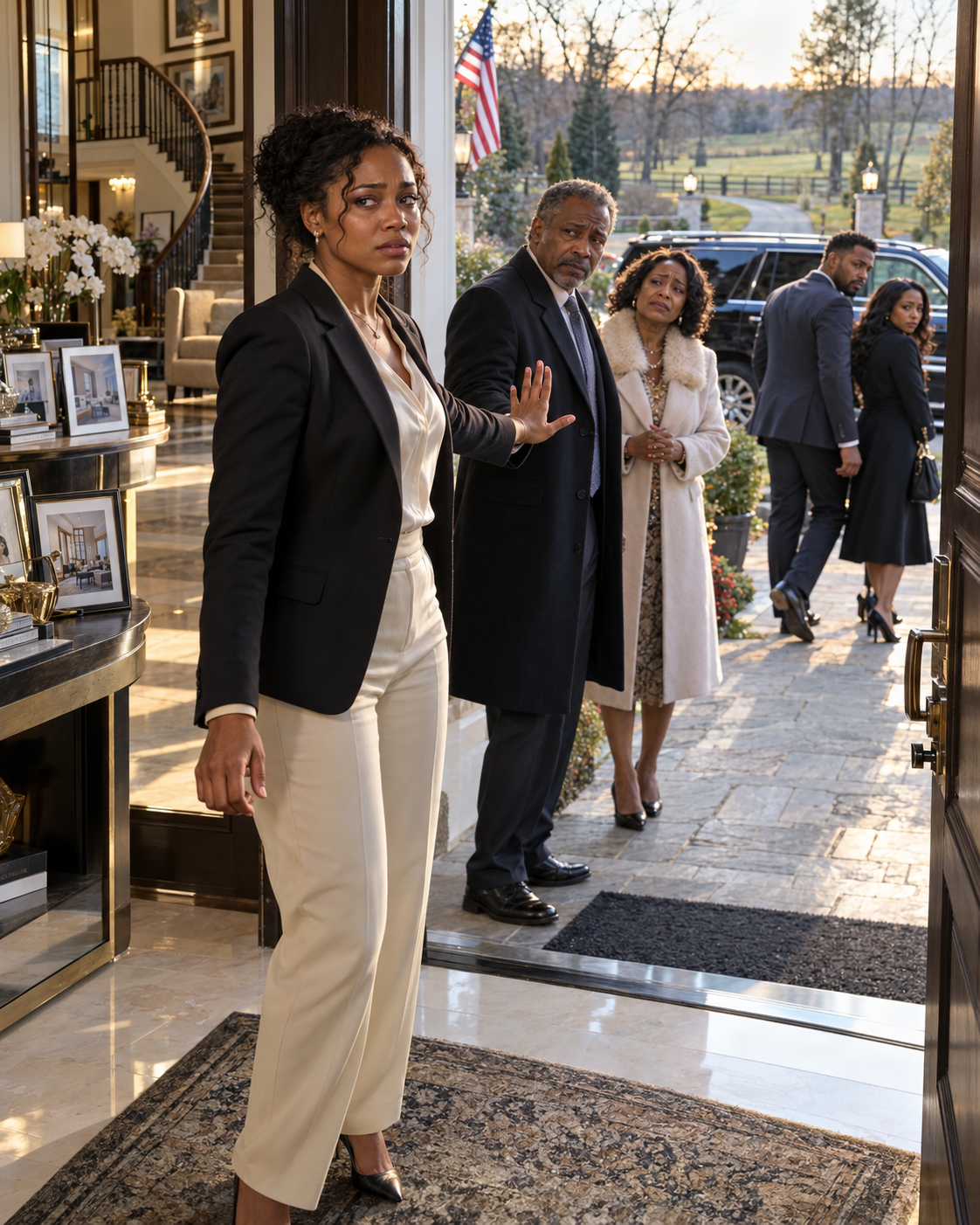
Your mother said you were dead to us,” my father whispered from the other side of my security gate
I didn’t take the envelope immediately.
For some reason, that frightened me more than the loan.
The paper looked old. Not ancient, just old enough that the corners had softened and the white had gone the color of weak tea. My name was written across it in the looping handwriting I had known since childhood.
Mara.
No last name.
No address.
Just my first name.
I looked at my mother.
She had gone completely still.
“Where did you find that?”
Vanessa answered before she could.
“In the cedar chest.”
My mother’s face drained of color.
Nathan took a step toward his wife.
“You promised.”
“I promised I wouldn’t bring it up unless she needed to know.”
“I didn’t need to know anything,” I said. “You came here asking for money.”
Vanessa looked at me.
“And that’s exactly why I think you do.”
My father said her name sharply.
“Vanessa.”
She shook her head.
“No. We’re past pretending.”
The room became unbearably quiet.
I took the envelope.
It was sealed.
I turned it over.
No stamp.
No date.
Nothing.
“What is this?”
My mother whispered, “A letter.”
“From you?”
She nodded.
“To me?”
Another nod.
“Then why didn’t I get it?”
She looked at Arthur.
Arthur looked at the floor.
That was the first moment I understood that whatever had happened eight years ago wasn’t quite the story I had been carrying all these years.
I broke the seal.
Inside was a single sheet of paper.
I recognized my mother’s handwriting immediately.
My hands began to shake before I finished the first sentence.
Mara,
If you are reading this, then either your father finally told you the truth or I have finally found the courage to stop hiding behind him.
I stopped.
“Mom.”
She closed her eyes.
I read the next line.
I did not want you to leave.
I looked up.
Nobody spoke.
The letter continued.
When you chose design school instead of accounting, your father said we should stop paying your tuition. I agreed because I was afraid of him. But when you left the house, I put this letter in your suitcase. Arthur found it before you drove away.
My breath caught.
I remembered that night.
I remembered carrying two suitcases down the stairs.
I remembered my father standing by the door.
I remembered my mother crying in the kitchen.
But I had always believed the tears were disappointment.
I had never considered fear.
I read on.
He told me that if I contacted you, he would cut off the college fund completely and make sure you received nothing from the family. I believed him when he said he was protecting Nathan’s future. I thought I could fix things later.
There was a stain across the bottom of the page.
A water mark.
Or a tear.
I couldn’t tell.
I read the final paragraph.
I am sorry I chose silence when you needed a mother. I am sorry that when you stopped calling, I let myself believe you were better without us. I watched your career from a distance. I saw your awards. I saw the hotel in Charleston. I saw your interview in the magazine. I was proud of you every single time, and I hated myself for being too afraid to say it.
The room blurred.
I lowered the paper.
My mother was crying.
Not dramatically.
No sobbing.
Just tears slipping down her cheeks while she sat with both hands folded tightly in her lap.
“You knew?” I asked my father.
He didn’t answer.
“You knew she wrote this?”
“Yes.”
“And you hid it?”
“I didn’t hide it.”
I stared at him.
“I found it before you left. I thought it would make things worse.”
“You destroyed it.”
“I was trying to keep the family together.”
I laughed, but there was no humor in it.
“You kept the family together by making sure I wasn’t in it.”
Arthur’s face tightened.
“You were stubborn.”
“I was eighteen.”
“You were angry.”
“I was your daughter.”
He looked away.
That was the first crack in the story I had spent eight years telling myself.
My father wasn’t a monster.
That would have been easier.
He was a frightened, controlling man who had convinced himself that love meant preventing people from making choices he couldn’t understand. My mother had been too afraid to fight him. Nathan had grown up inside the protection that fear created.
And I had paid for all of it.
Still, understanding wasn’t forgiveness.
Those were different currencies.
Nathan paced toward the window.
“This is unbelievable.”
I folded the letter carefully.
“You knew about it?”
“No.”
“Then why did Vanessa?”
He turned toward his wife.
Vanessa looked exhausted.
“Because I found it while we were packing the old house.”
“You’re selling it?”
Nathan didn’t answer.
My father did.
“We have to.”
That was another piece.
The house.
The old family house where every photograph of us had been taken.
The dining room where Nathan’s graduation dinner had filled the walls with flowers while my college acceptance letter had been ignored.
The hallway where, years earlier, my mother had removed a framed picture because she said there wasn’t enough room.
The picture had been of me.
I had forgotten that until that moment.
“You’re losing the house,” I said.
Arthur nodded.
“And Nathan’s business?”
Silence.
I looked at Vanessa.
She answered softly.
“It’s gone.”
Nathan glared at her.
“We’re negotiating.”
“With creditors,” she said.
He snapped, “I said we’re negotiating.”
There was something almost childlike in his anger.
For the first time, I understood that the arrogance wasn’t confidence.
It was terror.
I didn’t enjoy that realization.
I wished I did.
It would have been easier to hate him.
Instead, I remembered Nathan at nine years old, asleep in the back seat while I sat beside him on the way home from school. I remembered covering him with my jacket when he forgot his coat.
I remembered being the sister who thought she was supposed to protect him.
Then I remembered the eighteen-year-old version of him standing in the kitchen while our father said, “Your sister has made her choice.”
Nathan had looked at me and shrugged.
“Then she can live with it.”
He hadn’t understood what those words would become.
Maybe I hadn’t either.
I sat down.
“What exactly happened to the money?”
Nathan rubbed his forehead.
“I made some bad investments.”
“How bad?”
“Bad.”
Vanessa gave a bitter laugh.
“His restaurant expansion collapsed. Then he borrowed against the second location to cover the first. Then he tried to recover the losses through real estate.”
Nathan glared at her.
“Do you want to tell her everything?”
Vanessa looked at me.
“I think she deserves the truth.”
My father sighed.
“We invested in the first restaurant.”
I stared at him.
“You what?”
Arthur nodded.
“Quietly.”
“So when you told me you couldn’t help with school because money was tight—”
“We didn’t say that.”
“You said I had to learn independence.”
My mother’s eyes closed.
My father didn’t answer.
Nathan suddenly said, “I didn’t ask them to cut you off.”
“No,” I said. “You just accepted everything they gave you.”
He flinched.
That was the first time I saw shame on his face.
Not anger.
Shame.
He sat down.
“I was twenty-two,” he said quietly. “I thought that’s how families worked.”
“So did I.”
The words came out softer than I intended.
For a while, nobody spoke.
Outside, wind moved through the trees.
My house had always felt enormous when I was alone in it, but that evening the rooms felt strangely intimate. Four people sitting around a table, each carrying a version of the same childhood that didn’t quite overlap.
Eventually I asked, “Why now?”
My father answered.
“Because Nathan is in trouble.”
“No.”
He looked at me.
“That’s not the whole answer.”
He said nothing.
My mother did.
“Because we were wrong.”
I waited.
She wiped her cheek.
“We thought success would prove that we had been right about you. Then you became successful anyway, and instead of admitting we had been wrong, we stayed away because every year made the apology harder.”
That hurt.
More than the money.
More than Nathan’s arrogance.
More than the letter.
Because it was ordinary.
There had been no conspiracy.
No secret inheritance.
No hidden reason I had been excluded.
Just pride.
Fear.
Cowardice.
Years accumulating because nobody wanted to be the first person to say, “I hurt you.”
I understood that kind of silence.
I’d lived inside it.
I looked at the letter again.
“Mom, why didn’t you ever send this?”
She looked at Arthur.
Then at me.
“Because he told me that if I went behind his back, Nathan would lose everything.”
Nathan’s head lifted.
“What?”
My father closed his eyes.
“Your father told me the business loans were tied to the family property,” Helen said. “I was afraid that if I left, I would take everything down with me.”
Nathan stared at Arthur.
“You said the business was mine.”
Arthur didn’t respond.
The room changed again.
Nathan’s expression slowly emptied.
“You used the house as collateral?”
Arthur nodded.
“For the restaurant.”
“And the second location?”
Another nod.
Nathan stood.
“You told me those were investments.”
“They were.”
“You told me I couldn’t fail.”
“I was trying to help you.”
“You put the house up for it?”
Arthur’s face hardened.
“I did what I thought was necessary.”
Nathan laughed once, sharply.
“So you spent our money saving me while telling Mara she didn’t deserve hers.”
Nobody answered.
Nathan turned away.
For the first time that day, he looked exactly like my little brother.
Not the golden child.
Not the arrogant businessman.
Just a man who had finally discovered that the safety net beneath him had never been as strong as he’d believed.
Vanessa stood beside him.
“We’re selling the house to settle the remaining debt.”
I asked, “How much is left?”
She named a number.
It was large.
But not impossible.
I could have paid it.
That was the cruelest part.
I could have written a check.
It wouldn’t have ruined me.
It wouldn’t even have changed my lifestyle.
And for a brief, shameful second, I considered it.
Not because Nathan deserved rescuing.
Because my mother was sitting across from me with eight years of regret in her face.
Because the house represented my childhood.
Because some wounded part of me still wanted to be the daughter who could solve everything.
I reached for my phone.
Nathan noticed.
“Mara—”
“I haven’t agreed to anything.”
He stopped.
I put the phone down.
“I need you all to leave.”
My mother looked devastated.
“I understand.”
“No,” I said. “I don’t think you do.”
I stood.
“I spent eight years believing you didn’t want me. Then I find out you did, but you were too afraid to fight for me. I spent eight years becoming someone who didn’t need you because I had to. And now you’re standing in my house asking me to use the life I built without you to repair the damage you created together.”
Nobody moved.
“I can’t do that.”
My father nodded slowly.
“Fair enough.”
Nathan shook his head.
“You’re really going to let us lose everything?”
I looked at him.
“You already did.”
He stared at me.
Then his shoulders dropped.
That was the closest thing to an apology I’d ever seen from him.
My mother stood.
She came toward me but stopped a few feet away.
“I don’t expect forgiveness.”
“Good.”
She nodded.
“I just want you to know that I love you.”
The words were almost unbearable.
I wanted to hear them.
I had wanted to hear them for years.
But wanting them didn’t make the past disappear.
“I believe you,” I said.
She looked surprised.
“That doesn’t mean I can come back.”
“I know.”
That was the first honest conversation we’d had in almost a decade.
They left just after sunset.
I watched their car disappear down the drive.
Then I went upstairs and sat on the floor beside my bed with the letter in my lap.
I cried.
Not because I wanted them back.
Because I finally understood that the little girl who had spent years wondering what she had done wrong could stop asking.
The next morning, I woke before dawn.
I expected relief.
Instead, I felt hollow.
I made coffee and walked into my study.
The room was exactly as I’d left it.
Awards.
Plans.
Contracts.
Photographs.
Everything I had built.
I sat behind my desk and opened my laptop.
There were twenty-three unread emails.
One was from a law firm I didn’t recognize.
Subject line:
Bennett Family Property — Urgent.
I almost deleted it.
Then I saw the attachment.
A scanned document.
The property deed for my parents’ house.
My name appeared on the final page.
I stared at it for a long time.
Then I called the number.
A woman answered.
“Ms. Bennett? Thank you for calling. I’ve been trying to reach you.”
“Why is my name on this deed?”
There was a pause.
“Because your father transferred the property to you eight years ago.”
My heart stopped.
“He did what?”
“He executed the transfer the week you left home.”
“That isn’t possible.”
“I have the recorded documents.”
I pulled the letter from my mother’s envelope and read it again.
Arthur had hidden it.
But apparently he had done something else.
Something neither my mother nor Nathan knew.
The attorney continued.
“There’s a second document attached. It concerns the debt against the property.”
I opened it.
My father’s signature was at the bottom.
The loan was secured against the house.
But there was a handwritten condition beneath the legal language.
If the property is ever sold, the first portion of the proceeds must be used to establish an education fund in Mara Bennett’s name.
I stopped breathing.
Eight years ago, my father had told me I was on my own.
Yet on the same week he cast me out, he had quietly placed the family house in my name and created a fund for my future.
It didn’t make him innocent.
It didn’t erase what he had done.
But it changed the shape of the wound.
I spent the entire morning trying to understand why.
At noon, my father called.
I almost didn’t answer.
“Hello?”
His voice sounded tired.
“You got the documents.”
“Yes.”
Silence.
“Why?”
He took a long breath.
“Because I knew I was wrong.”
I closed my eyes.
“Then why did you let me believe you hated me?”
“I didn’t know how to admit I was afraid.”
“Afraid of what?”
“That you would succeed without us.”
I almost smiled at the absurdity of it.
“You were afraid I’d succeed?”
“No.”
His voice cracked.
“I was afraid you’d prove me wrong.”
There it was.
Not a villain’s confession.
A father’s shame.
“I didn’t know how to be your father if I wasn’t the one deciding what your life should look like.”
I sat very still.
He continued.
“So I made a terrible choice. I thought if I gave you the property, you’d eventually come back when you needed something. I thought you would hate me less if you believed I had left you something.”
“You could have told me.”
“I know.”
“Why didn’t you?”
“Because by then, every year I waited made it harder.”
I looked out the window.
The fields were silver with frost.
“What about the debt?”
“I’ll handle it.”
“With what?”
“The house.”
“You can’t sell it if it’s mine.”
“I know.”
That stopped me.
“Then why did you tell me Nathan would lose everything?”
“Because I hoped you would save him.”
I laughed quietly.
“You still don’t understand.”
“No.”
He sounded defeated.
“I don’t.”
I rubbed my forehead.
“Dad, I don’t want the house.”
Silence.
“You don’t?”
“No.”
“What do you want?”
I looked around my study.
At the degrees.
At the photographs.
At the plans I’d drawn at two in the morning when nobody believed in me.
“I want you to stop deciding what I need.”
He didn’t answer.
I continued.
“If the house is mine, I’ll decide what happens to it.”
“All right.”
“And Nathan doesn’t get a bailout.”
“I understand.”
“And Mom gets the letter back.”
“She can have it.”
“No.”
I looked down at the page.
“I’m keeping it.”
He breathed out.
“Okay.”
We ended the call without saying goodbye.
Three weeks later, I drove to my parents’ house.
Not because I had forgiven them.
Because I had made a decision.
The house looked smaller than I remembered.
The porch paint was peeling.
The oak tree in the front yard had grown so large that its branches covered half the roof.
My mother opened the door.
When she saw me, she froze.
“You came.”
“I did.”
Arthur appeared behind her.
Nathan was in the living room, surrounded by cardboard boxes.
Vanessa stood beside him.
Nobody knew what to say.
I held up a folder.
“I’ve hired an attorney.”
Nathan groaned.
“For what?”
“I’m selling the house.”
My mother looked startled.
Arthur nodded slowly.
“I understand.”
“But not the way you think.”
I handed him the papers.
“I’ve negotiated the debt down.”
His eyebrows rose.
“How?”
“Your lender would rather have cash than a foreclosure. I can pay the settlement.”
Nathan stared at me.
“You’re paying it?”
“No.”
He looked confused.
“Then what?”
“I sold the property to a nonprofit housing organization.”
My mother covered her mouth.
I continued.
“They’re turning it into transitional housing for young adults aging out of foster care.”
Nobody spoke.
The old dining room.
The hallway.
The bedroom where I had once packed my suitcases.
All of it would become something useful.
Not a monument to what happened to us.
Not a bargaining chip.
Not a place where one child was favored over another.
A place for kids who had nowhere safe to go.
Nathan looked at me.
“You don’t want the money?”
“I don’t need it.”
Arthur’s eyes filled.
“Why would you do that?”
I looked around the room.
“Because I know what it’s like to leave a house believing you’re completely alone.”
My mother started crying.
This time, I let her.
The sale closed two months later.
Nathan filed for bankruptcy.
It wasn’t painless.
He lost the restaurant.
Vanessa moved into a small apartment across town and took a job managing a catering company. She and Nathan eventually separated, though neither blamed the other publicly.
My father moved into a condo.
My mother started volunteering three mornings a week at the nonprofit taking over the house.
I didn’t ask her to.
She simply did.
For a while, we spoke once a month.
Then twice.
Sometimes we had coffee.
Sometimes we argued.
Sometimes we sat together without knowing what to say.
Forgiveness didn’t arrive like a sunrise.
It came in awkward pieces.
My father once apologized for the first time without explaining himself.
My mother once admitted that she had envied my courage.
Nathan sent me a birthday card with no request attached.
Just:
I should have defended you.
I kept that card too.
Years later, the brass plaque still hangs at the gate of my estate.
Mara Bennett Design Group.
Sometimes clients ask why I chose the name.
I tell them it’s my name.
Nothing more.
They don’t need to know that once, my name was the thing my family tried to make me ashamed of.
The strangest part is that I don’t hate them anymore.
I don’t romanticize what happened, either.
There are wounds that heal without disappearing.
There are relationships that become possible only after they stop being obligations.
And there are doors you close not because you want someone to suffer outside them, but because you finally understand that your home has to be a place where you are safe.
One spring afternoon, my mother came to visit.
She stood at the gate holding a cardboard box.
“What is that?” I asked.
She smiled.
“Photographs.”
I hesitated.
“Of what?”
“Us.”
I opened the box.
There were dozens of photographs inside.
Birthdays.
Christmas mornings.
School plays.
Camping trips.
And beneath them, a stack of pictures I’d never seen.
Me at seven, asleep against my father’s shoulder.
Me at twelve, covered in flour beside my mother.
Me at seventeen, holding my first design sketch.
My mother had kept them all.
Even the ones I thought had been destroyed.
She touched the last photograph.
“This one was taken the week before you left.”
In it, I was standing at the kitchen table, laughing at something outside the frame.
My father was behind me.
His hand rested lightly on my shoulder.
I looked young.
Not broken.
Not rejected.
Just young.
I stared at the photograph for a long time.
Then I looked at my mother.
“Why didn’t you show me these?”
She swallowed.
“Because I thought you needed to remember the bad so you wouldn’t come back too easily.”
I nodded slowly.
“And now?”
“Now I think you should be allowed to remember everything.”
I put the photograph back in the box.
“Coffee?”
She smiled.
“Yes.”
We walked toward the house together.
Not as if nothing had happened.
Not as if eight years could be erased.
Just two people moving forward with the truth finally between them instead of hidden behind it.
And for the first time, when my mother stepped through my front door, I didn’t feel like the daughter who had finally been allowed back in.
I felt like the woman who had built the house herself—and had finally decided who was allowed to enter.