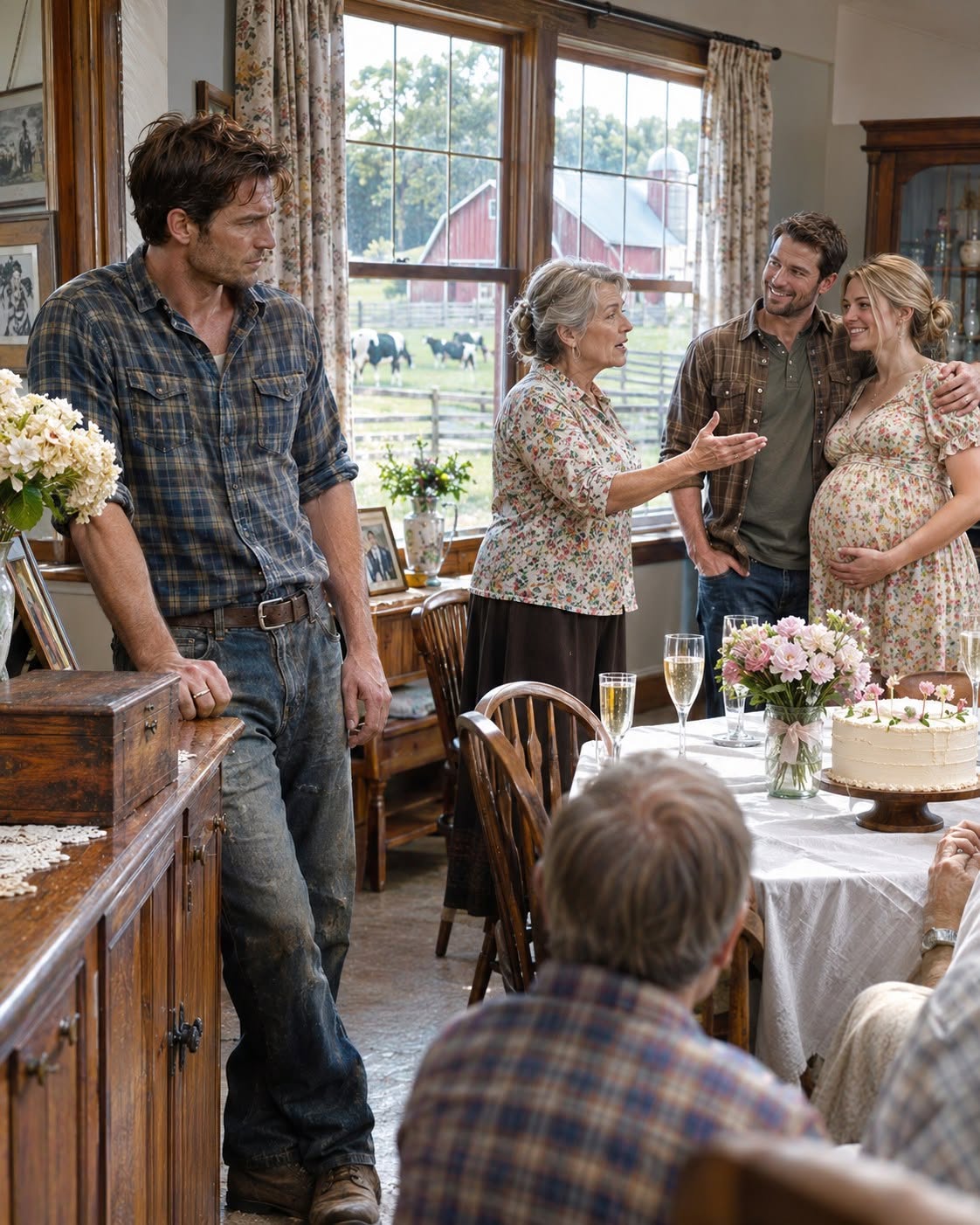
“Your grandmother’s savings bonds are paying for your brother’s wedding. That’s final.” My mother announced it in front of forty guests at my younger brother Toby’s engagement party.
THE LAND MY GRANDMOTHER LEFT BEHIND
“The bank wants its money,” Mom whispered. “And if you don’t help us, we’re going to lose everything.”
Then I saw the payment deadline.
Thirty days.
I looked at the loan papers, then at my mother, then at Toby, who was sitting beside her with his arms folded.
“How much?” I asked.
Mom swallowed.
“Two hundred and eighty thousand dollars.”
For a moment, I thought I’d misheard her.
“Two hundred and eighty thousand?”
Toby shifted in his chair.
“It’s not as bad as it sounds, Caleb.”
I almost laughed.
“That’s a strange thing to say about a debt bigger than most people’s farms.”
Mom pushed the folder closer.
“The bank is threatening foreclosure. The family land has been used as collateral. We just need you to refinance the loan or put your new farm up as security. Once the wedding business gets going, we’ll pay everything back.”
I stared at her.
“The wedding business?”
Toby finally looked up.
“Hannah and I are planning to turn the old property into a wedding venue. There’s a beautiful barn, open fields, and a pond. People pay a fortune for places like that.”
I looked from him to Mom.
“You’re asking me to put my farm at risk so Toby can start another business?”
“It’s not another failed business,” Mom snapped.
Toby’s face tightened.
“Thanks for the confidence.”
I turned another page.
There were loan statements, late notices, and a list of assets.
Then I saw something that made my stomach drop.
My grandmother’s old farmhouse was listed as additional collateral.
“Why is Grandma’s house on this paperwork?”
Mom’s eyes moved toward the window.
“It was part of the family property.”
“That doesn’t answer my question.”
She sighed.
“Your grandmother left the house to me. I had to use it to secure the loan.”
I read the date.
The loan had been taken out almost two years earlier.
That meant Mom had borrowed against the property long before the engagement party.
Long before she’d announced that Grandma’s bonds were paying for Toby’s wedding.
I put the papers down.
“Did you use the savings bonds to pay this loan?”
Mom’s expression changed.
“Some of them.”
“How much?”
She didn’t answer.
I looked at Toby.
He stared at the table.
“Mom,” I said quietly, “how much of Grandma’s money did you take?”
“Caleb, this isn’t the time to start blaming people.”
“Then when is the time?”
She pressed her lips together.
“Thirty-eight thousand dollars.”
I leaned back.
The bonds had been worth considerably more than that, even before interest.
“And where’s the rest?”
Toby cleared his throat.
“Some went toward the lodge deposit. Some went toward the wedding arrangements. And we had a few other expenses.”
I stared at him.
“What other expenses?”
He rubbed his forehead.
“Business expenses.”
I looked at the folder again.
There it was.
A second loan, a personal credit line, and a list of overdue payments.
The wedding wasn’t the real problem.
The wedding was just the latest thing they’d used to hide it.
For years, I’d believed Mom was simply careless with money. She’d sold calves without consulting me, dipped into the farm accounts, and repeatedly covered Toby’s mistakes.
Now I understood something worse.
She’d been using the family property as an ATM.
And she’d finally run out of things to borrow against.
I closed the folder.
“No.”
Mom blinked.
“What?”
“No. I’m not signing anything.”
Her face hardened.
“Caleb, you don’t understand what you’re doing.”
“I understand perfectly. You’re asking me to risk the farm I built because you and Toby borrowed money you couldn’t repay.”
“It’s your father’s land!”
“Dad’s land?” I repeated. “The land where I worked every morning before sunrise? The land where I repaired fences, raised calves, and kept the herd alive after he died?”
Mom looked wounded.
“Don’t speak about your father that way.”
“I’m speaking about the work I did on his farm.”
Toby pushed his chair back.
“You got your own place. You have a wife, a successful dairy operation, and a whole new life. Why can’t you help your own family?”
I looked at him.
“Because every time I help you, you learn that someone else will pay for your decisions.”
He stood.
“That’s convenient.”
“No, Toby. What’s convenient is spending money you don’t have and calling it family when the bill arrives.”
Mom began crying.
I hated seeing her cry.
Even after everything, she was still my mother.
But I had learned that feeling sorry for someone didn’t mean handing them the keys to everything I’d worked for.
I stood and carried the folder back to her.
“I’m not signing. But I’ll help you understand exactly what happened.”
She wiped her cheeks.
“What does that mean?”
“It means I’m going to find out who owns what, what the bank actually has a claim against, and whether you’ve put anything else at risk.”
Toby scoffed.
“You think you’re some kind of lawyer now?”
“No. That’s why I’m going to hire one.”
They left without saying goodbye.
That evening, Maya found me sitting at the kitchen table with the loan papers spread out in front of me.
She set two cups of coffee down.
“You look like you’ve been wrestling a bull.”
“I’m beginning to think a bull would be easier.”
She pulled out the chair beside me.
I showed her the loan.
She read every page slowly.
Then she reached the signature section.
“Caleb, look at this.”
She pointed to a paragraph near the bottom.
The loan wasn’t just secured against Mom’s farmhouse.
It included a parcel of agricultural land that had once belonged to my grandmother.
I frowned.
“That field was supposed to be divided between the family.”
“Was it?”
“Grandma told me she’d left part of it for my future barn.”
Maya looked at me.
“Did you ever see the deed?”
I shook my head.
“No. Mom handled the estate paperwork after Grandma died.”
Maya leaned back.
“Then you need to see it.”
The next morning, I called an attorney named Denise Harper.
She specialized in agricultural property and estate disputes.
I explained everything, including the savings bonds.
She listened without interrupting.
When I finished, she asked one question.
“Do you have any documentation showing your grandmother intended those bonds for you?”
“I have old letters, birthday cards, and a few notes she wrote when she gave them to me.”
“Bring everything you have. And don’t sign anything your mother gives you.”
I spent the next two days digging through boxes.
I found photographs of Grandma standing beside me in the old dairy barn. I found birthday cards with her familiar handwriting.
One envelope contained a note she’d written when I turned sixteen.
Caleb, I know you dream of building something that belongs to you. Keep working toward it. A good farm is more than buildings and fences. It’s a place where people can begin again.
I read that line several times.
Then I found another envelope.
It was addressed to me in Grandma’s handwriting.
Inside was a letter dated six months before she died.
It mentioned the savings bonds, but there was something else.
She wrote that she’d arranged for a portion of the family acreage to be held for my benefit until I was old enough to manage it.
I called Denise immediately.
When she read the letter, her expression became serious.
“This could be important,” she said.
“What does it mean?”
“It means we need the original estate documents. A personal letter doesn’t automatically establish ownership, but it may point us toward a trust or a specific bequest that was never properly disclosed.”
I felt my pulse quicken.
“Are you saying Mom might have taken land that wasn’t hers?”
“I’m saying we shouldn’t assume she had the authority to pledge it.”
Denise requested the probate records and contacted the bank.
Meanwhile, I did something I’d been avoiding.
I called Walter and Rose.
They’d sold me their farm, but they still lived in the old farmhouse and helped whenever they could.
I told them what was happening.
Walter listened quietly.
When I finished, he removed his glasses.
“Your grandmother came to see us about that land before she passed.”
I stared at him.
“What?”
“She was worried about what would happen after she was gone. She asked whether we’d be willing to help you establish yourself if the family farm became difficult.”
Rose nodded.
“She said you had your father’s hands and your grandfather’s stubbornness. She didn’t want anyone taking your future away.”
I felt something tighten in my chest.
“Why didn’t you tell me?”
“We didn’t want to interfere,” Walter said. “We thought your mother would do right by you.”
I looked down.
So had I.
A week later, Denise called.
She’d found the original probate file.
Grandma had established a small testamentary trust for me.
It contained two separate assets: the savings bonds purchased over the years and a specific parcel of eighteen acres, including the field beside the old dairy barn.
The trust named me as its beneficiary.
Mom had been appointed temporary trustee while I was underage, but her authority ended when I turned twenty-one.
I was thirty-four.
I read the documents twice.
“Then how did she borrow against the land?”
Denise took a breath.
“That’s what we’re investigating. The deed appears to have been transferred using an affidavit that doesn’t match the trust provisions. The bank may have relied on documents that weren’t valid.”
“Can they take the land?”
“Not automatically. But this will require urgent legal action.”
I felt angry, but underneath the anger was something colder.
Mom hadn’t simply spent money meant for me.
She may have used land that had never belonged to her.
Then Denise called again the following afternoon.
“There is another issue.”
I sat down.
“What now?”
“The savings bonds were registered in your grandmother’s name with you as the designated beneficiary on several of them. Some were held in a custodial arrangement. We’ll need to determine exactly how they were redeemed.”
“Can we recover the money?”
“Possibly. But first we need to establish who redeemed them, when, and under what authority.”
For the first time, I realized this wasn’t just a family argument.
It was a legal matter.
And the truth was going to come out whether Mom liked it or not.
Three days later, Mom called.
“Your brother says you’ve hired an attorney.”
“I have.”
“Against your own mother?”
“I’m trying to protect Grandma’s estate.”
She let out a bitter laugh.
“Your grandmother would be heartbroken to see what you’ve become.”
That sentence hurt more than I expected.
I took a breath.
“Grandma taught me to work hard and stand up for what was right. I think she’d understand.”
Mom went quiet.
Then she said something that changed the direction of everything.
“You don’t know the half of what happened after your father died.”
I gripped the phone.
“What does that mean?”
“Your father left debts. The farm was nearly bankrupt. I had to make decisions.”
I closed my eyes.
“Why didn’t you tell me?”
“Because you were grieving. And because Toby was already struggling.”
“So you used Grandma’s money to keep the farm going?”
“Some of it.”
“And the rest?”
She didn’t answer.
I asked her to meet me at Denise’s office.
For once, she agreed.
Toby came with her.
He looked tired. His wedding ring was still new, but his expression had aged.
Denise laid out the documents.
She explained the trust, the property description, and the limitations on Mom’s authority.
Mom stared at the papers.
“I was told I could manage the property.”
“Manage it for the beneficiary,” Denise replied. “Not transfer it for personal borrowing.”
Mom’s face went pale.
Toby leaned forward.
“What happens now?”
Denise folded her hands.
“The bank will need to review its security documents. The trust property may be subject to a challenge. We also need a full accounting of the bonds and all withdrawals made from the trust.”
Mom looked at me.
“Caleb, please. We can settle this ourselves.”
I looked at her.
“We could have settled it ourselves before you emptied the box.”
She began to cry.
Then, for the first time, she told us the whole story.
After Dad died, the farm had been in worse shape than I’d realized.
He’d taken out loans to buy equipment and expand the herd. Milk prices dropped, veterinary bills increased, and a bad winter killed several animals.
Mom had borrowed against the family property to keep the operation running.
At first, she’d intended to repay everything.
But Toby’s first business failed.
Then his second.
Mom had covered his debts because she was afraid he’d lose his house.
When the wedding came along, Hannah wanted something beautiful, and Toby insisted he could build a profitable venue on the old property.
Mom borrowed again.
She believed the wedding bookings would bring enough money to cover the payments.
They hadn’t.
The truth was ugly, but it was more complicated than I’d expected.
Mom hadn’t started out trying to steal my future.
She’d started by trying to save everyone.
Then she’d become so afraid of admitting she’d failed that she’d kept taking money from places where she had no right to take it.
I looked at her.
“Did you ever intend to tell me about the trust?”
She stared at her hands.
“No.”
The honesty was almost worse than another lie.
Toby suddenly spoke.
“I knew about the land.”
Mom turned toward him.
“Toby.”
He continued.
“Mom told me it was family property. I knew Grandma had mentioned Caleb, but I thought it was just something she’d said. I didn’t ask questions.”
I looked at my brother.
“Did you know she was using my bonds?”
He hesitated.
“I knew she was getting money from the bonds. I didn’t know they were specifically yours.”
“You never thought to ask?”
He looked away.
“No.”
The meeting ended with Denise requesting a temporary restriction on any further transfer of the disputed property.
The bank agreed to pause foreclosure proceedings while its legal department reviewed the trust documents.
But the deadline hadn’t disappeared.
We had twenty-eight days to find a solution.
That night, I couldn’t sleep.
I kept thinking about my father.
He’d spent his life believing the farm would stay in the family. He’d wanted both his sons to have a place there.
But somewhere along the way, that dream had turned into a burden everyone expected me to carry.
Maya found me on the porch just before sunrise.
“You don’t have to save them,” she said.
“I know.”
“Do you?”
I looked across our pasture.
The cows were beginning to gather near the feeding station.
“I don’t want Mom to lose her home.”
“That’s different from giving her your farm.”
She sat beside me.
“You can help someone without letting them destroy what you’ve built.”
I nodded.
By morning, I’d made a decision.
I called Denise and asked her to prepare a proposal.
I would not refinance the debt.
I would not pledge my farm.
But I was willing to help Mom negotiate a sale of the portion of the property that legally belonged to her, provided the disputed trust land was removed from the loan.
If the sale brought in enough money to settle the bank’s legitimate claim, the foreclosure could be avoided.
Anything left would be used to establish a modest, manageable living arrangement for Mom.
Toby would have to take responsibility for his own debts.
And there would be no more secret withdrawals.
Denise warned me that Mom might refuse.
She was right.
When we presented the proposal, Mom became furious.
“You want me to sell the land your father worked his whole life to build?”
I answered quietly.
“You already borrowed against it. The bank is going to sell it if you don’t act.”
Toby shook his head.
“This is ridiculous. You’re making us sell everything while you sit on your big new farm.”
“No,” I said. “I’m offering a way to stop the bank from taking everything.”
Mom pointed at me.
“You could pay the loan and keep the property in the family.”
“I could. But then what happens six months from now when Toby needs another loan?”
Toby stood.
“Leave me out of this.”
“You’ve been in the middle of it from the beginning.”
He looked at me with something close to hatred.
Then he said the words I had been waiting years to hear.
“Maybe Grandma was right to favor you.”
The room went silent.
I stared at him.
“Grandma didn’t favor me. She saw that I was working toward something and wanted to help me get there. You had your own bonds. You cashed them for a boat.”
“That was different.”
“How?”
He opened his mouth, but nothing came out.
Mom sat down heavily.
For several minutes, nobody spoke.
Then she looked at the proposal again.
“What if I lose the house?”
I softened my voice.
“We’ll make sure you have somewhere safe to live. I’m not trying to leave you homeless.”
She looked up.
“Why are you helping me after everything I’ve done?”
I thought about the empty cedar box.
About the engagement party.
About the years of watching Toby receive second chances while my own plans were postponed.
“Because you’re my mother,” I said. “But that doesn’t mean I have to let you keep making the same choices.”
It took another week of negotiations.
The bank’s investigation revealed that the disputed eighteen acres had been included in the collateral package through an improperly documented transfer.
The bank agreed to release its claim against that parcel once the legitimate portion of the property was sold and the loan was restructured.
The sale was painful.
The old property went to a neighboring agricultural family who wanted to expand their operation.
The house was sold separately.
Mom moved into a smaller home near town.
The proceeds paid off the secured loan, although a substantial amount of unsecured debt remained.
Toby had to sell his truck and close the wedding venue project before it ever opened.
Hannah was furious when she learned how much of their future had been built on borrowed money.
For a while, she and Toby separated.
I didn’t celebrate.
Watching a family fall apart is not satisfying, even when some of the pieces were broken by their own hands.
But something unexpected happened.
Toby got a job with a farm equipment supplier.
It wasn’t glamorous, and the hours were long.
He started paying his debts instead of asking Mom to cover them.
Several months later, he showed up at my farm.
He stood by the gate, hands shoved into his jacket pockets.
“Got a minute?”
I nodded.
We walked toward the pasture.
He watched my cattle grazing.
“Your place looks good.”
“Thanks.”
He kicked a small stone along the path.
“I owe you an apology.”
I didn’t answer immediately.
He continued.
“I knew Mom was using money to help me. I didn’t know how much of it was yours, but I knew enough to ask questions. I didn’t because it was easier to let her handle everything.”
I looked at him.
“Why are you telling me now?”
“Because I finally understand what you meant about consequences.”
He took a breath.
“I used to think you were lucky. You had the farm, the animals, and Grandma’s savings. I thought everyone was always helping you.”
I almost smiled.
“You saw the things I had. You didn’t see the mornings I worked before sunrise.”
He nodded.
“I know that now.”
Then he looked toward the barn.
“Do you think there’s any chance I could work here sometimes? Not for free. I want to learn how to actually run something.”
I studied him.
A few years earlier, I might have agreed immediately.
But I wasn’t going to confuse an apology with a promise of change.
“Maybe,” I said. “But if you work here, you start at the bottom. You show up when you’re scheduled. You follow the records. And you don’t borrow against anything that isn’t yours.”
He gave a small, embarrassed smile.
“Fair enough.”
He began helping two Saturdays a month.
At first, he struggled with the physical work.
He’d forgotten what early mornings felt like.
But he kept showing up.
Eventually, Hannah returned to him.
They rented a small house and postponed their plans for a large wedding.
Their daughter was born in early spring.
I visited the hospital with Maya.
When Toby placed the little girl in my arms, I felt something soften inside me.
He looked exhausted, but happy.
“Meet your niece,” he said.
I smiled down at her.
“What did you name her?”
“Martha.”
I looked up.
He nodded.
“After Grandma.”
For a moment, I couldn’t speak.
Then I gently touched the baby’s tiny hand.
“That’s a good name.”
Months later, Mom came to visit.
She arrived on a quiet Sunday afternoon carrying a small cardboard box.
I recognized the handwriting on its lid.
It was Grandma’s.
Mom placed it on the kitchen table.
“I found this while sorting through the house.”
Inside were photographs, old recipes, and a bundle of letters tied with faded ribbon.
At the bottom lay a small envelope addressed to me.
My hands trembled as I opened it.
The letter was short.
My dear Caleb,
If you’re reading this, I hope you’ve found a place where you can work with pride and sleep without worrying about tomorrow.
I know families don’t always divide things equally. But fairness isn’t always about giving everyone the same amount. Sometimes it’s about recognizing what each person is willing to build.
Never let anyone convince you that your dreams matter less because someone else asks louder.
And remember, a farm isn’t valuable because of the acres it owns. It’s valuable because of the care given to the land, the animals, and the people who depend on it.
Whatever happens, keep your hands honest and your heart kind.
Love, Grandma Martha.
I read it twice.
When I looked up, Mom was crying.
“She always believed in you,” she whispered.
I folded the letter carefully.
“She believed in both of us. She just knew we needed different things.”
Mom lowered her eyes.
“I was wrong, Caleb.”
It was the first time she’d said those words without adding an excuse.
“I thought I was keeping the family together. I thought if I gave Toby enough help, he’d finally succeed. And I thought you’d always be strong enough to manage without anything.”
I looked at her.
“That was the problem. You thought because I could manage, I didn’t need anyone to care about what happened to me.”
She nodded slowly.
“I know.”
We sat in silence for a while.
Then she reached into her purse and placed a small envelope on the table.
Inside was a cashier’s check.
It wasn’t close to the value of the savings bonds.
But it was something.
“I sold some jewelry and paid off a portion of what I owed,” she said. “This is what I could put aside for you.”
I pushed the envelope back.
“Mom, you need money for yourself.”
“Please take it.”
I looked at her.
“I’m not going to accept this as payment for everything that happened. But if you want to make things right, keep paying what you owe and never take something that belongs to someone else again.”
She nodded.
For the first time, I believed she understood.
Our relationship didn’t become perfect overnight.
Trust takes longer to rebuild than it takes to break.
Mom still visited, but she no longer involved herself in my business accounts.
Toby and I slowly became brothers again, although our relationship was different.
We stopped pretending that love meant one person had to carry everyone else’s mistakes.
And the farm continued to grow.
Two years after that first meeting with the bank, Maya and I built a new barn on the eighteen acres Grandma had intended for me.
We used local lumber, hired a few neighbors, and designed it around the needs of our growing herd.
Walter helped me choose the layout.
Rose insisted on planting flowers along the entrance.
On opening day, I brought Grandma’s old butter churn and placed it on a shelf near the office.
Maya laughed when she saw it.
“You’re keeping that old thing here?”
“Of course.”
“What’s it for?”
I smiled.
“Reminding me where everything started.”
That afternoon, Toby arrived with Hannah and little Martha.
He carried a wooden sign he’d made himself.
It read:
MARTHA’S BARN — BUILT WITH HONEST HANDS.
I ran my fingers over the lettering.
“You made this?”
He nodded.
“Figured Grandma deserved a place here.”
I hung it above the office door.
Later, as the guests gathered around the barn, Mom stood beside me.
She watched the cattle moving through the new gates.
“Your grandmother would have been proud,” she said.
I looked across the pasture.
For years, I’d thought the bonds were the thing Grandma had left me.
I had measured their value in dollars, imagining that one day they’d become lumber, steel, a roof, and a place of my own.
But the money had never been the most important part.
The important thing was that someone had believed in me before I had anything to show for myself.
And when that belief was tested, I finally learned to believe in myself.
I couldn’t get the bonds back.
I couldn’t undo the choices my mother had made or the years I’d spent feeling like the less important son.
But I had something Grandma had wanted me to have all along.
A future I could call my own.
As the sun began setting behind the barn, little Martha toddled toward the butter churn.
Toby caught her before she knocked it over.
“Careful, sweetheart,” he said. “That’s something special.”
I smiled.
“Your great-grandmother used to make butter with that. She gave it to people who were starting over.”
Toby looked at me.
“Maybe we should do that again.”
The following spring, we started a small tradition.
Whenever a young farmer bought their first dairy animal, we’d give them a jar of homemade butter and a handwritten note.
It wasn’t much.
But it reminded them that somebody believed they could build something worthwhile.
And every time I handed over one of those jars, I thought about Grandma.
I also thought about my mother.
I learned that forgiveness doesn’t mean pretending nothing happened. It doesn’t mean giving people unlimited access to your life, your money, or your future.
Sometimes forgiveness means letting someone face the consequences of their choices while refusing to let bitterness become your own burden.
Family should be a place where people support one another, not a place where one person’s sacrifices become everyone else’s entitlement.
And the people who truly love you won’t demand that you destroy your future to rescue theirs.
Grandma’s savings bonds never built my barn.
But her belief in me did.
And that turned out to be worth far more than the money she’d saved.