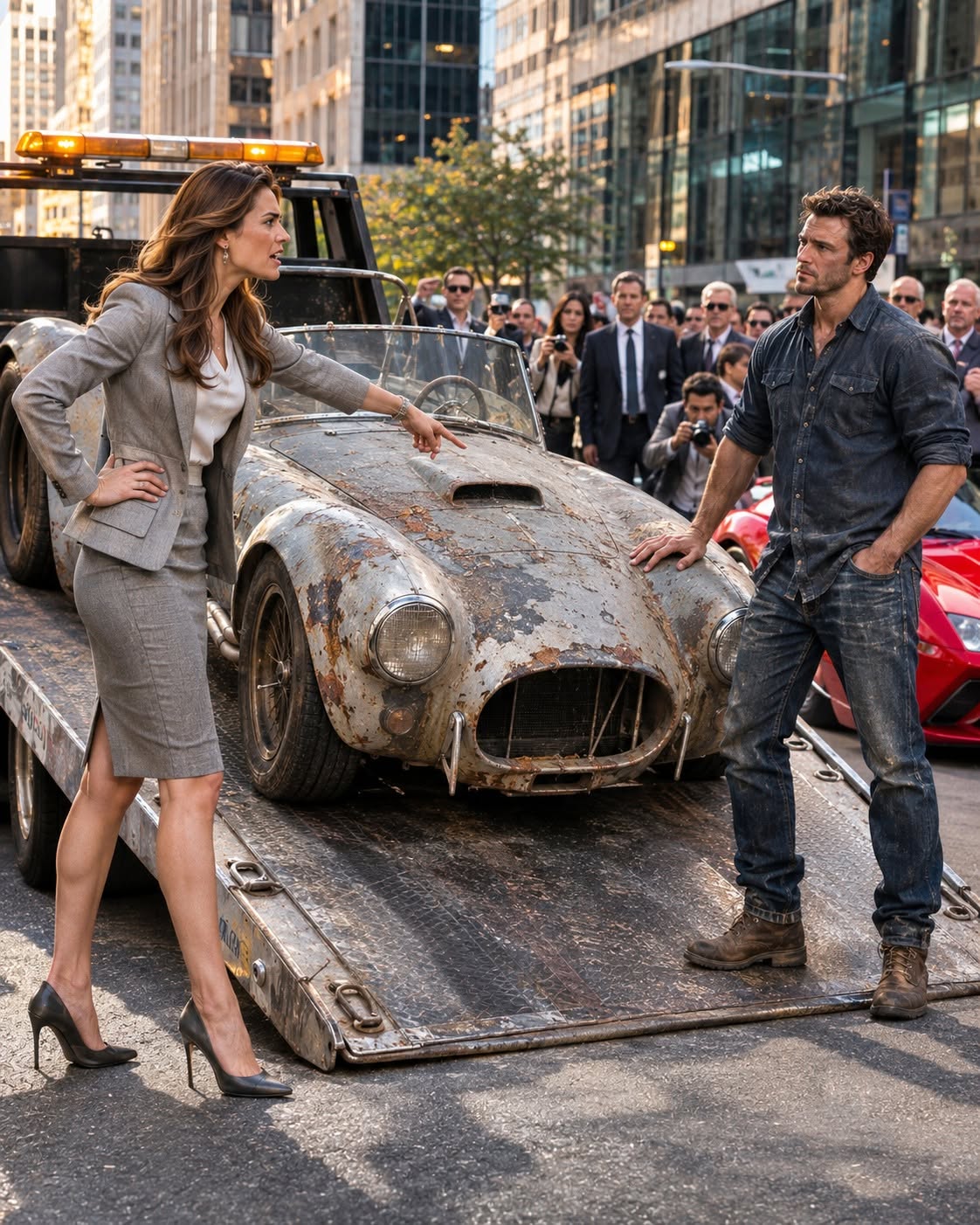
“You have five minutes to move that piece of junk before I have it crushed.” The woman pointing at my car was Evelyn Vance
The photograph showed a younger version of the elderly man standing beside my blue Mustang.
But he wasn’t alone.
A second man stood on the other side of the car, one hand resting proudly on its roof.
I recognized him immediately.
My father.
The man who had taught me how to rebuild an engine before I was old enough to drive.
The man who had spent his entire life working with cars, only to die before he could see me become a father myself.
And standing between them, sitting on the hood of the Mustang, was a little boy.
Me.
I stared at the photograph, unable to speak.
“Where did you get this?” I finally whispered.
The elderly gentleman’s eyes softened.
“My name is Arthur Whitmore. Thirty years ago, I was the chief development engineer at Shelby American. Your father, Daniel Mercer, was the finest automotive engineer I ever worked with.”
I looked down at the photograph again.
“That’s impossible. My father never mentioned working for Shelby.”
Arthur gave a sad smile.
“That’s because he was betrayed.”
The entire showroom seemed to disappear around us.
Evelyn Vance slowly lowered her arms.
“What exactly is going on?” she asked.
Arthur ignored her.
“Your father and I built something together. Something the automotive world was never supposed to forget.”
He pointed toward the blue Mustang.
“That car isn’t a 1967 Mustang that someone happened to restore. It’s the original experimental Shelby prototype we called the Bluebird.”
A murmur spread through the showroom.
One of the collectors actually dropped his champagne glass.
I shook my head.
“No. My father bought that car from a junkyard. At least, that’s what he told me.”
Arthur nodded.
“That’s exactly what he wanted everyone to believe.”
He turned toward the showroom windows.
“May I see it?”
I hesitated.
Then I nodded.
We walked outside together.
The faded blue Mustang sat beneath the harsh afternoon sunlight, its peeling paint revealing patches of older primer. The driver’s-side door had a dent near the handle. One headlight was cloudy, and the chrome bumper had a deep scratch.
To everyone else, it looked like an abandoned project.
To Arthur, it was something else entirely.
He approached slowly, almost reverently.
His fingers trembled as he touched the roof.
“Thirty-two years,” he whispered. “I’ve spent thirty-two years wondering where you went.”
Evelyn followed us outside.
“Mr. Whitmore, with all due respect, this vehicle is registered as a standard 1967 Mustang. We have no documentation suggesting it’s a prototype.”
Arthur turned.
“That’s because the documentation was deliberately destroyed.”
He looked at me.
“Your father hid the original engineering records inside the car. He knew someone would eventually come looking for it.”
I felt a chill move through my chest.
“Why would he do that?”
Arthur took a long breath.
“Because the company was about to do something unforgivable.”
He explained that in 1967, Shelby American had been developing an experimental high-performance Mustang designed to compete with the most powerful European racing machines.
The project had been expensive, secretive, and controversial.
Daniel Mercer had developed a revolutionary engine modification and a lightweight suspension system that could dramatically improve handling at high speeds.
The prototype was never meant to be sold.
It was supposed to become the foundation for an entirely new generation of racing Mustangs.
But before the project could be completed, someone stole the engineering designs.
Worse, the stolen technology appeared in a rival company’s experimental vehicle.
Daniel discovered the theft and reported it.
Within weeks, he was accused of stealing company property himself.
His reputation was destroyed.
The project was canceled.
And the original prototype disappeared.
“My father never told me any of this,” I said.
“He was protecting you,” Arthur replied. “He believed the people responsible would eventually come after his family.”
I stared at the car.
For years, I had believed my father simply loved old Mustangs.
Now I wondered how much of his life had been spent hiding from something he couldn’t explain.
Arthur crouched beside the front wheel.
“There’s something I need to check.”
He pointed toward a small section of the frame hidden behind the wheel well.
“Your father always used a particular welding pattern. Three short marks followed by one long one.”
I knelt beside him.
The pattern was there.
I had seen it dozens of times during my restoration work without ever understanding its meaning.
Arthur closed his eyes.
“Daniel, you stubborn old fool. You actually did it.”
Evelyn was listening carefully now.
“Are you saying this car is worth more than the prototype inside our showroom?”
Arthur stood.
“I’m saying your company has spent millions trying to recreate something that has been sitting outside your building for decades.”
He looked directly at her.
“And the vehicle in your showroom is almost certainly a fraud.”
The senior technician, who had laughed at me earlier, stepped forward.
“That’s a serious accusation.”
Arthur nodded.
“Then let’s establish the truth.”
He asked for the original inspection reports on the green-and-gold Shelby.
Evelyn motioned for an assistant to retrieve them.
A few minutes later, the documents arrived.
Arthur examined the engine identification numbers, mounting specifications, and restoration records.
He didn’t need long.
“Who authorized the replacement engine?” he asked.
The senior technician shifted uncomfortably.
“Our restoration director approved it.”
“Name?”
“Richard Cole.”
Arthur’s expression hardened.
“Richard Cole worked for us in 1967. He was one of the engineers dismissed after the Bluebird scandal.”
I looked at Evelyn.
She looked as though someone had just pulled the floor out from beneath her.
“Richard Cole is our head of heritage engineering,” she said. “He’s been with Sterling Motors for eleven years.”
Arthur handed the documents back.
“Then I suggest you find out exactly what he’s been doing.”
Before Evelyn could answer, a voice came from behind us.
“There’s no need for that.”
A tall man in an expensive gray suit approached from the showroom entrance.
He was in his early sixties, with silver hair and a perfectly arranged tie.
Richard Cole.
His eyes moved from Arthur to me, then settled on the Mustang.
For the first time that afternoon, someone looked at my car with genuine fear.
“Arthur,” he said coldly. “I thought you were retired.”
“I was,” Arthur replied. “Until I saw Daniel Mercer’s car.”
Richard forced a laugh.
“That’s an old wreck. You can’t seriously believe it’s the original prototype.”
“I believe the evidence will speak for itself.”
Richard turned to Evelyn.
“Ms. Vance, we have a scheduled private auction preview. We cannot allow an outsider to interfere with the company’s business.”
Evelyn’s expression had changed.
“Richard, is the engine in our Shelby original?”
“Of course.”
“Then explain the altered mounting holes.”
He paused.
“Our restoration team made necessary adjustments.”
“Why weren’t those adjustments documented?”
“Because they were minor.”
Arthur stepped forward.
“An engine replacement isn’t minor when you’re selling a supposedly original prototype for several million dollars.”
Richard’s jaw tightened.
“This is ridiculous.”
He turned toward the showroom.
“Everyone inside. Now.”
But the collectors weren’t moving.
One of them, a gray-haired woman wearing a diamond necklace, stepped forward.
“My family has been negotiating a purchase of that vehicle for three months. If its history is questionable, I want an independent inspection.”
Another collector agreed.
Then another.
Evelyn looked at Richard.
“Give me the complete restoration file. Every invoice, every inspection, every communication.”
Richard stared at her.
“You don’t understand how this business works.”
“No,” she answered. “But I understand what fraud looks like.”
For a moment, I thought Richard might argue.
Instead, he smiled.
It wasn’t a friendly smile.
“Be careful, Evelyn. Sometimes people who dig too deeply discover things they would rather not know.”
He walked away.
Arthur watched him disappear through the glass doors.
Then he looked at me.
“We need to open the Mustang.”
I immediately shook my head.
“Not here. I don’t have the tools, and I can’t risk damaging anything.”
Arthur smiled.
“Your father would be proud to hear you say that.”
We arranged for the car to be moved to a secure workshop inside Sterling Motors.
For the first time since I had arrived, nobody looked at my Mustang as an eyesore.
A group of technicians gathered around it.
Evelyn personally ordered that the vehicle be handled with care.
She even asked someone to bring protective covers.
I stood beside the car, feeling strangely uncomfortable.
A few hours earlier, I had been worried about losing my job.
Now an entire luxury showroom was treating the $120 car I had purchased as if it were a national treasure.
But my thoughts kept returning to Chloe.
She would be waiting for me.
And I had promised her I would be home before dinner.
I checked my phone.
Three missed calls.
I immediately called back.
“Daddy?”
Chloe’s little voice came through the speaker.
“Hey, sweetheart. I’m sorry I’m late.”
“Are you coming home?”
“Yes. I just need a little more time.”
There was a pause.
“Did you sell the blue car?”
I smiled.
“Not yet.”
“Good. I like that car.”
My throat tightened.
“Why?”
“Because Grandpa fixed it. You told me.”
I closed my eyes.
She was right.
The Mustang wasn’t just a car.
It was one of the few things I still had that connected me to my father.
“I’ll tell you everything when I get home,” I promised.
“Okay. Don’t forget to bring milk.”
I laughed.
“I won’t.”
When I hung up, Arthur was standing nearby.
“Your daughter?”
I nodded.
“Seven years old.”
Arthur smiled sadly.
“Daniel would have loved being a grandfather.”
I looked away.
“Sometimes I wish he had lived long enough to meet her.”
Arthur placed a hand on my shoulder.
“He knew you would be a good father. That’s why he made the choices he did.”
I wanted to believe him.
But I still didn’t understand why my father had hidden the car’s identity.
And I was about to discover that the most important secret wasn’t inside the engine.
It was beneath the rear seat.
The technicians removed the back cushion carefully.
At first, they found nothing unusual.
Then one of them noticed a small metal plate beneath the upholstery.
It was held in place by four screws.
I recognized the screws immediately.
My father had used the same unusual fastening method on nearly every restoration project he ever touched.
I took a screwdriver and removed them myself.
Beneath the plate was a narrow compartment.
Inside sat a small leather pouch, a folded envelope, and a brass key.
Arthur stared at the objects.
“Daniel’s handwriting,” he whispered.
I unfolded the envelope.
The first line was addressed to me.
To my son, when you’re old enough to understand why I kept this car.
My hands began to shake.
I read silently at first.
Then Arthur asked me to read it aloud.
The letter explained that my father had known the Bluebird project would never be officially recognized as long as the people responsible for the stolen designs remained in positions of power.
He had kept the original engineering records, along with proof of who had altered the documents.
But there was something else.
He had also preserved a personal account of what happened.
A record of the people who had threatened him, the people who had abandoned him, and the people who had helped him escape the scandal.
At the bottom was a sentence that made me stop breathing.
If Richard Cole ever comes looking for this car, do not trust him.
Arthur slowly sat down.
“I knew it,” he whispered.
The room fell silent.
I looked at the elderly engineer.
“Why didn’t you tell me about Richard before?”
Arthur’s face filled with regret.
“Because I didn’t know he was still involved. I believed he had disappeared years ago.”
He took the leather pouch and carefully opened it.
Inside was a small film canister.
“These are the original engineering negatives,” he said. “Your father must have photographed every drawing before the documents were stolen.”
The brass key belonged to a storage facility outside Detroit.
And the letter contained one final instruction.
If the car was ever found, the key and the film had to be delivered to an independent automotive historian named Margaret Ellis.
Arthur recognized the name immediately.
“She was a legal investigator for the racing association. If anyone can authenticate this material, it’s Margaret.”
Evelyn had been listening from the doorway.
“I’ll arrange the transport and contact her.”
I looked at her.
“Why are you helping us?”
She didn’t answer immediately.
Then she looked down at her shoes.
“Because I almost destroyed something that mattered more than anything in this building.”
She swallowed.
“And because I owe you an apology.”
I wasn’t ready to forgive her.
Not yet.
But I nodded.
That evening, I finally drove home.
The Mustang’s engine sounded rough, and the steering wheel still pulled slightly to the left.
But I had never loved the sound of it more.
Chloe ran out of the house as soon as I parked.
“Daddy!”
She wrapped her arms around my waist.
I lifted her and kissed her cheek.
“I brought milk.”
She laughed.
Then she noticed the unusual expression on my face.
“What’s wrong?”
I looked at the Mustang.
“Nothing’s wrong, sweetheart. I just found out something about Grandpa.”
“Good something?”
I thought for a moment.
“Complicated something.”
She rested her head against my shoulder.
“Can we still eat pancakes tomorrow?”
I smiled.
“Absolutely.”
For the first time in a long while, I felt that maybe things were finally going to be okay.
But the next morning, everything changed.
At 6:15 a.m., my phone rang.
It was Evelyn.
“Are you home?”
“Yes. Why?”
“Someone broke into the workshop last night.”
I sat up immediately.
“Was the Mustang damaged?”
“No. The car is safe. But the storage compartment was opened, and the original film canister is missing.”
I felt my stomach drop.
“What about the letter?”
“Still here.”
“Then someone knew exactly what they were looking for.”
Evelyn paused.
“There’s something else. Richard Cole hasn’t reported to work.”
I looked toward Chloe’s bedroom.
She was still asleep.
“Call the police,” I said.
“Already done. But there’s a problem.”
“What?”
“The security footage shows someone using an executive access card. The person entered at 2:13 a.m. and left twenty minutes later.”
“Who?”
“Richard.”
I ended the call and stared at the wall.
My father had spent decades protecting the truth.
And now someone was trying to bury it again.
I arranged for a neighbor to stay with Chloe and drove back to Sterling Motors.
When I arrived, Evelyn was waiting with two detectives.
Arthur sat in a chair, looking older than he had the previous day.
“We need to find that film,” he said.
I nodded.
“There’s a storage facility. My father’s key.”
Evelyn looked at me.
“Then let’s go.”
The facility was located in an old industrial district outside Detroit.
The building was nearly abandoned.
A security guard checked the key and led us to unit 217.
Inside were dozens of cardboard boxes, old photographs, engineering notebooks, and a collection of racing trophies.
On a workbench sat a metal case.
The brass key opened it.
Inside were the original Bluebird drawings.
But there was something even more important.
A thick envelope containing signed statements from three former Shelby employees.
Each statement described how Richard Cole had stolen Daniel’s designs and altered the original prototype records.
One document included a transfer agreement showing that the engineering rights had been sold to a private company controlled by Cole’s associates.
The final page contained a signature.
Richard Cole.
Arthur read it twice.
Then he looked up.
“This is enough to expose him.”
But the detectives weren’t satisfied.
They needed the missing film.
I searched through the boxes.
At the bottom of an old toolbox, I found a second envelope.
Inside was a small handwritten note from my father.
Arthur, if you’re reading this, the first hiding place has failed. The original negatives are not in the car. They were never meant to be there.
I stared at the words.
Arthur leaned closer.
“What does that mean?”
I read the note again.
Then I remembered something.
When I was a child, my father had a strange habit.
Whenever he finished a major repair, he would take a photograph of the completed engine and place the negative inside an old metal toolbox.
He used to tell me that a photograph never forgot what people tried to change.
I remembered that toolbox.
It was still in my garage.
We rushed back.
I found it beneath a workbench, covered in dust.
The metal latch was stiff, but it finally opened.
Inside were dozens of old photographs.
And beneath them sat a small wooden box.
The film negatives were inside.
So was a cassette tape.
Arthur held the cassette as if it were something sacred.
“Daniel’s voice,” he whispered.
We found an old player in the workshop.
The tape crackled.
Then my father’s voice filled the room.
“If this recording is being played, something has happened to me, or the people I feared have finally found the car.”
I stopped breathing.
His voice sounded exactly as I remembered it.
Calm.
Steady.
A little tired.
“Arthur, if you’re listening, I want you to know I never blamed you for what happened. You tried to protect the project, but I knew the truth would cost us both.”
There was a pause.
Then he continued.
“To my son, if you are hearing this someday, I hope you understand that I didn’t hide the car because I was ashamed of it. I hid it because I wanted you to grow up without carrying my battles.”
My eyes filled with tears.
“I know you may wonder why I left you with so many unanswered questions. I wanted you to have a normal childhood. I wanted you to know me as your father, not as a man fighting a company that could never admit it was wrong.”
I covered my mouth.
The recording continued.
“One day, someone may tell you that your worth depends on what you own, what you drive, or how much money you make. Don’t believe them. The best thing I ever built wasn’t an engine. It was the life I got to share with you.”
The tape clicked.
Then came one final sentence.
“Take care of your daughter. Give her the childhood I fought so hard to give you.”
I couldn’t hold back anymore.
I sat down and cried.
Arthur lowered his head.
Even the detectives looked away.
For several minutes, nobody spoke.
Then the phone on the workbench rang.
It was Evelyn.
“Richard just contacted me,” she said.
“Where is he?”
“He wants to meet. He says he has something to trade.”
I looked at the cassette player.
“What does he want?”
“The original documents and the film negatives.”
Arthur stood immediately.
“Absolutely not.”
Evelyn continued.
“He says if we don’t agree, he’ll release a statement claiming the entire Bluebird story is fabricated. He has already contacted several journalists.”
I looked at the detectives.
They exchanged glances.
One of them nodded.
“We can arrange a controlled meeting.”
I turned to Evelyn.
“Tell him we’ll meet at the showroom tonight.”
She hesitated.
“Are you sure?”
“No. But my father spent his life protecting the truth. I’m not letting Richard destroy it.”
That evening, the showroom was closed to the public.
The green-and-gold Shelby stood beneath the lights.
Richard arrived at exactly seven.
He carried a leather briefcase.
Evelyn stood near the reception desk.
Arthur was beside me.
Two detectives waited in an office nearby.
Richard looked at us and smiled.
“I see you’ve found the little treasure.”
I placed a folder on the table.
“Everything you wanted is here.”
He opened it.
Inside were copies of the original engineering records.
His smile faded.
“Where are the negatives?”
“Safe.”
“Then we have a problem.”
“No,” I replied. “You do.”
Richard closed the briefcase.
“You have no idea what you’re dealing with. I spent decades building my reputation. I will not let an old accusation destroy everything.”
Arthur stepped forward.
“You destroyed Daniel’s reputation first.”
Richard laughed bitterly.
“Daniel was a fool. He thought principles mattered more than survival.”
“My father lost his career because of you.”
“Your father made his own choices.”
I looked at him.
“He chose not to become you.”
Richard’s expression hardened.
He turned toward Evelyn.
“Do you know how much Sterling Motors is worth? How much money is invested in the heritage program? You think collectors care about some forgotten engineer?”
Evelyn answered quietly.
“They care about honesty.”
Richard slammed his hand against the table.
“Honesty doesn’t build a company!”
“No,” she said. “But dishonesty destroys one.”
The detectives entered.
Richard looked toward the doors.
For the first time, he understood.
They had heard everything.
One officer informed him that he was being detained for questioning in connection with the theft of company property and suspected fraud.
Richard’s face turned red.
He pointed at me.
“You think you’ve won? That car will never be worth what you imagine.”
I looked at the blue Mustang visible through the glass.
“That’s fine. It was never about the money.”
The detectives escorted him away.
The showroom remained silent.
Then Arthur began to cry.
He wasn’t crying because Richard had been arrested.
He was crying because, after thirty-two years, Daniel’s name was finally going to be cleared.
Three months later, the investigation was complete.
The original negatives had been authenticated.
The engineering drawings matched the surviving factory records.
The statements from former employees were verified.
And Richard Cole was formally charged with fraud, theft, and falsifying historical vehicle documentation.
The green-and-gold Shelby was removed from the auction catalog.
Its buyer withdrew.
Sterling Motors issued a public statement admitting that its restoration department had failed to verify the vehicle’s authenticity.
Evelyn also made a personal announcement.
She would commission an independent review of every historical vehicle in the company’s collection.
But the biggest news came on a rainy Thursday morning.
Arthur called me.
“They’ve officially recognized the Bluebird.”
I stood in my kitchen, holding a cup of coffee.
“What does that mean?”
“It means your father’s work will finally receive the recognition it deserved.”
I looked through the window at the Mustang.
For the first time, I noticed how beautiful the faded blue paint looked beneath the rain.
Arthur continued.
“The museum wants to display it. They’ve offered a substantial amount to acquire the vehicle.”
I laughed softly.
“How substantial?”
“Enough to change your life.”
I was quiet for a moment.
Then I asked the question that mattered.
“Would they let me keep working on it?”
Arthur laughed.
“Son, I believe they’re hoping you’ll be the one restoring it.”
I thanked him and hung up.
That evening, Evelyn visited my small garage.
She stood beside the Mustang, looking at it with an expression I couldn’t quite read.
“I owe you more than an apology,” she said.
I wiped my hands on a rag.
“What do you mean?”
“I want to offer you a position at Sterling Motors.”
I almost laughed.
“After the way you treated me?”
She lowered her eyes.
“I know. I was wrong.”
“What position?”
“Director of Historical Restoration. You’ll have complete authority over our restoration standards, and you’ll lead the Bluebird project.”
I stared at her.
“That’s a big offer.”
“It’s also an opportunity to make sure nobody else gets treated the way your father was.”
I considered it.
The salary was more money than I had ever earned.
The benefits would take care of Chloe.
And the work would allow me to return to something I had once loved.
But there was one condition.
“I won’t travel constantly. I have a daughter. She’s my priority.”
Evelyn nodded without hesitation.
“Then we’ll build the position around that. No one should have to sacrifice their family to prove they’re good at their job.”
I looked at the Mustang.
Then at the little drawing Chloe had taped to the garage wall.
It showed a blue car with two stick figures inside.
One was tall.
The other had enormous pink hair.
Above them, she had written:
Me and Daddy.
I smiled.
“All right. I’ll accept.”
Six months later, the Bluebird was ready.
Not restored to look brand-new.
Restored to look like itself.
We preserved the original paint beneath the protective coating, repaired the damaged body panels, rebuilt the engine using the authenticated specifications, and kept every surviving mark that told its history.
Arthur attended the unveiling.
So did former Shelby engineers, collectors, automotive historians, and journalists from across the country.
The museum had arranged for the car to be displayed alongside the original engineering drawings and my father’s photographs.
A large plaque stood beside it.
It read:
THE BLUEBIRD
1967 Experimental Shelby Prototype
Designed and engineered by Daniel Mercer and Arthur Whitmore.
Preserved through the determination of a family who refused to let history be rewritten.
I stood beside Arthur, reading the words.
He placed a hand on my shoulder.
“Your father would have loved this.”
I nodded.
“He would’ve complained about the lighting.”
Arthur laughed.
“Absolutely.”
Then Chloe ran toward us wearing a little blue dress.
“Daddy!”
I knelt and caught her.
“Did you see Grandpa’s car?”
She nodded excitedly.
“Everyone likes it!”
“Yes, sweetheart. They do.”
She looked at the plaque.
“That’s Grandpa’s name.”
I nodded.
“That’s right.”
She studied the car for a moment.
Then she asked a question I wasn’t expecting.
“Daddy, are we rich now?”
Arthur burst out laughing.
I smiled.
“Not exactly.”
“But you have a big job.”
“I do.”
“And the car is famous.”
“Apparently.”
She thought about that.
Then she wrapped her arms around my neck.
“That’s okay. I just want you to come home for dinner.”
My throat tightened.
I hugged her a little closer.
“I promise.”
Later that afternoon, the museum director approached me with a proposal.
A wealthy collector had offered an extraordinary amount of money to purchase the Bluebird.
The offer was enough to pay off my debts, buy a beautiful house, and secure Chloe’s future.
I listened carefully.
Then I declined.
The director looked surprised.
“Are you certain?”
I glanced toward Chloe, who was showing Arthur how she had drawn a racing stripe on a piece of paper.
“Yes.”
I had spent too many years believing that the right opportunity was the one that paid the most.
My father had taught me something different without ever saying it directly.
Some things were valuable because they could never be replaced.
The Bluebird belonged in a place where people could learn its history.
And my daughter deserved to grow up knowing that her grandfather’s greatest achievement wasn’t a car.
It was the courage to stand by what he believed.
A year later, Sterling Motors established the Daniel Mercer Automotive Scholarship.
It provided financial support to young mechanics and engineering students who couldn’t afford expensive training programs.
The first scholarship recipient was a nineteen-year-old girl named Sofia.
She had been repairing motorcycles in her family’s backyard and had nearly given up on college because of the cost.
When she received the award, she cried.
Evelyn handed her the certificate.
Then she invited me to say a few words.
I stood in front of the small crowd.
“I used to think being successful meant working on the most expensive cars, knowing the right people, and having my name recognized.”
I looked toward the Bluebird.
“Then I became a father. I learned that being successful sometimes means leaving work early, keeping promises, and making sure the people who depend on you know they’re loved.”
I paused.
“My father lost almost everything because he refused to let someone else take credit for his work. But he never lost the one thing that mattered most to him. He never stopped being a father.”
I looked at Sofia.
“If you love what you do, don’t let anyone convince you that your background determines how far you can go. And never confuse the price of something with its worth.”
The audience applauded.
But I wasn’t thinking about the applause.
I was thinking about the day Evelyn had pointed toward the industrial compactor and given me five minutes to move my car.
Five minutes.
That’s all she thought it deserved.
Five minutes before a machine would crush what she believed was worthless.
She had looked at faded paint, a dented hood, and an old engine.
She hadn’t seen the history beneath it.
She hadn’t seen the years of sacrifice.
She hadn’t seen a father’s love hidden inside a machine.
And most importantly, she hadn’t seen the man standing in front of her.
A man who had once built extraordinary cars, walked away from a promising career to raise his daughter, and believed his best days were already behind him.
She had judged the Mustang by its appearance.
And nearly made the same mistake with its owner.
That night, I returned home with Chloe.
We ate pancakes for dinner because she insisted it was a special occasion.
Afterward, she brought me an old photograph she had found in a box.
It showed my father sitting beside the blue Mustang, with me as a little boy on his lap.
I stared at it for a long time.
On the back, in my father’s handwriting, were six simple words:
The best things are worth protecting.
Chloe climbed onto my lap.
“Is that Grandpa?”
“Yes.”
“Was he a good mechanic?”
I smiled.
“The best.”
“Better than you?”
I pretended to think about it.
“Maybe.”
She giggled.
Then she pointed at the Mustang outside.
“Are you going to keep it forever?”
I looked at the old blue car.
Its paint was still imperfect.
Its hood still carried the small dent.
And its engine still made a familiar uneven sound when it started.
“Yes, sweetheart,” I said. “As long as I can.”
She rested her head against my chest.
I turned off the kitchen light and watched the car through the window.
For years, I had thought my father’s greatest gift to me was teaching me how to build an engine.
I finally understood that it was something much greater.
He had taught me that a person’s value isn’t measured by their appearance, their possessions, or the approval of people standing behind expensive doors.
It’s measured by what they protect, what they stand for, and whom they choose to love when life becomes difficult.
The world had nearly crushed my father’s legacy because it looked like an old, forgotten machine.
But the truth had survived.
And so had the love he left behind.
Sometimes, the greatest treasures don’t shine. Sometimes, they arrive covered in dust, carrying old scars, and asking only for someone willing to look a little closer.
And sometimes, the person everyone underestimates is the very person who has something priceless to teach them.