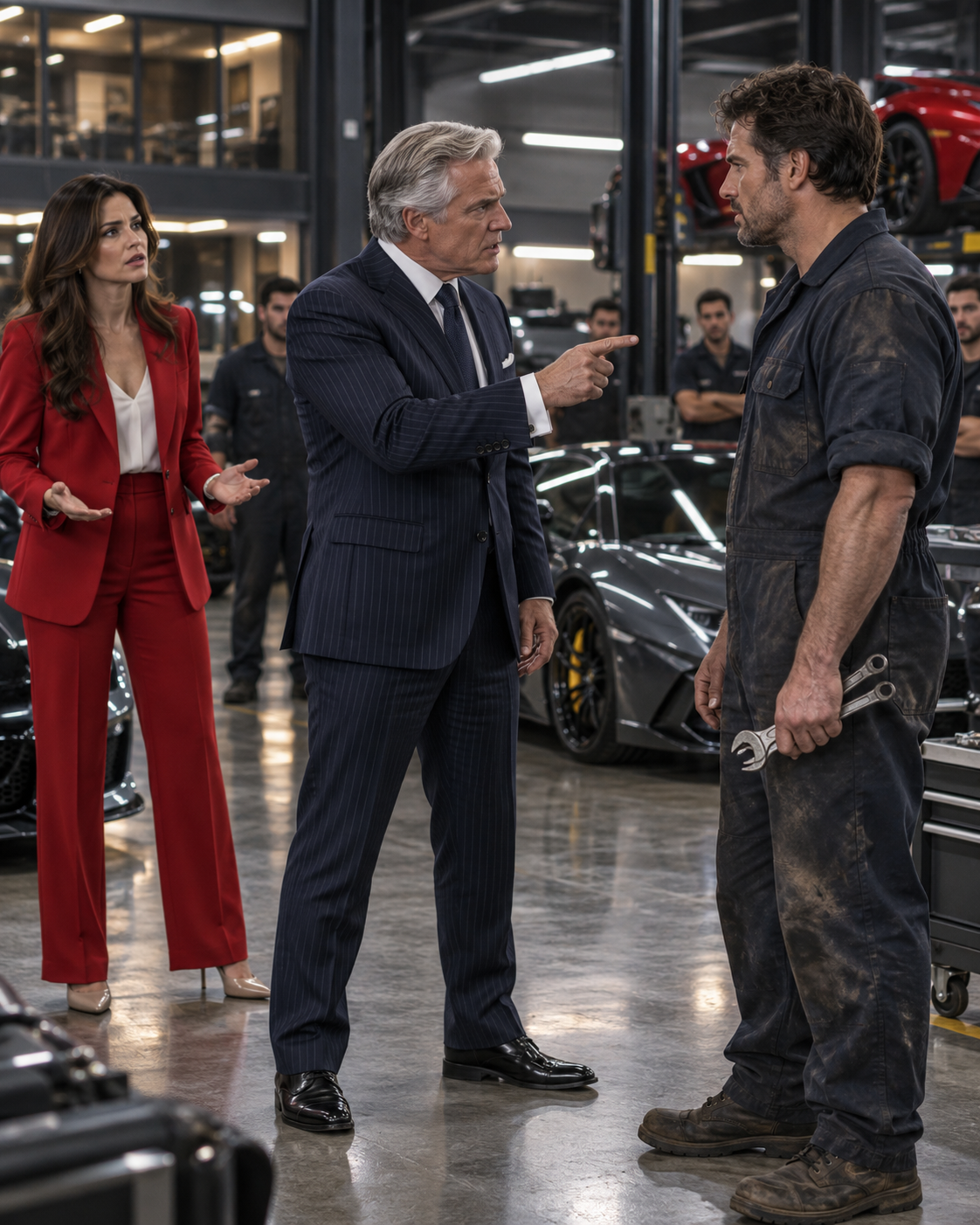
“You don’t belong under a McLaren,” the owner sneered in front of my Charlotte garage, staring at my oil-stained hands
Part 2
Julian stayed quiet for several seconds.
Then he reached into his coat and pulled out his phone.
“I need to show you something.”
He opened an email.
It was from one of the dealerships I had just mentioned.
The subject line read: FINAL REPAIR AUTHORIZATION.
Underneath it was an estimate that made my stomach tighten.
Nearly fifty thousand dollars.
Julian scrolled.
Then he showed me another email.
Then another.
Three different dealerships.
Three different diagnoses.
Three different explanations.
But one thing was identical.
Each one insisted the car needed expensive components that my inspection had shown were perfectly functional.
“You think they were lying?” I asked.
“I don’t know what they were doing.”
He locked his phone.
“But I know they were charging me for things that didn’t fix the problem.”
I leaned against my workbench.
“That happens more than it should.”
He looked at me sharply.
“You’re not angry?”
“I’ve been in this business long enough to know that bad work isn’t always malicious.”
“What if it is?”
“Then the truth eventually costs somebody more than honesty would have.”
He looked down.
That was when he told me the part he had kept hidden.
The McLaren wasn’t simply a toy.
It belonged to a company.
His company.
And the vehicle had been scheduled to appear at a major investor event in Atlanta.
If the car failed publicly, Julian would have to explain why.
The dealerships had convinced him that only they could solve the problem.
Instead, they had kept extending the timeline.
He had started losing sleep.
His investors had begun asking questions.
And the more money he spent, the less anyone seemed willing to admit they didn’t understand the failure.
“So you drove all the way from Atlanta to Charlotte because someone recommended me?”
He shook his head.
“No.”
That answer made me pause.
“Then why me?”
He looked at the garage.
At the old shelves.
At the handwritten invoices.
At the worn toolbox beside my lift.
Then he said, “Because my assistant found your reviews.”
I laughed.
“That’s it?”
“She showed me dozens of customers saying the same thing.”
“What?”
“They said you never tried to sell them something they didn’t need.”
I shrugged.
“That’s how it should be.”
Julian stared at me.
“I don’t think you understand how rare that is.”
I didn’t answer.
Because I wasn’t sure whether I wanted to.
Later that afternoon, Maya came back with my sister.
She ran into the shop carrying her backpack.
“Dad!”
I caught her in my arms.
“You survived the night?”
She nodded.
“I had pancakes.”
“Then I know you survived.”
She looked past me.
Julian was standing beside the McLaren.
“Who’s he?”
I introduced them.
Julian crouched slightly.
“You must be Maya.”
She nodded suspiciously.
“Did you fix Daddy’s car?”
Julian smiled.
“Your dad fixed mine.”
Maya looked at the McLaren.
“Is it really yours?”
“Yes.”
“Is it fast?”
“Very.”
She looked at me.
“Can Daddy drive it?”
I laughed.
Julian did too.
Then his smile disappeared.
He looked at me with a seriousness that made the room feel smaller.
“I want to invest in this shop.”
I thought I had misheard him.
“You what?”
“I want to put money into your business.”
“No.”
He raised an eyebrow.
“You haven’t heard the offer.”
“I don’t need to.”
“I’ll help you buy modern diagnostic equipment, expand the building, and add another service bay.”
“I don’t want to sell my shop.”
“I didn’t ask you to sell it.”
That stopped me.
He continued.
“You keep ownership.”
“You’d be a partner?”
“Only if you want me to be.”
I looked at Maya.
She was sitting at the desk, drawing again.
I had spent years refusing loans that came with strings.
I had turned down opportunities that would have forced me to become the kind of shop owner I never wanted to be.
But this was different.
Julian wasn’t asking me to change who I was.
He was offering me a chance to build something stronger without abandoning the people who had trusted me when I had almost nothing.
Still, I didn’t say yes.
Not that day.
I took three nights to think.
I read every contract.
I asked questions.
I had an attorney review the agreement.
I made Julian put everything in writing.
No control over pricing.
No pressure to reject ordinary customers.
No requirement to chase luxury clients.
No changing the shop’s philosophy.
If I accepted his money, my name would remain on the door.
And my decisions would remain mine.
Julian agreed to every condition.
On the fourth morning, I signed.
The first thing we bought was not a new sign.
It wasn’t a luxury lift.
It wasn’t a fancy office.
It was diagnostic equipment.
The kind of equipment that let a small shop see what expensive machines could see.
Then we renovated the back of the building.
A second service bay went in.
The walls were repainted.
The lights were replaced.
And for the first time in years, my little shop looked like it had a future.
But I refused to let the new equipment change the way I worked.
A teacher with an aging sedan still mattered.
A single mother with a noisy minivan still mattered.
A construction worker whose truck was his entire livelihood still mattered.
If their car needed a repair, I explained the problem.
If it didn’t need a repair, I told them that too.
Word spread.
At first, it was slow.
Then it wasn’t.
People began driving from other parts of Charlotte.
Then from outside the city.
Some arrived in pickup trucks.
Others arrived in European cars worth more than my house.
I treated them exactly the same.
One afternoon, a man in an expensive suit brought in a Porsche.
He asked, “Do you work on cars like this?”
I smiled.
“I work on cars that need fixing.”
He laughed.
“I’ve heard that line before.”
“Then you’ve been talking to the right people.”
The shop became busier.
My days became longer.
But something had changed.
I no longer felt like I was fighting just to survive.
I was building something.
Something Maya could see.
Something she could understand.
One evening, she sat beside me while I finished an invoice.
“Daddy?”
“Yeah?”
“Are we rich now?”
I looked at her.
“No.”
She frowned.
“Why not?”
“Because being rich isn’t the same as having more money.”
She thought about that.
“Then what are we?”
I smiled.
“We’re okay.”
She nodded as though that was enough.
Then she picked up a piece of cardboard and disappeared into the back room.
I didn’t ask what she was doing.
I should have.
Because the next morning, she walked into the shop carrying a freshly painted sign.
She placed it beside the entrance.
Three simple promises were written across it.
“Good work, fair price, no shortcuts.”
I stared at those words for a long time.
Then I looked at my daughter.
“Did you make that?”
She nodded proudly.
“I thought people should know.”
Something tightened in my chest.
Because those words weren’t a slogan.
They were everything I had spent years trying to teach her without ever giving a speech about it.
But there was one more thing I hadn’t understood about Julian.
And months later, when I discovered what had happened after he left Charlotte that first morning, I realized our partnership had never really been about a McLaren.
Part 3
The truth came quietly.
No dramatic phone call.
No police cars outside my shop.
No shouting.
Just an envelope sitting on my desk one Tuesday morning.
Inside was a letter from Julian.
He explained that after returning to Atlanta, he had demanded a full internal review of the dealership invoices.
The findings were complicated.
Some technicians had followed flawed diagnostic assumptions.
Others had authorized expensive component replacements before confirming the original fault.
There were also disagreements inside the dealership network about responsibility for the repeated failures.
Julian never told me that everyone involved had acted dishonestly.
He never claimed there was some grand conspiracy.
He simply said that the system had rewarded confidence more often than accuracy.
And my little garage had reminded him of something he had forgotten.
A mechanic could still say, “I don’t know.”
A business owner could still say, “You don’t need that.”
A customer could still be treated like a person instead of an invoice.
At the bottom of the letter, Julian had written one sentence.
“You didn’t just fix my car; you reminded me what trust is supposed to feel like.”
I folded the letter and put it in my desk.
Then I walked outside.
Maya’s sign was still hanging beside the entrance.
The paint wasn’t perfect.
The letters weren’t perfectly straight.
But nobody had ever written anything more beautiful on that building.
Over the next few years, the shop grew.
Not into some enormous corporation.
Not into a chain of glossy dealerships.
Just into something solid.
We had more employees.
More equipment.
More service bays.
And more customers than I ever imagined.
Julian remained a partner, but he never tried to turn my garage into something it wasn’t.
He occasionally stopped by Charlotte.
Whenever he did, he still walked through the shop without his expensive jacket and rolled up his sleeves.
Sometimes he would sit with Maya and ask about school.
Sometimes he would bring her books.
And sometimes, when the shop was quiet, we would talk about how strange life could be.
One evening, years after that rainy night, Maya was standing beside the entrance.
She was older now.
Tall enough to reach the sign without stretching.
I watched her clean a small streak of dust from the letters.
“Still like your sign?” I asked.
She smiled.
“More than ever.”
“You know we could replace it with something professional.”
She shook her head.
“No.”
“Why?”
“Because this one is true.”
I didn’t argue.
The sun was setting over Charlotte.
The garage lights came on one by one.
A family pulled in with an old sedan.
Behind them, a luxury SUV waited its turn.
Two completely different worlds.
The same line formed at my counter.
The same questions.
The same answers.
“How much will it cost?”
“How long will it take?”
“What does it really need?”
And I kept giving them the truth.
Not because it made me special.
Because Maya was watching.
Children remember what we do more than what we tell them.
They remember whether our promises survive when money is involved.
They remember whether we choose convenience when nobody is looking.
They remember whether we treat someone differently because of what they drive.
That night, after we closed the shop, Maya and I stood outside beneath the old sign.
She looked at me.
“Dad?”
“Yeah?”
“Do you remember the McLaren?”
I laughed softly.
“How could I forget?”
“That car changed everything.”
I looked at the garage.
Then at her.
“No.”
She frowned.
“The car didn’t change everything.”
“Then what did?”
I touched the edge of her handmade sign.
“You did.”
She smiled.
I realized then that the greatest thing I had ever repaired was never an engine.
It was the future I was trying to build for a little girl who once sat in the corner of a tired garage coloring race cars while rain hammered the roof.
The McLaren had brought money to my doorstep.
Julian had brought opportunity.
But integrity had built the life we actually kept.
And every night when I locked the garage doors, I could still hear Maya’s voice in my head.
“Good work, fair price, no shortcuts.”
Those words had started as a child’s crooked painting.
They became the standard by which I measured every decision.
Because expensive machines can impress people.
Fancy buildings can make people look successful.
Money can open doors that once seemed impossible to reach.
But none of those things can buy the one thing that matters when the lights go out and the room gets quiet.
Trust.
And sometimes, the smallest garage on the wrong side of town can teach you that the most valuable thing you own isn’t what’s parked outside.
It’s the name people trust when they walk through your door.