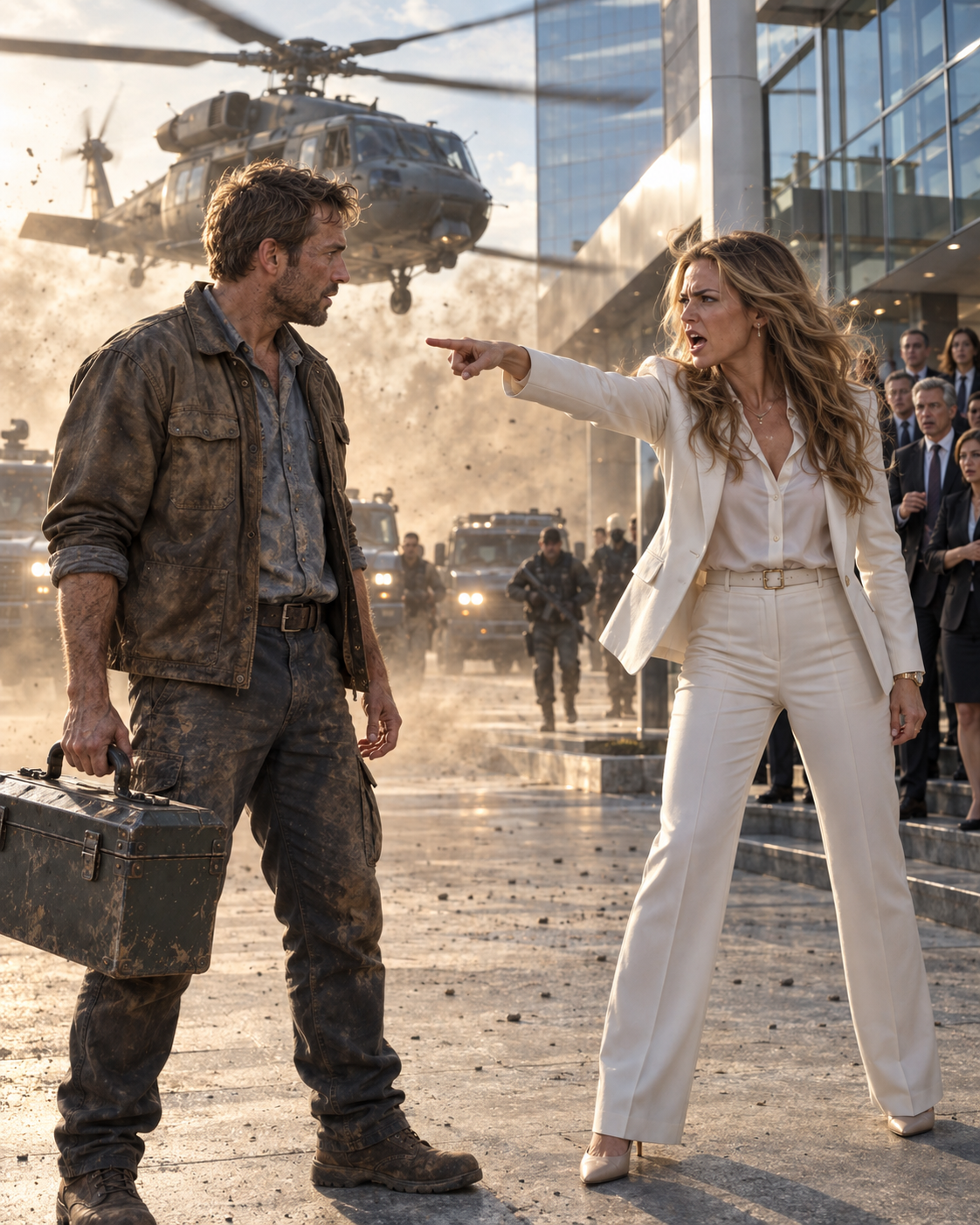
With my pickup being dragged across Sterling Aeronautics’ parking lot and Vivien Ashcroft sneering
The helicopter disappeared into the clouds, leaving Sterling Aeronautics far behind us.
I sat across from Commander Nolan Vance while rain streaked the small window beside my shoulder.
The tablet was still open on the flight data.
I had seen failures like this before.
Not this exact one.
But close enough to make my instincts uncomfortable.
“What happened to the pilots?” I asked.
Vance’s jaw tightened.
“They survived.”
I waited.
“One has a fractured spine.”
He paused.
“The other nearly lost an eye.”
I looked back at the data.
“How long were they fighting the controls?”
“Forty-seven seconds.”
Forty-seven seconds.
In a test aircraft, that could feel like an eternity.
Vance leaned forward.
“The aircraft was climbing when the control system suddenly commanded a left correction.”
“Pilot countered?”
“Immediately.”
“And the aircraft?”
“It countered him.”
I closed my eyes.
That was exactly what I had warned Sterling about.
A pilot could feel the machine resisting.
Then instinct would make him pull harder.
The computer would interpret that as another error.
The aircraft would fight harder.
It became a battle between human judgment and software logic.
And eventually, physics chose a winner.
Vance watched me carefully.
“Can you tell what was changed?”
“I need the raw code.”
“You’ll have it.”
“Unfiltered?”
“Everything.”
I looked at him.
“Why me?”
He didn’t answer immediately.
Then he said, “Because three years ago, you were one of the best test pilots in the country.”
I looked down at my hands.
“I haven’t flown a military aircraft in three years.”
“That’s not what I said.”
The helicopter landed at a secure flight facility just before midnight.
Two engineers were waiting beside a glass-walled analysis room.
They barely spoke as I entered.
The crash data filled six monitors.
I spent the next hour reading numbers.
Then I saw it.
“There.”
One engineer stepped closer.
“What?”
“The filter threshold.”
He looked confused.
“That’s not supposed to be there.”
“Exactly.”
I enlarged the parameter.
Someone had changed the acceptable sensor deviation from a conservative threshold to one so wide that the system would ignore the early warning.
“Who authorized this?”
The engineer shook his head.
“No idea.”
Vance looked at me.
“Can you prove it?”
“Not yet.”
I remembered the forged signature.
Then I remembered Vivien’s expression.
She hadn’t looked surprised when I refused to sign.
She had looked irritated.
As if my refusal had ruined something already planned.
I opened the Sterling test reports.
The same altered parameter appeared in their system.
Then I noticed something stranger.
The software version number didn’t match the version listed on the certification document.
Someone had replaced the approved build.
I whispered, “They’ve been testing a different system.”
Vance’s expression darkened.
“Meaning?”
“Meaning the ninety-eight percent success rate they’re showing investors may not exist.”
Nobody spoke.
I leaned back.
Suddenly, the entire situation looked different.
This wasn’t incompetence.
It was deliberate.
At 6:17 a.m., Vivien Ashcroft received the first warning.
The military had suspended the Aegis Vector demonstration.
She called me seventeen times.
I ignored every call.
Then my daughter’s school called.
I answered immediately.
“Mr. Hale?”
“Yes.”
“This is the front office.”
My stomach tightened.
“Is Emma okay?”
“She’s fine.”
I exhaled.
“We’ve had someone asking questions about you.”
Everything inside me went cold.
“What kind of questions?”
“About your work.”
“Who?”
“They wouldn’t give a name.”
I looked at Vance.
He had heard every word.
“I’ll handle it,” I said.
When I ended the call, he was already reaching for his phone.
“You’re not going back to Sterling alone.”
“I wasn’t planning to.”
But I knew I had to go back.
Not for Vivien.
Not for my job.
For my daughter.
Because if someone was willing to manipulate aircraft software, forge signatures, and nearly kill pilots, I couldn’t pretend the danger would stop at the hangar door.
By late morning, we returned to Sterling.
The security team blocked us at the entrance.
One guard stepped forward.
“You’re not authorized.”
Vance handed him a federal credential.
The man’s face changed.
Then Vivien appeared behind the glass doors.
She looked exhausted.
For the first time since I had known her, she didn’t look powerful.
She looked frightened.
She opened the door herself.
“Let them in.”
The security guard hesitated.
Vivien repeated herself.
“I said let them in.”
We walked into the building.
Nobody spoke.
Employees stared as I passed.
Some looked ashamed.
Others looked terrified.
Vivien followed us into the certification lab.
She closed the door.
“I owe you an apology.”
I said nothing.
She swallowed.
“I was wrong.”
“You were more than wrong.”
Her eyes lowered.
“I know.”
“You accused me of misconduct.”
“I know.”
“You suspended me.”
“I know.”
“You forged my signature.”
Her head snapped up.
“I didn’t.”
The room went silent.
Vance placed the tablet on the table.
“Someone did.”
Vivien stared at the altered report.
“I never authorized this.”
“Who had access?”
She hesitated.
“Our CFO.”
Preston Winthrop.
He was the man who had spent months telling investors that Aegis Vector was the safest flight-control platform Sterling had ever built.
He was also the man who had repeatedly asked why certification was taking so long.
We pulled his access records.
He had entered the software repository at 2:13 a.m. on three separate nights.
Each time, he accessed the same parameter file.
Each time, the warning threshold changed.
Then the audit log disappeared.
Vivien whispered, “He’s been deleting the evidence.”
I looked at her.
“Not all of it.”
I connected the backup server.
There it was.
A hidden mirror of the original code.
The approved parameters were intact.
The altered version was sitting beside them.
Someone had created a second build and quietly pushed it into testing.
I opened the investor performance dashboard.
Ninety-eight percent success.
I compared it against the raw flight logs.
Sixty-four percent.
Vivien stared at the screen.
“That’s impossible.”
“No.”
I pointed to the data.
“It’s fraud.”
Preston walked into the room twenty seconds later.
He looked annoyed rather than concerned.
“What is this?”
Vivien turned toward him.
“Close the door.”
He did.
Then he saw me.
His expression changed.
“Mason.”
I smiled faintly.
“Long walk home.”
His eyes moved toward Vance.
“What is the military doing here?”
Vance answered.
“Investigating an aircraft failure connected to your software.”
Preston’s face went pale.
Only for a second.
But it was enough.
I opened the audit log.
“Why did you change the sensor threshold?”
“I didn’t.”
I played the access recording.
His employee credentials appeared on screen.
He stared at it.
“Someone stole my credentials.”
“At 2:13 a.m.?”
“I don’t know.”
“Three times?”
He said nothing.
Vivien stepped toward him.
“Did you know the aircraft could enter control conflict?”
Preston’s voice dropped.
“Everyone knew there were anomalies.”
I felt something inside me break.
“Anomalies?”
He looked at me.
“The board needed the demonstration.”
“So you hid the warnings.”
“We needed time.”
“You nearly killed two pilots.”
His face hardened.
“Do you know what happens when a project like this fails?”
I answered quietly.
“People die.”
He looked away.
“You don’t understand business.”
“No.”
I stepped closer.
“I understand consequences.”
He laughed bitterly.
“You think integrity pays the bills?”
I thought about my daughter waiting at school.
“Sometimes it pays for the lives of people who come home.”
That ended the argument.
Federal investigators arrived before noon.
Preston was taken away quietly.
There were no cameras.
No dramatic handcuffs.
Just a man walking through the same doors he had entered every morning for years.
Vivien remained behind.
She asked me to stay.
I almost refused.
Then she said, “Please.”
I stopped.
She stood in the empty certification lab.
“I thought you were difficult.”
“I was.”
“No.”
She shook her head.
“You were honest.”
I looked at the floor.
“I didn’t know the difference anymore.”
She sat down.
“For years, I believed leadership meant never admitting fear.”
I said nothing.
She continued.
“Yesterday, I watched a tow truck take your truck away, and I thought I was proving I was in control.”
Her voice cracked.
“Then I learned two pilots almost died because I didn’t listen to you.”
I looked at her.
“Control isn’t the same as leadership.”
She nodded.
“I know that now.”
The Aegis Vector demonstration was canceled.
The program was not destroyed.
It was rebuilt.
Every line of code was audited.
Every safety report was recreated.
Every certification was repeated by independent teams.
The ninety-eight percent success rate disappeared from the investor presentations.
So did the people who had benefited from it.
Months later, Sterling announced the truth publicly.
Vivien stood before reporters and accepted responsibility.
She did not blame Preston.
She did not blame engineers.
She did not blame the pressure of investors.
She said, “I failed to listen when an employee told me something I didn’t want to hear.”
Then she looked directly into the cameras.
“And people could have died because of my arrogance.”
I watched the broadcast from my kitchen.
My daughter sat beside me eating cereal.
“Is that your boss?”
“She used to be.”
Emma looked at me.
“Did you save everyone?”
I thought about the two pilots.
The engineers.
The passengers who would eventually fly aircraft controlled by the repaired system.
“I helped.”
She smiled.
“That’s what heroes say.”
I laughed.
“I’m not a hero.”
She leaned against my shoulder.
“Then what are you?”
I looked at the framed photograph on the wall.
It showed me beside an aircraft I had flown years ago.
“I think I’m your dad.”
She smiled.
“That’s better.”
A week later, Vivien sent me an offer.
Senior safety director.
More money than I had ever made.
A private office.
Authority over certification.
I stared at the letter for a long time.
Then I declined.
Not because Sterling was evil.
Not because I hated Vivien.
But because I had finally understood what my three years there had taught me.
You don’t protect people by standing in the room where everyone agrees with you.
You protect them by being willing to stand alone when everyone else is desperate to move forward.
I went back to flying, but differently.
I became an independent flight-safety consultant and eventually began training young test pilots.
I taught them something no manual could properly explain.
“Never confuse confidence with certainty.”
One afternoon, Emma came with me to an airfield.
A prototype aircraft lifted into the blue sky.
She watched it disappear into the distance.
“Dad?”
“Yeah?”
“Are you scared when you fly?”
I smiled.
“Always.”
She looked surprised.
“Then why do you do it?”
I put my hand on her shoulder.
“Because being brave doesn’t mean you aren’t afraid.”
I watched the aircraft bank into the sunlight.
“It means you refuse to let fear make your decisions.”
She was quiet for a moment.
Then she asked, “Was that what happened when they took your truck?”
I laughed.
“Pretty much.”
She hugged me.
I held her tightly.
For the first time, the memory of that tow truck didn’t hurt.
It reminded me of the day I had lost a job.
And gained something more important.
My voice.
My integrity.
My daughter’s trust.
I thought the story was over.
Then, three months later, an envelope arrived at my house with no return address.
Inside was a single photograph.
It showed the original Aegis Vector prototype sitting inside a military hangar.
On the back, someone had written a sentence in black ink.
“Your test was not the only one that failed.”
I turned the photograph over again.
There was one more detail.
A small red circle had been drawn around the aircraft’s tail number.
I recognized it immediately.
It belonged to a second prototype Sterling had never disclosed publicly.
I looked toward Emma’s bedroom.
She was laughing with her friends upstairs.
For a moment, I considered throwing the photograph away.
Then I remembered the road.
The rain.
The helicopter.
The two pilots who almost never made it home.
I placed the photograph inside a folder and locked it in my desk.
Because sometimes doing the right thing doesn’t give you peace.
Sometimes it simply gives you the courage to face whatever comes next.
And as I turned off the light that night, my phone rang from an unknown number.
I answered.
Nobody spoke.
Then a familiar voice whispered, “Mason, you found the first problem.”
A pause.
“You haven’t found the reason it was built.”
The line went dead.
I stood alone in the dark, staring at the locked drawer.
And for the first time since I left Sterling Aeronautics, I wondered whether the machine I had stopped was never the real threat at all.