With my daughter watching from the evacuation truck, I saw the helicopter disappear into the wildfire smoke
The helicopter shook violently as Mara pulled me across the deck, and for a few seconds I could not hear anything except the thunder of the rotors and the blood pounding inside my ears.
Ellie was already strapped into a seat near the cockpit.
Walter sat opposite her with an oxygen mask pressed over his face, looking furious about the entire situation.
I dropped beside them and grabbed Ellie’s hand.
“I’m here,” I said.
She nodded, but her eyes never left Mara.
Mara turned toward the pilot and shouted something I could not hear.
The helicopter banked hard.
Through the open side door, I saw our house disappear beneath a rolling wall of smoke.
The roof was still visible.
The shop was not.
The trees behind it had become a line of fire.
I stared until the smoke swallowed everything.
Then Mara crouched beside me.
“Your house is gone?”
“I don’t know.”
She looked at me for a second.
“Neither do I.”
There was no comfort in her voice.
Only honesty.
That was somehow better.
I looked toward the thermal display mounted near the cockpit.
White shapes moved against a field of gray.
“Those people,” I said.
Mara nodded.
“Seven confirmed signatures.”
“You came for them?”
“We came because the entire corridor needed to be searched.”
She paused.
“And because I knew you might be there.”
I looked at her.
She didn’t look away.
For a moment, neither of us said anything.
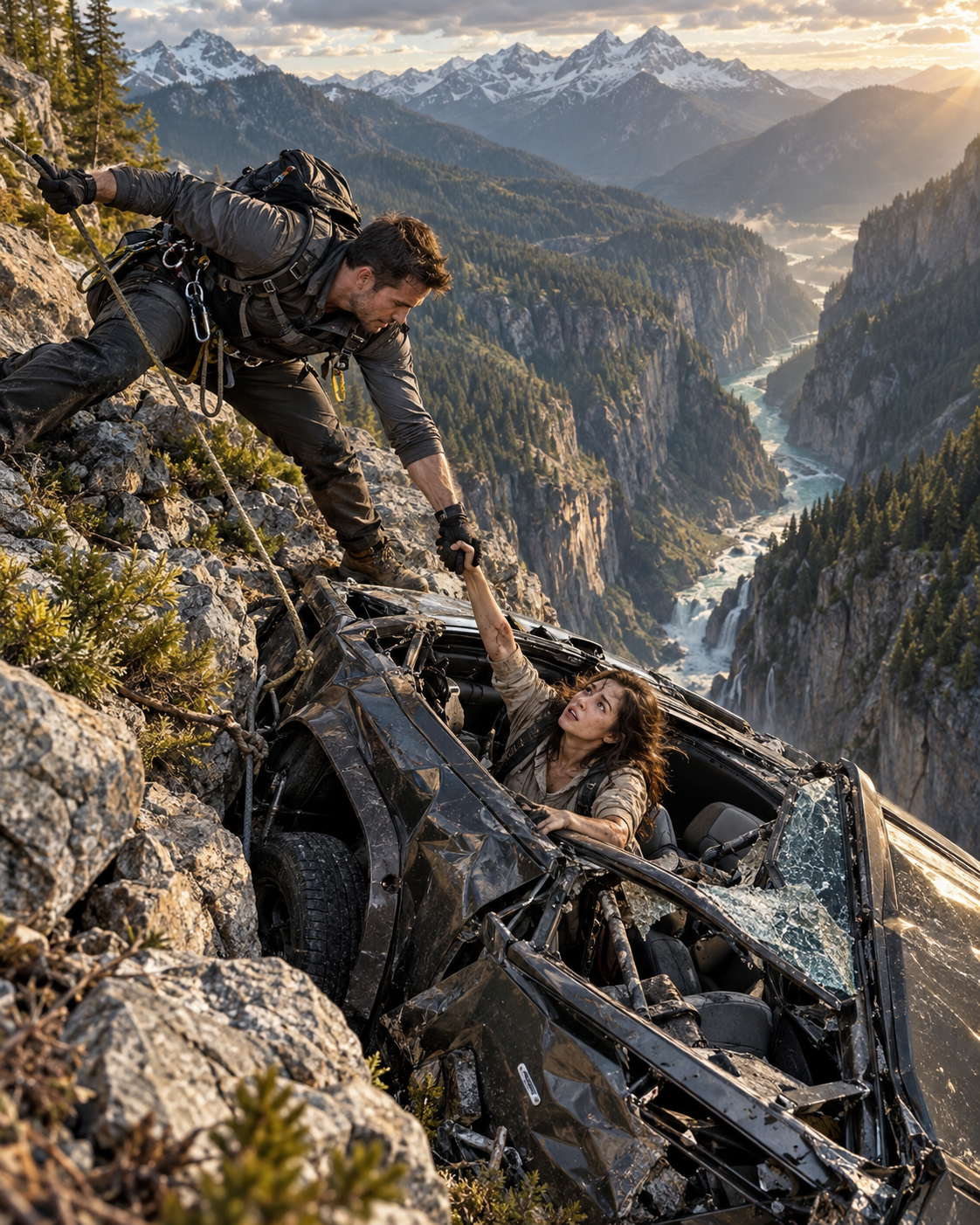
Six months earlier, I had climbed down a canyon because I could not live with myself if I drove away.
Now this woman had flown into a wildfire because she had remembered a sentence I barely remembered saying.
But there was something else on her face.
Something heavier.
“What aren’t you telling me?” I asked.
Her expression changed.
“Nothing.”
“You’ve never been good at that word.”
She almost smiled.
Then the helicopter dropped suddenly.
Ellie screamed.
Mara grabbed the nearest strap.
The pilot shouted a warning.
A column of superheated air had risen from the drainage below and thrown the aircraft sideways.
For three seconds, the whole cabin seemed weightless.
Then we stabilized.
Mara looked toward the thermal screen.
“Bring us around.”
The pilot shook his head.
“Visibility is collapsing.”
“There’s another signature.”
“Where?”
“Southwest of the ridge.”
He studied the display.
“I don’t have it.”
“I do.”
She pointed.
“Right there.”
The pilot adjusted course.
The helicopter descended through smoke so thick that I could barely see the end of the rotor blade.
Then a tiny white shape appeared on the screen.
One person.
Moving.
I realized the shape was running.
“That’s a firefighter,” Mara said.
“He’s separated from his crew.”
The pilot hesitated.
Mara didn’t.
“Go.”
We dropped lower.
Through the smoke, I saw a man stumbling between burning trees.
His helmet was missing.
One sleeve of his coat was on fire.
He fell.
The helicopter hovered above him.
A cable dropped.
Mara clipped into a second harness.
I grabbed her arm.
“What are you doing?”
“Stopping for somebody.”
Before I could answer, she disappeared through the open door.
I watched her descend into the smoke.
She reached the firefighter.
The cable tightened.
Then the smoke swallowed them both.
My hands went cold.
The helicopter pulled upward.
For one terrible moment, nothing happened.
Then Mara’s voice came over the cabin radio.
“Bring us up.”
The firefighter rose beneath her.
They disappeared into the helicopter.
When Mara climbed back inside, she was covered in ash.
The firefighter was barely conscious.
But alive.
She leaned against the wall and closed her eyes.
I looked at her.
“You really meant it.”
She opened one eye.
“I usually do.”
The aircraft turned toward the fairgrounds.
I thought that was the end of it.
I was wrong.
At the landing zone, medics rushed toward us.
Ellie was taken first.
Walter followed.
I climbed down last.
Mara remained on the helicopter.
I looked up.
“Thank you.”
She shook her head.
“No.”
I frowned.
“You don’t owe me anything.”
She looked toward the burning mountain.
“I needed you to know that.”
Then the helicopter lifted again.
I watched it vanish into the smoke.
By noon, every confirmed survivor from the eastern slope had been evacuated.
Nine houses were gone.
Two roads had disappeared.
Hundreds of acres had burned.
But everyone whose heat signature had been confirmed was alive.
Our house survived too.
Barely.
The fire burned around the cleared perimeter and scorched one wall.
The shop was destroyed.
The roof was warped.
Every tree behind the house was black.
But the house stood.
Ellie called it ugly and standing.
The phrase became a family joke.
Three weeks later, we were allowed back.
The first morning I walked through the burned yard, I found pieces of our lives everywhere.
A melted garden chair.
A blackened toolbox.
A photograph fused to the side of a cabinet.
I picked it up.
It was the only picture I had of my mother holding Ellie when she was a baby.
The glass was gone.
The photograph was burned around the edges.
But their faces were still visible.
I stood there for a long time.
Then I heard a car.
Mara stepped out.
No helicopter.
No security team.
No reporters.
Just a pair of grocery bags in her hands.
“You came all this way for groceries?”
She looked at the house.
“I thought you might need coffee.”
Walter appeared behind me.
“If you brought cheap coffee, you can leave.”
Mara laughed.
It was the first time I had heard her laugh without smoke, sirens, or danger surrounding us.
She stayed for lunch.
Walter complained about helicopter engines.
Ellie showed her the drawings she had made during the evacuation.
I repaired a broken chair while Mara sat on the porch.
For the first time, neither of us had somewhere else to be.
After Walter went inside, Mara looked across the burned hillside.
“I used to think helping people was about having the right equipment.”
I put down the screwdriver.
“What changed?”
“You.”
I shook my head.
“No.”
“Yes.”
She looked at me.
“You showed me something I didn’t understand before.”
“What?”
“That the value of helping someone isn’t measured by what comes back.”
The wind moved through the blackened trees.
A few tiny green shoots were already pushing through the ash.
Mara continued.
“When I was trapped in that canyon, I thought my life was ending.”
“I know.”
“I was wrong.”
She looked down at her hands.
“My life actually changed there.”
I waited.
She told me that after the accident, she had started reviewing every emergency call her company handled.
She discovered how many people lived beyond roads, outside reliable communications, beyond the reach of ordinary rescue.
She had always treated the work as an operation.
Aircraft.
Contracts.
Response times.
Budgets.
Statistics.
Then she became the person waiting for someone to arrive.
And suddenly the numbers had faces.
“That’s why you changed the tasking,” I said.
She nodded.
“When I saw your name, I wanted to save you.”
She paused.
“But I knew I couldn’t make the whole rescue about you.”
“So you searched everyone.”
“Exactly.”
She looked toward the mountain.
“And that’s why seven people came home.”
I thought about that.
It was strange how one small decision could travel farther than anyone could imagine.
I had stopped on a road because I heard something.
Mara had stopped in a helicopter because she remembered something.
Neither of us knew where the choice would lead.
Ellie came outside carrying three cups of coffee.
She handed one to Mara.
Then she looked between us.
“I have a question.”
Walter shouted from inside.
“That usually means trouble.”
Ellie ignored him.
“Who saved who?”
Mara smiled.
I looked at the mountain.
Then at my daughter.
“Nobody saved anybody.”
Ellie frowned.
“That doesn’t make sense.”
“It does.”
I pointed toward the black ridge.
“Sometimes you help someone because they need help.”
“And sometimes,” Mara added, “they carry that kindness somewhere you will never see.”
Ellie considered that.
Then she nodded slowly.
“Like planting something?”
“Exactly.”
She looked at the ash-covered ground.
“And you don’t know where it grows.”
Mara smiled.
“You don’t even know if you’ll ever see it.”
That afternoon, Mara left before sunset.
She stood beside her car and looked at me.
“You know, Nolan, there’s something I’ve never told you.”
I waited.
“When I fell off that road, I wasn’t supposed to be there.”
I frowned.
“What do you mean?”
“I had received a warning.”
“About the road?”
She nodded.
“Someone had reported unstable rockfall along that stretch.”
“Then why were you driving there?”
Her face became serious.
“Because someone called me.”
“Who?”
She looked toward the mountain.
“I don’t know.”
I felt something tighten in my chest.
“What do you mean you don’t know?”
“The call came from a blocked number.”
She opened her car door.
“The person told me someone was in danger and gave me a location.”
“But there was nobody there.”
“Not when I arrived.”
I stared at her.
“Then why would someone send you there?”
“I don’t know.”
She hesitated.
“But after the accident, the investigators found something strange.”
“What?”
“The rockfall wasn’t natural.”
The evening suddenly felt colder.
“What are you saying?”
“I’m saying someone had moved the warning markers.”
I remembered the bent guardrail.
The black SUV.
The phone that had slipped from her pocket and vanished into the canyon.
Mara looked directly at me.
“And my phone was never recovered.”
I swallowed.
“Why are you telling me this now?”
“Because yesterday, I received another call.”
My stomach tightened.
“What did they say?”
She reached into her jacket.
She pulled out a photograph.
The picture showed a road.
A mountain.
A guardrail.
And a black SUV.
My black SUV.
No.
Not mine.
Hers.
But the photograph had been taken before the crash.
I stared at it.
There was something in the background.
A person standing beside the road.
Watching.
“Who took this?”
“We don’t know.”
I looked closer.
The person was too far away to identify.
But they were holding something.
A phone.
Mara folded the photograph.
“I thought the accident was an accident.”
“And now?”
“Now I think someone wanted me there.”
The silence between us became heavy.
“Why?”
She shook her head.
“That’s what I’m trying to find out.”
I remembered the day on the canyon road.
The missing phone.
The damaged guardrail.
The convoy that arrived minutes after I left.
The strange look on the rescue technician’s face when he heard Mara’s name.
None of it had mattered then.
Now every detail felt connected.
Mara stepped toward her car.
“There’s one more thing.”
I looked at her.
“The caller knew your name.”
My blood went cold.
“What?”
“He didn’t just tell me where to drive.”
She lowered her voice.
“He told me that if anything happened, Nolan Reed would eventually find me.”
For several seconds, I could not speak.
I looked toward the road.
Six months ago, I had believed I was simply the man who stopped.
I had believed Mara was simply the woman I rescued.
I had believed the wildfire was simply another disaster.
But suddenly the pieces no longer looked random.
Mara opened the car door.
“Get some rest.”
“That’s it?”
“For tonight.”
She got inside.
Before she closed the door, she looked back at me.
“If someone wanted us connected, I want to know why.”
Then she drove away.
I stood in the burned yard until the taillights disappeared.
Behind me, Ellie called my name from the porch.
I turned.
She was holding something.
A small black rectangle.
My heart stopped.
“Where did you find that?”
She said she found it underneath the old porch steps while looking for her sketchbook.
I walked toward her slowly.
She handed it to me.
It was cracked.
Burned around the edges.
But I recognized it immediately.
Mara’s missing phone.
The phone that had fallen from her jacket six months earlier.
The phone that should have been buried somewhere beneath Redstone Canyon.
I held it in my hand.
The screen flickered once.
Then, against every reasonable explanation, it turned on.
There was one unread message.
No sender name.
No number.
Just six words.
“YOU SHOULD HAVE LET HER DIE.”
I looked at Ellie.
Then toward the dark mountain.
And for the first time since the rescue, I understood something that frightened me more than the wildfire ever had.
Maybe the person who started this story had never stopped watching.
… And now they knew exactly where I lived.